343 IJSTR©2015
Study On Spatial Organization Of Device
Performance South Sulawesi Provincial
Government
Andi Amin Akhiruddin, Rakhmat, Juanda Nawawi, Muhammad Rusdi
Abstract: This study aims to describe the identification of regional Organization Structuring South Sulawesi Provincial Government under Government Regulation No. 38 of 2007 and Government Regulation No. 41 of 2007, knowing Planning Implications regional organization based on Government Regulation No. 38 of 2007 and Government Regulation No. 41 of 2007 on Performance government of South Sulawesi, and analyze models of regional Organization Structuring South Sulawesi Provincial Government ideal based on Government Regulation No. 38 of 2007 and Government Regulation No. 41 of 2007. The method used is descriptive to assess the condition of the South Sulawesi provincial government organizations as a result of the implementation of Government Regulation No. 38 of 2007 and Government Regulation No. 41 Year 2007 on Organizational Structure Model of the Region of South Sulawesi Provincial Government and the resulting impact on South Sulawesi Provincial Government Performance. Data collection techniques used were interviews, questionnaires and study documents analyzed by descriptive qualitative and quantitative (in percentage). The results showed that the arrangement of the South Sulawesi Provincial Government Organizations related mass organizations using maximal patterns based on Government Regulation No. 41 of 2007 has not kept pace even found no addition of several fields and sub-sub-fields in the affairs handled by the regional work units of South Sulawesi Province. But seen from the Organization Structuring implications arising on the performance of the Government of South Sulawesi showed quite good results, this is in line with some of the responses of respondents who said it was very appropriate views of some of the indicators used by the author in a variable rate Accountability, Responsibility and Innovation as a parameter in describing South Sulawesi provincial government performance. Structuring the ideal model of the regional organization of South Sulawesi Provincial Government granted an analytical nature writer and still require a more in-depth studies, especially concerning aspects of potential and needs, as well as regional financial competitiveness.
Index Terms: Regional Organizations, Performance.
————————————————————
1 Introduction
Philosophically, the basic essence of local government as an institution that is born of political decentralization policy is to provide public services in an effective, efficient, economical and accountable. Today duties and responsibilities of local governments in the course of the administration and development of increasingly widespread and increasing in line with the complexity of the problems faced and the strong demand broader autonomy, real and responsible. Local governments are required to be creative in order to carry out the various tasks and responsibilities effectively in accordance with the purpose of granting autonomy to the regions. According to Made Kelvin (2009; 6)
Theoretically, to be able to function optimally, there are at least seven main elements that make up the Local Government namely:
1. The existence of government affairs submitted to the Regional. The affairs of the contents of autonomy which is the basis for the Regional authority to regulate and manage their own household;
2. The existence of a lug of institutional autonomy submitted to the Regional.
3. The presence of personnel is an employee who has the task to run the affairs of autonomy become household contents relevant region;
4. The existence of financial resources to finance the implementation of regional autonomy;
5. The presence of a representative embodiment of the representatives of the people who have gained legitimacy to lead the regional administration; 6. The existence of public service management in
order to run efficiently, effectively, economically and accountable;
7. The existence of oversight, supervision, monitoring and evaluation of effective and efficient so that regional autonomy can run optimally.
Seventh integral element above is a system that forms the Regional Government. Structuring Local Government will always be associated with the seven elements above. The arrangement must be comprehensive and integrated, because the approach undertaken in part will always produce less than optimal care. Along with the above opinion then according Kaho (2001: 60), there are four factors that affect the successful implementation of regional autonomy that implementing human, financial, equipment and organization should be good. Implementation of regional autonomy is still hampered partly by the lack of ____________________________
• Andi Amin Akhiruddin: Graduate School, Science of Public Administration. Hasanuddin University, Makassar, Indonesia Email: [email protected] • Rakhmat: Faculty Of Social Sciences and Political
Sciences. Hasanuddin University, Makassar, 90245 • Juanda Nawawi: Faculty Of Social Sciences and
Political Sciences. Hasanuddin University, Makassar, 90245
344 readiness and capability of local government officials and
regulatory framework for. In addition, local governments also have not been able to raise awareness on the bureaucracy to provide a quality service to the community and siding. Formation of structure in the form of fat can lead to implications:
(1) The presence of a number of work units adjacent to the task and the resulting clash of policies, activities and interests;
(2) The existence of a work unit that does not have a clear job;
(3) Breach of focused programming and budgeting activities because of the many programs that must be accommodated in the budget;
(4) Turning pendulum of executive power into legislative heavy with risk financing swelling of the regional legislature; (5) The emergence of the issue of money politics (money politics) ranging from KDH election process (head area), LPJ-KDH to the issuance of regulations;
(6) The emergence of KDH are not of the political power of the majority in parliament, so it should always be smart and clever as work in conditions that are very fragile;
(7) The politicization of office because of mutation and promotion can occur because of the proximity to the axis of power;
(8) Carved up the sea area and the issuance of regulations on fees for the various commodity sectors, while the budget allocation for sectoral growth was not professional. The purpose of this study is to describe:
1) The arrangement of the regional organization in South Sulawesi Provincial Government;
2) Planning Implications regional organization on the performance of the Government of South Sulawesi; 3) Ideal Model of the regional organization in South
Sulawesi Provincial Government.
2. RESEARCH METHODS
Study Design
In this study, the phenomenon of organizational arrangement which is one of the study focuses on the study of organizations, then the methodology in the category of research institutes, the unit of analysis is the organization. In a study of public organizations that focus on reforming the organization and its implications directly or indirectly to the performance of the organization. The author uses a survey method with descriptive research techniques, the research intends to explain the causal relationship of the variables studied. The variables in question is the arrangement of regional organizations as the independent variable (the independent variable) and the performance as the dependent variable (the dependent variable). The research approach used is qualitative research, supplemented with quantitative data analysis techniques. Quantitative approach in this study is meant to be able to explore more extensive information, detailed and in-depth of the phenomenon that occurs, can also examine the findings of a case that occurred in the study area, so the studies obtained are expected to develop the concept and become more comprehensive.
Location Research
The study sites in the city of Makassar in South Sulawesi Provincial Government with consideration of the division of government affairs between the Government, Provincial and Regency / City, so there is a difference between the affairs of the Provincial Government and the Government of the District / City.
3. RESULTS
In line with the implementation of Government Regulation No. 41 of 2007, then in accordance with local needs and developments, until the year 2012 has been designated 1442 the structural positions within the Government of South Sulawesi province. The complete picture of the complete structural position shown by Table 1 below.
Table 1. The number of structural positions provincial government. South Sulawesi
No. Commentary Total
1 Eselon I b 1
2 Eselon II a 46
3 Eselon II b 17
4 Eselon III a 356
5 Eselon III b 25
6 Eselon IV a 997
7 Eselon IV b -
Total 1.442
The number of structural positions are scattered in various work units (SKPD) in the scope of the government of South Sulawesi province in which the enactment of Government Regulation No. 41 of 2007, until 2012, the Government of South Sulawesi province has 170 SKPDs including 105 Regional Technical Implementation Unit (UPTD ) as shown by the following Table 2:
Table 2. Total SKPDs scope south Sulawesi Provincial Government
No. SKPD Total
1 Regional Secretariat 15
2 Expert Staff 5
3 parliament Secretariat 1
4 Regional Office 19
5 Regional Technical Institute 25
6 UPT Department 99
7 UPT Agency 6
Total 170
1) Regional Secretariat
Secretariat area is an element of staff headed by a Regional Secretary under and responsible to the Governor. The key task of the Regional Secretariat is to assist the Provincial Governor in governance, administration and management of the organization and provide administrative services to the entire province at local device. To perform these tasks, the regional secretariat functions are:
• Coordinating the provincial government policy formulation;
• Implementation of government administration; • Management of personnel resources, finance,
345 IJSTR©2015
• Implementation of other tasks given by the Governor in accordance with its duties and functions.
The organizational structure of the Secretariat are as follows:
1.
Assistant Government• Bureau of Public Administration • Bureau of Local Government • Legal and Human Rights
2.
Economic and Development Assistant• Economic Development Bureau. • Development Bureau.
• Cooperation Bureau.
3.
Assistant Social Welfare• Welfare Development Bureau
• Mental and Spiritual Development Bureau • Development Bureau of Drug and HIV / AIDS
4. Administrative Assistant
• Organization and Personnel Bureau • Public Relations and Protocol • General and Equipment Bureau • Bureau of Public Asset Management
2)Parliament Secretariat
Parliament Secretariat has the main duty to assist Parliament in organizing tasks and authority. To carry out their duties Parliament Secretariat has the function:
• Facilitate meetings and review / working visit Parliament;
• Coordinate the preparation of legal products; • Implementation of RT affairs, administration,
infrastructure, security order, staffing and administration. Council membership;
• Preparation / planning, budgeting and financial management Parliament;
• Coaching and development of public relations, protocol, analysis of data and information management;
• Facilitate reception and aspirations
The organizational structure of the secretariat of the council is as follows
• Secretary of Parliament. • Functional Group. • The Trial.
• General Section.. • Finance Department.
• Documentation Section, Publication and Protocol.
3) Regional Offices
Agencies are implementing elements of the provincial government headed by a department head under and responsible to the Governor through the Regional Secretary. This area agencies carry out tasks and operational functions for specific areas. The number of services in the province of South Sulawesi as many as 19 departments as shown by Table 3 below :
Table 3. Number and Nomenclature Office Government of South Sulawesi
No. Official No. Official
1 Public Health Office 11 Forest Service
2 Education Authorities 12 Department of Industry and Trade
3 Department of Youth and
Sports 13
Department of Cooperatives and SMEs
4 Social Service 14
Department of Water Resources
Management
5 Department of Manpower and Transmigration 15
Department of Highways
6 Department of Culture
and Tourism 16
Department of Spatial Planning and Settlement
7 Department of Agriculture and Horticulture 17
Office of Energy and Mineral SD
8
Department of Animal Husbandry and Animal Health...
18
Department of Transportation, Communication and Information
9 Department of Marine
and fisheries 19 Department of Revenue 10 Plantation Office
Source: Secretariat of the Organization Bureau Prov. South Sulawesi.
4)Regional Technical Institute and Other Agencies
Local technical institute a support element of local government headed by a chief who is under and is responsible to the Governor through the Regional Secretary. Local technical institutions and other institutions in South Sulawesi province amounted to 25 pieces, and more indicated by Table 4 below:
Table 4. Number and Nomenclature Regional Technical Institute Provincial Government of South Sulawesi
No. Regional Technical Institute No.
Regional Technical Institute
1 Provincial
Inspectorate 14
District Traffic Agency and the City
2
Agency of Regional Development Planning
15 Regional General Hospital Labuang BAJI
3 Regional
Employment Board 16
Regional Special Hospital DADI
4 Regional Financial
Management Agency 17 Municipal Police Units
5 Agency for National
Unity and Politics 18 Government Liaison Office
6
Regional Environmental Agency
19
Secretariat of the Indonesian Broadcasting Commission
7 Regional Security Agency Food 20 Regional Management Agency Disaster
8 Regional Investment Coordinating Board 21
Secretariat of the Governing Council KORPRI
9 Library and Regional
Archives 22
Provincial Extension Coordination Board Secretariat
10
Community
Empowerment Board and the Village Government Village
346 11
Women's
Empowerment and Family Planning Agency
24 Regional SSR Earth Mother and Child
12 Board of Education and Training
25 Capital Region SSR and Siti Fatimah
13 Research and Development
Source: Bureau of south Sulawesi Provincial Secretariat Organizations
5) Expert Staff
Besides the Regional Office and the Regional Technical Institute, the organizational structure of the Government of South Sulawesi province there are also groups of structural positions expert staff where appropriate Regional Regulation of the Provincial Government Organization there are five (5) the expert staff positions;
• Expert Staff of Law and Politics • Expert Staff Governance • Expert Staff Development
• Expert Staff Society and Human Resources • Expert Staff of Economics and Finance.
4. DISCUSSION
The implementation of the decentralization policy became normative foundation for change in the governance area, including the change of the central government, provincial and district / city that would change implies a change in workload and organizational structures that carry out government affairs as a logical consequence that provide fundamental changes to the institutional arrangement in the area. Along with the implementation of regional autonomy is expected to provide a more satisfactory public services, accommodations for public participation, reducing the burden of the central government, independence and maturity growth areas as well as programming that is more in line with local needs (Wilson, 1989: 27-28). So one way to get closer to the public administration is the decentralization policy (Smith, 1995: 8). Decentralization policy (decentralization) initiated January 1, 2001 as the realization of the mandate of Act No. 22 of 2009 (now Act No. 32 of 2004) on local government, has given the expansion of the authority of local governments to establish institutions that fit their needs. So the challenge for the performance of government officials to the quality of service associated with this decentralization policy should lead to ways of realistic working as an institutional arrangement through deregulation efforts to assess and complete legislation underlying the provision of services, increased professionalism of public service officials, policy autonomy management is to build and improve the performance of the units of government organizations, government information technology development and to further increase public participation in order to increase the accountability of public services. Institutional arrangement is actually a process that knows no end because the arrangement in line with the changes taking place, both in macro and micro environment. Institutional arrangement is one step in managing the system of government. Therefore, institutional arrangements must be accompanied by the arrangement of human resources, cash in and out flow of financial, facilities and infrastructure needs, as well as the mechanism of the
working relationship between organizational units. In line with the decentralization policy in the context of institutional arrangement, based on legislation that directly regulates the regional organizations consisting of Government Regulation No. 38 of 2007 concerning the division of government affairs between the government, provincial government and local government district / city, Government Regulation number 41 of 2007 on the organization of regional and domestic Ministerial Decree number 57 of 2007 on Technical Guidelines for Structuring regional organization. As Autonomous Region, South Sulawesi province have the right, authority and duty to regulate and manage their own affairs and interests of the Government of South Sulawesi society according to the principles of autonomy and assistance which, of course, how to set up and administer governmental affairs among the provinces with the other provinces are not the same absolute because it is influenced in addition to the privilege, specificity and characteristics of the respective provinces are also affected by sources of financing, the quality of Human Resources (HR), the potential of Natural Resources (SDA) and the infrastructure is owned and community characteristics. To run the affairs of government are the rights, powers and obligations of the provincial government are all government matters except:
a. Foreign policy, b. defense c. security, d. Judicial e.
Monetary and Fiscal National, and f. religion
347 IJSTR©2015
Table 5. Determination of Variable Magnitude Organization of the device
NO VARIABLE CLASS INTERVAL VALUE
1 POPULATION (soul)
For the province outside of Java
≤ 1.500.000 1.500.001 - 3.000.000 3.000.001 - 4.500.000 4.500.001 - 6.000.000
> 6.000.000
8 16 24 32 40
2
WIDE AREA (KM2)
For the province outside of Java
≤ 20.000 20.001 - 40.000
40.001 - 60.000 60.001 - 80.000
> 80.000
7 14 21 28 35
3
TOTAL budget
≤ Rp500.000.000.000,00 Rp500.000.000.001,00 -Rp1.000.000.000.000,00 Rp1.000.000.000.001,00
-Rp1.500.000.000.000,00 Rp1.500.000.000.001,00
-Rp2.000.000.000.000,00 >
Rp2.000.000.000.000,00
5 10 15 20 25
Under these provisions, the results of the calculation of the amount of regional organizations to the Government of South Sulawesi province are as follows:
Table 6. Results of Calculation Amount of the regional organization of South Sulawesi Province
No. Criteria Value
1 Total Population = 8.190.222
>6.000.000 40
2 An Area =45.764.53 Km2
>40.001 Km2 20
3
Total budget = Rp. 2.198.776.396.284,65 >2.000.000.000.000,00
25
Total 85
Source: The results of primary data processing, 2014
Source: Appendix Government Regulation No. 41 of 2007
Based on the results of the above calculations, the amount of regional organizations of South Sulawesi province arranged with maximum pattern as follows:
a) Secretariat area, consisting of a maximum of four (4) assistant
b) Parliament Secretariat
c) Department of at most 18 (eighteen)
d) regional technical Institute at most 12 (twelve)
In accordance with the above pattern, regional organizations that can be formed given the duties and functions are mandated by legislation so as not to reduce the amount of area that is in charge of personnel, supervision (inspectorate), hospitals, financial and civil service police force and other agencies which organizes the implementation of government affairs. Based on Government Regulation No. 38 of 2007 is associated with the rule clump, then the design of regional organizations as shown in Table 7 as follows:
Table 7. According to the regional Organization Design Pattern Based Maximum cluster Affairs in the Government Regulation No. 38 of 2007
Secretariat Service Technical Institutions
Regional Secretariat Maximum 4 Assistant
At most 18, at least consists of services that handle:
At most 12, at least
consists of the Institute of technology that handles:
Parliament Secretariat 1. The field of education, youth and sport; 1.The field of education, youth and sport;
2. Health 2. Field of research and
development 3. Communication and informatics fields of
transportation 3. Environmental field
4. Population and civil registration 4. Food security 5. Field of culture and tourism 5. Capital investment 6. The field of public works which includes
building the clan, irrigation, copyrighted works and spatial
6. Library field,
archives, and documentation
7. Areas of the economy that includes cooperatives and micro, small and medium enterprises, industry and trade
7.Empowermen community and village governance
8. Field of land services 8 Field of Women's Empowerment and family planning
9. Agriculture which includes crops, livestock, aquaculture, marine and fisheries, plantation and forestry
9. Field personnel,
education and training
10. Mining and energy 10. Field supervision
11. Areas of revenue, finance and asset
348 Nomenclature (naming) of each affairs further stipulated in the Regulation of the Minister of Home Affairs No. 57 of 2007 on Technical Guidelines for Structuring the regional organization as table 8 below:
Table 8. Regional Organizations Based Nomenclature Minister Regulation No. 57 Year 2007
Secretariat Department Technical institutions.
1. Regional Secretariat 1. Department of Education
1. Planning Board
Regional Development and Investment
a.
Administration assistant and Social Welfare 2. Department of Health2. Agency / Office The existence of National Unity agency
Politics, and the Well
• Bureau of Public Administration 3. Social Service, Power Work, and Transmigration 3. Agency / Office LH
• Administration Bureau Public Welfare
4. Department Of Transportation Communication, and Informatics
4. Agency / Office of Food Security
• Administration Bureau social
5. Public Works Service (Highways, irrigation, Settlements and Procedures space)
5. Agency / Office of Research and Statistics
a.
Assistant Economy and Development 6. Department of Cooperatives and Micro, Small, and Medium Enterprises6. Agency / Office Library, Archives, and Documentation
• Administration Bureau development
7. Department of Youth, Sports, and Culture
7. Agency / Office of Empowerment Community and Village Government
• Administration Bureau Natural Resources
8. Department of Revenue, Financial Management and Assets
8. Agency / Office of Women's Empowerment and Family Planning
• Administration Bureau economy
9. Other Agency in accordance with the characteristics and potential of each area
9. Employment and Training Agency
a.
Administrative Assistant general10. inspectorate
• Legal and
PUU 11. Hospital
• Bureau of Organization and Management and
apparatus
12. Other Technical Institute in accordance with the needs and capabilities of each region
• Financial Bureau, revenue, fixtures and asset
• General Bureau, Archives and Library
2. Parliament Secretariat
Source: Regulation of the Minister of Interior No. 57 of 2007 Besides, based on Government Regulation No. 41 of 2007 (Chapter VI, paragraph 1 of article 24, paragraph 2 of Article 25 and paragraph 3 of Article 26) as a concept in the preparation of the organizational structure of the area is described that each Regional Secretariat, Office of the area and Technical Institute has a structure institutional as follows:
a) The Secretariat of the area consists of an assistant, and each assistant consists of a maximum of three (3) agency, and each bureau consists of a maximum of four (4) sections, and each section consists of at most 3 (three ) subsections.
b) Parliament Secretariat is composed of a maximum of four (4) sections, and each section consists of a maximum of three (3) subsections.
c) The Department consists of 1 (one) secretariat and at most four (4) field, the secretariat consists of three (3) subsections, and each field is composed of a maximum of three (3) sections.
d) technical and operational units in the department consists of 1 (one) subsections administrative and
functional groups.
e) technical implementation services unit that is not in the functional position can be formed at most two (2) sections.
f) Inspectorate consists of 1 (one) secretariat and at most 4 (four) auxiliary inspectors, the secretariat consists of three (3) sub-divisions, as well as functional groups.
g) The Board consists of 1 (one) secretariat and at most four (4) field, a secretariat composed of 3 (three) subsections, and each field is composed of 2 (two) subfields or functional groups.
h) Office consists of 1 (one) subsections administration and at most 3 (three) sections. i) Technical and operational units in the body consists
of 1 (one) subsections administrative and functional groups.
349 IJSTR©2015
For it as a reference on the Government Regulation No. 41 of 2007 and the Regulation of the Minister of Home Affairs No. 57 of 2007 above, then the corresponding South Sulawesi Provincial Regulation No. 10 of 2009 concerning the change of South Sulawesi Provincial Regulation No. 6 of 2008 on the organization and work of the Secretariat Procedures South Sulawesi Province, South Sulawesi Provincial Regulation No. 11 of 2009 on changes in South
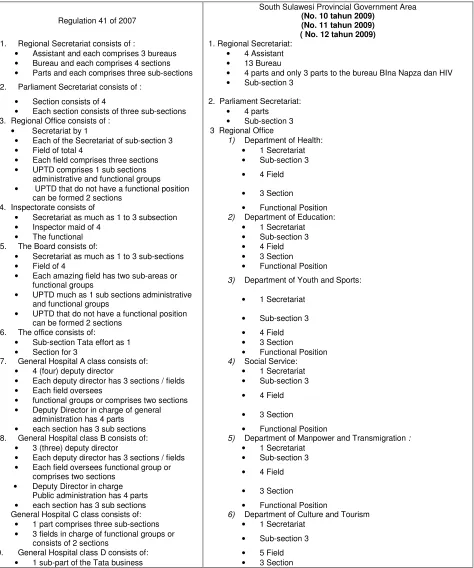
Sulawesi Provincial Regulation No. 8 of 2008 on the organization and functioning of the Regional Office of South Sulawesi, South Sulawesi Provincial Regulation No. 12 of 2009 concerning changes Provincial Regulation South Sulawesi No. 9 of 2008 on the Organization and Work Procedures Inspectorate, Regional Planning Board, Regional Technical Institute and other institutions in South Sulawesi Province as set forth in table 9 below:
Table 9. The concept of Organizational Structure and Working Procedures Government of South Sulawesi
Regulation 41 of 2007
South Sulawesi Provincial Government Area (No. 10 tahun 2009)
(No. 11 tahun 2009) ( No. 12 tahun 2009) 1. Regional Secretariat consists of : 1. Regional Secretariat:
• Assistant and each comprises 3 bureaus • 4 Assistant • Bureau and each comprises 4 sections • 13 Bureau
• Parts and each comprises three sub-sections • 4 parts and only 3 parts to the bureau BIna Napza dan HIV 2. Parliament Secretariat consists of : • Sub-section 3
• Section consists of 4 2. Parliament Secretariat: • Each section consists of three sub-sections • 4 parts 3. Regional Office consists of : • Sub-section 3
• Secretariat by 1 3 Regional Office
• Each of the Secretariat of sub-section 3 1) Department of Health:
• Field of total 4 • 1 Secretariat
• Each field comprises three sections • Sub-section 3 • UPTD comprises 1 sub sections
administrative and functional groups • 4 Field • UPTD that do not have a functional position
can be formed 2 sections • 3 Section
4. Inspectorate consists of • Functional Position • Secretariat as much as 1 to 3 subsection 2) Department of Education:
• Inspector maid of 4 • 1 Secretariat
• The functional • Sub-section 3
5. The Board consists of: • 4 Field
• Secretariat as much as 1 to 3 sub-sections • 3 Section
• Field of 4 • Functional Position
• Each amazing field has two sub-areas or
functional groups 3) Department of Youth and Sports: • UPTD much as 1 sub sections administrative
and functional groups • 1 Secretariat
• UPTD that do not have a functional position
can be formed 2 sections • Sub-section 3
6. The office consists of: • 4 Field
• Sub-section Tata effort as 1 • 3 Section
• Section for 3 • Functional Position
7. General Hospital A class consists of: 4) Social Service:
• 4 (four) deputy director • 1 Secretariat
• Each deputy director has 3 sections / fields • Sub-section 3 • Each field oversees
• functional groups or comprises two sections • 4 Field • Deputy Director in charge of general
administration has 4 parts • 3 Section
• each section has 3 sub sections • Functional Position
8. General Hospital class B consists of: 5) Department of Manpower and Transmigration :
• 3 (three) deputy director • 1 Secretariat
• Each deputy director has 3 sections / fields • Sub-section 3 • Each field oversees functional group or
comprises two sections • 4 Field
• Deputy Director in charge
Public administration has 4 parts • 3 Section
• each section has 3 sub sections • Functional Position
9. General Hospital C class consists of: 6) Department of Culture and Tourism • 1 part comprises three sub-sections • 1 Secretariat
• 3 fields in charge of functional groups or
consists of 2 sections • Sub-section 3
350
• 2 Section • Functional Position
11. The hospital grade A special area consists of 7) Department of Agriculture and Horticulture
• 2 (two) deputy director • 1 Secretariat
• Each deputy director has 3 sections / fields • Sub-section 3 • Each field oversees
• functional groups or comprises two sections • 4 Field • each section has 2 sub sections • 3 Section 12. Special Hospital area Class B consists of:
• Functional Position
• 1 subsection administration 8) Department of Animal Husbandry and Animal Health
• 3 Section • 1 Secretariat
• Sub-section 3 • 4 Field • 3 Section
• Functional Position
9) Department of Marine and Fisheries • 1 Secretariat
• Sub-section 3 • 4 Field • 3 Section
• Functional Position
10) Department of Plantation: • 1 Secretariat • Sub-section 3 • 4 Field • 3 Section
• Functional Position
11) Forest Service: • 1 Secretariat • Sub-section 3 • 4 Field • 3 Section
• Functional Position
12) Department of Industry and Commerce: • 1 Secretariat
• Sub-section 3 • 6 Field • 3 Section
• Functional Position
13) Department of Cooperatives and Micro, Small and Medium Enterprises:
• 1 Secretariat • Sub-section 3 • 4 Field • 3 Section
14) Department of Water Resources Management: • 1 Secretariat
• Sub-section 3 • 4 Field • 3 Section
• Functional Position
15) Department of Highways • 1 Secretariat • Sub-section 3 • 4 Field • 3 Section
• Functional Position
16) Department of Spatial Planning and Settlement: • 1 Secretariat
• Sub-section 3 • 4 Field • 3 Section
• Functional Position
17) Department of Energy and Mineral Resources: • 1 Secretariat
• Sub-section 3 • 4 Field • 3 Section
• Functional Position
351 IJSTR©2015
• 1 Secretariat • Sub-section 3 • 7 Field • 3 Section
• Functional Position 19) Revenue Service area:
• 1 Secretariat • Sub-section 3 • 4 Field • 3 Section
• Functional Position 4. Provincial Inspectorate:
• 1 Secretariat • Sub-section 3 • 4 inspector • 3 Section
• Functional Position 5. Technical Institute regions:
1) Planning Board area: • 1 Secretariat • Sub-section 3 • 5 Field 2Sub-Sector • Functional Position • 2 Sub-Sector • Functional Position
2) Regional Employment Board:
• Secretariat •3Sub-section •4Field •2Sub-Sector • Functional Position
3) The existence of the agency Agency National Unity, Politics and Public Protection
• 1 Secretariat • Sub-section 3 • 4 Field • 2 Sub-Sector • Functional Position 4) Regional Environmental Agency:
• 1 Secretariat • Sub-section 3 • 4 Field • 2 Sub-Sector • Functional Position
5) Food Security Agency Region: • 1 Secretariat • Sub-section 3 • 4 Field • 2 Sub-Sector • Functional Position
6) Regional Investment Coordinating Board: • 1 Secretariat
• Sub-section 3 • 4 Field • 2 Sub-Sector • Functional Position
7) Agency the Library and Archives area: • 1 Secretariat
• Sub-section 3 • 4 Field • 2 Sub-Sector • Functional Position
8) Agency for Community Empowerment, Government village and Village:
• 1 Secretariat • Sub-section 3 • 4 Field • 2 Sub-Sector • Functional Position
352 • 1 Secretariat
• Sub-section 3 • 4 Field • 2 Sub-Sector • Functional Position 10) Board of Education and Training:
• 1 Secretariat • Sub-section 3 • 4 Field • 2 Sub-Sector • Functional Position
11) Research and Development area: • 1 Secretariat
• Sub-section 3 • 4 Field • 2 Sub-Sector • Functional Position
12) District Traffic Agency and the City • 1 Secretariat
• Sub-section 3 • 4 Field • 2 Sub-Sector • Functional Position
13) Government Liaison Office Prov. Sulawesi: • 1 Sub-section layout of Business • Section 3
• Functional Position Group 14) Municipal Police Units:
• 1 Secretariat • 2 subsections • 3 Field • 2 Section
15) Regional Financial Management Agency: • 1 Secretariat
• 3 subsections • 4 Field • 2 subsections • Functional Position
16) Regional Disaster Management Agency: • The steering committee • Implementing elements • 1 Executive Secretariat • 3 subsections • 3 Field • 2 Section
17) Secretariat of the Governing Council Officer Corps of the Republic of Indonesia
• 1 Head of Secretariat • 3 parts
• 2 subsections
18) Provincial Extension Coordinating Board: • 1 Head of Secretariat
• Business planning Part 1 • 3 subsections
• 3 Section • 2 subsections
19) Indonesian Broadcasting Commission • 1 Secretariat
• 4 Sub-Section
20) General Hospital Labuang Baji: • 3 Deputy Director • 3 field to 1 Deputy Director • 6 sections for 2 deputy director • 2 Section
• 2 Sub-Section
21) Regional General Hospital DADI: • 2 Deputy Director
• 3 parts for 1 Deputy Director • 3 Division 1 Deputy Director • 2 Sub-Section
• 2 Section
353 IJSTR©2015
• 3 Deputy Director
• 4 field for 2 Deputy Director • 3 part 1 Deputy Director • 9 Sub-Section
• 10 Section
23) Special Hospital Earth Mother and Child: • Director
• 1 Sub-Division of Administration • 3 Section
24) Special Hospital Fatimah Mother and Child: • Director
• 1 Sub-Division of Administration • 3 Section
Source: Association of South Sulawesi Provincial Regulation Year 2009-2010 Volume XVI
Based on the above table 9 shows the addition of a few fields on the Office and Technical Institute of South Sulawesi Province, namely; Department of Culture and Tourism, Department of Industry and Trade, transportation services, information and communication as well as the Regional Development Planning Agency. This shows the arrangement of the Organization of the South Sulawesi Province has not adhered to the maximum pattern as in Government Regulation No. 41 of 2007, in addition to the presence of the Minister of Home Affairs No. 57 of 2007 opened up opportunities for the region in institutional restructuring especially if the local authority based on cluster affairs so that each region will make the Regional Regulations (Government) in accordance with the needs and potential of their respective regions.
5. CONCLUSIONS AND SUGGESTIONS
That each region should be able to adapt to change in line with the demands of the public service that requires each region must be able to effectively and efficiently run function. By because the ability of regional institutions in implementing the restructuring of regional organizations in accordance with governmental affairs submitted to the area. It is also mandated by the Provincial Government of South Sulawesi associated with functional assignment submitted to the authority related to the implementation of Government Regulation No. 38 of 2007 and Government Regulation No. 41 in 2007. And with this study, the authors give some conclusions related to the implications of the implementation of Government Regulation No. 38 of 2007 and the Government Regulation No. 41 In 2007, on several criteria:
1. Implementation of Organizational Structuring Government South Sulawesi related to the implementation of the obligatory functions and options based on Government Regulation No. 38 of 2007 has not been in accordance with the amount of regional organizations set out in the Government Regulation No. 41 Year 2007 concerning the maximum pattern in the preparation of the regional organization. It can be seen from the clump of affairs are handled by some regional work units that have an impact on the composition of the positions that tend to be filled by the structural position . 2. Implications of Organizational Structuring South
Sulawesi provincial government to demonstrate achievement of the performance is quite good in terms of authority and accountability in terms of Responsibility apparatus and the development of institutional innovation, but still many obstacles in
terms of budgeting activities in each regional work units and positions that have not adopted the composition functional demands of organizational change.
3. Model of the regional organization of South Sulawesi Provincial Government obtained from several informants range of views and some adequate references, but all of them can not be separated from policy rules concerning the reform of institutions that still need a scientific study in order to answer the question of structuring an effective and efficient organization.
So that the results of this study will provide suggestions as follows: (1) leadership commitment must be built in the vision and mission of the institution through a mechanism that is able to support the relationship of each task work unit. (2) Evaluation of institutional arrangements related to the affairs of the authority does not have to be a rationalization but can also be merging with allied functions, even new organization is required to support the vision and mission of the organization. (3) A challenge to changes in the organization's environment, making the organization must be adaptive, so that the organization must be able to develop a policy strategy to address the demands of independence as the hallmark of institutional organization and institutional development services that can move public participation and improve the quality of people's lives through counseling and outreach activities and creating new policies that affect communities, for example; free educational programs and free health currently implemented by the Government of South Sulawesi province. In connection with the changing demands of the organization, the organization must continuous improve the competence of its human resources through training to foster skills training and knowledge in order to create a responsive organization.
REFERENCES
[1] Kaho, Josep Riwu, 2001, Prospek Otonomi Daerah di Negara Republik Indonesia, PT. Raja Grafindo Persada, Jakarta.
[2] Smith, B.C. 1995. Decentralization: The Territorial Dimension of the State. Winchester Masschusetts: Allen & Unwin, Inc.
354 2007), Bahan kuliah Pasca Sarjana MAPD
STPDN, Jatinangor.
[4] Undang Undang Nomor 32 Tahun 2004 tentang Pemerintah Daerah.
[5] Peraturan Pemerintah Nomor 38 Tahun 2007 Tentang Pembagian Urusan Pemerintahan Pusat, Provinsi dan Kabupaten/Kota.
[6] Peraturan Pemerintah Nomor 41 Tahun 2007 Tentang Pedoman Organisasi Perangkat Daerah.
[7] Peraturan Daerah Provinsi Sulawesi Selatan Nomor 2 Tahun 2008 Tentang Urusan Pemerintahan Provinsi Sulawesi Selatan.
[8] Peraturan Daerah Provinsi Sulawesi Selatan Nomor 6 Tahun 2008 Tentang Organisasi Dan Tata Kerja Sekretariat Daerah Provinsi Sulawesi Selatan