175
Abstract: Dual Tree Complex Wavelet Transform (DTCWT),is a form of discrete wavelet transform which generates complex coefficients by using a dual tree of wavelet filters to obtain their real and imaginary parts.In this paper, the dual-tree complex wavelet transform (DTCWT) based despeckling algorithm is proposed for SAR images by considering the significant dependences of the wavelet coefficients across different scales. The DTCWT has the advantage of improved directional selectivity, approximate shift invariance, and perfect reconstruction over the discrete wavelet transform.The wavelet coefficients in eachsubband are modeled with a bivariate Cauchy probability density function (PDF) which takes into account the statistical dependence among the wavelet coefficients. The simulation results show that this method is faster and gives better performance when compared to the conventional discrete wavelet transform.
Keywords: Discrete Wavelet Transform, Dual Tree Complex Wavelet Transform, SAR image, Satellite images,Bivariate Cauchy probability density function.
————————————————————
I
INTRODUCTION
Synthetic aperture radar (SAR) is a coherent imaging technology, recording both the amplitude and the phase of the backscattered radiation [4]. The complex information processing capability of SAR systems provides high-resolution imagery, high-contrast observation, and accurate determination of topographical features when captured from an airplane or a satellite. Pixels in a SAR image represent the backscattered radiation from an area in the imaged scene. Brighter areas are produced by stronger radar response, and darker areas are from weaker radar responses. The amount of backscattering depends greatly on wavelength, orientation or polarization, incidence angle of the radar wave, and nature of the surroundings. Each resolution cell of the system contains many scatterers. The phases of the return signals from these scatterers are randomly distributed and cause interference. As a consequence, SAR images are inherently affected by a signal-dependent noise known as speckle. It results in degraded visual appearance and severely diminishes the effectiveness of automated scene analysis. Hence, speckle removal is a critical preprocessing step in tasks such as segmentation, detection, and classification of SAR images. The wavelet coefficients of natural images have significant dependences due to the following properties of the wavelet transform: 1) If a wavelet coefficient is large/small, the adjacent coefficients are likely tobe large/small, and 2) large/small coefficients tend to propagate across the scales.
The discrete wavelet transform is commonly used in maximally decimated form. Although the algorithms based on DWT provide high coding efficiency for natural images the standard DWT[2] has major disadvantages that weaken its application.
Lack of shift invariance: It means that small shifts in the input signal cause an unpredictable change in the distribution of energy between DWT coefficients at different scales. It has been observed that the standard DWT is seriously disadvantaged by the shift sensitivity that arises from the down samplers in the DWT.
Poor Directional Selectivity: When the m Dimensional transform (m>1) coefficients reveal only a few feature orientations in the spatial domain, the transform is considered as poor directional selectivity.
The conventional discrete wavelet transform (DWT) only exhibits shift invariance when implemented in its undecimated form, which is computationally inefficient, particularly in multiple dimensions. The directional selectivity of the DWT is poor because its separable filters cannot distinguish between edge features on opposing diagonals. DTCWT has the advantage of approximate shift invariance, good directional selectivity in two dimensions, and perfect reconstruction over the traditionaldiscrete wavelet transform [6]. In this paper, the bivariate Cauchy PDF [5] is used to model the interscale dependence of the dual-tree complex wavelet transform (DTCWT) coefficients.The bivariate Cauchy PDF isutilized in the complex domain for denoising images corrupted by an additive white Gaussian noise. In this paper, a closed- form expression to estimate the dispersion parameter of the bivariate Cauchy PDF is obtained using Mellin transformation. The organization of this paper is as follows. Section II describes the statistical models for representing the wavelet coefficients of the SAR image in intensity format, as well as that of the noise. Section III describes the dual tree complex wavelet transform. Section IV proposes a novel method for estimating the dispersion parameter of the bivariate Cauchy PDF. The MAP estimate of the uncorrupted wavelet coefficients of the SAR image is derived in Section V. The experimental results are discussed in Section VI.
____________________________
Dr. Siva Agora Sakthive l Murugan1, K.Karthikayan 2, Natraj.N.A 3, Rathish.C.R 4
Associate Professor 1, Assistant Professor 2,3,4
1,2 DepartmentofEEE, 3 DepartmentofECE,
SreeSakthi Engineering College 1,2, United Institute of
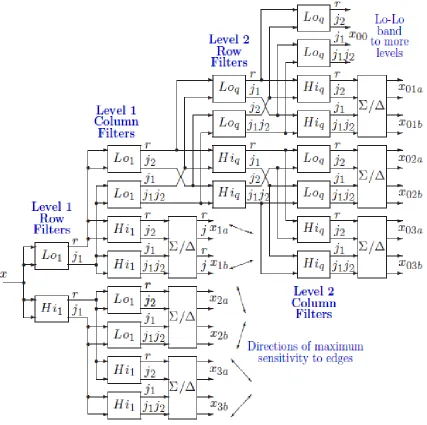
Fig 1: Two levels of complex wavelet tree for the 2-D input image x giving six directional sub bands.
II.
DUAL
TREE
COMPLEX
WAVELET
TRANSFORM
Dual Tree Complex Wavelet Transform (DTCWT), a form of discrete wavelet transform which generates complex coefficients by using a dual tree of wavelet filters to obtain their real and imaginary parts. The dual tree implementation of a complex wavelet transform (DTCWT),[3]have the desirable properties of approximate shift invariance and good directional selectivity. These properties are important for many applications in image analysis and synthesis, including denoising, deblurring, super resolution, watermarking, segmentation and classification. The block diagram of the dual tree is shown in Fig. 1. The key to obtain shift invariance from the dual tree structure lies in designing the filter delays at each stage, such that the low pass filter outputs in tree b are sampled at points midway between the sampling points of the equivalent filters in tree a. This requires a delay difference between the a and b low pass filters of 1 sample period at tree level 1, and ½ sample period at subsequent levels. At levels 1 any standard orthogonal or bi-orthogonal wavelet filters are
177 respectively. N(k,l) represents the corrupting multiplicative
speckle noise component. Assuming that the speckle is fully developed,Y(k,l) can be expressed as
Y(k,l)=S(k,l) N(k,l) (1)
By simple logarithmic transformation applied on (1), the multiplicative nature of speckle is transformed into an additive noise
And it is represented as
y(k,l)=s(k,l)+ n(k,l) (2)
where y(k,l), s(k,l)and n(k,l) be the logarithms of Y(k,l), S(k,l) and N(k,l) respectively. The DTCWT of a 2-D image y(k,l) results in an approximation and six directional subbands at each level, which are strongly oriented at angles of ±150,±450,±750. The approximation subband contains the low- frequency portions of the image and possesses most of the information of the image. Thus, the denoising has to be done only in the six directional subbands. Since the DTCWT is a linear operation, after applying DTCWT on (3), we obtain
di(k,l)=xi(k,l)+ni(k,l) (3)
where di(k,l),xi(k,l) and ni(k,l) denote the (k,l)thDTCWT coefficient of the log-transformed observed intensity, the original intensity, and the corresponding speckle noise component at each level J with orientation i respectively. The DTCWT coefficients are modeled using a bivariate Cauchy pdf. The Cauchy PDF of an N-dimensional vector x is given by
𝑝 𝑥 =[𝜋(|𝐱|2 + 𝛾2)](1+𝑁)/2𝛾Γ((1+𝑁)/2) for 1≤j≤J (4)
Where 𝛾be the dispersion parameter. Let Xj=(xj,xj+1) be an
interscale-dependence reflectance vector. xjrepresents the
DTCWT coefficient at jthe level, and xj+1 is the DTCWT
coefficient at the same position as xj. Hence the joint PDF is
given by
𝑝 𝑥𝑗 =2𝜋 (xj2+xj+1𝛾𝑗 2+𝛾𝑗2for 1≤j≤J (5)
As proposed in [7], the noise standard deviation is obtained from the noisy coefficients of each DTCWT subband separately.
𝜎 =𝑀𝐴𝐷 (𝑑 𝑘,𝑙 )0.6745 for 1≤j≤J (6)
where MAD signifies the Median Absolute Deviator.
A. Estimation of Dispersion Parameter
The bivariate Cauchy PDF in (7) requires the accurate estimation of the dispersion parameter 𝛾𝑗 for every scale j
Using MellinTransformation,the dispersion parameter for the Bivariate Cauchy PDF is given by
𝛾𝑗 = Ґ(32) Ґ(−1 2)
8𝜋 𝑚𝑑𝑗 1 −𝜎𝑛4𝜋2 for 1≤j≤J (8)
B. MAP Estimator
The MAP is a natural and optimal choice when the PDFs of the signal and noise are known a priori. The standard MAP estimator for x given the noisy observation d is given by
𝑥𝑗 = arg max 𝑝(𝑥𝑗|𝑑𝑗) for 1≤j≤J (9)
The generalised solution of the MAP estimator in (9) is obtained as follows,
𝑥𝑗 =𝑑𝑗3 + −3 𝑞𝑗2 + 𝑞𝑗42+𝑝𝑗273+ −3 𝑞𝑗2 − 𝑞𝑗42+𝑝𝑗273 (10)
𝑥𝑗 + 1 =𝑑𝑗 + 1 3 + −
𝑞𝑗 + 1 2 +
𝑞𝑗 + 12
4 +
𝑝𝑗 + 13
27
3
+
−𝑞𝑗 +1
2 −
𝑞𝑗 +12
4 +
𝑝𝑗 +13 27 3
(11)
Where
𝑝𝑗 = 𝛾𝑗
2+ 3𝜎2
1 +𝑑𝑗 +1𝑑𝑗22
−𝑑𝑗
2
(a) (b) (c)
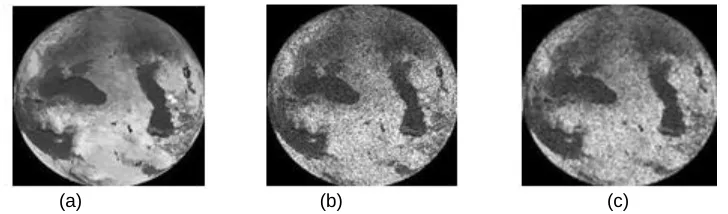
Fig 2: Input Image, (b) noisy image(σ=0.2), (c) Denoised image using DWT
(a) (b) (c)
Fig 3: Input Image, (b) noisy image(σ=0.2), (c) Denoised image using DTCWT
𝑞𝑗 = − 𝛾𝑗
2𝑑𝑗
1 +𝑑𝑗 +1𝑑𝑗22+ 1 27∗ 9𝑑𝑗
𝛾𝑗2+ 3𝜎2
1 +𝑑𝑗 +1𝑑𝑗22 − 2𝑑𝑗
3
𝑞𝑗 + 1 = −𝛾𝑗
2𝑑𝑗 + 1
1 +𝑑𝑗 +1𝑑𝑗22 + 1
27∗ 9𝑑𝑗 + 1
𝛾𝑗2+ 3𝜎2
1 +𝑑𝑗 +1𝑑𝑗22 − 2𝑑𝑗 + 1
3
The shrinkage function can be obtained as
𝑥𝑗 = 𝑠𝑖𝑔𝑛 𝑑𝑗 𝑚𝑎𝑥 0, 𝑑𝑗
1+ 3𝜎𝑛 2 𝑥𝑗 2+𝑥𝑗 +12+𝛾𝑗 2
for 1≤j≤J (12)
The despeckled image is obtained by performing an inverse DTCWT on the estimated wavelet coefficients in (12). Exponential transformation is then performed to reverse the effect of the logarithmic transformation.
IV. EXPERIMENTAL RESULTS
In this section, the performance of the dual tree complex wavelet transform baseddespeckling with Bivariate Cauchypdf and MAP estimation is analyzed using satellite images. A synthetically speckled image is generated by multiplying the noise free image with the speckle noise. Antonini Filter is used for first level and 14-tap Q-shift filter is used for the following levels of the DTCWT decomposition. J+1 level is carried for denoisingupto J levels. Fig(2) and Fig (3) shows the denoising performance for the satellite image using Discrete wavelet transform and Dual tree Complex wavelet transform respectively for 3-level decomposition.
TABLE I
Comparison of PSNR values using DWT and DTCWT
σ=0.2 σ=0.4 σ=0.6 σ=0.8
DWT 29.77 28.13 27.45 25.22
DTCWT 32.01 30.98 29.19 27.76
The performance is analyzed in terms of peak signal-to-noise ratio (PSNR). The PSNR is defined as
PSNR= 10log10(255 2
/MSE)
Where MSE is the mean square error between the original and the denoised image. The table shows the PSNR values (in decibels) for three level wavelet decomposition. It can be observed that the DTCWT provides PSNR values that are larger than the discrete wavelet transform
V. CONCLUSION
179 Wavelet Transform for Image Compression,‖IEEE
Trans. On Image processing 2008, vol.16, No.5, pp.1289-1302.
[3] Ivan W. Selesnick, Richard G. Baraniuk, ―Dual Tree Complex Wavelet transform,‖IEEE Signal Processing Magazine, pp 123-151, Nov 2005.
[4] H. Xie, L. Pierce, and F. T. Ulaby, ―Statistical properties of logarithmically transformed speckle,‖
IEEE Trans. Geosci. Remote Sens., vol. 40, no. 3,pp.
721–727, Mar. 2002.
[5] L.Sendur and I.W. Selesnick,‖Bivariate shrinkage functions for wavelet based denoising exploiting interscale dependency, ÏEEE Trans. Signal process, vol.50, no.11, pp.2244-2756, Nov. 2002.
[6] N.G.Kingsbury, ―Complex wavelets for shift invariant analysis and filtering of signals‖, Appl.Comput.
Harmon. Anal.,vol.10,No. 3, pp.234-253.
[7] D.L.Donoho and I.M. Johnstone, Ïdeal spatial adaptation by wavelet shrinkage‖, Biometrika, vol. 81, no.3, pp.425-455, may 1994.
[8] Tison, J. M. Nicolas, F. Tupin, and H. Maitre, ―A new statisticalmodel for Markovian classification of urban areas in high-resolution SARimages,‖ IEEE Trans. Geosci. Remote Sens., vol. 42, no. 10, pp. 2046– 2057, Oct. 2004.