Failure Is an Option: Using Errors
as Teaching Opportunities
Jimmy B. Beck, MD, MEd, Caitlin McGrath, MD, Kristina Toncray, MD, Sahar N. Rooholamini, MD, MPH
Success consists of going from failure to failure without loss of enthusiasm.
Winston Churchill In this article, we continue the Council on Medical Student Education in Pediatrics series describing the characteristics and skills of effective clinical teachers by providing a practical framework for using errors as opportunities to promote the professional growth of students. For our purposes, a medical error is “the failure of a planned action to be completed as intended or the use of a wrong plan to achieve an aim.”1
Because medical students are closely supervised during their clinical rotations, it is unlikely that a student error would lead to major patient harm. However, many students will experience an error during medical school2 and may be reluctant to report their own errors for fear of negatively impacting their evaluations.3 The hidden curriculum, which refers to the implicit culture of rules and norms present in the clinical learning environment, may also discourage a student from speaking up.4 Furthermore, students who have a negative experience after an error occurs are less likely to take responsibility for future errors, 5 whereas students who witness their attending physicians take ownership of errors are more likely to emulate that behavior.6 Rather than minimizing errors, great clinical teachers
acknowledge errors as
opportunities to teach students to reflect and take helpful action.4 Despite the potential benefits of using errors as teaching opportunities, barriers such as time constraints, the desire to avoid uncomfortable future relationships with students, and a lack of training about how to make disclosures may make physicians hesitant to discuss errors with students.7
The following 3-part framework is helpful for transforming medical errors into valuable learning opportunities: (1) orient students to errors as learning opportunities, (2) model appropriate ways to view and handle errors, and (3) debrief errors with students. We share a fictional case to illustrate this framework:
You are supervising Elaine, a third-year medical student on her pediatric clerkship, in a busy outpatient clinic. She feels a sense of satisfaction with her Spanish-speaking skills after interviewing and examining a non-English–speaking patient with vomiting and makes a diagnosis of acute gastroenteritis. When you interview the patient using a certified interpreter, you note that key elements are missing from the history, and on your examination, the patient has examination findings classic for appendicitis.
ORIENT
Effective learning requires clear expectations within an emotionally supportive environment.8
Establishing a framework for
PEDIATRICS Volume 141, number 3, March 2018:e20174222
MONTHLY FEATURE 11
Department of Pediatrics, University of Washington, Seattle, Washington
Dr Beck and Dr Rooholamini conceptualized the ideas presented and drafted the initial manuscript; Drs McGrath and Toncray conceptualized the ideas presented; and all authors reviewed and revised the manuscript and approved the final manuscript as submitted.
DOI: https:// doi. org/ 10. 1542/ peds. 2017- 4222 Accepted for publication Dec 19, 2017
Address correspondence to Jimmy B. Beck, MD, MEd, Seattle Children’s Hospital, 4800 Sandpoint Way NE, M/S FA.2.115, PO Box 5371, Seattle, WA 98105. E-mail: jimmy.beck@ seattlechildrens.org
PEDIATRICS (ISSN Numbers: Print, 0031-4005; Online, 1098-4275).
Copyright © 2018 by the American Academy of Pediatrics
FINANCIAL DISCLOSURE: The authors have indicated they have no financial relationships relevant to this article to disclose.
FUNDING: No external funding.
POTENTIAL CONFLICT OF INTEREST: The authors have indicated they have no potential conflicts of interest to disclose.
To cite: Beck JB, McGrath C, Toncray K, et al. Failure Is an Option: Using Errors as Teaching Opportunities. Pediatrics. 2018;141(3):e20174222
at Viet Nam:AAP Sponsored on August 28, 2020
www.aappublications.org/news
approaching errors intentionally and honestly establishes the teacher as a “safe” person with whom to discuss errors. Before the rotation begins, teachers can inform students about their own approach to discussing errors. When meeting students, teachers can reiterate their philosophy toward errors and ask students about their experiences with the disclosure of errors. Understanding a student’s experience with errors establishes a baseline for future growth.
In Elaine’s case, before the start of her rotation, you sent her an introductory email stating, among other things, “In my clinical work, I like to take a proactive approach when any error occurs. Errors are a normal part of clinical practice, with each error providing a valuable opportunity to improve.”
MODEL
Many students have not observed a teacher modeling the disclosure and discussion of errors.9
Modeling a professional response to errors requires the willingness to be vulnerable. Modeling of vulnerability by the teacher through open discussion with the team, patients, and families after an error is associated with positive learner attitudes and behaviors, such as accepting responsibility for and disclosing errors.10 When teachers discuss lessons and growth from their errors, students may gain a better understanding of how to approach their own errors.4, 11
DEBRIEF ERRORS
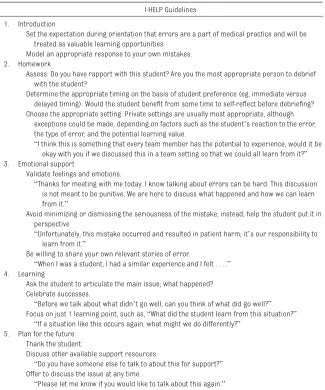
The final component of using errors as teaching opportunities involves intentional debriefing after students witness or are involved in an error. The acronym I-HELP (introduction, homework, emotional support, learning) (Table 1) provides a structure for teachers to use to guide students through debriefing an error.
Introduction
As above, before the occurrence of an error, teachers (1) set the expectation and then (2) model error discussion and disclosure as part of clinical practice and as valuable learning opportunities.
Homework
Clinical teachers prepare by
considering the who, when, and where of error debriefing. In determining the most appropriate person to debrief with the student, a teacher considers whether they were directly involved with, or observed, the error. The teacher also reflects on whether they have a strong emotional response to the error. In some cases, another teacher or clerkship director may be
a more appropriate person to debrief. Next, the teacher considers the appropriate timing, such as immediate or delayed timing. In general, feedback close in time to the event is preferable, although patient care may preclude an immediate discussion, and a student’s emotional state plays a role in timing. Finally, choosing an appropriate setting is critical for building trust with the student.
During lunch, you ask Elaine to discuss the appendicitis case. You noticed that she did not seem surprised when you approached her and seemed open to further conversation.
Emotional Support
Given the significant emotional turmoil associated with committing
BECK et al 12
TABLE 1 Guidelines for Debriefing Errors With Medical Students: I-HELP Acronym I-HELP Guidelines
1. Introduction
Set the expectation during orientation that errors are a part of medical practice and will be treated as valuable learning opportunities.
Model an appropriate response to your own mistakes. 2. Homework
Assess: Do you have rapport with this student? Are you the most appropriate person to debrief with the student?
Determine the appropriate timing on the basis of student preference (eg, immediate versus delayed timing). Would the student benefit from some time to self-reflect before debriefing? Choose the appropriate setting. Private settings are usually most appropriate, although
exceptions could be made, depending on factors such as the student’s reaction to the error, the type of error, and the potential learning value.
“I think this is something that every team member has the potential to experience, would it be okay with you if we discussed this in a team setting so that we could all learn from it?”
3. Emotional support
Validate feelings and emotions.
“Thanks for meeting with me today. I know talking about errors can be hard. This discussion is not meant to be punitive. We are here to discuss what happened and how we can learn from it.”
Avoid minimizing or dismissing the seriousness of the mistake; instead, help the student put it in perspective
“Unfortunately, this mistake occurred and resulted in patient harm; it’s our responsibility to learn from it.”
Be willing to share your own relevant stories of error.
“When I was a student, I had a similar experience and I felt . . . .”
4. Learning
Ask the student to articulate the main issue; what happened? Celebrate successes.
“Before we talk about what didn’t go well, can you think of what did go well?”
Focus on just 1 learning point, such as, “What did the student learn from this situation?” “If a situation like this occurs again, what might we do differently?”
5. Plan for the future Thank the student.
Discuss other available support resources.
“Do you have someone else to talk to about this for support?”
Offer to discuss the issue at any time.
“Please let me know if you would like to talk about this again.”
at Viet Nam:AAP Sponsored on August 28, 2020
www.aappublications.org/news
an error, 11 it is critical to assess and validate the student’s feelings. Avoid minimizing or dismissing the seriousness of the mistake. Instead, help the student gain perspective. Also, consider assessing for other support structures (ie, family, institutional support, others with similar experiences). Teachers can reduce the student’s sense of isolation by sharing their own relevant stories of error and how they felt at the time.
Thanks for meeting with me today. I wanted to discuss our patient with appendicitis and the factors that may have led to initially missing the diagnosis. I know talking about errors can be hard. I remember missing a diagnosis when I was a student, and my attending correcting me but not really discussing it in the moment, which seemed like a lost opportunity to learn.
Learning
When sitting down to discuss, teachers use open-ended questions and ask the student to first articulate the event and then identify the main issue(s). This promotes guided self-reflection and allows the teacher to assess the student’s state of mind. It can be helpful to ask students to articulate what they felt went well with the situation and reaffirm the successful aspects of their care. Lastly, teachers ask their students to discuss what they want to learn from the error, attempting to focus on 1 learning point.
When reflecting on today’s patient, what do you think went well? How did this experience make you feel? What did you learn from this patient and your experience?
Plan for the Future
The teacher ends by thanking the student and offering to discuss the issue again at any time.
Elaine, thanks for being open to talking about this. Discussing and learning from
our errors can make people feel vulnerable, but it is part of how we grow as clinicians. My door is always open to you to talk more if you’d like.
Bridging or prompting statements such as the examples suggested in Table 1 can be used to promote trust and build support.
CONCLUSIONS
There are many missed opportunities to teach students how to respond to and learn from errors. Great clinical teachers can model proactive and intentional responses to errors, and by creating a supportive
environment, they can guide students to process and learn from mistakes. Students who learn to discuss and grow from errors promote positive changes in their own professional development and, potentially, impact the health of their future patients.
ACKNOWLEDGMENTS
We thank Emily Ruedinger and Khiet Ngo for their help in conceptualizing this framework. We also thank Khiet Ngo for his helpful comments and thoughtful reviews of the article.
ABBREVIATION
I-HELP: introduction, homework, emotional support, learning
REFERENCES
1. Institute of Medicine (US) Committee on Quality of Health Care in America; Kohn LT, Corrigan JM, Donaldson MS, eds. To Err Is Human: Building a Safer Health System. Washington, DC: National Academy Press; 2000 2. Kiesewetter J, Kager M, Lux R,
Zwissler B, Fischer MR, Dietz I. German
undergraduate medical students’
attitudes and needs regarding medical errors and patient safety–a national survey in Germany. Med Teach. 2014;36(6):505–510
3. Gold KB. Medical Students’ Exposure and Response to Error on the Ward. New Haven, CT: Yale University; 2009 4. Fischer MA, Mazor KM, Baril J, Alper
E, DeMarco D, Pugnaire M. Learning from mistakes. Factors that influence how students and residents learn from medical errors. J Gen Intern Med. 2006;21(5):419–423
5. Vohra PD, Johnson JK, Daugherty CK, Wen M, Barach P. Housestaff and medical student attitudes toward medical errors and adverse events. Jt Comm J Qual Patient Saf. 2007;33(8):493–501
6. Martinez W, Lo B. Medical students’ experiences with medical errors: an analysis of medical student essays. Med Educ. 2008;42(7):733–741 7. Mazor KM, Fischer MA, Haley HL,
Hatem D, Rogers HJ, Quirk ME. Factors influencing preceptors’
responses to medical errors: a factorial survey. Acad Med. 2005;80(suppl 10):S88–S92 8. Bannister SL, Hanson JL,
Maloney CG, Dudas RA. Practical framework for fostering a positive learning environment. Pediatrics. 2015;136(1):6–9
9. Bell SK, Moorman DW, Delbanco T. Improving the patient, family, and clinician experience after harmful events: the “when things go wrong” curriculum. Acad Med. 2010;85(6):1010–1017
10. Martinez W, Hickson GB, Miller BM, et al. Role-modeling and medical error disclosure: a national survey of trainees. Acad Med. 2014;89(3):482–489
11. Plews-Ogan M, May N, Owens J, Ardelt M, Shapiro J, Bell SK. Wisdom in medicine: what helps physicians after a medical error? Acad Med. 2016;91(2):233–241
DOI: 10.1542/peds.2017-4222 originally published online February 13, 2018;
2018;141;
Pediatrics
Jimmy B. Beck, Caitlin McGrath, Kristina Toncray and Sahar N. Rooholamini
Failure Is an Option: Using Errors as Teaching Opportunities
Services
Updated Information &
http://pediatrics.aappublications.org/content/141/3/e20174222 including high resolution figures, can be found at:
References
http://pediatrics.aappublications.org/content/141/3/e20174222#BIBL This article cites 9 articles, 1 of which you can access for free at:
Subspecialty Collections
dev_sub
http://www.aappublications.org/cgi/collection/teaching_curriculum_ Teaching/Curriculum Development
b
http://www.aappublications.org/cgi/collection/medical_education_su Medical Education
following collection(s):
This article, along with others on similar topics, appears in the
Permissions & Licensing
http://www.aappublications.org/site/misc/Permissions.xhtml in its entirety can be found online at:
Information about reproducing this article in parts (figures, tables) or
Reprints
http://www.aappublications.org/site/misc/reprints.xhtml Information about ordering reprints can be found online:
at Viet Nam:AAP Sponsored on August 28, 2020
www.aappublications.org/news
DOI: 10.1542/peds.2017-4222 originally published online February 13, 2018;
2018;141;
Pediatrics
Jimmy B. Beck, Caitlin McGrath, Kristina Toncray and Sahar N. Rooholamini
Failure Is an Option: Using Errors as Teaching Opportunities
http://pediatrics.aappublications.org/content/141/3/e20174222
located on the World Wide Web at:
The online version of this article, along with updated information and services, is
by the American Academy of Pediatrics. All rights reserved. Print ISSN: 1073-0397.
the American Academy of Pediatrics, 345 Park Avenue, Itasca, Illinois, 60143. Copyright © 2018 has been published continuously since 1948. Pediatrics is owned, published, and trademarked by Pediatrics is the official journal of the American Academy of Pediatrics. A monthly publication, it
at Viet Nam:AAP Sponsored on August 28, 2020
www.aappublications.org/news