Seismic Response of Rc Frame Building With
Soft Storey At Different Floor Levels
K.Vamsi Satyanarayana
#, Vinodh kumar*
#
M.Tech student, Structural Engineering , GITAS college of engineering, Bobbili, Vizianagaram
*Assistant Professor, GITAS college of Engineering, Bobbili, Vizianagaram.
Abstract- Many multistorey buildings in India today have open first storey as an unavoidable feature. This is primarily being adopted to accommodate parking or reception lobbies in the first storeys. The upper storeys have brick infilled wall panels. Reinforced concrete (RC) frame buildings with masonry infill walls have been widely constructed for commercial and may effect .so by using to avoid lateral displacement and storey drift, stiffness of masonary infill, performance of soft storey building by using ETABS provided columns and adjacent infills at each corner of building at different floor levels at different zones
key words: storey, soft storey, infill walls
I. INTRODUCTION
A RC framed building with soft storey at different floor levels may give give failure to the particular due to load combination and type of zone related.the given analysis will give safe measures and different calculations that may avoid the failure criteria by using the soft ware ETABS The lateral loads generated by ETABS correspond to the seismic zones II, III, IV & zone V and the 5% damped response spectrum given in IS: 1893-2002.
For the Modeling of the G+10 storey RC building with first soft storey, two soft storey, three soft storey
were consider line element was used for
beams(230mm x 600mm) and columns(230mm x750mm) and concrete element for slabs in the present investigation, Brick materials are used for masonry infill as internal walls(115mm) and external walls(230mm). The base of structure was fully fixed by constraining all the degrees of freedom
II. OBJECTIVES
The main objective of this dissertation is
1. focus on the behaviour of RC frame buildings with bare frame, bare frame with slab element, first soft storey, second soft storey, third soft storey in seismic zones II, III, IV, and zone V.
2. To study the effect of storey drifts, lateral displacement and base shear in the seismic zones II, III, IV and zone V of bare frame, bare frame with slab element, full infills, and soft storey at different levels of buildings.
3. To check the applicability of the multiplication factor of 2.5 as given in the Indian Standard IS 1893:2002 for design of bare frame, bare frame with slab element, full infills, and soft storey at different levels of building in zones II,III,IV& zone V.
4. To analyze the RC frame for dynamic analysis in relation to the storey drift and lateral displacements, base shear using software ETABS.
5. To study the comparison between the storey drifts, lateral displacements, base shear of all Models in seismic zones II, III, IV and zone V.
6. To investigate the bare frame, soft storey behaviour at different levels of RC frame building for all cases so as to arrive at suitable practical conclusion for achieving earthquake resistant RC frame building.
7. To identify the storey drift where there is exceeds its permissible values of storey drifts i.e.0.004h, in each zone for different Models.
8. To study failure conditions of six Models at different storeys in each zone for all Model buildings.
9. To promote safety without too much changing the constructional practice of reinforced concrete structures
III. METHODOLOGY
Figure 1 Plan for G+10 storey building
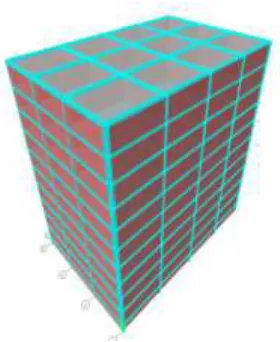
Figure 2 Model 1: G+10 RC bare frame building 3D view
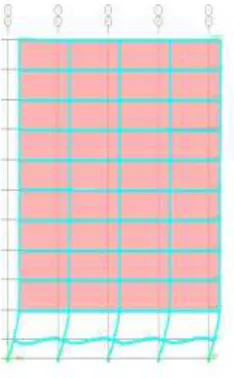
Figure 3 Model 1: G+10 RC bare frame building lateral displacement
Figure 4 Model 2: G+10 RC bare frame building with slab element 3D view
Figure 5 Model 2: G+10 RC bare frame building with slab element lateral displacement
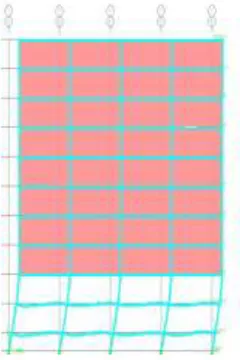
Figure 7 Model 3: G+10 RC building of full infill wall with slab element lateral displacement
Figure 8 Model 4: G+10 RC first soft storey building with slab element 3D view
Figure 9 Model 4: G+10 RC first soft storey building with slab element lateral displacement
Figure 10 Model 5: G+10 RC two soft storey building with slab element 3D view
Figure 12 Model 6: G+10 RC three soft storey building with slab element 3D view
Figure 13 Model 6: G+10 RC three soft storey building with slab element lateral displacement
IV. STRUCTURAL PROPERTIES
Type of frame Ordinary moment
resisting RC frame OMRF) fixed at the base
Seismic zones II,III,IV,&V
Number of storey G+10 storey
Floor height 3 m
Depth of Slab 150 mm
Size of beam (230 × 600) mm
Size of column (230 × 750) mm
Spacing between frames in x-direction
8 m
Spacing between frames in y-direction
7 m
Materials M 25 concrete, Fe 415
steel and
Infill Brick
Thickness of external infill walls
230 mm
Thickness of external infill walls
115 mm
Density of concrete 24KN/m3
Density of infill 20 KN/m3
Type of soil Medium soil
Seismic zone As per IS (1893-2002)
Seismic zone factor, Z For zone II: 0.10
For zone III: 0.16 For zone IV: 0.24 For zone V: 0.36
Importance Factor, I 1
Response spectrum analysis
Linear dynamic analysis
Damping of structure 5 percent
Plinth height above ground level
1.8 m
Type of the building OMRF(Ordinary
moment resisting RC frame )
Wall load for the outer side for ( 3 m height wall)
12.42 KN/m
Wall load for the inner side for ( 3 m heightwall)
6.21 KN/m
Wall load for the outer side for ( 1.8 m height wall)
6.90 KN/m
Wall load for the inner side for(1.8 m height wall)
3.45 KN/m
Total Dead load of slab 5.75 KN/m2
Live load 2 KN/m2
V. RESULTS
The following results were obtained when analyzing the structures in ETABS.
Lateral displacements of Model 1 in zones II, III, IV, and zone V
The graphs shown the variation of lateral displacements of bare frame (model 1) in all seismic zones II, III, IV and zone V respectively.
Figure 14 Comparison of lateral displacement in model 1for seismic zones
Lateral displacements of Model 2 in zones II, III, IV, and zone V
The graph shown the variation of lateral displacements for bare frame with slab element (Model 2) in all seismic zones II, III, IV and zone V respectively.
Figure 15 Comparison of lateral displacement in Model 2
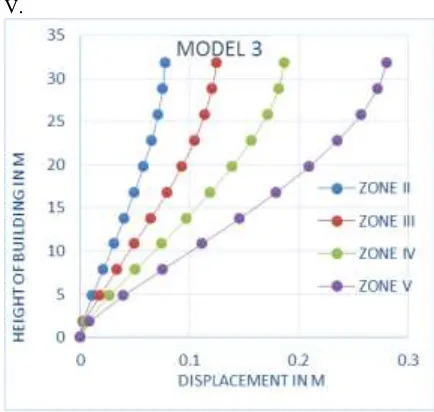
Lateral displacements of Model 3 in zone II, III, IV, & zone V
The graph shown the variation of lateral displacements for bare frame with slab element and
with full infills (Model 3) in zone II, III, IV, and zone V.
Figure 16 Comparison of lateral displacement in Model 3
Lateral displacements of Model 4 in zone II, III, IV, & zone V.
The graph shown the variation of lateral displacements for bare frame with first soft storey (Model 4) in zone II, zone III, zone IV, and zone V.
Figure 17 Comparison of lateral displacement in Model 4
Lateral displacements of Model 5 in zone II, III, IV, & zone V
The graph shown the variation of lateral displacements for bare frame with two soft storey building with slab element and with full infills
(Model 5) in zone II, III, IV, and zone V.
Figure 18 Comparison of lateral displacement in Model 5
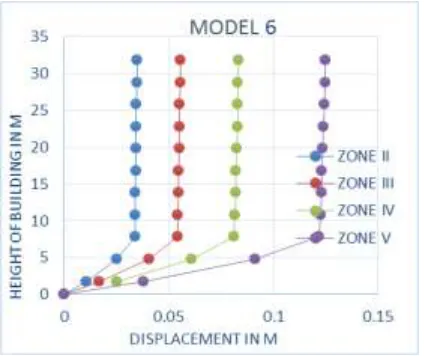
Lateral displacements of Model 6 in zone II, III, IV, & zone V
The graph shown the variation of lateral displacements for bare frame with three soft storey building with slab element and with full infills (Model 6) in zone II, III, IV, and zone V.
Figure 19 Comparison of lateral displacement in Model 6
VI. CONCLUSION
The storey drifts observed of the structure are
found within the limit as specified by code (IS: 1893-2002, part-1) in linear dynamic analysis.
Story drift value is more in the story 11 of bare
frame as compared to the soft storey at different levels of building.
The presence of masonry infill influences the
overall behaviour of structures when subjected to lateral forces. Lateral displacements and storey drifts are considerably reduced while contribution of the infill brick wall is taken into account.
Infilled frames should be preferred in seismic
zones more than the open first storey frame, because the storey drift of first storey of open first storey frame is very large than the upper storeys, this may probably cause the collapse of structure.
Lateral displacement of bare frame Model is
higher than other Models because of less lateral stiffness of storey, due to absence of infill walls. The lateral displacements were observed in model 2 are reduced to 13.14%, 20.68% 30.74% and 45.82% as compared to the model 1 in zone II, III, IV and zone V respectively
First storey displacement of soft first storey
Model is maximum than other Models due to absence of infill in the first storey. In soft first storey frame, there is sudden change in drifts between first and second storey in all seismic zones.
Concluded that the providing of infill wall in
RC building controlled the displacement, storey drifts and lateral stiffness.
The increase in base shear in models III, IV and
V was 71.64%, 94.54%, 87.34%, 82.93%, and 82.56% respectively when compared to the model 1 in all zones.
Base shear is more in full infilled Model (model
3) as compared to the other R.C building models.
Bare frame has a lesser value of base shear as
compared to the other R.C building Models.
REFERENCES
1. C.V.R.Murty, "Why Are Open Ground Storey Buildings Vulnerable in Earthquakes", Indian Institute of Technology Kanpur, Earthquake tip 21, December 2003.
2. D. B. Karwar and Dr. R. S. Londhe (2014), Performance of RC Framed Structure by Using Pushover Analysis, International Journal of Emerging Technology and Advanced Engineering.
3. Dhadde Santosh (2014), Evaluation and Strengthening of Soft Storey Building, International Journal of Ethics in Engineering & Management Education.
4. ETABS (Version 9.7) “ETABS User’s Manual Revision 9.7”
6. FEMA-273, (1997), NEHRP Guidelines for the Seismic Rehabilitation of Buildings, Federal Emergency Management Agency, Washington, D. C, October. 7. Goutam Mondal and S.K.Jain (2008),” Lateral Stiffness of
Masonry Infilled RC Frame with Central Opening”, Earthquake Spectra, Vol. 24, N0.3, PP.701-723, Aug 2008. 8. Hiten L. Kheni,and Anuj K. Chandiwala(2014), Seismic
Response of RC Building with Soft Stories, International Journal of Engineering Trends and Technology (IJETT) – Volume 10 Number 12 - Apr 2014.
9. IS-1893 2002 Indian Standard Criteria for Earthquake Resistant Design of Structures (part 1) BIS, New Delhi, 10. Jaswant N. Arlekar, Sudhir K. Jain and C.V.R. Murty,
"Seismic zone Response of RC Frame Buildings with Soft First Storeys" Proceedings of the CBRI Golden Jubilee Conference on Natural Hazards in Urban Habitat, 1997,' New Delhi.
11. M. N. Fardis and T. B. Panagiotakos “Seismic Design and Response of Bare and Masonry-Infilled Reinforced Concrete Buildings” Journal of Earthquake Engineering, 1:3, pp.475-503, 1997.
12. M.Koti Reddy, D.S.Prakash Rao and A.R.Chandrasekaran, "Modeling of RC Frame Buildings with Soft Ground Storey", the Indian Concrete Journal, Volume 81, No. 10, October 2007.
13. Mainstone, R.J., (1971), “On the Stiffness and Strengths of Infilled Frames”, Proceedings of the Institution of Civil Engineers, Supplement IV, Paper No. 7360S, pp. 57-90. 14. Mr. D. Dhandapany (2014), Comparative Study of and
Analysis of Earthquake G+5 Storey Building with RC Shear Wall, Int. J. Engineering Research and Advanced Technology,Vol 2 (3),167-171.
15. Murty,C.V.R., and Jain,S.K., (1996), “Draft IS:1893 Provisions on Seismic Design of Buildings,” Bureau of Indian Standards, New Delhi.
16. Perumal Pillial E.B., Govindan P.,‟ Structural Response Of Brick Infill In R.C Frames.‟International Journal Of Structural‟,vol.14, No 2, Dec 1994.
17. Rakshith Gowda K.R and Bhavani Shankar (2014), Seismic Analysis Comparison of Regular and Vertically Irregular RC Building with Soft Storey at Different Level, International Journal of Emerging Technologies and Engineering (IJETE).
18. Helou and Abdul Razzaq Touqan, "seismicBehaviour of RC Structures with Masonry Walls" An-Najah Univ. J. Res. (N.Sc.), Volume 22, 2008, pp 77-92.
19. Haque, Khan Mahmud Amanat, "Seismic zoneVulnerability of Columns of RC Framed Buildings with Soft Ground Floor" International Journal of Mathematical Models And Methods In Applied Sciences, Issue 3, Volume 2,2008, pp 364-371.
20. Suchita Hirde and Ganga Tepugade(2014), Seismic Performance of Multistorey Building with Soft Storey at Different Level with RC Shear Wall, International Journal of Current Engineering and Technology E-ISSN 2277 – 4106, P-ISSN 2347 – 5161.
21. Takuya Nagae, Keiichiro Suita, Masayoshi Nakashima, "Performance Assessment for Reinforced Concrete Buildings with soft first stories" Annuals of Disas. Res.Inst,Kyoto
22. Yong Lu, T. P. Tassios, G.-F. Zhang, and Elizabeth Vintzileou, "Seismic zone Response of Reinforced Concrete Frames with Strength and Stiffness Irregularities", ACI Structural Journal Technical, Volume 96, No. 2, March -April 1999, pp 221 -229.