International Journal of Engineering Trends and Technology (IJETT) – Volume 24 Number 4- June 2015
CFD Simulation for Wind Load on Octagonal Tall Buildings
Dr S.K. Verma #1, A.K Roy *2, Sunil Lather* 3 ,Manoj Sood*4
1
Associate Professor, Department of Civil Engineering, PEC university of Technology, Chandigarh, India
2
Civil Engineering Department, NIT Hamirpur, Himachal Pradesh, India
Abstract— Lateral loads i.e. wind load, seismic load, govern the
design of tall buildings. Wind code IS 875 (PART-3rd) provides the
pressure coefficients (CP) only at 0º and 90º wind incidence angles
and only for few standard cases.Therefore, experimental studies become important and wind tunnel experiment is carried out to measure wind loads on the models of tall buildings at different wind incident angles. CFD offers a very powerful alternative to predict the wind related phenomena on buildings or different kind of structures. A software package, FLUENT-14 (ANSYS 14.0) is used for CFD analysis. CFD analysis is carried out considering the same parameters as used in the experimental study.The buildings chosen in present study is octagonal in plan. Mean area weighted average wind pressures on the faces of the building models are measured in order to study the effect of varying wind incident angles namely 0º, 15º and 30º on wind pressure distribution.
Keywords: Tall building; computational fluid dynamics (CFD);
pressure coefficients; wind tunnel testing; wind incidence angle
I. INTRODUCTION
Structural design of tall buildings is dictated by wind loads. Generally wind loads are determined by referring to relevant wind loading codes and relevant literature. Some of the relevant wind load codes are: [AS/NZS: 1170.2-2002, ASCE: 7-02-1170.2-2002, IS: 875-(Part-3)-1987, NBC-(Part-4)-1995]. However, the information available in such codes regarding wind pressure or force coefficients even for a simple plan shape such as square one is for limited wind directions only. For building shapes other than rectangular plan shapes very limited information with regards to wind loads is available. This necessitates the need for extensive wind tunnel testing for buildings of peculiar shapes. But wind tunnel tests being very expensive and time consuming; Computational Fluid Dynamics (CFD) simulation has become a good alternative. Dalui 2008 has carried out experimental investigation on octagonal shaped tall buildings, Stathopoulos 1996 and Blocken 2008 used CFD for assessing the wind loads. In present study a numerical modeling employing CFD has been used and the results obtained are compared with those obtained from experimental study
II. EXPERIMENTAL PROGRAM
The experimental study has been conducted in the Closed Circuit Wind Tunnel at the Department of Civil Engineering, Indian Institute of Technology Roorkee, Roorkee, India. It is
a closed circuit, continuous flow, closed test section type (i.e. closed jet type) wind tunnel with single fan (65 HP). Cross-section of the test Cross-section is 1.3 m × 0.85 m size and the length of the test section is 8.2 m. In the present study models are made at a length scale of 1:300. Table 1 gives the comparison of dimensions in case of prototype and the models.
TABLE 1
PROTOTYPE AND MODEL DIMENSIONS
Paramete r
Prototyp e (m)
Model
(mm) Scale
Length Width
Total Height
30 30 150
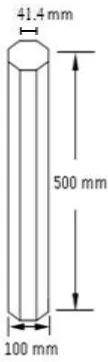
100 100 500
1:3 00
Models (Fig. 1) have been prepared using 6 mm thick perspex sheets for the experimental study in the wind tunnel. Pressure tapings are installed on the surfaces of building models for measuring the surface pressure and mean pressure coefficient values are calculated for each face at different wind incidence angles.
International Journal of Engineering Trends and Technology (IJETT) – Volume 24 Number 4- June 2015
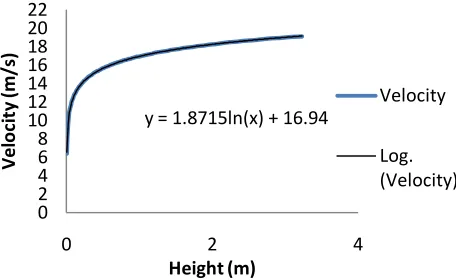
Fig 2 Velocity profile used in CFD Simulation
III. CFD SIMULATION OF WIND TUNNEL STUDY CFD simulation for Wind essentially consists of following:
A. Simulation of Atmospheric Boundary Layer Flow
These profiles should be representative of the roughness characteristics of that part of the upstream terrain that is not included in computational domain (i.e., the terrain upstream of inlet plane).
B. Validation of Atmospheric Boundary Layer Flow Simulation
The velocity profile graph of wind tunnel is used and mathematical equation is generated which are used in user defined functions (UDF’s). UDF are obtained through C-programming which are generally defined at inlet face of model in Fluent to simulate atmospheric boundary layer. For generating our UDF the velocity profile obtained in wind tunnel is used which is shown in Fig 2.
C. Detail of meshing of the geometry of experimental setup
Fine meshing is used on the building face, near the bottom area around building. The quality of mesh is 0.95-1.0 for model with 0º and between 0.55 to 0.95 for 75º wind incident angle. The quality of mesh can be checked in ICEM CFD and if this value is above 0.5 (range is 0.0-1.0) the quality of mesh is referred as good. To get first cell height we need some calculations as suggested by CFD package. If Reynolds number is more than 5 x 10⁵flow over a surface will be turbulent. For most of wind flow problems flow is turbulent.
Fig 3 Top view and side view of mesh of Octagonal Building Model
D. Domain Considered for CFD Simulation of Experimental Models
The building dimensions were same as the buildings used for the wind tunnel study as explained earlier i.e. 100mm × 100mm × 500 mm. The wind tunnel cross section (i.e. domain dimensions) taken for the CFD simulation was considered using optimum domain recommendations by Roy A.K.(2012).
Fig 4. Computational domain of the building models used for CFD simulation (Roy . 2012)
IV. SOLVER SETTINGS
Normally the solutions are steady-state solutions. Second-order differencing was used for the pressure, momentum and turbulence equations and the “coupled” pressure-velocity coupling approach due to its robustness for steady-state, single-phase flow problems. The residuals fell below the commonly applied criteria of falling to 10-4 of their initial values after several hundred iterations. However, this was not the only test for convergence the drag, lift and side forces and the moments acting on the building were monitored during the simulation and only when they achieved stationary values were the simulations deemed to have converged.
V. RESULTS AND DISCUSSION
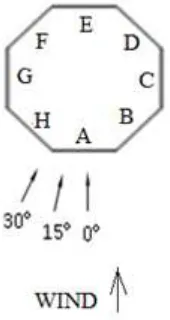
The wind pressure measurements are made by varying
wind deflection in clockwise direction with reference to 0º wind incidence flow at A is taken into account in all y = 1.8715ln(x) + 16.94
0 2 4 6 8 10 12 14 16 18 20 22
0 2 4
V
el
o
ci
ty
(m
/s
)
Height (m)
Velocity
International Journal of Engineering Trends and Technology (IJETT) – Volume 24 Number 4- June 2015
Fig. 5 Direction of incidence angle (wind flow) for Building
Models
The results are calculated as area weighted average of pressure coefficient Cp on each face. The reference velocity is taken as 15 m/s at the height of 500 mm from the base of the model.
A. Uniform Octagonal Plan Shape Building
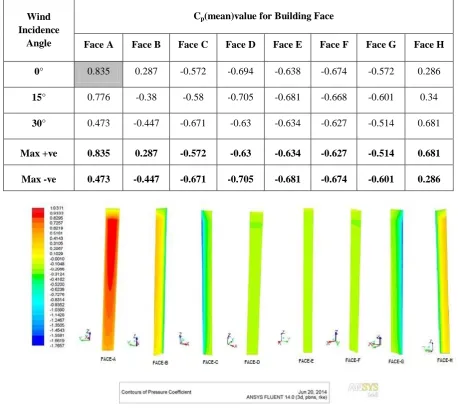
The building model with uniform octagonal plan shape was tested in the wind tunnel by S.K. Dalui (2008) to measure the wind pressure distribution on its surfaces under varying wind incidence angles. Table 1 depicts the variation of mean wind pressure coefficients on different faces of uniform octagonal building at different wind incidence angles.
Face A: It can be observed from Table 1 that at 0º wind
International Journal of Engineering Trends and Technology (IJETT) – Volume X Issue Y- Month 2013
TABLE 1
FACE AVERAGE CP (MEAN) CFD COMPUTED VALUES ON DIFFERENT FACES FOR VARIOUS WIND INCIDENCE ANGLES FOR OCTAGONAL BUILDING MODEL
Wind Incidence
Angle
Cp(mean)value for Building Face
Face A Face B Face C Face D Face E Face F Face G Face H
0° 0.835 0.287 -0.572 -0.694 -0.638 -0.674 -0.572 0.286
15° 0.776 -0.38 -0.58 -0.705 -0.681 -0.668 -0.601 0.34
30° 0.473 -0.447 -0.671 -0.63 -0.634 -0.627 -0.514 0.681
Max +ve 0.835 0.287 -0.572 -0.63 -0.634 -0.627 -0.514 0.681
Max -ve 0.473 -0.447 -0.671 -0.705 -0.681 -0.674 -0.601 0.286
Fig. 6 Contours of pressure coefficient at 0º wind
incidence for Face A to H
From Fig. 6 it can be observed that positive pressure on wind ward face increases from bottom to top edge of the face due to increase in wind velocity with height. Further it can also be seen that maximum positive pressure is observed along the centre line of the wind ward face and this pressure decreases towards the edges of the face.
Face B: From Table 1 at 0º wind incidence angle Face B
suction from 15º wind incidence angle to 30º wind incidence angle variation is very less i.e. from -0.38 to -0.447 respectively.
Face C: It can be observed from Table 1 that at all the wind
incidence angles i.e. 0º, 15º and 30º this face experience suction and suction value keep on increasing with increase in wind incidence angle. This face is sideward face at 0º wind incidence angle and it become inclined leeward at 15º and 30º wind incidence angles.
Face D: It can be observed from Table 1 that at all the wind
International Journal of Engineering Trends and Technology (IJETT) – Volume X Issue Y- Month 2013
inclined leeward faces. Positive pressure decreases from wind ward edge to leeward edge. For Face E at all the wind incidence angles i.e. 0º, 15º and 30º this face experience suction. For this leeward face maximum suction of -0.681 occurs at 15º wind incidence angle. For 0º and 30º wind incidence angle suction is almost same at both the incidence angles.
Face F: For 0º wind incidence angle this face experience the
same suction as face D faces. For other angles its value are different from face D. It can be observed from Table 1 that at all the wind incidence angles i.e. 0º, 15º and 30º this face experience suction. For this inclined leeward face maximum suction occurs at 0ºand minimum suction occurs at 30º wind incidence angle.
Face G: It can be observed from Table 1 that at all the wind
incidence angles i.e. 0º, 15º and 30º this face experience suction and suction value keep on decreasing with increase in
wind incidence angle. This face is sideward face at 0º wind incidence angle and it become inclined windward at 15º and 30º wind incidence angles. Minimum suction value i.e. -0.672 occurs at 30º wind incidence angle.
Face H: At 0º wind incidence angle face H experience
positive pressure but its value is much less than that at face A. Suction goes on increasing from windward side to leeward side. With increase in wind incidence angle this face becomes from inclined windward to windward face. Hence with increase in wind incidence angle (i.e. from 0º to 15º, 15º to 30º) pressure coefficient values for this face goes on increasing. Minimum and maximum mean Cp values for this face are 0.286 and 0.681 at 0º and 30º respectively.
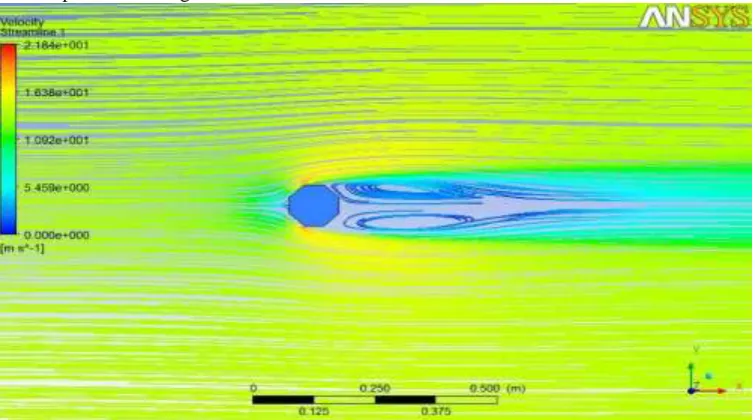
Velocity vector field: Velocity vector field as obtained
for octagonal tall building is shown in Fig 7. It shows vortices are formed behind face D
Fig. 7 Velocity vector field for octagonal building at 0º wind
incidence angle
VI. CONCLUSION
From the study carried out the following broad conclusions are arrived. Computational Fluid Dynamics (CFD) offers to be a suitable alternative to predict the wind related phenomena on buildings and other different kind of structures. Visualisation of boundary layer separation can be observed accurately with the help of CFD simulation.
The pressure values, flow streamline, velocity vector and numbers of related parameter variables etc. through the model surface can be determined with the help of CFD analysis.
The accuracy of results depends upon meshing of the geometry model and defining the physical property values exactly as the realistic environment conditions.
The study of boundary layer separation and wake formation can be studied easily with the help of CFD simulations and mitigation measures to counter the effects due to vortex shedding can be applied accordingly.
REFERENCES
[1] ANSYS Ltd., 2010. Ansys Fluent solver, Release 14.0.0: Theory. Canonsburg.
[2] Ansys tutorial manuals, Release 14.0.0.
[3] ASCE 7-95 Standard, minimum design load for buildings and other structures, New York, 1995.
[4] Australian standard AS: 1170 Part 2, 1975
International Journal of Engineering Trends and Technology (IJETT) – Volume X Issue Y- Month 2013
[6] B. Blocken, J. Carmeliet, , T. Stathopoulos, "CFD evaluation of wind speed conditions in passages between parallel buildings – effect of wall-function roughness modifications for the atmospheric boundary layer flow", Journal of Wind Engineering and Industrial Aerodynamics, Volume 95, Issues 9–11, Pages 941-962. 2007a.
[7] B. Blocken, J. Carmeliet, T. Stathopoulos, “CFD simulation of the atmospheric boundary layer: wall function problems”, Atmospheric Environment, 41, 238–252. 2007b.
[8] B.J. Vickery, "Wind loads on low rise buildings", drc, seminar, Darwin, Australia, 30 march, 1976.
[9] B.L. Sharma, & U.N .Sehgal, Study of exterme winds over North India. Indian Journal of met. andgeophysies. Vol. 19. 1968. [10] Code of practice for design loads (other than Earthquake forces)
for buildings and structures IS 875-1987 part 3 wind load Bureau Indian Standard New Delhi.
[11] E. Jack. Cermark., wind tunnel studies of building and structures. ASCE publications. 1998.
[12] Explanatory Handbook On Indian Standard Code Of Practice For Design Loads (Other Than Earthquake) For Buildings And Structures Part 3 Wind Loads [Is 875 (Part 3): 1987]
[13] H.C. Shellard, The estimation of design wind speeds. Proc. of conference on Wind Effects on Buildings & Structure, NPL, Middlesex. 1963.
[14] Hideyuki Tanaka, Yukio Tamura, Kazuo Ohtake, Masayoshi Nakai, Yong Chul Kim. ''Experimental investigation of aerodynamic forces and wind pressures acting on tall buildings with various unconventional configurations''. J. Wind Eng. Ind. Aerodyn. 107–108 (2012) 179–191, 2012
[15] http://www.grc.nasa.gov/www/wind/valid/tutorial/spatconv.html [16] Kim Young-Moon, You Ki-Pyo, Nag-HoKo. Across-wind
responses of an aeroelastic tapered tall building. Journal of Wind Engineering and Industrial Aerodynamics 96 (2008) 1307–1319. 2008.
[17] Kwok., "Effect of building shape on wind induced response of tall buildings," Proceedings, 7th Int. Conf. on wind engineering, Aachen, West Germany, 1987.
[18] M. Sanayei, L. Edgers, J.L. Alonge, and P. Kirshen, , “Effects of increased wind loads on a tall building,” civil engineering practice, vol. 19, no. 1, 2004.
[19] P. Mendis, T. Ngo, N. Haritos, A. Hira “Wind loading on tall buildings.” 2007.
[20] P.J. Richards, R.P. Hoxey, Appropriate boundary conditions for computational wind engineering models using the k-ε turbulence
model. Journal of Wind Engineering and Industrial Aerodynamics 46&47, 145-153. 1993.
[21] Peterka and Cermak, "Aerodynamics of bluff bodies", Journal fluid mechanics, vol.5, 1975.
[22] Revuz ., On the domain size for the steady-state CFD modelling of a tall building.Wind and structures, Vol. 15, No. 4 (2012) 313-329. 2012
[23] S.K. Dalui " Wind effects on tall buildings with peculiar shapes " , PhD. Thesis, Dept. of Civil Engineering, I.I.T. Roorkee, Roorkee, India. (2008).
[24] S.K. Verma “Wind effects on structurally coupled buildings”, PhD. Thesis, Dept. of Civil Engineering, I.I.T. Roorkee, Roorkee, India. (2009).
[25] S.K. Verma, A.K. Ahuja and A.D. Pandey “Effects of wind incidence angle on wind pressure distribution on square plan tall buildings” J. Acad. Indus. Res. Vol. 1(12) May 2013 pp 747-752 [26] T. Stathopoulos and B.A . Baskaran. “Computer simulation of
wind environmental conditions around buildings”, Engineering Structures, 18, pp. 876-885. 1996