1
Combining trait models of impulsivity to improve explanation of substance use behaviour
Kaidy Stautz, Linda Dinc, Andrew J Cooper Goldsmiths, University of London
Author Note
Kaidy Stautz, Linda Dinc, Andrew J Cooper, Department of Psychology, Goldsmiths, University of London, New Cross, SE14 6NW, United Kingdom.
Kaidy Stautz is now at: Behaviour and Health Research Unit, Institute of Public Health, University of Cambridge, Cambridge CB2 0SR, United Kingdom.
2 Abstract
The UPPS-P model of impulsivity (Whiteside & Lynam, 2001) is gaining popularity among personality and substance use researchers, but questions remain as to whether its five facets have incremental validity in explaining substance use over a more parsimonious model specifying only two facets: reward drive and rash impulsiveness. In three cross-sectional studies (total N = 486), we investigated whether the novel components of the UPPS-P model (negative urgency, positive urgency, lack of perseverance) predicted typical and problematic alcohol and cannabis use after accounting for reward drive, rash impulsiveness, and trait neuroticism (assessed with the Eysenck Personality Questionnaire). Reward drive and rash impulsiveness scores were calculated using principal components analysis of multiple scales, including UPPS-P premeditation and sensation seeking. Results showed that rash
impulsiveness was a robust predictor of typical and problematic substance use. The novel facets of the UPPS-P did not improve prediction of typical substance use. The urgency scales inconsistently predicted problematic use. Specifically, negative urgency predicted one of three measures of negative consequences from alcohol use, and positive urgency only predicted negative consequences from cannabis use. Results suggest that the three novel facets of the UPPS-P model add little over a two component model in explaining substance use, though may provide preliminary evidence for the utility of a revised global urgency construct in explaining problematic substance use.
3
Combining trait models of impulsivity to improve explanation of substance use behaviour
It is now widely recognised that personality traits play an important role in risk for problematic substance use and the development of substance use disorders. Traits related to the broad domain of impulsivity, whether measured via self-report questionnaire or
behavioural task, appear to be particularly important as predictors of substance use and related problems (Birkley & Smith, 2011; de Wit, 2009; Dawe, Gullo, & Loxton, 2004; Dawe and Loxton, 2004; Verdejo-Garcia, Lawrence, & Clark, 2008). Impulsivity is a
multidimensional construct, comprising several distinct facets that are typically moderately correlated with each other (Sharma, Markon, & Clark, 2014). Given this multidimensionality, a key question is the degree to which different facets of trait impulsivity are associated with substance use and related problems.
Two components of impulsivity: reward drive and rash impulsiveness
Two component (or dual-process) models have been relatively prominent in the literature seeking to relate impulsivity-related personality traits to substance use. Dawe and Loxton (2004) proposed that impulsivity comprised two components, named reward drive and rash impulsiveness. Reward drive reflects one’s motivation towards, and sensitivity to, rewarding stimuli in the environment. Rash impulsiveness reflects one’s inability to inhibit or modify prepotent approach responses to internal and external stimuli, and to consider the consequences of one’s actions. These two factors, which show a small positive association (Gullo, Ward, Dawe, Powell, & Jackson, 2011), have been incorporated into the
4
stronger incentive sensitisation effects following use. Individuals higher in rash
impulsiveness will find it more difficult to inhibit approach motivation towards substances despite the negative consequences that may ensue. Importantly, reward drive and rash
impulsiveness are anchored to distinct neurobiological processes, with reward drive reflecting functioning of the mesolimbic dopamine system and rash impulsiveness a marker of activity in the orbitofrontal cortex and anterior cingulate cortex. A broad literature links activity in these brain areas to substance use and addictive behaviour (e.g. Goldstein & Volkow, 2011; Pierce & Kumaresan, 2006). Reward drive and rash impulsiveness have been measured at the trait level using a diverse range of scales, and as yet there is no agreed upon single measure of the two components (see Stautz & Cooper, 2013). Evidence supports the 2-CARS model in relation to substance use (e.g. Gullo et al., 2011). Reward drive has been shown to predict future alcohol consumption among college students (Wray, Simons, Dvorak, 2011), and increases in reward drive predict alcohol use frequency and substance use initiation over two years in adolescents (Uroševićá et al., 2015). Measures of rash impulsiveness predict the onset of substance use disorders over six years (Sher, Bartholow, & Wood, 2000). Whilst reward drive typically shows weaker relationships with substance use than rash
impulsiveness, it is consistently associated with substance-related processes such as craving, cue reactivity, and alcohol approach bias (see Dawe & Loxton, 2004, for a review).
Five components of impulsivity: the UPPS-P framework
5
structure comprised of factors for urgency, (lack of) premeditation, (lack of) perseverance, and sensation-seeking. Whiteside and Lynam (2001) used the results of these analyses to develop a novel measure of these four facets of impulsivity, the UPPS Impulsive Behaviour Scale. The Five Factor Model of personality was used to anchor these impulsivity factors within the broader personality trait framework.
In relation to the two component model, lack of premeditation conceptually aligns with rash impulsiveness in that it reflects a reduced capacity to consider the consequences of one’s behaviour. Whilst measures representing reward drive were not included in Whiteside and Lynam’s factor analysis, UPPS sensation seeking appears to reflect an amalgam of reward drive and more general disinhibition in that it reflects an impulsive motivation for new rewarding experiences (Gullo, Loxton, & Dawe, 2014). However, factor analytic studies indicate that earlier measures of trait sensation seeking and novelty seeking load more
strongly onto a rash impulsiveness factor than a reward drive factor (Dawe & Loxton, 2004). There is also evidence that a separate reward drive variable accounts for unique variance in delinquent behaviour, including substance use, over the UPPS scales (Carlson, Pritchard, & Dominelli, 2013). Perseverance and urgency are arguably more novel factors (Whiteside & Lynam, 2001). Perseverance refers to the ability of an individual to remain focused on a task that is perceived as boring or repetitive, while urgency refers to the tendency to engage in risky and disinhibited behaviour when in a heightened emotional state.
6
behaviours now typically employ the expanded scale and measure both negative and positive urgency (e.g. Adams, Kaiser, Lynam, Charnigo, & Milich, 2012; Coskunpinar & Cyders, 2012; Curcio & George, 2011; Simons, Dvorak, Batien, & Wray, 2010).
Urgency scales: particularly relevant for explaining substance use?
The UPPS-P model has been widely used as a framework in empirical studies and meta-analytic reviews that consider the extent to which impulsivity-related traits relate to substance use and its consequences (e.g. Carlson et al., 2013; Coskunpinar, Dir & Cyders, 2013; Curcio & George, 2011; Cyders, Flory, Rainer, & Smith, 2009; Dinc & Cooper, 2015; Stautz & Cooper, 2013, 2014; Zapolski, Cyders & Smith, 2009). From these studies, the urgency scales appear to be especially relevant for substance use, and particularly so for problematic engagement with substances. Two meta-analytic reviews of the link between impulsivity-related traits and alcohol use have shown moderate positive relationships between the urgency scales and typical alcohol use and stronger positive relationships between the urgency scales and alcohol problems, relative to other scales in the UPPS-P model (Coskunpinar et al., 2013; Stautz & Cooper, 2013). The urgency scales have been shown to relate more strongly with substance use problems than typical use in cross-sectional studies (e.g. Adams et al., 2012; Stautz & Cooper, 2014), and prospective studies (e.g.
Cyders, et al., 2009; Zapolski et al., 2009), as well as potentiating the relationship between affective states and substance use (e.g. Cyders et al., 2010; Dinc & Cooper, 2015).
7
Smith, 2010). Another possibility is that high urgency individuals are more likely to use substances when they are already in emotional and behavioural states conducive to further risky behaviour, thus exacerbating the risk of negative consequences (Simons et al., 2010). Regarding the distinction between negative and positive urgency, these traits are highly related conceptually and there is currently limited, mixed evidence regarding the degree to which they uniquely explain or predict problematic substance when analysed together, or indeed why this should be the case theoretically.
Are five components needed?
In a recent wide-ranging critical review of the UPPS-P model, Gullo et al., 2014 questioned the utility of the model with regards to substance use, relative to two-component models. These authors criticised the UPPS-P on several grounds, including: the reliance on factor analyses of self-report inventories to derive the model, the lack of evidence regarding the incremental validity of the UPPS-P traits in predicting substance use and
related-problems, the relatively weak delineation and evidence for the neurocognitive bases of the UPPS-P model relative to two-component models, and the lack of theoretical integration of the UPPS-P model with existing work on the neurophysiological and behavioural bases of substance use and addiction.
8
UPPS-P subscales tend to show moderate to large associations with each other and at times indistinguishable patterns of association with outcome variables. For example, lack of premeditation has been found to correlate with positive urgency at over .40 in multiple studies (Carlson et al., 2013; Stautz & Cooper, 2014; Stojek & Fischer, 2013). In a meta-analytic review, Berg, Latzman, Bliwise, and Lilienfeld (2015) found that two pairs of UPPS-P scales (lack of premeditation and lack of perseverance, and negative and positive urgency) showed highly similar patterns of correlations with multiple aspects of psychopathology. Whilst this is consistent with a view that the five UPPS-P traits are subscale measures of three higher order processes reflecting deficits in conscientiousness, sensation seeking, and emotion-based impulsivity (Birkley & Smith, 2011), it also indicates that distinctions
between the five scales may be too narrow to warrant their use as discrete predictor variables. Regarding substance use specifically, it is notable that whilst perseverance shows positive associations with measures of alcohol use (Coskunpinar et al., 2013, Stautz & Cooper, 2013), these associations often drop out when other impulsivity-related traits are accounted for (e.g. Cyders et al., 2009).
Gullo et al. (2014) reviewed the limited number of studies that have addressed the incremental validity of the UPPS-P scales in predicting substance use, and found that only premeditation and negative urgency consistently accounted for additional unique variance (see Table 2 in Gullo et al., 2014 for a full list and basic description of these studies). A subset of these studies included positive urgency, showing mixed evidence of positive urgency’s incremental validity in predicting drinking quantity and problems, and illegal substance use.
9
Gullo et al. (2014) also raise the important point that we need to consider if negative urgency, which reflects the tendency to engage in disinhibited behaviour when in negative mood states, accounts for any additional variance in predicting facets of substance use when controlling for both traits related to rash impulsiveness and trait negative emotionality (i.e. neuroticism). Cyders and Smith (2008) report evidence from numerous studies supporting the explanatory utility of the urgency scales over and above neuroticism. Negative urgency has been shown to predict multiple forms of psychopathology, including dysregulated eating, obsessional thinking, and depression when adjusting for neuroticism or other measures of negative affect (Anestis et al., 2009; Cougle, Timpano, & Goetz, 2012; Smith, Guller, & Zapolski, 2013). Given the conceptual overlap between the urgency traits and negative emotionality, surprisingly few studies have considered the extent to which these traits predict aspects of substance use when controlling for traits that represent propensity to experience negative affect. Pang, Farrahi, Glazier, Sussman, and Leventhal (2014) found that negative urgency significantly predicted lifetime use and age of first use of alcohol in an adolescent sample when controlling for depression, but they did not control for any of the other UPPS-P traits in regression models. Similarly, Kaiser, Milich, Lynam, and Carnigo (2012) found that negative urgency significantly predicted a range of substance use outcomes in a college student sample, including weekly consumption of cannabis, alcohol, and cigarettes, and total AUDIT score, even when controlling for neuroticism and distress tolerance. They also did not, however, control for the other UPPS-P traits in this study. Gonzalez, Reynolds, and Skewes (2011) found that negative urgency significantly predicted alcohol-related problems when controlling for depressive symptoms and other UPPS traits, though not positive urgency or reward drive, in a college student sample.
10
found that a combined positive and negative urgency variable predicted cannabis-related problems, but not cannabis usage, in a sample of college students after controlling for positive and negative affect, emotional instability, distress tolerance, self-control (measured as an amalgam of premeditation and perseverance) and sensation-seeking. It is notable that the two urgency traits were combined in this study, so the relative utility of each trait could not be established.
Settles et al. (2012) examined the role of negative urgency in predicting externalizing behaviours while controlling for traits reflecting negative affect across three studies. In the first study they found that negative urgency significantly and positively predicted the number of alcohol dependence symptoms in a female adult sample after controlling for trait anxiety, depression and angry hostility. They did not, however, control for other UPPS-P traits. In the second study, they found that negative urgency significantly and positively predicted the presence of problem drinking and smoker status in a sample of older children after
controlling for premeditation, perseverance and negative affect. In a third study, they found that negative urgency significantly and positively predicted alcohol-related problems and the use of illicit substances in a college student sample, while controlling for premeditation, perseverance, and negative affect. Thus, there is some evidence to suggest that negative urgency remains a significant predictor of alcohol-related problems and illicit substance use when controlling for traits relevant to negative affect and rash impulsiveness. However, all three of the studies in Settles et al. (2012) did not include measures of sensation seeking or positive urgency, and all focused on substance use problems, and not levels of usage. Furthermore, neither Dvorak and Day (2014) nor Settles et al. (2012) controlled for traits related to reward drive.
11
To summarise, there are two divergent approaches to investigating relationships between impulsivity-related personality traits and substance use, and there is a dearth of research examining whether the UPPS-P scales add value in explaining substance use over a more parsimonious two factor model. Furthermore, whilst a number of studies have found the negative and positive urgency scales to explain or predict aspects of substance use, there is considerable overlap between these two scales as well as with other UPPS-P subscales, and between negative urgency and neuroticism.
Our aims are therefore: (i) to examine whether the novel components of the UPPS-P (negative urgency, positive urgency, and lack of perseverance) explain variance in alcohol and cannabis use and related problems over that explained by two components derived from measures reflecting reward drive and rash impulsiveness, including UPPS-P lack of
premeditation and sensation seeking; and (ii) to examine whether negative urgency and positive urgency both uniquely explain substance use when analysed together, after
12 Study 1
Method
Participants and Procedure
The sample comprised 271 undergraduate students (208 female, 58 male, 5 did not report gender) aged 17-44 (M = 20.48, SD = 4.15), completing a psychology degree at a university in London, United Kingdom. Data on ethnicity and socioeconomic characteristics were not collected. Participants completed a pen and paper questionnaire battery in a lecture theatre, and received course credit for their time. The study was approved by the Goldsmiths, University of London Ethics Committee.
Measures
Demographics. Participants self-reported their age and gender. These variables were used as covariates in regression models due to their associations with certain impulsivity-related traits and with substance use, both of which tend to be more pronounced in males than females and in younger compared to older adults (Chen & Jacobson, 2012; Cross, Copping, & Campbell, 2011).
Personality. The UPPS-P Impulsive Behaviour Scale (Lynam, Smith, Whiteside, & Cyders, 2006) is a 59 item measure that assesses five facets of impulsivity: lack of
premeditation, lack of perseverance, sensation seeking, negative urgency, and positive urgency. Items are measured on a four point Likert-type scale. Facet scores were coded as a continuous score representing mean score per item, with higher values reflecting higher impulsivity.
The Behavioural Activation System scale (BAS; Carver & White, 1994) was used to assess traits related to reward sensitivity. There are three subscales: Drive reflects the
13
Reward Responsiveness reflects the tendency to respond positively to the anticipation or occurrence of reward. Items are measured on a four point Likert-type scale. Previous evidence shows that the Drive and Reward Responsiveness traits load on one latent trait, whilst Fun Seeking loads separately, reflecting the distinction between reward drive and rash impulsiveness (Smillie, Jackson, & Dalgleish, 2006).
The revised Eysenck Personality Questionnaire (EPQ-R; Eysenck, Eysenck, & Barrett, 1985) was used to assess extraversion, psychoticism, and neuroticism. EPQ extraversion has been shown to correlate with both reward drive and rash impulsiveness whilst EPQ psychoticism scale has been linked with rash impulsiveness (Franken & Muris, 2006; Heym & Lawrence, 2010), indicating that these scales may reflect the two impulsivity-related components to some degree. The EPQ-R is a 100 item scale with a yes/no response format. One item from the psychoticism scale that specifically pertained to substance use (“Would you take drugs which may have strange or dangerous effects”) was removed before analysis. Responses were summed to form a continuous score, with higher values reflecting higher levels of each trait.
Alcohol use. Alcohol consumption was measured using the Alcohol Use
Questionnaire (AUQ; Townshend & Duka, 2002), based on the timeline follow-back method. The AUQ consists of 12 items. Nine items require participants to indicate their typical
14
2.3 units. Secondly, a binge drinking score was calculated based on typical speed of drinking, the number of times a participant gets drunk and the percentage of time feeling drunk in the last six months (see Townshend and Duka, 2002, for more details on scoring the AUQ).
The Alcohol Use Disorders Identification Test (AUDIT; Babor, Higgins-Biddle, Saunders, & Monteiro, 2001) was used to assess problematic alcohol consumption. The AUDIT contains ten items. Scores are summed for a continuous total score. Higher scores reflect more hazardous and harmful use. The AUDIT demonstrates good psychometric properties (Reinert & Allen, 2002).
Results
Data Screening
Participants who failed to complete two or more scales (n = 7) were excluded from analysis. Three participants’ scores on the AUDIT and three other participants’ scores for binge drinking were outliers (z scores > 3.29) and were Winsorised. One further participant was a multivariate outlier and was also excluded, leaving a total sample of 263 for analysis. After exclusion, all variables had less than 5% missing values. The SPSS expectation maximisation algorithm was used to impute missing data.
Correlations and Variable Reduction
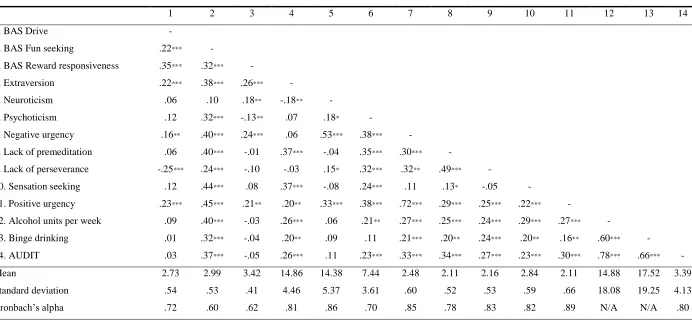
Pearson correlation coefficients between all trait measures and three aspects of alcohol use are presented in Table 1. Of note is the substantial positive correlation between negative and positive urgency (r = .72, p < .001), and the high correlation between
15
Trait scores related to reward drive and rash impulsiveness (BAS drive, fun seeking, and reward responsiveness, EPQ extraversion and psychoticism, and UPPS lack of
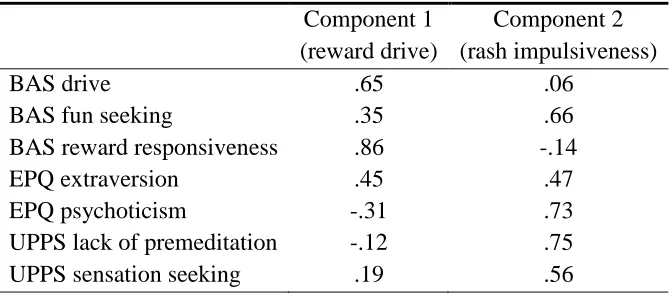
premeditation and sensation seeking) were submitted to principal components analysis with direct oblimin rotation, such that variance from each trait score could load onto multiple extracted components. Two components with an eigenvalue greater than 1 were extracted. The first component, accounting for 34.70% of the variance, reflected rash impulsiveness, with high loadings from lack of premeditation, psychoticism, and BAS fun seeking. The second component accounted for 19.43% of the variance and reflected reward drive, with high loadings from BAS drive and reward responsiveness (Table 2). The Pearson correlation between the two extracted components was r = .17, p = .005.
Testing Incremental Validity
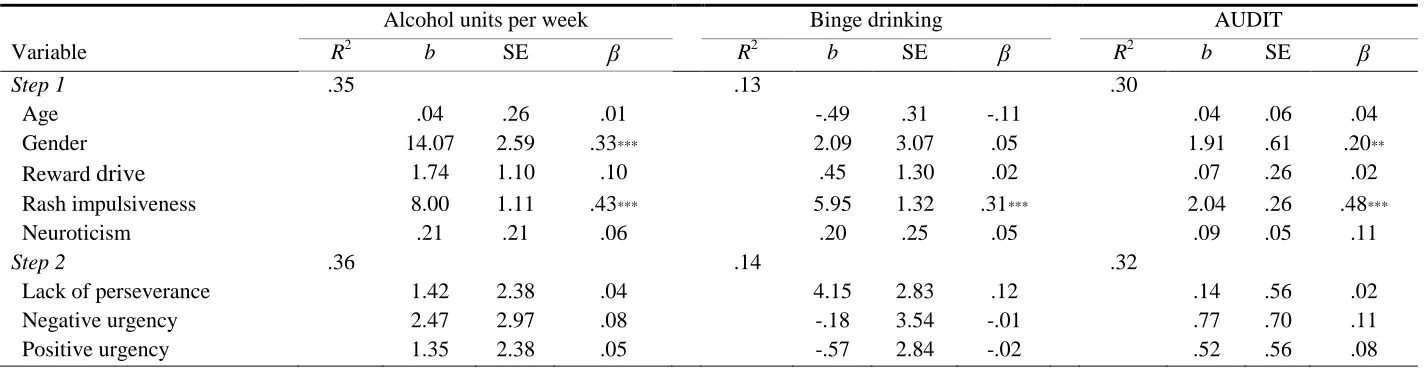
Three hierarchical multiple regression analyses were conducted with alcohol units per week, binge drinking, and AUDIT scores as criterion variables (Table 3). Sixty five
participants who scored zero on all three measures of alcohol use behaviour were considered non-drinkers and were not included in these analyses. At step 1 of the models, the reward sensitivity and rash impulsiveness components were entered along with age, gender, and EPQ neuroticism. At step 2, negative urgency, positive urgency, and lack of perseverance were added.
The regression model predicting alcohol units per week was significant at step 1, F(5, 191) = 20.22, p < .001. Male gender and rash impulsiveness were significant predictors. At step 2 there was not a significant improvement in predictive value, Fchange = 1.07, p = .36.
16
significant improvement in predictive value, Fchange = 0.73, p = .54. Negative urgency,
positive urgency, and lack of perseverance were not significant predictors.
The model predicting AUDIT scores was significant at step 1, F(5, 191) = 16.45, p < .001. Male gender and rash impulsiveness were significant predictors. At step 2 there was not a significant improvement in predictive value, Fchange = 1.78, p = .15. Negative urgency,
positive urgency, and lack of perseverance were not significant predictors.
Models were also tested without age and gender as covariates. There were no substantial changes to the pattern of results.
Study 2
Method
Participants
Data were collected as part of a study examining associations between personality, mood, and alcohol consumption. Further details on this study have been reported in a thesis (Stautz, 2013), but data from the present analysis have not been previously published. The sample comprised 100 undergraduate students (79 female, 21 male) with an age range of 18-21 (M = 19.12, SD = .90). Sixty one participants were recruited through a research
participation scheme and took part in exchange for course credit, and 39 participants were recruited through posters on university notice boards and paid £5. Participants were informed prior to taking part that the experiment would involve the consumption of alcoholic beer.
Procedure
The study was approved by the Goldsmiths, University of London Ethics Committee. Participants were tested individually (n=60) or in dyads with a friend (n=40). Two days prior to testing participants were asked to not consume any alcohol on the day of testing. A
17
detectable levels of alcohol. All participants gave written informed consent before completing a battery of questionnaires. They were then seated in a cubicle where they were presented with three 200ml measures of beer in clear plastic cups, along with a 200ml cup of tap water. The beer brands used were Fosters (4% alcohol by volume), Becks (5%), and Becks Blue, a non-alcoholic beer. Participants were not provided information about the beer brands or alcohol content. Beers were refrigerated prior to presentation. Participants were informed that the experiment required them to rate the three beers for pleasantness, strength of taste,
sweetness, and fizziness (adapted from Field & Eastwood, 2005) using a five point Likert-type response format. Participants were told that they would have ten minutes to complete this task and that they could consume as much or as little of the beer as they liked.
Participants tested in dyads could talk to each other during testing, but their cups were obscured from each other by an opaque barrier. The researcher monitored participants from outside the cubicle for the duration of the taste test. Following the taste test, participants were debriefed and given the opportunity to ask questions about the study. In this post-experiment interview, the majority of participants (n=82) reported that they were unaware that their consumption was being measured as part of the study.
Measures
Personality. Participants completed the UPPS-P Impulsive Behaviour Scale and the three BAS subscales, as in Study 1. They also completed the short form EPQ-R extraversion, neuroticism, and psychoticism scales (Eysenck et al., 1985). These abbreviated scales present 12 items per trait with a yes/no response format. One item from the psychoticism scale that directly addressed substance use was removed from analysis.
18
Alcohol Problem Index (RAPI; Neal, Corbin, & Fromme, 2006), a measure of negative consequences experienced when drinking during the past year. Each item on the RAPI has a four point response format ranging from 0 – None to 3 – Five or more times. Scores range from 0 to 54. Mean scores on these measures (Table 4) indicated that participants were, on average, relatively hazardous drinkers with a medium level of problematic use (Babor et al., 2001).
Results
No variables showed missing values greater than 5%. The SPSS expectation maximisation algorithm was used to impute missing data.
Participants’ mean amount of beer remaining was 408.60ml (SD = 138.95). Only three participants consumed all of the beer available. Beer remaining scores were
substantially negatively skewed (S = -1.22). Scores were reflected and square root
transformed. The resulting data showed a sufficient normal distribution (S = .37), with higher levels of this score representing more beer consumed.
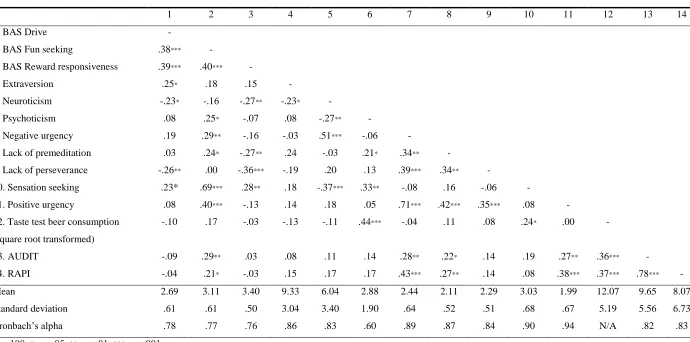
Table 4 presents Pearson correlation coefficients. Taste test beer consumption was significantly correlated with psychoticism (r = .44, p < .001) and sensation seeking (r = .24, p = .01). Consumption was significantly correlated with scores on the AUDIT (r = .36, p < .001) and RAPI (r = .37, p < .001), indicating that the taste test was a valid behavioural measure of alcohol consumption. Negative and positive urgency again showed a substantial positive association (r = .71, p < .001).
We used the same procedure as in Study 1a to produce two components representing reward drive (34.82% of variance in this sample) and rash impulsiveness (20.70% of
19
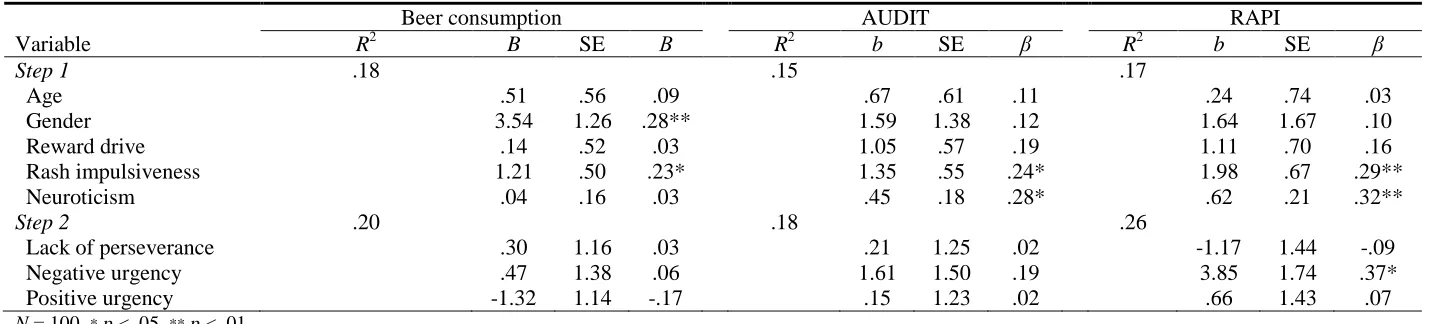
variables was identical to that described in Study 1. The model was significant at step 1, F(5, 94) = 4.16, p = .002. Male gender and rash impulsiveness were significant predictors. At step 2 there was not a significant improvement in predictive value, Fchange = .54, p = .66. Negative
urgency, positive urgency, and lack of perseverance were not significant predictors of beer consumption.
These models were then used to predict AUDIT and RAPI scores. The model predicting AUDIT scores was significant at step 1, F(5, 94) = 3.35, p = .009; as was the model predicting RAPI scores, F(5, 91) = 3.64, p =.005. Rash impulsiveness and neuroticism were significant predictors in both models. For the AUDIT model, the addition of negative urgency, positive urgency, and lack of perseverance at step 2 did not lead to significant improvements in predictive value (Fchange = 0.95, p = .42), and none of these traits were
significant predictors. For RAPI scores, there was a significant improvement at step 2 (Fchange
= 3.77, p = .013). Negative urgency significantly predicted RAPI scores, whilst positive urgency and lack of perseverance did not.
Models without age and gender included showed no substantial changes to the pattern of results.
Study 3
Method
Participants and Procedure
20
Committee. Participants were recruited using online message forums and through emails sent to six universities in London, and were offered entry into a £50 prize draw in return for participation. Measures were completed online through the Unipark/Questback website (http://www.unipark.org.uk). Participants completed a consent form before beginning the questionnaires, and were given the opportunity to email the researcher with any questions about the study.
Measures
Personality. Participants completed the UPPS-P Impulsive Behaviour Scale and the short form EPQ-R extraversion, neuroticism, and psychoticism scales.
Cannabis use. Lifetime cannabis use was assessed with the item “Have you ever smoked a cannabis cigarette?” with a binary yes/no response option. Cannabis use frequency in a typical month was assessed with the item “How often do you smoke cannabis?” Five response options were provided, ranging from Never (0) to 4 or more times per week (4). This item was adapted from the revised Cannabis Use Disorders Identification Test (CUDIT-R; Adamson et al., 2010). The item has previously been shown by to have good test-retest reliability (Spearman’s rho = .86) (Adamson et al., 2010), as well as high item-total
correlation with the full scale CUDIT-R (.82). Problematic cannabis use was assessed using an adapted 12 item version of the Cannabis Problems Questionnaire (Proudfoot et al., 2010). Respondents are asked to report (yes or no) whether they have experienced negative
21
excellent test-retest reliability (Copeland, Gilmour, Gates, & Swift, 2005; Proudfoot et al., 2010).
Data Analysis
Data were analysed using IBM SPSS version 21 and R version 3.0.0 with the pscl (Jackman, 2008; Zeileis, Kleiber, & Jackman, 2008) and VGAM (Yee, 2010) packages. All variables had less than 5% of missing values. Missing trait scores were imputed using expectation maximisation. An ordinal logistic regression model was used to predict cannabis use frequency scores. A hurdle regression model with truncated Poisson count distribution was used to predict problematic cannabis use scores. A hurdle model assumes that zero and non-zero values come from different data generating processes, with explanatory variables allowed to differently impact each stage. The first stage of the model is a logistic regression that tests the probability that the threshold (i.e. greater than zero) is crossed. The second stage models a truncated-at-zero distribution of positive integers. Hurdle models have previously been used to model similar relationships to those tested here (Dvorak & Day, 2014).
Continuous scores were standardised prior to regression analyses to aid interpretation. Entry of predictor variables was identical to Studies 1a and b. The Akaike Information Criterion (AIC) was used to assess model quality. When comparing two or more possible models, the model with the smallest AIC value is preferred.
Results
22
Males scored significantly higher than females on sensation seeking (males: M = 3.08, SD = .64; females: M = 2.78, SD = .55; t(113) = 2.44, p = .02) and on cannabis use frequency (males: M = 2.07, SD = 1.57; females: M = .84, SD = 1.26; t(113) = 3.87, p < .001). No other significant gender differences were found.
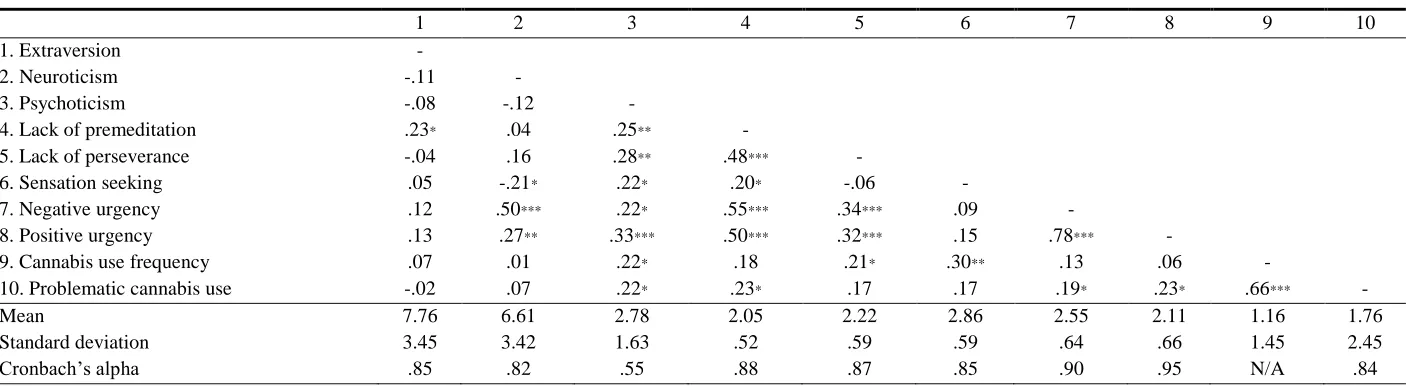
Bivariate correlations and descriptive statistics are presented in Table 6. Psychoticism was significantly correlated with all UPPS-P traits in this sample. Neuroticism showed
significant associations with both negative urgency (r = .50, p < .001) and positive urgency (r = .27, p = .004). Cannabis use frequency was significantly associated with psychoticism (r = .22, p = .02), lack of perseverance (r = .21, p = .02), and sensation seeking (r = .30, p = .001). Problematic cannabis use was significantly associated with psychoticism (r = .22, p = .02), lack of premeditation (r = .23, p = .01), negative urgency (r = .19, p = .04), and positive urgency (r = .23, p = .01).
Principal components analysis was conducted on four trait scores: EPQ extraversion and psychoticism, and UPPS lack of premeditation and sensation seeking. Two components were extracted, reflecting reward drive (36.68% of variance) and rash impulsiveness (27.67% of variance). The correlation between these components was r = .10, p = .30.
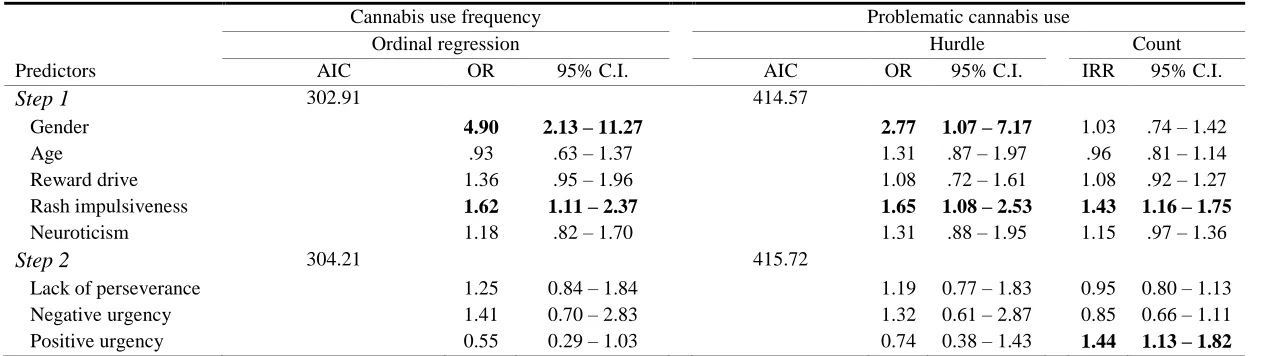
Table 7 presents results of regression analyses. At step 1 of the model predicting cannabis use frequency, male gender and rash impulsiveness were significant predictors. At step 2, model quality was reduced, and negative urgency, positive urgency, and lack of perseverance were not significant predictors. At step 1 of the model predicting problematic cannabis use, male gender and rash impulsiveness were significant predictors of scoring over zero in the hurdle portion of the model. In the count portion, rash impulsiveness was the only significant predictor of experiencing a greater number of negative consequences from
23
An additional analysis with gender and age not included produced highly similar results. Rash impulsiveness was an even stronger predictor of both cannabis use (odds ratio = 1.89, 95% confidence interval = 1.30, 2.75) and negative consequences (incident rate ratio = 1.44, 95% confidence interval = 1.18, 1.76) at step 1 of these models. Positive urgency remained a significant predictor of negative consequences (incident rate ratio = 1.43, 95% confidence interval = 1.13, 1.81).
Discussion
The UPPS-P model has been gaining traction in the personality and substance use literature as a framework to investigate impulsivity-related traits as predictors of substance use. It is important to consider the extent to which this model adds value to the more parsimonious two-component models that have also been used as a framework in this
literature (Gullo et al., 2014). Across three studies, we examined the extent to which negative urgency, positive urgency, and lack of perseverance from the UPPS-P explained variance in alcohol and cannabis use and problems when controlling for components reflecting rash impulsiveness and reward drive (calculated using scales including UPPS-P lack of
24
robust positive predictor of level of use and problems for both alcohol and cannabis. Reward drive did not significantly explain any substance use outcomes. This is line with the
observation that reward drive shows weaker cross-sectional associations with alcohol use and problems than other impulsivity-related traits in adolescent samples (Stautz & Cooper, 2013), and may indicate that individual differences in reward drive are not particularly relevant in explaining the measures of substance use employed here, or that there were limitations in our method of assessing reward drive. Alternatively, as noted by Gullo et al. (2011), this trait may be a better indicator of substance use related processes such as physiological responses to substances and craving. Concordant with previous research (see Gullo et al., 2014), lack of perseverance did not explain any substance use outcomes across the three studies.
25
heavy substance use (Gunn & Smith, 2010; Settles et al., 2012; Settles, Zapolski, & Smith, 2014; Stautz & Cooper, 2014). Clearly cross-sectional studies, such as the current study, cannot speak to the issue of temporal priority or causal direction in these relationships.
It is unclear why negative urgency was only associated with problematic alcohol use, albeit inconsistently, and positive urgency only with problematic cannabis use, though
previous studies have found positive urgency, and not negative urgency, to be associated with lifetime cannabis use and to predict increases in illegal drug use over one year (Robinson, Ladd, & Anderson, 2014; Zapolski et al., 2009). We are not aware of any theory that links either negative or positive urgency distinctly with problematic use of specific substances. Rather, they are both purported to confer risk for problematic use of any substances (Smith & Cyders, 2016).
The other novel component of the UPPS-P model, lack of perseverance, did not explain a significant amount of variance in any substance use outcome after other
impulsivity-related traits and neuroticism were taken into account. Whilst this scale may have utility in other contexts, results from the current studies confirm findings from Gullo et al. (2014) that lack of perseverance is not uniquely associated with any substance use outcomes. Researchers in this area may save test administration time in future studies by not including this scale.
26
findings as that reported in a recent meta-analytic review of UPPS-P scales and
psychopathology more broadly (Berg et al., 2015). The authors of that review concluded that “the close similarity in the correlational patterns of these subscales raises questions regarding their distinctiveness” (p. 1137). We concur, and suggest that more work is conducted to refine description and measurement of urgency, perhaps combining the negative and positive elements into a single scale of affect-based impulsivity, as some previous studies have done (Smith, Guller, & Zapolski, 2013; Stautz & Cooper, 2015). Given the potential utility of a general urgency measure, we support a three factor approach to measuring trait impulsivity such as that proposed by Sharma et al. (2014), with factors reflecting impulsive behaviour arising from: (i) reward drive/positive emotionality; (ii) rash impulsiveness/disinhibition; and (iii) urgency/negative emotionality. Findings from the current study and one previous
investigation (Sharma, Kohl, Morgan, & Clark, 2013) suggest that the urgency factor in this three factor framework is not associated with substance use per se, though may be associated with experiencing negative consequences from substance use.
Additionally, despite the modest evidence for the incremental validity of urgency, we would echo the concerns raised by Gullo et al (2014) around the degree to which urgency has been linked with neurobiological processes relevant to addiction. It is encouraging to see recent attempts to redress this, however, and more neuroimaging and neuropharmacological research examining the degree to which urgency is underpinned by relevant neurobiological processes would clearly be useful (Albein-Urios et al., 2013; Cyders et al., 2014; Muhlert & Lawrence, 2015). Studies examining the neurobiological bases of urgency while controlling for other relevant personality traits are particularly important.
27
The current study is the first, to our knowledge, to test the incremental validity of the novel components of the UPPS-P model in predicting substance use after accounting for traits reflecting reward drive, rash impulsiveness, and trait neuroticism. Furthermore, we examined two substances, one licit and one illicit, and two aspects of substance use – typical
consumption and problematic use.
Nevertheless, there are several limitations. Firstly, the data reported were cross-sectional, and so the direction of relations between impulsivity-related traits and substance use cannot be inferred. Secondly, the samples reported in the current studies were all drawn from undergraduate university students and were predominantly female, limiting the
generalizability of the results. Previous evidence suggests that associations between certain impulsivity-related traits and problematic alcohol use may be stronger in females (Stautz & Cooper, 2013). Third, the measures used to assess impulsivity in Study 3 were less
comprehensive than Studies 1 and 2. Specifically, our assessment of reward drive and rash impulsiveness was weaker in this study due to the BAS scales not being included. We also note that a number of measures, particularly EPQ psychoticism and BAS reward
responsiveness, showed weaker reliability throughout the three studies, limiting their potential association with other variables. Weak reliability of predictors caused by
measurement error can inflate Type I error rates in tests of incremental validity such as those used in the current study (Westfall & Yarkoni, 2016). Research with larger datasets (either from new studies or generated from evidence synthesis) that allow for more complex
28
was significantly positively correlated with the alcohol self-report measures in the same study, supporting its validity.
Conclusions
In conclusion, results from three studies suggest that the novel facets of the UPPS-P model of impulsivity do not explain additional variance in measures of alcohol and cannabis use over that explained by a two factor model of impulsivity plus neuroticism. Findings also provide modest evidence that urgency from the UPPS-P model explains additional variance in problematic substance use after controlling for rash impulsiveness, reward drive, and neuroticism. However, negative urgency predicted only one of three measures of problematic alcohol use, whilst trait positive urgency only predicted negative consequences from cannabis use, but not alcohol use. Rash impulsiveness, on the other hand, was a robust predictor of increased alcohol and cannabis use and related problems. Whilst the results from the current studies suggest there may be some utility in a global urgency construct in explaining
problematic substance use above and beyond the traits in two component models, Gullo et al. (2014) are certainly correct to note that much more empirical and theoretical work is needed to incorporate urgency within existing models of addictive behaviour, particularly those models with a well-established neurobiological grounding.
References
Adams, Z. W., Kaiser, A. J., Lynam, D. R., Charnigo, R. J., & Milich, R. (2012). Drinking motives as mediators of the impulsivity-substance use relation: Pathways for negative urgency, lack of premeditation, and sensation seeking. Addictive Behaviours, 37, 848– 855. doi:10.1016/j.addbeh.2012.03.016
29
Cannabis Use Disorders Identification Test-Revised (CUDIT-R). Drug and Alcohol Dependence, 110, 137-143. doi:10.1016/j.drugalcdep.2010.02.017
Albein-Urios, N., Verdejo-Román, J., Soriano-Mas, C., Asensio, S., Martínez-González, J.M., & Verdejo-García, A. (2013). Cocaine users with comorbid cluster B personality disorders show dysfunctional brain activation and connectivity in the emotional regulation networks during negative emotion maintenance and reappraisal. European Neuropsychopharmacology, 23, 1698–1707. doi:10.1016/j.euroneuro.2013.04.012 23712090
Anestis, M. D., Smith, A. R., Fink, E. L., & Joiner, T. E. (2009). Dysregulated eating and distress: Examining the specific role of negative urgency in a clinical sample. Cognitive Therapy and Research, 33, 390–397. doi:10.1007/s10608-008-9201-2
Babor, T. F., Higgins-Biddle, J. C., Saunders, J. B., & Monteiro, M. G. (2001). The alcohol use disorders identification test: Guidelines for use in primary care. Geneva,
Switzerland: World Health Organization.
Berg, J. M., Latzman, R. D., Bliwise, N. G., & Lilienfeld, S. O. (2015). Parsing the
heterogeneity of impulsivity: A meta-analytic review of the behavioural implications of the UPPS for psychopathology. Psychological Assessment, 27, 1129-1146.
doi:10.1037/pas0000111
Birkley, E. L., & Smith, G. T. (2011). Recent advances in understanding the personality underpinnings of impulsive behaviour and their role in risk for addictive behaviours. Current Drug Abuse Reviews, 4, 215–227.
Carlson, S.R., Pritchard, A.A., & Dominelli, R.M. (2013). Externalizing behaviour, the UPPS-P impulsive behaviour scale and reward and punishment sensitivity. Personality and Individual Differences, 54, 202–207. doi:10.1016/j.paid.2012.08.039
Carver, C. S., & White, T. L. (1994). Behavioural inhibition, behavioural activation and affective responses to impending reward and punishment: The BIS/BAS scales. Journal of Personality and Social Psychology, 67, 319–333. doi:10.1037/0022-3514.67.2.319 Chen, P., & Jacobson, K. C. (2012). Developmental trajectories of substance use from early
adolescence to young adulthood: gender and racial/ethnic differences. Journal of Adolescent Health, 50, 154-163. doi:10.1016/j.jadohealth.2011.05.013
Copeland, J., Gilmour, S., Gates, P., & Swift, W. (2005). The Cannabis Problems
30
Coskunpinar, A., & Cyders, M. A. (2012). Mediation–moderation analysis of problematic alcohol use: The roles of urgency, drinking motives, and risk/benefit perception. Addictive Behaviours, 37, 880-883. doi:10.1016/j.addbeh.2012.03.014
Coskunpinar, A., Dir, A. L., & Cyders, M. A. (2013). Multidimensionality in impulsivity and alcohol use: A meta-analysis using the UPPS model of impulsivity. Alcoholism: Clinical and Experimental Research, 37, 1441–1450. doi:10.1111/acer.12131
Cougle, J. R., Timpano, K. R., & Goetz, A. R. (2012). Exploring the unique and interactive roles of distress tolerance and negative urgency in obsessions. Personality and Individual Differences, 52, 515–520. doi:10.1016/j.paid.2011.11.017
Cross, C. P., Copping, L. T., & Campbell, A. (2011). Sex differences in impulsivity: A meta-analysis. Psychological Bulletin, 137, 97-130. doi:10.1037/a0021591
Curcio, A. L., & George, A. M. (2011). Selected impulsivity facets with alcohol
use/problems: The mediating role of drinking motives. Addictive Behaviours, 36, 959– 964. doi:10.1016/j.addbeh.2011.05.007
Cyders, M. A., Dzemidzic, M., Eiler, W. J., Coskunpinar, A., Karyadi, K., & Kareken, D. A. (2014). Negative urgency and ventromedial prefrontal cortex responses to alcohol cues: fMRI evidence of emotion-based impulsivity. Alcohol: Clinical and Experimental Research, 38, 409-417. doi:10.1111/acer.12266
Cyders, M. A., Flory, K., Rainer, S., & Smith, G. T. (2009). The role of personality
dispositions to risky behaviour in predicting first year college drinking. Addiction, 104, 193–202. doi:10.1111/j.1360-0443.2008.02434
Cyders, M. A., & Smith, G. T. (2008). Emotion-based dispositions to rash action: Positive and negative urgency. Psychological Bulletin, 134, 807–828. doi:10.1037/a0013341 Cyders, M. A., Smith, G. T., Spillane, N. S., Fischer, S., Annus, A. M., & Peterson, C.
(2007). Integration of impulsivity and positive mood to predict risky behaviour:
Development and validation of a measure of positive urgency. Psychological Assessment, 19, 107–118. doi:10.1037/1040-3590.19.1.107
Cyders, M. A, Zapolski, T. C. B., Combs, J. L., Settles, R. F., Fillmore, M. T., & Smith, G. T. (2010). Experimental effect of positive urgency on negative outcomes from risk taking and on increased alcohol consumption. Psychology of Addictive Behaviours, 24, 367–375. doi:10.1037/a0019494
31
Dawe, S., & Loxton, N. J. (2004). The role of impulsivity in the development of substance use and eating disorders. Neuroscience and Biobehavioural Reviews, 28, 343–351. doi:10.1016/j.neubiorev.2004.03.007
de Wit, H. (2009). Impulsivity as a determinant and consequence of drug use: A review of underlying processes. Addiction Biology, 14, 22–31. doi:10.1111/j.1369-1600.2008.00129 Dinc, L., & Cooper, A. J. (2015). Positive affective states and alcohol consumption: The
moderating role of trait positive urgency. Addictive Behaviours, 47, 17–21. doi:10.1016/j.addbeh.2015.03.014
Dvorak, R. D., & Day, A. M. (2014). Marijuana and self-regulation: Examining likelihood and intensity of use and problems. Addictive Behaviours, 39, 709–712.
doi:10.1016/j.addbeh.2013.11.001
Eysenck, S. B. G., Eysenck, H. J., & Barrett, P. (1985). A revised version of the psychoticism scale. Personality and Individual Differences, 6, 21–29.
doi:10.1016/0191-8869(85)90026-1
Field, M., & Eastwood, B. (2005). Experimental manipulation of attentional bias increases the motivation to drink alcohol. Psychopharmacology, 183, 350–357.
doi:10.1007/s00213-005-0202-5
Franken, I. H. A., & Muris, P. (2006). Gray’s impulsivity dimension: A distinction between reward sensitivity versus rash impulsiveness. Personality and Individual Differences, 40, 1337-1347. doi:10.1016/j.paid.2005.11.016
Goldstein, R. Z., & Volkow, N. D. (2011). Dysfunction of the prefrontal cortex in addiction: neuroimaging findings and clinical implications. Nature Reviews Neuroscience 12, 652-669. doi:10.1038/nrn3119
Gonzalez, V. M., Reynolds, B., & Skewes, M. C. (2011). Role of impulsivity in the relationship between depression and alcohol problems among emerging adult college drinkers. Experimental and Clinical Psychopharmacology, 19, 303–313.
doi:10.1037/a0022720
Gullo, M. J., Loxton, N. J., & Dawe, S. (2014). Impulsivity: Four ways five factors are not basic to addiction. Addictive Behaviours, 39, 1547–1556.
doi:10.1016/j.addbeh.2014.01.002
Gullo, M. J., & Dawe, S. (2008). Impulsivity and adolescent substance use: Rashly dismissed as “all-bad”? Neuroscience and Biobehavioural Reviews, 32, 1507–1518.
32
Gullo, M. J., Ward, E., Dawe, S., Powell, J., & Jackson, C. J. (2011). Support for a two-factor model of impulsivity and hazardous substance use in British and Australian young adults. Journal of Research in Personality, 45, 10–18. doi:10.1016/j.jrp.2010.11.002
Gunn, R. L., & Smith, G. T. (2010). Risk factors for elementary school drinking: Pubertal status, personality, and alcohol expectancies concurrently predict fifth grade alcohol consumption. Psychology of Addictive Behaviours, 24, 617–627. doi:10.1037/a0020334 Heym, N., & Lawrence, C. (2010). The role of Gray’s revised RST in the P–psychopathy
continuum: the relationships of Psychoticism with a lack of fear and anxiety, and increased impulsivity. Personality and Individual Differences, 49, 874-879. doi:10.1016/j.paid.2010.07.021
Jackman, S. (2008). pscl: Classes and methods for R developed in the Political Science Computational Laboratory, Stanford University. Department of Political Science, Stanford University, Stanford, CA. Retrieved from
http://CRAN.R-project.org/package/pscl
Kaiser, A. J., Milich, R., Lynam, D. R., & Charnigo, R. J. (2012). Negative urgency, distress tolerance, and substance abuse among college students. Addictive Behaviours, 37, 1075– 1083. doi:10.1016/j.addbeh.2012.04.017
Lynam, D.R., Smith, G.T., Whiteside, S.P., & Cyders, M.A. (2006). The UPPS-P: Assessing five personality pathways to impulsive behaviour. Unpublished technical report.
Muhlert, N., & Lawrence, A. D. (2015). Brain structure correlates of emotion-based rash impulsivity. Neuroimage, 115, 138–146. doi:10.1016/j.neuroimage.2015.04.061 Neal, D. J., Corbin, W. R., & Fromme, K. (2006). Measurement of alcohol-related
consequences among high school and college students: application of item response models to the Rutgers Alcohol Problem Index. Psychological Assessment, 18, 402–414. Pang, R. D., Farrahi, L., Glazier, S., Sussman, S., & Leventhal, A. M. (2014). Depressive
symptoms, negative urgency and substance use initiation in adolescents. Drug and Alcohol Dependence, 144, 225–230. doi:10.1016/j.drugalcdep.2014.09.771
Pierce, R. C., & Kumaresan, V. (2006). The mesolimbic dopamine system: The final common pathway for the reinforcing effect of drugs of abuse? Neuroscience & Biobehavioural Reviews, 30, 215-238. doi:10.1016/j.neubiorev.2005.04.016
33
Reinert, D. F., & Allen, J. P. (2002). The Alcohol Use Disorders Identification Test
(AUDIT): A review of recent research. Alcohol: Clinical and Experimental Research, 26, 272–279.
Robinson, J. M., Ladd, B. O., & Anderson, K. G. (2014). When you see it, let it be: Urgency, mindfulness and adolescent substance use. Addictive Behaviours, 39, 1038-1041.
doi:10.1016/j.addbeh.2014.02.011.
Settles, R. F., Cyders, M. A., & Smith, G. T. (2010). Longitudinal validation of the acquired preparedness model of drinking risk. Psychology of Addictive Behaviours, 24, 198-208. doi:10.1037/a0017631
Settles, R. F., Fischer, S., Cyders, M. A., Combs, J. L., Gunn, R. L., & Smith, G. T. (2012). Negative urgency: A personality predictor of externalizing behaviour characterized by neuroticism, low conscientiousness, and disagreeableness. Journal of Abnormal Psychology, 121, 160–172. doi:10.1037/a0024948
Sharma, L., Kohl, K., Morgan, T. A., & Clark, L. A. (2013). “Impulsivity”: relations between self-report and behaviour. Journal of Personality and Social Psychology, 104, 559-575. doi:10.1037/a0031181
Sharma, L., Markon, K. E., & Clark, L. A. (2014). Toward a theory of distinct types of "impulsive" behaviors: A meta-analysis of self-report and behavioural measures. Psychological Bulletin, 140, 374-408. doi:10.1037/a0034418
Sher, K. J., Bartholow, B. D., & Wood, M. D. (2000). Personality and substance use disorders: a prospective study. Journal of Consulting and Clinical Psychology, 68, 818-829. doi:10.1037/0022-006X.68.5.818
Simons, J. S., Dvorak, R. D., Batien, B. D., & Wray, T. B. (2010). Event-level associations between affect, alcohol intoxication, and acute dependence symptoms: Effects of urgency, self-control, and drinking experience. Addictive Behaviours, 35, 1045–1053. doi:10.1016/j.addbeh.2010.07.001
Smillie, L.D., Jackson, C.J. and Dalgleish, L.I. (2006) Conceptual distinctions between Carver and White's (1994) BAS scales: a reward-reactivity versus trait impulsivity perspective. Personality and Individual Differences, 40, 1039–1050.
doi:10.1016/j.paid.2005.10.012
34
Smith, G. T., Guller, L., & Zapolski, T. C. B. (2013). A comparison of two models of urgency: Urgency predicts both rash action and depression in youth. Clinical Psychological Science, 1, 266-275. doi:10.1177/2167702612470647
Stautz, K. (2013). Impulsivity, peer influence, and adolescent substance use (Unpublished doctoral thesis). Goldsmiths, University of London. Retrieved from:
http://research.gold.ac.uk/10158
Stautz, K., & Cooper, A. (2013). Impulsivity-related personality traits and adolescent alcohol use: A meta-analytic review. Clinical Psychology Review, 33, 574–592.
doi:10.1016/j.cpr.2013.03.003
Stautz, K., & Cooper, A. (2014). Urgency traits and problematic substance use in adolescence: Direct effects and moderation of perceived peer use. Psychology of Addictive Behaviours, 28, 487–497. doi:10.1037/a0034346
Stautz, K., & Cooper, A. (2015). Trait urgency and substance use decision making in adolescents and young adults: The role of socio-affective factors. Personality and Individual Differences, 81, 174-179. doi:10.1016/j.paid.2014.07.010
Stojek, M., & Fischer, S. (2013). Impulsivity and motivations to consume alcohol: a prospective study on risk of dependence in young adult women. Alcohol: Clinical and Experimental Research, 37, 292–299. doi:10.1111/j.1530-0277.2012.01875
Townshend, J. M., & Duka, T. (2002). Patterns of alcohol drinking in a population of young social drinkers: a comparison of questionnaire and diary measures. Alcohol and
Alcoholism, 37, 187–192.
Uroševićá, S., Collins, P., Muetzel, R., Schissel, A., Lim, K. O., & Luciana, M. (2015). Effects of reward sensitivity and regional brain volumes on substance use initiation in adolescence. Social Cognitive and Affective Neuroscience, 10, 106-113.
doi:10.1093/scan/nsu022
Verdejo-García, A., Lawrence, A. J., & Clark, L. (2008). Impulsivity as a vulnerability marker for substance-use disorders: Review of findings from high-risk research, problem gamblers and genetic association studies. Neuroscience and Biobehavioural Reviews, 32, 777–810. doi:10.1016/j.neubiorev.2007.11.003
Westfall, J., & Yarkoni, T. (2016). Statistically Controlling for Confounding Constructs Is Harder than You Think. PLoS ONE 11(3): e0152719. doi:10.1371/journal.pone.0152719 Whiteside, S. P., & Lynam, D. R. (2001). The five factor model and impulsivity: Using a
35
Wray, T. B., Simons, J. S., & Dvorak, R. D. (2011). Alcohol-related infractions among college students: Associations with subsequent drinking as a function of sensitivity to punishment. Psychology of Addictive Behaviours, 25, 352–357. doi:10.1037/a0023614 Yee, T. W. (2010). The VGAM package for categorical data analysis, Journal of Statistical
Software, 32, 1-34. Retrieved from http://www.jstatsoft.org/v32/i10/
Zapolski, T. C. B., Cyders, M. A., & Smith, G. T. (2009). Positive urgency predicts illegal drug use and risky sexual behaviour. Psychology of Addictive Behaviours, 23, 348–354. doi:10.1037/a0014684
36 Table 1
Descriptive statistics, reliability estimates, and bivariate correlations between traits and alcohol use measures (Study 1a)
1 2 3 4 5 6 7 8 9 10 11 12 13 14
1. BAS Drive -
2. BAS Fun seeking .22*** -
3. BAS Reward responsiveness .35*** .32*** -
4. Extraversion .22*** .38*** .26*** -
5. Neuroticism .06 .10 .18** -.18** -
6. Psychoticism .12 .32*** -.13** .07 .18* -
7. Negative urgency .16** .40*** .24*** .06 .53*** .38*** -
8. Lack of premeditation .06 .40*** -.01 .37*** -.04 .35*** .30*** -
9. Lack of perseverance -.25*** .24*** -.10 -.03 .15* .32*** .32** .49*** -
10. Sensation seeking .12 .44*** .08 .37*** -.08 .24*** .11 .13* -.05 -
11. Positive urgency .23*** .45*** .21** .20** .33*** .38*** .72*** .29*** .25*** .22*** -
12. Alcohol units per week .09 .40*** -.03 .26*** .06 .21** .27*** .25*** .24*** .29*** .27*** -
13. Binge drinking .01 .32*** -.04 .20** .09 .11 .21*** .20** .24*** .20** .16** .60*** -
14. AUDIT .03 .37*** -.05 .26*** .11 .23*** .33*** .34*** .27*** .23*** .30*** .78*** .66*** -
Mean 2.73 2.99 3.42 14.86 14.38 7.44 2.48 2.11 2.16 2.84 2.11 14.88 17.52 3.39
Standard deviation .54 .53 .41 4.46 5.37 3.61 .60 .52 .53 .59 .66 18.08 19.25 4.13
Cronbach’s alpha .72 .60 .62 .81 .86 .70 .85 .78 .83 .82 .89 N/A N/A .80
37 Table 2
Loadings of trait scores on two principal components Component 1
(reward drive)
Component 2 (rash impulsiveness)
BAS drive .65 .06
BAS fun seeking .35 .66
BAS reward responsiveness .86 -.14
EPQ extraversion .45 .47
EPQ psychoticism -.31 .73
UPPS lack of premeditation -.12 .75
38 Table 3
Hierarchical multiple regression models with alcohol consumption, binge drinking, and AUDIT scores as criterion variables
Alcohol units per week Binge drinking AUDIT
Variable R2 b SE β R2 b SE β R2 b SE β
Step 1 .35 .13 .30
Age .04 .26 .01 -.49 .31 -.11 .04 .06 .04
Gender 14.07 2.59 .33*** 2.09 3.07 .05 1.91 .61 .20**
Reward drive 1.74 1.10 .10 .45 1.30 .02 .07 .26 .02
Rash impulsiveness 8.00 1.11 .43*** 5.95 1.32 .31*** 2.04 .26 .48***
Neuroticism .21 .21 .06 .20 .25 .05 .09 .05 .11
Step 2 .36 .14 .32
Lack of perseverance 1.42 2.38 .04 4.15 2.83 .12 .14 .56 .02
Negative urgency 2.47 2.97 .08 -.18 3.54 -.01 .77 .70 .11
Positive urgency 1.35 2.38 .05 -.57 2.84 -.02 .52 .56 .08
39 Table 4
Descriptive statistics, reliability estimates, and bivariate correlations between traits and alcohol use measures (Study 2)
1 2 3 4 5 6 7 8 9 10 11 12 13 14
1. BAS Drive -
2. BAS Fun seeking .38*** -
3. BAS Reward responsiveness .39*** .40*** -
4. Extraversion .25* .18 .15 -
5. Neuroticism -.23* -.16 -.27** -.23* -
6. Psychoticism .08 .25* -.07 .08 -.27** -
7. Negative urgency .19 .29** -.16 -.03 .51*** -.06 -
8. Lack of premeditation .03 .24* -.27** .24 -.03 .21* .34** -
9. Lack of perseverance -.26** .00 -.36*** -.19 .20 .13 .39*** .34** -
10. Sensation seeking .23* .69*** .28** .18 -.37*** .33** -.08 .16 -.06 -
11. Positive urgency .08 .40*** -.13 .14 .18 .05 .71*** .42*** .35*** .08 -
12. Taste test beer consumption
(square root transformed)
-.10 .17 -.03 -.13 -.11 .44*** -.04 .11 .08 .24* .00 -
13. AUDIT -.09 .29** .03 .08 .11 .14 .28** .22* .14 .19 .27** .36*** -
14. RAPI -.04 .21* -.03 .15 .17 .17 .43*** .27** .14 .08 .38*** .37*** .78*** -
Mean 2.69 3.11 3.40 9.33 6.04 2.88 2.44 2.11 2.29 3.03 1.99 12.07 9.65 8.07
Standard deviation .61 .61 .50 3.04 3.40 1.90 .64 .52 .51 .68 .67 5.19 5.56 6.73
Cronbach’s alpha .78 .77 .76 .86 .83 .60 .89 .87 .84 .90 .94 N/A .82 .83
40 Table 5
Hierarchical multiple regression with taste test beer consumption, AUDIT, and RAPI scores as criterion variables
Beer consumption AUDIT RAPI
Variable R2 B SE Β R2 b SE β R2 b SE β
Step 1 .18 .15 .17
Age .51 .56 .09 .67 .61 .11 .24 .74 .03
Gender 3.54 1.26 .28** 1.59 1.38 .12 1.64 1.67 .10
Reward drive .14 .52 .03 1.05 .57 .19 1.11 .70 .16
Rash impulsiveness 1.21 .50 .23* 1.35 .55 .24* 1.98 .67 .29**
Neuroticism .04 .16 .03 .45 .18 .28* .62 .21 .32**
Step 2 .20 .18 .26
Lack of perseverance .30 1.16 .03 .21 1.25 .02 -1.17 1.44 -.09
Negative urgency .47 1.38 .06 1.61 1.50 .19 3.85 1.74 .37*
Positive urgency -1.32 1.14 -.17 .15 1.23 .02 .66 1.43 .07
41 Table 6
Descriptive statistics, reliability estimates, and bivariate correlations between traits and cannabis use measures
1 2 3 4 5 6 7 8 9 10
1. Extraversion -
2. Neuroticism -.11 -
3. Psychoticism -.08 -.12 -
4. Lack of premeditation .23* .04 .25** -
5. Lack of perseverance -.04 .16 .28** .48*** -
6. Sensation seeking .05 -.21* .22* .20* -.06 -
7. Negative urgency .12 .50*** .22* .55*** .34*** .09 -
8. Positive urgency .13 .27** .33*** .50*** .32*** .15 .78*** -
9. Cannabis use frequency .07 .01 .22* .18 .21* .30** .13 .06 -
10. Problematic cannabis use -.02 .07 .22* .23* .17 .17 .19* .23* .66*** -
Mean 7.76 6.61 2.78 2.05 2.22 2.86 2.55 2.11 1.16 1.76
Standard deviation 3.45 3.42 1.63 .52 .59 .59 .64 .66 1.45 2.45
Cronbach’s alpha .85 .82 .55 .88 .87 .85 .90 .95 N/A .84
42 Table 7
Regression models with cannabis use frequency and problematic use as criterion variables
Cannabis use frequency Problematic cannabis use
Ordinal regression Hurdle Count
Predictors AIC OR 95% C.I. AIC OR 95% C.I. IRR 95% C.I.
Step 1 302.91 414.57
Gender 4.90 2.13 – 11.27 2.77 1.07 – 7.17 1.03 .74 – 1.42
Age .93 .63 – 1.37 1.31 .87 – 1.97 .96 .81 – 1.14
Reward drive 1.36 .95 – 1.96 1.08 .72 – 1.61 1.08 .92 – 1.27
Rash impulsiveness 1.62 1.11 – 2.37 1.65 1.08 – 2.53 1.43 1.16 – 1.75
Neuroticism 1.18 .82 – 1.70 1.31 .88 – 1.95 1.15 .97 – 1.36
Step 2 304.21 415.72
Lack of perseverance 1.25 0.84 – 1.84 1.19 0.77 – 1.83 0.95 0.80 – 1.13
Negative urgency 1.41 0.70 – 2.83 1.32 0.61 – 2.87 0.85 0.66 – 1.11
Positive urgency 0.55 0.29 – 1.03 0.74 0.38 – 1.43 1.44 1.13 – 1.82