Article
1
A Generic Adaptive Fractal Filtering Algorithm
2
for Identifying Work Piece Defects on Multiple
3
Surfaces
4
Liang Gong 1*, Chenhui Lin1, Zhuang Mo 1, Xiaoye Shen1, Ke Lin1, Xiangpeng Liu1,
5
and Chengliang Liu1*
6
1 School of Mechanical Engineering, Shanghai Jiao Tong University, Shanghai 200240, China;
7
[email protected]; [email protected]; [email protected]; [email protected];
8
9
* Correspondence: [email protected] [email protected]; Tel.: +86-139-1837-6686
10
11
Featured Application: Detecting workpiece’s edge and surface defects in a noisy image.
12
Abstract: In addition to image filtering in the spatial and frequency domains, fractal characteristics
13
induced algorithms offers considerable flexibility in the design and implementations of image
14
processing solutions in areas such as image enhancement, image restoration, image data
15
compression and spectrum of applications of practical interests. Facing up to a real-world problem
16
of identifying workpiece surface defects, a generic adaptive fractal filtering algorithm is proposed,
17
which shows advantages on the problems of target recognition, feature extraction and image
18
denoising at multiple scales. First, we reveal the physical principles underlying between signal SNR
19
and its representative fractal dimension indicative parameters, validating that the fractal dimension
20
can be used to adaptively obtain the image features. Second, an adaptive fractal filtering algorithm
21
(Abbreviated as AFFA) is proposed according to the identified correlation between the image fractal
22
dimensions and the scales of objects, and it is verified by a benchmarking image processing case
23
study. Third, by using the proposed fractal filtering algorithm, surface defects on a flange workpiece
24
are identified. Compared to conventional image processing algorithms, the proposed algorithm
25
shows superior computing simplicity and better performance Numerical analysis and engineering
26
case studies show that the fractal dimension is eligible for deriving an adaptive filtering algorithm
27
for diverse-scale object identification, and the proposed AFFA is feasible for general application in
28
workpiece surface defect detection.
29
Keywords: Fractal dimension, surface defect identification, adaptive fractal filtering, edge
30
extraction, image denoising.
31
32
1. Introduction
33
Surface defects on metal components are commonly under careful manual inspection in mass
34
production lines since they impact the normal operation of a mechanical system [1,2]. Compared to
35
detection methods such as electromagnet magnetization, eddy current testing, or to other methods
36
using instruments such as ultrasonic phased array, scanning microscope, thin film inductive
37
microsensor, infrared interferometry [3-8], image-based surface defect identification takes
38
advantages over its counterparts on accuracy, efficiency and noncontact measuring convenience.
39
However, it is still a challenge to inspect the defects using an automatic imaging system owing
40
to miscellaneous patterns of the defects, low contrast between the defect and background, the
41
existence of pseudo defects, as well as tiny workpiece surface defect detection problem such as small
42
cracks and scratches are not easily identified by the conventional algorithms [9-12]. For surface defect
43
(SIFT), Speeded Up Robust Features (SURF) and Local Binary Patterns (LBP) [13] and a novel
non-45
symmetry and anti-packing model (NAM) was proposed in [14].
46
In addition to image filtering in the spatial and frequency domains, fractal characteristics
47
induced algorithms offers considerable flexibility in the design and implementations of image
48
processing solutions.
49
Chen Moon and Guo Hongyang [15] designed their experiments in which the input signal of the
50
filter is divided into many frames containing the same number of sample points. The fractal
51
dimension of each frame will be used to determine the control parameters of the filter corresponding
52
to the frame. In other studies [16,17], the fractal dimension is used to effectively enhance the image
53
contour in the filtering algorithm. In [18], the impact response signal of fiber grating is processed by
54
fractal filter method. After fractal filtering, the signal purity of time domain impact energy signal is
55
increased, and the signal clutter caused by external interference factors are eliminated [13].
56
Although these works are inspiring, the parameter tuning is cumbersome for achieving
high-57
performance results and an adaptive algorithm is needed to compute the general and detailed
58
information of an image and automatically derives the filtering parameters according to the object
59
features.
60
The principal objective in this study is to simultaneously detect the work piece contour, segment
61
its surfaces along edges, identify the defects and filter the high-frequency noises. The difficulties arise
62
from the fact that all the sub-objectives do not abide by explicit patterns, herein under certain
63
circumstances part of them are paradox in conventional image processing algorithms. To tackle this
64
problem, an intuitive way is to mimic the attention mechanism during visual inspection by
65
recognizing the features at different scales in turn. Fortunately, the fractal dimension lend itself to
66
this computation. In this paper, a fractal dimension-based filtering algorithm is proposed by
67
leveraging the full-image complexity, self-similarity and different scale characteristics to recognize
68
the elements including the work piece contour, edges, defects, and noises. The proposed algorithm
69
evaluates the individual scale and morphological features for each element and constructs an
70
operator to associate the fractal dimension with image processing purposes. Hereby an adaptive
71
digital image filer is designed to simultaneously enhance the object features and suppress the noises,
72
which automatically identify the elements at different scale according to intrinsic metrics and
73
exempts from artificially tuning the filtering parameters.
74
Basically, the core problem for detecting subtle defects in images is to identify and recognize the
75
workpiece outlines, edges, surface defects, and noises with different spatial scales.
76
Taking flange image processing as an example, the workpieces, edges, surface defects and noises
77
have different fractal dimensions. For these feature dimensions, adjusting the parameters in the
78
fractal filter algorithm can achieve filtering or extracting the edges of the workpieces and surface
79
defects.
80
The paper is organized as follows. Section 2 gives the definition of fractal dimension of signals
81
and proves the fractal dimension is strongly related to the signal-to-noise ratio of signals. Section 3
82
gives the procedure of fractal filtering and shows the results of fractal filtering on two benchmark
83
datasets. Section 4 shows the application of the AFFA in a work piece surface defect identification
84
practice. Finally, a conclusion is drawn in section 5.
85
2. Fractal Dimension Relevant to Signal-to-noise Ratio
86
Fractal dimension is one of the intrinsic characteristics of signals. Through the mathematical
87
calculation and derivation, the fractal dimension calculation method of one-dimensional or even
88
multi-dimensional signals can be obtained. For solving the problem of whether the signal of a certain
89
signal-to-noise ratio can be processed by using fractal dimension-based filtering, it is necessary to
90
first demonstrate that there is a significant correlation between the fractal dimension and the
signal-91
to-noise ratio of the signal.
92
2.1 Calculation of Fractal Dimension
94
In these studies, the definition of fractal dimension can be described as follows [13,14],
95
D( )(∆) = x − x
(1)
D( )(2∆) = (max x , x , x − min {x , x , x }) /
(2)
N( )(Δ) = D( )(∆)/∆ (3)
N( )(2Δ) = D( )(2∆)/2∆ (4)
d ( )=logN
( )(Δ) − logN( )(2Δ)
log2 = 1 + log
D( )(Δ)
D( )(2Δ) (5)
Where k means the sequence number of the frame in the entire signal. N means the number of discrete
96
points in each frame. Δis the side length of the grid used to calculate the fractal dimension.
97
2.2 Relationship between Signal-to-Noise Ratio and Fractal Dimension
98
Take sine signal as an example. B.U. Heerdun and Feng Han [14] process the signal without
99
dividing it into frames. According to their settings, the input signal of the filter should be a combined
100
signal of sine wave and random noise,
101
f(t) = sin(t) + A ∗ (rand(1, length) − 0.5) (6) The results show that fractal dimensions vary with signal-to-noise ratio of the input signal (Table
102
1). More specifically, the fractal dimension increases when the noise level rises which implies that the
103
artificial thresholds in digital filter can be designed adaptively according to the fractal characteristics.
104
3. Image Processing Using Adaptive Fractal Filtering Algorithm(AFFA)
105
For identifying objects in an image, a fractal dimension is able to indicate the geometrical features
106
at different scales. Intuitively the outline of object, the texture, the local abnormality, and the noise
107
shows both diverse frequency-domain independence and scale variability. Meanwhile the fractal
108
dimension is invariant to image translation and rotation. According to these characteristics, an
109
adaptive fractal algorithm is proposed to deal with identifying objects with different scale and
110
patterns in an image.
111
3.1 The design of Fractal Filter in Image Processing
112
Step one, convert a picture to a grayscale image if necessary. Then change every pixel into
113
floating point number. Take every rows and columns of pixels as lines of one-dimensional data.
114
Calculate their average fractal dimension (Using equation 1-5), which will be regarded as the fractal
115
dimension of the whole image.
116
Step two, denote the image as 𝑓(𝑥 , 𝑦 ) for each pixel, and an adaptive filtering operator a is
117
constructed to represent the quantitative effect how the designated pixel affects its neighborhood and
118
the whole image.
119
𝑎 = (𝑚 − 𝑑) (7)
where d is the fractal dimension of a whole image and m, p are constants, According to Table 1, d
120
generally varies from 1.10 to 1.50 and the item “m-d” should be comparable to d. In most cases, set m
121
= 2.7 to fulfill the symmetry for d.
122
Table 1. Deterministic relationship between the fractal dimension and noise
123
A d(Test 1) d(Test 2) d(Test 3) Average d
The purpose of constructing “m-d” is to let this term be monotonically decreasing during the
125
span [1.10-1.50]. The corresponding physical meaning is that a lower SNR, stronger noise lead to a
126
greater value of d, and a decrease when d increases which can be interpreted as the filter needs to take
127
into more considerations of the overall information rather than the designated pixel. The value of p
128
is used to magnify the variation of the term “m-d” to enhance its discrimination, making it more
129
sensitive to the fractal dimension changes, and its empirical value of p is 6.
130
Accordingly, an adaptive fractal filter is designed as follows,
131
g(x , y ) = af(x , y ) +1 − a
3 g(x , y ) + g(x , y ) + g(x , y ) (8) Step three, subtract the former image 𝑓(𝑥 , 𝑦 ) from the processed image 𝑔(𝑥 , 𝑦 ), then change
132
it back to a grayscale image.
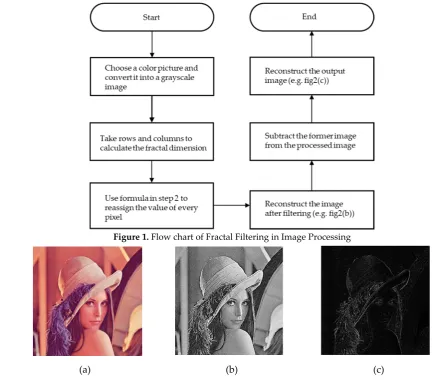
133
To show the procedure more clearly, generalize a flow diagram as in Figure.1.
134
3.2 Fractal Filtering Performance Benchmarking
135
Take the benchmark picture Lenna as the input and extract the edges of Lenna used the proposed
136
AFFA. It’s obvious that the edges are enhanced in the processing image 2(b) and reserve edges very
137
clearly in the final image 2(c).
138
In general, the proposed algorithm is adaptive to image features of different scales, it can
139
enhance the outlines to proper extent. This algorithm has a computational complexity of O(9N)
140
(where N is the total number of pixels).
141
Figure 1. Flow chart of Fractal Filtering in Image Processing
142
(a) (b) (c)
Figure 2. set m=2.7, p=6. (a) is an original LENA image.
4. Workpiece Surface Defect Identification with AFFA
144
As a detachable workpiece, the flange is widely used in the connection between the shaft end,
145
the pipe end and the equipment. The surface quality directly determines the mechanical strength and
146
sealing characteristics of the joint. The flange surface defects will cause equipment failure and device
147
failure. The flange production involves 7 kinds of machining processes, forming 14 profiles, which
148
are easy to cause plenty of surface flaws on each type of surface, and the inferior rate is nearly 10%.
149
Flange manufacturers use visual inspection to monitor product quality, work intensity is high,
150
detection efficiency is low, and accuracy is difficult to guarantee. The use of AFFA to process flange
151
images is the first step to detect flange defects.
152
4.1 Flange surface imaging and processing with AFFA
153
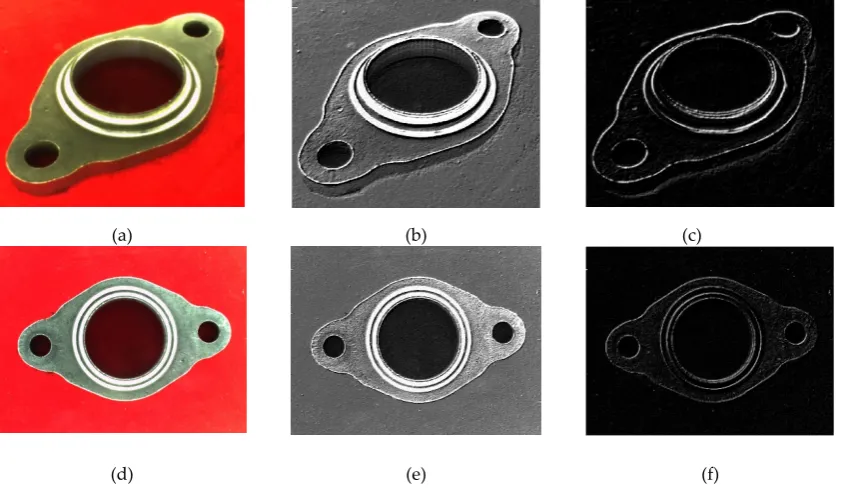
Take two flange images as example, the defects on the surface and edges of flanges are apparent.
154
Before applying AFFA, images are selected and cut. In the algorithm, it’s set to save the images after
155
filtering, which are enhanced on edges (figure3. b, e), and images after subtraction, which are the
156
conclusive results (figure3, c, f). Finally, it can export a process result (figure4). Usually the defects
157
end white dots on the surface.
158
(a) (b) (c)
(d) (e) (f)
Figure 3. Flange surface image processing by setting m=2.6, p=6.
159
162
(a) (b)
Figure 5. Flange image processed by traditional algorithm.
163
Table 2. UIQI of images processed by AFFA and Gauss filtering
164
AFFA Gauss Scoring Difference*
Fig3 (c) & Fig5 (a) 0.0406 0.0362 12.15% Fig3 (f) & Fig5 (b) 0.0356 0.0322 10.55%
*Scoring Difference = (Score of AFFA-Score of Gauss)/Score of AFFA
165
4.2 Comparison against Gaussian Filtering & Canny Edge Extraction Algorithm
166
To reflect the enhancement of AFFA compare to the traditional filtering algorithm, combine
167
Gaussian filtering algorithm with Canny operator to achieve the same goal that AFFA did.
168
Take an example of flange surface image process. It’s obvious that the results are obscure and
169
full of noise. Furthermore, it takes average 2.65 seconds using the traditional algorithm to process
170
one image, comparing to 1.63 seconds by AFFA.
171
To compare the results of the two algorithms more objectively, a universal image quality index
172
(UIQI) is adopted, which is independent of the contents and types of the image under test [19,20].
173
The observation condition or the quality measurement method of the individual observer has a strong
174
ability to reflect the loss of real information, so the UIQI quality index is selected to reflect the quality
175
of the processed image. The greater the value of the UIQI index, the higher the quality of the
176
processed image. Table 2 shows the scores of AFFA and Gauss filtering results for flanges with
177
different view angle.
178
For both cases, AFFA outperforms classic Gauss filtering algorithm by more than 10%, which
179
validates the adaptability of the proposed AFFA from computational complexity and accuracy
180
perspectives.
181
5. Conclusions
182
In this paper, a generic adaptive signal filtering algorithm is proposed, which automatically
183
profiles the elements with different scale and morphological features according to the fractal
184
dimension induced operator. In dealing with a work piece surface defect identification problem, the
185
proposed algorithm preserves the image contour, edges while eliminates the noises, showing a
186
superior performance and computational simplicity over conventional algorithms.
187
Inspired by human cognitive nature, the proposed AFFA can be applied to more extensive
188
applications. Although to an engineering end the proposed adaptive fractal filter is approximately
189
equal to a low-pass image filter in this paper, it stands to reason that by altering the structure in
190
Equation (8), the AFFA will be equivalent to low-pass, band-pass, or high-pass digital filter in its
191
result, which implies its feasibility and scalability in the digital signal processing field.
192
Author Contributions: L.G. conceived the fundamental idea and derived basic mathematical frame, C.H. Lin
194
and Z.M. conducted mathematical modeling and article writing. K.L. and Z.M. also completed the software
195
development. X. S. and X. L. finished the algorithm experimental verification. C.L. Liu supervised the whole
196
project.
197
Acknowledgments: The help of Yi Ju and Yuan Wei, in samples collection and software development is
198
gratefully acknowledged.
199
Funding: This study was supported by the Natural Scientific Foundation of China under Grant NO.11202125
200
and the Scientific Plan Project of Shanghai Science and Technology Committee under Grant NO. 16391903102.
201
Conflicts of Interest: The authors declare no conflict of interest.
202
References
204
1. Hasegawa, K.; Tamako, H.; Miyazaki, K. Allowable subsurface flaws located near vessel surface in JSME
205
code.Solid State Phenomena 2007, 120, 77-84, DOI: 10.4028/www.scientific.net/SSP.120.77.
206
2. Tao, X.; Zhang, Z.; Zhang, F.; Xu, D. A Novel and Effective Surface Flaw Inspection Instrument for
Large-207
Aperture Optical Elements. IEEE Transactions on Instrumentation and Measurement 2015, 64 (9), 2530-2540,
208
DOI: 10.1109/TIM.2015.2415092.
209
3. Gusev, A.P. Hysteresis of the magnetic field of surface flaws in different steels during magnetization with
210
an attachable electromagnet. Russian Journal of Nondestructive Testing 2015, 51 (10), 616-623, DOI:
211
10.1134/S1061830915100058.
212
4. Koliskina, V.; Kolyshkin, A. Mathematical model for eddy current testing of metal plates with two
213
cylindrical flaws. In Proceedings of the IEEE 15th International Conference on Environment and Electrical
214
Engineering, Rome, Italy, 10-13 June 2015, pp. 374-377, DOI: 10.1109/EEEIC.2015.7165190.
215
5. Guo, Z.; Zhang, D.; Tan, Y.; Shi, F.; Zhang, B.; Gong, J. Ultrasonic phased array on the inner surface of
216
circular stage for detecting the circumferential flaw in a pipe. In Proceedings of 2015 IEEE International
217
Ultrasonics Symposium, Taipei, China, October 24, 2015, DOI: 10.1109/ULTSYM.2015.0530.
218
6. Carlini, M.; Castellucci, S.; Allegrini, E.; Giannone, B.; Ferrelli, S.; Quadraroli, E.; Marcantoni, D.; Saurini,
219
M.T. Ceramic flaws: Laboratory tests and analysis using Scanning Electron Microscope to identify surface
220
defects. Journal of the European Ceramic Society 2014, 34 (11), 2655-2662, DOI:
221
10.1016/j.jeurceramsoc.2014.01.009.
222
7. Cha, Y.-J.; Kim, K.H.; Shon, J.-S.; Kim, Y.H.; Kim, J. Surface flaws detection using AC magnetic field sensing
223
by a thin film inductive microsensor. IEEE Transactions on Magnetics 2008, 44 (11 PART 2), 4022-4025, DOI:
224
10.1109/TMAG.2008.2002774.
225
8. Sinha, J.K.; Tippur, H.V; Infrared interferometry for rough surface measurements: Application to failure
226
characterization and flaw detection. Optical Engineering 1997, 36 (8), 2233-2239, DOI: 10.1117/1.601447.
227
9. Park, Y.; Kweon, I.S; Ambiguous Surface Defect Image Classification of AMOLED Displays in
228
Smartphones. IEEE Transactions on Industrial Informatics 2016, 12 (2), 597-607, DOI: 10.1109/TII.2016.2522191.
229
10. Win, M.; Bushroa, A.R.; Hassan, M.A.; Hilman, N.M.; Ide-Ektessabi, A. A contrast adjustment thresholding
230
method for surface defect detection based on mesoscopy. IEEE Transactions on Industrial Informatics 2015,
231
11 (3), 642-649, DOI: 10.1109/TII.2015.2417676.
232
11. Kunakornvong, P.; Sooraksa, P. A practical low-cost machine vision sensor system for defect classification
233
on air bearing surfaces. Sensors and Materials 2017, 29 (6), 629-644, DOI: 10.18494/SAM.2017.1484.
234
12. Liu, K.; Wang, H.; Chen, H.; Qu, E.; Tian, Y.; Sun, H. Steel Surface Defect Detection Using a New
Haar-235
Weibull-Variance Model in Unsupervised Manner. IEEE Transactions on Instrumentation and Measurement
236
2017, 66 (10), 2585-2596, DOI: 10.1109/TIM.2017.2712838.
237
13. Ke, X.; Yang, X.; Peng, Z.; Lei, W. Application of RNAMlet to surface defect identification of steels, Optics
238
and Lasers in Engineering 2018, 105, 110-117, ISSN:0143-8166.
239
14. Liu, Y.; Xu, K.; Wang, D. Online surface defect identification of cold rolled strips based on local binary
240
pattern and extreme learning machine Metals 2018, 8 (3), DOI: 10.3390/met8030197.
241
15. Chen, Y. L.; Guo, H. Y.; Journal of North University of China (Natural Science Edition) 2006, Vol.27 No.3,
272-242
275 (In Chinese).
243
16. Heerdun, B.; F. H. Progress in Geophysics 2008, Vol.23 No.2, 627-630 (In Chinese).
244
17. Paskac, M.P.; Reljin, B.D.; Reljin, I.S. Multifractal techniques for texture classification and image filtering.
245
In Proceedings of the 23rd Telecommunications Forum, Belgrade, Serbia, 24-26 November 2015, pp.
791-246
798, DOI: 10.1109/TELFOR.2015.7377585.
247
18. Jia, H.; Zeng, J.; Wang, K.; Guo, X.; Gong, X.; Yu, J.; Li, Y. Research on fiber optic impact load localization
248
based on honeycomb layout and fractal filtering principle. In Proceedings of SPIE - The International
249
Society for Optical Engineering, Beijing, China, 28-30 OCTOBER 2017, 10618, DOI: 10.1117/12.2295290.
250
19. Wang, Z.; Bovik, A.C. A universal image quality index. IEEE Signal Processing Letters 2002, 9 (3), 81-84, DOI:
251
10.1109/97.995823.
252
20. Biswas, S.; Ghoshal, D.; Hazra, R. A new algorithm of image segmentation using curve fitting based higher
253