S a u n d e r s , Fi o n a C., G al e, An d r e w W. a n d S h e r ry, An d r e w H .
( 2 0 1 6 ) R e s p o n d i n g t o p r oj e c t u n c e r t a i n ty: e vi d e n c e fo r h i g h
r e li a bility p r a c ti c e s in la r g e-s c al e s af e t y–c ri ti c al p r oj e c t s .
I n t e r n a ti o n al Jo u r n al of P r oj e c t M a n a g e m e n t , 3 4 ( 7). p p . 1 2 5
2-1 2 6 5 .
Do w n l o a d e d fr o m : h t t p ://i n si g h t . c u m b r i a . a c . u k /i d/ e p ri n t/ 5 1 6 2 /
U s a g e o f a n y i t e m s f r o m t h e U n i v e r s i t y o f C u m b r i a’ s i n s t i t u t i o n a l r e p o s i t o r y ‘I n s i g h t ’ m u s t c o n f o r m t o t h e f o l l o w i n g f a i r u s a g e g u i d e l i n e s .
Any it e m a n d it s a s s o ci a t e d m e t a d a t a h el d i n t h e U niv e r si ty of C u m b r i a ’s in s ti t u ti o n al r e p o si t o r y I n si g h t ( u nl e s s s t a t e d o t h e r wi s e o n t h e m e t a d a t a r e c o r d ) m a y b e c o pi e d , di s pl ay e d o r p e rf o r m e d , a n d s t o r e d i n li n e wi t h t h e JIS C f ai r d e a li n g g ui d eli n e s ( av ail a bl e h e r e) fo r e d u c a t i o n al a n d n o t-fo r-p r ofi t a c tiviti e s
p r o v i d e d t h a t
• t h e a u t h o r s , ti tl e a n d full bi blio g r a p h i c d e t ail s of t h e it e m a r e ci t e d cl e a rly w h e n a n y p a r t
of t h e w o r k is r ef e r r e d t o v e r b a lly o r i n t h e w ri t t e n fo r m
• a h y p e rli n k/ U RL t o t h e o ri gi n al I n si g h t r e c o r d of t h a t it e m is i n cl u d e d i n a n y ci t a ti o n s of t h e w o r k
• t h e c o n t e n t is n o t c h a n g e d i n a n y w a y
• all fil e s r e q ui r e d fo r u s a g e of t h e it e m a r e k e p t t o g e t h e r wi t h t h e m a i n it e m fil e.
Yo u m a y n o t
• s ell a n y p a r t of a n it e m
• r e f e r t o a n y p a r t of a n it e m wi t h o u t ci t a ti o n
• a m e n d a n y it e m o r c o n t e x t u ali s e it i n a w a y t h a t will i m p u g n t h e c r e a t o r ’s r e p u t a t i o n
• r e m ov e o r a l t e r t h e c o py ri g h t s t a t e m e n t o n a n it e m .
T h e full p oli cy c a n b e fo u n d h e r e.
Responding to project uncertainty: Evidence for high reliability practices in large-scale
safety-critical projects
Fiona C Saundersa1, Andrew W Galea and Andrew H Sherryb c
a School of Mechanical, Aerospace and Civil Engineering, The University of Manchester, Pariser Building,
Sackville Street, Manchester M13 9PL, United Kingdom
b Dalton Nuclear Institute, The University of Manchester, Pariser Building, Sackville Street, Manchester, M13 9PL, UK
c National Nuclear Laboratory, Chadwick House, Warrington Road, Birchwood Park, Warrington, WA3 6AE,
United Kingdom
Abstract
In large-scale safety-critical projects unforeseen events and uncertainties must be carefully managed
to safeguard the integrity of the end product and deliver projects to time and cost. Based on 47
‘vignettes’ of uncertainty across projects in two safety-critical sectors, this study provides an
empirical examination of whether practices consistent with theories of high reliability organising are
adopted by project managers as a response to project uncertainty. Our findings are that confronting
uncertainties in safety-critical projects does involve many high reliability practices. Respondents
expressed a sense of balancing competing demands, and provided evidence of learning, acting
mindfully, avoiding over-rigid processes, and of upholding constructive tensions, conceptual slack
and close interdisciplinary working.
However these practices are often fragile in nature and dependent on key individuals. There are also
differences between the two sectors studied, with more widespread evidence of high reliability project
organising in civil nuclear than in aerospace projects.
Keywords
Projects; high reliability organising, safety-critical, uncertainty
1Corresponding Author at: School of Mechanical, Aerospace and Civil Engineering, The University of
Manchester, Pariser Building, Sackville Street, Manchester M13 9PL, UK. Tel 0044 161 3063738: Email:
1. Introduction
Designing the next generation civil airliners, constructing new nuclear power plants and safely
decommissioning former civil nuclear assets are all large-scale safety-critical projects that must be
completed in a safe, yet timely manner. However, the uncertainties in these projects are numerous
and non-trivial in nature. For example, what is the condition of the radioactive waste that needs to be
removed from a decades old storage pond; or what are the performance trade-offs and design
implications in bringing ever lighter and more fuel efficient aircraft into service? Barton, Sutcliffe,
Vogus, & Dewitt (2015) argue that performance in these uncertain contexts is “a situation specific
accomplishment that involves managing contradictions and interruptions” (Barton et al., 2015,p75)
and that high reliability theory provides a theoretical framework for how this may be achieved. To
date, however, most research into high reliability organisations has focused on high hazard operations
(cf. La Porte, 1988; Mannarelli, Roberts, & Bea, 1996; Roberts & Bea, 2001; Rochlin, La Porte, &
Roberts, 1987; Roe & Schulman, 2008; Schulman, 1993) and there is little prior work on high
reliability organising in the project context. Saunders (2015) argued that safety-critical projects - like
operations – are complex, highly consequential, and under tremendous pressure to deliver safe
outcomes. However, there remain a number of key differences between operations and projects,
including the non-routine and temporary nature of project work and the strong change mandate that
drives many projects (Reich et al., 2013; Turner & Mueller, 2003; Williams, 2009). Safety-critical
projects also typically progress at a more measured pace, are more loosely coupled and less highly
dynamic than an active operational context such as the real-time operating environment of a nuclear
power plant.
The study reported on here extends the application of high reliability theory into the domain of the
safety-critical project and provides the first empirical evidence for practices associated with high
reliability organising in safety-critical projects as a response to project uncertainty. We draw on 47
retrospective accounts (vignettes) of project uncertainty from project management practitioners on
“How does the manner in which project management practitioners respond to uncertain situations
compare with the principles of an ideal-type high-reliability organisation?”
Our contribution to theory is twofold. First, we empirically examine whether practices consistent
with high reliability organising are adopted by project management practitioners in safety-critical
projects in response to uncertain situations. Secondly, we provide the first empirical testing of earlier
work by (Saunders, 2015), who posited the principles of an ideal-type high-reliability organisation
and the notion of high reliability project organising . This approach is consistent with Reich et al.'s
(2013) call for project management research not to reinvent theory, but rather use extant theories from
the wider domain of organisational theory as a lens through which to view projects.
Lastly, we did not investigate any causal relationships between evidence for high reliability practices
and eventual project outcomes as the nine case-study projects in this study were each at very different
stages of their lifecycle, and none were yet complete. One other hypothesis raised by this study is
whether interviewing the same respondents at a different (later) point in their projects’ lifecycle would
yield different results. And, if there is a difference in results, is this a function of the project’s
lifecycle stage and fact that uncertainty typically decreases as the project proceeds (Winch, 2010), or
of the additional experience gained by the respondent during the intervening time. Investigating this
hypothesis also lies outside the scope of this paper.
The remainder of the paper proceeds as follows; first, the literature on high reliability organising is
discussed and the principles of an ideal-type high-reliability organisation presented. Subsequent
sections describe the study design, the findings and explore their implications for both theory and
practice.
2. The theoretical context
The aim of early research on high reliability organisations (HROs) was to explore how three specific
organisations (a nuclear power plant, the US air traffic control network and US navy aircraft carriers
(La Porte, 1988; Rochlin et al., 1987; Schulman, 1993) appeared to violate the principles of normal
managed to maintain safe and reliable operations, while often operating under considerable time
pressure in high-risk environments (Rochlin, 2011). The researchers identified several common
features in the three organisations including the high prioritisation of safety, decentralised decision
making within a strong management hierarchy, the presence of organisational and technical
redundancy and powerful cultures of learning, openness and accountability (Roberts & Bea, 2001).
They argued that high reliability organisations are not error free, but rather remain obsessive about the
potential causes of failure and are quick to respond to any errors that do occur (Weick, Sutcliffe, &
Obstfeld, 1999; Weick & Sutcliffe, 2007).
Since the late 1980’s, HRO research has proliferated, leading to an extensive body of work – largely
case study based – but latterly attempting to position HROs within the wider domain of organisational
theory (cf. Boin & van Eeten, 2013; Klein, Bigley, & Roberts, 1995; Mannarelli et al., 1996; Myers,
2005; Ruchlin, 2004). As HRO research has evolved, some of its early assumptions have also been
revised. For example, early studies viewed HROs as closed systems immune from external influences
and with the total elimination of errors as the overriding organisational goal. Gradually researchers
acknowledged that HROs are in fact open systems; subject to the pressures of “aggressive knowledge
watchers” (La Porte, 1996, p64) such as regulators and the wider public. HRO’s organisational
objectives may also be more nuanced; safety is no longer the single overriding concern, with
reliability of service and profitability attaining greater significance (Perin, 2005; Rochlin, 1993).
Researchers also accept that in complex, highly interdependent systems errors are inevitable (Perrow,
1984; Rijpma, 1997) but what matters is how resilient the organisation is in predicting, handling and
recovering from these errors (Hollnagel, Woods, & Leveson, 2006).
There are a number of ongoing criticisms of theories of high reliability organising which merit
attention. First, there has been a long-running debate between both normal accident theory and high
reliability theory as rival explanations of safe performance in safety-critical environments (cf.
(Hopkins, 2014; Leveson, Dulac, Marais, & Carroll, 2009; Rijpma, 1997). Normal Accident Theory
contends that the highly-complex and tightly inter-coupled nature of complex socio-technological
Sagan (1993) argues that NAT takes a pessimistic view; asserting that accidents are inevitable and
that adding redundancy to systems can actually increase the interactive complexity that can lead to
accidents. In contrast, high reliability organising is more optimistic, implying that accidents can be
avoided through effective organisational structures and management, and that redundancy provides
the organisational slack to foster safe operation. Secondly, there is an ongoing discussion over
whether high reliability theory is still relevant in lower hazard sectors, such as construction or
healthcare, where reliability is a relative rather than an absolute requirement (cf. Olde Scholtenhuis &
Doree, 2013). The third point of contention is whether theories of high reliability organising are at all
empirically testable; if HROs cannot be identified a priori, then it is impossible to assess whether they
actually possess the defining characteristics of HROs (Hopkins, 2014).
Despite these unresolved questions, researchers have widened the application of high reliability theory
to several other highly complex and consequential operational environments - for instance: healthcare
(Chassin & Loeb, 2013; Ruchlin, 2004), power generation (Roe, Schulman, van Eeten, & de Bruijne,
2004; Roe & Schulman, 2008), oil and gas industry (Mannarelli et al., 1996; Thorogood, 2013),
fire-fighting (Barton et al., 2015; Thomas, Fox, & Miller, 2015; Vidal & Roberts, 2014), the military
(Bierly & Spender, 1995; Demchak, 1996) and construction (Busby & Iszatt-White, 2014; Olde
Scholtenhuis & Doree, 2013). However, there are very few studies that have explored large-scale
projects through the lens of high reliability theory and those that have are limited to either IT (Denyer,
Kutsch, Lee-Kelley, & Hall, 2011; Sullivan & Beach, 2009) or construction projects (Brady &
Davies, 2010; Olde Scholtenhuis & Doree, 2013). To date, there have been no empirical studies of
high reliability organising in the specific context of the safety-critical project (projects where safety is
of paramount importance and where the hazards that must be controlled can harm the environment,
personnel, or the public (Wears, 2012)). Reiman, Rollenhagen, Pietikäinen, & Heikkilä (2015) argue
that safety-critical projects constitute a distinct project context, as the hazards of nuclear power
2.1 Characteristics of an “ideal-type” high reliability organisation
A number of authors have sought to characterise HROs (notably Boin & Schulman, 2008; La Porte,
1996; Roberts & Rousseau, 1989; Weick et al., 1999; Weick & Sutcliffe, 2007) . Saunders (2015)
synthesised an “ideal-type high reliability organisation” from this literature which comprises five
main features: clear organisational objectives, a strong organisational culture, the presence of
redundancy and slack, mindful behaviour and the ability to prosper in the paradoxes.
Saunders (2015) then discussed the similarities and differences between safety-critical projects and
ongoing operations - arguing that safety-critical projects were sufficiently similar to ongoing
operations to permit the translation of theories of high reliability organising to the project context ,
and generating a number of practices and behaviours that might be observed in high-reliability project
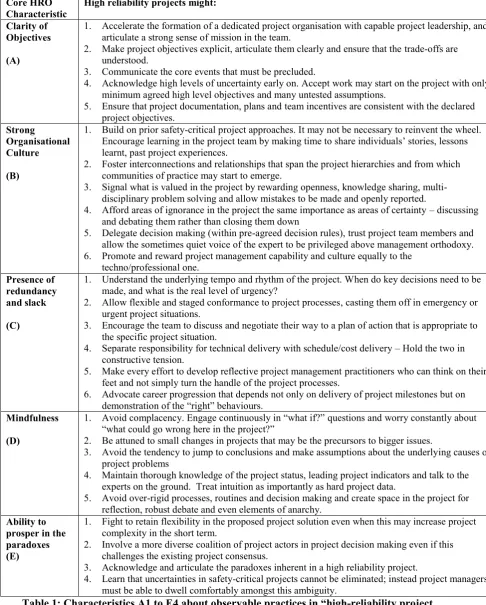
organising (see Table 1). Our aim here is to empirically examine whether these practices and
behaviours are adopted by project managers as a response to project uncertainty. This approach is
consistent with (Barton et al., 2015; Gebauer, 2012; Vidal, 2015; Weick & Sutcliffe, 2007) , who have
all argued previously that high reliability thinking, and in particular the principles of mindfulness
implicit in it, enables individuals and organisations to better cope with uncertainty. However, we
acknowledge that Saunders' (2015) notion of high reliability project organising has much wider
applicability than in the management of project uncertainty alone, and may also be relevant to a
Core HRO Characteristic
High reliability projects might:
Clarity of Objectives
(A)
1. Accelerate the formation of a dedicated project organisation with capable project leadership, and articulate a strong sense of mission in the team.
2. Make project objectives explicit, articulate them clearly and ensure that the trade-offs are understood.
3. Communicate the core events that must be precluded.
4. Acknowledge high levels of uncertainty early on. Accept work may start on the project with only minimum agreed high level objectives and many untested assumptions.
5. Ensure that project documentation, plans and team incentives are consistent with the declared project objectives.
Strong
Organisational Culture
(B)
1. Build on prior safety-critical project approaches. It may not be necessary to reinvent the wheel. Encourage learning in the project team by making time to share individuals’ stories, lessons learnt, past project experiences.
2. Foster interconnections and relationships that span the project hierarchies and from which communities of practice may start to emerge.
3. Signal what is valued in the project by rewarding openness, knowledge sharing, multi-disciplinary problem solving and allow mistakes to be made and openly reported.
4. Afford areas of ignorance in the project the same importance as areas of certainty – discussing and debating them rather than closing them down
5. Delegate decision making (within pre-agreed decision rules), trust project team members and allow the sometimes quiet voice of the expert to be privileged above management orthodoxy. 6. Promote and reward project management capability and culture equally to the
techno/professional one. Presence of redundancy and slack (C)
1. Understand the underlying tempo and rhythm of the project. When do key decisions need to be made, and what is the real level of urgency?
2. Allow flexible and staged conformance to project processes, casting them off in emergency or urgent project situations.
3. Encourage the team to discuss and negotiate their way to a plan of action that is appropriate to the specific project situation.
4. Separate responsibility for technical delivery with schedule/cost delivery – Hold the two in constructive tension.
5. Make every effort to develop reflective project management practitioners who can think on their feet and not simply turn the handle of the project processes.
6. Advocate career progression that depends not only on delivery of project milestones but on demonstration of the “right” behaviours.
Mindfulness
(D)
1. Avoid complacency. Engage continuously in “what if?” questions and worry constantly about “what could go wrong here in the project?”
2. Be attuned to small changes in projects that may be the precursors to bigger issues.
3. Avoid the tendency to jump to conclusions and make assumptions about the underlying causes of project problems
4. Maintain thorough knowledge of the project status, leading project indicators and talk to the experts on the ground. Treat intuition as importantly as hard project data.
5. Avoid over-rigid processes, routines and decision making and create space in the project for reflection, robust debate and even elements of anarchy.
Ability to prosper in the paradoxes (E)
1. Fight to retain flexibility in the proposed project solution even when this may increase project complexity in the short term.
2. Involve a more diverse coalition of project actors in project decision making even if this challenges the existing project consensus.
3. Acknowledge and articulate the paradoxes inherent in a high reliability project.
4. Learn that uncertainties in safety-critical projects cannot be eliminated; instead project managers must be able to dwell comfortably amongst this ambiguity.
3. Methodology and Methods
The ontology underpinning the study is an objectivist one, which demands that reality is objective and
measurable and exists externally to its social actors (Guba & Lincoln, 1998); and that generated
knowledge should be based on observations of this reality (Grix, 2010). To achieve this, we adopted a
qualitative research design which utilised semi-structured interviews (Cassell, 2011) to capture
detailed accounts of how respondents identified, analysed and acted upon instances of project
uncertainty. The study design was informed by extensive reviews of the literature on project
uncertainty and theories of high-reliability organising and on the earlier work by Saunders (2015).
Interviews were held with 30 project management practitioners involved in nine large safety-critical
projects. The projects were selected to reflect two main types: “new build/new product introduction
projects” and “maintenance projects” and ranged in size from a three year, circa £35Million budget to
a 10-12 year, circa £14Billion budget. None of the projects were yet complete. Each project was
located within the UK (with the exception of one aerospace test facility which was located in
Germany, but led from the UK) and most encompassed supply chains that were complex and
international in nature. Each project was also highly regulated: internally through an independent
in-house regulatory division, and externally by the Office for Nuclear Regulation and the Environment
Agency for civil nuclear projects, and the European Aviation Safety Agency, Federal Aviation
Authority and other national airworthiness bodies for civil aerospace projects. Individual
semi-structured interviews (lasting approximately 1 hour) were undertaken at the project sites during 2014.
Several respondents per project were interviewed to minimise individual respondent bias.
Respondents were chosen using intensity sampling (as a form of purposeful sampling where
respondents are selected who are experts about a particular experience(Morse, 1994,p228)). An
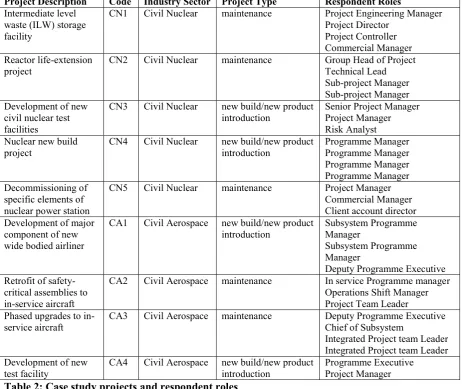
anonymised list of the nine projects and the respondent roles is provided in Table 2 below. The
projects are coded CA1 to CA4 for the civil aerospace projects and CN1 to CN5 for civil nuclear.
During the interviews respondents were asked to recount instances of uncertainty that had arisen
during their project. Respondents were free to choose any instance of uncertainty, at any stage of the
Project Description Code Industry Sector Project Type Respondent Roles Intermediate level
waste (ILW) storage facility
CN1 Civil Nuclear maintenance Project Engineering Manager Project Director
Project Controller Commercial Manager Reactor life-extension
project CN2 Civil Nuclear maintenance Group Head of Project Technical Lead Sub-project Manager Sub-project Manager Development of new
civil nuclear test facilities
CN3 Civil Nuclear new build/new product introduction
Senior Project Manager Project Manager Risk Analyst Nuclear new build
project CN4 Civil Nuclear new build/new product introduction Programme Manager Programme Manager Programme Manager Programme Manager Decommissioning of
specific elements of nuclear power station
CN5 Civil Nuclear maintenance Project Manager Commercial Manager Client account director Development of major
component of new wide bodied airliner
CA1 Civil Aerospace new build/new product introduction
Subsystem Programme Manager
Subsystem Programme Manager
Deputy Programme Executive Retrofit of
safety-critical assemblies to in-service aircraft
CA2 Civil Aerospace maintenance In service Programme manager Operations Shift Manager Project Team Leader Phased upgrades to
in-service aircraft CA3 Civil Aerospace maintenance Deputy Programme Executive Chief of Subsystem Integrated Project team Leader Integrated Project team Leader Development of new
test facility
CA4 Civil Aerospace new build/new product introduction
Programme Executive Project Manager Table 2: Case study projects and respondent roles
The interview prompts (Figure 1) were based on Daft & Weick's (1984) theory of the organisation as
an interpretive system and explored how the uncertainty had arisen, was acted upon and what its
impact on the project was. To avoid leading respondents, the researchers made no mention of high
reliability theory. Instead respondents recounted these vignettes of project uncertainty in their own
words, producing rich, if subjective, retrospective recollections of the practices and behaviours that
were adopted as a response to project uncertainty. In total, 47 vignettes of project uncertainty were
described; 23 from aerospace and 24 from nuclear projects. Vignettes covered a range of emerging
uncertainties, from the discovery of an oil leak in an aircraft gearbox, uncertainty over the choice of
technology to use in a nuclear transfer flask, to uncertainty in the proposed organisational structure for
a nuclear new build project.
The interview transcripts were uploaded into NVivo10. Using NVivo to support qualitative data
analysis can improve data management, the transparency of the analysis and increase the flexibility of
the analysis process (Crowley, Harré, & Tagg, 2002; Gibbs, 2014). However, there is a risk that
NVivo can shape the analysis and that using software can alienate the researcher team from the data.
In this study the software only provided organisational support for the analysis and no internal NVivo
software rules were used to impose interpretations on the data. A technique called template analysis
was used to analyse the transcripts. Template analysis involves the use of a coding template which is
generated either a priori or from a preliminary analysis of a subset of the data (Brooks, McCluskey,
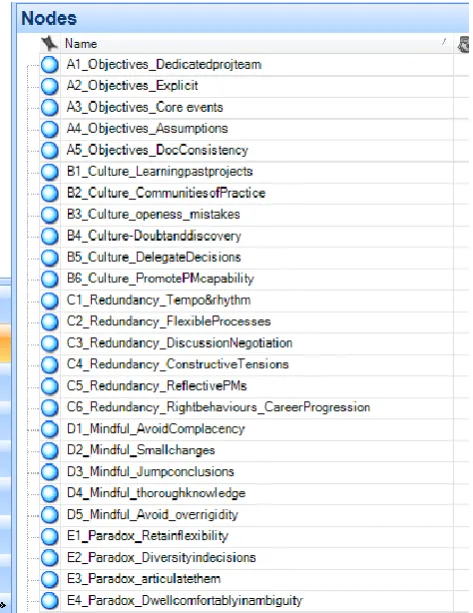
Turley, & King, 2015). The coding structure in this study was a priori identified and comprised
characteristics A1 to E4 of high reliability project organising as posited by Saunders (2015). This
coding structure as it appeared in NVivo 10 is shown in Figure 2 below.
Each vignette was coded according to the template in Figure 2, by reading through the vignette
looking for evidence for practices either consistent or at odds with each characteristic. King ( 2004)
warns against the counting of the frequency of occurrence of each code in template analysis; as one
cannot assume that the frequency of occurrence of a code represents its salience. Instead the
distribution of codes across respondents and projects merely suggests avenues for further
Figure 2: Coding template for evidence for high reliability practices as a response to project uncertainty
4. Findings
The findings are organised around the 5 features of an ideal-type high reliability organisation and the
associated principles of high reliability project organising posited by Saunders (2015). Within each
section we have also highlighted areas of commonality and difference between the two sectors, and
areas of alignment and dissonance with theories of high reliability organising, the implications of
which we return to in the later discussion.
4.1 Clarity of Objectives
In both sectors the projects were organised as dedicated project teams in line with characteristic A1;
the size, priority and consequential nature of the projects made this an essential prerequisite. These
teams were multi-layered with core programme delivery teams supplemented with a number of
subsystem, or planning the optimal sequence of installing services into different areas of a new
nuclear power station. Instilling the right values and behaviours in each of these dispersed and
disparate teams was not without challenge, as demonstrated by this quotation from a civil nuclear
programme manager.
“There has been a great deal of effort put in to try to shape the structure, and make it a
normal delivery organisation. We have made some progress. We inherited from
[Organisation X] a structure which was based on contracts. You can’t do a project like this.
It’s not just about contracts. It’s about the interfaces and gaps between the contracts that are
the problem. It’s taken us a long time to shift away from this, to say we are going to manage
by areas”
Several respondents also discussed the need to work with assumptions when responding to
uncertainty, often well into the detailed design phase – providing evidence for characteristic A4. For
example in developing new nuclear test facilities (CN3) a respondent spoke of
“There are too many unknowns in the project. We are working up the delivery brief. The
project hasn’t been given a definitive ‘you shall do this, with this, at this time’. We are
defining our own scope of delivery.”
Faced with this situation, the projects proceeded cautiously and systematically, working with
assumptions and drawing on all the expertise that was available (both within and beyond the project
organisation) to try to reduce the uncertainties and consequent risks to project delivery.
However there were some key differences between the sectors; with civil nuclear projects exhibiting a
stronger sense of mission (characteristic A1), more acknowledgement of the trade-offs across
performance objectives (A2) and of the core events that must be precluded from happening (A3).
For example, when the objectives and delivery mechanism for a new Intermediate Level Waste (ILW)
storage facility (CN1) were suddenly changed this created a high level of uncertainty. The team
worked hard to define the new objectives and garner a renewed sense of mission in the project-
despite initially feeling frustrated by these upheavals in a project in which considerable emotional
effort had been expended. On the same project the trade-offs in project priorities were openly stated,
specifying a due by date in the contract bid process. Civil nuclear respondents also recounted several
examples of events that were not permitted under any circumstances such as failure to produce a
safety case on time, or operating a nuclear power station outside the limits prescribed by the safety
case. For example, during routine sampling within the graphite core of a nuclear power plant (CN2)
higher than expected weight-loss was encountered, requiring the rapid writing of an emergency
safety-case, without which the reactor would have been shut-down.
In civil aerospace, this clarity of objectives, whilst in evidence at the programme manager level, did
not always permeate all areas and levels of the projects, as articulated by the following civil aerospace
respondent:
“the impact it has on uncertainty is that the people doing the work did not know that if the
[new subsystem] had got on the aircraft we would have been stuck with it for a very long
time, demolishing our salaries on a monthly basis”
Another common concern, almost preoccupation, amongst civil aerospace respondents was that of
securing resources, and the challenge of keeping specialist resources tethered to the project team.
There were several examples of projects starting despite key resources still being fully utilised on
other projects, and of organisational restructuring and frequent personnel changes impacting the
project’s sense of mission. Although the project teams were aware of this weakness in the
organisational environment of the project, they were powerless to change it; evidence of the fragility
of high reliability project organising.
4.2 Strong Organisational Culture
Both sectors provided evidence of learning (B1), of taking visible actions that reward openness and
knowledge sharing (B3) and of delegated decision making (B5).
“At the end of day knowledge, skills, experience and wisdom are engendered in the people in the
team. We learn. We become more competent individuals. So learning is shared with programme and
stakeholders – done consciously.” Civil nuclear respondent
“I’ve come from [x] programme and now work on [y] so I can share my experience with the new
to do this for the current phase. I will look at what we did on the [x] programme and did we carry
any mistakes into the [y] programme and I’ll put processes and procedures in place to make sure that
doesn’t happen again. ”Civil aerospace respondent
Learning on projects in both sectors was deliberate. This learning was often codified (in the form of
revised processes, or a lessons learnt log) and communicated to others to allow the lessons to be acted
on throughout the project team. Overall learning was more formal within civil nuclear projects, with
respondents being more likely to document learning from past projects and draw on those lessons
learnt logs and revised processes. In contrast learning in the civil aerospace projects was often based
on relationships, and knowing the right person to ask in a given situation – evidence of two
contrasting learning strategies - codification vs personalisation - in the two sectors (Hansen, Nohria,
& Tierney, 1999).
Openness and knowledge sharing (B3) as a response to project uncertainty was evidenced in both
sectors as exemplified on the nuclear life extension project (CN2) below:
“Prioritisation of tasks is done with the safety case officer but it’s not an authoritarian
approach. It is more about openness with partners. We work better when we are more open.
Whenever a question is raised I try to make sure whoever has asked the question is satisfied
with the answer.”
The ILW storage facility project (CN1) provided further evidence of this desire to signal what is
valued in the project and the sanctioning of a more collaborative style of working rather than a culture
of blame.
“For example we have to hold ourselves to account for time periods and also hold the contractors
to account. If either side is going to fail we need to raise an early warning and work together
with mutual trust and respect and co-operation to try to deliver a successful outcome. We need to
be a much better client. This is totally alien to company culture.”
In both sectors the ability to nurture a high reliability project culture of openness seemed to rely more
on the interpersonal skills and sheer force of will of senior project staff, rather than being mandated
this culture of openness, within a prevailing organisational culture that would often prefer not to
“admit to problems in capacity in the supply chain. So approach is that we will just muddle through
the project and project timescale will just start to slip to the right.” (Civil nuclear respondent)
Again this is evidence of the fragile nature of the high reliability project organisation.
Individuals, including those outside the core project organisation, were also generally empowered to
discuss and make technical decisions (B5) in response to project uncertainty as articulated here:
“We got the people who were involved at the time, who were the experts in the design, as the
[component] suite is contracted out to external third parties on a design and make basis.
They are the experts in this technology, not us.” Civil aerospace respondent
This privileging of technical experts was widely encountered across both civil nuclear and aerospace
projects. Perhaps due to the complexity of the technology, the project management practitioners
regularly sought out the organisation’s key technical specialist to understand a problem, better
quantify the risks associated with different courses of action and for reassurance that nothing had been
missed. The challenge facing especially the civil nuclear industry is the impending retirement of large
sections of the technical nuclear community (Cogent, 2009; Kettunen, Reiman, & Wahlström, 2007)
and the subsequent loss in expertise. This is a further illustration of the fragility of high-reliability
project organising, which depends on deep and often tacit technical knowledge, which will one day be
lost to the organisation.
A key difference between the two sectors was in their willingness to afford areas of ignorance in the
project the same importance as areas of certainty (B4). Several civil nuclear respondents provided
examples of attempts to bring uncertainty out into the open, whereas there was limited evidence of
this within civil aerospace. Civil nuclear respondents recognised that the first step in resolving
uncertainty is to know where it resides, whether in the interfaces between contracts or technical
specialists, or in the robustness of the base-lined project schedule as recounted by a nuclear
“What creates uncertainty is the failure to have a nice base-lined project. The approach to
the schedule here is not the approach that I am used to. ….. Here a lot of it is coming from
the Responsible Designer saying ‘here is what we think we are doing’. So no one knows how
long it is going to take. ”
The project managers who were able to afford areas of ignorance the same or even greater priority
than areas of certainty were lone voices at first in this project, but by working closely together and
demonstrating small successes, they gradually engendered a noticeable cultural shift in the wider
organisation.
“Us as a small group of programme managers, we directly influenced the way the
organisation is shaping itself and the level of rigour that is in the cost and the schedule plan.”
Civil nuclear respondent
Lastly, there was limited evidence in either sector of projects fostering interconnections that spanned
project hierarchies (B2) or of rewarding project management capability and culture equally to
techno/professional capability (B6). Nevertheless, there was an acknowledgement that core project
teams and senior individuals within those teams had a responsibility to lead by example, encouraging
the right behaviours early in the project delivery to avoid the confrontations that are often associated
with managing contractors. In the nuclear sector an early contract was repeatedly delayed and its
scope amended until the contract was no longer fit for purpose. Faced with a contract whose
commercial arrangements were well adrift from the project objectives, the programme manager chose
to terminate the contract for the following reason
“and being the first contract, is this giving us the behaviours that we want to see on the
project?” Civil nuclear respondent
There were also instances of close, collaborative working with respondents building strong
relationships, which helped resolve the tensions, trade-offs and inherent complexities of large-scale
safety-critical projects.
“We are a multifunctional team and I work with two colleagues – one supply chain chap and
one engineering chap. We spend a lot of time together…..Our aim is as many engines on test
design is invariably late. Once we have the design we then struggle to get the parts in the
door….We are constantly looking at the picture of variables that is driving the test
programme – can we do this or that to maximise our learning?” Civil aerospace respondent
4.3 Presence of Redundancy and Slack
Both sectors provided evidence of projects allowing flexible and staged conformance to project
processes (C1), of encouraging the team to negotiate their way to a situation specific plan of action
(C3) and of the development of reflective project management practitioners (C5).
Within nuclear, flexible conformance to project processes was shown on the ILW storage facility
(CN1), where the levels of estimating uncertainty were high, due to the absence of norms for the
required work scope. In response a conscious decision was made to prepare initial estimates with
higher levels of uncertainty than those organisationally mandated.
“This is new. Systems are not configured to allow this and approaches and procedures do not
support it. So those are the challenges we face. Its obvious procedures don’t work, systems
do not support, so often flying on systems that are being pulled together as we go”.
The Project Director had to tenaciously argue her case here with the project’s sponsors, a brave step in
a project closely monitored by the regulatory authorities and the UK National Audit Office.
In civil aerospace, the established rhythm of the development programme could quickly alter –
accompanied by rapid escalation and prioritisation of tasks, as this case of a new subsystem being
unfit for purpose for an aircraft engine shows.
“I actually quite like it when the choice is clear – absolutely knackered or fix it now – easy
decision – priority calls are easy to make, budget is available – go straight to top with no
endless approvals required.” Civil aerospace respondent
Although the project was initially slow to realise the issues with the subsystem, once alerted to the
seriousness of the situation the project cast off the established processes and rapidly developed a
second solution in parallel with the first, to enable a quick switch-over to happen.
Many respondents across both sectors also described instances of project uncertainty where discussion
multi-functional in nature and usually included supply chain and customer representatives. The following
quotation from the subsystem retrofit project (CA2) illustrates this.
“There are a couple of turning points in all of this. We had a workshop January this year and
we’ve had various meetings but as things got closer we were more confident that the design
would pass qualification the urgency to get these things resolved rose. Some of the
assumptions that were in the plan on day one needed to be revisited.”
Further evidence of C3 was demonstrated in how the same project organised the roll-out of the retrofit
parts, building in redundancy to the process so that the system as a whole became more reliable. This
allowed different airline operators to work at different retrofit rates and evidenced a preference for a
system wide solution rather than a project focused solution.
Evidence of the emergence of reflective practitioners (C5) was found in both sectors too, although
there were more examples of it amongst civil nuclear respondents. For example one nuclear
programme management team reflected at length on how to implement a more robust contractor
engagement process within a conservative, contractually driven technical organisation.
“The idea of the ECI [Early Contractor Involvement] was a little bit organic. We did some
work with the civils and that was the starter. As time went on it became clear that such an
approach could have wider benefits and this is how the strategy emerged. We started in civils
and we have expanded this approach across all the disciplines and I would look to take this
approach into future projects. It’s a very good tool. I probably wouldn’t have thought of by
myself - I am not sure any of us would in isolation.” Civil nuclear respondent
These findings echo those of the civil aerospace projects in that, at least at the higher echelons of the
management of safety-critical projects, practitioners are thoughtful and reflective, rather than trained
technicians adept at turning the handle of well-documented project processes as argued by Crawford,
Morris, Thomas, & Winter (2006).
There were areas of dissonance between the sectors in terms of understanding the underlying tempo
and rhythm of the project (C2) and for separating responsibility for technical delivery from
(C2) than the rapid drum beat of the civil aerospace product development programmes, driven by
entry into service dates. Even on the in-service nuclear plant (CN2) there was rarely a sense of
urgency, with the project team working steadily towards the next safety-case. In civil aerospace the
following quotation demonstrates that the way project uncertainties are managed is dependent on their
nature and their speed of change.
“I guess it’s about pace of change – my job changes by the hour as I’m trying to execute an
engine build. This market stuff – does it change monthly? No. Does it change year to year?
Probably so I review it more infrequently.” Civil aerospace respondent
In contrast, there was much clearer separation of responsibility for technical delivery with
schedule/cost delivery (C4) in nuclear projects than in aerospace. Interestingly, this tension was not
viewed negatively, but rather as an effective means of maintaining conceptual slack in the
organisation. For example
“There is tension in the relationship between the technical and the project management guys
but this is positive and encouraged as it provides multiple perspectives and diversity of
opinion.” Civil nuclear respondent
Further evidence of this constructive tension was provided on (CN3) with one respondent
commenting that
“This is a really good bunch of people I work with. They fight and they bicker but at the end
of the day they all work very hard together, to get the project delivered.”
Another dimension to this tension was that between nuclear and non-nuclear professionals, who had
different experiences of project delivery environments. For instance, there has been a transfer of
project managers into nuclear new build from other recently completed infrastructure projects (Davies
& Mackenzie, 2014). On CN4, this tension was evident as the ‘non-nuclear ’programme managers
sought to reduce the construction schedule duration by undertaking a number of activities in parallel
with one another, a change strongly resisted by the ‘nuclear’ project managers.
Whilst this study found evidence for all the posited practices associated with mindfulness (D1-D5) in
response to project uncertainty, there were commonalities and noticeable differences across the two
sectors. In both sectors respondents stressed the importance of not jumping to conclusions (D3) and
maintained a thorough knowledge of the project status (D4). However there was stronger evidence in
nuclear projects for avoiding complacency (D1) and being attuned to small changes in projects (D2)
and more evidence for avoiding over-rigid processes (D5) within civil aerospace.
Respondents in both sectors emphasised the need to understand what they did not know, and the
effectiveness of simple questioning to help uncover the actual status of specific issues and increase
their confidence in the available data. Respondents focused on the root causes of issues, avoiding
jumping to possibly erroneous conclusions as shown here:
“The issue emerged on a routine maintenance check that was done. That flight was then
grounded and the units were stripped off and sent back to us for investigation. When we
investigated it there was no fault found because it was as per the drawing but when we
investigated further and took the cap off we noticed a reservoir of liquid.” Civil aerospace
respondent
Respondents also described making judgement calls, assessing priorities and knowing when to
escalate uncertain situations to senior management as shown here:
“My role is to quantify and put enough value and structure in place to deal with that risk,
and questioning, probing the teams to make sure that they have taken these actions both in the
commercial teams and in the technical teams. I do that through experience and asking the
right questions in reviews.” Civil nuclear respondent
“Sometimes it is gut-feel and instinct, and you just get a feel for those are the three or four
things I need to make sure are supported, coaxed along. The rest of the stuff will just
happen.” Civil aerospace respondent
Individuals in both sectors utilised a range of approaches, e.g. active questioning, formal status
reports, regular meetings, and relied on a combination of hard data and intuition (often based on
for highly consequential safety-critical projects: how to avoid biased decision making (Gladwell,
2006; Tversky & Kahneman, 1982) when relying on intuition and judgement?, and how well
equipped are these project management practitioners to anticipate and react to Black Swan events -
those that lie well beyond their span of experience? (Taleb, 2007)
No instances of complacency in nuclear projects were recounted (D1). Instead nuclear respondents
seemed to share a nagging sense of what might go wrong on these highly-consequential projects and
described “sniffing out uncertainty by feeling my way, and trying to understand what I do not know”
and “starting any project with a heightened level of nervousness, nervous energy almost, because you
want to shake things and reduce the risks and uncertainties”. Experienced individuals had often been
caught out on previous projects and consequently operated with an amplified awareness of what could
go wrong. The picture in civil aerospace was more nuanced. On occasion, complacency manifested
itself in the initial denial of issues. At other times, suppliers were not challenged on the robustness of
their project schedules, as described by one respondent on the engine test facility (CA4)
“We’ve used them [supplier Z] before ……. Out there we did have a similar situation but we
managed to sit down with [supplier Z], to get them to understand that they were a month
behind, and they held programme from that point onwards. That gave us a false sense of
security, in terms of this particular project. ”
In contrast, another civil aerospace respondent had drawn up a Plan B approach, only to be unable to
gain traction from the wider project organisation to resolve the issue.
“So we are now in limbo waiting for this software test to be done. So this is all very
uncomfortable now as it may end up being a major issue, in which case we will come under
pressure to do a modification very quickly….. And we are still sitting here waiting around and
it just doesn’t feel quite right. Personally I think we should be doing some work now at small
expense to develop the longer term solution to a certain level of maturity to give us a head
start. The problem is the solutions don’t fit within my subsystem, and nobody in the other
Similarly, there was stronger evidence in civil nuclear for being attuned to small changes in projects
that might presage more serious issues (D2). There were examples in both sectors where respondents
did view small problems as warning signals of larger issues; or who double checked with the technical
experts before proceeding with a technical solution. For example:
“Yes being candid with you we've had a couple of incidents on site recently, where something
isn’t quite right, not big issues but they are sort of indicators of things we need to nail
quickly" Civil nuclear respondent
However, mindfulness seemed a more elusive characteristic in civil aerospace projects; its existence
often threatened by schedule pressure caused by aggressive Entry to Service dates which had been
pre- agreed with customers. For example:
“So a few months back we had some issues. We had been running development engines, and
on strip-down we found some debris in a certain part of the engine…At the time we put it
down to development, may be during the manufacturing process some bits had been left
behind. Subsequently we found a cracked [component] in another development engine, no
debris and the crack was in a slightly different location, and we decided this was a
manufacturing defect. We never really connected these two issues together. ”
Contrastingly, in civil aerospace projects there was more evidence for avoiding over-rigid processes
in projects (D5). Within civil nuclear projects structures and processes were rigid, informed by
onerous regulatory regimes and the conservative nature of the industry as argued by (Oedewald &
Gotcheva, 2015) and (Saunders, Gale, & Sherry, 2015). There was only one instance of a project
being structured more flexibly, as evidenced here:
“We know what we want to do and when, but should new information emerge in the future, or
the existing experimental plan is not delivering the data you want then you might have to
revisit what you are doing, alter the plan, engage with people, do an independent review and
get buy-in.” Civil nuclear respondent.
Paradoxically, within the civil aerospace projects, the complexity and turbulence of the engine
recalculating and re-planning it would have been impossible to maintain the pace of progress on the
engine development programme, maximizing the learning and increasing the maturity of the engine
design as quickly as possible.
4.5 Ability to Prosper in the Paradoxes
There was widespread evidence for projects in both sectors involving a more diverse coalition of
individuals in project decision making (E2) and being able to deal with ambiguity (E4).
Broad coalitions of decision making (E2) were reported on all nine case study projects, with a wide
range of experiences and technical specialisms accessed in order to resolve uncertain situations. This
coalition of experts was not confined to the host project organisation but was consciously cultivated
within the wider supply chain.
For example, the new test facility project (CA4) recounted how expertise from ever widening circles
of the supplier base was sought to resolve the challenge of transporting very large aircraft assemblies
along the road network in Germany.
“So they [our global physical logistics] came back with this information that we can’t get
through the bridges in Germany. So at that point we realised we had to engage with logistics
professionals in Germany. So the [company Y] Germany team then engaged with some
haulage companies out there to get them to look at, and understand the options that we had. ”
Civil aerospace respondent
Similar strong evidence for an ability to deal with ambiguity and be prepared for new uncertainties to
emerge (E4) was noted across both sectors,as exemplified below:
“I live with uncertainty. I know the [safety] cases are not lacking in uncertainty. I live with that –
I am aware it is there and I openly introduce margin into the safety cases. I try to get one big
margin or contingency on top of the safety case. I am happy that that process is happening and
that’s how I can live with it. ” Civil nuclear respondent
“One of the key characteristics of the role is the ability to deal with ambiguity and uncertainty.
means I like to know everything that there is to know about something. Over time I’ve got more
comfortable with dealing with uncertainty.” Civil aerospace respondent
Central to dealing with project uncertainty was the ability to balance the inevitable tension between
being in complete possession of the necessary technical information and the need to drive progress on
the project. Many respondents had learnt, often painfully, through past experience never to assume
anything, to foster an attitude attuned to the presence of uncertainty, and to adopt a “risk mind-set”
that went beyond merely attending to the project risk log.
However this study provided scant evidence of project management practitioners acknowledging and
articulating the paradoxes in a high reliability project (E3). There were a couple of exceptions to this,
most notably the following quotation:
“I’m pretty convinced now, that uncertainty is a perception. By putting risk and opportunities and
assumptions around it, it becomes more concrete and although there is still probability around it.
You have to try and put a process around it and try to quantify it. The quantification is itself
uncertain because you’ve got probabilities around it. But at least it’s a structured process.” Civil
nuclear respondent
Here, the individual, on whose shoulders the responsibility for project delivery rests, must satisfy the
demands of project sponsors to quantify the level of uncertainty which resides in different elements of
the project. Paradoxically, this process, however well-structured and intentioned it is, remains a
highly subjective one, influenced by individual experiences, preconceptions and judgements.
Lastly, there was more evidence for projects sanctioning more flexible decision making structures and
fighting to retain flexibility in the proposed project solution (E1) in civil nuclear than civil aerospace.
For example, this quotation shows how the finding of optimal delivery mechanisms was prioritised
over short term project progress on CN1.
“So we have looked around and found out that Nuclear Decommissioning Authority have
these NEC 3 based tools and contract management plans, but they have just not been brought
building a contract management plan and will try to coach the contractor with our contract
and our rules of engagement with people on the ground. We will walk them through what has
to be delivered, what the constraints are, in first couple of weeks of the contract. So we are
trying to look forward as early in the contract as possible to try to anticipate issues, risks and
uncertainties. ”
Throughout this interview there was a real sense of an individual grappling with paradox; with the
project being delivered very differently to previous projects, requiring flexibility and adaptation in
hitherto rigid project processes. The Project Director has brought in external staff from a diverse
range of backgrounds and experiences and strives to provide the leadership to hold fast to this course,
even when issues and difficulties arise.
5. Discussion
This study has provided empirical evidence for the adoption of high reliability practices as a response
to uncertain situations in large-scale safety-critical projects. Respondents expressed a sense of
balancing and juggling in the paradox, for example, in knowing whether to test new engines for flight
or run further experiments; and provided evidence of learning, acting mindfully, avoiding over-rigid
processes, and of upholding constructive tensions, conceptual slack and close interdisciplinary
working.
However these practices were often fragile, with much depending on the tenacity and strength of will
of individual project managers, rather than being embedded in the organisation’s culture and memory
(Schatzki, 2006). Perin (2005) calls for a culture of doubt and discovery as opposed to an all knowing
command and control philosophy in these safety-critical environments. The indications of this study
are that this culture of doubt and discovery relies heavily on the presence and practices of key
individuals, rather than being established throughout project organisation. The challenge facing
safety-critical projects is how to identify, develop and nurture sufficient numbers of such individuals
High reliability practices in this study also often emerged in response to situation specific difficulties
as argued by Barton et al. (2015) as opposed to being planned for from the start, and occurred at the
project operational level, rather than being mandated by senior management. Another practical
implication of this study is the need to increase senior management awareness of the principles of
high reliability project organising.
Lastly, high reliability practices in dealing with uncertainty were often local to particular
organisational structures and individuals, and were hard to influence beyond the core project team.
Structural factors in both civil nuclear and aerospace often thwarted attempts by project managers to
act in a manner more consistent with theories of high-reliability project organising. For example,
complex ownership structures, the quasi public-sector nature, and short term incentive mechanisms in
the civil nuclear industry can tempt organisations to adopt short-term financially expedient project
solutions. Oedewald & Gotcheva (2015) also argue that it is difficult to delegate decision making in
large nuclear projects as they are typically structured around long and often fragmented networks of
contractors and subcontractors, not all of whom have specific nuclear industry expertise. And in civil
aerospace, the commercial imperative to deliver safe engines to tight customer deadlines, can lead to
suboptimal resource allocation, reactive responses to emerging problems and a pervasive
organisational culture of firefighting. These are structural issues that reside beyond the sphere of
influence of even the largest, most consequential safety-critical project.
This study also identified a number of sectoral differences between civil aerospace and nuclear
projects. There was more evidence of practices associated with high reliability project organising in
civil nuclear projects particularly in terms of characteristics A1,A2 and A3 (having a stronger sense of
mission, clearer objectives and core events that had to be precluded), characteristics B3 and B4
(reporting mistakes openly and affording areas of ignorance in the project the same importance as
areas of certainty), C4 ( better separation between technical and cost delivery), and D1 and D2 (no
evidence of complacency and being attuned to small changes that could be the precursors to
something bigger). In civil aerospace projects there was considerably more emphasis on the tempo of
practices at odds with high reliability thinking in civil nuclear. This differed from civil aerospace,
where there were several instances where objectives were not clearly communicated, of complacency
and slow initial reactions to emerging uncertainties. There are two alternative explanations for this.
First, that the requirement for safety in nuclear is so absolute that technology has to be “right first
time, every time”, even if that means significant delays to a project. And secondly, that the high levels
of secrecy and the need to be seen to be in control at all times in the nuclear industry, render any
practices at odds with high reliability hidden and beyond the pale. This stands in stark contrast to civil
aerospace where projects are driven by ambitious and highly public product launch dates, and
development is a more iterative process, with more tolerance of errors and ultimately the assembly,
engine or aircraft technology only has to be ultra-safe when it is ready to be certified and to fly.
There are a number of wider theoretical and practical implications of this study. Firstly, there is a risk
that high reliability project organisations are viewed as somehow ‘heroic’; embodying cultures and
cognitive processes that enable high reliability projects to outperform non-high reliability projects
(Saunders, 2015). This study has provided no empirical evidence of this. In any case there remain
difficulties in defining what is meant by ‘high reliability’ (Schulman, 1993). Reliability in high
reliability organisations has become a proxy for organisational effectiveness, but organisational
effectiveness is another problematic construct. What is organisational effectiveness? From whose
perspective is it being measured? For all the research into high reliability organisations, and the
plethora of defining features for such organisations, high reliability remains subjective; an
organisational attribute rather than an objective measure of performance. Additionally the majority of
the research on high reliability organising has been descriptive in nature, based on case studies of
particular organisational contexts. There has not yet been clear articulation of the mechanism by
which the characteristics and processes of high reliability organisations translate into safe and reliable
performance (Boin & Schulman, 2008). For example, which are the most important high reliability
characteristics? How do these characteristics translate into effective and safe performance? Although
Stout, & Roberts, 1993), a significant gap for both research and practice remains an overarching
theoretical framework that would provide explanatory power to the principles of HROs.
Secondly, an important issue raised by this study is the transferability of prior high reliability
organising research from the operational context into projects. We agree with Sullivan & Beach
(2009) and Saunders (2015) that projects are particular forms of organisations in which the theories of
high reliability organising might usefully be applied. Safety-critical projects do share many
similarities with ongoing operations, notably their complexity, consequential nature, the presence of
uncertainty and the marshalling of many specialist resources to enact organisational processes to
deliver a set of objectives. However there are a number of differences between operations and
projects, including the more measured tempo at which projects proceed and the temporary and
non-routine nature of the work (c.f. Lundin & Soderholm, 1995; Reich et al., 2013; Turner & Mueller,
2003). Finally, Schatzki (2006) contends that a key influence on organisational action is its sense of
memory of practices and structures that have served it previously and this memory may simply not be
present in a newly forged project organisation. We argue that the long term nature of large-scale
safety-critical projects and the regular transfer of individuals from one project to the next enable
Schatzki's (2006) organisational memory to be sufficiently preserved from one project to the next.
Finally, some might argue that the evidence for high reliability project organising in this study is
simply a response to project organising, rather than being a specific response to project uncertainty.
For example, learning from past projects, clarity of objectives and close interdisciplinary working are
central to all aspects of project organising. In theory this is true, but as the litany of past failed
projects attests, good project management practice is not always adhered to. The contribution of this
study is to look at specific instances of uncertainty in highly consequential safety-critical projects, as
recounted by those involved, to look for evidence of high reliability practices as a direct response to
these uncertainties. We acknowledge that there is an overlap between specific responses to
uncertainty and the broader issue of how a project is organised, and in this regard our findings that
perhaps not so astounding. However, we contend that the highly- consequential nature of large scale
safety-critical projects and the imperative attached to their safe execution, render the practices of high
reliability project organising essential to the management of project uncertainty, even if that comes at
the increased cost and effort of providing redundancy and conceptual slack and of maintaining a razor
sharp clarity of focus on safety over other performance objectives.
6. Conclusions
This paper makes contributions to both theory and practice in the domain of large-scale safety-critical
projects. Theoretically, the paper extends the application of high reliability theory into a new domain
(that of the safety-critical project). Secondly, it provides the first empirical examination of how
practices associated with high reliability project organising are adopted by project management
practitioners in safety-critical projects in response to uncertain situations. In terms of practice, it
proffers practices and behaviours that project managers can adopt as a response to project uncertainty
and describes the differences between civil nuclear and aerospace sectors in a manner from which
practitioners can usefully learn.
The 47 vignettes provide evidence of many practices in safety-critical projects that are consistent with
high reliability organising. Respondents expressed a sense of balancing and juggling in the paradox,
of learning, acting mindfully, avoiding over-rigid processes, and of upholding constructive tensions,
conceptual slack and close interdisciplinary working. There was also more evidence of practices
associated with high reliability organising in civil nuclear projects than in civil aerospace projects.
However these practices across both sectors were often fragile, less deeply embedded within the host
project organisation than proponents of high reliability theory might wish for.
The main limitation in the study is the “snap-shot” nature of the data collection. Despite this, the
wide variety of vignettes that were recounted, across projects at several different stages of their
lifecycle, has provided sufficient data to assess whether practices consistent with high reliability
organising are adopted as a response to project uncertainty in safety-critical projects. Future work