RESEARCH
Hybrid spiral-dynamic
bacteria-chemotaxis algorithm with application
to control two-wheeled machines
K. M. Goher
1*, A. M. Almeshal
3, S. A. Agouri
2, A. N. K. Nasir
2, M. O. Tokhi
2, M. R. Alenezi
3, T. Al Zanki
3and S. O. Fadlallah
4Abstract
This paper presents the implementation of the hybrid spiral-dynamic bacteria-chemotaxis (HSDBC) approach to con-trol two different configurations of a two-wheeled vehicle. The HSDBC is a combination of bacterial chemotaxis used in bacterial forging algorithm (BFA) and the spiral-dynamic algorithm (SDA). BFA provides a good exploration strategy due to the chemotaxis approach. However, it endures an oscillation problem near the end of the search process when using a large step size. Conversely; for a small step size, it affords better exploitation and accuracy with slower con-vergence. SDA provides better stability when approaching an optimum point and has faster convergence speed. This may cause the search agents to get trapped into local optima which results in low accurate solution. HSDBC exploits the chemotactic strategy of BFA and fitness accuracy and convergence speed of SDA so as to overcome the problems associated with both the SDA and BFA algorithms alone. The HSDBC thus developed is evaluated in optimizing the performance and energy consumption of two highly nonlinear platforms, namely single and double inverted pendu-lum-like vehicles with an extended rod. Comparative results with BFA and SDA show that the proposed algorithm is able to result in better performance of the highly nonlinear systems.
Keywords: Spiral dynamics, Bacteria chemotaxis, Two-wheeled inverted pendulum with new configuration, PD-like fuzzy logic control, Hybrid fuzzy logic control
© The Author(s) 2017. This article is distributed under the terms of the Creative Commons Attribution 4.0 International License (http://creativecommons.org/licenses/by/4.0/), which permits unrestricted use, distribution, and reproduction in any medium, provided you give appropriate credit to the original author(s) and the source, provide a link to the Creative Commons license, and indicate if changes were made.
Background
Optimization algorithms play a dominant role in solv-ing real problems [38, 58]. Bacterial foraging algorithm (BFA) [42] and spiral-dynamics algorithm (SDA) [50, 51] are well-known optimization techniques in solving real-world problems. Evolutionary algorithms (EA) have been used extensively in literature: soft computing techniques [46], particle swarm optimization [53, 55], incremental encoding [13], neural stochastic multi-scale optimization [9], multi-objective optimization [12, 23], multi-criteria
optimization [43] and fuzzy logic and genetic
program-ming [48].
Nasir et al. [33, 34, 36] proposed linear and nonlinear adaptive BFA where the bacteria step size is varied based on the combination of bacteria and iteration index. Chen
and Lin [14], Farhat and El-Hawary [18] and Huang and
Lin [22] utilized index and total number of chemotaxis
to vary bacteria step size within a specified range. Niu et al. [39], Yan et al. [57] and Xu et al. [56] varied the step size within a user-defined range using combina-tion of index and total number of iteracombina-tions. Supriyono
and Tokhi [49] developed various versions of BFA based
on linear and nonlinear mathematical formulations to establish relationship between bacteria step size and their current fitness value. This relationship enables bacteria to have different step sizes in similar iteration as well as through the whole operation. There are other adaptive approaches considered the variation of the step size based on fitness value [16, 28, 29, 44, 45, 54].
Nasir et al. [30–32] proposed adaptive spiral-dynamic
Open Access
*Correspondence: [email protected]; [email protected] 1 Department of Informatics and Enabling Technologies, Lincoln University, Lincoln, New Zealand
algorithm (ASDA) to establish relationship between spiral radius (r) and fitness value of each search point. They introduced schemes to make variation in the spiral radius within a specific range, enabling each search point to have different spiral radius in moving from one loca-tion to another localoca-tion. Moreover, the movement step of each search agent was made with respect to its fitness value at the current location. As a result of the variation, there was improvement to the performance mainly on the accuracy of the final solution.
Hybrid optimization techniques
Hybrid approach is the combination of two or more algorithms aimed to retain the advantages and eliminate the weaknesses of the original algorithms. This includes the synergization between different groups such as bio-inspired, nature-bio-inspired, etc. Biswas et al. [10, 11] pro-posed hybrid BFA-PSO where a chemotactic strategy of bacteria was designed to represent exploitation part of the algorithm, while the exploration of optimum loca-tion was accomplished by PSO. The same approach using
a constant step size was implemented by Korani [26],
where the PSO operator was used to determine new direction of bacteria motion. Ghaffar et al. [19] adopted a modified PSO operator to determine new direction of bacteria to avoid local optima solution. Biswas et al. [11] proposed chemotactic differential evolution algorithm where adaptive chemotactic strategy of bacteria has been used to improve fitness accuracy of classical differential
evolution (DE). Sinha et al. [47] implemented the same
approach on an electric power system. Kim et al. [24] and
Kim [25] used GA and BFA to tune a PID controller for
automatic voltage regulation. Panigrahi and Ravikumar
[40] and Hooshmand et al. [21] incorporated Nelder–
Mead method into bacteria chemotaxis phase to enhance the search strategy and improve bacteria location. Other
hybrid approaches involving BFA [41, 59] used bee
col-ony algorithm and Tabu search.
Limitations of BFA and SDA
BFA is a well-known bio-inspired algorithm. It has a com-parable or better performance compared to other types
of optimization algorithm [17]. Therefore, it has been
adopted by many researchers worldwide to solve
real-world problems in many areas [52]. However, BFA has a
slow convergence speed and longer computation time. Due to this issue, the application of original BFA in online and offline tuning for solving a complex real-world
prob-lem is unsatisfactory [15]. On the other hand, SDA is a
relatively new and a simple algorithm developed inspired from natural spiral phenomena on earth. It has a rela-tively fast convergence speed which can complement the
drawback of BFA performance. Previous study showed that SDA has a similar or better performance compared to other differential evolutionary (DE) and particle swarm
optimization (PSO) algorithms [50, 51]. However, SDA
has a premature convergence issue where it hardly pro-vides an optimal solution for complex problems.
Hybrid spiral‑dynamic bacteria‑chemotaxis
A hybrid bacteria-chemotaxis spiral-dynamic algorithm (HSDBC) has been proposed by Nasir et al. [30–32] to syn-ergize the chemotactic strategy of bacteria and ASDA. The chemotaxis phase in BFA was designed such that it repre-sents exploration stage and placed at the first phase of the algorithm, while the ASDA as the exploitation stage and was placed at the second phase of the algorithm. The com-bination simplified the BFA algorithm and greatly reduced the total computation time of BFA. Moreover, compari-son with original algorithms concluded that it improved the accuracy of the final solution and had the capability to avoid the local optima problem. HSDBC is a new variant of hybrid-type BFA-SDA algorithm developed to solve the issues aforementioned above. Our previous study showed that the algorithm outperformed both BFA and SDA algo-rithms in terms of accuracy in finding a global optima solution. Compared to BFA, the total computation time has been significantly reduced and its convergence speed has been considerably increased [31, 37].
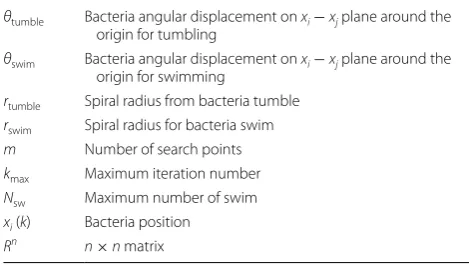
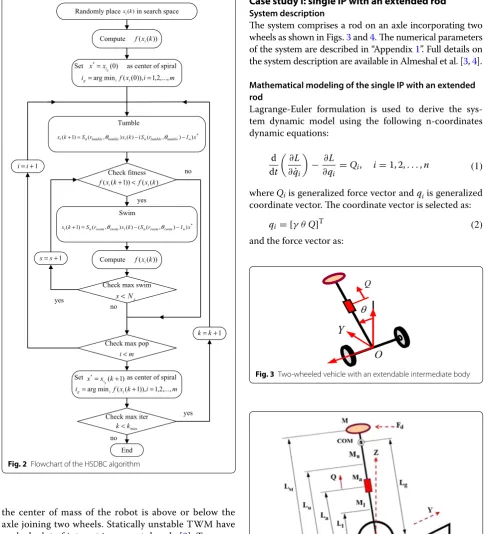
Full description of the HSDBC algorithm for n-dimen-sional optimization is shown in Fig. 1. The description of the associated parameters used in the algorithm is shown
in Table 1, and the corresponding flow chart is given in
Fig. 2. The HSDBC algorithm has been tested to model
and control nonlinear systems including flexible robot manipulator and a twin rotor system using a PD-like FLC [35, 37].
Contribution overview and paper organization
Establishing the optimal control strategy for nonlinear dynamic systems, specifically inverted pendulum-based systems, has been and still remains a field of interest for a countless number of research studies due to their vari-ous promising real-life applications including personal transport systems and wheelchairs. This paper presents an extended study of the proposed algorithm in solving complex problem of two-wheeled inverted pendulum systems. We will implement HSDBC algorithm to control two different configurations of two-wheeled machines. A detailed simulation study of the HSDBC algorithm using several unimodal and multimodal benchmark
func-tions can be found in the work of Nasir and Tokhi [37].
This paper is organized as follows: “Background” sec-tion introduces both ASDA and ABFA optimizasec-tion algorithms, along with an explanation of the principle of HSDBC algorithm. In order to test and validate the proposed HSDBC algorithm on real dynamic systems, two case studies are considered in the study and are
introduced in “Methods” section. “Case study I: single
IP with an extended rod” section describes in details the first case study that involves a single inverted pendulum (IP) system. A double IP system with an extended rod is considered as the second case study
and is presented in “Case study II: double IP with an
extended rod” section. The results of the investigation are presented at the end of each of the previously
men-tioned sections, sections “Case study I: single IP with
an extended rod” and “Case study II: double IP with an extended rod”. At last, the paper is concluded in “ Con-clusion” section.
Methods
An inverted pendulum as a typical multi-input multi-out-put system has the characteristics of nonlinear,
multivari-able and close coupling Luo et al. [27]. The uniqueness
and wide application of technology derived from this unstable system has drawn interest of many researchers including Akesson et al. [2], Askari et al. [5] and Balan et al. [6, 7]. There are various applications of IP configu-ration including design of walking gaits, wheelchairs, and personal transport systems.
The system considered in this paper is a two-wheeled machine (TWM) with an extendable rod as described by Goher et al. [20] and verified by Almeshal et al. [3,
4]. This system stabilizes it extendable intermediate
body (IB) by controlling the wheel movements in a desired manner. A TWM is designed such that either
Step 0: Preparation
Select the number of search points (bacteria) m≥2, parameters
0
≤
θ
tumble,
θ
swim<
2
π
,0
<
r
tumble,
r
swim<
1
ofS
n(
r
,
θ
)
, maximum iteration number,k
max and maximum number of swim, Ns for bacteria chemotaxis.Set
k
=
0,
s
=
0
.Step 1: Initialization
Set initial points xi(0)∈Rn, i=1,2,...m in the feasible region at random and center x*as
x*=x
ig(0), ig=arg mini f(xi(0)), i=1,2,...,m.
Step 2: Applying bacteria chemotaxis
i. Bacteria tumble (a)Update
x
ixi(k+1)=Sn(rtumble,θtumble)xi(k)−(Sn(rtumble,θswim)−In)x*
i=1,2,...,m. ii. Bacteria swim
(a) Check number swim for bacteria i. If
s
<
N
s, then check fitness, Otherwise set i=i+1, and return to step (i).(b) Check fitness
If
f
(
x
i(
k
+
1))
<
f
(
x
i(
k
)
, then updatex
i,Otherwise set
s
=
N
s, and return to step (i). (c) Updatex
ixi(k+1)=Sn(rswim,θswim)xi(k)−(Sn(rswim,θswim)−In
i
=
1,2,...,
m
. Step 3: Updating x*x*=x
ig(k+1),
ig=arg mini f(xi(k+1)), i=1,2,...,m.
Step 4: Checking termination criterion
If
k
=
k
maxthen terminate. Otherwise set k=k+1, and return to step 2Fig. 1 HSDBC algorithm for n-dimensional optimization
Table 1 HSDBC algorithm parameters
θtumble Bacteria angular displacement on xi−xj plane around the
origin for tumbling
θswim Bacteria angular displacement on xi−xj plane around the
origin for swimming
rtumble Spiral radius from bacteria tumble rswim Spiral radius for bacteria swim m Number of search points kmax Maximum iteration number Nsw Maximum number of swim xi (k) Bacteria position
the center of mass of the robot is above or below the axle joining two wheels. Statically unstable TWM have
evoked a lot of interest in present decade [8]. Two case
studies are used to test and validate the developed algorithm; single IP and double IP with an extended rod. For consistency, the two systems are considered to move along an inclined surface. The results of the simulation are shown in a comparative manner with three different optimization algorithms; BFA, SDA and HSDBC.
Case study I: single IP with an extended rod System description
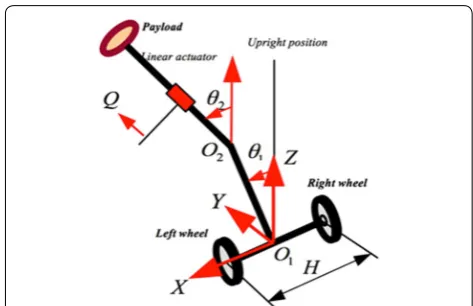
The system comprises a rod on an axle incorporating two wheels as shown in Figs. 3 and 4. The numerical parameters of the system are described in “Appendix 1”. Full details on the system description are available in Almeshal et al. [3, 4].
Mathematical modeling of the single IP with an extended rod
Lagrange-Euler formulation is used to derive the sys-tem dynamic model using the following n-coordinates dynamic equations:
where Qi is generalized force vector and qi is generalized
coordinate vector. The coordinate vector is selected as:
and the force vector as:
(1)
d dt
∂L ∂q˙i
− ∂L
∂qi
=Qi, i=1, 2,. . .,n
(2) qi= [γ θQ]T
m i x f
ig=arg mini ( i(0)), =1,2,...,
no Check fitness ) ( ( )) 1 (
(x k f x k
f i + < i
Check max iter max
k k<
Check max pop
m i<
Set as center of spiral Compute f(xi(k))
1 + =i i 1 + =k k 1 + =s s End Check max swim
s
N s<
Compute f(xi(k))
Set as center of spiral
m i k x f
ig=arg mini ( i( +1)), =1,2,...,
) 1 ( *=x k+
x ig
) 0 ( * g i x x = yes yes no no yes Randomly place in search space xi(k)
Swim * ) ) , ( ( ) ( ) , ( ) 1
(k S r x k S r I x
xi + = n swimθswim i − n swimθswim −n
Tumble * ) ) , ( ( ) ( ) , ( ) 1
(k S r x k S r I x
xi + = n tumbleθtumble i − n tumbleθtumble −n
Fig. 2 Flowchart of the HSDBC algorithm
Q
O
Y
Fig. 3 Two-wheeled vehicle with an extendable intermediate body
The system equations of motion of the model can be written as:
Driving further the above equations yields the follow-ing nonlinear equations of motion of the system:
Detailed explanations of the constant parameters appearing in Eqs. (4)–(9) are formulated in “Appendix 2”.
Control strategy
Three independent control loops, shown in Fig. 5, are
implemented on the system. Fuzzy PD-like combined with conventional integrator is designed as shown in Fig. 6. The three control loops are working to: stabilize the
(3) Qi= [FcFdFa]T
(4) d
dt
∂L
∂y˙
− ∂L ∂y =Fc
(5) d
dt
∂L ∂θ˙
− ∂L
∂θ =Fd
(6)
d dt
∂L ∂Q˙
− ∂L
∂Q =Fa
(7)
C7y¨+(C15+C16Q)θ¨cos(θ+α)
−(C15+C16Q)θ˙2sin(θ+α)
+C16Q˙θ˙cos(θ+α)+C11sinα=Fc
(8) (C18+QC16)y¨cos(θ+α)
−(C18+QC16)yθ˙ sin(θ+α)C16Q˙˙ycos(θ+α)
2θ (C¨ 12Q2+C13Q+C14)+ ˙θ (4C12Q+2C13Q)˙
+ ˙yθ˙2sin(θ+α)(C10+Mu(C5+Q)+Mm(C6+Q))
− ˙θsinθ (C10g+Mug(C5+Q)+Mmg(C6+Q))=Fd
(9) 2C8Q¨ −C16θ˙y˙cos(θ+α)−2C12Qθ˙2
−C13θ˙2−C16gcosθ =Fa
IB at the vertical upright position, keep the cart wheels within a specified linear position from a predefined refer-ence while moving on an inclined surface, and to control the linear displacement of the payload along the IB.
The inputs to the three control loops are the error sig-nal, change of error and the sum of previous errors. The system inputs are the driving force Fc, the linear
actua-tor force Fa and the disturbance force Fd. FLC controllers
are developed based on Mamdani-type fuzzy inference engine with (25) fuzzy rules shown in Table 2.
Constrained optimization
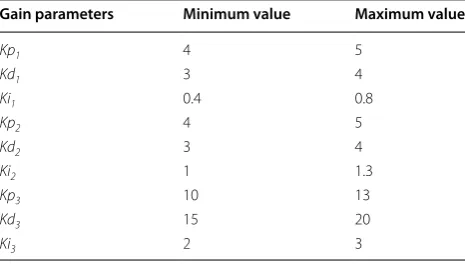
The optimization process is constrained within the sta-bility region of the system. Each parameter has a feasible interval that guarantees the stability of the system within the defined gain limits. Table 3 presents the limits of each parameter which represent the search space of each of
Fig. 5 System block diagram
Fig. 6 Fuzzy PD + I controller
Table 2 Fuzzy rule base
ê e
NB NS Z PS PB
NB NB NB NB NS Z
NS NB NB NS Z PS
Z NB NS Z PS PB
PS NS Z PS PB PB
PB Z PS PB PB PB
Table 3 Boundary limits of the controller gain parameters
Gain parameters Minimum value Maximum value
Kp1 4 5
Kd1 3 4
Ki1 0.4 0.8
Kp2 4 5
Kd2 3 4
Ki2 1 1.3
Kp3 10 13
Kd3 15 20
the three addressed algorithms. Those parameters were obtained through a manual tuning exercise of the system.
Objective functions
The performance index of the system is chosen as the minimum mean squared error (MSE) of each control loop. The MSE is calculated for each control loop of the vehicle system using the following equations:
The objective function of the system is calculated based on the total MSE which can be expressed as:
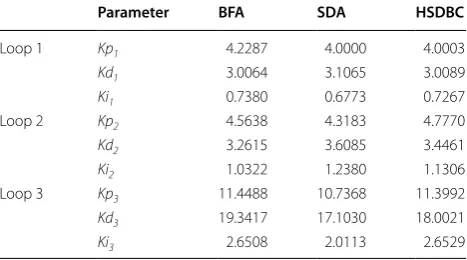
The parameters used to implement the three optimiza-tion algorithms are shown in Tables 4, 5 and 6 and the
calculated optimized parameters are shown in Table 7.
The data shown in Table 8 gives the minimum cost
func-tions due to the implementation of the three optimiza-tion algorithms where the HSDBC algorithm was able to give the minimum cost function compared to the BFA and SDA optimizations.
Simulation results
Four consecutive simulation runs of the system model yielded the performance of the system as shown in Fig. 7.
(10) Objective_Function1=min
1 N
N
i=1
(Yd−Ym)2
Objective_Function2=min
1 N
N
i=1
(θd−θm)2
Objective_Function3=min
1 N
N
i=1
(Qd−Qm)2
(11) J=
3
i=1
Objective_function(i)
As noted from Fig. 6; the three optimization algorithms;
BFA, SDA and HSDBC, resulted generally in a satis-factory performance of the system. However, HSDBC algorithm showed a superior performance in minimiz-ing the percentage overshoot in the payload
displace-ment as appeared in Fig. 7c. As per the tilt angle shown
in Fig. 7b, all the three algorithms behaved the same in
terms of minimizing the level and period of oscillations.
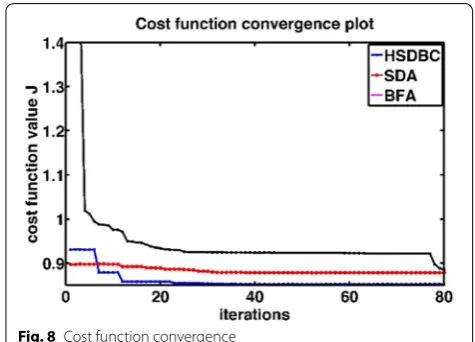
As per convergence graph shown in Fig. 8 show that the
three algorithms resulted in similar convergence of the cost function within around 25 iterations. However, the HSDBC was faster in convergence of the cost function too early if compared to the BFA and SDA algorithms.
Attention has been focused on energy consumption in this investigation. The control effort components as a
measure of energy consumption are shown in Fig. 9. It is
noted that the control effort required in the transient range; the three algorithms yielded nearly close results. However, the HSDC was more robust as it resulted less oscillation of the control effort components in the magnified areas of the plots. Significant amount of energy saving has been achieved specifically in the cart and tilt angle control efforts as appeared in Fig. 9a, b. Furthermore, the HSDBC resulted in a great improvement in the control effort for the payload; this can be demonstrated by the significant improvement shown in Fig. 9c in terms of less oscillations and the short time taken by the control signal to stabilize.
Case study II: double IP with an extended rod
In this case study, an additional link is added and hence increasing the degrees of the freedom (DOF) and the complexity of the structure. The double IP with such
con-figuration shown in Fig. 10 is mimicking the scenario of
Table 4 BFA parameters
P S Nc Ns Nre Ned Ped Sr
9 40 10 6 2 2 0.25 S/2
Table 5 SDA parameters
P R Theta Initial points Iterations
9 0.9 π/4 5 90
Table 6 HSDBC parameters
P R Rzw Ns Theta Initial points Iterations
9 0.95 0.55 2 π/4 5 90
Table 7 Optimized gain values
Parameter BFA SDA HSDBC
Loop 1 Kp1 4.2287 4.0000 4.0003
Kd1 3.0064 3.1065 3.0089
Ki1 0.7380 0.6773 0.7267
Loop 2 Kp2 4.5638 4.3183 4.7770
Kd2 3.2615 3.6085 3.4461
Ki2 1.0322 1.2380 1.1306
Loop 3 Kp3 11.4488 10.7368 11.3992
Kd3 19.3417 17.1030 18.0021
Ki3 2.6508 2.0113 2.6529
Table 8 Cost functions
Minimum cost function value BFA SDA HSDBC
a wheelchair on only two wheels which has been studied significantly by Ahmad and Tokhi [1].
The design of the two-wheeled robotic vehicle is based on double inverted pendulum system with a movable payload moving on an inclined surface with five DOF. The increased DOFs will enable the vehicle to maneu-ver freely in all directions and in different environments. Moreover, the second link provides an extended height to lift up the payload to a demanded height. The system equations of motion are presented with five highly cou-pled differential equations as follows:
(12) 2C27δ¨L+2C1δ¨R+C6θ¨1cos(θ1+α)
−C6θ˙12sin(θ1+α) +0.5(C25+C26Q)
¨
θ2cos(θ2+α)− ˙θ22sin(θ2+α)
+0.5C28Q˙θ˙2cos(θ2+α) +C16gsinα=TL−TfL
(13) 2C27δ¨R+2C1δ¨L+C6θ¨1cos(θ1+α)
−C6θ˙12sin(θ1+α)
+0.5(C25+C26Q)
¨
θ2cos(θ2+α)− ˙θ22sin(θ2+α)
+0.5C28Q˙θ˙2cos(θ2+α)
+C16gsinα=TR−TfR
Fig. 7 Performance of the single IP. a Linear displacement of the cart, b tilt angle of the intermediate body, c linear displacement of the payload
(14) 2C2θ¨1+(C5+M2uL1(C8+Q)+M L1(C9+Q))
¨
θ2cos(θ1−θ2)− ˙θ2(θ˙1− ˙θ2)sin(θ1−θ2)
+ ˙θ2cos(θ1−θ2)Q˙(M2uL1+M L1)
+C6(δ¨L+ ¨δR)cos(θ1+α)
+C6(δ˙L+ ˙δR)sin(θ1+α)(θ˙12− ˙θ1)
+ ˙θ12θ˙2sin(θ1−θ2)
(C5+M2uL1(C8+Q)+ML1(C9+Q))
−g C14θ˙1sinθ1=0.5(TR+TL)
(15) C19Q¨ − 0.5θ˙22(2C19Q+C22)
−C23θ˙1θ˙2cos(θ1−θ2)
−0.5C25θ˙2(δ˙L+ ˙δR)cos(θ2+α)
+g C18cosθ2=Fa−Ffa
(16) ¨
θ2(C19Q2+C20Q+C21)+ ˙θ2(2C19Q2+C22)
+ ¨θ1cos(θ1−θ2)(C23Q+C24)
− ˙θ1(θ˙1− ˙θ2)sin(θ1−θ2)(C23Q+C24)
+C23θ˙1cos(θ1−θ2)
+0.5(δ¨L+ ¨δR)cos(θ2+α)(C25Q+C26)
−0.5(δ˙L+ ˙δR)θ˙2sin(θ2+α)(C25Q+C26)
+0.5C25(δ˙L+ ˙δR)cos(θ2+α)
− ˙θ1θ˙2sin(θ1−θ2)(C23Q+C24)
+0.5θ˙2
2(δ˙L+ ˙δR)sin(θ2+α)(C25Q+C26) −gθ˙2sinθ2(C17+C18Q)=TM−TfM−LdFd Fig. 9 Control effort components in a single IP. a Cart control effort,
b tilt angle control effort, c linear actuator driving force
Control strategy
A robust hybrid fuzzy logic control strategy (FLC) with five control loops is developed. The control strategy block diagram is presented in Fig. 11, to control the vehicle and to counteract the disturbances occurring due to different movement scenarios.
The control system of the vehicle consists of five hybrid FLC controllers with a total of 15 gain parameters. The gain parameters were first tuned heuristically in order to test the controller as well as to find the boundaries of the search space of those gain parameters. The same optimization algo-rithms, SDA, BFA and HSDBC, are implemented in order to optimize the vehicle control system parameters. The perfor-mance index of the system is chosen as the minimum mean squared error (MSE) for each control loop and defined as:
The objective function is chosen as the summation of the MSE of the system expressed as:
Minimization of the objective function J is used to find the optimal controller gain parameters that result in the mini-mum control loop errors in the stability region of the system.
(17) MSE 1=min
1 N
N
i=1
(δLd−δLm)2
MSE 2=min
1 N
N
i=1
(δRd−δRm)2
MSE 3=min
1 N
N
i=1
(θ1d−θ1m)2
MSE 4=min
1 N
N
i=1
(θ2d−θ2m)2
MSE 5=min
1 N
N
i=1
(Qd−Qm)2
(18)
J=MSE1+MSE2+MSE3+MSE4+MSE5
Constrained optimization
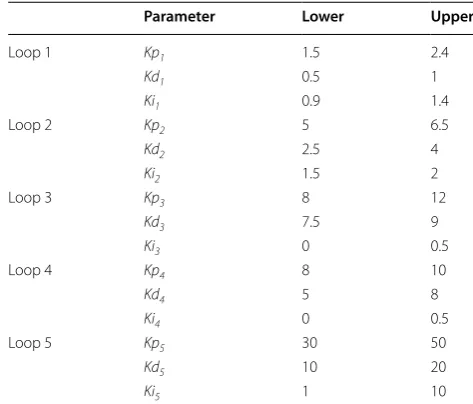
With the complexity of the model, slight changes in the control gain parameters will result in oscillations in the system response and may lead to instability of the vehicle. Constrained optimization techniques are used to avoid this problem occurring while optimizing the control sys-tem parameters. The optimization process is constrained within the stability region of the system. This is achieved by defining a feasible interval for each control param-eter shown in Table 9, which assures the stability of the system.
Results and discussion
This simulation scenario allows comparing the perfor-mance of the HSDBC with other similar optimization algorithms. Tables 10, 11 and 12 provide the simulation
Fig. 11 Block diagram of the vehicle control system
Table 9 Boundary limits of the controller gain parameters
Parameter Lower Upper
Loop 1 Kp1 1.5 2.4
Kd1 0.5 1
Ki1 0.9 1.4
Loop 2 Kp2 5 6.5
Kd2 2.5 4
Ki2 1.5 2
Loop 3 Kp3 8 12
Kd3 7.5 9
Ki3 0 0.5
Loop 4 Kp4 8 10
Kd4 5 8
Ki4 0 0.5
Loop 5 Kp5 30 50
Kd5 10 20
Ki5 1 10
Table 10 BFA parameters
P S Nc Ns Nre Ned Ped Sr
15 20 14 6 2 2 0.25 S/2
Table 11 SDA parameters
P R Theta Initial points Iterations
15 0.95 π/4 10 150
Table 12 HSDBC parameters
P R Rzw Ns Theta Initial points Iterations
parameters used for BFA, SDA and HSDBC algorithms, respectively. The optimized control gain parameters reported by each optimization algorithm are presented in
Table 13, whereas Table 14 provides the minimum cost
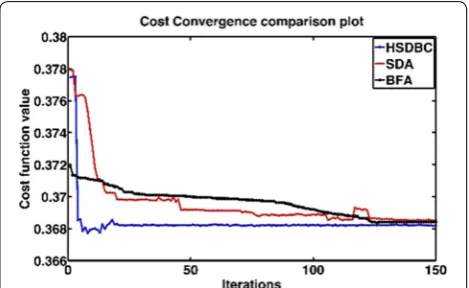
function calculated by each of the optimization algo-rithms. Clearly, the HSDBC algorithm has found the minimum cost function value of 0.3682.
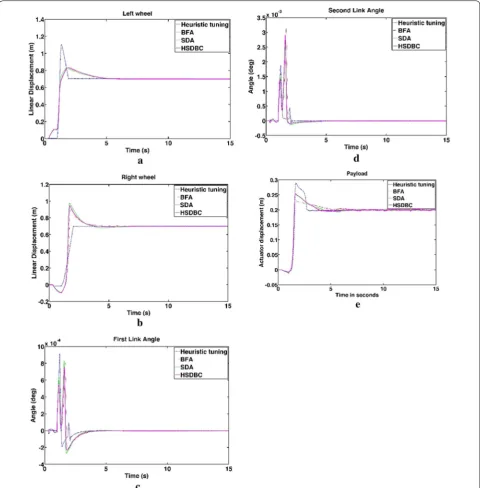
Figure 13 shows the system response based on the
optimized control parameters obtained by the imple-mentation of the BFA, SDA and HSDBC algorithms in comparison to the manual-tuned gain parameters. It can be noted that BFA, SDA and HSDBC are of much similar effect on the system response by finding sta-ble solutions, lowering the overshoots and improved steady-state error. However, HSDBC algorithm has a superior performance in minimizing the percentage overshoot and the settling time for the linear
displace-ment of the left and right wheel as shown in Fig. 13a, b and the tilt angles of the two pendula as shown in
Fig. 13c, d. Furthermore, HSDBC-optimized gain
parameters clearly improved the settling time of the
payload actuator displacement as depicted in Fig. 13e.
As can be noticed from the cost function convergence
plots shown in Fig. 12, the HSDBC algorithm cost
func-tion has converged into the minimum value within approximately 25 iterations. However, the BFA and SDA algorithms seem to need more iterations to settle into
their best-found minimum values presented in Table 14.
HSDBC has successfully found the minimum cost func-tion and proved its speed in convergence. In terms of
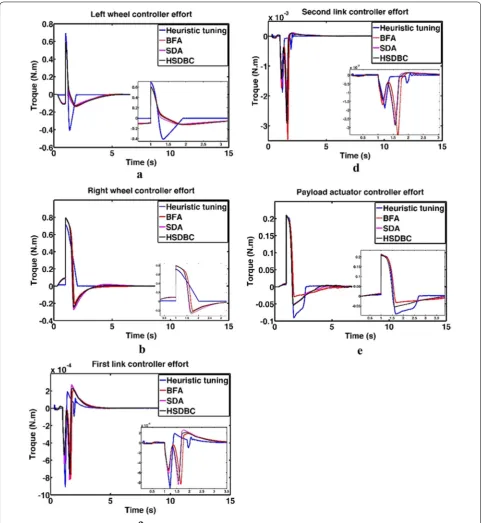
the control output components shown in Fig. 14, the
control efforts was minimized by the implementation of HSDBC algorithm for the left wheel, first link and the payload linear actuator. However, the heuristic tuning yields better results in case of the right wheel and the second link. This seems to be accompanied with a poor response of the system, in terms of increased distur-bance period and higher gain values, if compared to the results obtained by the HSDBC algorithm.
Conclusions
A novel hybrid spiral-dynamics bacteria-chemotaxis (HSDBC) optimization algorithm has been proposed. Chemotactic strategy of bacteria through spiral tum-ble and swim actions of bacteria is adopted to improve exploration strategy of SDA. Moreover, spiral radius
Fig. 12 Cost function convergence plot for BFA, SDA and HSDBC algorithms
Table 13 Optimized gain values
Parameter BFA SDA HSDBC
Loop 1 Kp1 2.0729 2.3452 2.1566
Kd1 0.8572 0.8714 0.8095
Ki1 1.3925 1.2778 1.2026
Loop 2 Kp2 6.0155 5.1504 5.1530
Kd2 2.8185 3.1264 2.6917
Ki2 1.6390 1.9794 1.8754
Loop 3 Kp3 8.7514 11.3330 11.4514
Kd3 8.1889 8.3229 8.9946
Ki3 0.2449 0.2731 0.3771
Loop 4 Kp4 8.9718 9.8522 9.9903
Kd4 5.1315 6.7829 6.6239
Ki4 0.0071 0.0532 0.0410
Loop 5 Kp5 49.9646 36.5230 36.6753
Kd5 13.6834 14.2519 14.3583
Ki5 4.0408 5.3567 5.4203
Table 14 Cost functions
Minimum cost function BFA SDA HSDBC
and angular displacement of spiral model is made adap-tive to enhance the movement of bacteria within fea-sible region. Incorporating these two schemes have successfully saved the SDA from getting trapped into local optima point and provides faster convergence. The proposed algorithm has been utilized to optimize the performance of two different IP platforms; single
and double IP with a new configuration of an extended intermediate body. Simulation results have shown that the proposed hybrid algorithm outperformed its prede-cessor algorithms (BFA and SDA) in terms of increased convergence speed and better fitness accuracy. Further-more, implementation of the HSDBC yielded significant
saving in the energy consumption of the two tested platforms.
Future work will consider investigating standard PID tuning methods, such as Ziegler–Nichols method, and evaluating and comparing their performance with the HSDBC algorithm.
Authors’ contributions
Author details
1 Department of Informatics and Enabling Technologies, Lincoln University, Lin-coln, New Zealand. 2 Department of Automatic Control and Systems Engineer-ing, The University of Sheffield, Sheffield, UK. 3 Electronics Engineering Technol-ogy Department, College of Technological Studies, Public Authority for Applied Education and Training (PAAET), Adailiya, Kuwait. 4 Mechanical Engineering Department, Auckland University of Technology, Auckland, New Zealand.
Acknowledgements
The authors of this paper would like to thank Lincoln University in New Zealand by offering the funding support for this publication.
Competing interests
The authors declare that they have no competing interests.
Funding
This research is originally funded by a governmental PhD scholarships and research grants from various countries including New Zealand, Malaysia, Kuwait and the UK.
Appendices
Appendix 1: Single IP parameters
Description Unit
LP Position of the COM of the payload m Lu Position of the COM of the rod’s upper part m La Position of COM of the linear actuator m Ll Position of COM of the lower part of the rod m
Q Displacement of the linear actuator m Y Linear displacement of the vehicle m θ The angular displacement of the IB rad
˙
γ Linear velocity of the IB m/s
˙
θ Angular velocity of the IB rad/s
¨
γ Linear acceleration of the IB m/s2 ¨
θ Angular acceleration rad/s2
¨
Q Linear acceleration of the attached payload m/s2
ML Mass of the lower part of the rod kg
Ma Mass of the linear actuator kg
Mu Mass of the upper part of the rod kg
M Payload mass kg
MW Wheel mass kg
Mc Cart mass kg
RW Radius of the wheel m
g Gravitational acceleration m/s2
Tc Kinetic energy of the cart N m
TL Kinetic energy of the lower part of the rod N m
Ta Kinetic energy of the linear actuator N m Tu Kinetic energy of the upper part of the rod N m Tp Kinetic energy of the payload N m
VL Potential energy of the lower part of the rod N m Va Potential energy of the linear actuator N m
Vu Potential energy of the upper part of the rod N m
Vp Potential energy of the payload N m
Vc Potential energy of the cart N m
α Inclination angle rad
Appendix 2: Single IP constants
C1=4Ll+L2l +4LlLu C2=4Ll+2Lu
C3=4L2l +4L2u+8LlLu C4=4Ll+4Lu
C5=2Ll+Lu C6=2Ll+2Lu
C7=Mc+Ml+Ma+Mu+Mm C8=Mc+Ml+Ma+Mu+Mm
C9=1
2MlL
2 l +
1 2Jl+
1 2MaL 2 a+ 1 2Ja
C10=MlLl+MaLa
C11=(Mc+Ml+Ma+Mu+Mm)g
C12=1
2Mu+ 1 2Mm+
1 2Mu+
1 2Mm
C13=1
2(C2+C4)Mu+ 1
2Mu(C2−2Lg)+ 1
2Mm(C4−2Lg)
C14=C9+
1
2C1Mu+C3Mm+ 1
2(Mu+Mm)L
2 g
−C5MuLg+
1
2C1Mu+ 1 2MmL
2
g−C6MmLg
C15=C10+C5Mu+C6Mm C16=Mu+Mm
C17=C5Mu+C6Mm C18=C10+C17
C19=C10+Mu(C5+Q)+Mm(C6+Q) C20=C10g+Mug(C5+Q)+Mm(C6+Q)
Lu=C5+Q Lm=C6+Q
Jm=Mm(Q2+(C4−2Lg)Q+L2g−2LgC6+C3)
Ju=Mu(Q2+(C2−2Lg)Q+L2g−2LgC5+C1)
Appendix 3: Double IP constants
C1=0.125Rw(Mm+M1+M2l+Ma+M2u+M)
C2=0.5MmL21+M1L2c1+M2lL 2
1+MaL21+M2uL21+ML 2 1
C3=M2lL 2
c2+MaL2a
C4=0.5Mm(cosα+sinα)+0.5M1(cosα+sinα) C5=M2lL1Lc2+MaL1La
C6=0.5Rw(M2lL1+MaL1+M2uL1+ML1) C7=Rw(M2lLc1+MaLa)
C8=2Lc2+L2u C9=2Lc2+2L2u
C10=4L 2 c2+L
2
2u+4L2uLc2 C11=4L2c2+4L
2
2u+8L2uLc2 C12=MwR2w+Jw
Publisher’s Note
Springer Nature remains neutral with regard to jurisdictional claims in pub-lished maps and institutional affiliations.
Received: 27 October 2016 Accepted: 5 May 2017
References
1. Ahmad S, Tokhi MO. Modelling and control of a wheelchair on two wheels. In: Proceedings of the 2nd Asia International Conference on Modelling & Simulation (AICMS 08), Kuala Lumpur, Malaysia; 2008. 2. Akesson J, Blomdell A, Braun R. Design and control of YAIP an inverted
pendulum on two wheels robot, computer aided control system design. In: IEEE international conference on control applications. 2011. p. 2178–83.
3. Almeshal AM, Goher KM, Tokhi MO. Modelling of two-wheeled robotic wheelchair with moving payload. In: Proceedings of the 14th interna-tional conference on climbing and walking robots and the support technologies for mobile machines (CLAWAR 2011), Paris, France. 2011. p. 731–41.
4. Almeshal AM, Goherm KM, Nasir AN, Tokhi MO. Hybrid spiral dynamic bacterial chemotaxis optimisation for hybrid fuzzy logic control of a novel two-wheeled robotic vehicle. In: Proceedings of the 15th international conference on climbing and walking robots and the support technolo-gies for mobile machines (CLAWAR 2013), Sydney, Australia. 2011. p. 179–88.
5. Askari M, Mohamed HAF, Moghavvemi M, Yang SS. Model predictive control of an inverted pendulum. In: Proceedings of the international conference for technical postgraduates (TECHPOS). 2009. p. 1–4. 6. Balan R, Maties V, Hancu O, Stan S. A predictive control approach for
the inverse pendulum on a cart problem. In: Proceedings of the IEEE international conference mechatronics and automation, vol. 2024. 2005. p. 2026–31.
7. Balan R, Maties V, Stan S. A solution of the inverse pendulum on a cart problem using predictive control. In: Proceedings of the IEEE ISIE, Dubrovnik, Croatia. (2005). p. 63–8.
8. Baloch M, Parent M (2003) Modelling and model verification of an intel-ligent self-balancing two wheeled vehicle for an autonomous urban transportation system. In: Proceedings of conference on computer intel-ligence, robot and autonomous system, Singapore.
9. Banchs RE, Klie H, Rodriguez A, Thomas SG, Wheeler MF. A neural sto-chastic multiscale optimization framework for sensor-based parameter estimation. Integr Comput Aided Eng. 2007;14(3):213–23.
C14=M1Lc1+MmL1+M2lL1+MaL1+M2uL1+ML1 C15=M2lLc2+MaLa
C16=M1+Mm+M2l+Ma+M2u+M C17=C15+M2uC8+MC9
C18=C8+C9 C19=M2u+M C20=2C8M2u+2C9M C21=C3+M2uC10+MC11 C22=2M2uC8+2MC9 C23=M2uL1+ML1
C24=C5+M2uL1C8+ML1C9 C25=M2uRw+MRw
C26=C7+M2uRwC8+MRwC9 C27=C1+C12
C28=Rw(M2u+M)
10. Biswas A, Dasgupta S, Das S, Abraham A. Synergy of PSO and bacterial foraging optimization: a comparative study on numerical benchmarks. Adv Soft Comput. 2007;44:255–63.
11. Biswas A, Dasgupta S, Das S, Abraham A. A synergy of differential evolu-tion and bacterial foraging optimizaevolu-tion for global optimizaevolu-tion. Neural Netw World. 2007;17(6):607–26.
12. Campomanes-Álvarez BR, Cordón O, Damas S. Evolutionary multi-objective optimization for mesh simplification of 3D open models. Integr Comput Aided Eng. 2013;20(4):375–90.
13. Carro-Calvo L, Salcedo-Sanz S, Ortiz-García EG, Portilla-Figueras A. An incremental-encoding evolutionary algorithm for color reduction in images. Integr Comput Aided Eng. 2010;17(3):261–9.
14. Chen Y, Lin W. An improved bacterial foraging optimization. In: Paper presented at the 2009 IEEE international conference on robotics and biomimetics, ROBIO 2009, pp. 2057–2062.
15. Das TK, Venayagamoorthy GK, Aliyu UO. Bio-inspired algorithms for the design of multiple optimal power system stabilizers: SPPSO and BFA. IEEE Trans Ind Appl. 2008;44(5):1445–57.
16. Dasgupta S, Das S, Abraham A, Biswas A. Adaptive computational chemotaxis in bacterial foraging optimization: An analysis. IEEE Trans Evol Comput. 2009;13(4):919–41.
17. Dwibhashya SP, Rambabu C. Optimal bidding strategy in competi-tive market using GA & BFA: a comparacompeti-tive study. Int J Eng Res Dev. 2012;3(6):83–94.
18. Farhat IA, El-Hawary ME. Short-term hydro-thermal scheduling using an improved bacterial foraging algorithm. In: Paper presented at the 2009 IEEE electrical power and energy conference (EPEC 2009), 2009. pp. 1–6. 19. Ghaffar HIA, Ebrahim EA, Azzam M. Design of PID controller for power
system stabilization using hybrid particle swarm-bacteria foraging opti-mization. WSEAS Trans Power Syst. 2013;8(1):12–23.
20. Goher KM, Tokhi MO, Ahmad S. A new configuration of two-wheeled vehicles: towards a more workspace and motion flexibility. In: Proceed-ings of the 4th IEEE international systems conference, San Diego, CA, USA, April 5–8, 2010.
21. Hooshmand RA, Parastegari M, Morshed MJ. Emission, reserve and economic load dispatch problem with non-smooth and non-convex cost functions using the hybrid bacterial foraging-Nelder–Mead algorithm. Appl Energy. 2012;89(1):443–53.
22. Huang W, Lin W. Parameter estimation of wiener model based on improved bacterial foraging optimization. In: Paper presented at the 2010 international conference on artificial intelligence and computational intelligence (AICI 2010), 1, 2010. pp. 174–178.
23. Jia L, Wang Y, Fan L. Multiobjective bilevel optimization for production– distribution planning problems using hybrid genetic algorithm. Integr Comput Aided Eng. 2014;21(1):77–90.
24. Kim DH, Abraham A, Cho JH. A hybrid genetic algorithm and bacterial foraging approach for global optimization. Inf Sci. 2007;177(18):3918–37. 25. Kim DH. Hybrid GA–BF based intelligent PID controller tuning for AVR
system. Appl Soft Comput. 2011;11(1):11–22.
26. Korani WM. Bacterial foraging oriented by particle swarm optimization strategy for PID tuning. In: Proceedings of the 2008 GECCO conference companion on genetic and evolutionary computation (GECCO’08), Atlanta, 12–16 July 2008. p. 1823–6.
27. Luo Z, Shi Z, Hu P, Hao L, Liu H. Error analysis of a inverted pendulum on an inclined rail. In: Proceedings of the 2nd IEEE international conference on advanced computer control (ICACC 2010), 3, 2010. pp. 52–55. 28. Majhi B, Panda G, Choubey A. On the development of a new adaptive
channel equalizer using bacterial foraging optimization technique. In: Proceedings of 2006 annual IEEE india conference, INDICON, New Delhi, 2006. p. 1–6.
29. Majhi R, Panda G, Majhi B, Sahoo G. Efficient prediction of stock market indices using adaptive bacterial foraging optimization (ABFO) and BFO based techniques. Expert Syst Appl. 2009;36(6):10097–104.
32. Nasir ANK, Tokhi MO, Abd Ghani NM, Raja Ismail RMT. Novel adaptive spiral dynamics algorithms for global optimization. In: Proceeding of 11th IEEE international conference on cybernatic intelligent system 2012, Limerick, Ireland, 23–24 August 2012.
33. Nasir ANK, Tokhi MO. A novel hybrid bacteria-chemotaxis spiral-dynamics algorithm with application to modelling of a flexible system. In: Proceed-ings of 2013 5th international conference on modeling, simulation and applied optimization (ICMSAO’13), Hammamet, Tunisia, April 28–30, 2013. 34. Nasir ANK, Tokhi MO. Novel adaptive bacteria foraging algorithms for
global optimization. In: Proceedings of 2013 5th international conference on modeling, simulation and applied optimization (ICMSAO’13), Ham-mamet, Tunisia, April 28–30, 2013.
35. Nasir ANK, Tokhi MO. A novel hybrid bacteria-chemotaxis spiral-dynamic algorithm with application to modelling of flexible systems. Eng Appl Artif Intell. 2014;33:31–46.
36. Nasir ANK, Tokhi MO, Ghani NMA. Novel adaptive bacterial foraging algorithms for global optimization with application to modelling of a TRS. Expert Syst Appl. 2015;42:1513–30.
37. Nasir ANK, Tokhi MO. Novel metaheuristic hybrid spiral-dynamic bacteria-chemotaxis algorithms for global optimisation. Appl Soft Comput. 2015;27:357–75.
38. Neri F, Cotta C. Memetic algorithms and memetic computing optimiza-tion: a literature review. Swarm Evol Comput. 2012;2:1–14.
39. Niu B, Fan Y, Zhao P, Xue B, Li L, Chai Y. A novel bacterial foraging opti-mizer with linear decreasing chemotaxis step. In: Paper presented at the 2010 2nd international workshop on intelligent systems and applications (ISA 2010); 2010.
40. Panigrahi BK, Ravikumar PV. Bacterial foraging optimisation: Nelder–Mead hybrid algorithm for economic load dispatch. IET Gener Transm Distrib. 2008;2(4):556–65.
41. Panikhom S, Sarasiri N, Sujitjorn S. Hybrid bacterial foraging and tabu search optimization (BTSO) algorithms for Lyapunov’s stability analysis of nonlinear systems. Int J Math Comput Simul. 2010;4(3):81–9.
42. Passino KM. Biomimicry of bacterial foraging for distributed optimization and control. IEEE Control Syst Mag. 2002;22:52–67.
43. Rokni S, Fayek AR. A multi-criteria optimization framework for industrial shop scheduling using fuzzy set theory. Integr Comput Aided Eng. 2010;17:175–1963.
44. Sanyal N, Chatterjee A, Munshi S. An adaptive bacterial foraging algo-rithm for fuzzy entropy based image segmentation. Expert Syst Appl. 2011;38(12):15489–98.
45. Sathya PD, Kayalvizhi R. Optimal segmentation of brain MRI based on adaptive bacterial foraging algorithm. Neurocomputing. 2011;74(14–15):2299–313.
46. Sedano J, Berzosa A, Villar JR, Corchado E, de la Cal E. Optimising opera-tional costs using Soft Computing techniques. Integr Comput Aided Eng. 2011;18(4):313–25.
47. Sinha N, Lai LL, Saikia LC, Malakar T. Hybrid bacteria foraging-de based algorithm for economic load dispatch with non-convex loads. In: Proceedings of 2010 international conference on machine learning and cybernetics (ICMLC), Qingdao, 11–14 July 2010, p. 3206–12.
48. Smith JF III, Nguyen TVH. Autonomous and cooperative robotic behavior based on fuzzy logic and genetic programming. Integr Comput Aided Eng. 2007;14(2):141–59.
49. Supriyono H, Tokhi MO. Parametric modeling approach using bacterial foraging algorithms for modeling of flexible manipulator systems. Eng Appl Artif Intell Syst. 2012;25(5):898–916.
50. Tamura K, Yasuda K. Spiral multipoint search for global optimization. In: Proceedings of 10th international conference on machine learning and applications, 2011. p. 470–5.
51. Tamura K, Yasuda K. Primary study of spiral dynamics inspired optimiza-tion. IEE J Trans Electr Electron Eng. 2011;6(S1):98–100.
52. Tang WJ, Li MS, Wu QH, Saunders JR. Bacterial foraging algorithm for optimal power flow in dynamic environments. IEEE Trans Circuits Syst I. 2008;55(8):2433–42.
53. Tao H, Mohamad ZJ, Ahmed MM, Abdalla AN, Jing W. A wavelet-based particle swarm optimization algorithm for digital image watermarking. Integr Comput Aided Eng. 2012;19(1):81–91.
54. Venkaiah C, Vinod Kumar DM. Fuzzy adaptive bacterial foraging congestion management using sensitivity based optimal active power re-scheduling of generators. Appl Soft Comput. 2011;11(8):4921–30. 55. Wu J-W, Tseng JCR, Tsai W-N. A hybrid linear text segmentation algorithm
using hierarchical agglomerative clustering and discrete particle swarm optimization. Integr Comput Aided Eng. 2014;21(1):35–46.
56. Xu X, Liu YH, Wang AM, Wang G, Chen HL. A new adaptive bacterial swarm algorithm. In: Paper presented at the 2012 8th international conference on natural computing (ICNC 2012), Chongqing China; 2012. pp. 991–995.
57. Yan X, Zhu Y, Chen H, Zhang H. Improved bacterial foraging optimization with social cooperation and adaptive step size. Intelligent Computing Technology, Lecture notes in computer science, vol. 7389. 2012. pp. 634–640.
58. Zang H, Zhang S, Hapeshi K. A review of nature-inspired algorithms. J Bionic Eng. 2010;7:S232–7.