University of New Hampshire Scholars' Repository
Hospitality Management Scholarship
Hospitality Management
3-2010
Environmental attitudes towards wine tourism
Christopher Taylor
Eastern New Mexico UniversityNelson Barber
University of New Hampshire, [email protected]
Cynthia Deale
East Carolina UniversityFollow this and additional works at:
https://scholars.unh.edu/hospman_facpub
Part of the
Hospitality Administration and Management Commons
This Article is brought to you for free and open access by the Hospitality Management at University of New Hampshire Scholars' Repository. It has been accepted for inclusion in Hospitality Management Scholarship by an authorized administrator of University of New Hampshire Scholars' Repository. For more information, please [email protected].
Recommended Citation
Taylor, Christopher; Barber, Nelson; and Deale, Cynthia, "Environmental attitudes towards wine tourism" (2010).International Journal of Wine Research. 1.
International Journal of Wine Research 2010:2 13–26 13
O R I g I n A L R e s e A R c h
open access to scientific and medical research
Open Access Full Text Article
submit your manuscript | www.dovepress.com
environmental attitudes towards wine tourism
christopher Taylor1
nelson Barber2
cynthia Deale3
1school of Business, eastern new
Mexico University, Portales, Roosevelt county, nM, UsA; 2Whittemore
school of Business, University of new hampshire, Durham, nh, UsA; 3Department of hospitality
Management, east carolina University, greenville, nc, UsA
correspondence: nelson Barber Whittemore school of Business, University of new hampshire, Durham, nh, UsA
email [email protected]
Abstract: Wine tourism marketers frequently seek new ways to promote destinations, often executing ecologically sustainable practices. As consumer environmental knowledge of a wine tourism destination increases, consumer attitudes change, influencing perceptions of the environmental policies of a wine region. In this consumer-driven economy, it is therefore important to search for effective ways to market destinations, and one approach is selective marketing. By focusing on consumers in this manner, it is possible to understand better their concerns and motivations, which should aid in marketing and advertising efforts. This study investigated wine consumers environmental concerns and attitudes about wine regions. Results suggest environmental attitudes differed by demographics regarding the impact of wine tourism, providing ideas on further marketing efforts for those involved in wine tourism.
Keywords: sustainable wine tourism, green products, wine marketing, consumers
Introduction
Over the last decade, the general public and business sector, as well as US govern-ment and international agencies, have started to accept the broad concept of sustain-able development. As suggested by Hart and the European Commission, this concept includes the view that economic growth and the protection of the environment can occur simultaneously, and are not competing aims.1,2 According to a recent analysis of Gallup’s 2007 Environment Poll, overall US public concern for environmental quality has gradually increased since the onset of the post-9/11 era, with 61% of Americans expressing a sympathetic attitude toward the environmental movement.3 It is also becoming evident that environmental consciousness has increased as consumer life-styles change to integrate environmental considerations, such as purchasing decisions based on how products satisfy individual needs, while minimizing the negative impact on the natural environment.4
Vermeir and Verbeke suggest buyers are not engaging in everyday consumption decisions, but rather are considering sustainable purchase consumption. Everyday con-sumption is driven by convenience, habit, value for money, personal health concerns, and individual responses to social and institutional norms.5 In contrast, sustainable consump-tion is based on a thoughtful decision-making process that considers social responsibility in addition to individual needs and wants.5 One possible opportunity for incorporating environmental responsibility into consumer behaviour and related tourism planning is to attract consumers who are fundamentally interested in protecting the environment and consequently behave in ways that lead to a smaller ecological footprint.
Number of times this article has been viewed
This article was published in the following Dove Press journal: International Journal of Wine Research
Empirical evidence indicates that environmental concern is a major factor in consumer decision-making,6–8 and with green product markets expanding at a remarkable rate around the world,9 companies are pursuing market opportunities in the production and promotion of environmentally sensitive goods and services.7 In this context, segmentation analysis enables companies to target effectively consumers who are envi-ronmentally conscious. To determine the type of individual most concerned about the environment, researchers of green marketing have attempted to profile and segment consumers using a variety of demographic variables, including income,7,10 education,11,12 gender,6,11,13 location of residence,7,11 and age10,11 in relation to concern for the environment.14 Unfortunately, these studies have reported mixed results in explaining demographic environmental concerns. Other constructs such as consumer involvement and personality measures of behaviour, knowledge, and attitude have been shown to be promising predictors of ecological concern.6,7,15
Wine production and the wine tourism industry have been promoted throughout the world; yet these activities are not without environmental, economic, and social issues. For example, in countries of the European Union several environmental projects have been implemented to assist wine tourism and viticulture development, including initiatives in Portugal, Greece, Germany, and Moldova.16 As noted by Marshall, Cordano, and Silverman in a study of the devel-opment of a model of environmentalism related to wine,17 the US industry is faced with increased pressure to practice better land stewardship.
This transformation is occurring perhaps in part due to winery violations of the Clean Air and Water Act17 and debates over the use of pesticides. While the US wine industry has made strides to enhance its environmental stewardship through initiatives such as the Wine Industry’s Code of Sustainable Winegrowing Practices,17 one of the challenges of wine production in the 21st century is the ability to implement sustainable practices to meet the needs of environmentally aware consumers.
Thus, the purpose of this study was to investigate wine consumer market segmentation by determining how respon-dents’ concerns about environmental issues and their impact on tourism destinations are influenced by gender, generation, attitude, involvement, subjective knowledge, and regions of the US where respondents live. The authors sought to contrib-ute to sustainable wine tourism research, firstly, by updating the research on the influence of demographic and personal-ity variables on environmental concerns and, secondly, by investigating the usefulness of selective marketing tech-niques in sustainable wine destination management. The
resulting benefit to wineries and wine regions is that for those who individually or collectively support and carry out environmental practices, understanding consumer behavior and attitudes may allow for joint efforts in marketing and promotional strategies that will enhance businesses and communities.
Therefore, this study focused on wine tourism to inves-tigate the relationship between consumer environmental involvement, environmental attitude, behavior, and intention to visit. It is possible that as consumer environmental involve-ment increases, consumer attitudes and behavior will change, resulting in intention to choose a travel destination on the basis of perceptions of the environmental policies of different wine regions, thus aiding in marketing and advertising efforts. As this overarching theme of investigation evolved, several specific research questions were developed to guide the study and are placed in context. First, to address these questions, the following concepts are discussed: Environmental tour-ism, wine tourtour-ism, environmentally conscious consumers, and personality and demographic variables, followed by the study research questions.
Environmental tourism
Tourism planners and tourism business operators increasingly have to take environmental issues into account. A large pro-portion of typical vacation activities are directly dependent on the natural resources at a destination. The effects of global environmental changes are already visible and more dramatic changes are predicted and expected to have major impacts on a range of tourism destinations.15 Ecotourism seeks to pro-mote tourism and at the same time conserve the environment. Yet many who manage hospitality and tourism properties do not view themselves as major contributors to environmental degradation.18 As tourists and people engaged in the tourism industry become more aware of tourism’s impact on global climate change, more attention is being given to the impact on the environment. Recent developments include “green” ecotourism resorts and lodging operations, even those work-ing in wine regions are beginnwork-ing to consider their environ-mental impact.19,20 This has motivated destination managers towards attracting consumers who are intrinsically interested in protecting the environment and behave in ways that lead to a smaller ecological footprint. To attract environmentally-oriented, conservation-minded tourists, Inskeep suggested selective marketing techniques should be used.21
Wine tourism
2008, many of which are virtual.22 Following the regional designations outlined above, 65% of the wineries are located in the Pacific region (California 50%), 7% in the mid-Atlantic region, 6.6% in each of the South Atlantic and East North Central regions, 4.0% in each of the Mountain, West North Central, and West South Central regions, with the remain-ing wineries in New England (1.8%) and East South Central regions. Wine tourism has been defined in terms of activities and motives, such as visitation to vineyards, wineries, wine festivals, and wine shows where wine tasting and experienc-ing the attributes of a wine region are the prime motivatexperienc-ing factors for visitors,23 and more comprehensively as a com-bination of consumer behavior, a destination development strategy, and a marketing opportunity for the wine industry.24 Research has been conducted on what motivates people to visit wine regions, with results of the top 10 reasons listed at number four “to be in a beautiful rural setting” and at number nine “to learn about the ‘green’ aspects and eco-tourism”.25
However, the sustainability of wine tourism, which is being developed in many regions throughout the world, has come into question.26 For example, benefits are sought for local residents and many question the costs of wine tour-ism. At the same time, special interest groups and ordinary residents want to preserve their natural environment and lifestyles. Finally, long-term economic sustainability, given increasing competition from other destinations, could affect demand for products and services.26 Yet, the environmental performance of the wine industry, which faces a number of serious environmental issues, does not receive as much media attention as industries often characterized as “dirty”. These issues include the application of toxic pesticides, herbicides, and fertilizer; the use of scarce water supplies; the creation of contaminated wastewater runoff; organic wastes; and the consumption of nonhazardous packaging materials.20
As for consumers, there seems to be a true lack of under-standing about the groups wine tourists fit into, which can vary according to their motivations and lifestyles.27,28 Hall suggests there may be three types of wine tourists, compris-ing wine lovers, those interested in wine, and just curious tourists,29 while Ali-Knight and Charters suggested some wine consumers become wine tourists just to enhance their knowledge about wine.30
Isaykina identified tourists at wine festivals as clustered into four groups, described as apathetic wine tourists, stress relievers, active outgoing persons, and family-and-fun oriented tourists.31 Getz and Brown suggested wine tour-ism is a characteristic of cultural tourtour-ism, and that age and gender are important in understanding preferences for wine tourism experiences and destinations.32 Females, searching
for a different experience, are more likely than males to visit wineries. Females are likely to want more of a pleasant social experience, excellent customer service and a pleasant atmo-sphere. Males, especially older ones, are likely to be more knowledgeable visitors who will be specifically interested in and more critical of the wines. Finally, Nowak and colleagues found that by creating positive emotional experiences, win-eries can cultivate relationships with millennial customers that may lead to long-term, profitable relationships through continued patronage and brand loyalty.33
Environmentally conscious
consumers
In keeping with the techniques of selective marketing, it is useful to consider how a “true” environmental tourist might be defined. That is, for organizations to position their “green” products, services, and destinations, what are the personal-ity and demographic attributes that distinguish sustainable consumption of products and services from other forms of tourist behavior?34 Once identified, appropriate communica-tion strategies can be developed.
According to Diamantopoulos and colleagues,7 there is a need to take a closer look at the role of sociodemographics for profiling green consumers because they found many earlier studies failed to investigate the impact of sociodemographic variables on all components of environmental consciousness; namely, knowledge about green issues, attitudes towards environmental quality, and levels of environmentally sensi-tive behavior. However, evidence suggests there is little value in the use of sociodemographic characteristics alone for profiling environmentally conscious consumers, and consid-eration of personality variables should be taken into account in conjunction with demographics.15,35,36 Examples of these variables include personality measures such as ideological expressiveness;35 attitudes such as those toward pollution, and consumption patterns of ecologically responsible buyers.15
Diamantopoulos and colleagues also suggested that many of the previous studies were based on data collected nearly 30 years ago, creating a potentially serious problem, because environmental knowledge, attitudes, and behaviors have undergone significant changes during this time.7 They also noted several studies of the general public, particularly in the US, were limited to single states/regions and thus not broadly representative of the rest of the country.
Personality and demographic
variables
the study variables and end with the proposed research questions.
environmental involvement
Involvement has been defined as the relevance and impor-tance a product or destination has to consumers and their purchase decision, and is considered as a central, meaning-ful, and engaging activity in his or her life.37–40 Involvement is considered as a continuum covering a wide range of cognitive and behavioral processes, and depending on the psychological stimuli, can be evoked differently. Thus, one would expect the level of involvement to influence attitudes and behaviors associated with purchasing and selection of a travel destination.
environmental knowledge
An important component of environmentally conscious consumer behavior is the increased awareness of the need for “green” information sources, which has been shown to influence consumer purchasing decisions. Martin and Sim-intiras found that the ability of consumers to answer objective questions on environmental issues correctly did not correlate with subjective environmental knowledge and purchase intention.41 Research has shown that what consumers think they know about a product37 or the environment was a better predictor of purchasing intentions than what they actually knew.42 Therefore, in this study, a consumer subjective knowledge was used for the segmentation analysis.
environmental attitude
Attitudes are essential to consumer behavior research, and marketing often seeks ways to determine and modify attitudes about products, brands, and services. The main focus has been that by understanding attitudes, market research can better predict consumer behavior, thereby changing consumer attitudes to elicit an appropriate behavior. One purpose of knowledge is to help maintain strong attitudes, ie, those that are resistant to change and persistent over time. Eagly43 and Chaiken and Barber and colleagues6 suggested strong attitudes are often thought to be constructed on an exten-sive, well-organized knowledge framework that provides an informational basis for reactions to the “attitude object”. When considering the environment, increased knowledge is considered a key component in changing environmental attitudes, and both environmental knowledge and attitudes are assumed to influence environmental behavior.7,44,45 found significant correlations between participants’ attitudes and knowledge, stating that the basis for many environmental
problems and issues is irresponsible environmental behavior, and one of the most important influences on this behavior is attitude.
generational effect
There are demonstrable differences between age groups, particularly when grouped by generation cohorts, such as generation Y (millennial), generation X, and baby boomers. Major US consumer product companies consider the millen-nial generation, born between 1978 and 2000 as a segment with very high buying power,33,37 displaying strong support for social responsibility and high levels of concern about the world, the environment, poverty, and global issues in general.46 This group is very technology connected through the use of social network web sites,33 and many organiza-tions have used this medium to market products and services. Members of the baby boomer generation, born between 1946 and 1964, were influenced by the 1960s decade, with music, events, and social changes leaving a permanent impression on them. Many voiced strong opinions about the need for clean air, clean water, a cleaner environment, and making the earth a cleaner and safer place.47
Previous studies linking age to environmental concern have been mixed. Mohai and Twight found age to be a strong predictor of environmental concern,48 while Guagnano and Markee found the opposite effect.11 In the research reviewed by Diamantopoulos and colleagues, linkages between age and environmental consciousness that indicated younger people had higher levels of knowledge about environmental issues were established in only two studies.7 Diamantopoulos and colleagues also found evidence that younger people support environmental reform and accept pro-environmental ideolo-gies more readily than their elders.7
gender effect
One possible reason for this difference is the universal tendency to socialize girls toward nurturing and responsi-bility, whereas boys are socialized toward achievement and self-reliance.50 Theoretical explanations of gender differences when considering environmental issues have been mixed, with Henderson suggesting women are more concerned than men,51 while Davidson and Freudenburg,52 Hunter and col-leagues,53 and Zelezny and colleagues54 suggested females have higher environmental values than men. On the other hand, Guagnano and Markee suggested that females were likely to find environmental issues confusing and hard to understand.11
Regional differences
The respondents were grouped according to regional designa-tions established by the US Census Bureau.55 These catego-ries are: New England (Maine, New Hampshire, Vermont, Massachusetts, Rhode Island, Connecticut), Mid Atlantic (New York, Pennsylvania, New Jersey), East North Central (Wisconsin, Michigan, Illinois, Indiana, Ohio), West North Central (North Dakota, South Dakota, Nebraska, Kansas, Minnesota, Iowa, Missouri), South Atlantic (Delaware, Mary-land, District of Columbia, Virginia, West Virginia, North Carolina, South Carolina, Georgia, Florida), East South Cen-tral (Kentucky, Tennessee, Mississippi, Alabama), West South Central (Oklahoma, Texas, Arkansas, Louisiana), Mountain (Idaho, Montana, Wyoming, Nevada, Utah, Colorado, Arizona, New Mexico), and Pacific (Alaska, Washington, Oregon, California, Hawaii).
The investigation of regional differences in environmen-tal concern follows from the idea that attitudes, values, and beliefs have historical and cultural roots, and these roots are specific to distinctive regions of the US.11,56 As an example, for American tourists and recent retirees living in the South-ern region, the climate and landscape have become important. Today farming is less prominent in this region with tourism contributing greatly to the state and local economies.55
Guagnano and Markee found that those living in the Pacific region are often considered as having distinctive views on the environment and have a unique environmental ethic11 and, as reported by the Environmental Protection Agency, individuals living in the Pacific and Mountain regions and, more recently, the South Atlantic region are concerned about issues related to water shortages, while those in the New England region may be more concerned about issues such as acid rain and industrial pollution.57
Yet, despite the growing concern and interest in environ-mental studies, the researchers failed to identify a study that
currently explores regional differences in the US. Several researchers have compared the US with other countries and found, for instance, that Japanese and British respondents had fewer negative attitudes towards paying more for an environmentally sound product than did US respondents.58 Guagnano and Markee over a decade ago explored regional environmental concern and demographics of age, gender, and attitudes.11
Research hypotheses
Given the discussion on personality and demographic vari-ables and the overall literature review, the following research hypotheses were proposed:
• Highly environmentally involved consumers are more concerned about environmental issues and wine tourism destinations.
• Consumers with high environmental subjective knowl-edge are more concerned about environmental issues and wine tourism destinations.
• Consumers with high environmental attitudes are more concerned about environmental issues and wine tourism destinations.
Given the limited research available and the strong social consciousness of younger US citizens, the follow-ing research hypothesis was proposed:
• Younger consumers are more concerned about environ-mental issues and wine tourism destinations.
While there is a lack of convincing theory with regard to the impact of gender, based on the available empirical evidence, the following research hypothesis was proposed:
• Females are more concerned about environmental issues and wine tourism destinations.
Given that there are no current data on regional environmental differences and consumer attitudes and beliefs, particularly with the regional population shifts of the past 20 years, the following research question was proposed:53
• There are differences between consumers living in dif-ferent regions regarding environmental issues and wine tourism destinations.
Methodology
Design of the study
The required profile was that potential recipients were over 21 years of age (the legal drinking age in the US), were wine consumers, and had visited a winery or wine region in the past two years. Respondents not meeting these requirements were eliminated from the data analysis. InfoUSA randomly selected 10,000 emails (the maximum number the researchers could afford) from the regional categories provided and, in December 2008, a URL link provided to InfoUSA was sent along with a cover letter introducing the study. According to InfoUSA past experience with blast emails, there is an average open rate of 0% to 1%. This would mean that of the 10,000 emails sent, no more than 1,000 would be opened by the email recipients. According to the results from InfoUSA, there were 1,032 emails opened (1.03%). After four weeks, and with only 315 respondents (30.5% response rate – 315/1,032), a followup email was sent by InfoUSA to those who had not responded to the first email blast inquiring about the reason for non-response. The majority typi-cally fail to complete surveys due to a general unwillingness to participate in any unsolicited email study. Based on the historical open rate of blast emails by InfoUSA and prior experience with questionnaires of this length (20 minutes), and the results of a similar study design by Diamantopoulos and colleagues,7 this rate seemed reasonable (http://www.infousa.com).
Measures
environmental involvement
Following the work of Zaichkowsky,59 this construct was measured by modifying the product involvement questions to address the environment. Indicators of environmental involvement were “unimportant/important”; “means noth-ing to me/means a lot to me”; “insignificant/significant”; “does not matter to me/matters to me”, each assessed on a seven-point bipolar scale.
environmental subjective knowledge
This construct measured respondents’ perceived environ-mental knowledge. The instrument construction followed subjective environmental knowledge questions developed in previous wine studies by Amyx and colleagues,42 Dodd and colleagues,59 and Barber.37 Three questions measured self-assessed environmental knowledge, each anchored between “very little” (=1) and “very much” (=7). An example of self-reported assessment of product knowledge is “How much do you feel you know about environmental issues?”
environmental attitude
Following work by Vermeir and Verbeke,5 Milfont and Duckitt,60 and Dunlap and colleagues,61 the attitude inventory
consisted of 10 questions rated on a Likert-type scale. The questions, anchored by 1 (“strongly disagree”) and 7 (“strongly agree”), measured the overall relationship between wine production and wine tourism with the environment. An example of these indicators is “Wine tourism impacts sur-rounding communities located near the wine region”.
Regional categorization
Other studies on regional segmentation have used regional categorization that is not as detailed and meaningful as set out by the US Census Bureau in 2008.11 Therefore, respon-dents for this study were grouped according to regional designations established by the US Census Bureau.15 These categories are: New England, mid-Atlantic, East North Cen-tral, West North CenCen-tral, South Atlantic, East South CenCen-tral, West South Central, Mountain, and Pacific.
Four new variables were created for this study. Two vari-ables followed work by Barber37 and Dodd and colleagues.59 First, a variable for attitude was created by categorizing the respondents as having “strong attitudes”, “moderate attitudes” and “weak attitudes”. The second variable was subjective environmental knowledge, categorized as “high subjective knowledge”, “some subjective knowledge” and “low subjective knowledge”. The third variable was environmental involvement, based on a study by Yuan and colleagues39 which used the overall mean and distribution derived from data collected from their study, and classified the respondents into low or high involvement. The overall mean environmental involvement of the sample from this current study was found to be (M = 5.40, SD = 1.06) with a coefficient alpha in the reliability test of 0.90, indicating good internal consistency of the items. Respondents below 5.40 (excluding 5.40) were defined as low involved (n = 149) and those scoring above were considered high involved (n = 166), or those with strong involvement with environmen-tal issues. Finally, the fourth variable was the generational issue determined by grouping respondents by birth year as “millennials” or “baby boomers”.
Data analysis
Statistical analysis was computed using the Windows versions of Statistical Package for Social Sciences (v. 15.0; SPSS Inc, Chicago, IL). Multivariate analysis of variance (MANOVA) was used to analyze the main and interaction effects of how respondents’ beliefs about the impact of wine tourism on a community (four dependent variables) is influenced by the six independent categorical variables, ie, gender, generation, attitude, involvement, subjective knowledge, and region.
When calculating MANOVA a multivariate F value (Wilks’ lambda) is reported and considered the most appro-priate for this factorial design.63 If MANOVA is significant, followup tests are performed. This is accomplished by con-ducting multiple ANOVAs, one for each dependent variable and, to control for Type I error, the Bonferroni inequality approach was used.63 Post hoc pairwise comparison testing was performed if any of the ANOVAs were significant using the Scheffé method which tends to give narrower confidence limits and is, therefore, the preferred method and the most conservative with respect to Type I errors.63
Results
Descriptive statistics
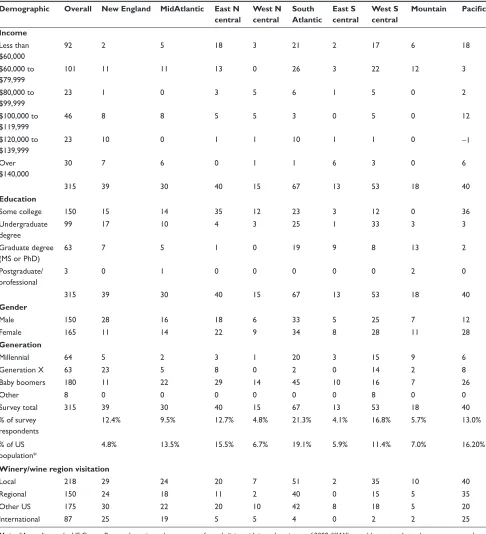
Table 1 presents the overall and regional demographics. Forty-eight percent of the respondents were male (n = 150) and 52% were female (n = 165). Respondents had high levels of education, with 65% of the sample having earned at least a four-year college degree. Thirty percent of the respondents had an annual household income of less than $60,000, while 21% had incomes of over $120,000. The average age of respondents was 43 years and they reported an average of 20 years consuming wine. Overall, the sociodemographic background of the respondents (middle-aged, educated, and with higher incomes) mirrored the profile of wine consumers in general,64 and was similar to data collected in a survey conducted by Barber.37
Fifty-seven percent of the respondents were baby boom-ers, with millennials and generation X each at 20%. Millenni-als had consumed wine on average for four years, generation X for 15 years and baby boomers for 31 years. The average number of bottles (750 mL) purchased per respondent was nine per month, and the average total amount spent during this same period was $178, or $20 per bottle. Twelve percent of the respondents were from New England, 10% from the mid-Atlantic, 21% from the South Atlantic, and 17% from the West South Central.
When asked how much more they would be willing to pay for tasting fees at a winery, to be sure that the winery would have the least possible negative environmental effects, 27% of the respondents said they would not be willing to pay more, while 58% said they would be willing to pay a 30% premium. Finally, when asked if they would be willing to pay an environmental travel fee to protect a wine region, 30% of the respondents said they would not be willing to pay such a fee, while 57% said they would.
Interestingly, there was a significant difference between males and females when asked how much more they would be willing to pay for wine to be sure that it has the least possible negative environmental impact t(235) = –7.99,
P 0.01. Females stated they would be willing to pay a 77% premium, while males reported only a 50% premium, sup-porting the work by Hunter and colleagues53 and Zelezny and colleagues54 who found females to be more environmentally sensitive and concerned.
environmental subjective knowledge, involvement and attitude
For subjective knowledge, 67 (22%) reported low envi-ronmental knowledge, 183 (58%) some envienvi-ronmental knowledge, and 65 (21%) high environmental knowledge. Respondents’ overall reported moderate levels of subjec-tive environmental knowledge (M = 4.6, SD = 1.1, on a seven-point scale), indicated they considered themselves somewhat knowledgeable about environmental issues. These results were similar to a study by Amyx and colleagues42 where respondents reported moderate subjective knowl-edge. Interestingly, respondents considered themselves more knowledgeable than friends (M = 5.1, SD = 1.2) and much less so than environmental experts (M = 3.8, SD = 1.1). There were no differences in the overall response for males versus females (both M = 4.6); however, males did consider themselves much more knowledgeable when compared with friends (M = 5.6, SD = 0.9) than did females (M = 4.7, SD = 1.2).
did males (M = 4.3, SD = 1.9). The results were expected, based on the research of Hunter et al.53
There were generational differences in attitude. Overall, millennials had a strong attitude toward environmental issues (M = 5.5, SD = 0.9), followed by baby boomers (M = 5.0, SD = 0.8). Millennials felt very strongly that the balance of
nature is very delicate and easily upset (M = 5.5, SD = 1.1). This supported studies by Howell and Laska that younger people were concerned with environmental issues, as were baby boomers.47,65
When considering the region of the US where respondents lived, overall environmental attitude was strongest in the East
Table 1 Respondent demographics overall and by region (n = 315)
Demographic Overall New England MidAtlantic East N central
West N central
South Atlantic
East S central
West S central
Mountain Pacific
Income
Less than $60,000
92 2 5 18 3 21 2 17 6 18
$60,000 to $79,999
101 11 11 13 0 26 3 22 12 3
$80,000 to $99,999
23 1 0 3 5 6 1 5 0 2
$100,000 to $119,999
46 8 8 5 5 3 0 5 0 12
$120,000 to $139,999
23 10 0 1 1 10 1 1 0 -1
Over $140,000
30 7 6 0 1 1 6 3 0 6
315 39 30 40 15 67 13 53 18 40
Education
some college 150 15 14 35 12 23 3 12 0 36
Undergraduate degree
99 17 10 4 3 25 1 33 3 3
graduate degree (Ms or PhD)
63 7 5 1 0 19 9 8 13 2
Postgraduate/ professional
3 0 1 0 0 0 0 0 2 0
315 39 30 40 15 67 13 53 18 40
Gender
Male 150 28 16 18 6 33 5 25 7 12
Female 165 11 14 22 9 34 8 28 11 28
Generation
Millennial 64 5 2 3 1 20 3 15 9 6
generation X 63 23 5 8 0 2 0 14 2 8
Baby boomers 180 11 22 29 14 45 10 16 7 26
Other 8 0 0 0 0 0 0 8 0 0
survey total 315 39 30 40 15 67 13 53 18 40
% of survey respondents
12.4% 9.5% 12.7% 4.8% 21.3% 4.1% 16.8% 5.7% 13.0%
% of Us population*
4.8% 13.5% 15.5% 6.7% 19.1% 5.9% 11.4% 7.0% 16.20%
Winery/wine region visitation
Local 218 29 24 20 7 51 2 35 10 40
Regional 150 24 18 11 2 40 0 15 5 35
Other Us 175 30 22 20 10 42 8 18 5 20
International 87 25 19 5 5 4 0 2 2 25
North Central region (M = 5.4, SD = 1.3), with 53% of its respondents having “high” environmental attitudes, followed by the Mountain region (M = 5.0, SD = 1.4), the Pacific region (M = 4.9, SD = 1.3), and the New England region (M = 4.7, SD = 1.3). Respondents in the Pacific region found humans are severely abusing the environment (M = 5.8, SD = 1.3), while respondents in the Mountain region reported humans have the right to modify the natural environment to suit their needs (M = 5.9, SD = 1.4). Finally, those respondents from the West North Central region stated they were con-cerned there will not be enough water to meet their demands (M = 5.5, SD = 2.0).
Wine tourism
When respondents were asked how wineries and wine tourism influenced the environment, respondents believed strongly that wine tourism brings new income to a community and improves its economy (M = 6.1, SD = 0.9); at the same time, respondents also believed strongly that wine tourism must protect the natural and cultural environment (M = 5.3, SD = 0.9) and that proper wine tourism development requires wildlife and natural habitats be protected at all times (M = 5.1, SD = 1.0).
When respondents were asked about what they thought were the main issues with wine tourism, 63 (20%) considered that wine tourism created a scarcity of water, 126 (40%) viewed wine tourism as impacting the surrounding communi-ties located near the winery/region, and 79 (25%) considered wine tourism to uses excessive amounts of energy. When
considering these issues by region, 93% of the respondents in the West North Central region thought that wine tourism created a scarcity of water, 63% in the East North Central region, and 52% in the New England region.
Multivariate analysis of variance
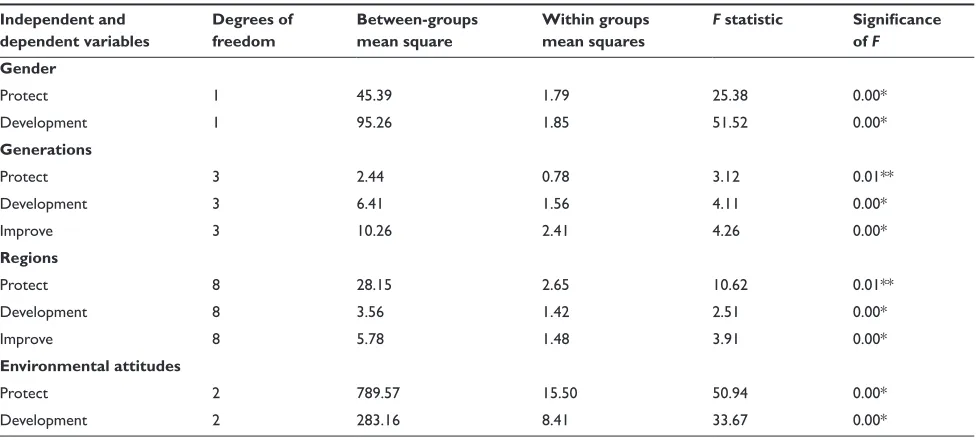
The results of the MANOVA testing indicated there were significant differences found by gender (Wilks’ Λ = 0.922, F’(4, 174) = 3.69, P 0.01), generations (Wilks’ Λ= 0.841, F’(12, 460) = 2.60, P 0.01), region (Wilks’ Λ= 0.496, F’(32, 643) = 4.21, P 0.01), subjective knowledge (Wilks’ Λ= 0.914, F’(8, 348) = 1.99, P 0.05), and attitude (Wilks’ Λ = 0.532, F’(8, 348) = 16.16, P 0.00) on the dependent measures. Environmental involvement (the first research question) and subjective environmental knowledge (the second research question) were not significant. Analyses of variances (ANOVA) on each dependent variable were conducted as followup tests using the Bonferroni inequality approach, and are shown in Table 2.
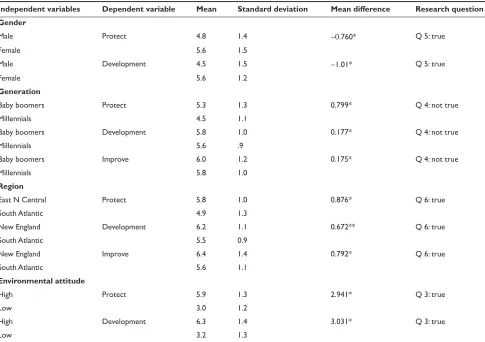
For the ANOVA on the gender, generation, region, and attitude independent variables, three dependent variables were significant. Post hoc analyses to the univariate ANOVA for the “protect”, “development”, and “improve” scores consisted of conducting pairwise comparisons to find which independent variable, ie, gender, generation, region, or atti-tude most strongly influenced the dependent variables. Each pairwise comparison was tested using the Scheffé method (see Table 3).
Table 2 AnOVA results
Independent and dependent variables
Degrees of freedom
Between-groups mean square
Within groups mean squares
F statistic Significance
of F
Gender
Protect 1 45.39 1.79 25.38 0.00*
Development 1 95.26 1.85 51.52 0.00*
Generations
Protect 3 2.44 0.78 3.12 0.01**
Development 3 6.41 1.56 4.11 0.00*
Improve 3 10.26 2.41 4.26 0.00*
Regions
Protect 8 28.15 2.65 10.62 0.01**
Development 8 3.56 1.42 2.51 0.00*
Improve 8 5.78 1.48 3.91 0.00*
Environmental attitudes
Protect 2 789.57 15.50 50.94 0.00*
Development 2 283.16 8.41 33.67 0.00*
Table 3 Post hoc results
Independent variables Dependent variable Mean Standard deviation Mean difference Research question Gender
Male Protect 4.8 1.4 -0.760* Q 5: true
Female 5.6 1.5
Male Development 4.5 1.5 -1.01* Q 5: true
Female 5.6 1.2
Generation
Baby boomers Protect 5.3 1.3 0.799* Q 4: not true
Millennials 4.5 1.1
Baby boomers Development 5.8 1.0 0.177* Q 4: not true
Millennials 5.6 .9
Baby boomers Improve 6.0 1.2 0.175* Q 4: not true
Millennials 5.8 1.0
Region
east n central Protect 5.8 1.0 0.876* Q 6: true
south Atlantic 4.9 1.3
new england Development 6.2 1.1 0.672** Q 6: true
south Atlantic 5.5 0.9
new england Improve 6.4 1.4 0.792* Q 6: true
south Atlantic 5.6 1.1
Environmental attitude
high Protect 5.9 1.3 2.941* Q 3: true
Low 3.0 1.2
high Development 6.3 1.4 3.031* Q 3: true
Low 3.2 1.3
Note: *Mean difference is significant at the P 0.00 level; **Mean difference is significant at the P 0.02 level; ***Mean difference is significant at the P 0.05 level.
gender
For “development”, there was a significant difference between males and females, with female respondents having stronger beliefs that proper wine tourism development requires that wildlife and natural habitats be protected at all times (M = 5.6, SD = 1.2) compared with males (M = 4.5, SD = 1.5), with the mean differences = –1.01, P 0.00.
generation
For the dependent variable “protect”, there was a significant difference between millennials and baby boomers. Baby boomers reported stronger beliefs that wine tourism must protect the cultural environment (M = 5.2, SD = 1.3) than millennials (M = 4.5, SD = 1.1), with the mean differences = 0.799, P 0.00. For “development”, there was a significant difference between millennials and baby boom-ers. Baby boomers reported stronger beliefs that proper wine tourism development requires wildlife and natural habitats be protected at all times (M = 5.8, SD = 1.0) than millennials (M = 5.6, SD = 0.9), with the mean differences = 0.177 (P 0.00).
Region
For “protect”, there was a significant difference between East North Central consumers and those from the South Atlantic, with East North Central respondents having stronger beliefs that wine tourism must protect the cultural environment (M = 5.8, SD = 1.0) compared with South Atlantic (M = 4.9, SD = 1.3), with the mean differences = 0.876, P 0.00. For the dependent variable “development”, consumers from New England reported that proper wine tourism development requires wildlife and natural habitats to be protected at all times (M = 6.2, SD = 1.1) compared with South Atlantic (M = 5.5, SD = 0.9), with the mean differences = 0.672,
P 0.01. Finally, for the dependent variable “improve” those consumers from New England reported that wine tourism is good for a community’s economy (M = 6.4, SD = 1.4) compared with South Atlantic (M = 5.6, SD = 1.1), with the mean differences = 0.792, P 0.00.
environmental attitude
(M = 5.9, SD = 1.3) and those with “low” or weak attitudes (M = 3.0, SD = 1.2) that wine tourism must protect the cultural environment, with a mean difference of 2.941,
P 0.00. For “development”, there was a significant differ-ence between those respondents with “high” environmental attitudes and those with “low” attitudes. “High” attitude respondents reported stronger beliefs that proper wine tourism development requires that wildlife and natural habitats be protected at all times (M = 6.3, SD = 1.4) than “low” involved (M = 3.2, SD = 1.3), with the mean differ-ences = 3.031, P 0.00.
Interaction
Of greater interest were the results of the interaction test-ing, with the interaction between generation, region, and gender being significant (Wilks’ Λ = 0.895, F’(8, 348) = 2.49, P 0.01). Post hoc analysis indicated that female baby boomers from New England reported significantly stronger beliefs that proper wine tourism development requires wild-life and natural habitats to be protected at all times (M = 6.8, SD = 1.3) than did male baby boomers from the Mountain region (M = 3.0, SD = 1.1). At the same time, millennial males from the West North Central region (North Dakota, South Dakota, Nebraska, Kansas, Minnesota, Iowa, Missouri) reported significantly stronger beliefs that wine tourism must be developed in harmony with the cultural environ-ment (M = 7.0, SD = 0 .9) than did female millennials from the Pacific region (M = 3.0, SD = 1.3). Finally, female baby boomers from the New England region reported significantly stronger beliefs that wine tourism must be developed in har-mony with the natural and cultural environment (M = 6.8, SD = 1.4) than did male baby boomers from the Mountain region (M = 5.0, SD = 1.0).
Discussion
This study contributes to wine tourism research by inves-tigating the usefulness of selective marketing techniques in wine destination management. The fundamental idea of the selective marketing approach is to attract certain kinds of wine tourists to the destination, ie, those who behave in an environmentally friendly manner. Selective marketing has been proposed by a number of authors in the past, but its feasibility has been hampered by inconsistent findings of research on the effects of demographics and personal-ity variables on environmental concerns. The results of this study’s multivariate analysis indicated that there were significant differences in respondents’ beliefs about how wine tourism should impact a community, particularly when
gender, age, region of the US, and environmental attitude were considered.
As proposed by the fifth research question, gender differ-ences were found, with female respondents having stronger beliefs that wine tourism development requires wildlife and natural habitats to be protected at all times. This supports results from the studies by Arcury and Torgler and colleagues where they found gender was an important determinant of environmental attitudes and behavior,36,44 with Hunter and colleagues53 and Zelezny and colleagues54 indicating that females tend to exhibit both higher concern and participate more frequently in green behaviors. In fact, females reported much stronger attitudes toward environmental issues. These results contradict those of Guagnano and Markee,11 who found that environmental issues were confusing and hard to understand for females.
There were generational differences, with baby boomers reporting stronger beliefs when compared with millennials, which was contrary to the fourth research question. Baby boomers reported that proper wine tourism development requires wildlife and natural habitats be protected at all times and that wine tourism must protect the cultural envi-ronment. This result was expected, given that Lee et al found many baby boomers have voiced strong opinions about the need for clean air, clean water, a cleaner environment, and making the earth a cleaner and safer place.47 However, this result is contrary to that found by Tulgan and Martin46 who reported that millennials were more environmentally concerned.
The sixth research question was found to be true, as expected. For the three dependent variables, “protect”, “development”, and “improve”, the South Atlantic region found these variables less important than either the New England (“development” and “improve”) and the East North Central (“protect”) regions. Despite limited research on regions of the US, this difference is likely to be due to the different values and political views that are held in this region of the country.
Finally, the third research question was found to be true. The respondents with “high” or strong environmental atti-tudes believed that tourism destinations, particularly wine regions, need to consider the impact on the local community. These results support the results by Barber and colleagues6 who found that consumers felt strongly that wineries were not doing enough to protect the local environment.
where the respondent lives. Thus, comparison of studies done in similar geographic regions should produce similar findings, while the opposite may be true when comparing results from different regions. For example, female baby boomers from New England reported significantly stronger beliefs that proper wine tourism development requires wild-life and natural habitats to be protected at all times than did male baby boomers from the Mountain region. The regional difference was not expected because results for overall envi-ronmental attitude were stronger in the Mountain region than in the New England region; however the results appear to be modified when considering gender and generation together. Females reported stronger overall environmental attitudes than males.
Managerial implications
Those who promote wine tourism destinations need to rec-ognize marketing as the management of change. This can be accomplished through a sound selective marketing strategy which is considered to be an integral part of overall market-ing. To provide target segments with appropriate products, wine producers, and destination managers must tap into the reasons why consumers choose to purchase, drink wine, or visit a wine region.
These reasons could then guide destination marketing and wine producers to meet consumer expectations appro-priately, thereby taking into account the cues that packag-ing or a destination transmits (eg, savpackag-ing/recyclpackag-ing water in wine production or reduced chemical pesticides usage), instead of just focusing on positioning the product through short-lived messages send out by the media. For example, an advertisement for a tourist destination may target female travelers with discussion and visual cues on wineries in the area that promote water conservation and the protection of the region’s natural and culture heritage.
Millennials strongly agreed that traveling to wine regions was for tasting wine and visiting the winery. They also had strong attitudes towards the impact of wine tourism and would pay for an environmental tasting or visitation fee. Pairing their attitude and willingness to pay an environmental fee with their reasons for visiting a wine region, newly formed environmental friendly wine trails may increase demand for environmentally friendly wines, thus enhancing their business. This could be accomplished though connections to social networking sites with visual feed on the environmental concerns and attitudes of the destination, as well as the environmental practices of wineries, which could draw consumers into
the wine regions which offer positive experiences that in turn benefit particular wine regions. In addition, perhaps marketers involved in creating and distributing marketing and promotional materials about wines, wineries, and wine tourism regions via paper or electronic media could give more attention to the ecologically sound practices involved in the businesses. Therefore, rather than simply listing a particular winery “trail” in a region, the emphasis could be on the aspects of the wine industry that would include a “green” winery tour.
Another approach would be to profile light, medium, and heavy tourism travelers in an attempt to assess whether an expenditure-based segmentation approach could be beneficial to wine producers and regions. It has been demonstrated in other studies that wine consumers would be willing to pay more for an environmentally friendly wine.6,66 Thus an impor-tant part of this approach would be developing new strategies for ecological marketing by the redirecting of consumer needs and wants toward environmentally friendly wine products, such as organic wines, and reorientation of the product mix through repackaging and relabeling, all connected to the wine region destination and the use and application of environmental practices. Those promoting wine tourism may need to partner with those promoting destination regions and other tourism attractions to place further focus on the envi-ronmentally and socially sustainable aspects of the industry, thereby creating a win-win situation for regional tourism and the wine industry. Another strategy might be to work with local produce sales outlets to promote the ecologically friendly aspects of wine and other agricultural products such as those working to foster sustainable agriculture in various areas of the country.
Disclosures
The authors report no conflict of interest in this work.
References
1. Hart R. Growth, environment and culture – encompassing competing ideologies in one ‘new growth’ model. Ecol Econ. 2002;40(2): 253–267.
2. European Commission. Protecting the environment and economic growth: trade-off or growth-enhancing structural adjustment? 2008. Available from: http://ec.europa.eu/economy_finance/publications/ publication7726_en.pdf. Accessed on April 15, 2009.
3. Dunlap R. The state of environmentalism in the US Gallup News Service. 2007. Available from: http://www.gallup.com/poll/27256/State-Environmentalism-US.aspx. Accessed on April 14, 2009.
4. GFK. Americans reach environmental turning point: Companies need to catch up. Custom Research North America. 2007 Available from: http:// www.prnewswine.com/cgi-bin/stories.pl?acct=104&story=/www. story/08-22-207/00046497348$edate#linktoppagebottom. Accessed on August 25, 2008.
5. Vermeir I, Verbeke W. Sustainable food consumption: Exploring the consumer attitude-behavior intention gap. J Agric Environ Ethics. 2006;19:169–194.
6. Barber N, Taylor C, Strick S. Wine consumers environmental knowl-edge and attitudes: Influence on willingness to purchase. International Journal of Wine Research. 2009;1(1):59–72.
7. Diamantopoulos A, Schlegelmilch BB, Sinkovics RR, Bohlen GM. Can socio-demographics still play a role in profiling green consumers? A review of the evidence and an empirical investigation. J Bus Res. 2003;56(6):465–480.
8. Kilbourne WE, Beckmann SC. Review and critical assessment of research on marketing and the environment. Journal of Marketing Management. 1998;14(6):513–532.
9. Prakash A. Greening the firm – the politics of corporate environmental-ism. Cambridge, MA: Cambridge University Press; 2000.
10. Samdahl DM, Robertson R. Social determinants of environmen-tal concern: Specification and tests of the model. Environ Behav. 1995;21(1):57–81.
11. Guagnano G, Markee N. Regional differences in the sociodemo-graphic determinants of environmental concern. Popul Environ. 1995;17(2):135–149.
12. Jones RF, Dunlap RE. The social bases of environmental concern: Have they changed over time. Rural Sociol. 1992;57(1):28–47.
13. Mohai P. Women and the environment: An examination of the gender gap in environmental concern and activism. Soc Nat Resour. 1992;5:1–19.
14. Kollmuss A, Agyeman J. Mind the gap: why do people act environ-mentally and what are the barriers to pro-environmental behavior? Environmental Education Research. 2002;8(3):239–260.
15. Dolnicar S. Insight into sustainable tourists in Austria: Data based a priori segmentation approach. Journal of Sustainable Tourism. 2004;12(3):209–218.
16. Hall MC, Johnson G, Mitchell R. Wine tourism and regional develop-ment. In: Hall MC, Sharples L, Cambourne B, editors. Wine Tourism Around the World: Development, management and markets. Oxford, UK: Butterworth-Heinemann; 2000. p. 196–225.
17. Marshall R, Cordano M, Silverman M. The greening of the Californian wine industry: Implications for regulators and industry associations. Journal of Wine Research. 2005;16(2):151–169.
18. Kazim A. Towards a wider adoption of environmental responsibility in the hotel sector. International Journal of Hotel and Tourism Administra-tion. 2007;8(2):25–49.
19. Baughman AT, Brown EJ, Brummet W, Dramko JM, Goldstein JH, Hooper BE. California Winemaking Impact Assessment. Master’s Thesis. Santa Barbara, CA: University of California, Santa Barbara; 2000.
20. Marshall R, Cordano M, Silverman M. Exploring individual and institutional drivers of proactive environmentalism in the US wine industry. Business Strategy and the Environment. 2005;14:92–109. 21. Inskeep E. Tourism Planning: An integrated and sustainable
develop-ment approach. New York, NY: Wiley; 1991.
22. McKenney A. Number of US Wineries Tops 6,100. Wine Busi-ness Monthly. February 19, 2009. Available from: http://www. winebusiness.com/wbm/?go=getArticle&dataId=62895. Accessed on July 15, 2009.
23. Hall M, Macionis N. Wine tourism in Australia and New Zealand. In: Butler R, Hall M, Jenkins J, editors. Tourism and Recreation in Rural Areas. Chichester, UK: Wiley; 1998. p. 197–224.
24. Getz D. Explore Wine Tourism: Management, development and destina-tions. New York; NY: Cognizant;2000.
25. Thach L. Trends in wine tourism. Wine Business Monthly, August 15, 2007. Available from: http://www.winebusiness.com/wbm/ ?go=getArticle&dataId=50125. Accessed on July 19;2009.
26. Poitras L, Getz D. Sustainable wine tourism: The host community perspective. Journal of Sustainable Tourism. 2006;14(5):425–448. 27. Dodd T, Yuan J, Adams C, Kolyesnikova N. Motivations of young
people for visiting wine festivals. Event Management. 2006:10:1–11. 28. Frochot I. Wine tourism in France: A paradox? In: Hall M, Sharples L,
Cambourne B, Macionis N, editors. Wine Tourism Around the World: Development, management and markets. Oxford, UK: Butterworth– Heinemann; 2000. p.67–80.
29. Hall M. Wine tourism in New Zealand. In: Kearsley G, editor. Proceed-ings of Tourism Down Under II: Towards a more sustainable tourism. Dunedin, New Zealand: Centre for Tourism, University of Otago; 1996. p.109–119.
30. Ali-Knight J, Charters S. Education in a West Australian wine tourism context. International Journal of Wine Marketing. 1999;11(1):7–18. 31. Isaykina E. Defining the Target Market and Motivations for Visiting
the Grapefest Wine Festival in Grapevine, Texas. Lubbock, TX: Texas Tech University; 2001.
32. Getz D, Brown G. Critical success factors for wine tourism regions: A demand analysis. Tourism Management. 2006;27(1):146–158. 33. Nowak L, Thach L, Olsen J. Wowing the Millennials: Creating brand
equity in the wine industry. Journal of Product and Brand Management. 2006;15(5):316–323.
34. Sharpley R. Ecotourism: A consumption perspective. Journal of Ecotourism. 2006;5(1/2):7–22.
35. Fraj E, Martinez E. Environmental values and lifestyles as determin-ing factors of ecological consumer behaviour: An empirical analysis. Journal of Consumer Marketing. 2006;36(3):133–144.
36. Torgler B, Garcia-Valinas M, Macintyre A. Differences in preference towards the environment: The impact of a gender, age and parental effect. Discussion paper 221. Brisbane, Australia: QUT School of Economics and Finance; 2008:1–37.
37. Barber N. How Self-Confidence and Knowledge Effects the Sources of Information Selected During Purchase Situations. Published disserta-tion. Lubbock, TX: Texas Tech University; 2008.
38. Kolyesnikova N, Dodd TH, Wilcox JB. Gender differences as anteced-ents to reciprocal consumer behaviour. Journal of Consumer Marketing. 2009;26(3):200–213.
39. Yuan J, So SI, Chakravarty S. To wine or not to wine: Profiling a wine enthusiast for a successful list. Journal of Nutrition in Recipe and Menu Development. 2005;3(3/4):63–79.
40. Zaichkowsky JL. Measuring the involvement construct. J Consum Res. 1985;12:341–352.
41. Martin B, Simmintiras A. Determination of green purchase behaviour: A review of the literature and an agenda for further research, in Market-ing: Unity and diversity, Proceedings of the 1994 Marketing Educators Group Conference. 1994:628–637.
International Journal of Wine Research
Publish your work in this journal
Submit your manuscript here: http://www.dovepress.com/international-journal-of-wine-research-journal
The International Journal of Wine Research is an international, peer-reviewed open-access, online journal focusing on all sci-entific aspects of wine, including: vine growing; wine elabora-tion; human interaction with wine; and health aspects of wine. The journal provides an open access platform for the reporting
of evidence based studies on these topics. The manuscript management system is completely online and includes a very quick and fair peer-review system, which is all easy to use. Visit http://www.dovepress.com/testimonials.php to read real quotes from some of our published authors.
Dove
press
43. Eagly A, Chaiken S. The Psychology of Attitudes. New York, NY:Harcourt Brace; 1993.
44. Arcury T. Environmental attitude and environmental knowledge. Hum Organ. 1990;49(4):300–304.
45. Bradley J, Waliczek T, Zajicek J. Relationship between environmental knowledge and environmental attitude of high school students. J Environ Educ. 1999;30:17–22.
46. Tulgan B, Martin CA. Managing Generation Y: Global citizens born in the late seventies and early eighties. Amherst, MA: HRD Press; 2001.
47. Lee E, Mathur A, Moschis G, Strautman J. The Maturing Marketplace: Buying habits of baby boomers and their parents. Westport, CT: Quorum Books; 2000.
48. Mohai P, Twight BW. Age and environmentalism: An elaboration of the Buttel model using national survey evidence. Soc Sci Q. 1987;68(4):798–815.
49. Chang C. The influence of masculinity and femininity in different advertising processing contexts: An accessibility perspective. Sex Roles. 2006;55(5):345–356.
50. Palan KM. Gender identity in consumer behaviour research: A literature review and research agenda. Academy of Marketing Science Review. 2001;10:1–31.
51. Henderson KA. One size doesn’t fit all: The meanings of women’s leisure. Journal of Leisure Research. 1996;28(3):139–154.
52. Davidson DJ, Freudenburg WR. Gender and environmental risk con-cerns: A review and analysis of available research. Environ Behav. 1996;28(3):302–339.
53. Hunter L, Hatch A, Johnson A. Cross-national gender variation in environmental behaviours. Soc Sci Q. 2004;85:677–694.
54. Zelezny LC, Chua PP, Aldrich C. Elaborating on gender differences in environmentalism. J Soc Issues. 2000;56:443–457.
55. US Census. United States Department of Commerce, Regional Des-ignations. 2008. Available from: http://www.census.gov/. Accessed on July 8, 2009.
56. Leiserowitz A. Global Warming in the American mind: The roles of affect, imagery, and worldviews in risk perception, policy preferences and behavior. Published dissertation. Eugene, OR: University of Oregon; 2003.
57. Environmental Protection Agency. Effects of acid rain – forests. Avail-able from: http://www.epa.gov/acidrain/effects/forests.html. Accessed July 22, 2009.
58. Reiner DM, Curry TE, de Figueiredo MA, et al. American exception-alison? Similarities and differences in national attitudes toward energy policy and global warning. Environ Sci Tech. 2006;40:2093–2098. 59. Dodd T, Laverie D, Wilcox J, Duhan D. Differential effects of
experi-ence, subjective knowledge, and objective knowledge on sources of information used in consumer wine purchasing. Journal of Hospitality and Tourism Research. 2005;29(1):3–19.
60. Milfont T, Duckitt J. The structure of environmental attitudes: A first- and second-order confirmatory factor analysis. J Environ Psychol. 2004;24:289–303.
61. Dunlap R, Van Liere KD, Mertig A, Jones RE. Measuring endorsement of the new ecological paradigm: A revised NEP scale. J Soc Issues. 2000;56:425–442.
62. Churchill GA. Basic Marketing Research. 5th ed. Cincinnati, OH: South-Western; 2004.
63. Hair J, Anderson R, Tatham R, Black W. Multivariate Data Analysis. 5th ed. Upper Saddle River, NJ: Prentice Hall; 1998.
64. Motto K, Fisher L. US Wine Demographics Report. St. Helena, CA: The Wine Business Center; 2000.
65. Howell SE, Laska LB. The changing face of the environmental coalition: A research note. Environ Behav. 1992;24:134–144.