DOI:10.21276/ijprhs.2019.05.03
Surya Kumari et al. CODEN (USA)-IJPRUR, e-ISSN: 2348-6465
Original Article
Formulation and Evaluation Fast Dissolving Tablet of
Hibiscus rosa-sinensis
Leaf Mucilage as
Superdisintegrant
Ch. Surya Kumari
1,*, Subhranshu Panda
2,*, S Suresh Babu G Durgarao
1, K Chinnababu
1,
K Venketeswera Rao
11 Pharmaceutics Research Lab,K L College of Pharmacy, Koneru Lakshmaiah Education Foundation, KL Deemed to be
University, Guntur (Dt.), Andhra Pradesh-522 502, India.
2 Dept. of Pharmaceutics, Vikas College of Pharmacy, Vissannapeta, Krishna (Dt.), Andhra Pradesh-521 215, India.
A R T I C L E I N F O
A B S T R A C T______
International Journal of Pharma Research and Health Sciences
Available online at
www.pharmahealthsciences.net
Received: 10 Oct 2019 Accepted: 29 Oct 2019
Corresponding author * Ch Surya Kumari, Pharmaceutics Research Lab, K L College of Pharmacy, Koneru Lakshmaiah Education Foundation, KL Deemed to be
University, Guntur (Dt.), Andhra Pradesh-522 502, India., E-mail: [email protected]
Subhranshu Panda Vikas College of Pharmacy,
Vissannapeta, Krishna (Dt.), Andhra Pradesh-521 215, India
Natural polymers remain attractive primarily because they are natural products of plants, readily available, inexpensive and capable of multitude of chemical modification. Leaves of Hibiscus rosa-sinensis Linn (family: Malvaceae) contains high proportion of mucilage which can be used as additives in pharmaceutical formulations. The objective of the studide to extract mucilage from the leaves Hibiscus rosa-sinensis and examine the disintegrant property of the dried mucilage to assess its functionality as a pharmaceutical excipient. The Present work was carried out to study the disintergant property of Hibiscus rosa-sinensis mucilage using Imipramine as a model drug. The present work was carried out to develop fast dissolving tablet of Imipramine using natural disintegrant isolated from Hibiscus rosa-sinensis leaves and its efficiency was compared with synthetic superdisintegrant like crosspovidone. Hibiscus rosa-sinensis mucilage was isolated and characterised for its identification by chemical test and micrometric properties. Fast dissolving tablets of Imipramine were formulated by direct compression method using Hibiscus rosa-sinensis mouth feel and compressibility and aspartame as sweetener. The formulated tablets were evaluated for their pre and post compression parameters like tablet hardness, thickness, % friability, wetting time which was found to be in permissible limits. The in vitro disintegration time of tablet formulations containing 6% of mucilage was found to be 24 sec and that of tablet containing 4% of crosspovidone was 42secs. Based upon in vitro disintegration time in vitro drug release studies put and in between were carried out in phosphate buffer p H 6.8 which showed 100% drug release in 12 minutes of F3 formulation containing 6% of mucilage. Stability studies performed on F3 formulation indicated that the prepared tablets remain stable for the period of 90 days and showed no change in in-vitro drug release pattern.
Key words: Imipramine, Hibiscus rosa-sinensis, superdisintegrant, mucilage, Fast dissolving
1. INTRODUCTION
Oral route of administration still continues to be the most preferred route due to its diverse advantages including ease of administration, precise dosage, self - medication, versatility, pain avoidance leading to high level of patient compliance [1]. Tablets and capsules are the most popular dosage forms, but main drawback of such dosage form is dysphasia or difficulty in swallowing. This leads to the development of novel dosage forms such as fast disintegrating/ dissolving tablets (FDT). FDT are a solid single-unit dosage forms that are placed in mouth, allowed to disperse/dissolve in the saliva without the need of water and provides a quick onset of action [2]. Some drugs are absorbed from mouth, pharynx and esophagus as the saliva passes down into the stomach. In such cases bioavailability of drug is significantly greater than those observed from conventional tablet dosage form. The Centre for Drug Evaluation and Research (CDER), US (FDA) defined FDT as “a solid dosage form containing medicinal substance or active ingredient which disintegrates rapidly usually within a matter of seconds when placed upon the tongue.” The disintegration time for FDTs generally ranges from several seconds to about a minute [3-5]. The bioavailability of some drugs may be increased due to absorption of drugs in oral cavity and also due to pre gastric absorption of saliva containing dispersed drugs that pass down into the stomach. Recently immediate release tablets have started gaining popularity and acceptance as a drug delivery system, mainly because they are easy to administer, has quick onset of action is economical and lead to better patient compliance [6, 7]. They are also a tool for expanding markets, extending product life cycles and generating opportunities. In the formulation of FDT, superdisintegrants are added to facilitate the breakup or disintegration of tablet content into smaller particles that can dissolve more rapidly than in the absence of disintegrants. Common superdisintegrants used are croscarmellose sodium (Vivasol, Ac‐Di‐Sol), crospovidone (Polyplasdone), carmellose (NS‐300), carmellose calcium (ECG‐505), sodium starch glycolate (SSG) etc. Similarly, various natural polymers like gum karaya, starch, agar, plantago ovata mucilage have been used in the formulation of FDT. Mucilage of natural origin is preferred over semisynthetic and synthetic substances because they are comparatively cheaper, abundantly available, non irritating and non toxic in nature. Hence, in the present study, mucilage of Hibiscus rosa-sinensis linn was used to develop FDT of the selected model drug Imipramine. Imipramine is a tricyclic antidepressant with general pharmacological properties similar to those of structurally related tricyclic antidepressant drugs such as Amitriptyline and Doxepin A tertiary amine, Imipramine inhibits the reuptake of serotonin more so than most secondary amine tricyclics, meaning that it blocks the reuptake of neurotransmitters serotonin and nor adrenaline
almost equally. It binds the Sodium-dependent serotonin transporter and sodium-dependent nor adrenaline transporter, preventing or reducing the reuptake of nor epinephrine and serotonin by nerve cells. Peak plasma levels are reached in 2 to 8 hours, and plasma half-life ranges from 11 to 25 hours. It is excreted in the urine, mainly in the form of its metabolites, either free or in conjugated form; small amount are excreted in the faeces via the bile. Imipramine is one of the less sedating tricyclics and has moderate antimuscarinic activity. Imipramine is used for the treatment of nocturnal enuresis in children. Tricyclic anti- depressants are not recommended under 6 years of age.
2. MATERIAL AND METHODS Material
Imipramine was received as a gift sample from Biocon Pharmaceutical, Bangalore , India. Crospovidone, mannitol, and Avicel were purchased from Lobe Chem Ltd., Mumbai, India. Aspartame was purchased from Himedia Lab Pvt. Ltd., Mumbai, India. Hibiscus rosa-sinensiswas collected from Vikas herbal garden. All other chemicals used were of analytical grade and were used without further purification. Methods
Isolation and Characterization of Mucilage form Hibiscus rosa-sinensis
The leaves of Hibiscus rosa-sinensis linn were collected, from Chitkara University, Punjab. The fresh Hibiscus rosa-sinensis linn leaves were collected and washed with water to remove dirts and debries [8]. Leaves were powdered and soaked in water for 5-6 hrs, boiled for 30 minutes and left stand for 1hours to allow complete release of mucilage into water. The mucilage was extracted using multi-layer muslin cloth bag to remove the marc from the solution. Acetone (in the volumes of three times to the volume of filtrate) was added to precipitate the mucilage. The mucilage was separated, dried in an oven at <50º C, collected, ground, passed through #80 sieve and stored in desiccators at room temperature for further use. Dried powdered mucilage was characterized for various physicochemical properties like percentage yield, particle size, swelling index, angle of repose etc.
Pre-formulation studies
Grinding in smooth mortar can effect mixing. The mixtures were then placed in the sample holder of the instrument and the spectra were taken. The spectra were run from 3500 cm-1 to500 cm-cm-1 wave number. FT-IR spectrum of Imipramine Hydrochloride was compared with FT-IR spectrum of Imipramine Hydrochloride with polymer. The pure drug and the drug with excipients were scanned separately. Disappearance of Imipramine Hydrochloride peaks or shifting of peak in any of the spectra was studied [9, 10]. Preparation of standard calibration curve of Imipramine Standard calibration curve of Imipramine hydrochloride was prepared by dissolving accurately weighed 10 mg of imipramine hydrochloride in phosphate buffer (pH 6.8) solution in a 100 ml volumetric flask and the volume was made up to 100 ml by using phosphate buffer (pH 6.8) solution to obtain a stock solution of 100 μg/ml. From stock solution, appropriate aliquots were pipetted into different 10ml volumetric flasks and volumes were made up to 10 ml with phosphate buffer (pH 6.8) solution so as to get drug concentrations of 2, 4, 6, 8 and 10 μg/ml. The absorbance of these drug solutions were measured at 250.8 nm. This procedure was performed in triplicate to validate the calibration curve.
Formulation of Fast Dissolving Tablets of Imipramine using Hibiscus rosa-sinensis mucilage
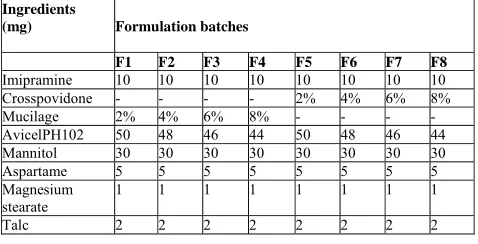
Fast dissolving tablets of Imipramine were prepared by direct compression method, in this powder blends of active ingredient and suitable excipient, which flow uniformly in the die cavity and forms a firm compact was prepared as per the composition given in the table 1 [11, 12]. Powdered drug was mixed with Hibiscus rosa-sinensis mucilage as superdisintegrants in 2%, 4%, 6% and 8%, microcrystalline cellulose as diluent, talc as glidant, and magnesium stearate as lubricant and mannitol was used as filler. All blends passed through mesh #60. Before compression, hardness was adjusted. Each tablet weighed 200 mg.
Table 1: Composition of fast dissolving tablets of Imipramine Ingredients
(mg) Formulation batches
F1 F2 F3 F4 F5 F6 F7 F8
Imipramine 10 10 10 10 10 10 10 10
Crosspovidone - - - - 2% 4% 6% 8%
Mucilage 2% 4% 6% 8% - - - -
AvicelPH102 50 48 46 44 50 48 46 44
Mannitol 30 30 30 30 30 30 30 30
Aspartame 5 5 5 5 5 5 5 5 Magnesium
stearate
1 1 1 1 1 1 1 1
Talc 2 2 2 2 2 2 2 2
Evaluation of precompression parameters
Formulation blends were evaluated for all precompression parameters like angle of repose, bulk density, tapped density, bulkiness, Hausner’s ratio and compressibility index. The evaluation was done using all the methods as per specified in pharmacopoeias [13-15].
Evaluation of Imipramine hydrochloride tablets. Weight variation
All prepared tablets were evaluated for weight variation as per USP XXIV monograph. Twenty tablets of each batch were used to evaluate weight variation among tablets and mean and standard deviation was calculated.
Friability
Tablets of all batches were used to evaluate friability as per USP XXIV monograph. Friability testing was done by Roche Friabilator. Twenty tablets were weighed and placed in a Roche friabilator and rotated at 25 rpm for 4 min. The tablets were taken out, de-dusted and reweighed. The percentage friability of the tablets was calculated by the formula,
% Friability = Initial weight – Final weight x Initial weight Hardness
Hardness of all batches was determined using Monsanto hardness tester. The test was carried out in triplicate for all batches as per USP XXIV monograph for uncoated tablets. Thickness
The thickness of the matrix tablets was determined using vernier caliper (Mitutoyo Dial Thickness Gauge, Mitutoyo, Japan) and the results were expressed as mean values of 10 determinations, with standard deviations.
Drug content
The tablets were powdered, and 5mg equivalent weight of Imipramine in tablet powder was accurately weighted and transferred into a 100 ml volumetric flask. Initially, 10 ml of phosphate buffer (pH6.8) was added and shaken for 10 min. Thereafter, the volume was made up to 100 ml with buffer. Subsequently, the solution in volumetric flask was filtered, and 1 ml of the filtrate was diluted and analyzed at 250 nm using UV-visible spectrophotometer Shimadzu UV-2450, Japan).
In vitro drug release study
In vitro drug release was studied using Lab India Dissolution Apparatus (LABINDIA DS 80 00, India), in 900 ml phosphate buffer pH 6.8, maintained at 37±1°C for 30 minutes, at 75 rpm. 5ml of sample was withdrawn after specified time interval, and was replaced by an equal volume of fresh dissolution medium. Collected samples were analyzed spectrophotometrically at measured wavelength of 250 nm, and cumulative percent drug release was calculated. The test was performed in triplicate to assure significance of results. Drug release profile was studied using percentage drug release versus time (hr) plot.
Stability studies
3. RESULTS AND DISCUSSIONS
Characterization of Mucilage form Hibiscus rosa-sinensis Mucilage isolated from Hibiscus rosa-sinensis was characterized for its physical and chemical properties the results of which are given in table 2 and 3.
Table 2: Physical characterizations
S.No Physical Parameters Observations
1 Appearance Greenish powder
2 Odor Characteristics
3 Percentage yield 26%
4 Weight loss on drying(mg)28.56±0.159
5 Solubility Slowly soluble in water to produce viscous solution
6 Density of liquid 1.058±0.018
7 pH 7.1±0.11
Table 3: Chemical characterization
S.No Chemical characterization Observations 1 Mounted in 90% ethanol transparent 2 Mounted in Ruthenium red Particles stained red 3 Mounted in iodine solution Particles stained blue 4 Molisch test (for carbohydrates) Positive
5 Ferric chloride test (for tannins) Negative 6 Silver nitrate (for chlorides) Negative 7 Barium chloride (for sulphates) Negative
Preformulation study
To study the compatibility of the drug with various polymers, IR spectra of drug and mucilage were carried out. The FTIR spectra of drug, mucilage and physical mixture of drug and mucilage (1:1) were shown in figure 1. No major differences in the FTIR patterns of pure drug and mucilage were observed. Therefore, the FTIR studies ruled out the possibilities of any drug excipient interaction during the preparation of tablets
Fig 1: FTIR Spectra of a) Imipramine b) Hibiscus rosa-sinensis c) Imipramine + Hibiscus rosa-sinensis
Preparation of standard calibration curve of Imipramine The standard calibration curve of Imipramine Hydrochloride was obtained by plotting Absorbance versus concentration as shown in figure 2. The standard calibration curve shows the correlation coefficient of 0.990. The curve was found to be linear in the concentration range of 2 to 10μg/ml (Beer’s range) at 250.8 nm.
Fig 2: Standard calibration curve of Imipramine hydrochloride
Evaluation of precompression parameters
Results of evalution of precompression parameters of the formulation blends are given in table 4 which indicated good flow behaviour and compressibility of prepared formulation blends
Table 4: Precompression Parameters of blend for Imipramine-Hibiscus
rosa-sinensis tablets
Parameters Formulation Batches
F1 F2 F3 F4 F5 F6 F7 F8
Angle of repose 26.56 29.24 27.92 28.5 23.45 20.21 24.32 26.12 Bulk density (g/ml) 0.317 0.357 0.436 0.385 0.350 0.362 0.291 0.321 Tappeddensity(g/ml)0.54 0.491 0.65 0.421 0.491 0.481 0.398 0.412 Carr’s index (%) 41.2 27.3 32.9 33.2 28.71 24.74 26.88 22.1 Hausnor’s ratio 1.19 1.24 1.20 1.21 1.24 1.26 1.19 1.25
Evaluation of post compression parameters of Imipramine hydrochloride tablets
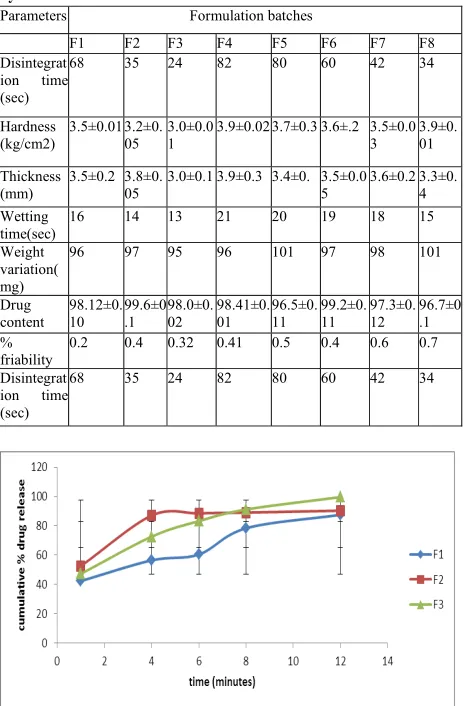
The formulated tablets were evaluated for weight variation, hardness, thickness, in vitro disintegration time, dissolution rate, wetting time and uniformity of drug content. The formulated tablets were of uniform weight with acceptable limit as per the IP specifications.
time with slow in vitro drug release in comparison with F3 formulation which may be due to binding property of mucilage in increased concentration. Further, it was found that F7 containing 6% cross povidone showed disintegration time of 42 seconds which was greater than that of F3 containing same level of disintegrating agent i.e 6% of mucilage. Wetting time was found to be in the range of 13-21 seconds. Formulation F3 containing 6% of mucilage showed fastest wetting time of 13 seconds which results in faster disintegration. Results of evaluation of post compression parameters are given in table 5.
Table: 5 Evaluation of post compression parameters of Imipramine hydrochloride tablets
Parameters Formulation batches
F1 F2 F3 F4 F5 F6 F7 F8
Disintegrat ion time (sec)
68 35 24 82 80 60 42 34
Hardness (kg/cm2)
3.5±0.01 3.2±0. 05
3.0±0.0 1
3.9±0.02 3.7±0.3 3.6±.2 3.5±0.0 3
3.9±0. 01
Thickness (mm)
3.5±0.2 3.8±0. 05
3.0±0.1 3.9±0.3 3.4±0. 3.5±0.0 5
3.6±0.2 3.3±0. 4 Wetting
time(sec)
16 14 13 21 20 19 18 15
Weight variation( mg)
96 97 95 96 101 97 98 101
Drug content
98.12±0. 10
99.6±0 .1
98.0±0. 02
98.41±0. 01
96.5±0. 11
99.2±0. 11
97.3±0. 12
96.7±0 .1 %
friability
0.2 0.4 0.32 0.41 0.5 0.4 0.6 0.7
Disintegrat ion time (sec)
68 35 24 82 80 60 42 34
Fig 3: In-vitro Drug Release Studies of Formulation F1, F2and F3
Fig 4: In-vitro Drug Release Studies of Formulation F7and F8
Stability studies
Stability studies performed on F3 formulation as per ICH guidelines for 60 days at 40°C±2°C / 75% RH±5%. Showed no remarkable change in the physical properties and release profile of the prepared tablets. Results of the stability studies are given in table 6
Table 6: stability studies of F3 formulation at 40°C±2°C/75% RH±5% Days
Parameter 0 15 30 60
In vitro drug release 100 99.4 99 99.6 Hardness (kg/cm2) 3.0±0.01 3.0±0.01 3.0±0.01 3.0±0.01 Disintegration time
(sec)
24 23.6 24 24
4. CONCLUSION
From the present study, it can be concluded that natural super disintegrants like Hibiscus rosa sinensis Linn mucilage powder showed better disintegrating property than the most widely used synthetic super disintegrants like Crosspovidone in the formulations of Fast dissolving tablets and may be used as disintegrant at the level of 6% w/w in tablet formulations. Hibiscus rosa-sinensis Linn mucilage powder can be used as superdisintegrants in place of currently marketed synthetic super disintegrating agent.
5. ACKNOWLEDGMENT
The authors wish to thank Biocon, Bangalore, for the gift sample of and Acharya Nagarjuna University, Guntur, for carrying out spectral analysis and DSC studies. The authors also place on record they are thanks to K L College of Pharmacy, K L E F, Vikas College of Pharmacy, AP, India, for their valuable support.
6. REFERENCES
1. Nyol S, Gupta M. Immediate release dosage forms: A review. J Drug Delivery Thera 2013; 3: 155-61. 2. Patel V, Patel K. Review on immediate release dosage
system. Int J Pharma Res Bio Sci 2012; 1: 37-66. 3. Kumar S, Gupta SK, Sharma PK. A review on recent
trends in oral drug delivery- fast dissolving formulation technology. Adv Biol Res 2012; 6: 6-13.
4. Konapura SA, Chaudhari PS, Oswal RJ, Kshirsagar SS, Antre RV, and Chorage TV. Mouth dissolving tablets an innovative technology. Int J Appl Biol Pharma Technol 2011; 2: 496-503.
5. Vijaya KS, Mishra DN. Rapidly disintegrating oral tablets of miloxicam. Indian drugs2006; 43:117-21. 6. Jani GK, Shah DP. Evaluation of mucilage of Hibiscus
rosasinensis Linn as a rate controlling matrix for sustained release of diclofenac. Drug Dev Ind Pharm 2008; 34: 807-16.
8. Swati S, Neeharika V and Lakshmi PK. Formulation and evaluation of fast dissolving tablets of freely and poorly soluble drugs with natural and synthetic superdisintegrants. Drug Invent Today 2011; 3: 250-256.
9. Gupta S, Parvez N, Sharma P. Extraction and characterization of Hibiscus rosa sinensis mucilage as pharmaceutical adjuvant. World Appl Sci J 2015; 33: 136-41.
10. Jadhav SB, Mali DA, Rajeghadage SH and Bathe RS. Formulation and evaluation of immediate release tablets of imipramine hydrochloride. Int J Biomed Adv Res 2014; 5: 559-60.
11. Bhupindera GP, Satish NP. Formulation evaluation and optimization of orally disintegration tablets of cinnarizine. J Sci Technol2010; 5: 9-21.
12. Chang RK, Guo X, Burnside BA, Courch RA. Fast dissolving tablets. Pharm Tech2000; 24: 52-4.
13. Indian Pharmacopoeia, ministry of health and family welfare, Govt. of India 4th ed. New Delhi: the controller of Publications; 1996.
14. Nayak AK, Manna K, Current development of orally disintegrating tablet technology. Journal of Pharmaceutical Education and Research 2011; 2: 21-34. 15. ICH Harmonisation Tripartite Guideline. Cover note for revision of Q1A(R) Stability testing of new drug substances and products. Q1A (R2): pp 9.