28 | P a g e
A STUDY ON PROBLEMS OF ERP IMPLEMETATION IN SUGAR INDUSTRY
WITH REFERENCE TO KOLHAPUR DISTRICT
Mr. Manoj A. Sathe1
Progressive Education Society’s
Institute of Management and Career Development (MCA) Nigdi, Pune, India
E-mail: [email protected]
Dr. Rajendra D. Kumbhar2
Rayat Shikshan Sanstha’s
Karmveer Bhaurao Patil Institute of Management Studies & Research, Satara, India
E-mail: [email protected]
ABSTRACT
ERP implementation causes enormous change that needs to be cautiously managed to avail benefits of ERP in Sugar Industry. To bring ERP into live out in any industry takes very long time with large asset of cost. Even though ERP has had positive weight in every industry, some of the industries came with achievement whereas some got breakdown in ERP implementation. This paper helps to study ERP packages and implementation problems faced by the end users in sugar industry with reference to Kolhapur district.
KEYWORDS—ERP, ERP implementation, Software Industry.
I. INTRODUCTION
Globalization means economic world without borders. Such globalization has shaped certain and essential requirement for any economic movement to get success for industry.
Co-operative sugar industries are not exclusion to the aforesaid fact. It means that for the sustainable perpetual
development of co-operative sugar industries
implementation of IT enabled technology is a must. The latest development in IT field is the Enterprise Resource Development, commonly known as ERP systems.
Enterprise Resource Planning commonly known as ERP is a system encompassing business integration through IT. Initially, ERP packages were targeted at the manufacturing industry, and consisted mainly of functions for planning and managing core businesses such as sales management, production management, accounting and financial affairs, etc. However, in recent years, adaptation not only to the manufacturing industry, but also to various types of industry has become possible and the development of implementation and use has been moving ahead on a global level.
ERP software is designed to module and automates many of the basic processes of a company, from finance to the shop floor, with the goal of integrating information across the organization as well as other business partners of the organization. The business partners are supplier, customers, stakeholders etc.
ERP package is a reflect image of the major business processes of an organization, such as customer order accomplishment and developed ERP systems' are set of standard processes, produce the dramatic improvements that they are capable of only, when used to connect parts of an organization and integrate its various processes seamlessly.
II. LITERATUREREVIEW
Review of literature is concerned to the study of previous research work in the field of chosen research problem and other problems related to Computerization of sugar industry. This is one of the most important components in the research process, which introduces research gaps as well as the research process to a researcher. In order to get associate with the research process, to understand the research gaps in the chosen research problem and earlier research studies associated with sugar industry. Study of literature is based on IT implementation, ERP implementation and automation in sugar industries. W.Mc. Whinney and C.R.Murry (1974) in their research on “Digital Computer tool for sugar factories” they list out many applications of computer in sugar industry such as accounting, engineering management, project design, process control, evaluation and planning etc. Researchers also depicts that development of in-house computer based information system and centralization in data management helps sugar industries for increase profit and status of organization
29 | P a g e organization should focus on ERP software vender
selection.
Besides this researcher have not done microanalysis of impact of each factor on ERP implementation.
T.K.Balwe (2004) in their seminar paper on “Cooperative Sugar Industry in Maharashtra: Past, Present and Future” he examined the designed and developed ERP software package known as VSI Sugar ERP for Indian sugar Industry. Author discussed in detail features of package, advantages, required infrastructure, implementation process and experiences of sugar factories who have implemented VSI Sugar ERP. It is a software package aimed to prove an integrated, low cost, software solution for sugar and allied industry with full and assured maintenance backup. The salient features of VSI sugar ERP are user friendly, easy and flexible for implementation and customization, ensured security rights required for system and adaptable to need based modifications for additional development. The author highlighted the necessity of this package to the sugar industries so as to bring a transformation in the operations of the sugar cooperative industries.
Dyaneshwar Pisal, Dr. Ajay Kumar, Vikas Kakade and Nilesh Chavan (2011) in their research work on “Computerized model for sugarcane harvesting for effective planning and control in cooperative sugar factories in Pune District” they analyzed basic problem of sugarcane harvesting is the improper time management. Researcher designed DSS model for providing idea of determine how much crushing is expected in each forthnight and manage total crushing of season in advance. Researcher suggested a system that helps for harvesting management.
Rajendra Kumbhar (2011) in his research work on ”ERP system for effective management of cooperative sugar industries –A case study of Sahyadri SSK, Shirawade, Karad” he has highlighted various issues related to sugar industries such as lack of transparency in management and slow rate of information processing that leads to losses, corruption and misappropriation of funds. To solve these problems researcher suggest multi-module integrated ERP software for organization development including sugarcane management, chemical lab management, cane billing, sales, godown management, shares, deposit, distillery and financial management modules.
Haridas B. Jogdankar and Minakshi V.Waykole (2014) in their research paper on “Impact of Information Technology and Management on Sugar Industries” studied status of IT implementation in private and cooperative sugar factories in Solapur district. Researchers were observed sugar factories are using obsolete technology and application software which are not fulfilling their information needs. Researcher also observed issues related to manpower training and other factors affecting on IT implementation
viz political, economical, social, environmental and legal. Researcher discusses the need of ERP software and adoption of modern method for maintaining IT resources Amit Pande and Varada Inamdar (2015) in their published research article “Deployment of an ERP in Cooperative Sugar Industry: An Opportunity or a Challenge?” studied present status of computerization and identified there is need of ERP system for improving effectiveness of business practices. Researchers also indentified loopholes in existing system in agriculture department and researchers made the suggestion of technology transfer.
III. AGLOBALSCENARIOOFSUGARINDUSTRY
Sugar was only discovered by western Europeans as a result of the Crusades in the 11th Century. Sugar is
produced in around 122 countries across the world. Most of them are situated in between 350S and 350N of the Equator with altitudes ranging from sea level above 700 meters and with varying climatic conditions and soils. About one third of the world’s sugar production is contributed by the five countries viz., Cuba, Puerto Rico, Dominican Republic, Jamaica and Trinidad. Columbus introduced sugarcane to American in his second voyage which led to the rapid development of sugar manufacturing in tropical America. The other settlers,
Spanish, Portuguese and Dutch spread sugar
manufacturing rapidly into many parts of America. During the 13th century, sugar cane cultivation started in all the countries in the Mediterranean. After that Mediterranean became the sources of supply of sugar cane to Europe and Africa. Out of the 122 sugar producing countries, 67 produce sugar from cane and 55 from beet. Asia ranks first in respect of area under sugarcane, followed by South America, Central America and the Caribbean. Sugar beet is mainly produced in Europe and to a lesser extent, in Asia and North America. Brazil, India, Thailand, Australia and Cuba are the largest sugarcane producing countries.
Cooperative Sugar Industry in Maharashtra: A Historical Background:
30 | P a g e protection to the sugar industry but also adopted a
favorable policy and provided incentive to the industry. Due to the new policy, 13 sugar factories were established in Maharashtra by the end of the Second World War. All these factories are private and joint stock companies. Before independence there was not a single cooperative sugar factory in Maharashtra . In 1948, the first cooperative sugar factory was established in Maharashtra in the Ahmednagar district, viz. the Pravara Cooperative sugar factory. From this period onwards, large number of cooperative sugar factories have been established in India, especially in Maharashtra. Now sugar factories have become a dominant aspect of agro industrial picture in Maharashtra.
Sugar Co-Operatives in Kolhapur District:
The Kolhapur district of Maharashtra lies between 15o 43' and 17o 10 ' north latitude and 73o 40 and 74o 42 East longitude in the Krishna, Panchaganga basin. It is bound on the north by Satara and Sangli Districts, on west by Ratnagiri District and on the east and south by Belgaum District of Karanataka state. The main rivers of the district are Krishna, Warana, Panchaganaga, Doodhganga, Kumbhi-kasari, hiranyakeshi which are helpful for irrigation and sugar cane production. This area lies under the tropical belt and its hot climate and humid atmosphere are favorable for the growth of sugarcane.
IV. PROFILEOFSAMPLESUGARUNITS
Researcher has selected following sugar units from Kolhapur District for study-
Unit
No Sugar Industry Name
Establishment Year
A
Tatyasaheb Kore Warana Sahakari Sakhar Karkhana Ltd., Warnanagar Tal Phanala, Dist Kolhapur
1983
B Shri. Datta SSK Karkhana Ltd.
Dattanagar, Shirol 1969
C
Jawahar Shetkari Sahakari Sakhar Karkhana Ltd., Kallappaanna Awadenagar, Hupari Yalgud, Tal. Hatkanangale, Dist. Kolhapur
1990
D
Chha. Rajaram Sahakari Sakhar Karkhana Ltd. Kasaba Bavada , Tal-Karveer
1984
V. MANAGEMENTPROBLEM
Some of the sugar units make heavy investments in ERP implementation but they are not getting real benefits of ERP system. Now days ERP implementation in sugar industry is growing, but due to the lack of knowledge regarding ERP implementation, failure rate also increases. ERP implementation is one of the most important and costly affair. Some sugar units especially in western Maharashtra are switched towards ERP implementation since 2007-08 Organizations spent huge amount of money
for ERP implementation but they are not getting desired results from ERP solution. Researcher done initial discussion with EDP Managers of two sugar units who are implementing ERP solution and according to that discussion these units are facing some problems like exceeds the budget of the project, delays in implementation and ERP implementation planning mismatch etc. So the research problem is to study the present status and issues related with ERP implementation in sugar units.
VI. OBJECTIVESOFSTUDY
Research work is undertaken to suffice following objectives
1. To find present status of ERP implementation in cooperative sugar units.
2. To identify problems in ERP implementation in cooperative sugar units.
VII. SCOPEOFSTUDY
The geographical scope of present study is confined to cooperative Sugar factories in Kolhapur District where ERP implementation is done. The conceptual scope of study is confined to ERP concept, implementation life cycle, ERP related technologies and infrastructural components required for ERP. The researcher was use various statistical tools for data analysis viz. averages, SD, correlation coefficient etc.
A. Conceptual Scope: The conceptual scope is focusing on
ERP concepts, ERP modules, ERP products and ERP implementation methodology.
B. Analytical Scope: The data collected is analyzed with
the help of statistical tools Excel and SPSS.
VIII. SIGNIFICANCEOFSTUDY
1. It will help the sugar industry to design the exact required ERP software solution.
2. This study will assist the top management for effective implementation of ERP and take suitable decisions.
IX. RESEARCHMETHODOLOGY
The study is descriptive inferential in nature and data is to be collected by using survey method..
Instrument: A structured schedule is prepared for collecting data from ERP users; based upon ERP implementation methodology used by vendors and EDP I/Cs of Cooperative sugar units and personally administered by the researcher to solicit information from the sample..
DATACOLLECTION
31 | P a g e user’s opinion on ERP implementation activities by
Sugar factories and opinion of steering committee members, ERP vendors is obtained by interacting with these peoples
Secondary Data: The necessary secondary data such as concepts of ERP has been collected from sources like documents, libraries, magazines, published reports, published sources such as journals, books, articles, Research papers, library and web sites.
SAMPLEDESIGN
In Kolhapur district there are seventeen cooperative sugar units are working out of these units six units are using ERP systems and researcher has taken four units for study.
There are 226 users using ERP system in these four units and sample size is calculated by using Solvins formula as below:
n= N/1+N (e)2
Where, N= Total population
e=Error tolerance (10%) n is total sample size
n=226/ 1+ 226 (0.10)2
= 226/3.26
= 69.32
n =69
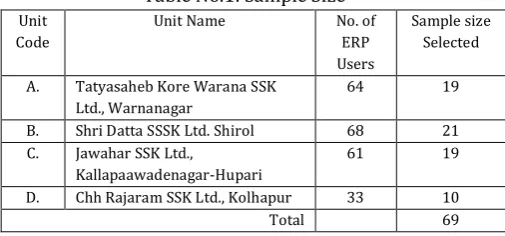
The method used for selection of sample is stratified proportionate random sampling method in which each sugar unit is considered as stratum. Following table shows unit wise sample size.
Table No.1: Sample Size Unit
Code
Unit Name No. of
ERP Users
Sample size Selected
A. Tatyasaheb Kore Warana SSK Ltd., Warnanagar
64 19
B. Shri Datta SSSK Ltd. Shirol 68 21
C. Jawahar SSK Ltd.,
Kallapaawadenagar-Hupari
61 19
D. Chh Rajaram SSK Ltd., Kolhapur 33 10
Total 69
(Source : Primary Data)
DATAANALYSIS
The data collected from primary and secondary sources will be analyzed by using statistical tools viz. Percentage, measures of central tendency.
A. ERP SELECTION CRITERIA:
For selection of ERP package different standard parameters are used in industry and researcher has taken opinions of respondents regarding various parameters used by sample units for selection of ERP vendor. Unit wise opinions of respondents from selected sugar industries regarding to ERP selection criteria are shown in
below table. This response helped researcher to analyze the link between parameter selection and the benefits received by the sugar industry based on these criterions.
Table No.2: Parameters used for Selection of ERP
Sr. No
Parameter Unit A Unit B Unit C Unit D Total
Yes Yes Yes Yes Yes No
1 Functional fit with company’s business (36.8%) 7 (76.2%) 16 (63.2%) 12 (60.0%) 6 (59.4%) 41 (40.6%) 28
2
Degree of integration between various components of ERP system 13 (68.4%) 10 (47.6%) 10 (52.6%) 4 (40.0%) 37 (53.6%) 32 (46.4%)
3 Flexibility
11 (57.9%) 12 (47.6%) 11 (57.1%) 5 (50%) 39 (56.5%) 30 (43.5%)
4 Complexity
5 (26.3%) 10 (47.6%) 12 (63.1%) 4 (40.0%) 31 (56.5%) 38 (44.5%)
5 User Friendliness 8 (42.1%) 12 (57.1%) 11 (57.8%) 5 (50%) 36 (52.2%) 33 (47.8%)
6 Quick Implementation 5 (26.3%) 14 (66.6%) 6 (31.6%) 4 (40.0%) 29 (42.0%) 40 (58.0%) 7
Ability to support multi-site planning & Control 15 (78.9%) 10 (47.6%) 11 (57.9%) 3 (30.0%) 39 (56.5%) 30 (43.5%) 8 Client Server Capability & Database Independence 15 (78.9%) 14 (66.7%) 13 (68.4%) 4 (40.0%) 46 (66.7%) 23 (33.3%)
9 Security
16 (84.2%) 15 (66.7%) 15 (78.9%) 7 (70.0%) 53 (76.8%) 16 (23.2%)
10 Availability of Regular Upgrades 4 (21.1%) 14 (66.7%) 12 (63.1%) 5 (50%) 35 (50.7%) 34 (49.3%)
(Source: Primary Data)
Above table depicts that all units are evaluated ERP product before selection and overall 59.4% respondents are opined that functional requirement fulfillment by ERP product is evaluated at the time of ERP selection, 53.6% respondents says that Integration of various subsystems is evaluated, 56.5% respondents opined that flexibility, complexity and ability to support multisite planning and control of ERP product is considered at the time of ERP selection.
It is revealed that 52.2% respondents say that user friendliness of ERP software is considered for ERP package selection whereas 50.7% respondents are opined that availability of regular updates is considered for ERP package selection. In case of Client Server Capability & Database Independence criteria for ERP selection, 66.7% respondents are agreed.
Above table also shows that 76.6% respondents opined that Security feature of ERP software is considered ERP selection but 42% respondents says implementation period required is considered at the time of ERP selection.
32 | P a g e
B. PROBLEMS IN ERP IMPLEMENTATION:
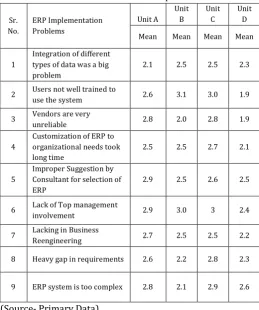
Researcher has gathered opinions of ERP users about various problems related to ERP implementation using liker scale and mean and standard deviation is calculated. Unit wise analysis is given as below.
Table No.3: Problems in ERP Implementation
Sr. No.
ERP Implementation Problems
Unit A Unit
B
Unit C
Unit D
Mean Mean Mean Mean
1
Integration of different types of data was a big problem
2.1 2.5 2.5 2.3
2 Users not well trained to
use the system 2.6 3.1 3.0 1.9
3 Vendors are very
unreliable 2.8 2.0 2.8 1.9
4
Customization of ERP to organizational needs took long time
2.5 2.5 2.7 2.1
5
Improper Suggestion by Consultant for selection of ERP
2.9 2.5 2.6 2.5
6 Lack of Top management
involvement 2.9 3.0 3 2.4
7 Lacking in Business
Reengineering 2.7 2.5 2.5 2.2
8 Heavy gap in requirements 2.6 2.2 2.8 2.3
9 ERP system is too complex 2.8 2.1 2.9 2.6
(Source- Primary Data)
Above table comprise viewpoint of respondents towards problems encountered by Unit A in ERP implementation. It is noticed that the mean value for all problems is between 2 to 3. It means Unit A is came across ERP implementation problems such as data integration, vendor unreliability, customization issues, inadequacy of consultancy, management negligence, lack of business reengineering, huge gap in requirement and complexity of ERP software. It signifies for Unit B that lack of top management involvement in ERP implementation and untrained users are prominent problem as mean of these parameters is 3.0 and 3.1 respectively.
However other problems are also noticed viz. vendor’s unreliability, complexity of ERP product, Heavy gaps in requirement, lack of business reengineering, integration of various subsystems since mean value is between 2 to 3. Above table comprises opinion of respondents about problems in ERP implementation in Unit C. It indicates that data integration, lack of business reengineering, improper suggestions from consultant, customization issues, vendor unreliability, requirement gaps, complexity of application etc are the prominent problems encountered in ERP implementation in Unit C, as mean lies between 2.5 to 2.9.
Above table consist of respondents opinions with regard to problems in ERP implementation in Unit D. It revealed unavailability of trained user and unreliable vendor are prominent problems as mean is 1.9. However other problems are data integration, lack of business reengineering, improper suggestions from consultant, customization issues, requirement gaps, complexity of application etc. as mean is between 2.1 to 2.5.
Overall it is observed that all sample units encounter the problems in general and it intensity differs as per unit and their management.
C. STATUS OF IT TRAINING ORGANIZED BY SUGAR UNITS
Researcher used data generated by training need assessment and worn it to know the frequency of training and training area imparted to employees of the sample sugar units.
Table No. 4: Status of IT Training
Sr Training
Area
Unit A Unit B Unit C Unit D
Y N Y N Y N Y N
1 IT
Awareness 5
1
4 6 15 4 15 1 09
2 System Security and Audit
3 1
6 4 17 5 14 2 08
3
Hardware and Networking
3 1
6 4 17 3 16 2 08
4 Recent
Trends in IT 2
1
7 4 17 3 16 0 10
5 ERP Usage 19 0 20 1 1
9 0 10 0
(Source: Primary Data)
Above table shows opinions of respondents from Unit A regarding IT trainings conducted by organization. In case of IT awareness training only 26.31% respondents gets training and it is given occasionally, 15.78% respondents are opined that system security & audit related and hardware & networking training is provide occasionally whereas 10.52% respondents says that training related to recent trends in IT is organized. All respondents are opined that ERP usage training is provided but its frequency is very less.
33 | P a g e organization is lacking in providing IT training except ERP
usage training.
In Unit C, ERP usage training is provided to all users, 26.31% users opined that system security and audit related training is organized whereas 15.78% opined that hardware & networking, recent trends in IT related training is provided by organization. Though organization provided ERP usage training to all users but they are lacking in providing training in other areas.
In Unit D, 10% respondents are agree on organization provides IT awareness training. 20% respondents opined that System Security and Audit and Hardware and Networking training are provided by organization whereas no training is provided related to recent trends in IT. In case of ERP usage training all respondents are availed training but frequency is very low. From above interpretation it has been concluded that Unit D is also lacking in providing IT related training.
From analysis related to IT training it depicts that top management is unaware about importance of training in IT field in general and ERP implementation in specific.
D. SATISFACTION ABOUT ERP SYSTEM
Researcher has collected opinions of ERP users regarding to satisfaction about ERP system as highly satisfied, satisfied, neutral, dissatisfied and shown in below table.
Table No. 5: Satisfaction about ERP System
Unit Code
Highly Satisfied
Satisfied Neutral Dissatisfied Highly
Dissatisfied
Unit A
2 (10.52%)
4 (21.05%)
2 (10.52%)
8 (42.10%)
3 (15.81%) Unit
B
4 (19.04)
7 (33.33%)
3 (14.28%)
4 (19.04)
3 (14.28%) Unit
C
3 (15.81%)
5 (26.31%)
3 (15.80%)
5 (26.31%)
3 (15.80%) Unit
D
2 (20.00%)
2 (20.00%)
1 (10.00%)
4 (40.00%)
1 (10.00%)
Total 11
(15.94%) 18 (26.08%)
9 (13.04%)
21 (30.43%) 10 (14.49%)
(Source: Primary Data)
Above table revels that in Unit A, 10.52% users are highly satisfied, 21.05% users are satisfied, 42.10% users are dissatisfied, 15.81% users are highly dissatisfied whereas 10.52% users are neutral about ERP system in organization. In Unit B 19.04% users are highly satisfied, 33.33% users are satisfied, 19.04% users are dissatisfied, 14.28% users are highly dissatisfied whereas 14.28% users are neutral about ERP system in organization. In Unit C, 15.81% users are highly satisfied, 26.31% users are satisfied, 26.31% users are dissatisfied, 15.80% users are highly dissatisfied whereas 15.80% users are neutral about ERP system in organization. In Unit D 20.00% users are highly satisfied, 20.00% users are satisfied, 40.00% users are dissatisfied, 10.00% users are highly dissatisfied whereas 10.00% users are neutral. In all units 15.94% users are highly satisfied, 26.08% users are satisfied, 30.43% users are dissatisfied, and 14.49% users are highly
dissatisfied whereas 13.04% users are neutral about ERP systems in their organization.
From above interpretation it has been concluded that more than half of the users are not satisfied about ERP systems in organization. Researcher observed that 57.96% respondents from the sample units are not happy with ERP systems in organizations.
X: CONCLUSION
In the light of above observations, discussions and observations on site the following conclusions are derived: Irrespective of the size of the sugar units, the status of ERP implementation is more or less the same in the general management functional area of all the units. All the units are performing the activities of their finance, agriculture department by using ERP. In spite of the major role of Engineering and Manufacturing departments in the process of cost reduction and quality improvement, most of the sugar units have neglected from ERP implementation. All ERP implementation issues are encountered in organization and customization, untrained users and unreliability of vendors are prominent problems found in ERP implementation. It is also found that more than half (60%) of the ERP users having education qualification below 12th standard. The suggestions offered
would be of immense help to sugar units under study in particular and cooperative sugar industry in general for furthering its ERP implementation base. This, in turn, would result in efficient and effective management of cooperative sugar units.
REFERENCES
1) W.Mc. Whinney, C.R.Murry (1974), “Digital computer tool for sugar factories”, Proceedings of International Conference.
2) Liang Zhang, Matthew K.O. Lee, Zhe Zhang1, Probir Banerjee. (2002). “Critical Success Factors of Enterprise Resource Planning”, Proceedings of the 36th Hawaii International Conference on System Sciences (HICSS’03).
3) T.K. Balwe (2004), Proceedings of State level conference on “Cooperative Sugar Industry in Maharashtra: Past, Present and Future” seminar held at Pune.
4) Dnyneshwar Pisal, Dr. Ajay kumar, VikasKakade and Nileshchavan(2012), ”Computerized model for sugarcane harvesting for effective planning and control in cooperative sugar factories in pune district.” IJCSR ,Vol No.1, IssueNo.9.
34 | P a g e Journal of Information Technology and Knowledge
Management, Volume 4, No. 1, pp. 33-37
6) Haridas B.Jogdankar and Minakshi V.Waykole(2014) “Impact of Information Technology and Management on Sugar Industries”. International Multidisciplinary Research Journal,Vol.4 Issue 6.
7) Amit Pande and Varda Inamdar (2015)”,
Understanding an ERP design with respect to cooperative sugar industry in Maharashtra”, IJMSS Vol.03 Issue-01