International Journal of Pharmaceutical Research&Allied Sciences, 2017, 6(2):238-246
Research Article
CODEN(USA) : IJPRPM
ISSN : 2277-3657
238
The effect of various denture cleansers on the colour stability of different
denture base resins
Lana A Shinawi BDS MSc. MCD. PhD
Department of Oral and Maxillofacial Prosthodontics, Faculty of Dentistry, King Abdulaziz University, Jeddah
21589, Saudi Arabia. P.O. Box 80209.
*
Corresponding authors
Lana A Shinawi BDS MSc. MCD. PhD
Department of Oral and Maxillofacial Prosthodontics, Faculty of Dentistry, King Abdulaziz University, Jeddah 21589, Saudi
Arabia. P.O. Box 80209.
Email: [email protected]@gmail.com
ABSTRACT
All denture wearers are instructed to maintain optimum oral and denture hygiene for the oral health of the tissues. Chemical cleansing is a simple and commonly used method by most denture wearers as it only requires the immersion of the prosthesis in any commercially available solutions following the manufacturer’s instructions. Aim: to report the effect, if any, of commonly available denture cleansers on the colour stability of six denture base materials. Materials and methods: Six types of denture base materials were tested (Self cure resin. Heat cure resin. Deflexthermo injected acrylic, Vertex, IvoBase copolymer and IvoBase Hybrid copolymer) by immersing in three different denture cleansers (Mono-dose sachets, Effervescent denture cleanser and denture cleansing powder) compared to distilled water as the control. All samples were immersed twice a day for 1 Day, 1 Week and 1 Month at 50ºC and stored in an incubator in between at 37ºC. The change in colour was measured using the colorimeter and colour alteration was determined using the Standard Commission Internationale de L’Eclairage (CIE LAB). Results: there was no significance change in colour in all groups of materials immersed in all solutions at the various immersion times except following immersion of Major heat cure resin in Steradent solution for one month (∆E≥3.3). Conclusion: colour change following immersion in commercially available solutions was not detectable by the naked eye.
Key words:Denture cleansing, Denture base materials, Colour Change
.
INTRODUCTION
239
dimensional stability. Additionally the monomer residues weakens the mechanical strength of the resin and is responsible for the low impact strength which commonly results in the acrylic denture base fracture Rahul Bhola [3].
In recent years, the thermoplastic resin polymers also knows as polyamides gained popularity as an alternative to PMMA due to its inert and hypoallergenic nature, in addition to favorable physical and chemical properties. Additionally, the flexible nature of this material offers many advantages including a stress breaking flexible design of removable partial dentures[4]. There are many thermoplastic systems available in the market for dental applications including, Proflex, Flexiplast, Bio-Dentaplast, and Valplast systems [5].
Regardless of the material used for the construction of the removable prosthesis, all denture wearers are advised to maintain good oral and denture hygiene through regular physical cleaning of the prosthesis by brushing with a soft non-abrasive brush. However in the elderly and those suffering from dementia and / or other age related conditions affecting their manual dexterity, chemical cleansing is a good alternative[6]. This is performed by simply immersing the prosthesis in any of the commercially available solutions twice a day, a simple yet repetitive task that is crucial for the oral health of the tissues due to the antimicrobial properties of these cleansers which can prevent the colonization of microorganisms such as Candida albicans and Candida glabrata, which are responsible for Halitosis and denture stomatitis[7].
An ideal denture cleanser should be readily available, affordable and simple to use as well as being an effective disinfectant but should be non-abrasive to prevent wearing and altering the colour of the prosthesis to prevent the need to replace it[8]. Several materials are used as denture cleansers, most commonly are cleansers containing sodium hypochlorite and alkaline peroxides [9] as well as those sodium bicarbonates cleansers[10]. Other denture cleansers contain dilute organic or inorganic acids [11]. The peroxide cleansers are reported to be active against the newly formed plaque and stains but may require prolonged immersion of the prosthesis[12]. Alkaline hypochloritehashave the advantage of being effective against both bacterial and fungal growth in addition to removal of stains, and other organic matter[12, 13].These are composed of oxidant and effervescent as well as surface tension reducers and chelating agents and are most commonly supplied as tablet or in powder forms which become hydrogen peroxide solutions upon missing with water [14]. It has long been established that acid containing cleansers are not recommended due to their corrosive nature[15].
There are reports that denture cleansers adversely affect the physical properties of polyamide and polymethyl methacrylate dentures base materials [7][8]and findings suggest that changes in physical properties are influenced by the polymerization type as well as the type of denture base tested [16].
One of the most important physical properties for many dental materials is colour stability as changes in colour can indicate the damage or aging of the said material [17-19]. Changes in colour can be measured using the Munsellcolour system or alternatively the standard Commission International de l’Eclairage (CIE L*a*b*) colour which is recommended by The American Dental Association (ADA). The CIE L*a*b* system describes all visible colours as being a blend of the three basic colours (red, blue, and green) and has been widely used in the study of colour changes in dental materials system [20, 21].
Aim
The current report examined the effect of various commercially available denture cleansers on the colour stability of several denture base materials.
MATERIALS AND METHODS
Six types of denture base materials were tested by preparing 40 disc shaped specimens for each material with a total of 240 discs. These discs were 20mm in diameter and 3mm in thickness. The denture base resin materials used were:
1. Vertex Castavaria (Joh. V. Oldenbarneveltlaan, 62 3705 HJ, Zeist, the Netherlands).
240
3. GC Major Heat cured PMMA resin (ProdottiDentari, S.p.A via Einaudi 23 – 10024, Moncalieri (TO) Italy)
using the conventional compression molding technique
4. AcrilatoDeflexThermo Injected Acrylic (Sitio de Montevideo 2381 Lanus (Zip Code) 1824 Bs.As. City
Argentine).
5. IvoBase Hybrid PMMA (IvoclarVivadent, AG FL-9494, Schaan / Liechtenstein)
6. IvoBase High impact PMMA copolymer (IvoclarVivadent, AG FL-9494, Schaan / Liechtenstein)
Resin discs were constructed according to the manufacturer’s instructions employing the lost wax technique where applicable (Dental wax; Lordell trading, New South Wales, Australia).
The denture cleansers used and immersion protocol
1. Steradent PRO. Mono-dose sachets (Reckitt Benckiser Healthcare Ltd. Dansom Lane, Hull HU8 7DS, U.K.
Active ingredient includes Sodium Sulfate, Sodium Carbonate Peroxide, Sodium Bicarbonate, Sodium
Carbonate). Immersion at 50ºC for 1 minute twice a day.
2. Effervescent denture cleanser (Tesco stores Ltd. Cheshunt EN8 9SL, U.K. Active ingredient includes
Sodium Bicarbonate, Citric Acid, Sodium Carbonate Peroxide, Potassium Monopersulfate, Sodium
Carbonate). Immersion at 50ºC for 3 minutes twice a day.
3. Smile denture cleansing powder (The Boots Company PLC, Nottingham, England NG2 3AA, U.K. Active
ingredient includes Sodium Chloride, Sodium Carbonate, Sodium Carbonate Peroxide). Immersion at 50ºC
for 10 minutes twice a day.
Immersion protocol
Samples were immersed the denture cleanser twice daily in at 50ºC initially at baseline then at 1 day, 1 week and 1 month intervals following the manufacturer’s instruction for each solution. The control immersion solution was distilled water. Between cleansings, the specimens were rinsed with tap water and then stored in distilled water at 37ºC in an incubator.
Colour test
For colour measurements of the resin specimen, a mark was made to position the measuring port of the instrument in the same location on the specimen for repeated measures. The colorimeter (Konica Minolta CR-400/410; Minolta Co, Osaka, Japan) was calibrated according the manufacturer’s instructions before each measurement period against a white background. The colour alteration was determined using the Standard Commission Internationale de L’Eclairage (CIE LAB) colour system, recommended by the American Dental Association[20]. An important aspect of the CIE-LAB is that the colour difference between times can be reached using the parameter, ΔE. This system is based on 3 parameters defining colour: L*, a*, and b*, where L* represents lightness, a* represents red-green, and b* represents yellow-blue.The colour alteration between each specimen, in terms of L*, a* and b*, is calculated by the following Equation:
ΔE = [(ΔL*)2 + (Δa*)2 + (Δb*)2]1/2
ΔE represents the differences measured in L*, a*, and b* values between the baseline coordinates and those measured after immersion for different time intervals and in different denture cleansers[22].
241
Statistical analysis:
Mean and standard deviations were determined for all the materials. One-way and 3-way analyses of variance (ANOVA) were performed to determine whether there were statistically significant differences among materials, denture cleansers, and immersion times. The differences in colour change values were evaluated with the Student-Newman-Keuls multiple comparison test (SNK test). Data was analyzed at an alpha level of .05. All analyses were computed with the Statistical Package for Social Science (SPSS) version 20 (IBM Corp., Armonk, NY). Mean colour change (∆E) ≥3.3 was considered significant change as reported in the literature [16]
RESULTS
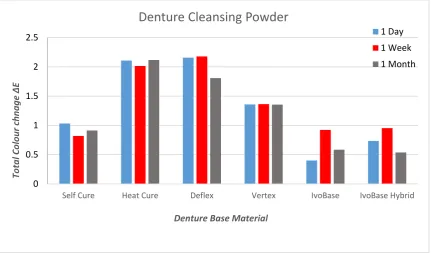
Results showed that the time is a significant factor in colour change in all tested denture base materials and with all three denture cleansers, however, there was no significance change in colour in all groups of materials immersed in all solutions at various immersion times except following immersion of Major heat cure resin in Steradent PRO. Mono-dose sachets solution for one month (∆E≥3.3). Otherwise, the colour change was not detectable by the naked eye.
Figures (1-4) shows the resulting colour change in all denture base material following immersion periods of 1 Day, 1 Week and 1 Month in each immersion solution as compared to the control.The effect of immersion in the Effervescent denture cleansing solution by Tesco is displayed in the figure 1while the results of immersion in Steradent PRO. Mono-dose sachets denture cleansing solution are displayed in the figure 2. Figure 3 represents the effect of immersion in denture cleansing powder / solution by Boots. Figure 4 shows the control (distilled water) medium.
Figure1: Colour change in all denture base material following immersion periods of 1 Day, 1 Week and 1 Month in Tesco effervescent denture cleansing solution.
0 0.2 0.4 0.6 0.8 1 1.2 1.4 1.6 1.8 2
Self Cure Heat Cure Deflex Vertex IvoBase IvoBase Hybrid
Tota
l C
ol
our
chna
ge
Δ
E
Denture Base Material
Effervescent Denture Cleanser
242
Figure 2: Colour change in all denture base material following immersion periods of 1 Day, 1 Week and 1 Month in Steradent mono – dose sachets denture cleansing solution.
Figure 3: Colour change in all denture base material following immersion periods of 1 Day, 1 Week and 1 Month in Boots denture cleansing powder solution.
0 0.2 0.4 0.6 0.8 1 1.2 1.4 1.6 1.8 2
Self Cure Heat Cure Deflex Vertex IvoBase IvoBase Hybrid
Tota
l C
ol
our
chna
ge
Δ
E
Denture Base Material
Mono-Dose Sachets
1 Day 1 Week 1 Month
0 0.5 1 1.5 2 2.5
Self Cure Heat Cure Deflex Vertex IvoBase IvoBase Hybrid
Tota
l C
ol
our
chna
ge
Δ
E
Denture Base Material
Denture Cleansing Powder
243
Figure 4: Colour change in all denture base material following immersion periods of 1 Day, 1 Week and 1 Month in Distilled Water.
DISCUSSION
In the current study and following 30 days of simulated immersion, the colour of all materials tested was not significantly affected by any of immersion solutions. Such findings are possibly a result of following the recommended manufacturers’ regimen of cleansing the specimens.
These results are in agreement with studies stating the effect of denture cleansers on both heat cured and microwave cured acrylic resin where authors reported no significant difference in the colour changes measured using the colorimeter between materials and solutions and no interactions even when 1% sodium hypochlorite was used for extended periods of 183 days [22]. It was suggested that the high water temperature used by some patients during cleaning may be a critical factor in the acrylic resin bleaching[24],thus signifying the importance of following manufacturers’ instructions during cleaning of dentures. The presence of inclusions of oil or moisture from the technician hand when manipulating the acrylic resin dough was also suggested to result in subsequent colour changes of resin[25].It has been reported that heat cured (hot water) polymerization may lead to rise to a differential expansion of the acrylic surface, which may result in the formation of zones within the acrylic resin, thus producing colour alteration [26, 27].
With regards to the tested polyamides where no significant colour change was detected, these findings are also in agreement with reports on colour changes of Polyamide resins following 20 days of immersion in various commercially available denture cleansers where no significant change in colour of resin was detected[7].
It is believed that the condensation polymerization process of nylons results in more stable chains unlike the addition polymerization process of heat cured resin which renders them susceptible to sorption and adsorption of water molecules from the cleansing solutions and changes in their physical properties [28]. Previous reports using NaOCl solutions are also in agreement as no colour change was detected in acrylic resins when using 1%, 5.25%, and 0.525% concentrations at periods of 72 h, 7days and 548 days of immersions [29-31].
More recently, a study reported significant colour changes measured using colorimeter when 1% sodium hypochlorite was used for extended periods of immersion (8 hours a day for 1 month) but not when it is used for short immersion times (10 minutes a day for 1 month) [32]. These finding signify the importance of adhering to the manufacturer’s instruction with regards to immersion times and temperature of solution.
0 0.2 0.4 0.6 0.8 1 1.2 1.4 1.6 1.8 2
Self Cure Heat Cure Deflex Vertex IvoBase IvoBase Hybrid
Tota
l C
ol
our
chna
ge
Δ
E
Denture Base Material
Distilled Water
244
Likewise[16] reported that the colour change of denture base heat cured acrylic resin increased as the immersion time increased and the same was true when testing hard reline acrylic resin regardless of curing method (heat cured hard reline resin vs visible light cured hard reline resin). However, the authors did state that some of the cleansers used in their study contained blue stain while others contained the yellow colouredcamphor Quinone, which might have directly affected the colour change recorded. Interestingly the report found colour changes following prolonged immersion in distilled water and suggested that the opacity observed following long periods of immersion maybe a result of monomer leaching out.
Reports on longer periods of immersion simulating 180 days of cleansing by patients showed significant change in the colour of heat cured acrylic resin measured using a colorimeter[33]. The authors did however state that the changes in colour were not significant if quantified using the (NBS) units.
Arruda reported Lately that no significant colour changes was detected in a study simulating 5 years of denture cleansing when testing the effect of alkaline peroxide and 0.5% NaOCl on heat cured acrylic resin. The changes measured using the colorimeter were trace as classified by NBS[34]. It is worth noting that temperature of immersion was 30ºC ± 2º for the alkaline peroxide cleanser and 23ºC ± 2ºC for NaOCl.
The finding of the current research highlights the importance of adhering to manufacturers’ instructions when preparing the cleansing solution in terms of the amount and temperature of water used. These findings are also in agreement with other work recommending shorter immersion times compared to over-night soaking.
Paranhos et al.reported slight colour alterations of acrylic resin following immersion in alkaline peroxide and 0.5% NaOCl solutions when applying prolonged immersion period of daily overnight (8 h) soaking corresponding to an expected1.5-year time. The authors highlighted the importance of evaluating the adverse effects when such solutions are employed for longer periods of immersion, since damage to denture base materials may accumulate [35].
CONCLUSION
Within the imitations of this study it was found that, when the manufacturers’ instruction was followed, denture cleansers did not cause detectable colour changes in acrylic resins. Further research using longer immersion periods is needed. The effect of these solutions on other characteristics and properties of acrylic resins, such as superficial roughness, should also be investigated.
REFERENCES
1. Thakral G.K, A.H., Yadav B, Thakral R. , Flexible Partial Dentures - A hope for the Challenged Mouth. People’s Journal of Scientific Research., 2012. 5(2): p. 55-59.
2. Ullari I, A.A.D., Ullari M.M, Usanmaz A: , Thermal and Dynamic Mechanical Properties of Microwave and Heat-Cured Poly(methyl methacrylate) Used as Dental Base Material. . J ApplPolym Sci. , 1999. 74: p. 2971– 78.
3. Rahul Bhola, S.M.B., Hongjun Liang, Brajendra Mishra, Biocompatible Denture Polymers – A Review. Trends Biomater. Artif. Organs, 2009. 23(3): p. 129-136.
4. ShivaniKohli , S.B., Polyamides in Dentistry. International Journal of Scientific Study, 2013 Volume 01( Issue 01): p. 20 - 25.
5. Ayman Al-Dharrab, L.S., Thermogravimetric Characterization of the MicrostructureComposition of Polyamide Injection Molded Denture Base Material vs Conventional Compression Molded Heat-cured Denture Base Material. The Journal of Contemporary Dental Practice, 2016. 17(4): p. 1-6.
245
7. Durkan, R., et al., Comparative effects of denture cleansers on physical properties of polyamide and polymethyl methacrylate base polymers. Dental Materials Journal, 2013. 32(3): p. 367-375.
8. Moon, A., J.M. Powers, and S. Kiat-Amnuay, Color stability of denture teeth and acrylic base resin subjected daily to various consumer cleansers. J EsthetRestor Dent, 2014. 26(4): p. 247-55.
9. Felton D, C.L., Duqum I, Minsley G, Guckes A, Haug S, et al., Evidence-based guidelines for the care and maintenance of complete dentures: a publication of the American College of Prosthodontists. . J Prosthodont 2011. 20(1): p. 1-12.
10. AL-Omari, A.W., Evaluation of the Effect of Some Denture Cleansers on Hardness of Acrylic Denture Base and Teeth Materials. Al–Rafidain Dent J. , 2009. 9(2): p. 273–278.
11. Cristiane F. Carvalho, A.D.V., Susana M. Salazar Marocho, and L.N. Sarina M. B. Pereira, Tarcisio J. ArrudaPaes-Junior, Effect Of Disinfectant Solutions On A Denture Base Acrylic Resin. ActaOdontol. Latinoam, 2012. Vol. 25 Nº 3 / 2012 / 255-260: p. 255-260.
12. da Silva FC, K.E., Mancini MN, Balducci I, Jorge AO, Koga-Ito CY. , Effectiveness of six different disinfectants on removing five microbial species and effects on the topographic characteristics of acrylic resin. . J Prosthodont. , 2008. 17: p. 627–33.
13. Jeyapalan, K., J.K. Kumar, and N.S. Azhagarasan, Comparative evaluation of the effect of denture cleansers on the surface topography of denture base materials: An in-vitro study. J Pharm BioalliedSci, 2015. 7(Suppl 2): p. S548-53.
14. Ferreira, M.A., et al., Efficacy of denture cleansers on denture liners contaminated with Candida species. Clin Oral Investig, 2009. 13(2): p. 237-42.
15. Budtz-Jørgensen, Materials and methods for cleaning dentures. J Prosthet Dent. , 1979. 42: p. 619–23.
16. Hong, G., et al., Influence of denture cleansers on the color stability of three types of denture base acrylic resin. J Prosthet Dent, 2009. 101(3): p. 205-13.
17. Anil N, H.C., Sahin S, Color stability of heat-polymerized and autopolymerized soft denture liners. J Prosthet Dent J Prosthet Dent 1999. 81: p. 481-4.
18. Saraç D, S.Y., Kurt M, Yüzbasioglu E. , The effectiveness of denture cleansers on soft denture liners colored by food colorant solutions. J Prosthodont 2007. 16: p. 185-91.
19. Iazzetti G, B.J., Gardiner D, Ripps A. , Color stability of fluoride-containing restorative materials. Oper Dent 2000. 25: p. 520-5.
20. Colorimetry, C.C.I.d.l.E., Colorimetry technical report. CIE Pub. No. 15, 3rd ed. Vienna: Bureau Central de la CIE, 2004: p. 16-20.
21. Hersek N, C.S., Uzun G, Yildiz F. , Color stability of denture base acrylic resins in three food colorants. J Prosthet Dent 1999. 81: p. 375-9.
22. Marina Xavier Pisani , C.H.L.d.S., Helena de Freitas Oliveira Paranhos, and A.P.M. Raphael Freitas Souza, The Effect of Experimental Denture Cleanser Solution Ricinuscommunison Acrylic Resin Properties. Materials Research., 2010. 13(3): p. 369-373.
23. Wyszecki G, S.W., Color science: concepts and methods, quantitative data and formulae. . New York: WileyInterscience, 1982. 2nd ed.: p. 168 - 223.
246
25. Robinson JG, M.J.S.R., The whitening of acrylic dentures: the role of denture cleansers. . British Dental Journal. , 1985. 159: p. 247-50.
26. Unlü A, A.O.T., Sahmali S. , The role of denture cleansers on the whitening of acrylic resins. Int J Prosthodont, 1996 9: p. 266–70.
27. Polysois GL, Y.S., Zissis AJ. Demetriou PP. , Color changes of denture base materials after disinfection and sterilization immersion. . International Journal of Prosthodontics. , 1997. 10(.): p. 83-9.
28. Mohamad Salman and Shatha Saleem, Effect of different denture cleanser solutions on somemechanical and physical properties of nylon and acrylicdenture base materials. J Bagh College Dentistry, 2011. Vol. 23(special issue), 2011(Vol. 23(special issue), 2011): p. 19 - 24.
29. McNeme SJ, v.G.A.a.W.G., Effects of laboratory disinfecting agents on color stability of denture acrylic resins. . Journal of Prosthetic Dentistry, 1991. 66: p. 132-6.
30. Pisani MX, M.A., Paranhos HFO, Silva CH. , Effect of experimental Ricinus communis solution for denture cleaning on the properties of acrylic resin teeth. Braz Dent J 2012. 23: p. 15-21.
31. Polyzois GL, Y.S., Zissis AJ, Demetriou PP. , Color changes of denture base materials after disinfection and sterilization immersion. . Int J Prosthodont 1997. 10: p. 83-89.
32. Haghi, H.R., et al., Effect of denture cleansers on color stability and surface roughness of denture base acrylic resin. Indian J Dent Res, 2015. 26(2): p. 163-6.
33. Peracini, A., et al., Effect of denture cleansers on physical properties of heat-polymerized acrylic resin. J Prosthodont Res, 2010. 54(2): p. 78-83.
34. Arruda, C.N., et al., Effects of Denture Cleansers on Heat-Polymerized Acrylic Resin: A Five-Year-Simulated Period of Use. Braz Dent J, 2015. 26(4): p. 404-8.