ISSN (e): 2250-3021, ISSN (p): 2278-8719
Vol. 08, Issue 4 (April. 2018), ||VI|| PP 54-62
Multimodal Biometric Authentication System Using Face and
Fingerprint Biometric
Jasmeen Sharma
1, Dharam Veer Sharma
21
(DepartmentOf Computer Science, Punjabi University, India)
2(Department Of Computer Science, Punjabi University, India)
Corresponding auther:Jasmeen Sharma
ABSTRACT:Biometric Authentication Systems Are Used Widely As A Part Of Many Softwares Or
Applications. These Are Of Generally Two Types: Unimodal Biometric System And Multimodal Biometric System. Unimodal Uses One Biometrics And Multimodal Uses More Than One Biometrics. Unimodal Systems Are Less Preferred Because Of Physiological Defects. Here, Multimodal Biometric System Is Proposed Using Two Biometric: Face And Fingerprint. In The Proposed System, Principal Component Analysis (PCA), Bacterial Foraging Optimization Algorithm (BFOA), Minutiae Extraction And Multi-Layer Neural Network (MLNN) Are Used. Minutiae Points Are Extracted From Fingerprint Images. Facial Features Are Extracted Using PCA. These Features Are Optimized Using BFOA Separately. The Selected Features Are Then Fused Using Weighted Sum Rule. Then The System Is Trained Using MLNN And It Works As Classifier. Then Testing Is Performed By Following The Same Procedure. System Generates Message As Genuine/Match Or Imposter/Not Match. This Proposed System Is Tested Using 200 Sample Images. This Proposed System Is Evaluated Using Three Parameters: False Acceptance Rate (FAR), False Rejection Rate (FRR) And Genuine Acceptance Rate (GAR). It Shows Accuracy As 99%.KEYWORD:Bacterial Foraging Optimization Algorithm, Minutiae Extraction, Multilayer Neural Network,
Principal Component Analysis.--- ------- Date of Submission: 23-03-2018 Date of acceptance: 07-04-2018
---I.
INTRODUCTION
The Area That Deals With The Kinds Of Signals For Which The Input Is A Picture And The Output Is Also Defined As Image Is Completed In Image Processing. It Can Be Further Separated Into Two Forms I.E. Analog And Digital Image Processing. Digital Image Processing Has Number Of Merits As Compared To Analog Image Processing. There Are Numerous Algorithms Which Can Be Used Over Digital Images Rather Than Analog Images. Digital Image Processing Makes The Understanding Easy While Dealing With Image.
A Picture Might Be Considered As A Two Dimensional (X,Y) Area, Where X And Y Are Spatial Directions, And The Adequacy Or Value At Any Combination Of Directions (X, Y) Is Known As The Fixation Or Dark Level Or Pixel Value Of The Picture. Pixel Is The Smallest Element In A Picture. Pixel Is Itself Signified As “Picture Element”. Whenever X, Y, And The Focus Estimations Of An Image Are For The Limited Part Or Discrete Amount, We Call The Picture A Computerized Picture. AComputerized Picture Is Made Up Of A Limited Number Of Components, Each Of Which Has A Specific Place And Esteem. These Components Are Called Picture Components, Buddies, And Pixels. Pixel Is The Term Utilized Most Broadly To Mean The Components Of A Computerized Picture. It Is Not Wrong To Say That Pictures Play The Most Essential Part In Human Mindfulness. Even For People Who Are Lacking To The Visual Band Of The Electromagnetic (EM) Range, Imaging Contraption Cover Nearly The Whole EM Range, Going From Gamma To Radio Waves. They Can Work On Pictures Produced By Source That People Are Not Comfortable To Connect With. These Include Ultrasound, Electron Microscopy, And PC Produced Pictures. Now And Then A Refinement Is Made By Characterizing Picture Handling As A Control In Which Both The Information And Yield Of A Procedure Are Pictures [1].
Biometrics Characteristics For The Purpose. For Instance, Uni-Modal Biometric System Works On One Biometric Like On Fingerprints Or On Facial Expressions Etc. On The Other Hand Multi-Modal Biometric System Works On More Than One Unique Feature Of A Human Being Like Both On Fingerprint And Facial Expressions. Basically Biometric Are Of Two Types:
1. Physiological 2. Behavioural
Physiological Biometrics Are Those Which Are Related To Physical Parts Of Human Body Like Iris, Fingerprints, Face, Ear, Veins, Hand Palm Etc. On The Other Hand, Behavioural Biometrics Are Those That Deal With Day To Day Activities Of Human. They Deal With Behaviour Of A Human Being. This Is Emerging Technology. As Many Researches Show That Every Person Is Unique In His Behaviour. Behavioural Biometrics Includes Way Of Talking, Way Of Walking, Way Of Typing, Our Gestures, Keystrokes, Different Expressions Etc.Multi Modal Biometrics Systems Make Use Of More Than One Biometrics Identifiers. Biometric Identifier Can Be Both Physiological, Both Behavioral Or The Combination Of Them. . They Have So Many Advantages Over Uni-Modal Systems. . It Is Often Used Where High Security Is Needed.One Trait Can Be Fooled But Fooling All The Traits Is Next To Impossible.
II.
LITERATURE SURVEY
Reddy Et Al. [2] Proposed A Multimodal Biometric Framework Based On PCA, LBP And PNN
(Probabilistic Neural Network). The Unimodal Biometric Framework Is Least Used Because Of Its Physiological Defects. In Proposed Strategy LBP Extracted The Face Highlights From Confront Pictures And Those Highlights Are Given As Contribution To PCA That Produces Face Feature Vector With Decreased Dimensions. Finger Highlights Are Extracted From Fingerprint Pictures Utilizing LBP And Those Highlights Are Given As Contribution To PCA That Creates Finger Feature Vector With Lessened Dimensions. Utilizing LBP, The Unmistakable Literary Highlights Of Face And Unique Mark Are Extricated. Weighted Summation Fusion Technique Is Utilized To Consolidate These Features/ Highlights. A Probabilistic Neural System Is Utilized As Classifier. A Normal Acknowledgment Rate Of 97.5% Accomplished With Proposed Strategy.
Kanade Et Al. [3] Proposed An Idea Of Feature Level Fusion With Weighted Error Correction To Obtain A Multi-Biometric Feature Vector Which Is Used To Get A Secure Template. In This Proposed Work, A Cryptographic Key Is Generated. Biometrics Needs Revocability And Protection While Cryptography Can't Identify The Client's Character. By Getting Cryptographic Keys Utilizing Biometrics, One Can Accomplish The Properties, For Example, Revocability, Confirmation About Client's Character, And Protection. As The Left And Right Irises Are Not Correlated, One Can Take Them As Two Autonomous Biometric. The Watchword Enhances Revocability, Protection, And Security Of The Framework.
Kumar And Shekhar [4] Proposed An Approach For Personal Recognition Using Rank-Level
Combination Of Multiple Biometrics Representations. Non-Linear Rank Level Fusion System Is Designed And Compared With Rank Level Fusion System. Not Many Efforts Are Required To Study Rank Level Fusion For Multi Biometric Combination. The Comparative Experimental Results From The Publicly Available Multi Biometrics Scores And Real Hand Biometrics Data To Evaluate/Ascertain The Rank-Level Combination Using Borda Count, Logistic Regression/Weighted Borda Count, Highest Rank Method, And Bucklin Method Are Presented. An Experimented Result Suggests That Essential Performance Enhancement In Recognition And Accuracy Achieved As Compared To Individual Palm Print Representations. They Also Suggested That Proposed Nonlinear Rank-Level Approach Supersedes The Rank-Level Combination Approaches.
Rathgeb Et Al. [5] Proposed A System That Generates An Irreversible Representation Of Multiple Biometric Templates. These Are Developed Using Adaptive Bloom Filters. The Proposed Work Uses Two Identifiers (Face And Iris) For Fusion And Generates Single Protected Template. It Helps In Improving The Privacy As Compared To Single Biometrics System.
Sanjekar Et Al. [6] Discussed Merits Of Multimodal Biometrics. Uni Modal Biometric Systems Have Many Demerits. Noisy Data, Inter Class Similarities, Intra Class Variation And Spoofing Affects The Performance Of The System. Moreover, Unimodal System Is Less Accurate And Secure Than Multi-Modal System. That’s Why Multimodal Systems Are Preferred. Multiple Biometric Identifiers Are Used In Multi-Modal Biometric System For Person Authentication. This Paper Explains The Basic Multi-Multi-Modal System, Its Working And Phases Of Fusion Through The Help Of Block Diagram.
Retina, Fingerprint, Etc. And Key Generation. MATLAB Was Used As A Framework. The Performance Of Framework Improved As Genuine Acceptance Rate Of 95.3% And False Acceptance Rate Of 0.01%.
Singh Et Al. [8] Developeda New Biometric Framework Using Ear And Iris, Which Was Initially Created By Edged Detection Proceeded By Withdrawing Features By Using PCA Technique. It Was Continuously Developing And Used In Various Applications. Multiple Biometric Systems Are A Blend Of Two Or More Uni-Modal Biometric Systems. Multimodal Biometric Systems Are Furnished For Using 2 Or More Physiological Or Behavioural Identifiers.
Dinca Et Al. [9] Presented A Review On Multi-Biometric Systems, Including Fusion Methods And Security. Combination Is A Main Prerequisite In Multi-Biometric Frameworks, Being The Technique Used To Consolidate Numerous Biometric Strategies Into A Framework. The Combination Segment Overviews The Strategy Of Combining The Biometric. The Security Area Deals With The Current Issues, For Example: Format Security, Sensor Satirizing, And Biometric Encryption. Contextual-Based Biometric Are Also Discussed.
Kim Et Al. [10] Reviewed Several Multi-Biometric Techniques Along With Fusion Of Biometrics. Biometrics Become Most Encouraging Technologies In Previous Few Years That Utilized Physiological Features Like Face, Voice, Fingerprint, Iris, Etc. For Individual Identification. Combination Of Two Or More Techniques Provides Better Performance As Compared To Unimodal Systems. Lastly, Discussed Few Applications Of Smart TV Domain Depend Upon Multimodal Biometric.
Omran Et Al. [11] Proposed A Multimodal System Using Iris And Finger-Print Recognition Framework. Fingerprint Identification Formula Is Revised To Create Delaney Triangulation Framework In Which Neighboring Triangles Were Compared Among Stored Templates And Input. Whereas Iris Recognition System Was Revised Segmentation Method Based On Correlation Filter. Such Method Was Applied To Lower Part Of Iris Region Which Is Supposed To Be Least Affected By Noise. The Suggested Multimodal System Provides High Accuracy And Less Error Rate Close To (0.9%).
Kumar Et Al. [12] Discussed Currently Used Multimodal Biometric Confirmation. Authentication Is A Process To Validate Person Identity Via Specific Inputs. Authentication Becomes Hot Topic Of Research Because Of Attacks On Computer Networks. This Paper Aims At To Describe The Best Combinations Of Biometric Characteristics For Authentication. It Also Mentioned The Merits And Demerits Of Biometric Mechanisms To Improve The Performance.
Awalkar Et Al. [13] Devised An Algorithm Which Uses The Combination Of Iris And Face. Iris Is Chosen For Its Good Recognition Power. Face Is Easily Available And Can Be Captured Easily. Score Level Fusion Is Used For Fusing The Match Scores. LBP (Local Binary Patterns) And Gabor Filters Are Used For Extracting Features From Face Images And Daugman’s Algorithm Is Used For Iris Feature Extraction. The Performance Was Evaluated And EER (Expected Error Rate) Was Turned Out To Be 1.48%.
Dhriti Gupta [14] Reviewed Different Levels Of Fusion In Biometric Systems. It Is The Need Of The Hour To Provide Security To A Person And Property. So, The Technology Is Developing In That Way. Biometric Systems Do The Needful. They Provide The Required Security. These Can Be Uni-Modal Or Multi-Modal Depending On The Number Of Identifiers They Use. The Comparison Is Made On The Basis Of Min-Max, Tan H Normalization And Z-Score Techniques. The Results Showed That Multi-Modal Biometric Systems Are Far Better Than Uni-Modal Systems In Dealing With Noisy Images, Spoofing, Error-Rates And Non-Universality.
Shende Et Al. [15]Discussed The Benefits Of Fingerprint And Iris Recognition Systems. These Can Be Used As Detection Techniques For Classifying The Client As Genuine Or Fake. Biometric Detection System Is More Reliable And Accurate Than Other System Such As Card, Password, Etc. Capable To Give Good Performance And Better Protection Against Spoofing Attacks.
III.
MINUTIAE EXTRACTION
Minutiae Are More Stable. Moreover There Is No Scope Of Making Copy Of Minutiae Points As Is The Case With Fingerprints. So, Minutiae Extraction Handles The Privacy Issue In Better Way. Yeah, Poor Quality Image Is A Challenge For Minutiae Extraction. For That One Can Use Image Enhancement Techniques [16].
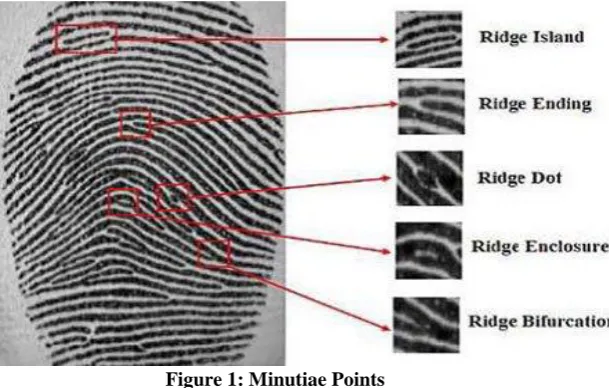
Minutiae Points Can Be Achieved With High Accuracy Using Image Segmentation Techniques. Image Segmentation Is Required To Separate The Foreground From Noisy Image. Noisy Mage Leads To Inaccurate Minutiae Points. For Keeping The Ridge Flow Genuine, Image Enhancement Techniques Can Be Used. Minutiae Points Can Be Of Various Types As Listed Below.
Ridge Ending:Ending Of The Ridge Flow.
Bridges:It Denotes That Ridge Which Joins Two Ridges.
Ridge Islands:It Denotes The Ridge Which Is Surrounded By Other Ridges.
Ridge Bifurcation:It Denotes The Point Where One Ridge Divides Into Two.
Ridge Dots:These Are Small Ridges Of Similar Size To A Dot.
Ponds / Lakes:These Are Blank Spaces Among Diverging Ridges.
Crossovers:It Denotes The Point Where Two Ridges Cross Each Other. [17]
Figure 1: Minutiae Points
IV.
BACTERIAL FORAGING OPTIMIZATION ALGORITHM
BFOA Is An Algorithm Used Globally For Optimization Of Problems And Inspired From Behaviour Of Enzymes Namely Escherichia Coli. It Is Invented By Passino. It Is Encouraged From Chemo Taxis Behaviour Of Bacteria. E. Coli Bacteria Search For Nutrients In Such A Way To Get Maximum Energy In A Unit Time. The Movement Of Bacteria In Search Of Nutrients Is Termed As Chemo Taxis. When They Get Sufficient Nutrients, They Become Lengthier In Size And Break Down Into Two Bacteria. This Activity Of Bacteria Is Termed As Reproduction. Due To Some Reasons Like Environment Changes, Some Bacteria Dies And Some Shifted To Another Part Or Group, Which Results In The Constancy Of The Population. This Behaviour Of Bacteria Can Be Termed As Elimination-Dispersal Activity. All These Activities Are Also Depicted In The Algorithm. So, Here, We Can Say The Said Algorithm Consists Of Four Main Processes As Depicted Below:
Chemo Taxis:In His Process, Algorithm Depicts The Movement Of Cells. E. Coli. Cells Can Move UsingTwo Modes: Swimming And Tumbling. Swimming Is Moving In Same Direction And Tumbling Denotes The Movement In Random Direction. Cells Can Alternate Between The Two In Their Lifetime.
Swarming:Group Behaviour Has Been Observed In E. Coli Bacteria To Form Patterns Or Swarms. TheyForm Groups Or Rings While Travelling Through The Medium.
Reproduction:The Least Healthy (Or Highest Cost In Terms Of Its Application) Dies And Some HealthierBacteria Breaks Down Into Two. The Population Size Hence Remains Intact.
Elimination And Dispersal:As Described Above As Well, Changes In The Living Environment Of TheBacteria Results In The Killing Of A Group Of Bacteria Or Shifting Of A Group Of Bacteria To Other Place. To Implement This In Algorithm, A Probability Is Used To Eliminate Some Features And Some Are Replaced In The Search Space.
Steps Of BFOA
D: Dimension Of The Search Space
T: Total Number Of Bacteria
Zc: Number Of Chemotactic Steps
Zs: Swimming Length
Zr: Number Of Reproduction Steps
Zed: Number Of Elimination- Dispersal Steps
Ped: Elimination- Dispersal Probability
S(I): Size Of Step Taken Randomly (Tumble)
Let P(A,B,C)= { Θi (A,B,C) , Where I= 1,2,…,T} Represent The Position Of Each Member In The Population At Ath Chemotactic Step, Bth Reproduction Step And Cth Elimination-Dispersal Step. Let J(I,A,B,C) Denotes The Cost At The Location Of The Ith Bacterium Θi (A,B,C) ∈Rd (Rational Numbers With D
Dimensions)
Step 1: Initialise Parameters D, T, Zc, Zr, Zs, Zed, Ped, S(I) (I=1,2,…,T), Θi Step 2: Elimination-Dispersal Loop: C=C+1
Step 3: Reproduction Loop: B=B+1 Step4: Chemo Taxis Loop: A=A+1 1. For I=1,2,…,T Repeat The Below 2. Compute Fitness Function J(I,A,B,C)
Let J(I,A,B,C)= J(I,A,B,C) +Jcc((Θi (A,B,C), P(A,B,C)) 3. Let Jlast(I,A,B,C)=J(I,A,B,C) Until We Find The Best One
4. Tumble: A Random Number Vector Is Generated ∆ (I) ∈Rd With Each Element Lies In[-1,1]
5. Take A Chemotactic Step As Follows: Θi (A+1,B,C)= Θi
(A,B,C)+S(I) ∆ (I)/ (Sqrt(∆T(I) ∆ (I))) 6. Calculate J(I,A+1,B,C) Using
J(I,A+1,B,C)= J(I,A,B,C) +Jcc((Θi (A+1,B,C), P(A+1,B,C)) 7. Swim:
A. Let G=0 (Swim Length Counter) B. While G<Zs Repeat C. Let G=G+1
D. If J(I,A+1,B,C)<Jlast, Let Jlast= J(I,A+1,B,C) And Θi (A+1,B,C)= Θi
(A,B,C)+S(I) ∆ (I)/ (Sqrt(∆T(I) ∆ (I))) And Use This To Find J(I,A+1,B,C)
E. Else G=Zs. End Of While Loop 8.Go To Next Bacterium I=I+1, I!=T
Step 5: If A<Zc, Repeat Step 4 As The Bacteria Life Is Not Over Step 6: Reproduction:
1. For The Given B And C, And For Each I=1,2,…,T Let Ji Health= ∑ J=1,2,…,Zc+1 J(I,A,B,C)
Be The Health Of Bacteria. More Heath Signifies Less Cost. Arrange Them In Ascending Order Of Jhealth.
2. The Tr Bacteria With The Highest Jhealth Values Die And Tr Best Bacteria Split Into Two. Step 7: If B<Zr Go To Step 3 Till The Reproduction Steps Are Over.
Step8: Elimination-Dispersal: For I=1,2,…,T With Probability Ped, Eliminate And Disperse Each Bacterium I Till C<Zed.
V.
PRINCIPAL COMPONENT ANALYSIS
It Is A Method Of Analysing Arrangement In Data, And Expressing The Information In Such A Way As To Focus Their Resemblance And Difference [18]. PCA Converts The Set Of Observations Of Correlated Variables Into A Set Of Values Of Linearly Uncorrelated Variables By Using Orthogonal Transformation. These Set Of Values Are Called Principal Components. It Is One Of The Simplest Techniques Of Analysis That Uses Eigen Values And Eigen Vectors. It Can Be Thought Of As A Technique To Explain The Internal Structure Of The Data Set Or Features In A Way That Makes It Easier To Solve The Issue Or The Problem. It Describes How Much Data Is Varying. It Is Mostly Used For Reducing Dimension Of The Image So That The Required Information Is Obtained And Extra Information Can Be Discarded. The Aim Is To Select A Good Quantity Of Images In Order To Have The Best Understanding Of Problem With The Minimum Database. Below Are The Steps Which Are Followed In PCA.
Step 1: First Create The Data Set Or Feature Set Or Feature Vector. Step 2: Mean Is Calculated For The Vectors.
Step 4: Co-Variance Is Calculated Of The Results Of Step 3. A Co-Variance Matrix Is Obtained. Step 5: Form The Above Covariance Matrix, Eigenvalues And Eigen Vectors Are Calculated. Step 6: Eigen Values And The Eigen Vectors Are The Principal Components.
VI.
IMPLEMENTATION
Step 1: Data Collection: In This Multimodal Biometric Fusion Data Is Collected From The UCI Machine Learning Repository Site. First Dataset Contains Face Images And Second One Contains Finger Print Images. Step 2: Conversion:The Multi Model Biometric System Needs To Convert The Original To Gray Scale Image. This System Works On Gray Scale Images.
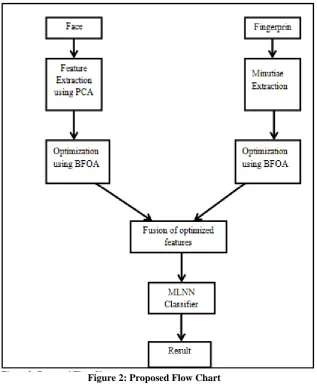
Figure 2: Proposed Flow Chart
Step 3: Feature Extraction In Fingerprint: Mostly, Local Ridge Features Are Used For Identification Systems Based On Fingerprints. These Local Ridge Features Are Called Minutiae. Here, In This Proposed System Minutiae Points Are Extracted From Fingerprints. Minutiae Points Are Extracted Using Binary And Thinned Image. First, Binary Image Is Extracted From Gray Scale Image And Then Resultant Binary Image Is Processed To Have A Thinned Image. From That Thinned Image, Minutiae Points Are Extracted. These Will Be Used For Matching.
Step 4: Feature Extraction In PCA (Principle Component Analysis):Principal Component Analysis Algorithm Is Used To Extract Features From Face Images. This Algorithm Can Be Used For Dimension Reduction, Data Analysis And Feature Extraction. It Defines The Eigen Values And Eigen Vectors.
Step 6: Fusion:Fusion Of Multiple Biometric Traits Is Required For Multi-Biometric Authentication System. This Gives More Accurate Results In Recognition Of A Person. Here, Weighted Sum Rule Based Technique Is Used For Fusion. Fusion Is Basically Done To Get A Single Vector Or A Scalar Number From Different Feature Sets Of The Different Modalities. It Is Performed While Training As Well As Testing Phases.
Step 7: Multi-Layer Neural Network:In This Classification Method, MLNN Is Used To Train The Features And Test The Features. There Are Three Layers Apparently Exist In MLNN Namely Input Layer, Hidden Layer And Output Layer. Except For The Input Features Each Feature Is A Neuron That Uses A Non-Linear Activation Function Using Sigmoid Method. MLNN Uses A Supervised Method For Training And For Testing Method, Simulation Model Is Used To Analyse The Similar Features. The Result Comes Out To Be True Identity /Match Exists Or An Imposter Or Not A Match. According To Which Access Can Be Granted Or Denied.
Step 8:Compute Performance Parameters:
False Acceptance Rate (FAR): It Defines How Many Users Are Falsely Accepted As True Identities. It Is The Measurement For Selection Of Imposters As Genuine Persons.
False Rejection Rate (FRR): It Is The Measurement Of How Many Genuine Users Rejected Falsely. It Gives The Probability Of Rejecting Genuine Persons Considered As Imposters.
Genuine Acceptance Rate (GAR): It Is The Opposite Of FRR. It Defines The Accuracy Of The System Or It Gives The Probability Of Selecting A Genuine User As A Genuine One.
GAR= 1- FRR.
VII.
DATABASE DESCRIPTION
Face Dataset:Face Images Files Are In PGM Format. The Size Of Individual Face Image Is 92*112 Pixels With 256 Gray Level Per Pixel.The Images Are Defined In 40 Directories, Which Have Names Of The Form XV, Where X Indicates The Subject Number. Each Subject Has 10 Images Having Different Expressions, Poses Etc. Each Of These 10 Dissimilar Images Are Defined By Y [19].
Figure 3: Face Images
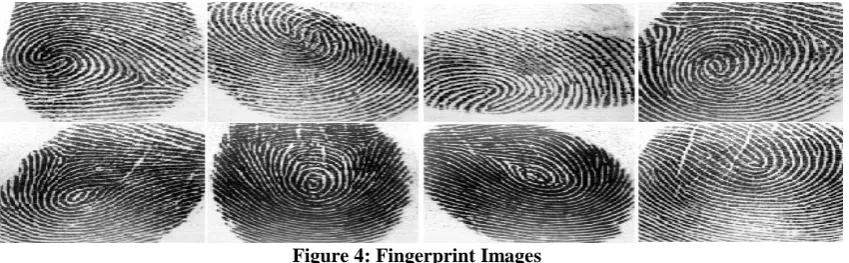
Fingerprint Dataset:Fingerprints Are Taken From CASIA Unique Finger Impression Picture Database. It Has 20000 Images For 500 Subjects Or Individuals. Every Individual Contributes For 40 Images Of His Fingers. Each Image Is Taken By Putting Different Levels Of Pressure On The Sensor. Each Image Is Of Size 328*356 [20].
Figure 4: Fingerprint Images
VIII.
CONCLUSION AND FUTURE SCOPE
Conclusion: In The Conclusion, Multi-Modal Biometric System Is Compared To Uni-Modal Biometrics. It Is
Will Use The Facial And Fingerprint For Verification Of The Person. In This Work, Bacteria Foraging Optimization Method Is Used To Select The Feature Based On The Extracted Features. It Is The Intension Of This Research Technique To Calculate The Fusion. In This Research Work, PCA (Principle Component Analysis) And Minutiae Algorithm Are Used For Feature Extraction Using Facial Images And Fingerprint Images Respectively. Principle Component Analysis Can Be Used For Reducing Dimensions, Data Analysis And Feature Extraction. Fingerprint Images Features Are Extracted From Fingerprint Images Using Minutiae Algorithm. Optimization Is Done Through BFOA (Bacteria Foraging Optimization) That Evaluates Feature Vector Of The Features With Reduced Dimensions. The Different Texture Features Of Facial And Fingerprint Are Extracted.Weighted sumFusion Method Is Used To Connect These Uni-Modal Features. It Could Conclude That The Fusion Produces Better Identification Consequences When Compared With Single Modalities. The Performance Study Using Database Might Be Performed And Calculate The Performance Parameters Like GAR, FAR And FRR. In This Proposed Work, GAR Or Accuracy Is 99%. False Rejection Rate Is 1%. False Acceptance Rate Is 1.3%.
Future Scope:ThisWork Can Be Extended With Other Biometric Identifiers. Other Biometrics Like Iris Can Also Be Added To It With Already Existed Biometrics. This Can Be Used As A Part Of Other Systems Too Like For Security Purpose. Other Algorithms Can Be Used To Improve Its Performance.
REFERENCES
[1]. Gonzalez, R.C. “Digital Image Processing”, Pearson Education India, 2nd Edition, Pp 1-28, 2009.
[2]. Reddy Ch Venkata Rami, KV Krishna Kishore, U. Srinivasulu Reddy, And M. Suneetha. "Person Identification System Using Feature Level Fusion Of Multi-Biometrics." International Conference On Computational Intelligence And Computing Research (ICCIC), IEEE, Pp. 1-6, 2016.
[3]. Kanade Sanjay, Dijana Petrovska-Delacrétaz And Bernadette Dorizzi, "Multi-Biometrics Based Cryptographic Key Regeneration Scheme.", In Biometrics: Theory, Applications, And Systems, BTAS'09, IEEE 3rd International Conference, Pp. 1-7, 2009.
[4]. Kumar Ajay, And Sumit Shekhar. "Personal Identification Using Multibiometrics Rank-Level Fusion.", IEEE Transactions On Systems, Man, And Cybernetics, Part C (Applications And Reviews), Vol 41, No. 5, Pp 743-752, 2011.
[5]. Rathgeb Christian, And Christoph Busch, "Cancelable Multi-Biometrics: Mixing Iris-Codes Based On Adaptive Bloom Filters.", Computers And Security, Vol. 42, Pp 1-12, 2014.
[6]. Sanjekar P. S. And J. B. Patil, "An Overview Of Multimodal Biometrics." Signal And Image Processing, Vol 4, No. 1, Pp 57, 2013.
[7]. Jagadiswary D., And D. Saraswady, "Biometric Authentication Using Fused Multimodal Biometric.", Procedia Computer Science, Vol. 85, Pp 109-116, 2016.
[8]. Singh Paramjeet And Er Rohini Sharma, "To Improve The Security In Biometric Authentication Based On Multi-Model Fusion System.", International Journal Of Applied Sciences And Tehnology, Vol. 2, Issue No. 4, Pp 198-202, 2017..
[9]. Dinca Lavinia Mihaela And Gerhard Petrus Hancke. "The Fall Of One, The Rise Of Many: A Survey On Multi-Biometric Fusion Methods.”, IEEE Access 5, Pp 6247-6289, 2017.
[10]. Kim Yeong Gon, Kwang Yong Shin, Won Oh Lee, Kang Ryoung Park, Eui Chul Lee, Cheonin Oh, And Hankyu Lee, "Multimodal Biometric Systems And Its Application In Smart TV.", Computer Applications For Database, Education, And Ubiquitous Computing, . Springer, Berlin, Heidelberg, Pp. 219-226, 2012. [11]. Omran Safaa S., And Maryam A. Salih., "Design And Implementation Of Multi-Model Biometric Identification System." International Journal Of Computer Applications (0975–8887) Vol. 99, No. 15, Pp 14-21, 2014.
[12]. Kumar K. And Mohammed F., "A Review Of Multimodal Biometric Authentication Systems", International Journal Of Scientific And Technology Research, Vol. 5, No. 12, Pp. 5-9, 2016.
[13]. Awalkar Kirti V., Sanjay G. Kanade, Dattatray V. Jadhav, And Pawan K. Ajmera. "A Multi-Modal And Multi-Algorithmic Biometric System Combining Iris And Face." International Conference On Information Processing (ICIP), IEEE, Pp. 496-501, 2015.
[14]. Gupta Dhriti, "Multimodel Biometric System: Fusion Techniques And Their Comparison." , 2ndInternational Conference On Recent Advances In Engineering &Computational Sciences (RAECS), IEEE, Pp. 1-4, 2015.
[15]. Shende Pradnya M. And Dr MV Sarode, "Multiple Biometric System Application: Iris And Fingerprint Recognition System." International Journal Of Application Or Innovation In Engineering &Management (IJAIEM), Vol. 5, Issue 3, 2016.
International organization of Scientific Research62 | P a g e
[17]. Barbu Tudor, Adrian Ciobanu And Mihaela Luca. "Multimodal Biometric Authentication Based On Voice, Face And Iris.", E-Health And Bioengineering Conference (EHB), IEEE, Pp. 1-4, 2015.
[18]. Https://Www.Bayometric.Com/Minutiae-Based-Extraction-Fingerprint-Recognition/ [19]. Http://Www.Cl.Cam.Ac.Uk/Research/DTG/Attarchive:Pub/Data/Att_Faces.Zip [20]. Http://Biometrics.Idealtest.Org/Detailsdatabase.Do?Id=3.