ISSN: 2231-5381
http://www.ijettjournal.org
Page 58Bandwidth and Resource Allocation for Full Implementation of
e-Election in Nigeria
Nsed A.Akonjom and Julie C.Ogbulezie
Dept. of Physics (Electronics & Computer Tech. Unit,), University of Calabar, Calabar, Nigeria. Corresponding author: Julie .C.Ogbulezie
Abstract
Voting is an act of democracy. Citizens are given the opportunity to voice their opinions by voting. Involving technology will enhance the process by ensuring that every citizen irrespective of his/her abilities or disabilities can exercise such rights. This research work seeks to bring to fore the full benefits of implementing complete e-Election in Nigeria and also using an M/G/S based simulation software predicted the bandwidth as well as resource allocation for an effective conduct of e-voting, which has become more and more glaring with the failure of over 78 years old practice of paper balloting. The study proposed a Public Network Direct Recording Electronic (PNDRE) Voting System which stands out as the ideal option for Nigeria.
Key words:voting system, OMR, direct data capture, PNDRE, bandwidth
1.0 Introduction
In many areas of modern life today, technology
dominates. It is believed that technology is
progress; progress is good and should, therefore,
be embraced. Countries in all the continent of the
world are at various stages of piloting or partially
using election voting and counting technologies,
including the use of Internet voting [1]. There is a
wide variety of different voting systems that are
based on traditional paper ballots, mechanical
devices, or electronic ballots [2]. The advancement
of information and telecommunication technology
allows for a fully automated online computerize
election process in addition to overcoming
commonly encountered election pitfalls, electoral
vote counts are done in real time, that by the end
of election day, the results are automatically out
[3],[4]. The protest and election petitions cases in
tribunals challenging election results as well as
apathy on Election Day in Nigeria are indicators
that it is time to change.
This work proposes a method which will best suit
Nigeria as a Nation taking into consideration the
latest technology and infrastructure available.
Public Network Direct- Recording Electronic
(PNDRE) voting System, which is a hybrid of the
direct- recording electronic (DRE) voting system
with various remote voting options via mobile
phone, internet and fax, using a public network
platform, is the way to go. The work, also using
simulation software employing stochastic
processes, predicted two very important
parameters which if not properly distributed and
applied can jeopardize any election process. These
are bandwidth and voting machine allocation on
Election Day.
1.1 The history of Elections in Nigeria
The history of Elections in Nigeria dates back to
the post independence Period, when the Electoral
ISSN: 2231-5381
http://www.ijettjournal.org
Page 59Since then the bodies name has been changed to
Federal Electoral Commission (FEDECO) in
1978, National Electoral Commission (NEC) in
1987, National Electoral Commission of Nigeria
(NECON) 1993 and Independent National
Electoral Commission (INEC) in 1998.The present
method of voting in Nigeria is the Open Secret
Ballot System (OSBS), where ballot paper is used.
In 2002, the Independent National Electoral
Commission (INEC), introduced the Electronic
Voter Registration (e-Registration). This was to
cater for the following problems and limitations:
unreliable voter registration data base file,
absence of a credible voter identification system
and tools, fraudulent electoral system process, and
lack of appropriate voting technology which
characterized the manual register.
The e-Registration was done using the Optical
Mark Recognition (OMR) Technology. It was
later abandoned due to errors in the database
caused by limited time and poorly trained ad- hoc
staff for the registration exercise.
A fresh voter register had to be compiled in 2006,
leading to the 2007 polls using the Direct Data
Capture (DDC) technology. The DDC
incorporated pictures of registrants which was
lacking in the OMR.
All efforts to implement e-voting in Nigeria were
blocked by the National Assembly in 2006, which
only approved the Registration aspects of the
e-election process proposed by INEC. This was also
abandoned, as it also suffered the same fate as the
OMR method. Then a fresh registration was
conducted in 2010 still using the DDC technology.
1.2 Proposed voting system for Nigeria.
The direct-record electronic (DRE) voting system
is the most advanced and user-friendly voting
system available today.DRE voting machine can
offer many compelling benefits, including good
usability and accessibility, multiple languages, and
elimination of over voting and unintentional
under voting [5]. When combined with
transmission of ballots and votes via telephone,
private computer network or the internet, it will
present the most ideal voting by extension
e-election Nigeria as the country needs to cater for
the various set-backs experienced in time past
while conducting election using ballot paper.
Combining DRE with other forms of voting
produces two types of e-voting opportunities;
(i) E-voting which is physically
supervised by Election Management
Board (EMB)- DRE machine
(ii) Remote e-voting where voting is
performed within the voter’s sole
influence, and is not supervised by
the EMB (INEC), example voting
from PC, mobile-phone television, via
the internet (i-voting) .This
combination is called Public Network
DRE (PNDRE).
A public network DRE (PNDRE) voting system is
an election system that uses electronic ballots and
transmits vote data from the polling place to
another location over a public network. The
PNDRE voting system can utilize either precinct
ISSN: 2231-5381
http://www.ijettjournal.org
Page 601.3 Components of PNDRE
The components that make up the proposed
PNDRE voting system are: a laptop, scanner,
printer, USB hub, camera, power packs, and
network MODEM, user interface MODEM,
voting device for disable (machine) persons, voting
machine. Fig.1 shows the interconnection of the
components fig. 2 Shows interconnections for
remote voting capability as well as real time result
computation devices which includes mobile phone,
PC with internet connection, servers, public
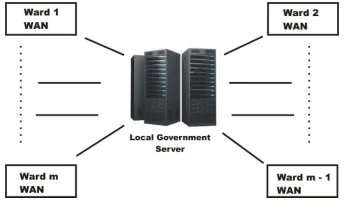
network (backbone). Figs 3-5 show the
interconnection of servers (WAN) at Local
Government, State and National levels.
Fig. 1: Design of DRE using the existing DDC machines connected
via a modem to a voting Machin
Fig. 2: A typical Ward Wide Area Network (WAN) for actualizing
PNDRE voting system
Fig. 3: Local Government WAN System for
Real Time Results Transmission
Fig. 4: State WAN for real time transmission of results
Fig. 5: National WAN for Real Time Transmission of
Results
The DRE has a laptop as the main active device,
with software to interpret effectively the signals
from the various passive devices connected to it. It
ISSN: 2231-5381
http://www.ijettjournal.org
Page 61- Process data from scanner during
voter authentication (accreditation)
and produce a voter list from the
voter register in it.
- Receive, send and process signal from
the public network.
- Have security against hacking and
virus attack.
- Form the operator terminal where
permission to vote is activated for
each voter in turn.
- Process data from user interface
MODEM of the two voting machines
connected to it namely, the voting
machine and disable voting device.
The DRE is made of two sections; the operator
device and the user device connected by a 5m
cable. (See Fig. 1).The voting machines are
basically passive devices and their signals can only
be processed by the laptop. The voting machine
has pictorial looks, like a typical ballot with
buttons beside each party for voters to press in,
while making their choices.
The disabled voting devices can employ voice
technology for blind voters or maybe a device
known as sip and puff for those with little or no
mobility and other such devices as will be needed
by the disables. It is expected that a special centre,
one in each local government should provide for
such needs.
The printer prints the voter list for eligible voters
after accreditation, a receipt for voter after voting
, the final result after polls , and the audit trail of
activities that the computer was engaged in a
period so desired.
Through the public network and internet
MODEM, the DRE and the various remote voting
devices are inter connected to the various severs at
the ward levels, local government levels, State and
National levels for collation of result. This mesh
structure is important for Nigerian political
structure which supports collation at the various
levels so mentioned. (See Figs 2, 3, 4 &5).
When PNDRE system is employed in election, the
advantages include; no risk of exhausting the
supply of ballots; it removes the need for printing
of paper ballots which is a significant reduction in
cost; it can be programmed to provide ballots in
multiple languages for a single machine; this
attribute is unique to electronic voting. Electronic
voting machines can be made fully accessible for
persons with disabilities. It can use headphones,
sip and puff, foot pedals, joysticks and other
adaptive technology to provide the necessary
accessibility for the various forms of disabilities
etc. Remote voting is facilitated by internet,
phones, personal Computer and even via fax and
email, making it possible for Astronauts in orbit to
vote.
2.0 Materials and Method
The simulation environment is made up of one
ISSN: 2231-5381
http://www.ijettjournal.org
Page 62voting stations. Using a simulation model that is a
generalised (M/S/G) queuing model system where
voters randomly arrive according to a Poisson
random process. The inter-arrival rate is
controlled by the mean time between successive
arrivals all governed by an exponential
distribution and introducing a random delay to
compensate for inter-net transfer time, since both
central DB server and local voting machine are
located within the same network segment for this
experiment. The effect execution of e–-election
(e-voting) is predicated on two very important
parameters which are: bandwidth of network
and resource allocation e.g. voting machine. The
transfer time is a function of bandwidth and
message size.
The metric used by the simulator are
i. The voting (simulation) time
ii. Average queue length of voters
iii. Waiting time of voter
iv. Voting machine requirement at each
ward
3.0 Results
There are three bandwidth sizes in this work;
a. A I Mbps is a conservative bandwidth.
b. A smaller bandwidth 128kbps
c. A bigger bandwidth 10mbps for a more
developed network.
3.1 Bandwidth Requiremen
BW
D1 D2 D3 D4 D5 D6 D7 D8 D9 D10 D11 D12
128KB 9.8 10.2 10.5 9.8 10 10.1 9.6 10.2 9.8 10.4 10 9.4
IMB 7.5 8.0 8.2 7.6 7.8 7.9 7.5 7.9 7.4 8.1 7.5 7.3
10MB 7.3 7.8 8.0 7.4 7.6 7.7 7.3 7.7 7.2 7.9 7.3 7.1
Table1. Average service time (minute)
The type WAN bandwidth applied has an impact on the
model performance table (1) shows the average service
time for the three different bandwidth values (128wp5,
1mbp5 ad 10 Mbp5). Which show results various
station. It can be seen that beyond 1Mbps marginal
utility become negative, as any pronounced
improvement in the bandwidth size will begin to
diminish.
ISSN: 2231-5381
http://www.ijettjournal.org
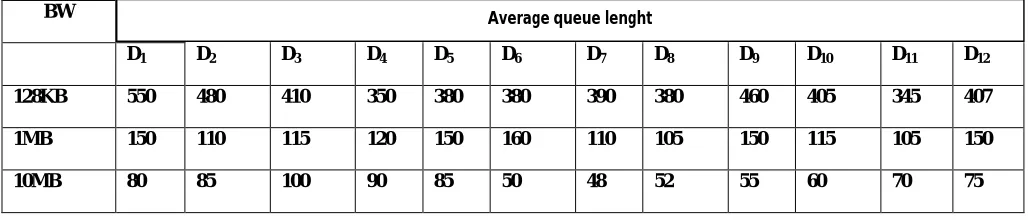
Page 63 BWD1 D2 D3 D4 D5 D6 D7 D8 D9 D10 D11 D12
128KB 550 480 410 350 380 380 390 380 460 405 345 407
1MB 150 110 115 120 150 160 110 105 150 115 105 150
10MB 80 85 100 90 85 50 48 52 55 60 70 75
Table 2, on the other hand shows the average queue
length for different bandwidths. The average queue
length for a 128 kps bandwidth can be 3 times as big
as a that of 1Mbps queue length. It can be seen that the
performance improvement beyond Mbp5 is rather
insignificant.
RESOURCES ALLOCATION (VOTING MACHINE)
When the number of voters for a ward is
relatively large can/or the arrival of voters is high, the
parameter which can easily be tuned is the allotting or
addition of more machine as required[6]. This is a very
important parameter as it is within the control of an
EMB. For a distributed network system the impact is
appreciable, as the load is distributed locally without a
significant impact on the main server. Unlike the
centralize DB network approach where addition of
voting machine may not improve the results
significantly, as the machine supply shift the overload
from the local station on the main (central) server.
Table3 shows the number of voting machine required
to complete all election transactions within 8 hours for
different population of different wards.
Assuming
i. A 1Mbps bandwidth and
ii. A cluster policy in a distributed
architecture.
No of Machines No of Voters
7 4000
9 8000
22 12,000
26 16,000
38 20,000
Table3 Voting Machine Allocation for different voting
strength
SUMMARY
The role of technology in conducting elections across the
globe cannot be over emphasized. The availability of
Public network backbone almost everywhere in Nigeria
in form of internet connectivity and GSM (mobile
ISSN: 2231-5381
http://www.ijettjournal.org
Page 64 implement and reap full benefit of its introductionwhich are reliability, fraud free and cheap elections..
This research work looked the most ideal voting
system, a hybrid of the DRE and other form of the
remote voting options like internet voting, mobile phone
voting etc., through a Public network backbone, this
system is called Public Network Direct Recording
Electronic (PNDRE) voting system. This system has
distinguishing features that makes it stand out, these
features are as follows:
- Ability for those with disabilities to vote
- Accuracy in computation of result - Real time computation of result
- Provision of paper auditing and so on.
This work looked at how best to deploy two main
parameter that are very important to a successful
e-voting process, Using an M/G/ S based simulation
software, predictions were made as to how many voting
machines are required for each ward and the ideal
bandwidth for effective transmission of data during
election.
RECOMMENDATIONS
For PNDRE voting system to perform well and bring
the best output, it is important the following be put in
place:
I. Improved Network (Public and Private)
system be deployed across the country.
II. Pilot scheme be run in at least three states,
Lagos, Kano, and Abuja in 2015 general
elections while other states use the usual ballot
paper voting system with electronic
accreditation using the e-authentication
device.
III. Proper development of man power in all
relevant areas of need should start now for
persons to be engaged in the future. This can
be achieved if the IT training in higher
institution includes those areas of handling
minor faults and operating of such devices.
The National Youth Service Corps(NYSC)
orientation camp is another place for such
training.
IV. Development of a national data bank with all
citizen having personal identification number
(PIN) that can serve as Voter Identification
Number (VIN) for election purposes, should
be seriously considered. It is vital tool for
achieving remote voting capabilities.
CONCLUSION
The introduction of computer and computer
networking in the election activities in Nigeria will in no
small measure improve the way the business of election
management and indeed governance in general is
handled. Electronic election (e-Election) in Nigeria will
eliminate the infelicities that have characterized
previous elections in the following ways:
- Introduction of voter authentication
through biometrics (finger prints and Iris
of the eye)
- Instantaneous transmission of results
from polling station to collation centre
making falsification impossible.
- Ballot box stuffing will be eliminated.
- It delivers a higher degree of accuracy of
both the voting method and the
transmission of results.
- It offers a better election result
management since result can be
ISSN: 2231-5381
http://www.ijettjournal.org
Page 65 - Paper trail will be printed from thepolling station reflecting the
summary/calculation of result at each
polling station, avoiding the alteration at
any stage.
- This system will lend itself to easy use by
the barely literate (user-friendly).
- It will also be powered by solar system
charged batteries.
- Disables will be given the opportunity to
vote
- It will in the long run reduce the cost of holding an election, as it will greatly
reduced human and economical
resources, not to talk of the tons of paper
used previously that will be eliminated
almost entirely.
The complete implementation of this work will be all
inclusive, with the Direct Recording Electronics (DRE)
voting system, internet voting system, and voting by fax
and mobile phones being part of it. This will increase
the voting points and solve the major problems of
apathy and other problems associated with polling unit
voting. It will also incorporate real time result
transmission that will ensure all results are gotten 2
hours after close of polls. Most importantly this work
will help electoral official to effectively deploy
resources during election
REFERENCES
[1] N.A. Akonjom, Computer Network Infrastructural Development for the Attainment of e-Election in Nigeria, Unpublished M. Sc. Thesis Faculty of Science University of Calabar 2009.
[2] National science foundation, Report on the national workshop in internet voting issues and research agenda, March 2001 htpp://news.findlaw.com/docs/voting/insfe-voterprt.pdf
[3] R. Mercuri, Electronic voting Tabulation checks and balances. Ph.D thesis. University of Pennsy/vania, Philadelphia P.A, 2000
[4] A.D. Rubin, Security considerations for remote electronic voting communications of the ACM, 45(12): 39-44, December 2002.
[5] P.S. Hermson, R.G. Niemi, and B.B. Bederson, Voting Technology: The not-so-simple Act of Casting Ballot. Washington DC: Brookings international press, ISBN 0-817-3563-4. 2008