DOI 10.1007/s13174-011-0053-8
S I : F O M E - T H E F U T U R E O F M I D D L E WA R E
Cloud management
Nigel Cook·Dejan Milojicic·Vanish Talwar
Received: 17 November 2011 / Accepted: 23 November 2011 / Published online: 8 December 2011 © The Brazilian Computer Society 2011
Abstract Cloud computing offers a number of benefits, such as elasticity with the perception of unlimited resources, self-service, on-demand, automation, etc. However, these benefits create new requirements for management of cloud computing. On the back-end, economic limitations dictate careful consolidation of servers with clear sustainability analysis; managed levels of abstractions are higher (from hardware, to VMs, to services); and reliability, availability, and supportability are built into higher levels of systems and services. On the client-side, cloud services have to be easy to use/manage, perform well, and be reliable. On both sides, geographical distribution and its implications on business continuity is a rule rather than exception; scalability is built-in by design; and QoS is still bebuilt-ing defbuilt-ined. In this paper, we discuss new requirements and approaches to cloud manage-ment. We present a few examples of cloud management for private, public, and HPC clouds. Based on these, we derive conclusions about manageability of current platforms and then make predictions about the research challenges of fu-ture cloud management. We expect these findings to help de-signers of next generation hardware and software platforms to develop more manageable systems and solutions. Keywords Cloud services·Service management· Middleware·Heterogeneity·Integration·Scalability· Service level agreements
N. Cook
Hewlett Packard, Littleton, CO, USA e-mail:[email protected] D. Milojicic (
)·V. TalwarHewlett Packard, Laboratories, Palo Alto, CA, USA e-mail:[email protected]
V. Talwar
e-mail:[email protected]
Abbreviations
QoS: Quality of Service;
SLA: service level agreements;
IT: Information Technology;
DevOps: Development Operations;
NVRAM: Nonvolatile Random Access Memory;
AWS: Amazon Web Services;
VM: virtual machines;
CAPEX/OPEX: Capital/Operational Expenditure;
SSD: Solid State Disks;
WBEM: Web-Based Enterprise Management
1 Introduction
Cloud computing is an emerging paradigm, with growing popularity and adoption [1]. Cloud providers host shared servers, and deliver computing, storage, and software to end-consumers as a service. Both Gartner and IDC have esti-mated healthy growth of cloud computing adoption [2,3]. Cloud services include compute-on-demand, online stor-age, online/shared office applications, key value store, and email, among many others services. Examples of public cloud providers are Amazon AWS [4], GoGrid [5], and RackSpace [6]. Several other companies have cloud of-ferings, such as HP [7], Google [8], IBM [9], and Mi-crosoft [10].
Fig. 1 Life-cycle of a managed object
by a number of companies (over 130 at the time of writ-ing this paper and growwrit-ing). In addition, there are other open source cloud stack efforts under way, such as Open-Nebula [14] and Tashi [15]. Research efforts and testbeds include RESERVOIR [16], Open Cirrus [17], and Open Cloud Consortium [18]. Other examples of cloud manage-ment among many include CloudWatch, Nimsoft, MMC, Mesos [19], Monalytics [20,21], vManage [22], and mul-tiple managers [23].
Traditional standardization organizations, such asDMTF, NIST, andIEEE, have independent efforts in standardizing different aspects of clouds and cloud management. They are still early in the process to understand the impact of these efforts. Amazon Web Services interfaces appear to be a de facto standard interface, while OpenStack is getting momen-tum as an open source implementation thereof.
Cloud computing is enabled by advances in virtual-ization, service-oriented computing, and utility computing. There are several requirements for cloud computing to be successful. These include low-cost, SLA compliance, secu-rity guarantees, high availability, energy efficiency, and ac-curate accounting. The key to meeting these requirements is effective management of cloud resources and services. This covers all aspects of the data center life-cycle from bring-up, provisioning, scheduling, monitoring, failure management, and shutdown.
As IT becomes increasingly automated, so does the im-portance of IT manageability. This is especially true in cloud where automation is essential for driving down the cost. Manageability is defined as the collective processes of de-ployment, configuration, optimization, and administration during the life-cycle of IT systems and services. Recent ex-amples of Amazon and VMware outages, which impacted the business continuity of a number of hosted companies, are key indicators of the importance of manageability.
Manageability has multiple dimensions. Resource man-agementconcerns scheduling and resource assignment, per-formance and availability, virtual machines, workload, and OS functions.Automationaddresses deployment, provision-ing, monitorprovision-ing, configuration, changes, and problems.
Manageability targets managed objects, which can be hardware or software (object, service, data, etc.). The life-cycle of a managed object is presented in Fig. 1, from bring-up, through operation, over failures/changes, till re-tire/shutdown. A managed object can have different granu-larity and composition. The life-cycle of a managed object
Fig. 2 Managing clouds and cloud services
Fig. 3 Levels of management
can also be of different duration; in clouds, it is typically shorter compared to non-clouds.
While the above figure is true in cases when the full sys-tem is owned and managed by the service provider, in the case of clouds this is not true. Different parts of the sys-tem can be managed by different owners and in different domains, behind different firewalls (see Fig.2, red arrows indicating independent management domains).
Figure3shows complexity of different phases and lev-els of management and how these phases and levlev-els inter-act. Cloud services are managed at the top of this spectrum, but their management depends on managing objects lower in the dependency chain. Since different objects are managed independently, there is a need for integration of individual managers to avoid inconsistency or undesired behavior.
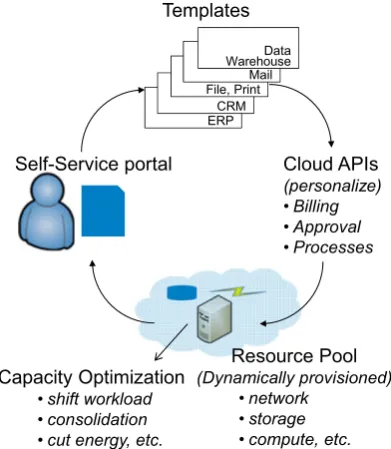
A distinct feature of cloud service management is “self-service,” typically accomplished through a portal (see Fig.4). An important interplay exists between development and delivery of services. The cloud management environ-ment sits on top of the stack of different layers of cloud delivery engines, automation engines, and deployment tem-plates and best practices.
Fig. 4 Self-service at the top of service management
[35], sustainability [36] and supportability [37]. We have also derived a lot of insights from similar “Future of Soft-ware Engineering” workshops, as well as from the specific paper on the future of middleware [38].
The rest of the paper is organized in the following man-ner. In Sect.2, we present three examples of contemporary cloud management. Section 3 summarizes some of the IT industry trends. In Sect. 4, we discuss requirements and research challenges. Finally, we summarize the paper in Sect.5.
2 State of the art cloud management examples
2.1 Managing private clouds: CloudSystem matrix
HP CloudSystem is an example of a layered management stack for private but also public or hybrid cloud environ-ments. The environment is constructed as a layering of ab-straction as follows:
Virtualization management.The lowest layer provides a life-cycle management of a set of virtualized resources that are drawn from a pool of capacity in the data center. Ex-amples of the virtualized resources and the corresponding management include virtualized servers, storage, and net-working, which can be managed by VMware vCenter, Mi-crosoft System Center Virtual Machine Manager, or HP In-sight Control. This can be applied to private cloud environ-ments and for public cloud environenviron-ments, such as Open-Stack or Amazon EC2. Each environment provides a notion of an underlying resource capacity implied by a combina-tion of the physical resource being virtualized, or by quotas
applied to consumption of individuals or groups. These sys-tems provide capabilities to manage the life-cycle of their virtualized resources, as well as provide monitoring infor-mation about the resource consumption and availability of their specific components.
Cloud service composition.Built on top of the virtual-ization management, is the component that manages com-position of the virtualization environment to create aggre-gate cloud service infrastructure. An aggreaggre-gate service is one that uses a heterogeneous mix of virtualized resources or resource geographies to realize a service offering. Com-position of services requires a model of the service com-ponents and their relationships, as well as modeling of the capacity and relationships of the underlying virtualized re-sources. The composition layer uses these two models to schedule use of the virtualized resources to match the in-frastructure demand generated by the composite service. Scheduling algorithms take account of service quality con-siderations, which include both availability considerations and isolation or compliance requirements between different services. This layer monitors the state of the infrastructure elements, alerting on failures, and monitors resource con-sumption with a goal of providing optimal utilization of the underlying resources, including energy and network band-width.
Application management models the components of a business application and the relationship to the infrastruc-ture provided from the cloud service composition layer. The infrastructure needs of the application can vary by the stage in the life-cycle, or due to varying workload demands placed on the service. As an example, during the develop-ment phase of an application, the application may reside on virtualized resources entirely contained within a testbed constructed from public cloud resources, while during pro-duction that same application may reside both on an internal private cloud holding the application transaction engine and one or more external clouds providing the Web interface and catalog components. While the application is running, the service responsiveness is monitored, and if it falls outside of set limits, then scaling adjustments are made, both by ad-justing the number of running application instances or by requesting adjustment of the infrastructure supplied by the cloud service composition layer.
the scalability and availability aspects of the services, rather than each application development team needing to create and operate a separate strategy for these aspects.
Challengesfor enterprise clouds at the composition layer include algorithms for distributed placement and schedul-ing of virtualized resources into the distributed capacity pools, particularly for requests targeted at times in the fu-ture. For the application management and scaling, a key is-sue is understanding the scaling model of an application, and interpreting the root cause of application service level changes. Other challenges specific to private, public, and hy-brid clouds include:
• Automated elasticity and SLA guarantees, security, and availabilityin shared environments are hard to support. • Unified and integrated management across compute,
stor-age, and network does not exist, preventing end-to-end management of applications and cloud services.
• Federated management across clouds instancesis hard to achieve for independently managed private clouds.
2.2 Managing public clouds: Internet data centers
There has been a recent surge in new Internet companies such as Facebook, Twitter, Google, Amazon, and LinkedIn. These companies provide online services such as search, so-cial computing, and shopping, and they are hosted within large-scale and globally deployed data centers accessed by millions of customers/users worldwide. Systems manage-ment in such large-scale infrastructures provides several challenges. Below we highlight three trends that provide specific challenges and opportunities towards next genera-tion systems management in such infrastructures.
Massive scale in terms of users, machines, data. Ex-isting Internet data centers already contain several hun-dreds of thousands of machines and this number is in-creasing to meet the growth in the number of users ac-cessing the online services. A simple back of the enve-lope calculation easily shows that we can expect several millions of managed objects in such future data centers. This poses several challenges for the automated deploy-ment of OS/VM/application images, load balancing to meet demands, fail-over/reliability of machines and software, as well as capacity planning to ensure service demands are met. Constraints to meet CAPEX, OPEX, and sustainability goals along with requirements to meet guaranteed service levels pose challenges for the design of scalable manage-ment systems. Furthermore, large-scale systems pose chal-lenges for system logging, monitoring, and analysis for ab-normal system behavior to meet high traffic rates. Various frameworks such as Scribe are in use by these companies but they are challenged by increasing scale. The growth of data and its storage poses additional challenges to ensure appropriate dynamic partitioning, migration, and replication
to meet service demands, as well as to perform traditional archiving and backup.
Services built by integrating multiple open source frame-works.Internet companies are challenged with the need to reduce the time to bring new services to the market and at the same time ensure scalability. Recent trends include leverag-ing open source frameworks to quickly brleverag-ing up the back-end infrastructure in operation at low-cost and leveraging resources to provide better core services. This has resulted in many open source frameworks such as Hadoop, Cassan-dra, Thrift, Storm, Hive, HBase, MySQL, PHP, Flume, etc. The Internet companies integrate these various open source frameworks on Linux to provide their back-end and process-ing infrastructure. While this speeds up the time it takes to bring up the infrastructure, it poses several challenges for ongoing operations and management. First, automated con-figuration management across multiple tools is a challenge. Gluing together multiple pieces written by different devel-opers requires painful and careful integration and setting of the configuration parameters. Given different possible com-binations of the integration, the current processes for config-uration are ad hoc. Further, there are challenges for tuning the framework, both individual and integrated, end-to-end.
Furthermore, there are also challenges for end-to-end di-agnosis of these integrated frameworks, especially in sce-narios where they are pipelined together, e.g. for streaming data processing. Each framework supports a self-managing capability that allows it to recover from failures and abnor-malities. However, when these frameworks are integrated to-gether, there is a lack of an end-to-end self-managing ca-pability, and allowing individual self-management loops to proceed without coordination leads to unpredictable behav-ior and inefficiencies. There is a need to develop an end-to-end monitoring and analysis framework that can be de-ployed on-demand in such multi-stage frameworks.
DevOps.A new DevOps model is emerging, i.e. devel-oper and sys-admin devel-operations are merging: several of to-day’s Internet companies develop in-house services and the operations work is also done by in-house system adminis-trators. This implies a culture where development and op-erations work together with shared responsibility. This is in contrast to previous models where software used to be pack-aged and shipped. System administrators, who were com-pletely disconnected from the original developers, would de-ploy the package. An update or new release would occur about once in a year.
the shared responsibility, the gap between the silos of pro-gram development and operations/admin tasks is disappear-ing. This implies there is tighter integration between pro-grams and system admin tasks and greater importance for operational efficiency during development. This poses a new model for system management and a new set of tools for this integrated DevOps model. DevOps focuses on appli-cation life-cycle management for developers, not end-users, taking products through life-cycle stages: frompackage (ap-plication model) throughpublish(environment-specific de-ployment models);provisionanddeploy;workload manage-ment; and back topackage(complete cycle). Specific De-vOps functions include:
• Modeling & Configuration Management • Infrastructure Provisioning
• Application Deployment
• Infrastructure and Application Monitoring • Embedded Workload Management
Challengesin this use case include the following: • Heterogeneityof deployment environments, e.g. multiple
infrastructure choices, databases, or hypervisors, as well as working across private and public clouds.
• Automated release and testing,to enable stable products (as the versions of managed objects change and the de-ployed base grows substantially).
• Support and documentation, to resolve issues in a pro-duction environment with performance life-cycle man-agement; enough information needs to be captured to en-able support to identify problems and provide feedback through DevOps to developers to diagnose and fix issues. • Modeling for automated configuration management, to address complex configurations of service compositions. • Maintaining stringent service level guarantees: to ensure
continuous availability of global Internet services with low latency response time even in the presence of flash crowds.
2.3 Managing HPC in the clouds: towards exascale
Today’s use of clouds for high performance computing is growing, but it is limited to small scale, testing and devel-opment. Amazon has built a top-500 supercomputer in its cloud with 7 k cores and achieved speeds of 41.82 teraflops, making it the 231st fastest supercomputer in the world (at the time). They accomplished it with Linux on Intel Xeon X5570 with a 10 Gig Ethernet interconnect. It was de-provisioned soon after running the test but it demonstrated supercomputer-based processing at the price of $1.60/node hour.
At the high-end of HPC, the US Department of Energy is preparing an Exascale program, and so are governments of other countries, such as in Europe, China and Japan. An
Table 1 HPC evolution
2010 2015 2018
Power 6 MW 15 MW 20 MW
Nodes # 18,700 5,000 100,000
Node concurrency 12 ∼1,000 ∼10,000
Interconnect BW 1.5 GB/s 1 TB/s 2 TB/s
MTTI Day ∼Day ∼Day
Fig. 5 HPC applications and target platforms
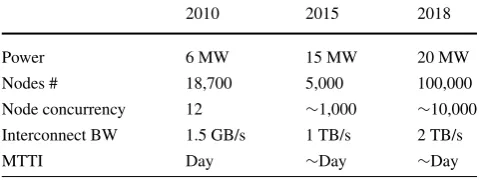
excerpt from the current DOE proposal for Exascale com-puting list of requirements is presented in Table1.
These parameters represent the boundaries of high-end HPC, but in many ways they are evolving in a similar di-rection as high-end data centers. The major differences are slower interconnects and less powerful computation nodes, similarity is in power, cooling, and packaging.
In the future, clouds will contain improved interconnects, such as photonics, that will enable more HPC applications to be executed in the cloud. The requirements for next gen-eration supercomputers are becoming very similar to cloud requirements even though some of the design choices may be different.
Of particular interest is differentiating which applications are best suited to which platform. Figure5shows the types of applications that best suit clouds and supercomputers. Applications that exhibit less latency sensitivity and can be allocated to ‘lower cost’ resources are best suited for clouds. A management platform that can perform such matching automatically will benefit HPC cloud adoption.
The following challenges remain for wider adoption of HPC in clouds:
• Latency: current interconnects deployed in cloud data centers do not offer sufficient performance for HPC ap-plications. Photonics offers some promise for the future. • Cost: to enable clouds for HPC, managing cost and
expanded, including physical clusters, job submissions, and future reservations.
• Power: as HPC grows in performance, power will con-tinue to be one of the main obstacles both for HPC and HPC in the cloud. Carefully managing power consump-tion is critical for reducing power cost (power capping, server consolidation, migration, etc.).
• Virtualization: while overheads are of less concern for cloud applications, they limit virtualization use for HPC applications. For example, in HPC applications I/O virtu-alization is not used at all.
• Security: it will be unacceptable to execute some applica-tions globally due to national security concerns. In addi-tion, privacy and export rules limit the use to specific re-gions. Automated management of regulatory compliance will be a key differentiator.
3 IT industry trends
New technology development always results in faster, big-ger, more reliable devices, such as memory, CPU, intercon-nect, networks, etc. However, today we are at a point where some new technology transitions will have a lasting impact on management.
NVRAM systems will have persistency and low la-tency storage access, driving the need for low-lala-tency and lightweight management stacks. This will require new man-agement models (e.g., new WBEM) and new hardware mon-itoring and other management tools.
Novel memory hierarchies, multi-core, photonics and ad-vances in networking will change systems design and imple-mentation. Management stacks will need to be optimized, lightweight, and decentralized.
Power and cooling dominate OPEX/CAPEX. To limit these costs, interfaces will have to be exposed for system and application power management.
As a result,operating systems will get redesigned with built-in management in various components (similarly to SMART in disks). There will be multiple components in the architecture that will contribute to management. Therefore integration and federation of management domains will be-come important.
Data-intensive computation and continuous production of data (from sensors and many other devices) will require the ability to archive, and manage the data life-cycle. Data elasticity is not the same as computation elasticity (stateful v. stateless; continuously produced and updated). Manage-ment will have to be intertwined with functional support; boundaries between functional support and management are disappearing.
New application modelssuch as social networking and big data will require new management architectures and
algorithms. This will result in new management models, which will be application-driven.
4 Future of cloud management: requirements and research challenges
In this section we summarize some of the requirements and challenges of future cloud management.
4.1 Future cloud management requirements
• Global scale(7–8 B users), mobile access by most users, elasticity at this scale.
• Ease of useresulting inshort time-to-manage, using vi-sual tools, analytics, what-if analysis, predictions, etc. • Cost efficiency, understanding the costs of hosting
ser-vices (infrastructure, serser-vices, and business objectives). • Support for SLAs with multiple objectives, ability to make
trade-offs in an easy and predictable way.
• Availability and business continuity. Managing replica-tion at the resources level and at the service level; trading off replication cost for the degree of availability.
• Automated regulatory compliance.Due to the global na-ture of cloud computing, export and privacy rules need to be verified automatically.
4.2 Future cloud management research challenges
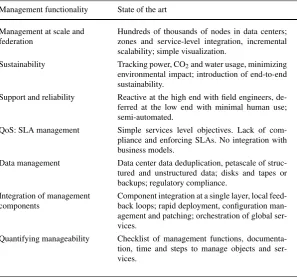
Meeting the above requirements, will expose new research challenges to cloud management. New challenges are de-rived from the level of scale, resource limitations (power in particular), reliability at such scale, and complexity of man-aging data, QoS, and integration. These challenges are dis-cussed in more detail below and also summarized in Table2
for cloud management today and for research direction. • Management at scale.Global and mobile access will
re-sult in unpredictable scale up and down. Elasticity of ac-cess also results in elasticity of management.Federation will be a way to address scalability and to connect inde-pendently managed clouds.
• Sustainability.Environmental awareness is becoming in-creasingly regulated and it will become a requirement, not just a desirable feature. Power limitations will drive cost and scale as data centers continue to grow.
• Reliability and support.As scale continues to grow, fail-ure rates will also increase, leaving no choice but to auto-mate support. Support will also move away from reactive towards deferred and proactive. Supportability and relia-bility will be built into the design across all layers. • QoS. SLA managementwas always hard and it will only
Table 2 Summary of state of the art and research direction of cloud management
Management functionality State of the art Research direction Management at scale and
federation
Hundreds of thousands of nodes in data centers; zones and service-level integration, incremental scalability; simple visualization.
Hierarchies of domains, federations of independently managed data centers and clouds; visualization analyt-ics at full scale.
Sustainability Tracking power, CO2and water usage, minimizing
environmental impact; introduction of end-to-end sustainability.
Trading off sustainability for QoS, automated ability and SLA management, accounting for sustain-ability of mobile services delivery.
Support and reliability Reactive at the high end with field engineers, de-ferred at the low end with minimal human use; semi-automated.
Preventive, substantially automated, self-healing and rejuvenation of components; field engineers only used at the very high end.
QoS: SLA management Simple services level objectives. Lack of com-pliance and enforcing SLAs. No integration with business models.
Multi-objectives, business objectives (pricing, cost-ing). Automated enforcement and compliance. Hierar-chical decomposition of SLAs.
Data management Data center data deduplication, petascale of struc-tured and unstrucstruc-tured data; disks and tapes or backups; regulatory compliance.
Global deduplication, Exascale largely unstructured data; hierarchies of storage around NVRAM with disks at the bottom; global compliance.
Integration of management components
Component integration at a single layer, local feed-back loops; rapid deployment, configuration man-agement and patching; orchestration of global ser-vices.
Choreographies and closed loops of loosely coupled domains addressing power, performance, availabil-ity, etc. individually and with trade-offs (e.g. power-performance for power capping).
Quantifying manageability Checklist of management functions, documenta-tion, time and steps to manage objects and ser-vices.
Measuring Quality of Management (QoM), elasticity of management (matching manageability capabilities to those of functionality supported), ease of manage-ment.
for SLA management. Multiple objectives will result in further complexity.
• Data management. With continuous generation of new data from sensors, multimedia data formats, and many other sources, the ability to manage this data, and com-press, deduplicate, archive, and dispose of it, according to regulatory compliance, will be a huge challenge. • Integration of management components, and run-time
composition. Increasingly more integrated services will result in even higher complexity of versioning, com-patibility, and coordination among multiple management components.
• Quantifying cloud manageabilityis a research challenge. Some of the ways to quantify manageability are listed be-low, but new models and metrics need to be devised: ◦ Checklist of manageability functions
◦ Number of steps to manage towards desired state ◦ Time to manage (including time to insight) ◦ Documentability (e.g. lines of management code) ◦ Elasticity of management (manage at scale) ◦ Availability and continuity of management ◦ Ease of use (GUIs, visualization, analytics, etc.)
5 Summary
In this paper, we evaluated cloud management today and some of the trends that we see coming in the future. We
presented three examples of cloud management: public, pri-vate, and HPC. For each, we emphasized challenges for the future of cloud management. We then related cloud manage-ment trends to the general trends in the IT industry. Based on these trends, we summarized some of the requirements and research challenges of future cloud management.
Cloud computing has a fundamental role in the future of society, as most IT is migrating towards the cloud. As mo-bile services find their way into the cloud, it will become even more ubiquitous. The role of cloud management will become essential—particularly in regard to how scale, De-vOps, and QoS are addressed. With the tremendous amount of data expected to be generated, data-intensive operations will become dominant compared to those that are compute-intensive, while sustainability and support will change in the future.
Table 3 Summary of trends impacting future of cloud management
Layers of the stack State of the art Research direction
Cloud users Traditional Internet users, increased mobile access limited from developed and emerging areas. Some mash-up ability of limited number of users. Some ability to customize and personalize accounts.
Dominantly mobile access, development countries growth towards 8 B users, especially through mobile. Extensive mash-ups through user composed services. Extensive personalization and customization. Cloud services developers Small number for traditional and mobile services
Few releases annually, careful testing some service location awareness New services through develop-ment.
Through composition, integration, large % of develop-ers; continuous roll-out of new releases, agile devel-opment. Full location awareness; integrate with local services available ubiquitously.
Cloud management operators Cloud and cloud service operators (small %) in-creasing updates to services mobile devices some high level dashboard, analytics reporting, some prediction.
Merging role with cloud developers (large %) frequent updates to mobile services, access devices, detailed business dashboards, visual analytics what-if analysis, prediction business outcomes.
Hardware andits impact on support
Disks, early adoption of SDDs, 10 Gb/s Ethernet, early adoption of optical interconnect, 16–24 Core CPUs, 100,000 server data centers, air cooling, very limited use of water cooling,high resource re-dundancy, reactive and delayed support, field en-gineers, complex software repair.
NVRAM adoption, broad optical interconnect, deploy-ment, 1000+Core CPUs, with sophisticated, photon-ics off-on chips, 1012+server data centers, ambient cooling (commodity), liquid cooling (high-end), self-healing, proactive support, customer self-repair, repair moving up the stack, restartable services.
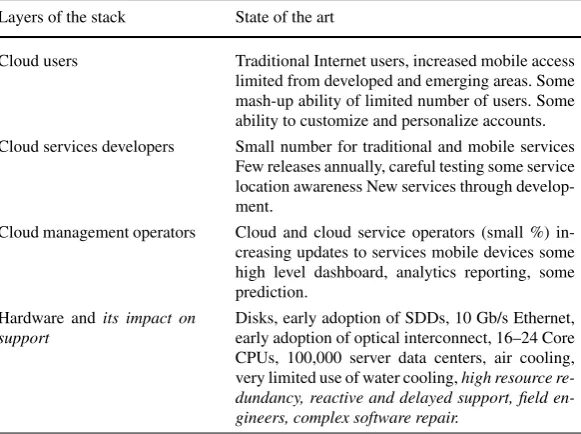
will drive innovation and cloud services pricing models— and therefore cloud management. (See also Table3.) Cloud management is fertile ground for fundamental research in systems, applications, and services.
Acknowledgements We would like to thank organizers of the FOME event, Gordon Blaire and Valerie Issarny, for their leadership in forming this event, as well for reviewing our paper. Their feedback significantly improved the content and the form. We are also thankful to Fabio Kon for continued guidance. Figure3was derived from the similar figure originally created by Sue Charles. Figure5was created by Abhishek Gupta as a part of his internship at HP Labs. Sue Charles and Puneet Sharma reviewed submitted document and provided valu-able feedback.
References
1. Armbrust M et al. Above the clouds: a Berkeley view of cloud computing. Tech report UCB/EECS-2009-28 (2009)
2. Gartner, http://www.gartner.com/it/page.jsp?id=1389313; http:// www.gartner.com/it/page.jsp?id=1454221
3. IDC,http://www.idc.com/research/cloudcomputing/index.jsp 4. Amazon AWS,http://aws.amazon.com/
5. GoGrid,http://www.gogrid.com/
6. RackSpace,http://www.rackspacecloud.com/
7. HP Cloud, http://www8.hp.com/us/en/solutions/solutions-detail. html?compURI=tcm:245-300983&pageTitle=cloud
8. Google Apps,http://www.google.com/apps/intl/en/business/index. html
9. IBM Cloud,http://www.ibm.com/ibm/cloud/
10. Microsoft Cloud,http://www.microsoft.com/en-us/cloud/ 11. Eucalyptus,http://www.eucalyptus.com/
12. RightScale,http://www.rightscale.com/ 13. Open Stack,http://www.openstack.org/
14. Moreno-Vozmediano R, Montero RS, Llorente IM (2009) Elastic management of cluster-based services in the cloud. In: ACDC’09. 15. Kozuch M et al (2009) Tashi: location-aware cluster management.
In: ACDC’09, Barcelona, Spain, June 2009
16. RESERVOIR,www.reservoir-fp7.eu
17. Avetisyan A et al (2010) Open cirrus a global cloud computing testbed. IEEE Comput 43(4):42–50
18. Open Cloud Consortium,http://www.opencloudconsortium.org/ 19. Hindman B et al. (2011) Mesos: a platform for fine-grained
re-source sharing in the data center, NSDI 2011, March 2011 20. Wang C et al (2011) A flexible architecture integrating monitoring
and analytics for managing large-scale data centers. In: ICAC 21. Kutare M et al (2010) Monalytics: online monitoring and analytics
for managing large scale data centers. In: ICAC
22. Kumar S et al (2009) vManage: loosely coupled platform and vir-tualization management in data centers. In: Proceedings of 6th ICAC, Barcelona, Spain, June 2009
23. Kephart J et al (2007) Coordinating multiple autonomic managers to achieve specified power-performance trade-offs. In: Proc of the 4th ICAC, IEEE CS
24. Cook N, Milojicic D, Talwar V (2011) Managing the cloud infras-tructure. In: Migrating to the cloud: for developers, and technolo-gists. Elsevier, Amsterdam
25. Wang C et al (2011) Statistical techniques for online anomaly de-tection in data centers. In: IM
26. Viswanathan K et al (2012) Ranking anomalies in data centers. In: NOMS (to appear)
27. Adams R, Brett P, Iyer S, Milojicic D, Rafaeli S, Talwar V (2006) Scalable management. In: Autonomic computing: concepts, in-frastructure, and applications. CRC Press, Boca Raton
28. Becker K, Pruyne J, Singhal S, Lopes A, Milojicic D (2010) Au-tomatic determination of compatibility in evolving services. Int J Web Serv Res, 8(1):21–40
29. Chen Y, Iyer S, Liu X, Milojicic D, Sahai A, Decomposition SLA (2008) Translating service level objectives into system level thresholds. Clust Comput 11(3):299–311
30. Vambenepe W, Thompson C, Talwar V, Rafaeli S, Murray B, Milojicic D, Iyer S, Farkas K, Arlitt M (2007) Dealing with scale and adaptation of global web services management. J Web Serv Res 4(4):65–84
31. Talwar V, Milojicic D, Wu Q, Pu C, Yan W, Jung G (2005) Ap-proaches for service deployment. IEEE Internet Comput 9(2):70– 80
Proceedings of the fifth open cirrus summit, Moscow, IEEE co-sponsored, June 2011
33. Cai Z, Chen Y, Kumar V, Milojicic D, Schwan K (2007) Auto-mated availability management driven by business policies. In: Proc. of the 10th IFIP/IEEE symposium on integrated network Mgmt, IM’07, Munch, pp 264–273
34. Rivaldo R, Chen Y, Milojicic D, Adams R, Model-based SML (2007) Management. In: Proceedings of the 10th IFIP/IEEE sym-posium on integrated network management (IM 2007), Munich, pp 761–764
35. Shankar C et al (2006) Specification-enhanced policies for auto-mated management of changes in IT systems. In: Proc of 20th USENIX LISA’06
36. Bash C et al Sustainability Dashboard Cloud (2011) Dynamically assessing sustainability of data centers and clouds. In: Proceedings of the fifth open cirrus summit, Moscow, IEEE co-sponsored, June 2011
37. Connelly C et al (2009) Reiki: serviceability architecture and ap-proach for reduction and management of product service inci-dents. In: Proc. IEEE ICWS, Jul 2009, pp 775–782