When social computing meets soft
computing: opportunities and insights
Fei Hao
1,2, Doo‑Soon Park
3*and Zheng Pei
4Introduction
Social media are computer-mediated tools that allow people to create, share or exchange information, ideas, pictures, audio or videos in virtual communities by using open Inter-net. Among online social networking services, there exist very interesting and challenge-able research works on how to improve an efficient social media computing and how to make an effective social network analysis and mining from the perspectives of both academia and industry. Therefore, social computing, as a research discipline, is emerging for handling those kind of data generated from social media. Normally, various social computing related techniques include statistical approaches, graph based approaches and so forth. However, a human nature is present in the social networks. This implies that the social networks are human-like-full of imprecise relations and connections between individuals, vague terms, groups and individuals with indefinite descriptions and characteristics of interests [1]. In order to better cope with these burning issues, advances on soft computing technologies, such as fuzzy set, formal concept analysis and rough set theories, probabilistic computing, as well as neural network and system, are paving a road to more valuable and feasible solutions to the emerging social media and big data, finally bringing a brilliant future of wisdom and intelligent social media network. This survey will be carried out for SNA from following various aspects, i.e.,
Abstract
The characteristics of the massive social media data, diverse mobile sensing devices as well as the highly complex and dynamic user’s social behavioral patterns have led to the generation of huge amounts of high dimension, uncertain, imprecision and noisy data from social networks. Thanks to the emerging soft computing techniques which unlike the conventional hard computing. It is widely used for coping with the tolerant of imprecision, uncertainty, partial truth, and approximation. One of the most impor‑ tant and promising applications is social network analysis (SNA) that is the process of investigating social structures and relevant properties through the use of network and graph theories. This paper aims to survey various SNA approaches using soft computing techniques such as fuzzy logic, formal concept analysis, rough sets theory and soft set theory. In addition, the relevant software packages about SNA are clearly summarized.
Keywords: Social computing, Soft computing, Fuzzy logic, Formal concept analysis, Rough sets
Open Access
© The Author(s) 2018. This article is distributed under the terms of the Creative Commons Attribution 4.0 International License (http://creativecommons.org/licenses/by/4.0/), which permits unrestricted use, distribution, and reproduction in any medium, provided you give appropriate credit to the original author(s) and the source, provide a link to the Creative Commons license, and indicate if changes were made.
RESEARCH
network representation, reputation/position analysis of users, social relationships char-acterization, topological structure analysis, social data analysis.
This paper is structured as follows: “Social computing” section overviews the main stream soft computing techniques; Then, a comprehensive taxonomy and its soft com-puting techniques based SNA approaches are presented in “Soft computing” section. Finally, “When social computing meets soft computing” section concludes this paper by presenting general remarks regarding the current stage of the research and a brief analy-sis of future perspectives.
Social computing
This section will present the basic definition of social computing as well as the potential applications.
Definition of social computing
The terminology of social computing was firstly proposed in 1994. However, there are various definitions for social computing. Schuler [2] pointed out that social computing can be any type of computing application that uses software as a medium or focus of social relations. Therefore, his opinion emphasized the importance of social softwares. Dryer et al. [3] stated that social computing is the interplay between persons, social behaviors, and interactions with computing technologies, its design model focuses on the reciprocal interaction of the system design, human behavior, social contribution and interaction results in the mobile computing system. Wang et al. [4, 5] provided the definition of social computing in the narrow/broad sense. Broadly speaking, social computing refers to the computational theory and method for social sciences. Narrowly speaking, social computing is a computational theory and method for social activities, social processes, social structures, social organizations and their functions and effects.
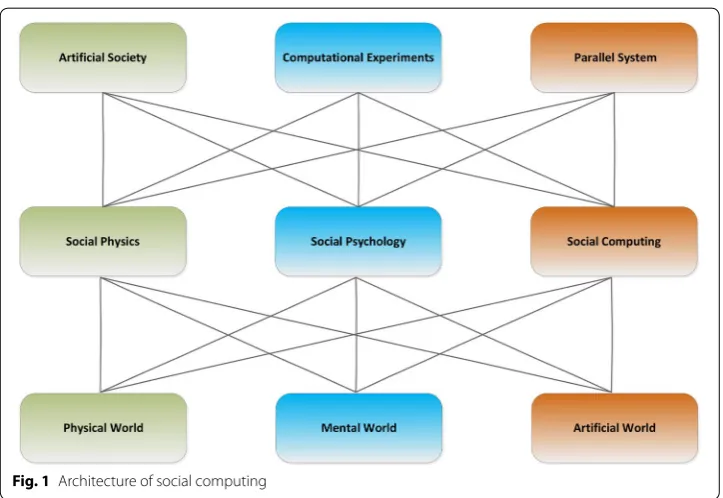
Figure 1 shows an architecture of social computing. The bottom level of this archi-tecture illustrates that the real-life world is composed of physical world, mental world as well as artificial world. From practical point of view, it is easy to obtain a recognition that the social physics, social psychology and social computing are the certain products of the three worlds, respectively, and there is a significant overlap between them. Impor-tantly, this recognition enables us to make full use of the model of artificial society, and use computers as experimental means under parallel system to check and demonstrate the hypothesis of social computing in the artificial world.
Research fields of social computing
Social computing is not only a technique but also a social phenomena. Basically, social computing has two main research trends: (1) social science-oriented social computing; (2) application-oriented social computing. And, these two research trends influence each other.
Social science‑oriented social computing
on social flows, healthcare, key nodes mining for disease dissemination, communities detection and so forth. The approaches about social network analysis are mainly catego-rized as: agent-based model, theoretical physics approach, and graph theory. Milgram et al. [6] and Watts et al. [7] pioneered the research on small-world. Based on their work, Barabasi et al. [8] found the connection between nodes followed the power-law distribu-tion. In addition, there are other significant research achievements, such as strong and weak ties [9], structural holes [10], and information cascades [11], etc. Second, com-putational social science is a cross-discipline among systems science, control science, and complex science. It mainly focuses on the research on social simulation and social system modeling by using equation based modeling and computational modeling [12]. Technically, data mining as a key technology for computational social science, is to dis-cover the interesting and useful patterns from massive data by using machine learning approaches.
Application‑oriented social computing
Application-oriented social computing refers to a type of particular application which incorporating the methodologies and technologies about social computing, such as communities, social network, social phycology. Application-oriented social computing experienced three phases: group software, social software and social media [13]. Group software was proposed in 1970s, and it was used in many research institutes. The essence of group software is a collaborative technology with the aim of supporting the interac-tions collaboratively. For example, computer supported cooperative work and computer
supported collaborative learning are two classic group software applications. In 2005, as the rapid development of Web 2.0 [14], social media is emerging. Social media empha-sizes the active interaction from users, users can complete the social interactions by generating, consuming the contents over the social media. Recently, the wide usage of ubiquitous devices, such as mobile phones and smart devices, the mobile social media [15–17] attracts much attention from academia and industry.
Soft computing
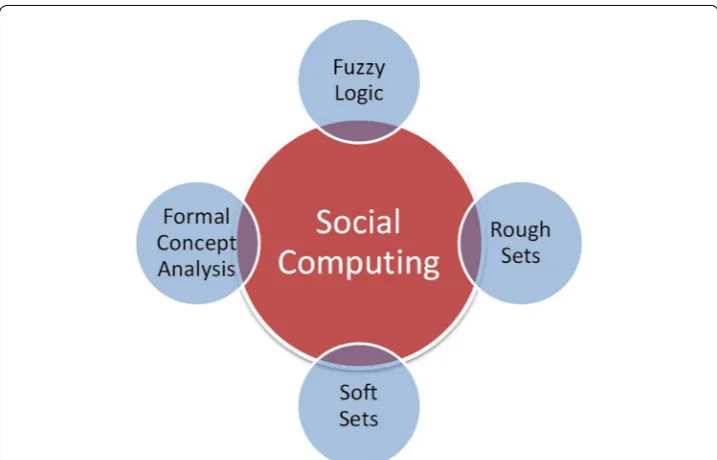
Soft computing is defined as a collection of techniques spanning many fields that fall under various categories in computational intelligence [18]. Soft computing is a consor-tium of methodologies which work with real life problems and provides in one form or another flexible information processing capabilities for handling real-life and complex situations [19]. The guiding principle of soft computing is to explore the tolerance for imprecision, uncertainty and partial truth to achieve tractability, robustness and low solu-tion cost that are not handled with convensolu-tional hard computing. Initially, soft computing is composed of three main branches: fuzzy systems [20, 21], evolutionary computation [22, 23], artificial neural computing [24]. Up to now, many new methods or techniques have been proposed for imprecision, uncertainty and partial truth, which are belong to soft computing. This paper makes a survey with the following soft computing techniques (as shown in Fig. 2) including fuzzy logic, formal concept analysis, rough sets analysis, and soft sets. The remainder of this section gives you the overview of these techniques.
Fuzzy logic
Fuzzy logic (FL), a commonly used soft computing approach, provides a simple way to get a definite conclusion based upon vague, ambiguous, imprecise, noisy or missing information of inputs. The working principle of FL is to process the data by allowing partial set membership rather than crisp set membership or non-membership. Fuzzy expert system consists of fuzzification unit that converts crisp values into fuzzified input [25]. It consists of inference engine that contains if then else rules and a defuzzification unit to convert the result in a readable form. FL incorporates fuzzy rule based IF X AND Y THEN Z inference approach to solve problem rather than attempting to model a sys-tem mathematically. For example, fuzzy inference engine can be used for obtaining the trust relationship between mobile users in mobile social networks [26].
Formal concept analysis
Formal concept analysis (FCA) [27] is a typical computational intelligence technique for data analysis. FCA defines formal concepts to represent the relationships between objects and attributes in a domain. The objects and attributes are grouped into formal concepts, and then a conceptual hierarchy of all formal concepts (also called as for-mal concept lattice) can be constructed, which is a complete lattice. Therefore, giving a formal context, FCA can derive all formal concepts from this context and construct their formal concept lattice. Formally, relations of subsets of objects as well as attributes can be analyzed in the formal concept lattice, in addition, conceptual hierarchy provide information to order them according to a subconcept–superconcept relation [28, 29].
Rough set theory
Rough sets theory (RST) [30–32] has been widely used for processing the incomplete and uncertain information. Recent years have witnessed the ubiquitous applications of RST in machine learning, data mining, and decision support analysis fields. Theoreti-cally, RST provides a useful method to understand unkownledge by using knowledge base, in fact, when the available information is not enough to determine the exact value of a given set, lower and upper approximations in RST can be used for the representa-tion of this set. The approximarepresenta-tion synthesis of concepts from the acquired data is the main objective of the rough set analysis [33]. In real world practices, if a subset is dif-ficult to define a concept in a given knowledge base, then rough sets can “approximate” the subset with respect to the knowledge base.
Soft set theory
When social computing meets soft computing
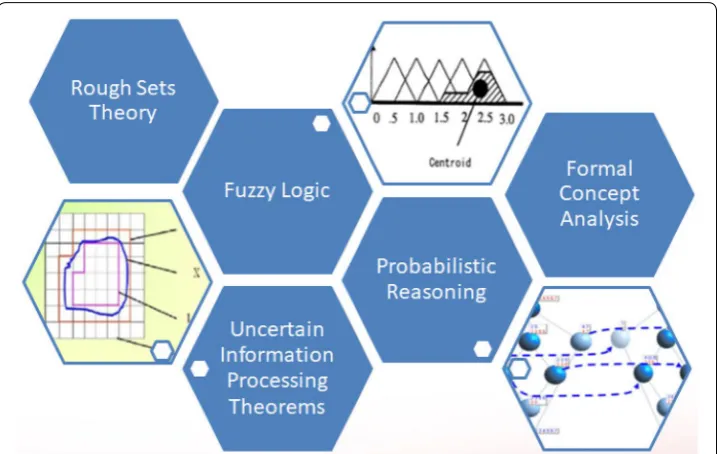
When social computing meets soft computing, what opportunities can it bring to researchers from both communities of soft computing and social computing. Figure 3 illustrates a category of study on social networks analysis from a soft computing per-spective. The survey on soft computing techniques based social networks analysis will be elaborated with the three main aspects: (1) structural analysis; (2) social data analysis; (3) social interaction analysis.
The rest of this section will provide the comprehensive survey on soft computing tech-niques (FL, FCA, RST) based social networks analysis from the aspects of structural analysis, social data analysis and social interaction analysis.
Representation of social networks
Social network is often modeled with a graph (sometimes an adjacency matrix) where the nodes indicating the individuals and edges indicating the relationships between the individuals. Most literatures considers the social relationships are binary value, i.e., 0 or 1. As a matter of fact, the social relationships between individuals are very complex and dynamic under different context, thus there exist much uncertainty or vagueness in social networks.
Fuzzy logic based representation approach
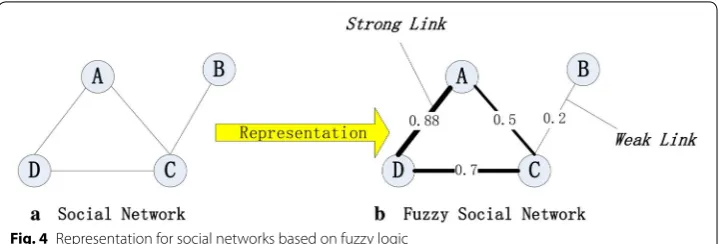
To overcome these uncertainty or vagueness, Refs. [39–46] applied fuzzy sets [36] for representing the social networks and analyzing the network. Commonly, a social net-work with vague relationships is represented with a fuzzy graph, so called fuzzy social networks [47]. The basic idea is described as follows: a fuzzy relation on a single set, R⊆X×X, is defined through the membership function.
(1)
µR:X×X→ [0, 1]
Equation (1) means that the social relationships between individuals are fuzzificated, denoted as µR(ui,uj). That is to say, the value of µR(ui,uj) is used to answer how strong is the relationship between ui and uj. Normally, the µR(ui,uj) has the following form:
Figure 4 shows a representation for social networks based on FL. Clearly, a general social network as shown in Fig. 4a does not consider the strength of social relationships between individuals. Thanks to the FL and computing with words [48, 49], a fuzzy graph (fuzzy social network) can describe various types of relationships according to value of ui and uj (shown in Fig. 4b). For example, the relationship between A and D is a strong link with 0.88 degree of membership, but a weak link between B and C with 0.2 degree of membership.
FCA based representation approach
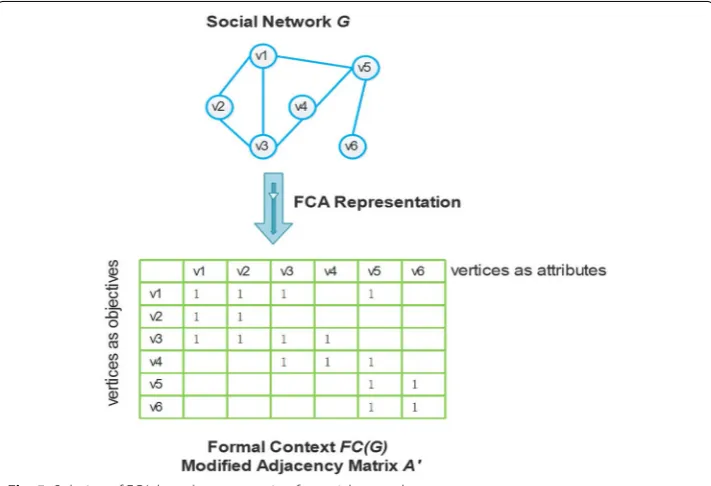
Recently years, FCA is also used for social networks analysis. Snael et al. [50] pioneered to represent the topology of a social network with a formal context. The solution of this representation approach as shown in Fig. 5 is to regard the individuals as both objects and attributes, and then construct the formal context according to the adjacency rela-tion between individuals. A social network G can be modeled as a set of subjects, in which some of them have some relationships with others. This can be formalized as a classical mathematical relationship visualized as an undirected graph. Then, the modi-fied adjacency matrix of G (denoted as A′) is viewed as a formal context of G, namely
FC(G)=(V,V,I), in which I is the binary relationship between two vertices. Ref. [51] proved that the FC(G) is equivalent to the modified adjacency matrix of G, i.e., FC(G)≡A′.
Based on this representation approach, Hao et al. [51] first studied the k-balanced trusted cliques detection in signed social networks [23]. Further, they investigated the
k-clique communities detection in social networks [29]. In both works [29] and [51], the authors initially converted the given social network into a formal context and then constructed the corresponding concept lattice. Finally, the important findings on equiva-lence between the equiconcepts and cliques are proved. In addition, Dorflein [52] stated and proved that the basic theorem on coherence networks of concept lattices as an extension of the basic theorem on concept lattices.
µR(ui,uj)=
1 if ui has the strongest relation with uj (0, 1) if ui has a certain extent related to uj 0 if ui is not related to uj
Positional analysis
In social networks, the major purpose of positional analysis is to find similarities between individuals of a social network. One of the widely studied notions in the positional analysis of social networks is regular equivalence [53, 54]. As fuzzy social networks have received considerable attention, a regular equivalence to fuzzy social net-works is generalized [42]. Based on FL, Portmann et al. [54] introduced a framework FORA to gain deeper insights into an organizations online reputation. Kudelka et al. [55] proposed a hybrid approach where the FCA is used for finding author’s profiles based on keywords and fuzzy rules to learn the properties of the authors and to enhance the set of experts. Expert or influential people identification is an important task in social network positional analysis [56]. Kudelka et al. [54] introduced a new soft computing method for expert identification in social networks based on formal concept analysis and fuzzy rules. They proposed a hybrid approach where the formal concept analysis is used for finding author’s profiles based on keywords and fuzzy rules to learn the properties of the authors and to enhance the set of experts.
Topological structure analysis
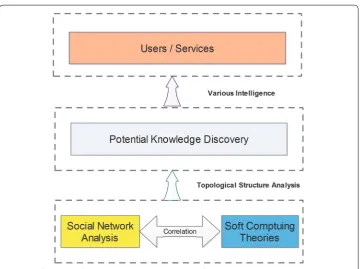
At present, most of previous work about topological structure mining mainly concen-trate on cliques and communities mining from social networks. The framework of topo-logical structure analysis with soft computing techniques is illustrated as shown in Fig. 6.
FL‑based topological structure mining
The problem of fuzzy community detection in networks was early studied in [57, 58], it allows each vertex of the graph to belong to multiple communities at the same time, determined by exact numerical membership degrees, even in the presence of uncer-tainty in the data being analyzed. Golsefid et al. [59] proposed a fuzzy clustering model
for detecting overlapping communities in complex networks. Their proposed model was developed based on the CPM clustering model [60] and assigns each node to each clus-ter by degree of belonging over an inclus-terval [0,1]. Therefore, instead of one node belong-ing to exactly one cluster, it can belong to more than one cluster, and associated with each node was a set of membership levels. Davis et al. [46] attempted to identify fuzzy overlapping groups in social networks using stochastic model. They modeled the fuzzy overlapping group detection as an optimization problem. In summary, the ideas of these approaches are based on fuzzy membership function which is defined for the connec-tions for one node to other communities.
FCA‑based topological structure mining
Rome et al. [61] observed that the web subgraph can be viewed as a formal context and that web communities can be modeled by formal concepts. They utilized FCA to explore the community structure of the Web graph. Hao et al. [29] detected the k-balanced trusted cliques from signed social networks based on FCA. Further, Hao et al. [51] pro-posed a novel algorithm for mining the k-clique and k-clique communities based on FCA. They proved that all Equiconcepts1 appearing in formal concept lattice of social network exactly match the cliques in social networks and also proved that the k-clique communities detection problem is equivalent to finding the k-intent Equiconcepts in the concept lattice of a social network. To reduce the high repetition rate between commu-nity-cores and isolated community, Fu et al. [62] presented an algorithm for detecting Blog community based on FCA. Initially, concept lattice was built from linkage relations
1 Equiconcepts refer to a type of special formal concepts where the extent equals to the intent.
between Blogs, then clusters were divided from the lattice based on equivalence relation, finally communities were clustered in each cluster based on the similarity of concepts [63, 64]. Ali et al. [65] investigated the community detection based on FCA, their approach take the formal context of the given social network, and determine the partial communities. Then, the ignored nodes are re-assigned to the communities by maximiz-ing GroupNode modularity function. Aimmaximiz-ing to address the cliques discovery from big graph, our recent work [66] adopted the formal concept analysis techniques and pro-posed a novel framework, called “cSketch” for identifying the cliques from big graphs. This framework takes the graph stream as the initial input, and summarizes the original graph stream into the sketched graph by using Hashing function over the vertices; Based on the obtained sketched graph, formal concept analysis is utilized for mining the cliques from it. The resulting cliques is approximate to the cliques appearing in the original graph. Ref. [67] exploited the formation principle of maximal cliques in social networks based on formal concept analysis. The authors proposed a FCA-based approach for detecting the bases of maximal cliques and detection theorem. Their work provides a new research solution and direction for future topological structure analysis in various complex networking systems. Hao et al. [68] pioneered a novel approach for similarity evaluation between graphs based on FCA. The feature of this approach is able to charac-terize the relationships between nodes and further reveal the similarity between graphs. Therefore, the highlight of their proposed approach is to take vertices and edges into account simultaneously. Thus, the measuring accuracy for graph matching can be improved.
Overall, FCA-based topological structure mining is conducted based on the equiva-lence relation between equiconcepts and topological structures. These approaches are not dependent on the mathematical model, but also not dependent on the heuristics. Hence, this kind of approach provides a novel points for mining the topological struc-ture from social networks.
RST‑based topological structure mining
Regarding to this research branch, RST is often integrated with other traditional cluster-ing algorithms in order to improve the detection performance of community discovery [69, 70]. Wang et al. [69] considered the difficulty of determining the value of K, and the relations among the cluster object or community node and the community. To overcome this disadvantage, they devised a community finding algorithm by incorporating the RST and k-mean clustering algorithm. Their proposed method is mainly used to find overlap-ping communities, and it can multi-anglely reflect the social network information bet-ter. In addition, our previous work [71] proposed rough k-clique theory that relaxes the conventional k-clique by using the newly defined upper/lower vertices approximation that are used for describing the boundary of the given subgraph. Therefore, the topologi-cal structure of any given subgraph can be characterized by the virtue of rough k-clique theory.
Social web mining
most liked information. Thus, social web mining is a efficient way for discovering use-ful knowledge and extracting social intelligence from the web log data obtained from open source websites that are available on the web [72]. Social media web sites person-alization is the procedure of modifying the content and structure of a web site to the precise requirements of each user taking benefit of the user’s directional behavior. The main phases of the web personalization comprises of: (1) the collection of web data; (2) the preprocessing phase of these data; (3) the analysis of the collected data and (4) the purpose of the actions that should be performed. The log files are collected from the proxy server log. The gathered data are undergoing a preprocessing phase to remove the unwanted and noisy information. The web directories are discovered based on the user and session clustering. For grouping the user and session, the Neuro Fuzzy Clustering Approach (NFCA) is applied [19]. Additionally, Ant Colony Optimization (ACO), as an advanced soft computing methodology, is used for social web mining. Ahmad et al. [73] presented an ACO based approach for expert identification and query routing in social networks. Kwon et al. [74] proposed a novel method for sentiment trend analysis using ACO algorithm and SentiWordNet. They first collected social data in the form of Resource Description Framework (RDF) triples, and then used ACO algorithm to digi-tized the amassed RDF triples. Using ACO algorithm, the pheromone values were com-puted to extract the trends of the user’s sentiments with the modified equations. Next, the user’s sentiment scores were evaluated for the computed pheromone values with respect to the sentiment words with SentiWordNet. Finally, they analyzed the sentiment trend of the online user by time.
Social data analysis
efficiently collect and analyze all possible tweets from customers. Considering the vague sentiment words in social networks, for example, the “excellent” and “good” are both expressed with positive sentiment, however, the positive degree of both words are not the same. To address this problem, Jusoh et al. [83] introduced the use of a fuzzy lexi-con and fuzzy sets in deciding the degree of positive and negative. Regarding to the data sparse and information overload issues, Hao et al. [38] proposed a soft set-based rec-ommendation model and devised the corresponding algorithm. Their approach is easier for implementation and recommendation; Besides, their approach not only recommend the items, but also make the feedback regarding to the results. Thus, there is no data sparse issue. Therefore, it is believed that the proposed approach can be applied into many other potential recommendation systems.
Human mobility analysis is another interesting research topic. Considering the human movement data including high levels of uncertainty and noise. Soft computing owns the necessary characteristics to extract accurate mobility models [84]. Proposed a novel approach to extract personal mobility patterns by means of the fuzzy c-means (FCM) algorithm. Their achievements will help to comprehensively capture and understand the movement of people in large spatial regions.
Medicine and healthcare services
features of this cognitive system include efficient big data representation, high-quality data associations, and natural semantics interpretation among dimensions.
Relevant softwares for social computing
This section lists the softwares for social network analysis [87–90]. Then, several specific softwares for social network analysis based on soft computing are presented as well.
Table 1 summarizes the commonly-used general software packages and specialized software packages for social networks analysis.
In addition, this paper also lists the main visualization softwares for social networks, as shown in Table 2.
Table 1 Software packages for social network analysis
No General software packages Specialized software packages
Type Academic/free Academic/free
1 Agna
Applied graph and network analysis BlancheNetwork dynamics 2 DyNet (SE and LS) [91]
Data‑driven visualizations CID‑ABMCompeting idea diffusion agent based model
3 GUESS
The graph exploration system CFinder [Finding and visualizing dense groups92] 4 Pajek [93]
Program for large network analysis Commetrix [Dynamic network visualization and analysis94] 5 NodeXL [95]: viewing and analyzing network
graphs PGRAPH [96]: Kinship networks
6 igraph (R, Python, C) [97]
Creating and manipulating graphs SONIVISAnalyzing and visualizing virtual information space 7 NetVis [98]: dynamic visualization of social networks E‑Net [99]: Ego‑NETwork analysis
8 ORA [100]: dynamic network analysis EgoNet [101]: egocentric networks 9 SocNetV: social networks visualiser KeyPlayer [102]: identifying nodes 10 UCINET 6 [103]
Comprehensive social network analysis software KliqFinder: cohesive subgroups 11 visone: analyis and visualization of social networks Network genie: network surveys 12 JUNG (Java): Java Universal Network/graph frame‑
work PNet: exponential random graph models (ERGMs)
13 libSNA (Python)
Open‑source library for social network analysis SONIVISAnalyzing and visualizing virtual information spaces 14 NetworkX (Python) [104]: package for complex
networks StOCNET [105]: statistical analysis
Table 2 Visualization softwares for social networks analysis
No Software name Descriptions
1 aiSee [106] Graph visualization
2 Apache Agora [107] Visualizing virtual communities
3 Cytoscape [108] Visualizing molecular interaction networks
4 Gephi [109] Visualization and exploration platform
5 Graphviz [110] Graph visualization
To the best of our knowledge, the specific softwares for soft computing-based social network analysis are not available. However, we can adopt the soft computing softwares or tools for assisting the social network analysis. For example, FCA-based social network analysis, an emerging approach social network analysis, is widely used. Particularly, we illustrate how to analyze the social network with an open platform for lattices-Galicia [112].
• Context construction A given social network g, modeled as a graph as shown in Fig. 7. By using the construction approach [29], the formal contexts (as shown in Fig. 8) are easily obtained as follows.
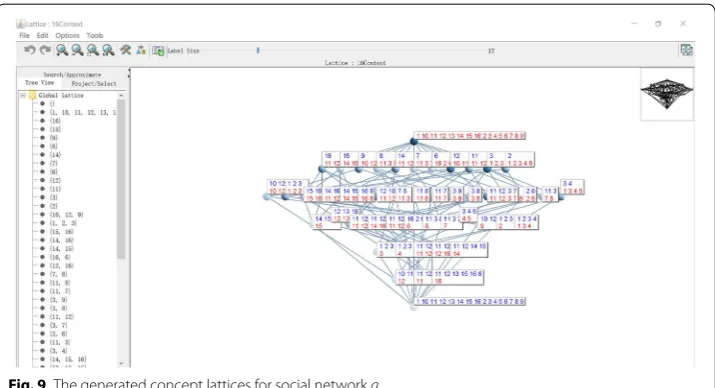
• Concept lattice building According to the formal concept lattice generation algorithm presented in [29], the formal concept lattices of the given graph g is shown in Fig. 9.
• Social computing issues In this step, we can execute the topological structure mining and analysis based on the above extracted formal concepts. For example, our pre-vious work [29] has proved that the equivalence relation between the equiconcepts and cliques. With this relation, we can extract the k-cliques, k-clique communities from social networks. Interestingly, the location-focused communities detection and evolutionary can be accomplished by observing the changing patterns of m-triadic concepts [113]. In field of graph matching, the formal concepts are regarded as the main features of the graphs for further evaluating the similarity between graphs [68].
Fig. 7 A social network g
Conclusions
As the scale of social media and number of users are rapidly increasing, social network analysis (SNA) has become an important tool for experts and researchers in social com-puting. Specially, the necessary information is often distributed and hidden on social site servers, so there is an urgent demand for designing some new approaches for collection and analysis the social network. Soft computing methodologies like fuzzy sets, neural networks, genetic algorithms, rough sets, soft sets and their hybridizations, have recently been widely utilized to solve data mining problems. They strive to provide approximate solutions at low cost, thereby speeding up the process. In this paper, we firstly answered what happening when social computing meets soft computing. Then, we discussed the state-of-art on various soft computing techniques those are used for social networks analysis. It is believed that this paper can provide more insights for researchers from the both social computing and soft computing fields.
Authors’ contributions
FH collected, reviewed and classified main literature for the paper, and also completed the writing of this work. DSP identified the insights of this work, especially the soft computing based social computing techniques in ubiquitous healthcare. ZP improved the part of soft computing techniques survey and presentation. All authors read and approved the final manuscript.
Author details
1 Key Laboratory of Modern Teaching Technology, Ministry of Education, No.199, South Chang’an Road, 710062 Xi’an, China. 2 School of Computer Science, Shaanxi Normal University, No.620, West Chang’an Avenue, 710119 Xi’an, China. 3 Department of Computer Software Engineering, Soonchunhyang University, ShinChang‑Myun, 336‑745 Asan, South Korea. 4 Center for Radio Administration & Technology Development, Xihua University, 610039 Chengdu, China.
Acknowledgements
This research was supported by the National Natural Science Foundation of China (Grant Nos. 61702317, 61372187) and MSIP (Ministry of Science, ICT and Future Planning), Korea, under the ITRC (Information Technology Research Center) support program (IITP‑2017‑2014‑0‑00720) supervised by the IITP (Institute for Information & Communications Technol‑ ogy Promotion) and the National Research Foundation of Korea (No. NRF‑2017R1A2B1008421) and was also supported by the Fundamental Research Funds for the Central Universities (GK201703059, GK201802013), and Fund Program for the Scientific Activities of Selected Returned Overseas Professionals in Shaanxi Province (Grant No. 2017024).
Competing interests
The authors declare that they have no competing interests.
Ethics approval and consent to participate
Not applicable.
Publisher’s Note
Springer Nature remains neutral with regard to jurisdictional claims in published maps and institutional affiliations. Received: 30 January 2018 Accepted: 12 March 2018
References
1. Zadeh LA, Abbasov AM, Shahbazova SN (2015) Fuzzy‑based techniques in human‑like processing of social net‑ work data. Int J Uncertain Fuzziness Knowl Based Syst 23(Suppl. 1):1–14
2. Schuler D (1994) Social computing. Commun ACM 37(1):28–29
3. Dryer DC, Eisbach C, Ark WS (1999) At what cost pervasive? A social computing view of mobile computing sys‑ tems. IBM Syst J 38(4):652–676
4. Wang FY (2007) Toward a paradigm shift in social computing: the ACP approach. IEEE Intell Syst 22(5):65–67 5. Wang FY, Carley KM, Zeng D, Mao W (2007) Social computing: from social informatics to social intelligence. IEEE
Intell Syst 22(2):79–83
6. Milgram S (1967) The small‑world problem. Psychol Today 1(1):61–67
7. Watts DJ, Strogatz SH (1998) Collective dynamics of “small‑world” networks. Nature 393:440–442 8. Barabasi AL, Bonabeau E (2003) Scale‑free networks. Sci Am 288(5):50–59
9. Granovetter M (1973) The strength of weak ties. Am J Sociol 78(6):1360–1380
10. Zhang E, Wang G, Gao K, Zhao X, Zhang Y (2013) Generalized structural holes finding algorithm by bisection in social communities. In: Sixth international conference on genetic and evolutionary computing. pp 276–279 11. Liu Q, Zhang L (2016) Information cascades in online reading: an empirical investigation of panel data. J Imaging
Sci Technol 55(4):60504–1605048
12. Halpin B (1999) Simulation in sociology. Am Behav Sci 42(10):1488–1508
13. Lugano G (2013) Social computing: a classification of existing paradigms. In: Privacy, security, risk and trust. pp 377–382
14. O’Reilly T (2007) What is web 2.0: design patterns and business models for the next generation of software. Mpra Paper 97(7):253–259
15. Su Z, Xu Q, Qi Q (2016) Big data in mobile social networks: a qoe‑oriented framework. IEEE Netw 30(1):52–57 16. Hao F, Min G, Lin M, Luo C, Yang LT (2014) MobiFuzzyTrust: an efficient fuzzy trust inference mechanism in mobile
social networks. IEEE Trans Parallel Distrib Syst 25(11):2944–2955
17. Choi S (2016) Understanding people with human activities and social interactions for human‑centered comput‑ ing. Hum Centric Comput Inf Sci 6(1):9
18. Shamshirband S, Gocic M, Petkovic D, Saboohi H, Herawan T, Kiah MLM, Akib S (2015) Soft‑computing methodolo‑ gies for precipitation estimation: a case study. IEEE J Sel Top Appl Earth Obs Remote Sens 8(3):1353–1358 19. Shan F, Sharma MK (2017) Study for social media mining methods with soft computing. Int J Emerg Technol
8(1):1–4
20. Dong S, Su H, Shi P, Lu R, Wu Z‑G (2017) Filtering for discrete‑time switched fuzzy systems with quantization. IEEE Trans Fuzzy Syst 25(6):1616–1628
21. Feng Z, Zheng WX, Wu L (2017) Reachable set estimation of T–S fuzzy systems with time‑varying delay. IEEE Trans Fuzzy Syst 25(4):878–891
22. Revay P, Cioffi‑Revilla C (2018) Survey of evolutionary computation methods in social agent‑based modeling stud‑ ies. J Comput Soc Sci 1(1):115–146
23. Friedrich T, Neumann F (2017) What’s hot in evolutionary computation. AAAI, Menlo Park, pp 5064–5066 24. Paradarami TK, Bastian ND, Wightman JL (2017) A hybrid recommender system using artificial neural networks.
Expert Syst Appl 83:300–313
25. Douven I (2015) Review of r. belohlavek and g. klir (eds). Concepts and fuzzy logic (MIT Press, 2011). Studia Logica 102
26. Hao F, Zhong S (2010) Tag recommendation based on user interest lattice matching. In: IEEE international confer‑ ence on computer science and information technology. pp 276–280
27. Ganter B, Wille R (1996) Formal concept analysis. Wissenschaftliche Zeitschrift‑Technischen Universitat Dresden 45:8–13
28. Poelmans J, Elzinga P, Viaene S, Dedene G (2010) Formal concept analysis in knowledge discovery: a survey. In: International conference on conceptual structures: from information to intelligence. pp 139–153
29. Hao F, Min G, Pei Z, Park DS, Yang LT (2017) k‑clique community detection in social networks based on formal concept analysis. IEEE Syst J 11(1):250–259
30. Pawlak Z (1982) Rough sets. Int J Comput Inf Sci 11(5):341–356 31. Pawlak Z, Skowron A (2007) Rudiments of rough sets. Inf Sci 177(1):3–27
32. Pawlak Z (1998) Rough set theory and its applications to data analysis. J Cybern 29(7):661–688
33. Zhou Q, Yongsheng LI, Yin C, Jingui LU (2003) Application of rough set theory in data mining. J Nanjing Univ Tech 25(2):44–48
34. Molodtsov D (1999) Soft set theory‑first results. Comput Math Appl 37(4–5):19–31
35. Molodtsov DA, Leonov VY, Kovkov DV (2006) Soft sets technique and its application. Neuron 44(1):59–73 36. Zadeh LA (1965) Fuzzy sets. Inf Control 8(3):338–353
37. Feng F, Li Y, Leoreanu‑Fotea V (2010) Application of level soft sets in decision making based on interval‑valued fuzzy soft sets. Comput Math Appl 60(6):1756–1767
39. Yager RR (2008) Intelligent social network analysis using granular computing. Int J Intell Syst 23(11):1197–1219 40. Yager RR (2010) Concept representation and database structures in fuzzy social relational networks. IEEE Trans Syst
Man Cybern Part A Syst Hum 40(2):413–419
41. Nair PS, Sarasamma ST (2007) Data mining through fuzzy social network analysis. In: Fuzzy information processing society. Nafips’07 meeting of the North American. pp 251–255
42. Fan TF, Liau CJ, Lin TY (2007) Positional analysis in fuzzy social networks. In: GRC, p 423
43. Fan TF, Liau CJ, Lin TY (2008) A theoretical investigation of regular equivalences for fuzzy graphs. Int J Approx Reason 49(3):678–688
44. Newman MEJ (2004) Analysis of weighted networks. Phys Rev E Stat Nonlin Soft Matter Phys 70(5 Pt 2):056131 45. Brunelli M, Fedrizzi M (2009) A fuzzy approach to social network analysis. In: Social network analysis and mining.
ASONAM’09. International conference on advances. pp 225–230
46. Davis GB, Carley KM (2008) Clearing the fog: fuzzy, overlapping groups for social networks. Soc Netw 30(3):201–212
47. Ciric M, Bogdanovic S (2010) Fuzzy social network analysis. pp 179–190
48. Zadeh LA (2002) Fuzzy logic = computing with words. IEEE Trans Fuzzy Syst 4(2):103–111
49. Li C‑C, Dong Y, Herrera F, Herrera‑Viedma E, Martínez L (2017) Personalized individual semantics in computing with words for supporting linguistic group decision making. An application on consensus reaching. Inf Fusion 33:29–40 50. Snasel V, Horak Z, Kocibova J, Abraham A (2009) Analyzing social networks using FCA: complexity aspects. In:
IEEE/WIC/ACM international joint conferences on web intelligence and intelligent agent technologies. WI‑IAT, pp 38–41
51. Hao F, Yau SS, Min G, Yang LT (2014) Detecting k‑balanced trusted cliques in signed social networks. IEEE Internet Comput 18(2):24–31
52. Dörflein SK, Wille R (2005) Coherence networks of concept lattices: the basic theorem. In: International conference on formal concept analysis. Springer, Berlin, pp 344–359
53. Borgatti SP, Everett MG (1989) The class of all regular equivalences: algebraic structure and computation. Soc Netw 11(1):65–88
54. Kudelka M, Radvansky M, Horak Z, Krome P, Snasel V (2012) Soft identification of experts in DBLP using FCA and fuzzy rules. In: IEEE international conference on systems, man, and cybernetics. pp 1942–1947
55. Trung DN, Jung JJ (2014) Sentiment analysis based on fuzzy propagation in online social networks: a case study on TweetScope. Comput Sci Inf Syst 11(1):215–228
56. Zia MA, Zhang Z, Chen L, Ahmad H, Su S (2017) Identifying influential people based on interaction strength. J Inf Process Syst 13(4):987–999
57. Nepusz T, Petroczi A, Negyessy L, Bazso F (2008) Fuzzy communities and the concept of bridgeness in complex networks. Phys Rev E Stat Nonlin Soft Matter Phys 77(2):016107
58. Zhang S, Wang RS, Zhang XS (2007) Uncovering fuzzy community structure in complex networks. Phys Rev E Stat Nonlin Soft Matter Phys 76(2):046103
59. Golsefid SMM, Zarandi MHF, Bastani S (2015) Fuzzy community detection model in social networks. Int J Intell Syst 30(12):1227–1244
60. Gregori E, Lenzini L, Mainardi S (2013) Parallel k‑clique community detection on large‑scale networks. IEEE Trans Parallel Distrib Syst 24(8):1651–1660
61. Rome JE, Haralick RM (2005) Towards a formal concept analysis approach to exploring communities on the world wide web. In: International conference on formal concept analysis. Springer, Berlin, pp 33–48
62. Fu Y, Cui Z (2014) Research of blog community detection based on FCA. Int J Data Min Intell Inf Technol Appl 4(1):26
63. Formica A (2006) Ontology‑based concept similarity in formal concept analysis. Inf Sci 176(18):2624–2641 64. Formica A (2008) Concept similarity in formal concept analysis: an information content approach. Knowl Based
Syst 21(1):80–87
65. Ali SS, Bentayeb F, Missaoui R, Boussaid O (2014) An efficient method for community detection based on formal concept analysis. In: International symposium on methodologies for intelligent systems. pp 61–72
66. Hao F, Park DS (2017) csketch: a novel framework for capturing cliques from big graph. J Supercomput 1:1–13 67. Hao F, Park DS, Pei Z (2017) Exploiting the formation of maximal cliques in social networks. Symmetry 9(7):100 68. Hao F, Sim DS, Park DS, Seo HS (2017) Similarity evaluation between graphs: a formal concept analysis approach. J
Inf Process Syst 13(5):1158–1167
69. Wang Z, Wang Z (2012) Research in social network based on rough set clustering algorithm. Int J Adv Comput Technol 4(15):295–301
70. Mitra A, Padhi P (2012) On application of rough set and neighborhood theory in social network. Int J Recent Trends Eng Technol 7(3):38
71. Hao F, Park DS, Shao Y (2016) A novel methodology on characterizing topological structure from complex net‑ works. Adv Sci Lett 22(9):2404–2408
72. Cooley RW, Srivastava J (2000) Web usage mining: discovery and application of interesting patterns from web data. University of Minnesota, Minneapolis
73. Ahmad MA, Srivastava J (2008) An ant colony optimization approach to expert identification in social networks. Springer, Boston
74. Kwon K, Jeon Y, Cho C, Seo J, Chung IJ, Park H (2017) Sentiment trend analysis in social web environments. In: IEEE international conference on big data and smart computing
75. Hotho A (2006) BibSonomy: a social bookmark and publication sharing system. In: Conceptual structures tool interoperability workshop at the international conference on conceptual structures. pp 87–102
76. Ho CW, Wang YB (2015) Re‑purchase intentions and virtual customer relationships on social media brand com‑ munity. Hum Centric Comput Inf Sci 5(1):18
78. Jaschke R, Hotho A, Schmitz C, Ganter B, Stumme G (2007) TRIAS—an algorithm for mining iceberg tri‑lattices. In: International conference on data mining. pp 907–911
79. Hao F, Zhong S (2010) ECKDF: Extended conceptual knowledge discovery in folksonomy. In: International confer‑ ence on computational problem‑solving. pp 71–76
80. Hao F, Zhong S (2009) Variable precision concepts and its applications for query expansion. In: Emerging intel‑ ligent computing technology and applications. With aspects of artificial intelligence. Proceedings international conference on intelligent computing, ICIC 2009, Ulsan, South Korea, 16–19 September. pp 154–165
81. Zhang W, Du Y, Song W (2015) Followee recommendation based formal concept analysis in social network. Int J Innov Comput Inf Control IJICIC 11(4):1155–1164
82. Mukkamala RR, Hussain A, Vatrapu R (2014) Fuzzy‑set based sentiment analysis of big social data. In: Enterprise distributed object computing conference. pp 71–80
83. Jusoh S, Alfawareh HM (2013) Applying fuzzy sets for opinion mining. In: International conference on computer applications technology. pp 1–5
84. Cuenca‑Jara J, Terroso‑Saenz F, Valdes‑Vela M, Gonzalez‑Vidal A, Skarmeta AF (2017) Human mobility analysis based on social media and fuzzy clustering. In: Global internet of things summit (GIoTS). IEEE, New York, pp 1–6 85. Fei H, Doo‑Soon P, Sang Yeon W, Se Dong M, Sewon P (2016) Treatment planning in smart medical: a sustainable
strategy. J Inf Process Syst 12(4):711–723
86. Hao F, Park DS, Min SD, Park S (2016) Modeling a big medical data cognitive system with N‑Ary formal concept analysis. In: Advanced multimedia and ubiquitous engineering. Springer, Singapore, pp 721–716
87. Hanneman RA, Riddle M (2005) Introduction to social network methods. Department of Sociology University of California Riverside, Riverside
88. Huisman M, Duijn MAJV (2005) Software for social network analysis. Models Methods Soc Netw Anal 270:e316 89. Loscalzo S, Yu L (2008) Social network analysis: tasks and tools. Springer, Boston, pp 151–159
90. Xu K, Tang C, Tang R, Ali G, Zhu J (2010) A comparative study of six software packages for complex network research. In: International conference on communication software and networks. pp 350–354
91. Neubig G, Dyer C, Goldberg Y, Matthews A, Ammar W, Anastasopoulos A, Ballesteros M, Chiang D, Clothiaux D, Cohn T (2017) Dynet: the dynamic neural network toolkit
92. Adamcsek B, Palla G, Farkas IJ, Derenyi I, Vicsek T (2006) CFinder: locating cliques and overlapping modules in biological networks. Bioinformatics 22(8):1021–1023
93. Mrvar A, Batagelj V (2002) Pajek—analysis and visualization of large networks. Lect Notes Comput Sci 2265:77–103 94. Trier M (2006) Towards a social network intelligence tool for visual analysis of virtual communication networks.
TUDpress Verlag, Dresden
95. Smith MA, Shneiderman B, Milic‑Frayling N, Mendes Rodrigues E, Barash V (2010) Analyzing (social media) net‑ works with NodeXL. pp 277–284
96. White DR, Batagelj V, Mrvar A (2013) Kinship and marriage networks anthropology analyzing large kinship and marriage networks with Pgraph and Pajek. Soc Sci Comput Rev 17(3):245–274
97. Csardi G, Nepusz T (2006) The igraph software package for complex network research. Inter J Complex Syst 1695:1–9
98. Nicholls J, Peters D, Slawinski A, Spoor T, Vicol S, Happa J, Goldsmith M, Creese S (2013) Netvis: a visualization tool enabling multiple perspectives of network traffic data. Eurographics Association
99. Apostolato IA (2013) An overview of software applications for social network analysis. Int Rev Soc Res 3(3):71–77 100. Carley KM (2014) ORA: a toolkit for dynamic network analysis and visualization. Springer, New York, pp 1219–1228 101. Yang R, Bai Y, Qin Z, Yu T (2014) EgoNet: identification of human disease ego‑network modules. BMC Genomics
15(1):314
102. http://www.maths.bris.ac.uk/R/web/packages/keyplayer/index.html
103. Johnson JD (1987) UCINET: a software tool for network analysis. Commun Educ 36(1):92–94
104. Hagberg A, Schult D, Swart P (2005) Networkx: Python software for the analysis of networks. Mathematical Mod‑ eling and Analysis, Los Alamos National Laboratory
105. Huisman M, Van Duijn MA (2003) StOCNET: software for the statistical analysis of social networks. Connections 68(4):1457–1458
106. http://freshmeat.sourceforge.net/projects/aisee
107. Weiss M, Moroiu G, Zhao P (2006) Evolution of open source communities. Springer, Boston, pp 21–32
108. Shannon P, Markiel A, Ozier O, Baliga NS, Wang JT, Ramage D, Amin N, Schwikowski B, Ideker T (2003) Cytoscape: a software environment for integrated models of biomolecular interaction networks. University of California River‑ side, Riverside, pp 165–184
109. Bastian M, Heymann S, Jacomy M (2009) Gephi: an open source software for exploring and manipulating net‑ works. In: Third international AAAI conference on weblogs and social media
110. Ellson J, Gansner E, Koutsofios L, North S, Woodhull G, Description S, Technologies L (2001) Graphviz‑open source graph drawing tools. In: Lecture notes in computer science. Springer, Berlin, pp 483–484
111. Krackhardt D, Lundberg M, O’Rourke L (2014) Krackplot: a picture’s worth a thousand words. Dermatol Times 72(2):200–222
112. Valtchev P, Roume C (2003) Galicia: an open platform for lattices. In: Using conceptual structures: contributions to ICCS’03. pp 241–254