55
Numerical Computation of
Maximum Shear Stress Intensity for
a Nearly Circular Crack Subject to
Shear Loading
Koo Lee Feng1,*, Nik Mohd Asri Nik Long2, Eshkuvatov Zainidin K2, Wong Tze Jin1
1Department of Basic Science and Engineering, Faculty of Agriculture and Food
Sciences, Universiti Putra Malaysia Bintulu Campus, 97008 Bintulu, Sarawak, Malaysia.
2Department of Mathematics and Institute for Mathematical Research,
University Putra Malaysia, 43400 Serdang, Selangor, Malaysia.
*Corresponding email: [email protected]
Abstract
Maximum shear stress intensity for nearly circular cracks subjected to equal and opposite shear stresses are considered. A hypersingular integral equation containing the crack opening displacement is formulated. Conformal mapping technique is employed to transform the obtained hypersingular equation into a similar equation over a circular crack. A suitable collocation points are chosen to reduce the hypersingular integral equation into a system of linear equations. Numerical solution of the linear equations and the corresponding maximum shear intensity is obtained and presented graphically. Our results seem to agree with the existing asymptotic solution.
Keywords: maximum shear intensity; nearly circular crack; conformal mapping;
56
1. INTRODUCTION
The solution of plane cracks of arbitrary shape inside an isotropic elastic medium has become very interesting and important topic in fracture mechanic. Different approaches have been used by researchers in dealing with the plane crack problems. Mastrojannis et al. [1] formulated the plane crack problem to the solution of a system of two dimensional Fredholm integral equations and numerical solution for tensile mode stress intensity factor is obtained. Singh and Danyluk [2] extended Kassir’s work [3,4] in finding the stress intensity factor for coplanar rectangular shaped crack subject to normal loading. Ioakimidis [5] derived a hypersingular integral equation for a flat crack subject to tensile pressure. Qin and Tang [6,7] derived a set of hypersingular integral equation for a flat crack subject to arbitrary loads in three dimensional elasticity using Somigliana formula and finite part integral while a complex hypersingular integral equation was suggested by Linkov and Mogilevskaya [8] to solve the elastic plane problem. Martin [9,10] applied the hypersingular integral equation to solve the crack problems subject to normal and shear loading, respectively and Chen el at. [11] used the hypersingular integral equation to solve the penny shaped crack problem. Theotokoglou [12] applied the hypersingular boundary integral equation method to solve the plane crack in infinite three dimensional bodies under shear loading.
Other approaches are perturbation method by Rice and Gao [13,14], variant formula by Borodachev [15,16] and Frechet derivative of some nonlinear operation [15]. In this study, the hypersingular integral equation approach is used to compute the maximum shear stress intensity for a nerly circular crack and we compare our computational result with Gao’s [17].
2. PROBLEM FORMULATION
Consider a three dimensional infinite, homogenous, elastic and isotropic solid body containing a flat circular crack, located on the Cartesian coordinate (x,y,z)with origin O and lies in the plane z 0. Let the radious of the crack, be and
(r, ):0 r , 0 . Assume that the stress at infinity and the body force are absent. Now, equal and opposite shear stresses in the X directions,
) , (x y
q are applied to the crack plane and on the planes, the shear stress component is given by
) , ( 1 vqx x y
xz
57
) , ( ) , ( 3 ) 2 ( . . 8 1 3 2 o o j y x q d y x w R ve v S H (1) where denotes the crack domain with boundary , w(x,y)is the unknown crack opening displacement, the over bar denote complex conjugation with respect to
j complex, with j 1, R is defined as 2
2
2 ( ) ( )
o
o y y
x x
R
and the angle is
x Rcos
x o and yyo Rsin
Equation (1) is solved subjected to w(x,y)0 on . The notation of H.Sin front of the integral sign on the left hand side of equation (1) should be interpreted as Hadamard finite part integral [21].
3. NEARLY CIRCULAR CRACK
Assume that is an arbitrary shaped crack with smooth boundary with respect to the origin O, such that is written as
(r, ):0 r ( )
where the boundary of , is given by r(). Next, let the polar coordinate defined as sei where 1, hence, the unit disc D is given by
(s, ):0 s 1, D
Employed the properties of Rieman mapping theorem, is mapped onto the unit disc, D using zaf() where
2 )
( c
f
(3) The domain is circular if c0 and as 2c 1 , a cusp developed.
Substitution equation (3) into (2) gives [16] :
D o o o D D o j Q d d K W v d d K W P C v d d S W S H ve v ) , ( ) , ( ) , ( 8 3 ) , ( ) , ( . 8 2 ) , ( . 8 3 2 ) 2 ( ) 1 ( 3 2 (4)where S 0 , (1)( , )
o
K and (2)( , )
o
58 3 ) ( 3 2 3 ' 2 3 ' ) 1 ( 1 ) ( ) ( ) ( ) ( ) , ( o j o o
o e o
f f f f K j o j o o
o e e
f f
f f
K o 2
3 ) 2 ( 3 2 3 ' 2 3 ' ) 2 ( 1 ) ( ) ( ) ( ) ( ) , (
and are defined as i o Se
and f'() f'()ei , respectively. The
notation C. P. is denoted as Cauchy Princinple value integral. The hypersingular integral equation over a circular disc D is to be solved subject to W 0 on s1 . Now, write W as
) , ( )
,
( , W Y s
W nk n
k n k
(5) where n jn
k n n
k s s C s e
Y ( , ) 21( 1 2) 1
2
(6)
and
1 2
1 0 , N k N N n k n Introduce ) cos( ) 1 ( ) ,
( 21 2
1
2
s C s m
s
Lm m mh
h
(7) such that the relationship of these two function is
nm B s sdsd L Y hk n k m h n
k
2 1 ) ( ) ( (8)where ij is the Kroneker delta and
2 1 1 2 2
n nk n
k h
B ,
2 2 2 1 1 2 ) 2 1 ( )! 1 2 )( 2 3 2 ( ) 2 2 2 ( 2 n k n k n k hnk n
00
2
nn
n
59 Both functions Lm(s,)
h and Y (s,) m
k have square-root zeros at s1.
Define n k n k n k n k n k B E G W W 2 1 1 2
Subsitute equation (5) into (4) and multiply with equation (6) and perform integrateation over using the relationship of (8) leads to
; ) 2 3 2 ( 2 , n k mm hk m n hk k k n n
k S Q
ve v
W
(9)
2 1
1 m N ;0 k N
N
where , 8 2 mm hk n h n h m k m k mm hk T B E B E v S , ) , ( ) ( )
( o o
D n k D m h mm
hk L Y H d d
T
o D o o n k n k n k n
k Y Q d
B E
Q 1
( ) ( ) and ) , ( 3 ) , ( ) 2 ( ) ,( (1) (2)
o o
o v K vk
H . In (9) , we have used the following notation :
))o o(so,o),Q(o)Q(socoso,sosin(o and do sodsd
Equation (9) is a system of linear equations and is to be solved for the coefficients, n
k
W , which will be used later in finding the maximum shear stress intensity. The integration in (9) are all regular, solving them should give no much difficulties. Here, we have used the Gaussian quadrature and trapezoidal formulas for the radial and angular direction, with the appropriate choice of collocation points
) ,
60
4. MAXIMUM SHEAR STRESS INTENSITY FACTOR
The maximum shear stress intensity factor is defined as [17] 2
3 2
2( )] [ ( )]
[ )
( K K
K
(10) where K2() and K3() are shear and tearing modes stress intensity factor, respectively. The stress intensity factor is defines as
3 , 2 ; ) ( (
) (
, 1 )
'
Y jB E W e
f T K
k n
n k n k n k n k i
j
j
(11) where Tj is constant,
) cos( ) 0 ( )
( 2
1
1
2
D n
Yn nk k
and ( 1 ) 1 2( 1 2)
1
1 2 2 2
2 1
1
2 s s D s
Cnk nk
5. NUMERICAL RESULT
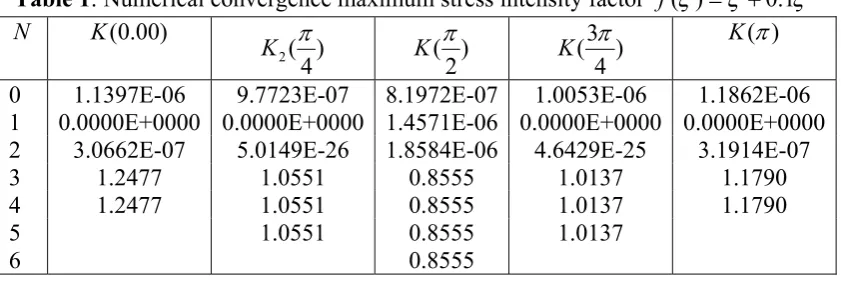
Numerical calculation have been carried out and shows that our numerical scheme converges rapidly with only a small value of N .
Table 1: Numerical convergence maximum stress intensity factor f() 0.12 N K(0.00)
) 4 ( 2
K )
2 (
K )
4 3 (
K K()
0 1.1397E-06 9.7723E-07 8.1972E-07 1.0053E-06 1.1862E-06 1 0.0000E+0000 0.0000E+0000 1.4571E-06 0.0000E+0000 0.0000E+0000 2 3.0662E-07 5.0149E-26 1.8584E-06 4.6429E-25 3.1914E-07 3 1.2477 1.0551 0.8555 1.0137 1.1790 4 1.2477 1.0551 0.8555 1.0137 1.1790
5 1.0551 0.8555 1.0137
6 0.8555
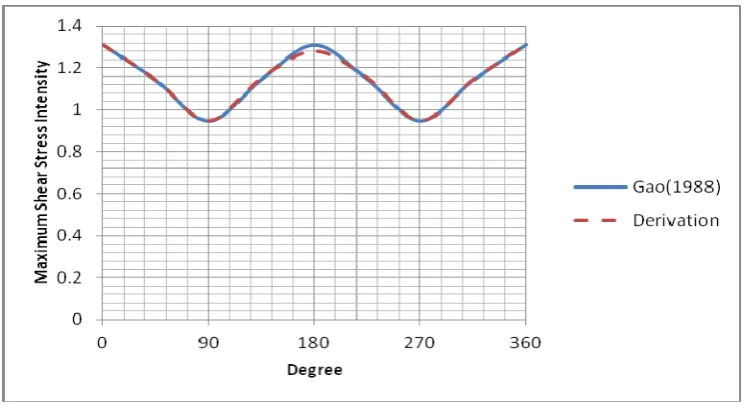
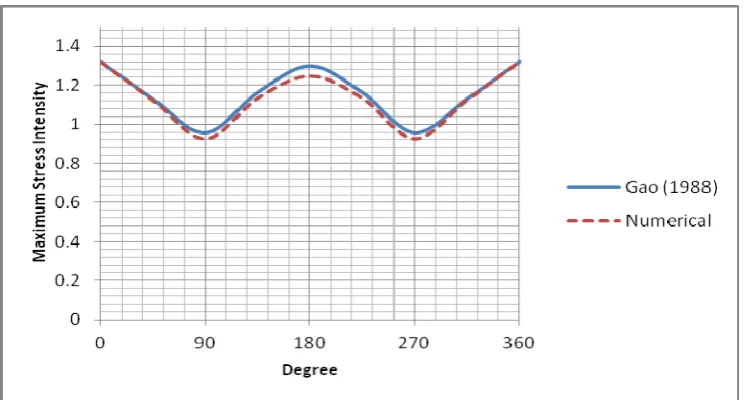
Figure 1, 2 and 3 shows that the variations of K() against for c0.001, 01
. 0
c and c0.1, respectively. It can be seen that the maximum shear stress intensity has local extremal value when the crack front is at cos()1 or
1 )
61
Figure 1: The maximum shear stress intensity for f() 0.0012.
62
Figure 3: The maximum shear stress intensity for f() 0.12.
6. CONCLUSION
In this study, a hypersingular integral equation for crack problem subject to shear loading is formulated. Then, a nearly circular crack is mapped conformally onto a unit circle where the equation is transformed into a similar hypersingular integral equation over a circular crack, which enable us make use of the formula obtained by Krenk [22]. By choosing the appropriate collocation points, this equation is reduced into a system of linear equations and solved for the unknown coefficients, which are later used in finding the maximum shear stress intensity. The maximum shear stress intensity for the mentioned crack subject to shear load presented graphically. Our result seems to agree with the previous work by Gao [17].
Acknowledgments
63
REFERENCES
[1] Mastrojannis, E.; Keer, L. M. & Mura, T. (1979), 'Stress intensity factor for a plane crack under normal pressure', International Journal of Fracture 15(3), 247-258.
[2] Singh, B. M. & Danyluk, H. T. (1985), 'Stress intensity factors for two rectangular cracks in three-dimensions', Engineering Fracture Mechanics 22(3), 475-483.
[3] Kassir, M. K. (1982), 'A three dimensional rectangular crack subjected to shear loading', International Journal of Solids and Structures 18, 1075-1082.
[4] Kassir, M. K. (1981), 'Stress-intensity factor for a three dimensional rectangular crack', Journal of Applied Mechanics, Transactions ASME 48(2), 309-312.
[5] Ioakimidis, I. N. (1982), 'Application of finite-part integrals to the singular integral equations of crack problems in plane and three-dimensional elasticity', Acta Mechanica 45(1-2), 31-47.
[6] Qin, T. Y. & Tang, R. J. (1993), 'Finite pat integral and boundary element method to solve embedded planar crack problem', International Journal of Fracture 60(4), 373-381.
[7] Qin, T. Y. & Tang, R. J. (1992), 'Finite-part integral and boundary element method to solve flat crack problems', Applied Mathematics and Mechanics 13(12), 1089-1095
[8] Linkov, A. M. & Mogilevskaya, S. G. (1994), 'Complex hypersingular integrals and integral equations in plane elasticity', Acta Mechanica 105(1-4), 189-205.
[9] Martin, P. A. (1996), 'Mapping flat cracks onto penny-shaped cracks, with application to somewhat circular tensile cracks.', Quarterly of Applied Mathematics 54, 663-675.
[10] Martin, P. A. (1995), 'Mapping flat cracks onto penny-shaped cracks: shear loadings', Journal of the Mechanics and Physics of Solids 43(2), 275-294.
64
[12] Theotokoglou, E. E. (2004), 'Boundary integral equation method to solve embedded planar crack problems under shear loading', Computational Mechanics 33(5), 327-333.
[13] Gao, H. & Rice, J. R. (1987), 'Somewhat ciruclar tensile crack', International Journal of Fracture 33, 155-174.
[14] Gao, H. & Rice, J. R. (1986), 'Shear stress intensity factors for a planer crack with slightly curved front', Journal of Applied Mechanics 53, 774-778.
[15] Borodachev, N. M. (1993), 'Solution of integral equation for almost circular cracks', Strength of Materials 25(4), 275-280.
[16] Borodachev, N. M. (1989), 'Method of solving problems of a plane crack which is nearly circular', International Applied Mechanics 25(7), 718-723.
[17] Gao, H. (1988), 'Nearly circular shear mode cracks.', International Journal of Solids and Structures 24, 177-193.
[18] Nik Long, N. M. A.; Koo, L. F. & Eshkuvatov, Z. K. (2011), 'Computation of Energy Release Rates For A Nearly Circular Crack', Mathematical Problem In Engineering, 2011, 17pages.
[19] Guidera, J. T. & Lardner, R. W. (1975), 'Penny-shaped cracks', Journal of Elasticity 5(1), 59-73.
[20] Ioakimidis, N. I. (1990), 'Two-dimensional principal value hypersingular integrals for crack problems in three-dimensional elasticity', Acta Mechanica 82(1-2), 129-134.
[21] Hadamard, J. (2003), Lectures on Cauchy's problem: In linear partial differential equations, Dover Publications