A SOCIO-PRAGMATIC CONSTRUCTIONIST FRAMEWORK FOR UNDERSTANDING
QUALITY IN PROCESS MODELLING
Jan Recker
School of Information Systems Queensland University of Technology
Brisbane, Australia Ema
ABSTRACT
Quality is one of the main topics in current conceptual modelling research, as is the field of business process modelling. Yet, widely acknowledged academic contributions towards an understanding or measurement of business process model quality are limited at best. In this paper I argue that the development of methodical theories concerning the measurement or establishment of process model quality must be preceded by methodological elaborations on business process modelling. I further argue that existing epistemological foundations of process modelling are insufficient for describing all extrinsic and intrinsic traits of model quality. This in turn has led to a lack of holistic understanding of process modelling. Taking into account the inherent social and purpose-oriented character of process modelling in contemporary organizations I present a socio-pragmatic constructionist methodological framework for business process modelling and sketch out implications of this perspective towards an understanding of process model quality. I anticipate that, based on this research, theories can be developed that facilitate a more comprehensive and adequate evaluation of the ’goodness’ of a business process model.
Keywords: Process modelling, epistemology, pragmatism, constructionism, model theory
INTRODUCTION
in this context is the increased popularity of business process modelling (Davies et al., 2006). Due to a strengthened interest in a more disciplined approach for Business Process Management, many organizations have been motivated to make significant investments in process modelling initiatives, which in turn has triggered substantial related research. Many studies have shown the relevance of process modelling to BPM initiatives, e.g., (Davenport, 1993). Process modelling denotes a requirement for a number of ISO 9000 quality programs (Ould, 1995) and is the basis of process-related IT implementations, such as Enterprise Resource Planning systems (Robinson and Dilts, 1999) or process-aware information systems (Dumas et al., 2005). The recent introduction of legislative frameworks such as the Sarbanes-Oxley Act (Nielsen and Main, 2004) further contributed to the increasing interest in business process modelling.
From a practitioner perspective, business process modelling is a way of capturing and graphically documenting how businesses conduct their operations (Curtis et al., 1992). It typically includes depictions of at least the activities, events/states, and control flow logic that constitute a business process (Scheer, 2000). Process models are used, amongst others, for the purposes of business improvement, documentation, automation and simulation.
From an academic perspective, process modelling resides in the research field of conceptual modelling. Conceptual modelling is the process of building a representation of selected semantics about a domain of interest for the purpose of understanding and communication among stakeholders (Mylopoulos, 1992; Wand and Weber, 2002; Siau, 2004). It is arguably inevitable for the tasks associated with information systems analysis and design (Karimi, 1988; Garda et al., 2004) and has, correspondingly, repeatedly been proposed to reside at the core of the IS discipline (Weber, 2003; Nelson et al., 2005). Traditional forms of conceptual modelling accounted only for an organization’s data and, if at all, that portion of its processes that interacted with data. Newer uses of information systems, however, extend deployment beyond transaction processing into communication and coordination, viz., a process-aware perspective on information systems (Dumas et al., 2005), which gave rise to a heightened interested in the conceptual modelling of business processes.
The ongoing and strengthened interest in process modelling has, over time, led to a wide range of process modelling techniques (also called languages) since Carl Petri first published his initial ideas on Petri nets in 1962 (Petri, 1962). Available approaches range from simple flowcharts and typical business modelling techniques to advanced variants of Petri nets with high expressive power. Consequently, a competitive market is providing a plethora of complementary tools and methods (Sinur, 2004).
The juxtaposition of methodologies, methods, and modelling techniques leads to confusion: are there really so many different ways to analyze and design information systems let alone business processes? Where are similarities in the approaches? Which one serves a particular purpose the best? These and similar questions reveal relevance not only to academics but also to practitioners (Olle et al., 1991). But why bother? Is it not acceptable to leave evaluation to evolution? Contemplating about the history of the IS discipline, it is advised that a Darwinist approach (“survival of the fittest”) does not seem to be a satisfactory option. First, it does not allow for an ex-ante selection of competing alternatives since it leaves evaluation to the final stages of development or deployment. Second, it does not allow for individual appropriateness criteria since it focuses on general “best practice” solutions that seem suitable in principle rather than in context.
model?”, a research field that has only recently begun to emerge and that is slowly gaining momentum. To date, research on quality in conceptual modelling is still believed to be in its infancy (Moody, 2005; Nelson et al., 2005). What holds true for conceptual modelling in general (Buhl and Heinrich, 2005), must be stressed even more for the field of business process modelling: several researchers explicitly state the need for research aiming at understanding and developing a common notion of business process model quality (Brito e Abreau et al., 2002; Wand and Weber, 2002; Poels et al., 2003; Moody, 2005; Krogstie et al., 2006). Before this background, the research discussed in this article aims at arriving at an understanding of business process model quality. More precisely, the research presented in this paper seeks to countervail the lack of a theoretically and methodologically sound and comprehensive appreciation of process model quality. The basic assumption of this paper is that a better understanding of process model quality can only be developed if business process modelling firstly is appreciated from a methodological perspective. In short, this paper argues that a methodology of process modelling is needed that exhibits sufficient explanatory power to address all those traits of quality that are relevant to contemporary process modelling activities in both practitioner and scholar communities.
In this context, I make the same distinction as Wilson (2002) between methodology and method. That is, methodology precedes method and is more fundamental in that it provides the philosophical groundwork for methods. Sadly however, evidence shows that there has been comparatively little research done on the nature of methods and methodology (Rescher, 1973). Accordingly, in this paper, I will outline a fundamental framework in terms of a methodology and epistemology of business process modelling. This will open the stage for some fundamental criticism of our scientific understanding of concepts in the nexus of BPM research in general and conceptual process modelling in particular. The contention of methodological and epistemological aspects in the framework will set the stage for the design of compliant methodical technical theories for investigating quality on the quality of business process modelling. Accordingly, in this paper I seek to discuss considerations towards an understanding of process model quality by shedding light into methodological and epistemological aspects of process modelling.
In the remainder of this paper I proceed as follows. In the next section, I briefly recapitulate previous research in the field of process model quality. Then, I introduce an alternative perspective upon organizational reality, socio-pragmatic constructionism, which I deem promising as a starting point for this endeavour. In the fourth section I apply this perspective to the conception of process modelling to discuss implications of this theory towards an understanding of models. Next, I sketch some implications of these elaborations towards an appreciation and understanding of process model quality in a basic framework. This paper then closes with a discussion of the conclusions drawn from this work and directions for future research.
RELATED WORK
Little research has comprehensively investigated the notion of business process model quality (Moody, 2005). Work related to this field mainly stems from investigations upon conceptual model quality in general. Noticeable is the work of Lindland et al. (1994) who developed an understanding of conceptual model quality based on semiotic theory (Morris, 1971), defining a syntactic, semantic and pragmatic level of model quality. More recently, Krogstie et al. (2006) revised this framework to address further aspects pertaining to the modelling of processes. Their approach will serve as a reference for my subsequent elaborations on the implications of a socio-pragmatic constructionist process modelling methodology towards an understanding of quality.
Early attempts that investigated process model quality include the guidelines of process modelling (Becker et al., 2000), a framework that defines six general guidelines, correctness, relevance, economic efficiency, clarity, comparability and systematic design. This approach proposes the differentiation of different abstraction layers of quality assessment. On a first layer, for instance, generic general modelling guidelines are suggested. These guidelines are then refined for certain views, e.g., models for business processes, and finally broken down to fully specified guidelines for certain modelling techniques (e.g., Event-driven Process Chains). The approach, however, lacks a sound theoretical methodology, and provides only limited empirical proof as to its feasibility as a quality framework (Rosemann et al., 2001).
Evaluation of process models has, to a certain extent, gained popularity since the emergence of quality frameworks with a focus on the representational capabilities and expressive power of process modelling techniques. Such frameworks have been developed either inductively from observable practice or deductively from applicable theories.
An example for inductively derived frameworks is the set of workflow patterns developed by van der Aalst et al. (2003). The development of this framework was triggered by a bottom-up analysis and comparison of fifteen workflow management systems, with focus on the expressive power of the underlying process modelling techniques, to outline similarities and differences between the analyzed systems. The evaluation of process modelling techniques, e.g., (Wohed et al., 2003; Russell et al., 2006; Wohed et al., 2006) is based on the assumption that a more complete coverage of the workflow patterns leads to techniques and systems with advanced expressive power. Other aspects or purposes of process model quality are neglected.
An example for an evaluation framework that has been derived through deductive research methods is representational analysis of process modelling techniques based on foundational ontologies, in particular the Bunge-Wand-Weber representation model for conceptual modelling (Wand and Weber, 1990, 1993). This theory of representation has been used in over thirty-five research projects for the evaluation of different modelling techniques, including data models, object-oriented models and reference models. It also has a strong track record in the area of process modelling, with contributions coming from various researchers, e.g., (Keen and Lakos, 1996; Green and Rosemann, 2000; Green et al., 2005; Recker and Indulska, 2007). Rosemann et al. (2006) provide an overview of these studies. Essentially, The Bunge-Wand-Weber model proposes a set of semantics representation constructs for models of Information Systems that modelling techniques should be able to express. As such, these types of evaluations emphasize a semantic level of model quality neglecting pragmatic or syntactic facets.
of the type of research in the BPM that has traditionally focussed syntactic and semantic investigations but lacked an appreciation of further traits of model quality such as pragmatic aspects.
In summation, most of the work presented defines methodical approaches towards the investigation of certain aspects of quality in process models. Only the BWW model approach is based on a sound methodological foundation, which however has at times been subjected to criticism, e.g., (Lyytinen, 2006; Wyssusek, 2006), especially with regards to its negligence of social and pragmatic traits of modelling quality. As I concur with Wilson (2002) that methodical solutions only reveal pertinence to certain methodological presuppositions, there is henceforth a need to investigate underlying methodological foundations of process modelling to arrive at a better understanding which methodical solution is applicable to appreciating process model quality. I will subsequently present a methodological perspective on process modelling that I deem very explanatory and explorative. It will serve as a starting point for an investigation of quality aspects in process models. During this investigation I will refer to aspects of related work whenever appropriate. In particular, I draw on the work of Stachowiak (1973) to discuss characteristics of process models, and the work of Morris (1971) on a general theory of signs, which has for instance been used in the semiotic quality framework (Lindland et al., 1994; Krogstie et al., 2006), to sketch implications of socio-pragmatic constructionism on the understanding of process model quality.
Socio-pragmatic constructionism
The following elaborations proceed on the basis of the paradigm debate that has evolved in the IS research discipline lately, refer, for instance, to (Benbasat and Weber, 1996; Weber, 2004; Gregor, 2006). In particular, traditional positivist research approaches have been subjected to a powerful base of criticism originating from the post-modern turn in the human and social sciences, see (Eden et al., 1981; Mir and Watson, 2000). Yet, evidence show that positivism still dominates the area of IS research (Orlikowski and Baroudi, 1991; Chen and Hirschheim, 2004; Mingers, 2004). I will neither re-cite the well-know criticisms nor repeat the debate of positivism versus anti-positivism here. Instead I seek to outline an alternative way based on perspectives of social constructionism and pragmatism, which, in my belief, offers powerful perspectives on IS research in general and process modelling in particular.
Information systems research positions itself at the intersection of historically well-established research fields such as management sciences, technology sciences, social sciences, human sciences etc (Vessey et al., 2002). Yet, the diversity of influential fields is hardly reflected in IS studies. Only few studies present multiple perspectives upon the phenomenon being studied. Despite the social nature of information systems and the fact that contemporary organizations are exposed to continuous and rapid internal and environmental changes, many IS research papers still present models and theories as universal panaceas holding objective truth (Chen and Hirschheim, 2004). An example of this is the use of representational theories based on philosophical ontology as axiomatic reference frameworks for the evaluation of the “goodness” of a conceptual model, e.g., (Wand and Weber, 1990, 1993), a theory that is coined by the underlying assumption that the underlying model of representation itself contains necessary and sufficient semantic categories to appropriately represent relevant real-world domains.
basic principles of social constructionism and pragmatism will be outlined and I will then reconcile these perspectives in the paradigm of socio-pragmatic constructionism.
Social constructionism
To start with the introduction of (social) constructionism, the term first needs clarification. Constructionism is closely related to the notion of constructivism. Both rely on an anti-positivist epistemology questioning the direct relationship between knowledge (expressed in symbols or models) and reality. Constructivism, often referred to as radical constructivism (von Glasersfeld, 2001), focuses an anthropocentric approach by claiming that reality, and also knowledge, is constituted as a solipsistic mental construction of an individual. Correspondingly, constructivism is concerned with how individuals construct and interpret their world. It insists on the mental states of singe individuals as the sole instance of knowledge creation. Consequently, as realities are subjective, so are knowledge, symbols and models. Social constructionism, on the other hand, has a social focus and proposes “the redefinition of social realities as constituted through discourse” (Neimeyer, 1998, p. 135). It emphasizes the social aspect of cognition. It states in particular that the acquisition of conceptual knowledge takes place before the background of a social community that defines language and action amongst its members. Consequently, realities are shaped through social discourse and are not the sole achievement of an individual. Berger and Luckmann (1966, p. 95) call such a social reality a “symbolic universe”. This notion, even more so than constructivism, appears naturally conducive to an understanding of process modelling. Process modelling teams exist in every BPM-affiliated organization. Each of these has defined and is and using their own approaches, languages and techniques to conduct process modelling tasks. It would appear sound, then, to assume that the social interaction between the individuals would have an impact on how each one of the individuals perceives organizational reality and describes the knowledge about it in the form of process models.
that social constructionism needs to be widened to embrace a means for differentiating, and establishing differences between, the multiple models of reality that may be constructed within one social community.
One means of doing so would be to include pragmatic aspects into the discussion. The embracement of pragmatic values within social constructionism opens the stage for incorporating different values and norms as relevant aspects of concerns in knowledge and quality studies. A good reference as to such an approach is the notion of fitness-for-use that builds the cornerstone of Total Quality Management approaches towards quality improvement of products and processes (Hradesky, 1994).
Pragmatism
In order to overcome the fallacy of social constructionism to be unable to determine what pictures of reality constitute ‘better’ forms of meaning creation, pragmatism offers a way to deal with the dilemma of relativism. Pragmatism was developed in the USA in the late 19th century (Wicks and Freeman, 1998). Its main claim is that the worth of a proposition, theory or model is to be judged by the consequences of accepting it. Basically, the tenet of pragmatism is that any picture, theory or model is good or true if and only if it is useful – in the sense of helping people to fulfil a given need. The pragmatic notion of knowledge acquisition, then, is “to gain an understanding which is necessary to deal with problems as they arise” (Dewey, 1988, vol. 4, p. 14). Pragmatists consequently do not search for universal truths. Instead, they agree with social constructionists that all construction of knowledge, i.e., the association of perceptual input to cognitive concepts, occurs before the background of our historically and socially situated pre-understanding of the context. Thus, interpretation is contextual, depending on the social environment and the horizon brought to it by the interpreter (Gadamer, 1989). In particular, pragmatism offers a criterion of usefulness spread across an epistemological (is this picture credible and reliable?) and a normative (does this picture help us in our actions?) dimension. This enables the researcher to advance the boundaries of positivist and anti-positivist philosophies (Wicks and Freeman, 1998).
The tenet of pragmatism has been reflected in some previous work on conceptual model quality, for instance in the notion of feasibility in the quality framework of Lindland et al. (1994), which defines a ‘satisfactory’ threshold for quality aspects.
Socio-pragmatic constructionism
Social constructionism as a paradigm for IS research in general and business process modelling specifically can in my belief be considerably enhanced in accepting a pragmatic viewpoint upon “truth”. It advances the perspective upon research by providing means of evaluating pictures, theories, propositions, and models in terms of their relevance and usefulness to given values, norms and objectives. Hence, it opens the stage for incorporating viewpoints and needs of various stakeholders in a given situation.
practices across the newly formed team but also introduces a shared language that leverages a certain understanding of modelling concepts and symbols. The models that are created by this team will be easily interpreted by members of the team. As practical experiences show, however, problems arise once such models are presented to “outsiders”, for instance senior management staff or CEOs, who are unlikely to be members of the modelling community and most probably have not participated in the establishment of common language and practice. The extrinsic form of representation chosen in the model may actually be easily understandable. Yet, an outsider may have significant problems grasping what is represented. The intrinsic model content has been created within the social community of the modelling team, which established a shared understanding of the content, for instance a set of business processes, through continuous investigation and discourse.
A SOCIO-PRAGMATIC CONSTRUCTIONIST PERSPECTIVE ON PROCESS
MODELLING
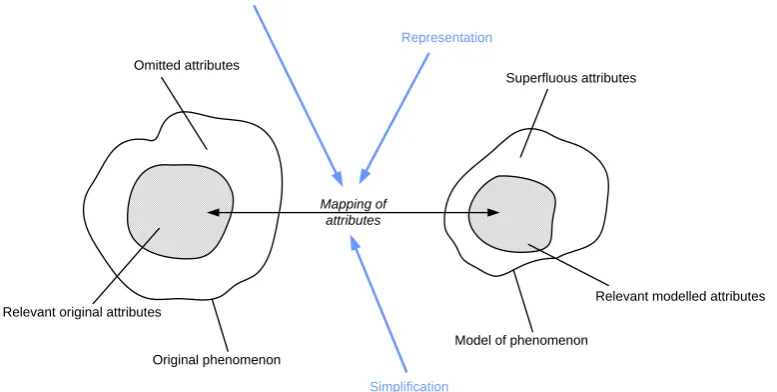
The implications of a socio-pragmatic constructionist perspective upon conceptual modelling in general and business process modelling in particular are significant. In the following, I seek to explore the implications in more detail. In order to structure this discussion, I draw on the general model theory (Stachowiak, 1972, 1973) as a reference for my elaborations. The general model theory is a well-known reference theory for conceptual modelling that distinguishes three constituent and common characteristics of models independent from any epistemological or ontological commitment, namely Representation, Simplification and Pragmatic orientation. Due to its dissociation from any philosophical commitment, it serves as a well-structured framework to discuss common traits of any model. The basic idea is that modelling is essentially just a mapping from a set of original attributes from a phenomenon of interest to another set of modelled attributes. The mapping process can be described as follows (see Figure 1).
Omitted attributes
Relevant original attributes
Original phenomenon
Mapping of attributes
Superfluous attributes
Model of phenomenon
Relevant modelled attributes
Representation Pragmatic orientation
Simplification
Using these three model characteristics, the implications of a socio-pragmatic constructionist perspective upon process modelling can be explored, thereby allowing for the derivation of basic traits of process model quality as will be discussed later in this paper.
Representation
Models are models of something (Stachowiak, 1973, p. 131). Social constructionism states that “something”, i.e., the phenomenon to be modelled, itself is being constituted within the social context in which the modeller operates. To be more concise: the universe of discourse that is subject to being modelled is a social phenomenon embedded into shared social practices and language use. The social community (let’s say, a process modelling team within an organization), contextualizes through established language and common practice the way that the phenomenon of investigation (let’s say a business process within the organization) is conceptualized by the modeller. This internal conceptualization of the original phenomenon is then externalized by the modeller within a model. Transferring these insights to the field of business process modelling, the phenomenon being modelled is a set of business processes within an organization. Now, obviously, both organizations and business processes are for themselves linguistic conceptualizations – a factual existence of either of them cannot be presumed. Rather, they are metaphors for certain perspectives or views upon the universe of discourse, and are thus conceptualized before the background of the established social context. The process model then is subjected to the conceptualization of the phenomenon (a business process) as it is socially contextualized within the community (a business organization).
In simple terms, this means that processes are merely metaphors we use within an organizational community to describe the actions and events that happen within the organizational context. And this is what process modellers seek to represent in a process model. The models of the processes then can only symbolizations of what the model creators understands under the concept of a business process, i.e., how (s)he perceives the series of actions and events that take place within the organization.
Simplification
be included and neglected in a model. The ultimate goal of this endeavour remains to be that the model should effectuate shared understanding and successful practice.
Pragmatic orientation
Models have a substitutive function in that they substitute a certain phenomenon as being conceptualized by a certain subject in a given temporal space with a certain incentive or operation in mind (Stachowiak, 1973, p. 132). The process of creating a model is never for the pure sake of modelling, Instead, they are designed and interpreted having a certain purpose in mind – in short, to fulfil a certain need. This statement may appear obvious. Yet, recent reflections on current process modelling practice (e.g., Recker, 2006; Rosemann, 2006a, b) do not get tired of stressing this message to practitioners over and over again. The need for doing so simply stems from the observation that many organizations still invest considerable amounts of time and resources into the creation of process models without being clear about why they are doing it in the first place.
For example, a process model can be designed for senior management staff to intuitively conceptualize the operational details of some business operations. Or, process models can be designed for systems analysts to determine the extent of compliance of existing or future IT infrastructure to the operational business activities. The socio-pragmatic constructionist perspective here again stresses the necessity of forming a shared horizon of meaning (a mutual acknowledgement), in order to arrive at meaningful interpretations of the models amongst various stakeholders. In other words, it is required to establish upfront why the organizations engages in a modelling exercise and for what task the resulting process models will be used as input.
IMPLICATIONS TOWARDS MODEL QUALITY
Forthcoming from the preceding elaborations I will sketch out some implications towards an understanding of process model quality in a basic framework. I base my elaborations on the understanding that the concept of model quality is inherently complex and cannot completely be appreciated via a correspondence theory in a factual or objectivist sense, let alone in a list of syntactical or semantic correctness criteria. Rather, these discussion should incorporate social, contextual and pragmatic variables.
Models are in their essence merely statements created in some (artificial) language and can hence be related to the study of language and signs. I refer to the semiotic theory of signs (Morris, 1971) as a theoretical reference for the subsequent discussion. In IS research, several researchers turned to this theory, for instance in theories on data model quality (Lindland et al., 1994) or information quality (Price and Shanks, 2005). Correspondingly, it would appear that Morris’ theory of signs serves as a suitable starting point for deriving dimensions of a framework to structure my investigation.
Basically, semiotic theory distinguishes three components within the study of linguistics signs, namely object, representamen and interpretant. The relationships between these three components is in contemporary studies expressed in the so-called semiotic triangle (see
imposing onto this relationship a perceived meaning. The act of interpretation is necessarily dependant on the use of the sign (θ) by the interpreter, thus on his social context (shaped for instance via linguistic norms and common practice) and on his individual background, viz., his pre-understanding and conceptualization (φ) of the context. Hence, there is no direct relationship between a linguistic symbol and some object in the “real world”. The relationship can only be established by the interpretant. In this sense, any linguistic symbol (such as the elements that comprise a process model) can only be interpreted; it cannot signify a priori.
Based on these relationships Morris (1971) defines three semiotic levels that can be used to measure quality:
• Syntax describes the formal relations between signs. Syntactic quality hence assesses the extent to which a representamen is created in accordance to formal laws of the symbolic language.
• Semantics studies the relation between the representamen and its designatum, i.e., the object it represents. Hence, semantic quality describes the extent to which the sign corresponds sufficiently to the concept it seeks to model.
• Pragmatics studies the extent to which interpretants of a sign are able to make use of the interpreted meaning of the sign for a given use. Pragmatic quality then is the sufficiency of a sign to act as a designatum for a certain object or concept before the background of a certain purpose.
Figure 2: Semiotic Theory of Signs (Morris, 1971)
Taking together the findings from the semiotic theory of signs and the methodological considerations of process modelling based on a socio-pragmatic constructionist perspective, aspects and dimensions of quality can be sketched that need to be considered in the domain of process modelling. The following discussion is structured by the before-mentioned three semiotic levels of quality.
Syntax
form meaningful statements. Translated to process modelling, the syntactic criterion demands that the creation of a process model based on the symbols provided by a process modelling language is accomplished in conformance to the formal laws of the modelling language, viz., its grammar. Now, while formalization of conceptual modelling languages is still a rather under-represented concept in IS research (ter Hofstede and van der Weide, 1992), one can generally observe two notions of formalization that facilitate the assessment of syntactic quality. Meta model-based approaches rest on the depiction of the grammar of a certain language L1 using another modelling language L2 (note that L2 may equal L1) (Holten, 2003). For instance, the grammar of the ebXML process specification language is expressed in UML (OASIS, 2001). On the other hand, the syntax of a modelling language (and thus a model) can be formally specified using logical expressions such as first-order predicate calculus or set theory. An example for this is the formal specification of EPC models provided by van der Aalst (1999). Another example is the use of formal Petri-net specifications for describing the syntax of process models (van der Aalst, 2005). Based on the grammar specification, a model can be syntactically verified in the sense that it is assessed whether it denotes a well-formed model in accordance to the formal laws of the symbolic language in which it was created.
While in general it would appear safe to assume that syntactically lawful models are desirable, the relevance of this criterion may diverge with respect to pragmatic considerations. For example, a process model that serves as an input to a workflow execution engine has higher requirements in terms of syntactical rigor, for example a verification of the model concerning the possibility of deadlocks or starvation areas. Process models that are used to communicate business requirements amongst senior management staff, however, may have less rigid requirements in terms of syntax and may even posit a superiority of clarity and visualization concerns over syntactic rigor. For instance, Dehnert and van der Aalst (2004) concede that process models used for business purposes demand intuitiveness rather than unambiguity and understandability rather than machine-readability.
I hence propose to relate seemingly factual aspects of quality (such as the consistency of language meta model) to social and pragmatic aspects such as, for instance, who is the intended audience and what is the purpose of the model created. This way, it can be established whether certain syntactic quality criteria, e.g., (Kiepuszewski et al., 2003; Verbeek et al., 2007) should be taken into account or not.
Semantics
processes as an interleaved series of events that trigger certain business activities that in turn lead to series of events. Quite contrary, IDEF3 diagrams (Plaia and Carrie, 1995) conceptualize processes based on an information-flow paradigm. They contain sets of so-called ‘units of behaviour’ that process and exchange information objects amongst themselves. The notion of events as triggers for business activities, is more or less absent in this language. Hence, the notion of events is likely to be absent in the way modellers, whose pre-understanding of process models has been coined by their IDEF3 modelling practice, conceptualize business processes.
What holds true for the development of process models holds true for their evaluation as well. As an example, an academically acknowledged theory for the evaluation of business process models is based on a series of control flow patterns (van der Aalst et al., 2003). A process modelling language is evaluated with respect of how many and how well it allows for the depiction of these workflow patterns. The underlying conception, obviously, is that a business process domain can be described as a composition of these control flow patterns. Another example for domain preconceptions in this field is the Bunge-Wand-Weber model (Wand and Weber, 1990, 1993), which prescribes a set of domain semantics that should be covered by any process modelling technique. Again, such a preconceived model of domain representation has to be continually assessed as to its relevance as a model of domain understanding within every social modelling context. In other words, the question is whether these reference frameworks for model quality evaluation match the existing pre-conceptions within process modelling domains that are brought to the evaluation task by the members of the community, viz., the model creators and model users within an organization.
A social constructionist perspective postulates that in order to assess the relation between model and phenomenon being modelled, the social context that determines the perception and cognition of the universe of discourse must be scrutinized. This includes the assessment of social practices. They determine the individual practices and the common language by which the modellers within the organization conceptualize and model the relevant phenomena. The pragmatic claim of a socio-pragmatic constructionist perspective furthermore demands an investigation of values, norms, needs and interests of the stakeholders involved in the modelling practice. This means that the perception of the universe of discourse (the set of processes to be modelled) is selected by the stakeholders interests (Vickers, 1970) – it is driven by their needs. Hence, the semantic criterion is concerned with the relation of the process model and the socially contextualized and purpose-driven conceptualization of the phenomenon being studied (here: a business process). In simple terms, a good process model would be one that matches the way the model reader thought a process model should look like – based on their needs and historically established understanding of the organization.
Pragmatics
or simulating and automating office procedures. In order to arrive at an evaluation of how well a model helps achieving these goals, it is necessary to form mutual agreements about the horizon of meaning of the process model amongst model designers and users. This means, it is vital to establish upfront within the community of model creators and users for what task exactly the model will be needed. For instance, imagine an organization that recently spent considerable time and money to upgrade their IT infrastructure. Yet, the upgraded infrastructure still induces problems in the day-to-day business operations. Given the extent of resources already spent, the ongoing process improvement exercise is imposed the restriction that the IT infrastructure in place for the business process under scrutiny is not to be changed and hence should not be included in the process models. This restriction should then be a valid criterion in the judgment of the process models.
Hence, the pragmatic judgment of process model quality is subject to individual norms, ethics, values and needs. Appropriate means for evaluation accordingly call for empirical research strategies rather than theoretical ones. Interestingly, other domains of conceptual modelling have taken into account some aspects of pragmatism in their studies. Taking the example of conceptual data modelling research, for instance, several researchers have turned to the exploration of different modelling forms and styles and the impact on problem solving tasks, such as, for instance, devising data structures (Khatri et al., 2006) or formulating database queries (Bowen et al., 2006). Yet, the domain of process modelling has not yet been thoroughly approached from this perspective and thus, examples for investigations into pragmatic aspects of process modelling quality are scarce at best. One of the few examples includes the work by Danesh and Kock (2005) who examined how two different process model styles impact redesign success. In summation, I see potential and first evidence that some of the successful research streams from related conceptual modelling domains could be adopted to the area of process modelling o extend the current body of knowledge.
CONTRIBUTIONS & CONCLUSIONS
This paper presented a socio-pragmatic constructionist perspective on the methodology of business process modelling. Driven by the objective of better understanding the quality of a process model I outlined a framework that places emphasis on both the social context in which modelling occurs and the pragmatic aspects of process modelling. I sketched implications of this methodology towards an understanding of process model quality in a basic discussion framework.
The main tenet of the work presented in this paper it to place emphasis on the “why” and “where” questions of process modelling initiatives. The paper sought to elicit why it is of importance to establish the purposes and tasks for which process models are to be used in order to be able to ascertain whether the models are ‘good’. Also, this paper sought to stress that process modelling, similar to any other form of communication through language discourse, is bound to the social context in which it is exercised. Especially in the case of business process management, where an organization is perceived and discussed as a set of intangible business processes, it is essential to establish that everyone involved brings to bear the same understanding of the subject matter in order to facilitate meaningful discussion.
perceived functionality of the methodology to produce desirable and accurate consequences for research and practice, for instance, by means of providing comprehensive explanatory power. The framework presented aims at providing an epistemology that enables the production of knowledge contingent to the particular context in which it is being applied.
Implications for Practice
Although methodological and/or philosophical argumentations often appear ‘far-stretched’ rather than directly applicable to IS practice, there are arguably practical merits of the work presented. First and foremost, the incorporation of social and pragmatic considerations into the discussion of process modelling and the model(s) produced facilitates an appreciation of the organizational and situational context in which modelling activities occur. By focusing aspects of model quality that transcend traditional syntactic and/or semantic concerns it is made possible to ultimately produce modelling outcomes that are not only of interest to relevant stakeholders but moreover are helpful in solving concrete modelling problems. This way, the ultimate goal of establishing and maintaining business success through principles and methods associated with business process management can be assisted through process modelling. And this should indeed be the goal of every process modelling exercise - rather than building ‘correct’ models that are more or less useless for solving organizational problems.
A second practical benefit stems from the implications that the framework described presents for education domains. Teaching domains can draw upon the discussion in this paper and derive conclusions as to the design of modelling-related curricula. Instead of focusing traditional aspects of modelling technique and/or tool features, more consideration can be placed upon situational and motivational aspects. By sharpening an understanding for the roles of actors, stakeholders, pragmatic motivations and the role of knowledge historicity, a better appreciation of the possibilities as well as limitations of process modelling can be taught. Existing curricula should be scrutinized in respect to the emphasis they place on syntactical, semantic and/or pragmatic aspects of process modelling. It would not surprise me to learn that to date, most process modelling courses are well-equipped to teach grammars and syntactical aspects (e.g., how do I model a feedback loop and what is an OR-join?) but falter when it comes to educating about the role of social discourse, organizational conventions and the prevalent question of the “why” of process modelling.
Implications for Theory
ACKNOWLEDGEMENTS
I am indebted to Peter Marshall from University of Tasmania for engaging in a series of fruitful discussions on research epistemology and also for introducing to me the philosophy of pragmatism. I also would like to thank Michael Rosemann from Queensland University of Technology for his stimulating comments when preparing an earlier version of this paper. Also, I would like to thank the reviewers and editor for their help in shaping this paper.
REFERENCES
Bajaj, A. & Ram, S. (1999) "Evaluating Completeness of Conceptual Business Process Models: A Metric Based on Case Studies", Journal of Information Technology Cases and Applications, Vol 1, No 4.
Baskerville, R. & Wood-Harper, A.T. (1996) "A Critical Perspective on Action Research as a Method for Information Systems Research", Journal of Information Technology, Vol 11, No 3, pp 235-246.
Becker, J., Rosemann, M. & von Uthmann, C. (2000) "Guidelines of Business Process Modeling" in van der Aalst, W.M.P., Desel, J. & Oberweis, A. (eds.) Business Process Management. Models, Techniques, and Empirical Studies, Springer, Berlin, Germany, pp 30-49. Benbasat, I. & Weber, R. (1996) "Research Commentary: Rethinking "Diversity" in Information
Systems Research", Information Systems Research, Vol 7, No 4, pp 389-399. Berger, P.L. & Luckmann, T. (1966) The Social Construction of Reality: A Treatise in the
Sociology of Knowledge, Doubleday, Garden City, Kansas.
Bowen, P.L., O'Farrell, R.A. & Rohde, F. (2006) "Analysis of Competing Data Structures: Does Ontological Clarity Produce Better End User Query Performance", Journal of the Association for Information Systems, Vol 7, No 8, pp 514-544.
Brito e Abreau, F., Henderson-Sellers, B., Piattini, M., Poels, G. & Sahraoui, H.A. (2002) "Quantitative Approaches in Object-Oriented Software Engineering" in Frohner, A. (ed.) Object-Oriented Technology. ECOOP 2001 Workshop Reader, Springer, Berlin, Germany, pp 174-183.
Buhl, H.U. & Heinrich, B. (2005) "Empirical Research Strategies in Conceptual Modeling - Silver Bullet or Academic Toys?" Wirtschaftsinformatik, Vol 47, No 2, pp 152-162.
Calás, M.B. & Smircich, L. (eds.) (1997) Postmodern Management Theory, Ashgate, Aldershot, England.
Carnap, R. (1950) Logical Foundations of Probability, The University of Chicago Press, Chicago, Illinois.
Chen, W.S. & Hirschheim, R. (2004) "A Paradigmatic and Methodological Examination of Information Systems Research from 1991 to 2001", Information Systems Journal, Vol 14, No 3, pp 197-235.
Curtis, B., Kellner, M.I. & Over, J. (1992) "Process Modeling", Communications of the ACM, Vol 35, No 9, pp 75-90.
Danesh, A. & Kock, N. (2005) "An Experimental Study of Two Process Representation Approaches and their Impact on Perceived Modeling Quality and Redesign Success", Business Process Management Journal, Vol 11, No 6, pp 724-735.
Davenport, T.H. (1993) Process Innovation: Reengineering Work Through Information Technology, Harvard Business School Press, Boston, Massachusetts.
Davies, I., Green, P., Rosemann, M., Indulska, M. & Gallo, S. (2006) "How do Practitioners Use Conceptual Modeling in Practice?" Data & Knowledge Engineering, Vol 58, No 3, pp 358-380.
Dehnert, J. & van der Aalst, W.M.P. (2004) "Bridging The Gap Between Business Models And Workflow Specifications", International Journal of Cooperative Information Systems, Vol 13, No 3, pp 289-332.
Dehnert, J. & Zimmermann, A. (2005) "On the Suitability of Correctness Criteria for Business Process Models" in van der Aalst, W.M.P., Benatallah, B., Casati, F. & Curbera, F. (eds.) Proceedings of the 3rd International Conference on Business Process Management, Springer, Nancy, France, pp 386-391.
Dewey, J. (1988) The Middle Works of John Dewey, Southern Illinois Press, Carbondale, Illinois. Dumas, M., van der Aalst, W.M.P. & ter Hofstede, A.H.M. (eds.) (2005) Process Aware
Information Systems: Bridging People and Software Through Process Technology, John Wiley & Sons, Hoboken, New Jersey.
Eden, C., Jones, S., Sims, D. & Smithin, T. (1981) "The Intersubjectivity of Issues and Issues of Subjectivity", Journal of Management Studies, Vol 18, No 1, pp 37-47.
Gadamer, H.-G. (1989) Truth and Method (2nd edition), Continuum, New York, New York. Garda, J.A., Casal, J.A., Vázquez, R.G., Pazos, J., Yánez, S.R. & Silva, A. (2004) "A
Methodological Framework for Generic Conceptualisation: Problem-Sensitivity in Software Engineering", Information and Software Technology, Vol 46, No 10, pp 635-649.
Gartner Group (2007) "Creating Enterprise Leverage: The 2007 CIO Agenda", EXP Premier Report No January2007, Gartner, Inc, Stamford, Connecticut.
Green, P. & Rosemann, M. (2000) "Integrated Process Modeling. An Ontological Evaluation", Information Systems, Vol 25, No 2, pp 73-87.
Green, P., Rosemann, M. & Indulska, M. (2005) "Ontological Evaluation of Enterprise Systems Interoperability Using ebXML", IEEE Transactions on Knowledge and Data Engineering, Vol 17, No 5, pp 713-725.
Gregor, S. (2006) "The Nature of Theory in Information Systems", MIS Quarterly, Vol 30, No 3, pp 611-642.
Hempel, C.G. (1965) Aspects of Scientific Explanation and other Essays in the Philosophy of Science, The Free Press, New York, New York.
Holten, R. (2003) "Specification of Management Views in Information Warehouse Projects", Information Systems, Vol 28, No 7, pp 709-751.
Hradesky, J. (1994) Total Quality Management Handbook, McGraw-Hill, New York, New York. Kant, I. (1929) The Critique of Pure Reason [translated by Norman Kemp Smith], St. Martin's
Press, New York, New York.
Karimi, J. (1988) "Strategic Planning for Information Systems: Requirements and Information Engineering Methods", Journal of Management Information Systems, Vol 4, No 4, pp 5-24. Keen, C.D. & Lakos, C. (1996) "Analysis of the Design Constructs Required in Process Modelling"
in Purvis, M. (ed.) Proceedings of the International Conference on Software Engineering: Education and Practice, IEEE Computer Society, Dunedin, Ireland, pp 434-441.
Khatri, V., Vessey, I., V. Ramesh, P.C. & Sung-Jin, P. (2006) "Understanding Conceptual Schemas: Exploring the Role of Application and IS Domain Knowledge", Information Systems Research, Vol 17, No 1, pp 81-99.
Kiepuszewski, B., ter Hofstede, A.H.M. & van der Aalst, W.M.P. (2003) "Fundamentals of Control Flow in Workflows", Acta Informatica, Vol 39, No 3, pp 143-209.
Krogstie, J., Sindre, G. & Jørgensen, H.D. (2006) "Process Models Representing Knowledge for Action: a Revised Quality Framework", European Journal of Information Systems, Vol 15, No 1, pp 91-102.
Lindland, O.I., Sindre, G. & Solvberg, A. (1994) "Understanding Quality in Conceptual Modeling", IEEE Software, Vol 11, No 2, pp 42-49.
Lyotard, J.-F. (1984) The Postmodern Condition: A Report on Knowledge, University of Minnesota Press, Minneapolis, Minnesota.
Lyytinen, K. (2006) ""Ontological Foundations of Conceptual Modeling" by Boris Wyssysek - A critical response", Scandinavian Journal of Information Systems, Vol 18, No 1, pp 81-84. Marshall, P., Kelder, J.-A. & Perry, A. (2005) "Social Constructionism with a Twist of Pragmatism:
A Suitable Cocktail for Information Systems Research" in Campbell, B., Underwood, J. & Bunker, D. (eds.) Proceedings of the 16th Australasian Conference on Information Systems, Australasian Chapter of the Association for Information Systems, Sydney, Australia. Mingers, J. (2004) "Real-izing Information Systems: Critical Realism as an Underpinning
Philosophy for Information Systems", Information and Organization, Vol 14, No 2, pp 87-103.
Mir, R. & Watson, A. (2000) "Strategic Management and the Philosophy of Science: the Case for a Constructivist Methodology", Strategic Management Journal, Vol 21, No 9, pp 941-953. Moody, D.L. (2005) "Theoretical and Practical Issues in Evaluating the Quality of Conceptual
Models: Current State and Future Directions", Data & Knowledge Engineering, Vol 15, No 3, pp 243-276.
Morgan, G. (ed.) (1983) Beyond Method: Strategies for Social Research, Sage, Beverly Hills, California.
Mylopoulos, J. (1992) "Conceptual Modelling and Telos" in Loucopoulos, P. & Zicari, R. (eds.) Conceptual Modelling, Databases, and CASE: an Integrated View of Information System Development, John Wiley & Sons, New York, New York, pp 49-68.
Neimeyer, R.A. (1998) "Social Constructionism in the Counselling Context", Counselling Psychology Quarterly, Vol 11, No 2, pp 135-150.
Nelson, H.J., Poels, G., Genero, M. & Piattini, M. (2005) "Quality in Conceptual Modeling: Five Examples of the State of the Art", Data & Knowledge Engineering, Vol 55, No 3, pp 237-242.
Nielsen, P. & Main, C. (2004) "Company Liability After the Sarbanes-Oxley Act", Insights, Vol 18, No 10, pp 2-12.
OASIS (2001) "ebXML Business Process Specification Schema Version 1.01".
Ogden, C.K. & Richards, I.A. (1923) The Meaning of Meaning: A Study of The Influence of Language upon Thought and of The Science of Symbolism, Harcourt, Brace & Company, New York, New York.
Olle, T.W., Hagelstein, J., MacDonald, I.G., Rolland, C., Sol, H.G., van Assche, F.J.M. & Verrijn-Stuart, A.A. (1991) Information Systems Methodologies: A Framework for Understanding, Addison-Wesley, Wokingham, England.
Orlikowski, W.J. & Baroudi, J.J. (1991) "Studying Information Technology in Organizations: Research Approaches and Assumptions", Information Systems Research, Vol 2, No 1, pp 1-28.
Ould, M.A. (1995) Business Processes: Modelling and Analysis for Re-Engineering and Improvement, John Wiley & Sons, Chichester, England.
Petri, C.A. (1962) "Fundamentals of a Theory of Asynchronous Information Flow" in Popplewell, C.M. (ed.) IFIP Congress 62: Information Processing, North-Holland, Munich, Germany, pp 386-390.
Plaia, A. & Carrie, A. (1995) "Application and Assessment of IDEF3-Process Flow Description Capture Method", International Journal of Operations & Production Management, Vol 15, No 1, pp 63-73.
Poels, G., Nelson, H.J., Genero, M. & Piattini, M. (2003) "Quality in Conceptual Modeling - New Research Directions" in Olivé, A. (ed.) Advanced Conceptual Modeling Techniques, Springer, Berlin, Germany, pp 243-250.
Price, R. & Shanks, G. (2005) "A Semiotic Information Quality Framework: Development and Comparative Analysis", Journal of Information Technology, Vol 20, No 2, pp 88-102. Quine, W.V.O. (1960) Word and Object, The MIT Press, Cambridge, Massachusetts. Recker, J. (2006) "Process Modelling in the 21st Century", BPTrends, Vol 3, No 5, pp 1-6. Recker, J. & Indulska, M. (2007) "An Ontology-Based Evaluation of Process Modeling with Petri
Nets", Journal of Interoperability in Business Information Systems, Vol 2, No 1, pp 45-64. Rescher, N. (1973) The Primacy of Practice, Basil Blackwell, Oxford, England.
Rosemann, M. (2006a) "Potential Pitfalls of Process Modeling: Part A", Business Process Management Journal, Vol 12, No 2, pp 249-254.
Rosemann, M. (2006b) "Potential Pitfalls of Process Modeling: Part B", Business Process Management Journal, Vol 12, No 3, pp 377-384.
Rosemann, M., Recker, J., Indulska, M. & Green, P. (2006) "A Study of the Evolution of the Representational Capabilities of Process Modeling Grammars" in Dubois, E. & Pohl, K. (eds.) Advanced Information Systems Engineering - CAiSE 2006, Springer, Luxembourg, Grand-Duchy of Luxembourg, pp 447-461.
Rosemann, M., Sedera, W. & Sedera, D. (2001) "Testing a Framework for the Quality of Process Models – A Case Study" in Kim, J.S., Lee, J.K., Suh, K., Wei, K.K. & Lee, H. (eds.) Proceedings of the 5th Pacific Asia Conference on Information Systems, The Korea Society of Management Information Systems, Seoul, Korea, pp 978-991.
Russell, N., van der Aalst, W.M.P., ter Hofstede, A.H.M. & Wohed, P. (2006) "On the Suitability of UML 2.0 Activity Diagrams for Business Process Modelling" in Stumptner, M., Hartmann, S. & Kiyoki, Y. (eds.) Conceptual Modelling 2006: 3rd Asia-Pacific Conference on Conceptual Modelling, Australian Computer Society, Hobart, Australia, pp 95-104.
Scheer, A.-W. (2000) ARIS - Business Process Modeling (3rd edition), Springer, Berlin, Germany. Siau, K. (2004) "Informational and Computational Equivalence in Comparing Information
Modeling Methods", Journal of Database Management, Vol 15, No 1, pp 73-86.
Sinur, J. (2004) "Magic Quadrant for Business Process Analysis", Gartner Research Note No M-22-0651 March, Gartner, Inc, Stamford, Connecticut.
Soffer, P. & Wand, Y. (2007) "Goal-Driven Multi-Process Analysis", Journal of the Association for Information Systems, Vol 8, No 3, pp 175-202.
Stachowiak, H. (1972) "Models" in UNESCO (ed.) Scientific Thought. Some Underlying Concepts, Methods, and Procedures, Mouton/UNESCO, Paris, France, pp 145-166.
Stachowiak, H. (1973) Allgemeine Modelltheorie [in German], Springer, Wien, Austria.
Styhre, A. (2003) Understanding Knowledge Management. Critical and Postmodern Perspectives, Copenhagen Business School Press, Herndon, Virginia.
Susman, G.I. & Evered, R.D. (1978) "An Assessment of the Science Merits of Action Research", Administrative Science Quarterly, Vol 23, No 4, pp 582-603.
ter Hofstede, A.H.M. & van der Weide, T.P. (1992) "Formalisation of Techniques: Chopping down the Methodology Jungle", Information and Software Technology, Vol 34, No 1, pp 57-65. van der Aalst, W.M.P. (1999) "Formalization and Verification of Event-driven Process Chains",
Information and Software Technology, Vol 41, No 10, pp 639-650.
van der Aalst, W.M.P. (2005) "Pi Calculus versus Petri Nets: Let Us Eat Humble Pie Rather Than Further Inflate the Pi Hype", BPTrends, Vol 3, No 5, pp 1-11.
van der Aalst, W.M.P., ter Hofstede, A.H.M., Kiepuszewski, B. & Barros, A.P. (2003) "Workflow Patterns", Distributed and Parallel Databases, Vol 14, No 1, pp 5-51.
Vessey, I., Ramesh, V. & Glass, R.L. (2002) "Research in Information Systems: An Empirical Study of Diversity in the Discipline and Its Journals", Journal of Management Information Systems, Vol 19, No 2, pp 129-174.
Vickers, G. (1970) Freedom in a Rocking Boat, Penguin Books, London, England.
von Glasersfeld, E. (2001) "The Radical Constructivist View of Science", Foundations of Science, Vol 6, No 1-3, pp 31-43.
Wand, Y. & Weber, R. (1990) "An Ontological Model of an Information System", IEEE Transactions on Software Engineering, Vol 16, No 11, pp 1282-1292.
Wand, Y. & Weber, R. (1993) "On the Ontological Expressiveness of Information Systems Analysis and Design Grammars", Journal of Information Systems, Vol 3, No 4, pp 217-237. Wand, Y. & Weber, R. (2002) "Research Commentary: Information Systems and Conceptual
Modeling - A Research Agenda", Information Systems Research, Vol 13, No 4, pp 363-376. Weber, R. (2003) "Editor's Comments: Still Desperately Seeking the IT Artifact", MIS Quarterly,
Vol 27, No 2, pp iii-xi.
Weber, R. (2004) "Editor's Comments: The Rhetoric of Positivism Versus Interpretivism: A Personal View", MIS Quarterly, Vol 28, No 1, pp iii-xii.
Wicks, A.C. & Freeman, R.E. (1998) "Organization Studies and the New Pragmatism: Positivism, Anti-positivism, and the Search for Ethics", Organization Science, Vol 9, No 2, pp 123-140. Wilson, T.D. (2002) "Alfred Schutz, Phenomenology and Research Methodology for Information
Behaviour Research" in Proceedings of the Fourth International Conference on Information Seeking in Context, Universidade Lusiada, Lisbon, Portugal.
Wohed, P., van der Aalst, W.M.P., Dumas, M. & ter Hofstede, A.H.M. (2003) "Analysis of Web Services Composition Languages: The Case of BPEL4WS" in Song, I.-Y., Liddle, S.W., Ling, T.W. & Scheuermann, P. (eds.) Conceptual Modeling - ER 2003, Springer, Chicago, Illinois, pp 200-215.
Wohed, P., van der Aalst, W.M.P., Dumas, M., ter Hofstede, A.H.M. & Russell, N. (2006) "On the Suitability of BPMN for Business Process Modelling" in Dustdar, S., Fiadeiro, J.L. & Sheth, A. (eds.) Proceedings of the Business Process Management - BPM 2006, Springer, Vienna, Austria, pp 161-176.
Wyssusek, B. (2006) "On Ontological Foundations of Conceptual Modelling", Scandinavian Journal of Information Systems, Vol 18, No 1, pp 63-80.