© Universiti Tun Hussein Onn Malaysia Publisher’s Office
JTET
http://penerbit.uthm.edu.my/ojs/index.php/jtet
ISSN 2229-8932 e-ISSN 2600-7932
Journal of Technical Education and
Training
A Content Analysis on Quality for CAD Based Product
Design: Developing a Framework for Malaysian Technical
Teacher Training Institute
Baharudin Saleh
1, Mohamad Sattar Rasul
1*, Haryanti Mohd Afandi
11Universiti Kebangsaan Malaysia, Bangi, 43600 MALAYSIA
DOI: https://doi.org/10.30880/jtet.2019.11.02.001
Received 05th September 2017; Accepted 08th May 2018; Available online 30th June 2019
1.
Introduction
The development of manufacturing technology products is increasing rapidly nowadays; therefore, the production process should not be limited to the domestic market but expanded into global markets. The production process must pass a systematic and well-planned process so that each manufactured product meets the set criteria and standards (Sulaiman et al. 2011; Tayal, 2013). Currently, to produce quality product design, a teacher trainee must learn high-level technology in their field as well as Computer-Aided Design (CAD). In an engineering context, CAD is widely used to design and develop products to be used by customers. CAD drawings offer the flexibility to draft and design in a digital sphere, which was previously done by hand. Many CAD programs are now using three-dimensional (3D) drawings to maximize productivity and provide quicker and better product results allowing for the development of the details. Using CAD programs in the manufacturing industry today should be capable of making adjustments to increase productivity by considering the minimum-maximum cost of production, responding to changes and rapid manufacturing, cost control and choosing the optimal design to solve specific tasks (Schey, 2009).
Development of product design is increasingly viewed as essential to attract users to own every designed product (Harston, 2012). Generations of good income by individuals, companies and industries are obtained by maintaining consumer loyalty to the design family (Shaukat, 2012). Attractive design and quality depend on the product characteristics (the aesthetic value, ergonomics, colour, overall shape, function, safety, etc.) and these factors influence
Abstract: Product design is a complicated process and requires a systematic requirement and specification to produce sufficient quality to remain competitive. One of the most important components in the design process is Computer-Aided Design (CAD), which renders a detailed drawing in either two-dimensional (2D) or three-dimensional modeling (3D). This paper discusses the conception of quality design to produce a creative design product. This study employed a systematic review to produce a framework of quality product design based on Computer-Aided Design (CAD). Out of 210 papers that were identified, 102 were reviewed and also 12 other relevant articles, books, reports, and documents, hence a total of 114 papers were included in this review. The reviews revealed that there are main aspect drivers of the product design, design process, design quality, customer need on the product, product evaluation, and design concept of quality products. The study also showed that the initial stage of idea-generating is an essential phase to produce innovative, creative and quality product design. This framework is useful as a guide for teachers to standardize product design concept and to assist Malaysian design and technology trainee teachers in producing a quality product design. Finally, this research proposes a conceptual framework based on our propositions. The proposed quality product design framework is beneficial to be used as a guideline for the Malaysian Technical Teacher Training Institute and policy makers to enhance the skills in the development of a quality product.
the consumers to get the product (Kroemer, Kroemer & Kroemer-Elbert, 2001; Ma, Chen & Wu, 2007; Soni, Khanna & Tandon, 2013).
In the Malaysian context, the production of creative and quality products still requires effort. A competitive global economy with rapid development shows that the focus is on the development of human capital with knowledge and skills in product design (Institut Pendidikan Guru Malaysia, 2015), while quality should be a priority (EPU, 2015; MITI, 2015). Knowledge and skills are part of a human capital development that needs to be nurtured and developed for the future of our country (Bahagian Pendidikan Guru, 2009; Malaysian Qualifications Agency, 2014).
The Organisation for Economic Co-operation and Development (OECD) reviews by Innovation Policy in Southeast Asia 2013 reported that on average, only 5.5% companies in Malaysia are actively involved in R&D and there is a lack of critical thinking skills among students from the lower level to a higher education institution level, with the achievement of 52nd out of 65 countries participating in the Program for International Student Assessment (PISA) with an average score which is below the global average score. These factors are caused by the lack of “soft skills” in most students, such as critical thinking, communication and innovation (EPU, 2015).
To create a sustainable innovation ecosystem is not an easy thing, especially in the product development stage. To figure out whether the matter above affects the construction of creative ideas to produce quality product design, several reports and studies from previous researchers showed the importance of creative ideas and highlighted that new ideas in design are supported by the integration of technologies such as Computer-Aided Design (CAD). Data from the analysis of the course work for students studying Design and Technology in CAD show that 65% of students do not master the aesthetic elements such as characteristic appearance of the product, end packaging of the product, or the function of the product; 55% of students do not master the elements of ergonomics that include the comfort features to the user and functionality of the product; while 60% of students are uncertain in the initial ideas brainstormed, such as finding information about a product to be designed and translating the product characteristics into sketches (aesthetic and ergonomic elements) in product design innovation (Unit Penilaian dan Pentaksiran IPGKPT, 2016).
Considering the above factors, the standards required to produce quality design and meet global standards cannot be met if there is no specific strategy implemented comprehensively. Also, there is still a lack of framework in product quality based on CAD, especially in the Malaysian Technical Teacher Trainees Institute. The purpose of this content analysis is to produce a framework of quality product design based on CAD. The reviews revealed that there are main aspect drivers of the product design, design process, design quality, customer need on the product, product evaluation, and design concept of quality products. This framework is useful as a guide for teachers to standardize product design concept and to assist Malaysian design and technology trainee teachers in producing a quality product design. Finally, this research proposes a conceptual framework based on our propositions.
2.
Methodology
The method of document analysis and systematic reviews were used to generate a conceptual framework to develop a model of quality product design based on CAD in teacher trainee learning context. Systematic reviews are designed to detect, assess and synthesize best research-related problems by providing research and findings to the issues being studied (Boland, Cherry & Dickson, 2013). According to Gough, Oliver and Thomas (2012), a systematic review is a method to form a theory, create evidence and solve a research problem. Merriam (2002) also explained that by collecting and analysing information generated by reading a document from multiple sources, research could be carried out thoroughly.
2.1
Material Collection
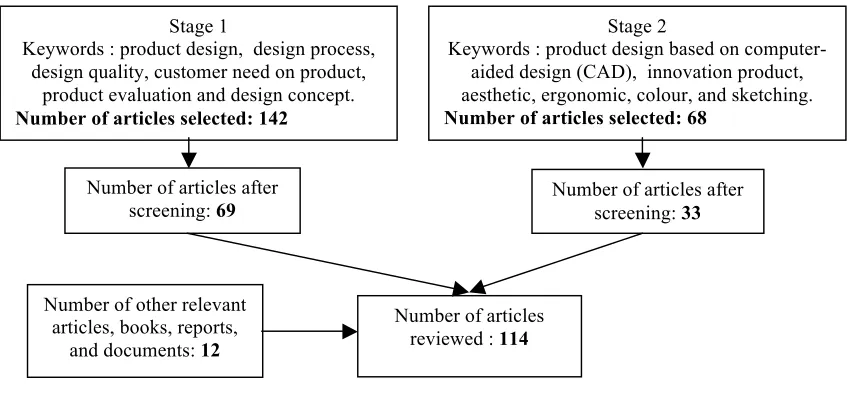
Research papers published between 1987 to the present were included in this systematic review. Related information were obtained from various government agencies, reports, journals, books and electronic references through a related website. The keywords for searching information are product design, design process, design quality, product design based on CAD, computer-aided design, and innovation product design. Recently published systematic reviews of closely related topics were considered as guidelines for this research (Chiu & Chu, 2012; Ilevbare, Probert & Phaal, 2013; Krishnan & Ulrich, 2001; Xavier et al., 2017). The articles listed from the initial search were refined with the help of a series of steps, as depicted in Figure 1 (Paras, Pal & Ekwall, 2017).
2.2
Practical screening based on the keyword
s
were found at this stage from the perspective of quality product design in technical and vocational education training (TVET) in Malaysian institutes. The databases and journals used were ProQuest, EMERALD, ScienceDirect, MyCite, Scopus, and ISI Web of Science (WoS).
Fig. 1 - Selection of articles
2.3
Screening Process
All articles were downloaded and transferred to a reference-management software. Articles were initially screened by reading the title, abstract and conclusion. Articles related to ‘product design’, ‘design process’, ‘design quality’, ‘customer need on product’, ‘product evaluation’ and ‘design concept’ were selected. Relevant articles from other areas with a significant discussion on the designing product were shortlisted. On this basis, 65 articles on product design and design process, along with 27 articles on product design based on CAD and innovation product were retained. Detail about the articles selected at each step is provided in Table 1.
Table 1 – Keywords used for article selected.
Stages Keywords Total number of articles screened articles Total number of
1 (Primary keywords)
‘product design’, ‘design process’, ‘design quality’, ‘customer need on product’, ‘product
evaluation’, and ‘design concept’ 142 69
2 (Secondary
keywords)
‘product design based on computer-aided design (CAD)’, ‘innovation product’, ‘aesthetic’,
‘ergonomic’, ‘colour’, and ‘sketching’. 68 33
Others Relevant articles, books, reports, and documents 12 12
Total 222 114
2.4
Descriptive analysis
The distribution of articles has been analysed over a specific period. The selected articles were published from 1987 to 2017; the number of articles published in this time span is depicted in Table 2. The number of articles published has increased in recent years. The primary reason for the increase is the growing consumer need for quality product design caused by the frequency of product design specification by the industries. Industries have become more conscious and are making adjustments to increase productivity by considering the cost of producing new products. Table 2 also shows the analysis of research articles based on their focus area, i.e. product design requirement, product design concept, detailed product design, and product design assessment, which constituted 60.5%. Research related to product design based on CAD, innovative product, and design quality (28.9%) are still in the nascent stage. Many studies have been focused on product design (Page, 2014) and design process (Singhry, Abd Rahman, & Imm, 2016).
Stage 1
Keywords : product design, design process, design quality, customer need on product,
product evaluation and design concept. Number of articles selected: 142
Stage 2
Keywords : product design based on computer-aided design (CAD), innovation product, aesthetic, ergonomic, colour, and sketching. Number of articles selected: 68
Number of articles after
screening: 69 Number of articles after screening: 33
Number of articles reviewed : 114
Number of other relevant
Table 2: Keywords used for the article selected by years
Design Aspect < 1994 1995 - 1999 2000 - 2004 2005 - 2009 2010 - 2014 2015 - 2017 Total Product design requirement, product design
concept, detailed product design, and product design assessment.
3 (2.6%)
2 (1.8%)
6 (5.3%)
6 (5.3%)
40 (35.1%)
12 (10.5%)
69 (60.5%) Product design based on computer-aided
design (CAD), innovation product, and design quality.
4 (3.5%)
2 (1.8%)
1 (0.9%)
6 (5.3%)
13 (11.4%)
7 (6.1%)
33 (28.9%) Other relevant articles, books, reports, and
documents.
0 (0.0%)
0 (0.0%)
1 (0.9%)
2 (1.8%)
5 (4.4%)
4 (3.5%)
12 (10.5%) Total (6.1%) 7 (3.5%) 4 (7.0%) 8 (12.3%) 14 (50.9%) 58 (20.2%) 23 (100.0%) 114
This studied systematic reviews were also analysed based on publication across the Scopus Q1 journal rankings. This information is shown in Table 3. Most of the papers were published in Design Studies (11), Journal of Engineering Design (07), Applied Ergonomics (05), Journal of Product Innovation Management (05), CIRP Annals - Manufacturing Technology (05), Journal of Mechanical Design (04), Journal of Marketing (04), Research in engineering design (03), Journal of Cleaner Production (03), Educational Technology Research and Development (03), International Journal of Technology and Design Education (02), International Journal of Design (02), and European Journal of Engineering Education (04). These articles focused on product design, design process and design quality. In contrast, the articles published in Computer-Aided Design (06), Computers in Industry (04), CAD Computer-Aided Design (04), and Computers & Industrial Engineering (03) focused on product design based on CAD. Overall, the selected articles were published in the Scopus Q1 journal rankings (refer to Appendix A), indicating that this research topic has numerous dimensions that can enrich knowledge by providing multiple perspectives.
Table 3: Top Journal by number of Scopus Q1 rankings publications
Journal Number
Design Studies 11
Journal of Engineering Design 7
Computer-Aided Design 6
Applied Ergonomics 5
CIRP Annals - Manufacturing Technology 5
Journal of Product Innovation Management 5
CAD Computer-Aided Design 4
Computers in Industry 4
European Journal of Engineering Education 4
Journal of Marketing 4
Journal of Mechanical Design 4
Computers & Industrial Engineering 3
Educational Technology Research and Development 3
Journal of Cleaner Production 3
The author’s affiliation with a particular country or region can provide a clear perspective of the research and development trends in the region. Table 4 shows that most of the studies on product design requirement and product design concept were conducted in the United Kingdom (UK) (21.1%), and the majority of studies on product design based on CAD and product innovation (11.4%) were also conducted in the UK. Other countries indicated that in recent years, there had been an increasing (18.4%) number of studies related to product design requirement and product design concept in the United States (US). Also, Asia countries (such as China, India, and Malaysia) have made significant contributions to the research on quality product design (Tang, Zhou, Wang, Liao, & Tao, 2014; Ismail, 2015; Hassan, Ismail & Mustapha, 2012). In contrast, the Europe region (such as France, Germany) conducted 14.9% of the research in product design (Le Masson, Hatchuel, Kokshagina, & Weil, 2016).
Design Aspect
Name of Country/Region
Total
US UK Europe Asia
Product design requirement, product design concept, detailed product design, and product design assessment.
21 (18.4%)
24 (21.1%)
12 (10.5%)
12 (10.5%)
69 (60.5%) Product design based on computer-aided
design (CAD), innovation product, and design quality.
7 (6.1%)
13 (11.4%)
5 (4.4%)
8 (7.0%)
33 (28.9%) Other relevant aspects of design. 2
(1.8%)
0 (0.0%)
0 (0.0%)
10 (8.8%)
12 (10.5%) 30
(26.3%)
37 (32.5%)
17 (14.9%)
30 (26.3%)
114 (100.0%)
The analysis is also based on research methodologies adopted and focused studies in the research on the development of product design. Moa et al. (2011) discussed the development of product design using simulation to produce thermal engineering design in one-dimensional (1D), two-dimensional (2D) and three-dimensional (3D) images with a multifunction CAD system. The next most adopted methods were experimental studies, qualitative and quantitative. Significant content analysis contributions were made by the author who has discussed current practices and provided future research directions (Xenakis & Arnellos, 2013; Tayal, 2013). Based on the list of reference items for this systematic review, information searching will lead to studies by the previous researcher. Thus, the researcher lists some journals and articles to aid in explaining in detail the design requirements for the production of quality products (Refer to Appendix B).
3.
Discussion Towards Conceptual Model Development
Ekuan and Stewart (2000) define the design as a process to realize ideas into product shapes. The resulting product has the characteristics of aesthetics, functional and capable of solving users’ problems. The design also is defined as a process of converting ideas into products that can be used by humans (Koskinen et al. 2011) with the use of scientific principles, technical information and imagination to realize the design of quality products (Jalil, 2000). Producing high-quality and innovative products depends on the designer's products (Ang et al., 2011) in tandem with creative and critical ideas. The idea to produce a product design and innovation can be triggered by brainstorming with a systematic process (Tayal, 2013). The process of designing a creative idea with the application of problem-solving methods is the most critical process because the product to be produced must meet the specifications of consumer demand (Mao et al. 2011; Sulaiman et al. 2011). Problem-solving is also emphasized by the World Design Organization (2017) in the process of designing in order to promote innovation, build success in business and lead to a better quality of life through products, systems and services. The organization also sees problems as opportunities to connect innovation (Industrial Designers Society Of America, 2017), technology, research, economic field, social and environment in developing the ideas of product design. Problem solving and creative thinking is required to provide an idea of a quality product design development process and meet the standards set (Ang et al., 2011; Ullman, 2010).
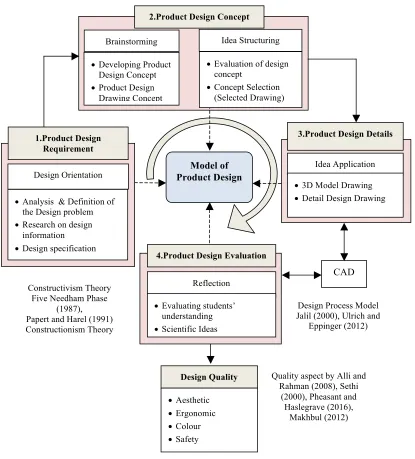
Based on the model presented by Ulrich and Eppinger (2012) and Jalil (2000), a constructed conceptual framework is shown in Figure 2. Within this conceptual framework, researchers integrate ten design process that makes four significant design process, namely: i) Product Design requirements; ii) Design Concepts; iii) Detailed Design Products; and iv) Assessment of Product Design. The four major product design processes are positioned as the entire process for the Model and Module of Product Design that will be developed and studied. The manufacturing process, the construction of the prototype and the final product are removed from the conceptual framework by taking into account that this study did not involve the production of prototypes and actual products. On the other hand, the quality of design that contains aspects of aesthetics, ergonomics, colour, and usability are included in this study as guidance to the production of quality products.
Figure 2: Research Conceptual Framework
3.1
Model and Product Design Process
There are several models related to the product design process (Alli & Rahman, 2008; Jalil, 2000; Ulrich & Eppinger, 2012; Design Council UK, 2007; British Standard Institution, 1989). However, this study uses a model developed by Jalil (2000) as the main framework in shaping the conceptual framework, and other models described above are used to strengthen the main model. Jalil (2000) in the Design Process Model stated that producing a product design is not a process that arises spontaneously, and the author has listed ten systematic design processes. The process starts with the requirement to design, analyse and define the design problems, and study the design specifications, conceptual design, production, evaluation and selection of concept, detailed design, design optimization, the production of detailed drawings and lists of materials, manufacturing, prototype construction, testing and performance improvement final and final products.
3.Product Design Details
4.Product Design Evaluation 1.Product Design
Requirement
Model of Product Design 2.Product Design Concept
Reflection
•Evaluating students’ understanding
•Scientific Ideas
CAD Idea Structuring
•Evaluation of design concept
•Concept Selection (Selected Drawing) Brainstorming
•Developing Product Design Concept
•Product Design Drawing Concept
Idea Application
•3D Model Drawing
•Detail Design Drawing Design Orientation
•Analysis & Definition of the Design problem
•Research on design information
•Design specification
Design Quality
•Aesthetic
•Ergonomic
•Colour
•Safety Constructivism Theory
Five Needham Phase (1987), Papert and Harel (1991) Constructionism Theory
Design Process Model Jalil (2000), Ulrich and
Eppinger (2012)
Quality aspect by Alli and Rahman (2008), Sethi
(2000), Pheasant and Haslegrave (2016),
a.
Product Design Requirement
The component of product design is design orientation (Needham & Hill, 1987) to provide an initial overview of the product to increase the interest of students to the products to be designed. By taking into account the initial overview of the product, the first aspect to be identified for design requirements is the analysis and definition of the design with the problems faced by users, and these were identified through a series of in-depth studies carried out by the designer (Ulrich & Eppinger, 2012). Once the problems encountered by users are identified, the second aspect is the study of specification information of product design survey related to the preliminary study of the product (Jamaluddin, Khairul Anawar & Mohd. Fadzil, 2006) in order to gain an in-depth understanding of the problems to be resolved (Jalil, 2000). The process of designing products also involves brainstorming creative ideas and troubleshooting methods (Ilevbare et al., 2013; Jin & Li, 2009) by obtaining information from various sources. Exploration, comparison and analysis of different possible product designs are also part of the requirement in designing the product (Tayal, 2013).
b.
Product Design Concept
The components of design concept consist of brainstorming and structuring ideas (Needham & Hill, 1987) to raise awareness of the importance of the consumer experience with respect to product design (Bruckman & Resnick, 1995). The existing ideas owned by the student in product design can raise awareness of a new view by modifying, adding and replacing the existing knowledge and ideas with scientific value (Resnick & Ocko, 1991). These ideas are brainstormed in the minds of students in the form of visualized abstracts. The importance of brainstorming and structuring ideas for product design concepts is to trigger the design concepts through brainstorming (Ang et al., 2011), which involves critical thinking and a systematic process (Sulaiman et al., 2011). Based on the ideas identified, the next step is to sketch the concepts that are essential elements in the design process by combining visual thinking and creativity (Hussain, 2004). The idea and sketches form a concept that will be assessed through evaluation methods with a matrix based on assessment schedule, developed by Professor Stuart Pugh, known as the Pugh Concept Selection (Jalil, 2000; Ulrich & Eppinger, 2012) to obtain the final design concepts that meet specifications. Thus, based on the Assessment Schedule with the matrix, the selection of the final design concept will be translated into a selection of drawings by making improvements if necessary (Olabanji & Mpofu, 2014; Ulrich & Eppinger, 2012).
c.
Detailed Product Design
The component for the detailed design of a product is idea application (Needham & Hill, 1987), which emphasizes the strengthening of abstracting new ideas about product design that was built in students’ minds to be applied in the form of graphic which is the product drawings. The first aspect is a three-dimensional (3D) CAD modelling drawing (Batchelor & Wiebe, 1995; Bilalis, 2000; Osakue, 2015), which emphasizes on the production of design model to features, size, colour, surface finishing, and principal dimensions of the product (Baddam, 2014; Ulrich & Eppinger, 2012). The second aspect is a detailed drawing of the product design produced to show the details of each component. Details of each component can illustrate the essential features of products such as i) painted in scale (Hassan, Ismail & Mustapha, 2016; Osakue, 2015); ii) the important dimensions of the product (Company et al., 2015); iii) the standard drawing format as in BS308 Engineering Drawing Practice or the US ANSI Standard Y14.5M. Dimensioning and tolerancing (Quintana et al., 2010); iv) every component is labelled with the reference number of the material list; and v) list of design product materials listed in drawings (Jalil, 2000). The use of CAD software for the application of a detailed product design seems to help students in producing designs, especially in showing a product’s 3D image (Allen & Pearson, 2016; Tang et al., 2014).
d.
Product Design Assessment
3.2
Quality Aspect of Product Design
Aspects of design quality in the usage of quality design learning module based on CAD were also identified. The aspects of the design quality of these products are aesthetics (Sethi, 2000), ergonomics (Pheasant & Haslegrave, 2016), colour on the product, product usability and safety of the product itself (Chen & Wang, 2012; Ibrahim, 2013). The quality aspect is adopted as the guide to quality designed products through the design processes that have been mentioned above. This is because in product design, emphasis on quality is required and preferred in addition to meeting users' requirement.
a.
Aesthetics of Product Design
Dieter, Suhaimi and Mohd Hazri (2008) state that aesthetics is how the product looks, feels, sounds and smells. Customer responses to this dimension are a matter of personal judgment and individual preferences (Gharakhani & Eslami, 2012). Assessment of the aesthetics of a product is therefore very subjective. Each person is different and has a view and understanding and may differ in their opinions, interests, and ideas in producing a product (Lee & Koubek, 2012). However, this situation does not affect the product. The interpretation given in connection with aesthetics refers to the features and product characteristics such as beauty, warmth, tidiness, and harmony of the function of a product (Soni et al., 2013). The aesthetic is how far the appearance of the product's design attracts the consumers to own the product (Lee & Koubek, 2010; Sethi, 2000; Xenakis & Arnellos, 2013). The critical issues affecting the aesthetic are ergonomics, i.e., designing the job to fit the worker, rather than physically forcing the worker to provide the position (US Department of Labor, 2000), and how well the design meets user’s comfort (Junwu, Dongtao & Zhenqiang, 2012).
b.
Ergonomics of Product Design
The concept of ergonomics has been in existence since 1700. Nowadays, ergonomics plays an essential role in improving the process of creating product design (Makhbul, 2012). Ergonomics is a broad field and includes a variety of disciplines such as psychology, physiology, biomechanics, and anthropometrics. However, in general, ergonomics mostly refers to the satisfaction and interaction between product and user, and is interpreted as the scientific study of the physical, capabilities and user criteria for the product. Ergonomics are also important in designs that are strictly related to physical products and systems or functions (Kroemer et al., 2001).
c. Colour of Product Design
Colour has its function in the beauty and value of a product (Bloch, 2011). Colour can affect the market for a product and is a primary matter in the process of designing a product (Shi, 2013). The purpose of the application of colour is to produce an atmosphere or mood to consumers. Also, the colour of the product will explain the function of a product (Ibrahim, 2013). From beverages to consumer electronics, marketers are using colour in innovative ways (Labrecque & Milne, 2012). For example, the top three colour responses successfully seen in products and branding relates to the word i.e. natural and gardening products are coloured green (nature) and televisions being predominantly black or silver (technology) (Page, Thorsteinsson & Ha, 2012).
Colours have a very significant effect on people's lives. In addition to the visual impact, colours provide different stimulations to an individual’s mental and physical perceptions (Ou et al., 2004). Visual preference for a given colour should be given priority so as not to affect the product design which may then affect the marketing of products and customers' willingness to buy (Kauppinen-Räisänen & Luomala, 2010). A view confirmed by Ma et al. (2007), where the design process, appearance, style and colour presentation will ultimately be determined by the effectiveness of the implementation of the colour plan and optimization of colour design. This can help in the decision-making process and improve product performance acceptance. Thus, surfaces used in colour design should also consider the design of the product colour arrangement and the intended use of the product (Chen & Wang, 2012). During the design process, the use of 3D CAD can automatically choose the product’s colour design and finalize the proposed design colour more efficiently for any product (Baddam, 2014; Tsai, Hung & Hung, 2007). The time required to produce a colour scheme by CAD is satisfactory and takes a shorter time compared to using a traditional process (Chen & Wang, 2012).
d. Safety of Product Design
for detailed design also plays a vital role in security product design, because when there are changes to the product design, improvements will be made to the design details (Leveson, 2011). Thus, before products were designed and marketed, manufacturers are responsible in ensuring safety testing and procedures by the prescribed standards.
4.
Conclusion
Product development is a process that involves a lot of consideration and decision-making on different levels. Design requirements and design concepts are viewed as high importance in realizing the development of quality products at the beginning with the triggering idea related to the production of quality product design. At the brainstorming level, the triggering of ideas occurs with a systematic method that can generate innovation and creative problem-solving. The stage of detailed product design level can promote design concept to a product design model in graphical form using the CAD application. It can assist in product design, starting from the concept stage through to documentation (detailed design drawings). Further research can help provide empirical evidence of the importance of components and aspects of the design process, such as product design requirements, the concept of product design, product design details and product design evaluation, produce a model of quality products and meet the standards set.
Acknowledgement
Appreciation to the Malaysia Ministry of Education (MOE) for awarding sponsored (HLP) to the first author to carry out this study.
References
Allen, L. & Pearson, L. C. (2016). The Past, Present and Futures of Drawing. Drawing Futures, Speculations in Contemporary Drawing for Art and Architecture. UCL Press.
Alli, H. H., & Rahman, A. R. A. (2008). Reka bentuk perindustrian: pengenalan. Dewan Bahasa dan Pustaka.
Backhaus, K., Jasper, J., Westhoff, K., Gausemeier, J., Grafe, M. & Stöcklein, J. (2014). Virtual Reality Based Conjoint Analysis for Early Customer Integration In Industrial Product Development. Procedia CIRP, 25(C), 61–68. Baddam, M. R. (2014). Right Approach To 3D Modeling Using CAD Tools. Texas A&M University-Kingsville. Bahagian Pendidikan Guru. (2009). Standard Guru Malaysia. Putrajaya: Kementerian Pendidikan Malaysia.
Bilalis, N., (2000). Computer Aided Design CAD. Report Produced for the EC Funded Project INNOREGIO: Dissemination of Innovation and Knowledge Management Techniques (1-27). Chania: Technical University of Crete. Bloch, P. H. (2011). Product Design and Marketing: Reflections After Fifteen Years. Journal of Product Innovation Management, 28(3), pp. 378–380. https://doi.org/10.1111/j.1540-5885.2011.00805.x
Boland, A., Cherry, M. G. & Dickson, R. (2013). Doing A Systematic Review: A Student’s Guide. Sage. Bon, A. T. (2010). Pengurusan Kejuruteraan. Penerbit UTHM.
Booth, P. (2014). An Introduction to Human-Computer Interaction (Psychology Revivals). Psychology Press. Bridger, R. (2008). Introduction to Ergonomics. CRC Press. https://doi.org/10.1201/9781439894927
Bruckman, a. & Resnick, M. (1995). The MediaMOO Project: Constructionism and Professional Community. Convergence: The International Journal of Research into New Media Technologies, 1(1), 94–109.
Chandrasegaran, S. K., Ramani, K., Sriram, R. D., Horváth, I., Bernard, A., Harik, R. F. & Gao, W. (2013). The Evolution, Challenges, And Future of Knowledge Representation In Product Design Systems. Computer-Aided Design, 45(2), 204–228. https://doi.org/10.1016/j.cad.2012.08.006
Chen, K.-M. & Wang, M.-J. (2012). Computer Aided Three-Dimensional Colour Planning And Visualization System For Product Design. JAIC-Journal of the International Colour Association, 7, 1-26.
Chulvi, V., González-Cruz, M. C., Mulet, E. & Aguilar-Zambrano, J. (2013). Influence Of The Type Of Idea-Generation Method On The Creativity Of Solutions. Research in Engineering Design, 24(1), 33–41.
Choo, A. M., Weng, N. K., & Ghazali, F. H. M. (2011). Pencetusan Idea Reka Bentuk Produk Mengguna TRIZ. Jurnal Teknologi Maklumat & Multimedia, 11, 1-9.
Das, S. P. & Mishra, P. (2015). Ergonomics and Its Impact on Workplace Productivity with Special Reference to Employees of Various Sectors in Mumbai. The International Journal of Business & Management, 3(4), 28-37.
Deng, L., Yu, S.-H., Wang, W.-J., Chen, J.-X. & Liu, G.-C. (2014). Colour Image Evaluation for Small Space Based on FA and GEP. Mathematical Problems in Engineering, 2014, 1-1. https://doi.org/10.1155/2014/863150
Dieter, G. E., Suhaimi, M. & Mohd Hazri, M. R. (2008). Reka Bentuk Kejuruteraan : Pendekatan Bahan Dan Pemprosesan. Kuala Lumpur: Institut Terjemahan Negara Malaysia.
Ekuan, K. & Stewart, D. B. (2000). The Aesthetics of The Japanese Lunchbox. Cambridge, MA.: MIT Press. EPU. (2015). Kertas 21: Inovasi Penjana Kekayaan. Putrajaya: Jabatan Perdana Menteri.
Executive, H. S. (2014). Safe Use of Work Equipment- Provision and Use of Work Equipment 1998. Retrieved from http://www.hseni.gov.uk/l22_safe_use_of_work_equipment.pdf
Gharakhani, D. & Eslami, J. (2012). Determining Customer Needs Priorities For Improving Service Quality Using QFD. International Journal of Economics and Management Sciences, 1(6), 21–28.
Gough, D., Oliver, S. & Thomas, J. (2012). An Introduction To Systematic Reviews. Los Angeles, CA: Sage.
Hassan, I. S., Ismail, M.A, & Mustapha, R. (2016). Model Digital Dengan Autocad: Dari Abstrak Ke Realiti. Penerbit Universiti Kebangsaan Malaysia.
Hassan, I. S., Ismail, M. A., & Mustapha, R. (2012). Mobile and CAD Technology Integration Effects on Designing Process of Malaysian Polytechnic Architecture Student in Producing a Creative Product. Journal Online Jaringan Pengajian Seni Bina (JOJAPS), pp. 1-11.
Harston, S. P. (2012). A Methodology for Strategically Designing Physical Products that are Naturally Resistant to
Reverse Engineering. Brigham Young University-Provo. Retrieved from
https://search.proquest.com/docview/1015155442?accountid=27931
Hussain, M. N. (2004). Rekabentuk Industri Dalam Menjana Kreativiti Jurutera. Retrieved from http://eprints.utm.my/id/eprint/590/1/A_mohd_nasir_rekabentuk_.pdf
Ibrahim, M. (2013). Reka Bentuk Produk. Kuala Lumpur: Dewan Bahasa dan Pustaka.
Ilevbare, I. M., Probert, D. & Phaal, R. (2013). A Review of TRIZ, and Its Benefits and Challenges in Practice. Technovation, 33(2–3), 30–37. https://doi.org/10.1016/j.technovation.2012.11.003
Industrial Designers Society of America. (2017). What Is ID? Retrieved from http://www.idsa.org/events/what-id Institut Pendidikan Guru Malaysia. (2015). Ringkasan Maklumat Kursus. Kementerian Pendidikan Malaysia, IPGM Cyberjaya.
Ismail, I. M. (2015). Pembangunan dan pengujian prototaip pembelajaran mobile berasaskan prestasi (MOBICAD) dalam kursus reka bentuk berbantu komputer (CAD). Doctoral dissertation, Universiti Kebangsaan Malaysia.
Jalil, M. K. A. (2000). Proses dan Kaedah Reka Bentuk. Penerbit UTM.
Jamaluddin, Z., Razali, A. M., & Mustafa, Z. (2012). Persepsi ke atas penggunaan alat dan teknik kualiti terhadap prestasi kualiti dalam industri pembuatan. Journal of Quality Measurement and Analysis (JQMA), 8(2), 1-8.
Jin, Y. T. & Li, S. C. (2009). TRIZ: Systematic Innovation In Manufacturing. Firstfruits Publishing.
Junwu, D., Dongtao, Y. & Zhenqiang, B. (2012). Research on Capturing of Customer Requirements Based on Innovation Theory. Physics Procedia, 24, Part C(0), 1868–1880.
Kauppinen-Räisänen, H. & Luomala, H. T. (2010). Exploring consumers’ product-specific colour meanings. Qualitative Market Research: An International Journal, 13(3), 287–308. https://doi.org/10.1108/13522751011053644 Koskinen, I., Zimmerman, J., Binder, T., Redstrom, J., & Wensveen, S. (2013). Design Research through Practice: From the Lab, Field, and Showroom. IEEE Transactions on Professional Communication, 56,262-263.
Kroemer, K. H. E., Kroemer, H. B. & Kroemer-Elbert, K. E. (2001). Ergonomics: How to Design For Ease And Efficiency. Upper Saddle River, NJ: Prentice Hall.
Le Masson, P., Weil, B. & Hatchuel, A. (2010). Strategic Management of Innovation and Design. Cambridge University Press.
Lee, S. & Koubek, R. J. (2010). Understanding User Preferences Based on Usability and Aesthetics Before And After Actual Use. Interacting with Computers, 22(6), 530–543. https://doi.org/10.1016/j.intcom.2010.05.002
Lee, S. & Koubek, R. J. (2012). Users’ Perceptions of Usability and Aesthetics As Criteria Of Pre- And Post-Use Preferences. European Journal of Industrial Engineering, 6(1), 87–117.
Leveson, P. N. (2011). The Use of Safety Cases in Certification and Regulation. ESD Working Paper Series ESD -WP-2011-13. Retrieved from https://pdfs.semanticscholar.org/1284/6472bbb648d4100c623e8c15c4de544fbfc7.pdf Li, Y. L., Tang, J. F., Chin, K. S., Luo, X. G., Pu, Y. & Jiang, Y. S. (2012). On Integrating Multiple Type Preferences Into Competitive Analyses Of Customer Requirements In Product Planning. International Journal of Production Economics, 139(1), 168–179.
Ma, M. Y., Chen, C. Y. & Wu, F. G. (2007). A Design Decision-Making Support Model for Customized Product Colour Combination. Computers in Industry, 58(6), 504–518.
Makhbul, Z.M. (2012). Ergonomik dan stres di Malaysia. Selangor: Penerbit Universiti Kebangsaan Malaysia
Makhbul, Z. M., & Hasun, F. M. (2007). Ergonomik dan stres di Malaysia: Implikasi terhadap teori, metodologi dan pengurusan. Jurnal Pengurusan (UKM Journal of Management), 26(2007) 99-130.
Malaysian Qualifications Agency. (2014). Education Programme Standards. Retrieved from http://www.utm.my/qrim/2014/07/03/education-programme-standards-mqa-2014/
Mao, A., Luo, J., Li, Y., Luo, X. & Wang, R. (2011). A Multi-Disciplinary Strategy for Computer-Aided Clothing Thermal Engineering Design. CAD Computer Aided Design, 43(12), 1854–1869. https://doi.org/10.1016/j.cad.2011.06.009
Merriam, S. B. (2002). Qualitative Research in Practice: Examples for Discussion and Analysis. San Francisco, CA: Jossey-Bass Inc Pub.
Ministry of International Trade and Industry Malaysia (MITI). (2015). Miti Report 2015. Retrieved from http://www.miti.gov.my/miti/resources/MITI_Report_2015-5.pdf
Needham, R. & Hill, P. (1987). Teaching Strategies for Developing Understanding in Science. Centre for Studies in Science and Mathematics Education, University of Leeds.
Norris, B. & Wilson, J. R. (1997). Designing Safety Into Products: Making Ergonomics Evaluation A Part Of The Design Process. Nottingham: University of Nottingham.
Olabanji, O. M. & Mpofu, K. (2014). Comparison Of Weighted Decision Matrix, And Analytical Hierarchy Process For CAD Design Of Reconfigurable Assembly Fixture. Procedia CIRP, 23(C), 264–269. https://doi.org/10.1016/j.procir.2014.10.088
Osakue, E. E. (2015). Teaching Solid Modeling with AutoCAD. Age, 26, 1–17.
Ou, L., Luo, M. R., Woodcock, A. & Wright, A. (2004). A Study Of Colour Emotion And Colour Preference. Part I: Colour Emotions For Single Colours. Colour Research & Application, 29(3), 232–240.
Page, T. (2014). Product Attachment and Replacement: Implications For Sustainable Design. International Journal of Sustainable Design, 2(3), 265–282.
Page, T., Thorsteinsson, G. & Ha, J.-G. (2012). Using Colours to alter Consumer Behaviour and Product Success. International Journal of Contents, 8(1), 69–73. https://doi.org/10.5392/IJoC.2012.8.1.069
Papert, S. & Harel, I. 1991. Situating Constructionism. Constructionism, 36(2), 1–11.
Paras, M. K., Pal, R. & Ekwall, D. (2017). Systematic Literature Review To Develop A Conceptual Framework For A Reuse-Based Clothing Value Chain. International Review of Retail, Distribution and Consumer Research, 3969 (October), 1–28.
Pheasant, S. & Haslegrave, C. M. (2016). Bodyspace: Anthropometry, Ergonomics and The Design Of Work. Boca Raton, FL: CRC Press.
Resnick, M. & Ocko, S. (1991). LEGO/Logo: Learning Through and About Design. Constructionism, (pp. 141–150). New York, NY: Ablex Publishing
Robertson, B. F. & Radcliffe, D. F. (2009). Impact Of CAD Tools On Creative Problem Solving In Engineering Design. CAD Computer Aided Design, 41(3), 136–146. https://doi.org/10.1016/j.cad.2008.06.007
Sagot, J.-C., Gouin, V. & Gomes, S. (2003). Ergonomics In Product Design: Safety Factor. Journal Safety Science, 41(2), 137–154. https://doi.org/10.1016/S0925-7535(02)00038-3
Schey, J. A. (2009). Pengenalan Kepada Proses Pembuatan. Kuala Lumpur: Institut Terjemahan Negara Malaysia. Sethi, R. (2000). New Product Quality and Product Development Teams. Journal of Marketing, 64(2), 1–14. https://doi.org/10.1509/jmkg.64.2.1.17999
Shaukat, M. (2012). Influence Of Product Complexity And Customer Demographics On Co-Design. The University of Michigan. Retrieved from https://search.proquest.com/docview/1027124969?accountid=27931
Sheng, Z., Wang, Y., Song, J. & Xie, H. (2015). Customer Requirement Modeling And Mapping Of Numerical Control Machine. Advances in Mechanical Engineering, 7(10), 1–11.
Shi, T. (2013). The Use Of Colour In Marketing : Colours And Their Psychological Implications. Berkeley Scientific Journal, 17(1), 1-6.
Singhry, H. B., Abd Rahman, A. & Imm, N. S. (2016). Effect Of Advanced Manufacturing Technology, Concurrent Engineering Of Product Design, And Supply Chain Performance Of Manufacturing Companies. The International Journal of Advanced Manufacturing Technology, 86(1–4), pp. 663–669.
Soni, S., Khanna, P. & Tandon, P. (2013). Knowledge Support System for Aesthetics in Product Design. Journal of Computing and Information Science in Engineering, 13(1), Article ID: 011006-1-11.
Sulaiman, R., Shapi, A., Hasan, M. K., & Prabuwono, A. S. (2011). Reka bentuk implan sendi pinggul dan penggunaannya dalam persekitaran digital. Sains Malaysiana, 40(11), 1307-1312.
Taib, J. M., & Hanafiah, K. A. (2006). Reka Bentuk Berbantu Komputer-Asas Pemodelan. Penerbit UTM.
Tang, H., Zhou, J., Wang, L., Liao, D. & Tao, Q. (2014). Development Of 2D Casting Process CAD System Based On PDF/Image Files. China Foundry, 11(5), 440–446.
Tayal, S. P. (2013). Engineering Design Process. International Journal of Computer Science and Communication Engineering IJCSCE Special issue on " Recent Advances in Engineering & Technology, 1–5.
Tsai, H. C., Hung, C. Y. & Hung, F. K. (2007). Computer Aided Product Colour Design With Artificial Intelligence. Computer-Aided Design and Applications, 4(1–6), 557–564. https://doi.org/10.1080/16864360.2007.10738575 Ullman, D. G. (2010). The Mechanical Design Process. New York, NY: McGraw-Hill.
Ulrich, K. T. (2011). Design Is Everything? Journal of Product Innovation Management, 28(3), 394–398. Ulrich, K. T. & Eppinger, S. D. (2012). Product Design and Development. New York, NY: McGraw-Hill/Irwin. Unit Penilaian dan Pentaksiran IPGKPT. (2016). Laporan Analisis Kerja Kursus Semester Lapan Pelajar Reka Bentuk Dan Teknologi IPGKPT Oktober 2016. Bandar Enstek, Negeri Sembilan: Institut Pendidikan Guru Kampus Pendidikan Teknik.
Vaský, J., Eliáš, M., Bezák, P., Červeňanská, Z. & Izakovič, L. (2010). 3D Model Generation From the Engineering Drawing. Research Papers Faculty of Materials Science and Technology Slovak University of Technology, 18(29), 47– 53. https://doi.org/10.2478/v10186-010-0025-z
Viscusi, W. K. & Cavallo, G. O. (1994). The Effect Of Product Safety Regulation On Safety Precautions. Risk Analysis, 14(6), 917–930. https://doi.org/10.1111/j.1539-6924.1994.tb00061.x
Appendix A: Number of articles referenced by name of Scopus Q1 journal rankings 1 1 1 1 1 1 1 1 1 1 1 1 1 1 1 1 1 1 1 1 1 1 1 1 1 1 1 1 1 1 1 2 2 2 2 2 2 2 2 2 3 3 3 3 4 4 4 4 4 5 5 5 6 7 11
0 2 4 6 8 10 12 14
Automation in Construction Annals of Nuclear Energy Academy of management review California management review CIRP Journal of Manufacturing Science and Technology Computers in Human Behavior Contemporary educational psychology Educational Studies in Mathematics Educational Technology & Society Energy Policy European Journal of Education IEEE Transactions On Professional Communication Information & Management Information Systems Journal Information Technology and Management Interactive Learning Environments International Journal of Advanced Manufacturing Technology International Journal of Fashion Design, Technology and …
Appendix B: Part of list of related research for systematic review
Researchers Research Topic Research Design
Ang Ng & Ghazali (2011)
Product design brainstorming using TRIZ
Case study systematically brainstorm a mobile table for laptop product type.
Riza Sulaiman et al.
(2011) Hip joint implants design and the usage in digital environment
Experimental study on Rapid Application Development (RAD). RAD life cycle consists of four phases: planning, analysis, design and implementation of the effectiveness of CAD in designing hip joint implant.
Deng et al. (2014) Color Image Evaluation for Small Space Based on FA and GEP Qualitative and quantitative analysis of colour images on product design. Lee & Koubek
(2010)
Understanding user preferences based on usability and aesthetics before and
after actual use
Experiments on simulation system of the usability and aesthetics of products by testing the hypothesis.
Olabanji & Mpofu (2014)
Comparison of weighted decision matrix, and analytical hierarchy
process for CAD design of reconfigurable assembly fixture
Assessment of analysis using the matrix method to identify the conceptual design approach Computer-Aided Design (CAD) based on the requirements of usability, cost and manufacturing capabilities.
Osakue (2015) Teaching Solid Modeling with AutoCAD Quantitativelearning solid modeling with AutoCAD. research with survey method towards students experience in
Ilevbare Probert & Phaal (2013)
A review of TRIZ, and its benefits and challenges in practice
Survey method on 40 respondents to identify the frequency and concept of TRIZ for brainstorming in designing the product. 30 of the 40 respondents indicated that 40 competitive principles in TRIZ is the most frequently used in designing the product.
Chandrasegaran et al. (2013)
The evolution, challenges, and future of knowledge representation in
product design systems
Literature Review and development to study the evolution of research in product design from the past to the current trends and make predictions of future development. The aim of this study was to examine both time trends to give an understanding in creating a support tool for the design of future research.
Xenakis & Arnellos (2013)
The relation between interaction aesthetics and affordances
Content analysis research to form theoretical concepts related to aesthetics and interaction with the product design process.
Tayal (2013) Engineering Design Process Lliterature/systematic reviewthe key elements in the design process, such as setting objectives and to develop a product design by identifying criteria, synthesis, analysis, development, testing and evaluation.
Isham Shah Hassan et al. (2012)
Mobile and CAD Technology Integration Effects on Designing Process of Malaysian Polytechnic Architecture Student in Producing
a Creative Product
Quantitative research to study the effects of mobile technology and CAD in the design process to produce creative products. Quasi-experimental methods were used to study the effects of the integration of mobile and CAD technology in the design process.
Baddam (2014) Right approach to 3D modeling using CAD tools
Survey study to identify the effectiveness of the learning modules in solid modeling (3D) method with 92.3% of surveyors who think that the creation of geometry is much easier in this method, 84.6% were able to understand the instructions MATE better and more efficient in designing and 76.9% have high confidence level in accuracy to produce a design using 3D modeling.
Company et al. (2015)
Approach for developing coordinated rubrics to convey quality criteria in
MCAD training
Experimental study on the feasibility of rubric criteria for the evaluation of training quality 3D CAD modelling in designing quality new products.
Chulvi et al. (2013) generation method on the creativity Influence of the type of idea-of solutions
Experimental studies using method, intuitive or logical for idea generation to make creative decisions on product design. Solution for design problems using quick answer, TRIZ logic and brainstorming.
Tang et al. (2014) Development of 2D casting process CAD system based on PDF/image files
Product analysis study using 2D format in PDF which contains some clearly defined drawings. Combining interactive CAD drawings storage file technology and coordinating developed PDF HZCAD2D information system.
Soni et al. (2013)
Knowledge Support System for Aesthetics in Product Design
Research on design development using the fuzzy method. Surveys and experiments were conducted on three products: stand mixer, coffee maker and washing machine. Research was conducted to develop support systems based on knowledge on aesthetic design for industrial products. Aesthetics characteristics studied were “cute,” “strong,” “slender” and “elegant.”
Mao et al. (2011)
A multi-disciplinary strategy for computer-aided clothing thermal engineering design. CAD
Computer-Aided Design
Research on development of product design using simulation to produce thermal engineering design for apparel products in the image of 1D, 2D and 3D with multifunction CAD system.
Vaský et al. (2010) 3D Model Generation From the Engineering Drawing
Experiment to complete the design elements using 3D CAD. Each additional design element in the design would add a symmetric gap and increase the difficulty of the reconstruction of the 3D object. This study introduces an algorithm for 3D generating models for parts of the record rotation vector with a solid model as described by the representative of CSG.
Irwan Mahazir (2015)
Construction and testing on performance-based mobile learning prototype (MOBICAD) in
Computer-Aided Design course (CAD)