
Framework of Lower-Limb Musculoskeletal Modeling for
FES Control System Development
M.K.I Ahmad
1,3, B.S.K.K Ibrahim
1,3, D. Hanafi
1, K.A.A.Rahman
1,3, and M.
Mahadi Abdul Jamil
2,31Department of Mechatronic and Robotic Engineering, 2Department of Electronic Engineering,
3Biomedical Engineering Modeling and Simulation (BIOMEMS) Research Laboratory,
Faculty of Electrical and Electronic Engineering,
Universiti Tun Hussein Onn Malaysia, 86400 Johor, MALAYSIA
1.
Introduction
The interest in the rehabilitation engineering using functional electrical stimulation (FES) has been increased in recent years [1-4,11,19,20,98-100]. The uses of FES are extremely varied and innovative in designs and applications [10,27,29]. FES is a treatment that uses the application of small electrical current signal to improve mobility and to restore the function of the paralyzed muscles due to spinal cord injury (SCI) [1,7,10,17,22-25,67,68], brachial plexus injury, stroke, multiple sclerosis,99, and traumatic brain injury [1-4,17,19,22,23,26,27]. Its benefits include: muscle strengthening and cardiovascular reconditioning, endurance, standing and gait control, enhancement of limb function, facilitation of voluntary responses, wound healing, reduction of osteoporosis, improving range-of-motion (ROM), and orthotic substitution [1,10,19,30,68,98,100].
Since the 1960s, FES-evoked leg muscle contractions have been widely employed as a rehabilitation therapy or as an exercise regimen for the paralyzed lower limbs or muscles of individuals with SCI with timeline stated in Fig. 1, [5,14,18,19].
Fig. 1: Timeline of FES evolution [98]
First application of FES has been designed to restore lower limb with paraplegia, function or paralyzed muscles in patients who had experienced a stroke or a SCI [1,17-20,28,29]. The functional based on lower limb training using FES includes the gait pattern, the retraining cycle ergometry and the individual muscle activation [7,8,10]. Either the lower or the upper limb, the primary objective of FES is to produce, develop and control muscle contractions by using the electrical current as a stimulation mediator between a patient's desired motion and standard actual physiological contractions [7,8,10,25]. In another word, based on paralyzed muscles, although atrophied after upper motor nerve spinal cord lesions, are still able to produce muscle contractions under FES control and thus generate power, force, and motion [5,17-19,28] .
Abstract: In recent years, the demand of interest in functional electrical stimulation (FES) is increasing due to the applications especially on spinal cord injury (SCI) patients. Numerous studieshave been done to regain mobility function and for health benefits especially due to FES control development for the paralyzed person. In this paper, the existing general framework modeling methods have been reviewed and the new modeling framework approach has been discussed. In general modeling and simulation can greatly facilitate to test and tune various FES control strategies. In fact, the modeling of musculoskeletal properties in people with SCI is significantly challenging for researchers due to the complexity of the system. The complexities are due to the complex structural anatomy, complicated movement and dynamics, as well as indeterminate muscle function. Although there are some models have been developed, the complexities of the system resulting mathematical representation that have a large number of parameters which make the model identification process even more difficult. Therefore, a new approach of modeling has been presented which is comparatively less burdened compared with mathematical representations. Hence this musculoskeletal model can be used for FES control system development.
Keywords: Functional electrical stimulation (FES), spinal cord injury (SCI), rehabilitation, framework, musculoskeletal.
*Corresponding author: [email protected]
Next, rehabilitation application of FES, as a therapeutic and rehabilitation modality, has the potential to increase strength, force production of the muscle contractions, voluntary movement, and functional skill abilities [1,17-18,29]. The use of FES has been proven to work well with rehabilitation exercises, such as cycling and rowing [1,6,11-13,16,19,29,68]. Based on findings,
the aapplications of cycling is abroad
[1,3,615,21,29,67,68]. Cycling is also a more efficient way of transportation, although the majority of FES cycling is done with stationary bikes [1,3,6]. In FES cycling, the hamstrings gluteal muscles and the quadriceps are stimulated [15,19]. Sometimes the calf muscles are also stimulated [1,15,29,67,68]. Due to the very highly demand, the FES application induced movement control is a significantly challenging area due to the complexity and nonlinearity of musculoskeletal system [2-4,8,9,17,29].
Development of the control system also focus on the efficiency aspects of paraplegic cycling and underline the advantages of an assisting motor in FES-cycling systems for both efficiency investigations and driving supports [1,3,6,31]. Therefore, the auxiliary motors can enhance FES-cycling performance, the overall power increased, loss of power due to muscle fatigue can be compensated for and leg cycling motion can be maintained [19,29,67,68] .Cycling by means of FES is an attractive training method for paraplegics. The stimulation patterns has been optimized for surface stimulation of quadriceps, hamstrings, gluteus maximus, and peroneus reflex as shown in Fig. 2 [32]. FES cycling has been applied to persons with SCI to counteract the secondary complications associated with paralysis and reduced physical activity (e.g., osteoporosis, pressure ulcers, muscle atrophy, poor circulation, and reduced cardio respiratory fitness) [1,5,33].
Fig.2: The major muscle groups of legs, by Quadriceps, adductors, abductors, gluteus, harmstrings, gastrocnemius and soleus.
(
http://suppversity.blogspot.com)Based on current research, FES with certain predetermined parameter, such as current and frequency, evoked the muscles and induced the contractions which resulting the force production of the lower and upper extremities [5,6]. The aims of this research are to develop the very complex system, to design the basic application approach due to next developments of paraplegic knee and hip joint models, and to analyze the control strategy for mobile FES-cycling. The developed knee and hip joint models should be capable with relating electrical stimulation and joint angles, especially for FES control development [2,3,4].
In this research, the main purpose also based on research on musculoskeletal of paraplegia. Thus, deeply focus on lower-limb modeling of knee and hip joint models with FES-cycling applications. For instance, in the current study, the issue that focused on the fatigue is the most challenging problem needed to be highlighted in the control development. Numerous literatures regarding control strategy in FES assisted cycle have been critically reviewed. Hence, the modeling application of fuzzy logic based on the genetic algorithm (GA) optimization approach has been proposed for this research. In order to obtain the data for the modeling purposes, the experimental data has been collected and the patient/subject for this experimental work has been identified. However, these experiments are still in progress.
2.
Theoretical Study
This pilot study more on development of a paraplegic knee and hip joint model and control of electrically stimulated muscle for FES-cycling [1,3,4,11,19]. Research study has contributes to develop the FES-cycling system control strategy by stationary FES-cycling. FES-cycling is largely influenced by the method of delivery of the current to the muscle during cycling. The modeling of musculoskeletal of paraplegic’s lower limb is significantly challenging due to the complexity of the system [2,3,11,19]. Then, for next stage of development of this study is to develop a knee and hip joint model that capable to relate electrical parameters with the dynamic joint torque as well as the knee angle for FES application which will be discussed for the next session with the development of FES-induced cycling control. Furthermore, a same case for the next stage of development, the crucial issue of FES is the control of motor function by artificial activation of paralyzed muscles. Then, major problems that limit the success of current FES control systems are nonlinearity of the musculoskeletal system and rapid changes of muscle properties due to fatigue [4,7,9,10,12,18,28,29,67,68] also has been planned for the next development that have potential to be discussed for the next paper. Majority of this system already developed [2-4]. However, for fine tuning in the term of performance, the efficiency of the system has been discussed in term of general method by previous researcher.
2.1 FES System
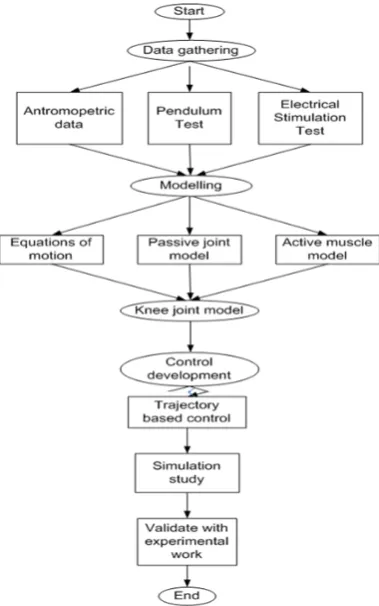
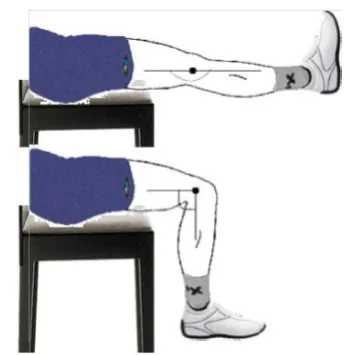
Lots of elements of the neuro-musculoskeletal system interact to enable the coordinated movement. In fact, researchers has been fascinated with the human movement that performs an extensive range of studies to describe these elements [37,43]. Thus, the same concept has been applied in this study. A theoretical framework is needed in order to standardize the system with the suitable control strategy. Hence, the development of this research starts with the data gathering, from the experimental test by using FES, for the electrical stimulation test, which is demosnstrated based on the flowchart of Fig.3. In order to conduct pendulum test for the knee joint, FES that collaborated with the goniometer has been used for colllecting experimental data of sensory system [3,4,5,17].
Based on the system requirement, the problem arises due to the data collection from anthropometric data is the data parameter of the lower limb characteristic. However, another challenge issue is due to synthesizing detailed descriptions of the elements of the neuro-musculoskeletal system with measurements of movement, to create an integrated understanding of normal movement [37,43,44], especially during swing phase of gait and cycling procedure.
Fig. 3: Flowchart of the system [98-100]
In the proposed frameworks, this project is concerned in order to develop the system with more efficient way and easy to handle for each procedure. Every parameter for modeling each system will be
developed by using Matlab/Simulink [1,4,5,98-100]. Moreover, the problem arises when the parameters by data gathering from the previous literature studies has been combined. Thus, the data gathering process of this research is more on to develop equation of motion, passive joint model and active muscle model, although it is difficult to establish the control parameters for these systems. These reflexes that contribute the knee joint model are more on the control development of trajectory- based control in order to develop the better knee joint dynamic model [1,3,4,5,45,50].
Fig. 4: Architecture of FES System
The computer-controlled stimulator system that consist of each control model will be developed to investigate the muscle fatigue characteristic using the OpenSim-Matlab/Simulink-Hasomed in Fig. 4[40-49,62]. In spite of its suitability, a dynamic simulation of the movement, that integrates the models, describes the anatomy and physiology of the elements of the neuro-musculoskeletal system, and the mechanics [37,43,44] of the knee joint swinging movement that provides such framework in this study. Therefore, the computer-controlled stimulator system, which has been described in Fig.4, has already being studied.
Fig. 5: Application of Electrical Stimulator with the surface electrodes on the muscles [98,99]
The same concept, in order to develop the architecture/control strategy/framework of the system in this research, has been applied into some architectures of FES system, as illustrated in Fig. 4. The performance criterion, according to this architecture, is almost can be simplified as the application of Analog to Digital conversion by using goniometer as the sensor and the data will be both selected and sampled by a software using Personal Computer (PC). The computer simulations are performed with various data collections that will be selected and sent to FES. For instance, the Hasomed GmbH functional electrical stimulator, shown in Fig.5, will be generated automatically according to the developed model and system requirement [4,63].
In this framework of the experimental study, the movement parameters at the end, that is due to the musculoskeletal gain. Therefore, such as trials on knee free swinging trajectory which is from the OpenSim, as in Fig. 6, will be combined together with Matlab/Simulink control strategy and the anthropometric measurements of the length of the lower limb that has been developed by OpenSim [34,43,44]. The model derives much of its significance from the architecture/control strategy/framework that will be developed, detailed with regard to FES-approaches for the function restoration, to achieve better analysis in the future work. For the next stage, our goal is set to implement an automatic procedure for evaluating and monitoring paralyzed person due to paraplegia [1,3,4,5].
This demonstrates through both our model and the measurements, based on conducting the real time experiments, in on-line mode and in preliminary standardized which is in off-line mode, with repeated simulation based on the able-body person. In the other hand, the human ethical approval considerations that discourage the use of invasive methods, which to determine the muscle forces in humans, will be applied for safety issues. This main system currently focused on the development of the lower limb musculoskeletal modeling in this stage. The detailed researches, based on the next stages of development of both the knee free swinging modeling system and the knee-hip joint models for FES-cycling system, and the implementation of an automatic procedure for evaluating and monitoring paralyzed patient due to paraplegia will be discussed in another publications.
Fig. 6: Application based on knee free swinging trajectory.
Based on the system requirement, this project is concerned with basic configuration of FES system such in Fig. 5, Fig. 6 and Fig. 7 that is more on the basic fundamental of either current or voltage flow, between two surface electrodes through muscle, with the advance development application by using FES. Electrical stimulation, once applied properly with the appropriate electrical stimulator, can being used for muscle strengthening [30,47,64] or even restoration of the movement in the paralyzed individuals [30,48,49].
Fig. 7: Basic configuration of FES with surface-stimulation electrodes causes a muscle contraction by stimulating electrically the motor-neurons that are attached to the muscle [64].
The application of FES as a therapeutic and rehabilitative, the stimulator will generate the pulse in order to replace the function of the brain in controlling the lower limb muscle, such in the current researches [4,6,8]. Specifically, the application of the electrical stimulations generates the action potentials in the motor-neurons, which propagate along the motor-neurons toward the muscle. In this study, during the action potentials reach the muscle, it will cause the muscle to contract [1-5]. Besides, the electrical stimulators will generate the electrical current. It totally can provide either a constant voltage or a constant current output. Hence, the stimulators that provide a constant output voltage, can maintain a voltage which is desired with the irrespective
of resistance changes, whereas the stimulators with a constant current output will make possible constant current pulse. On the other hand, each signal can be single, double or multichannel. Therefore, they were needed to have the possibility in order to change the parameters of the electrical stimulation, such as the stimulation pulses amplitude, the frequency of stimulation pulses, the duration of stimulation pulses and the stimulation pulse train. All these parameters have to be selected and adjusted by a therapist. This demonstrates that through a functional movement of a paralyzed extremity cannot be obtained by a single electric stimulus but a series of stimuli, which is called as a stimulation pulse train. It is triggered by a control signal [64].
2.2 Spinal Cord System
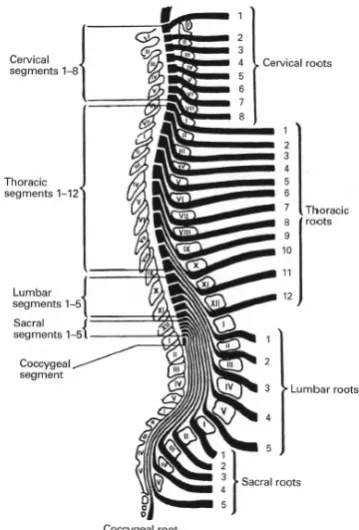
Based on spinal cord and nerves system, there are severity and range of primary symptoms as determined by the point on the spinal cord below which the function and the sensory information are impaired. Although at this stage, the effect and the position of these points are illustrated in Fig.8, where each level is designated by both the region in which it lies (cervical, thoracic, lumbar or sacral) and the spinal nerve number [4,5,29,65,66] .Then, when the spinal cord anthropometric concept has been applied in this study, every level of injury base on SCI problem divided into C6, C4, T3 and L1 which the Cervical is denoted as C, the Thoracic for T and the Lumbar denoted as L. Then, since in practice, the numbering system for the spinal cord is based on position and location of individual position that has been centralized based on human spinal cord and nerves neuro-musculoskeletal system [1,29].
Fig. 8: The spinal cord and spinal nerves
In this research area, there are focused on lower limb paralyzed injury of paraplegia and data will be collected during this research development study [7]. In addition, by employing an experimental and a simulation study, if below the level of the lesion of both afferent and efferent pathways (along with the information they carry) are affected, then they are accused as SCI [29,65,66,68]. Therefore, major pulse signals from brain cannot go through the human body system because the signals have been blocked [1,3,5]. This will result in the loss of the volitional control over the muscles and the sensation of the areas innervated below the lesion site, since the link between peripheral and central nervous system has been interrupted. An outline of autonomic control of blood pressure and heart rate, along with regulation of bladder and bowel, might has been disrupted [29,69,70]. Additionally, the extent to which a person’s sensory and motor control is affected is low-frequency chronic electrical stimulation is effective in increasing fatigue resistance. This research contributes to prove that the muscle fatigue associated with low frequency electrical stimulation is of peripheral origin, and to prove that the loss of force is probably due to fatigue of the fast contracting glycolytic fatigueable type-II motor fibres, which is not caused by the failure modes of neuromuscular transmission or conductance of the peripheral nerve [29, 69,70].
2.3 Previous modeling approaches
The application of FES as a therapeutic and rehabilitative modality has the potential in recent years. Numerous articles that have been published emphasizing on the models of the musculoskeletal system are really valuable tools in the study of human movement. Since in practice, modeling and a simulation study can greatly facilitate to test and tune various FES control strategies framework. On the basis of an accurate model, it totally can facilitate the design of stimulation patterns and control strategies that will produce the desired force and motion [71,72]. In other cases, modeling of joint properties of lower limbs in people with SCI is significantly challenging for researchers due to the complexity of the system. There are some limitations of the model which complexity is due to the combination of complicated movement, the complex structural anatomy and dynamics as well as the indeterminate muscle functions [72,73].
Furthermore, the forward dynamic models of the FES musculoskeletal system have been widely developed such as in [36,72,74,75-78]. It is easy to compare the results of simulation and experiments in the forward models, since the stimulation input and output are the same for both simulation and experiment. In this chapter, various components or building blocks of the forward dynamic approach for the musculoskeletal modeling has been briefly surveyed. Therefore, main objective of this study is to review a forward dynamic model and to identify its drawbacks so that the modeling approach can be improved. Moreover, main components of the forward joint model, as shown in Fig.9, consist of the segmental
dynamics, the active properties (muscle activation and contraction) and the passive properties (elasticity and viscosity).
Musculoskeletal Model
Segmental dynamics
Muscle model
Active properties
Passive properties
Muscle activation
Muscle
contraction Elasticity Viscosity
Fig. 9: Main components of the forward dynamics musculoskeletal model
The body segmental dynamics are generally modeled as a set of rigid limb segments, whose movements relative to each other are defined by the joint articulations, i.e. skeletal geometry and ligamentous constraints [72,79]. Thus, based on the system, the complexity of a body-segment dynamical model depends on the number and types of the body segments, the joints that connecting the segments, and the interaction among the segments, as well as the environment [72,80]. The degree-of-freedom (DoF) of human body can indicate the different levels of difficulty. In other cases, the complexity in analyzing multi-joint structure is often reduced through reducing the number of DoF into a manageable level. Kane’s equations [72,81] with the combination of computational advantages of d’Alembert’s principle and Lagrange’s equations have been utilized successfully in modeling of complex systems such as in [72,82-85]. Kane’s method of dynamics is a sophisticated mathematical technique that allows resolution of a large number of variables through the use of generalized speeds that define the motion in the system. Through the use of generalized speeds one is able to model the human lower extremity as a first-order set of differential equations [84].
In this study, there are different types of muscle model are used for different purposes. For example, the range extends from the analytical models that based on physical properties of the muscle, either at a microscopic or at macroscopic level, has been analyzed to empirical models which are purely mathematical descriptions of the input-output characteristics of the muscle [72,79]. However, most models built on analytical bases are not suitable for FES control applications [72,93]. Since the one way to develop this model for FES control application is to use mathematical models, the empirical model strategies, which aim to describe the input-output characteristics of muscle (often limited to conditions common in FES applications), and whose structure is suitable for the design of stimulation controllers, has become much useful. As a result, many researches have
been developed with the mathematical models of electrically stimulated muscle based on the Hill-type [72,86,87], the Huxley-type [72,88], the analytical approaches [18,72,89] and also the physiology approach [72,90]. The use of mathematical models can significantly enhance the design and evaluation of closed-loop control strategies applied to FES [72,91]. In fact, mathematical models can be used to promote an understanding of the system and they can be used to predict the behavior of the system [72,92]. Based on the framework model requirement, the accurate models of the artificial muscle activation in either healthy or paraplegic subjects have been developed. These prominent problems create the complexities of the system resulting mathematical representation have a large number of parameters that make the model identification process that are really difficult to develop.
One promising way of previous research proposed models is the application of fuzzy logic (FL). FL techniques have been widely applied in the modeling of complex non-linear plants [2-4,926,94]. The application of FL control strategy is the fastest growing soft computing in the medicine and biomedical engineering [26,95]. Hence, this model was applied from that, makes it capable of approximating complex nonlinear dynamic systems.
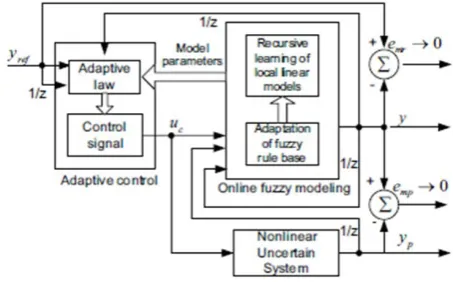
Fig. 10: Adaptive control based on T-S fuzzy model
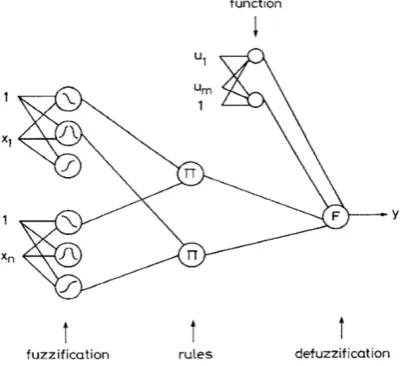
Fig. 10 illustrates the overall control system structure. As a result, the scheme consists of two parts: a dynamic Takagi-Sugeno, T-S fuzzy model and an adaptive controller-based on the model. Structure and parameters of the T-S model can be updated on-line [26], which makes it capable with approximation complex nonlinear dynamic systems. This fact shows the important role of the scheme is both computationally efficient and suitable for the real time implementation as the rule base evolution which is recursive based on the unsupervised learning and the parameters [26,72,94]. In other cases, beside its suitability in generating the target, fuzzy neural network modeling approach combines the advantages of both fuzzy modeling and neural networks. The network topology based on the structural approach is shown in Fig.11. It contains four layers, namely the fuzzification layer, the rule layer, the function layer, and lastly, the
fuzzification layer. There are some limitations of the model that acquire relational modeling that over the rule-based system which the values in the relational model can be identified directly from the process input-output data [26,72,96].
Fig. 11: The structural approach fuzzy neural network
2.4 Proposed modeling approach
Nowadays, there is much interest in biological inspired computation techniques such as genetic algorithm are used in designing hybrid fuzzy modes, particularly for generating the FL rules and for adjusting the membership function, (MF) [2,3,4,9,26]. The same concept has been applied in this study, where the new research resulting to the optimization - improvement in the modeling technique [2-4,9,26,72]. Thus, the optimization process is divided. Firstly, genetic algorithm is used to estimate the anthropometric inertia parameter and to adjust the fuzzy parameters in order to represent by minimizing the error between the data obtained [3,4,9,26,67,72]. In terms of subject numberings, at least one subject/patient used for this system, in order for the system can both measure and optimize the system based on the previous patient data.
In the trajectory based control, the FES-induced swinging motion with reduced energy consumption based on ‘natural’ trajectory approach has been developed. The controllers have been designed to track the trajectory based on natural dynamics of the paraplegic’s leg segment. In this strategy, two fuzzy controllers; with and without energy efficiency mechanisms have been developed MOGA optimization [2,3,4,9,26]. Thus, this controller with energy efficiency [26] has been used to minimize muscle activation torque as one of the objectives in the optimization process. Therefore, both controllers have shown a good tracking performance in both simulation and practical environment [4,9,26]. In contrast to the controller without energy efficiency, the energy efficient controller has shown the reduction of energy consumption up to 10% in the simulation study and also has been able to minimize the fatigue in the
experimental work [26]. Finally, this control strategy with fatigue reduction mechanism provides valuable insight into the control of FES-induced paraplegic since muscle fatigue being the most prominent pitfall in this area.
Fig. 12: Optimization of active properties
These optimized equations are used in modeling. Then, secondly the active properties are modeled based on input and output data from electrically stimulated test using GA/multi-objective genetic algorithm, MOGA [9,26,72]. Hence, Fig. 12 shows the optimization of active properties using MOGA with integrating estimated joint visco-elasticity and optimized equation of motion. Moreover, the effectiveness of the technique to control by optimization the FL using GA was shown in [26,97]. Important to realize, as demonstrated in Fig.12, optimization of equation of motion and fuzzy model based of knee joint visco-elesaticity. The model derives much of its significance from the architecture of overall procedure for estimation of the musculoskeletal model and optimization of fuzzy inference system, FIS is illustrated in Fig.13. This fact shows the important role one of the great estimated models and good prediction capability less burdened with complex mathematics. This model aims to be used as a simpler to implement as it eliminates the complicated mathematic modeling [9,26,72].
Fig. 13: Optimization procedure
The applications of FES as the therapeutic and rehabilitative modality have big potential in future. Tendency of simulations will advance the movement of science by facilitating the interactions between modeling and experimental works. In addition, by employing a simulation study, the modeling process needs the experimental work to acquire parameters used in simulations and to test the accuracy of results derived from simulations. The same concept has been applied in this study, previous study on Interfacing OpenSim models with MATLAB® /Simulink® [44] as the indicators of success of future development Matlab/Simulink-Hasomed. In future, the model derives much of its significance from the proposed architecture and has possibilities to combine the OpenSim with the Matlab/Simulink-Hasomed as shown in Fig.14. This combination between Matlab/Simulink and OpenSim [44] has already developed a platform in order for both dynamic simulation and control of movement based. The successful research has been developed in order to know the dynamic and the control of movement in simulation study. In this research, based on the hardware simulation system, the Hasomed-RehaStim hardware has brought a great contribution used with the integration of Matlab/Simulink template, as illustrated in Fig. 17 which has been developed by Hasomed GmbH itself. The idea is, it is really practical due to relation between OpenSim (software), Matlab/Simulink (software) with Hasomed-RehaStim stimulator (hardware). In this stage, as generally focused on proposal of this research and its methodology as an idea proposed. In another publication, it will going to be totally highlighted the next stage for this system development studies with the suitable parameter, the data analysis and the detailed description of the overall system proposed.
Fig.14: Interfacing models within OpenSim-Matlab/Simulink-Hasomed
2.4.1 OpenSim Background
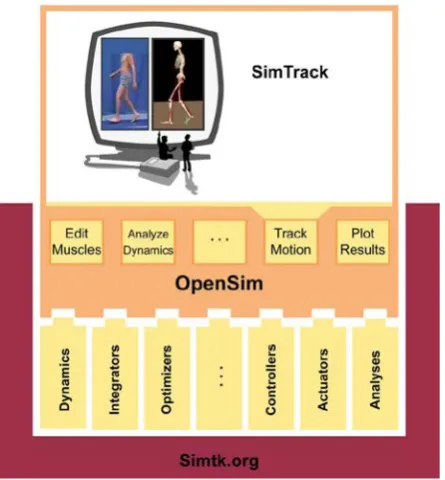
OpenSim illustrated in Fig. 15 is a freely available open-source software system that lets the users to develop models of the musculoskeletal structures, biomechanical modelling and simulation, as well as to create the dynamic simulations analysis of a wide variety of movements [34,40,41]. This system has been used in the previous studies to simulate the dynamics of individuals with pathological gait and to explore the biomechanical effects of treatments [36,37,38,43,50]. Also, the OpenSim software has been utilized to perform several steps of the data elaboration procedure and to compute meaningful variables.
Fig. 15: Schematic of OpenSim
In this study, OpenSim technology makes it possible to develop customized controllers, analyses, contact models, and muscle models among other things. As in Fig.16, users can analyze existing models and simulations, as well as can develop new models and simulations from within the graphical user interface (GUI). Likewise, a GUI provides the access to key of functionality [43,50]. OpenSim is being developed and maintained on Simtk.org by a growing group of participants.Simtk.org serves as a public repository for data, models, and computational tools related to physics-based simulation of biological structures [36-38,47,43,50]. OpenSim is easy-to-use, suitable with extensible software for modeling, simulating, controlling, and analyzing the neuro-musculoskeletal system. Furthermore, the OpenSim software also provides a platform on which the biomechanics community can build a library of simulations that can be exchanged, tested, analyzed, and improved through a multi-institutional collaboration [34] and [40-46]. In other way, dynamic simulations of movement allow one to study neuromuscular coordination, analyze athletic performance, and estimate internal loading of the musculoskeletal system. Subsequently, simulations can also be used to identify the sources of pathological movement and establish a scientific basis for treatment planning [36,37,38,43,50].
Fig. 16: Musculoskeletal model with FES muscle models in OpenSim platform
In the early 1990s, Delp and Loan introduced a musculoskeletal modeling environment, called SIMM [37,43,44,50,51], that lets the users to create, alter, and evaluate models of many different musculoskeletal structures [52-53]. Until now, this software is commonly used by lots of biomechanics researchers to create the computer models of the musculoskeletal structures and to
simulate the movements such as walking [53] and [55], cycling [56-58], running [59,60], and stair climbing [61].
2.4.2 Hasomed/Simulink Background
An overview of the hardware implementations of the hardware setup using Hasomed GmbH FES has been illustrated in Fig.17 [1]. This project is concerned with the customization between FES and the Matlab/Simulink software that already develop by the Hasomed GmbH due to the application based on the Matlab 2012b software which in some different GUI template model and scripting mode. Furthermore, FES system with the Matlab/Simulink template model currently built with real time function with some identification modes for the parameter changing such as current, pulse width and stim mode by serial port. Based on the system requirement, those GUI template is still need to be installed by software development kit, SDK 7.1. This model aims to be used to do connection (computer-controlled stimulator) between the Hasomed and Matlab /Simulink by MEX compiler on the 32/64-bit windows. Another challenge is due to checking how many the electrodes will be used and will be detected by putting them onto the skin to create a closed loop operation.
Fig. 17: Hasomed-RehaStim Matlab/Simulink Model [34][99] .
3.
Summary
Various musculoskeletal modeling approaches for FES control development have been reviewed. Thus, deep survey of literature in this paper is intended to highlight the challenges and problems related objective of this study was to the forward dynamic model of human lower limb for simulating FES-cycling applications. In general, a model should be kept as simple as possible, that is, its order and number of parameters should be as low as possible. Although at this stage, application by FL based with GA/MOGA optimization approach also being proposed in this study in order to create non-mathematical model based system. Conversely, for future
works, a too complex a model may lead to an inability to gain sufficient insight into system behaviour due to the tendency to get lost in model details such as parameter identification. In fact, musculoskeletal systems are complex, being inherently higher-order and nonlinear system. Therefore, the traditional way of handling such a system with using a mathematical model has ended up with large equations.
4.
Acknowledgements
This research work is fully funded by vot 0887 of Exploratory Fundamental Research Grant Scheme (ERGS), Ministry of Education Malaysia.
References
[1] M.K.I. Ahmad et al, Knee joint impedance hybrid modeling and control of functional electrical stimulation (FES)-cycling for paraplegic: Free swinging trajectory . IEEE EMBS: Biomedical Engineering and Sciences (IECBES), 2012:984-989
[2] B.S.K.K Ibrahim, M.O. Tokhi, M.S.Huq and S.C. Gharooni.Natural Trajectory based FES-induced
Swinging Motion Control. International Journal of
Integrated Engineering (2011)
[3] B.S.K.K Ibrahim, M.O. Tokhi, M.S.Huq and S.C. Gharooni .Fuzzy Logic based Cycle-to-Cycle Control of FES induced Swinging Motion. International Conference on Electrical, Control and Computer Engineering,(2011) [4] B.S.K.K Ibrahim, M.O. Tokhi, M.S.Huq and S.C.
Gharooni Optimized Fuzzy Control For Natural Trajectory Based Fes-Swinging Motion. International Journal of Integrated Engineering, 2011 3(3): 17-23 [5] Hamzaid NA, Davis GM. Health and fitness benefits of
functional electrical stimulation-evoked leg exercise for spinal cord-injured individuals: a position review. Top Spinal Cord Inj Rehabil. 2009; 14(4):88-121.
[6] Norhasliza Mohamad Yusoff, Hamzaid NA .Validation of In-built Muscle Activation Feedback Sensor for a Closed Loop Functional Electrical Stimulator Development. International Symposium on Medical and Rehabilitation Robotics and Instrumentation, (2013)
[7] Elder, W., & Spetzler, R. F. (2003). Functional Electrical Stimulation (FES). In J. A. Editors-in-Chief: Michael & B. D. Robert (Eds.), Encyclopedia of the Neurological Sciences (pp. 401-403). New York: Academic Press. [8] Embrey, D. G., Holtz, S. L., Alon, G., Brandsma, B. A.,
& McCoy, S. W. (2010). Functional Electrical Stimulation to Dorsiflexors and Plantar Flexors during Gait to Improve Walking in Adults with Chronic
Hemiplegia. Archives of Physical Medicine and
Rehabilitation, 91(5), 687-696.
[9] B.S.K.K Ibrahim, MO Tokhi, MS Huq, R Jailani, SC Gharooni. Fuzzy modeling of knee joint with genetic optimization. Applied Bionics and Biomechanics, 2011 8(1):85-99
[10] Faghri, P. D., Garstang, S. V., & Kida, S. (2009). Functional Electrical Stimulation (pp. 407-429)
[11] Hunt K.J., Stone B., Negård N.-O., Schauer T.,Fraser M.H., Cathcart A.J., Ferrario C., Ward S.A., Grant S.,”Control strategies for integration of electric motor assist and functional electrical stimulation in paraplegic
cycling: utility for exercise testing and mobile cycling.” IEEE Trans.Neural. Syst. Rehabil. Eng. 2004 12(1):89– 101
[12] Szecsi J et al. Functional Electrical Stimulation- Assisted cycling of patients with multiple sclerosis: Biomechanical and Functional outcome- A pilot study J Rehabil Med. 2009 Jul;41(8):674-80. DOI: 10.2340/16501977-0397 [13] N Ratchford,. A pilot study of functional electrical
stimulation cycling in progressive multiple sclerosis. Medicine, Clinical Neurology, Exercise & Occupational Therapy and Rehabilitation & Assistive Technology (2010) 27(2): 121-128. DOI: 10.3233/NRE-2010-0588 [14] Liberson WT, Holmquest HJ, Scot D, Dow M. Functional
electrotherapy: stimulation of the peroneal nerve synchronized with the swing phase of the gait of
hemiplegic patients. Arch Phys Med Rehabil
1961;42:101–5
[15] Rik Berkelmans FES Cycling Journal of Automatic Control, University of Belgrade, 18(2):73-76, 2008 [16] Davoodi, R.; Andrews, B.J., "Fuzzy logic control of FES
rowing exercise in paraplegia," Biomedical Engineering, IEEE Transactions on, vol.51, no.3, pp.541,543, March 2004
[17] Ferrarin, M.; Palazzo, F.; Riener, R.; Quintern, J., "Model-based control of FES-induced single joint
movements," Neural Systems and Rehabilitation
Engineering, IEEE Transactions on, vol.9, no.3, pp.245,257, Sept. 2001
[18] Ferrarin, M.; Pedotti, A., "The relationship between electrical stimulus and joint torque: a dynamic model," Rehabilitation Engineering, IEEE Transactions on, vol.8, no.3, pp.342,352, Sep 2000
[19] Hunt, K.J.; Stone, B.; Negard, N.-O.; Schauer, T.; Fraser, M.H.; Cathcart, A.J.; Ferrario, C.; Ward, S.A.; Grant, S., "Control strategies for integration of electric motor assist and functional electrical stimulation in paraplegic cycling: utility for exercise testing and mobile cycling," Neural Systems and Rehabilitation Engineering, IEEE Transactions on , vol.12, no.1, pp.89,101, March 2004 [20] Veltink, P.H.; Donaldson, N., "A Perspective On The
Control Of FES-supported Standing," Rehabilitation Engineering, IEEE Transactions on , vol.6, no.2, pp.109,112, June 1998
[21] Abdulla, Sh.C.; Sayidmarie, O.; Gharooni, S.; Tokhi, O., "Modeling and control of a novel FES driven assisted cycling mechanism," Methods and Models in Automation and Robotics (MMAR), 2012 17th International Conference on , vol., no., pp.464,469, 27-30 Aug. 2012 [22] Masdar, A.; Ibrahim, B.S.K.K.; Mahadi Abdul Jamil, M.,
"Development of wireless-based low-cost current controlled stimulator for patients with spinal cord
injuries," Biomedical Engineering and Sciences
(IECBES), 2012 IEEE EMBS Conference on , vol., no., pp.493,498, 17-19 Dec. 2012
[23] Masdar, A.; Ibrahim, B.S.K.K.; Jamil, M.M.A.; Hanafi, D.; Ahmad, M.K.I.; Rahman, K.A.A., "Current source with low voltage controlled for surface Electrical Stimulation," Signal Processing and its Applications (CSPA), 2013 IEEE 9th International Colloquium on , vol., no., pp.161,164, 8-10 March 2013
[24] Rahman, K.A.A.; Ibrahim, B.S.K.K.; Jamil, M.Mahadi.A.; Masdar, Aizan, "Relationship between brainwave signal and human activity of knee joint movement for paraplegic," Biomedical Engineering International Conference (BMEiCON), 2013 6th , vol., no., pp.1,5, 23-25 Oct. 2013
[25] Rahman, K.A.A.; Ibrahim, B.S.K.K.; Leman, A.M.; Jamil, M.M.A., "Fundamental study on brain signal for BCI-FES system development," Biomedical Engineering and Sciences (IECBES), 2012 IEEE EMBS Conference on , vol., no., pp.195,198, 17-19 Dec. 2012
[26] Mohamed Nasir, N., Ibrahim, K. K., Salam, B., & Ahmad, M. K. I. (2011). Comparative study on mathematical and black box modeling approaches of musculoskeletal system. International Seminar on the Application of Science and Mathematics ISASM 2011 [27] Dingguo Zhang , Tan Hock Guan , Ferdinan Widjaja ,
Wei Tech Ang, Functional electrical stimulation in rehabilitation engineering: a survey, Proceedings of the 1st international convention on Rehabilitation engineering & assistive technology: in conjunction with 1st Tan Tock Seng Hospital Neurorehabilitation Meeting, April 23-26, 2007, Singapore
[28] Popovic, D.B.; Stein, R.B.; Jovanovic, K.L.; Dai, R.; Kostov, A.; Armstrong, W.W., "Sensory nerve recording for closed-loop control to restore motor functions," Biomedical Engineering, IEEE Transactions on , vol.40, no.10, pp.1024,1031, Oct. 1993
[29] Dinesh Bhatia, Gagan Bansal, R.P. Tewari, K.K. Shukla. State of art: Functional Electrical Stimulation (FES). Int. J. of Biomedical Engineering and Technology, 2011 Vol.5, No.1, pp.77 – 99
[30] Petrofsky JS. Electrical stimulation: neurophysiological
basis and application. Basic Appl Myol. 2004;
14(4):205–213.
[31] W. Reichenfelser a, H. Hackl a, S. Mina b, S. Hanke b, P. Lugner a, M. Gföhler .Trainings- and Measurement- System for FES- Cycling. Proceeding of the 13th annual
conference of the IFESS, 2008. 53(1): 265-267
[32] Gföhler, M., Angeli, T., & Lugner, P. (2004). Modeling of Artificially Activated Muscle and Application to FES Cycling. Journal of Mechanics in Medicine (pp. 9–13) . [33] Fornusek, C., Hamzaid, N. (2008). Stimulation of shank
muscles during FES cycling to maximise ankle movement. 13th Annual Conference of the International Functional Electrical Stimulation Society (IFESS 2008)
[34] Markus Stålbom. (2008). Musculoskeletal system simulations to analyse muscle forces and movement pattern. Master Thesis (December 2008). Royal Institute of Technology, Department of Mechanics,SE-100 44 Stockholm, Sweden
[35] Davoodi, R., I. E. Brown, et al. (2003). "Advanced modeling environment for developing and testing FES control systems." Medical Engineering & Physics 25(1): 3-9.
[36] Delp, S. L. (1990). Surgery simulation: A computer graphics system to analyze and design musculoskeletal
reconstructions of the lower limb. Department of
Mechanical Engineering. Stanford, Stanford University. Ph.D.: 132.
[37] Delp, S. L., F. C. Anderson, et al. (2007). "OpenSim: open-source software to create and analyze dynamic
Simulations of movement." IEEE Transactions on
Biomedical Engineering 54(11):1940-1950.
[38] Delp, S. L. and J. P. Loan (1995). "A Graphics-based Software system to develop and analyze modelsof musculoskeletal structures." Computers in Biology and Medicine 25(1): 21-34.
[39] Eberhard, P., T. Spägele, et al. (1999). "Investigations for the dynamical analysis of human motion."
[40] Zajac, F. E., R. R. Neptune, et al. (2003). "Biomechanics and muscle coordination of human walking -Part II:
Lessons from dynamical simulations and clinical implications." Gait & Posture 17(1): 1-17.
[41] Zajac, F. E., E. L. Topp, et al. (1986). Musculotendon actuator models for use in computer studies and design of
neuromuscular stimulation systems. RESNA '86,
Minneapolis, MN, USA, Association for the Advancement of Rehabilitation Technology.
[42] Li Peng-Feng; Hou Zeng-Guang; Zhang Feng; Chen Yi-Xiong; Li Qing-Ling; Tan Min, "A simulation study of an FES based rehabilitation control system," Control Conference (CCC), 2010 29th Chinese , vol., no., pp.6107,6112, 29-31 July 2010
[43] Delp, S.L.; Anderson, F.C.; Arnold, A.S.; Loan, P.; Habib, A.; John, C.T.; Guendelman, E.; Thelen, D.G., "OpenSim: Open-Source Software to Create and Analyze
Dynamic Simulations of Movement," Biomedical
Engineering, IEEE Transactions on , vol.54, no.11, pp.1940,1950, Nov. 2007
[44] Mansouri, M., Reinbolt, J.A.: A platform for dynamic simulation and control of movement based on OpenSim
and MATLAB. Journal of Biomechanics 45, 1517–1521
(2012)
[45] Mansouri, M. B., & Reinbolt, J. A. (2010). Dynamic simulation of movement based on OpenSim and Matlab/Simulink.
[46] Davoodi, R.; Brown, I. E.; Lan, N.; Mileusnic, M.; Loeb, G. E., "An integrated package of neuromusculoskeletal modeling tools in Simulink™," Engineering in Medicine and Biology Society, 2001. Proceedings of the 23rd Annual International Conference of the IEEE, vol.2, no., pp.1205,1208 vol.2, 2001
[47] Petrofsky JS, Laymon M: The effect of aging in spinal cord injured individuals on the blood pressure and heart rate responses during fatiguing isometric exercise. Europ J Appl Physiol 2002; 86: 479-486.
[48] Marsolais EB, Kobetic R Functional electrical stimulation for walking in paraplegia. J Bone JointSurg 1987; 69:728-33.
[49] Phillips CA and Petrofsky JS: A review of fracture cases in spinal cord injured individuals participating in functional electric stimulation experiments. J Neurol Orthop Surg 1985; 6:247-251.
[50] S. L. Delp, J. P. Loan, M. G. Hoy, F. E. Zajac, E. L. Topp, and J. M.Rosen, “An interactive graphics-based model of the lower extremity to study orthopaedic surgical procedures,” IEEE Trans. Biomed. Eng., vol. 37, no. 8, pp. 757–767, Aug. 1990.
[51] S. L. Delp and J. P. Loan, “A computational framework for simulating and analyzing human and animal movement,” IEEE Comput. Sci. Eng., vol. 2, no. 5, pp. 46–55, Sep./Oct. 2000.
[52] A. N. Vasavada, S. Li, and S. L. Delp, “Influence of muscle morphometry and moment arms on the moment-generating capacity of human neck muscles,” Spine, vol. 23, pp. 412–422, 1998.
[53] J. R. Hutchinson, F. C. Anderson, S. S. Blemker, and S. L. Delp, “Analysis of hand limb muscle moment arms in Tyrannosaurus rex using a three-dimensional musculoskeletal computer model: Implications for stance, gait, and speed,” Paleobiology, vol. 31, pp. 676–701, 2005.
[54] R. R. Neptune, S. A. Kautz, and F. E. Zajac, “Contributions of the individual ankle plantar flexors to support, forward progression and swing initiation during walking,” J. Biomech., vol. 34, pp. 1387–1398, 2001. [55] D. G. Thelen and F. C. Anderson, “Using computed
muscle control to generate forward dynamic simulations
of human walking from experimental data,” J. Biomech., vol. 39, pp. 1107–1115, 2006.
[56] C. C. Raasch and F. E. Zajac, “Locomotor strategy for pedaling: Muscle groups and biomechanical functions,” J. Neurophysiolog., vol.82, pp. 515–525, 1999.
[57] R. R. Neptune and M. L. Hull, “A theoretical analysis of preferred pedaling rate selection in endurance cycling,” J. Biomech., vol. 32, pp.409–415, 1999.
[58] D. G. Thelen, F. C. Anderson, and S. L. Delp, “Generating forward dynamic simulations of movement using computed muscle control,” J.Biomech., vol. 36, pp. 321–328, 2003.
[59] D. G. Thelen, E. S. Chumanov, D. M. Hoerth, T. M. Best, S. C. Swanson, L. Li, M. Young, and B. C. Heiderscheit, “Hamstring muscle kinematics during treadmill sprinting,” Medicine Sci. Sports Exercise, vol. 37, pp. 108–114, 2005.
[60] K. Sasaki and R. R. Neptune, “Muscle mechanical work and elastic energy utilization during walking and running near the preferred gait transition speed,” Gait Posture, vol. 23, pp. 383–390, 2006.
[61] S. J. Piazza and S. L. Delp, “Three-dimensional dynamic simulation of total knee replacement motion during a step-up task,” J. Biomech. Eng., vol. 123, pp. 599–606, 2001.
[62] B.S. K. K. Ibrahim, M.O. Tokhi, S.C. Gharooni and M.S. Huq, Development of Fuzzy Muscle Contraction and Activation Model using Multi-objective Optimisation, 4th Annual IEEE International Systems Conference, San Diego, CA, USA, April, 2010.
[63] Lynsey D. Duffell, Nick de N. Donaldson, and Di J. Newham. Why is the Metabolic Efficiency of FES Cycling Low? IEEE Transactions on Neural Systems and Rehabilitation Engineering, 2009, 17 (3)
[64] Haim Ring. Functional Electrical Stimulation in post-stroke paralytic hand .5th Meeting abstract book 2004
[65] Milos R. Popovic, Thierry Keller, Ion P.I. Pappas, Volker Dietz, and Manfred Morari. Surface-Stimulation Technology for Grasping an. Walking Neuroprostheses IEEE ENGINEERING IN MEDICINE AND BIOLOGY TRANSACTION (2011)
[66] S. Shalaby, R. E., & Ingenieurwissenschaften, D. Der. (2011). Development of an Electromyography Detection System for the Control of Functional Electrical Stimulation in Neurological Rehabilitation. PhD Thesis [67] B.S.K.K. Ibrahim, M.O. Tokhi, S.C. Gharooni and M.S.
Huq. Identification of Active Properties of Knee Joint
using GA Optimization. World Academy of Science,
Engineering and Technology, 2009 55
[68] Hussain, Z.; Tokhi, M.O.; Jailani, R.; Ahmad, S.; Ibrahim, B. S K K, "Effect of Inclined Rowing Machine on FES-Assisted Indoor Rowing Exercise Performance," Modeling& Simulation, 2009. AMS '09. Third Asia International Conference on, vol., no., pp.242,245, 25-29 May 2009
[69] Kralj, A. and Bajd, T. (1989, 1990) Functional Electrical Stimulation, Standing and Walking after Spinal cord Injury, CRC press, Florida.
[70] Kralj, A., Bajd, T. and Turk, R. (1980) ‘Electrical Stimulation providing functional use ofparaplegic patient muscles’, Med. Progr. Technology, Vol. 7, pp.3–9.
[71] Perumal, R., Wexler, A.S. and Binder-Macleod, S.A. (2008). Development of a mathematical model for predicting electrically elicited quadriceps femoris muscle forces during isovelocity knee joint motion, Journal Neuroengineering Rehabilitation, 5(33).
[72] B.S.K.K Ibrahim. (2011).MODELING and Control of Paraplegic’s Knee Joint (FES-SWINGING). Doctor of Philosophy, Department of Automatic Control and Systems Engineering, University of Sheffield, UK, January 2011.
[73] Ghafari, A.S., Meghdari, A. and Vossoughi, G.R. (2009). Estimation of the human lower extremity musculoskeletal conditions during backpack load carrying. Journal of Scientia Iranica, 16(5):451-462.
[74] H. Hatze, (1980). Neuromusculoskeletal control systems modeling - A critical survey of recent developments, IEEE Trans. Automat. Control, 25:375-385.
[75] Pandy, M. G., Zajac, F. E., Sim, E. and Levine, W .S. (1990). An optimal control model for maximum-height human jumping. Journal of Biomechanics 23:1185–1198. [76] Veltink, P. H. (1991). Control of FES-induced cyclical
movements of the lower leg, Medical Biology Engineering Computing, 29(6):8–12.
[77] Veltink, P. H. (1991). Control of FES-induced cyclical movements of the lower leg. Medical Biology Engineering Computing. 29(6): 8 – 12.
[78] Veltink, P.H., Franken, H.M., Van Alsté, J. A., Boom, H. B. (1992b). Modeling the optimal control of cyclical leg movements induced by functional electrical stimulation. Int J Artif Organs. 15(12):746–755.
[79] Huq M. S. (2009). Analysis and control of hybrid orthosis in therapeutic treadmill locomotion for paraplegia, PhD Thesis. The University of Sheffield, Sheffield, UK. [80] Bronzino, J. (2006). The Biomedical Engineering
Handbook Biomedical Engineering Fundamentals, Third Edition, ed.. CRC Press, Inc., Boca Raton, FL, Chapter 16:16-1:16-21.
[81] Kane, T. R. and. Levinson, D.A. (1985) Dynamics: Theory and Applications, McGraw Hill, New York. [82] Langer, F.D., Hemami, H., Brown, D.B. (1987).
Constraint forces in holonomicmechanical systems.
Computer Methods in Applied Mechanics and Engineering. 62:255-274.
[83] Lesser, M. (1992). A geometrical interpretation of Kane's equations, Proceedings of the Royal Society of London. 436:69-87
[84] Komistek, R.D., Stiehl, J.B. and Dennis, D.A. (1998). Mathematical model of the lower extremity joint reaction
forces using Kane's method of dynamics. Journal of
Biomechanics. 31:185–189.
[85] Tisell, C., (2000). Integration of Database Technology and Multibody System Analysis. PhD Thesis, Department of Machine Design, Royal Institute of Technology, Stockholm, Sweden.
[86] Ding, J., Wexler, A.S. and Binder-Macleod S.A. (2002). A mathematical model that predicts the force-frequency relationship of human skeletal muscle. Muscle Nerve. 26(4):477-485.
[87] Shue, G.H. and Crago, P. E. (1998). Muscle-tendon model with length history dependent activation-velocity coupling. Annual Biomedical Engineering, 26 (3):369-380.
[88] Zahalak G. I. and Ma S.P. (1990). Muscle activation and contraction: constitutive relations based directly on
cross-bridge kinetics. Journal Biomechanical
Engineering, 112(1):52-62.
[89] Bobet, J. and Stein, R.B. (1998). A simple model of force generation by skeletal muscle during dynamic isometric contractions. IEEE Trans Biomed Eng, 45(8):1010-1016. [90] Riener, R. and Fuhr, T. (1998). Patient-driven control of
FES-supported standing up: A simulation study, IEEE Trans. Rehab. Eng., 6(2):113-124.
[91] Riener, R., Quintern, J. and Schmidt G. (1996). Biomechanical model of the human knee evaluated by neuromuscular stimulation, Journal of. Biomechanics. 29 (9):1157-1167.
[92] Zahalak, G. I. (1992). An overview of muscle modeling. In Neural prostheses replacing motor function after disease or disability (ed. Stein, R., Peckham, H. & Popovic, D.) New York and Oxford: Oxford University Press: 17-57. [93] Massoud, R. (2007). Intelligent control techniques for
spring assisted FES-cycling. PhD Thesis. The University of Sheffield, Sheffield, UK.
[94] Ruiyun Qi and Mietek A. Brdys, Adaptive fuzzy modeling and control for discrete time nonlinear uncertain system, 2005 American Control Conference.
[95] A. Yardimci, A Survey on Use of Soft Computing Methods in Medicine, Artificial Neural Networks – ICANN 2007, Springer Berlin/Heidelberg 2007, pp. 69–79.
[96] R.M. Saleem and B.E Postlethwaite, A comparison of neural networks and fuzzy relational systems in dynamic modeling, Control’94.
[97] O.Cordon, F. Herrera, et al. Recent advances in genetic fuzzy systems, Information sciences, 136: 1-5, 2001. [98] M.K.I Ahmad, B.S.K.K .Ibrahim, A.U.Shamsudin, D.
Hanafi, M. Mahadi Abdul Jamil, N.H.M.Nasir, F. Sherwani, K.A.A.Rahman, A.Masdar” Preliminary Study of Functional Electrical Stimulation Application of Swinging Trajectory Based on Knee-Joint
Range-Of-Motion (ROM)”.IEEE 7th IFESS2014,17-19 September
2014, Kuala Lumpur (un-published)
[99] M.K.I Ahmad, B.S.K.K .Ibrahim, M. Mahadi Abdul Jamil, D. Hanafi, N.H.M.Nasir,K.A.A.Rahman, M.K.Hat, A.Masdar, F. Sherwani, A.U.Shamsudin, and N.F.Ramin" An Overview of FES-Cycling Experiment Development with EMG and Electrical Stimulation Test for Paraplegia" International Conference on Biomedical Engineering (ICoBE 2015) , 30th – 31st of March 2015.(submitted)
[100] M.K.I Ahmad, B.S.K.K .Ibrahim, M. Mahadi Abdul Jamil, D. Hanafi, N.H.M.Nasir,K.A.A.Rahman, M.K.Hat, A.Masdar, F. Sherwani, A.U.Shamsudin, and N.F.Ramin" Preliminary Approach of FES-Cycling Framework Model Development for Spinal Cord Injury Application: Part 1"10th Asian Control Conference 2015 (ASCC 2015) Kota Kinabalu, Sabah 31st May - 3rd June 2015 (submitted)
![Fig. 1: Timeline of FES evolution [98]](https://thumb-us.123doks.com/thumbv2/123dok_us/8440057.1701028/1.595.307.537.453.553/fig-timeline-of-fes-evolution.webp)
![Fig. 17: Hasomed-RehaStim Matlab/Simulink Model [34][99] .](https://thumb-us.123doks.com/thumbv2/123dok_us/8440057.1701028/9.595.59.296.397.632/fig-hasomed-rehastim-matlab-simulink-model.webp)
