2063
Solid Waste Management And Collection System
In Metro Manila With Dijkstra Algorithm And
Internet Of Things
Nelson C. Rodelas. Virgilio O. Perez, Jr., Jayson E. Salvador, Joan P. Lazaro, Alexis John M. Rubio, Arriane D. Cabreros, Edie Boy M. Dela Cruz
Abstract: Solid Waste is one of the major problems of the Philippine government due to rapid growth of population. People are dumping waste on streets, open drainage and even rivers. Waste management is one of the solutions that tends to provide programs and to create mechanisms, encouragements and funds that hold responsibilities in implementing ordinances and laws of local government units. Thus, this research focuses on the development and application of a waste management system which segregates biodegradable and non-biodegradable wastes, measures the level of waste inside the container and helps the waste collector to find the shortest path of a nearest waste container; straight to the waste land fill using the Internet of Things (IoT) and mobile application. With the proposed system, the waste monitoring, collection and disposal are improved, especially in collection. Because of Global Positioning System (GPS) and Dijkstra Algorithm, the system provides an alternative direction t o ease collecting wastes from different houses going to sanitary landfills. Through wireless network topology, the level of waste container can be monitored and can give signal to waste collectors. Furthermore, the record of collected data and household location are also used to identify locations or communities that has produced more solid wastes and can be used for future research.
Index Terms: Solid Waste Management, Global Positioning System, Dijkstra Algorithm, Shortest Path, Solid Waste, Internet of Things, Cloud Technology.
—————————— ——————————
1
INTRODUCTION
Philippines is one of the developing Asian country and is the 12th largest country in the world today. It is evident that this country is very aggressive in terms of economic growth that it resulted in the manufacture and use of different products. This leads to generation of different wastes. The consequences of economic growth are the causes of climate change and environmental degradation [1]. Solid wastes are one of the major problems because of the rapid growth of population. People are dumping waste on streets, open drainage and even rivers. Because of this, the Philippine government created the Republic Act 9003 or the Ecological Solid Waste Management (SWM) Act of 2000 that mandates and provide framework for solid waste management [2]. This law provides solid waste management programs, creates mechanisms and incentives, acts providing drawbacks, allotment of funds, and other purpose that is connected to waste management [3] and the local government unit holds its responsibility in the implementation of the said law. The law mandates that the special waste collection, like health waste and non-recyclable materials is the responsibility of the local government while the separation and solid waste collection are conducted at the barangay level [4]. Some local government also created municipal and city ordinance for solid waste management, conducted different campaigns, trainings and seminars in SWM and recycling [5]. But according to studies, local government units mostly in metro manila are still struggle in the execution of solid waste management. Legislation strategies and policies, technical knowledge, lack of awareness and use of advance technology should be addressed [4].
It is estimated that 0.7 kg per person per day more than 8,000 tons of garbage in metro manila is generated per day. It is also stated in the study that the household is the major cause of waste (74%) and 95% of the solid waste in the household can turn in to compost or be recycled or reused [6]. Only 85% is the maximum collection rate are recorded in metro manila and uncollected garbage is either dumped anywhere. Most of the local government units do not comply on City and/or Municipality Recovery Facilities – facilities that solid waste can transfer, compost or recycle – mandated on the RA 9003 [1]. It is said on the law that the cluster of barangay should have recovery facilities but more than 8,500 barangays in the Philippines used these and 56% national average of these barangays are in metro manila area. It is also revealed that weakness of industries in recycling and high cost of transporting recyclable materials are major limiting factors in solid waste management [7]. Poor solid waste management process may lead to danger in human health, environment and human resources like flooding, attraction of different insects and rodents and water contamination [8]. Non-communicable diseases, infection transmission and physical and emotional effects are the major impacts on human health. Improper solid waste management can cause pollution, and pollutants from the dumpsites can increase the respiratory diseases and the cost of disposal [9]. Schools are also instructed to follow the RA 9003, Part 6, Rule 21, Section 2. It is stated that the Commission on Higher Education (CHED) and the Department of Education (DepEd) mandated schools to teach students on the ecological solid waste management to take action and actively engage students in all level, teachers, parents, school community, school personnel and administrators in the management process and include it in the student’s curriculum. Also, the National Waste Management Commission (NWMC) together with the Department of Environment and Natural Resources (DENR) headed a project that enhance the ability of the students in solid management through training programs among private educational
_________________________________
• Authors are all affiliated in University of the East Caloocan, College of Engineering, Computer Engineering Department, Caloocan City Philippines.
2064
institution [4]. However, according to research, the universities produce most of biodegradable waste (ranked 2) and recyclable materials (ranked 1) than the other producers of waste [10]. Although, some universities integrate these problem in innovating and inventing different systems in solving solid waste. There are huge number of advance technologies and methodologies that are being used in solid waste management like composition of waste fraction, landfilling with biogas recovery, different thermal processes, anaerobic digestions and others [11]. But these are all technologies that are used in the dumpsites and the process of segregation and collection of solid waste from different houses are still in manual process. There are already waste containers in every establishment, municipalities and barangays that segregate biodegradable and non-biodegradable but it can be improve by using sensors and technologies that would segregate wastes into its categories like plastic bottles, papers, cans and the likes. The local government mandates each barangay to schedule the collection of wastes but sometimes it is not well implemented and have delays due to small number of garbage collector trucks. The main purpose of the research is to design, construct and implement a new system of segregation, collection and management of solid waste using Internet of Things. To create a new system of collection of waste using Global Positioning System and Dijkstra Algorithm that could monitor the different trash containers located on different houses connected to the system through sensors and microprocessor.
2 METHODOLOGY
The researchers proposed a prototype that were able to collect and segregate solid waste materials into four categories: plastic bottles, papers, cans and biodegradable wastes. It has mobile application that monitors the different garbage container and notify the garbage collector that there is waste container that is available for waste collections. The system then gives shortest path on how garbage collector truck and the person that collects the garbage can reach the house in shortest time. It is integrated to any scheduled garbage collection process of every barangay whether it is collected through house to house process, designated garbage container or both.
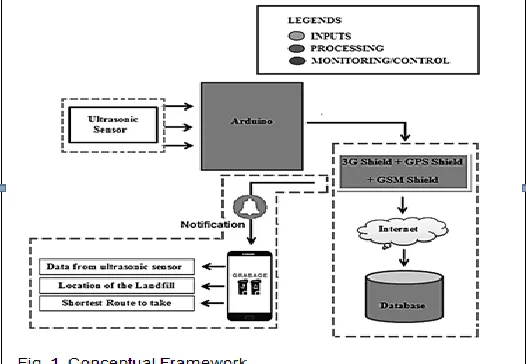
Fig. 1 shows the system flowchart and the main operation of the system. The ultrasonic sensor, Arduino microcontroller and
the different shields used for Internet of Things (IoT) are the hardware components meant for the main operation of the system. The ultrasonic sensor is responsible for monitoring the level of waste, different shields are responsible for obtaining the global positioning system of a particular garbage container, and sends it to cloud database and to sends information using mobile application. The weight of the solid waste was saved in the database and can be used to manage and analyze the results.
2.1 Hardware Development
The hardware components that were used for identifying recyclable waste materials are consist of Infrared (IR) sensor, Light Dependent Resistor (LDR) and Servo motor. The IR sensor and LDR are responsible for sensing the cleanliness of plastic bottle and the rotation of the Servo motor depends on the cleanliness of the plastic bottle. Another LDR and a Servo motor are responsible for restricting any material to enters the paper bin. Weight sensor were used to measure the weight of the solid waste materials. It is located at the bottom part of the container. The researchers used descriptive research method to describe the results of the functionality of the system from hardware, software and integration of both using the Internet of Things. The heart and the brain of the system was the Arduino UNO which is responsible for the communication of each component.
2.2 Software Development
2065
distance = [(x2 – x1) 2
+[(y2 –y1) 2
+[(z2 – z1) 2
]1/2 (1) where the coordinates of the location given by the global positioning system is represented by x, y and z.
3 RESULTS
The innovation in monitoring, managing and transporting of the collected wastes was the main concern of the research. The different hardware components used were meant for monitoring the weight of the recyclable wastes, cleanliness of the environment and to separate the different wastes to its category. The monitoring, location and possible routes in collecting the garbage were seen in the mobile application of the system. Clean plastic bottles were only accepted in the garbage container and it will be reject if it is unclean to also promote discipline to the users. It separates three categories of wastes: clean plastic bottles, unruffled papers and biodegradable wastes. In this section, the researchers presented and discussed the different results of the average response of the sensors, its limits and the accuracy in giving results to the users. It also discussed the results of testing to identify the area that produced largest amount of solid wastes in the designated barangays.
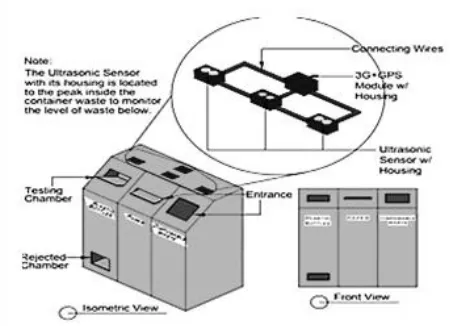
Fig. 2 represents the physical model of the garbage container. The model is divided into three containers; one for the disposable wastes and two for recyclable wastes materials specifically plastic bottles and unruffled papers. Each division of container is monitored by an ultrasonic sensor that is responsible for detecting the level of wastes on each container. When it reaches the programed threshold, the system the sends notification through mobile application. The plastic bottles are placed to the testing chamber to test whether the bottle is clean or does not have anything inside. If there is, there is a reject bottle chamber. For the papers, a space is provided by inserting the unruffled paper and shred. The researchers summarize the different results of the performance of each sensors and devices to identify the average response, limits and accuracy.
TABLE1
SUMMARY OF RESULTS OF DIFFERENT SENSORS, MOTORS AND GPS WITH AVERAGE RESPONSE, LIMITS AND ACCURACY
2066
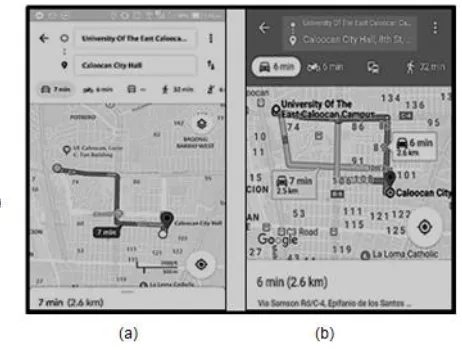
Fig. 3 shows the result of google map in giving direction and the result of the mobile application of the system that uses Dijkstra Algorithm. The results had both 2.6km of distance from the destination of the garbage collector track and the destination but the results also shows the difference in terms of the time in reaching the destination. Using the google map, the destination can be reached in seven (7) minutes while the result of the mobile application of the system is six (6) minutes lesser. Using the said algorithm, the destination can be reach faster than using the google map application [14]. To further prove the result, the researchers tested the mobile application in twenty (20) different distances and compared the time in reaching the destination to the result of the google map.
TABLE2
RESULTS OF THE SIGNIFICANT DIFFERENCE BETWEEN THE TIME RESPONSE OF GOOGLE MAP AND THE PROPOSED SYSTEM
Table 2 shows the result of the significant difference between the time response of the google map and the proposed system. It can be seen that the p-value is 0.033 with a mean difference of 2.684. The decision is to reject the null hypothesis and therefore, the difference between two means is statistically significantly different at the 0.05 level of significance. It can be said that the time response given by the google map is significantly different to the time response given by the proposed system [15] [16]. The figure below represented the difference of the time response of the google map and the proposed system. It explains that the proposed system can give faster response time than the google map using the Dijkstra Algorithm.
Fig. 4. Graphical Representation of Time Response of Google Map and the System
Fig. 4 shows the graphical representation of time response of the google map and the proposed system. The researchers tested the mobile application in twenty (20) destinations with different distances using the Dijkstra Algorithm in giving time (in minutes) in reaching the destination and compared it to the result of the google map. It can be seen in the graph that the mobile application gives lesser time to reach its destination compared to the time response given by the google map.
4 CONCLUSIONS
The proposed system is part of the waste management system which is made for homeowner in order for them to dispose and recycle their wastes systematically. The garbage collector responded on time whenever the container waste is reaching a critical level. The system prevents the overflowing of wastes and the collection wastes is done easily by applying the concept of Dijkstra Algorithm. The use of hardware and software components and their integration are better innovation that can be applied in waste management system. It is concluded that the proposed system is more systematic and teach the homeowners to be a disciplined citizen and responsible in their waste.
5 RECOMMENDATIONS
The system can only segregate the paper plastic bottle and non-recyclable wastes. It is recommended to add features by including cans in segregation since it is also included as one of the recyclable waste. It is also recommended to add more features in the system like data mining and other features that would improve the waste management. It is recommended to present the system to local government so that it can be implemented nationwide.
6 ACKNOWLEDGMENT
2067
7 REFERENCES
[1] N. Yukalang, B. Clarke and K. Ross, "Barriers to Effective Municipal Solid Waste Management in a Rapidly Urbanizing Area in Thailand," International Journal of Environmental Research and Public Health, vol. 14, pp. 1-23, 2017.
[2] H. Wang, W. Mao and L. Eriksson, "A Three-Dimensional Dijkstra's algorithm for multi-objective ship voyage optimization," Ocean Engineering, pp. 106-131, 2019. [3] I. Soringa, C. Bacat, C. H. Bensi and S. Tanduyan, "Solid
Waste Management Program (SWMP) of PacijanIsland ,Cebu, Philippines: The Level of Participation of the Inhabitants, Effects and Problems," in 2nd International and 12th Annual Scientific Conference of the Philippine Society for the Study of Nature (PSSN), Cebu, 2012. [4] P. Singal and R. S. Chhillar, "Dijkstra Shortest Path
Algorithm using Global Positioning System," International Journal of Computer Applications , vol. 101, no. 6, pp. 13-18, 2014.
[5] W. Shu-Xi, "The Improved Dijkstra's Shortest Path Algorithm and Its Application," Procedia Engineering , vol. 29, pp. 1186-1190, 2012.
[6] Press Release, "JICA," [Online]. Available: https://www.jica.go.jp/philippine/english/office/topics/news/ 171113.html. [Accessed 23 September 2019].
[7] A. Potdar, A. Singh, S. Unnikrishnan, N. Naik, M. Naik, I. Nimkar and V. Patil, "Innovation in Solid Waste Management through Clean Development Mechanism in Developing Countries," in International Conference on Solid Waste Management, Centre for Environmental Studies, National Institute of Industrial Engineering (NITIE), Mumbai, India, 2015.
[8] C. o. t. Philippiens, REPUBLIC ACT NO. 9003 - Ecological Solid Waste Management (ESWM) Act of 2000 of the Philippines, Metro Manila: Eleventh Congress, 2000. [9] V. E. Matunog and A. L. Awa, "Solid Waste Generation
Rate in Ozamiz City, Philippines," Journal of Multidisciplinary Studies, 2013.
[10] E. Lillo and S. M. Alcazar, "Solid Waste Management Practices in Carcar, City, Cebu, Philippines," in 2nd International and 12th Annual Scientific Conference of the Philippine Society for the Study of Nature (PSSN), Cebu, 2012.
[11] A. . C. Gequinto, "Solid Waste Management Practices of Select State Universities in CALABARZON, Philippines," Asia Pacific Journal of Multidisciplinary Research, vol. 5, no. 1, pp. 1-8, 2017.
[12] V. R. K. R. Galarpe, "Review on the Impacts of Waste Disposal Sites in the Philippines," Science International 29(1), pp. 379-385, 2017.
[13] A. L. Castillo and S. Otoma, "Status of Solid Waste Management in the Philippines," in The 24th Annual Conference of Japan Society of Material Cycles and Waste Management, Fukuoka, Japan, 2013.
[14] P. Beigl, S. Lebersorger and S. Salhofer, "Modelling municipal solid waste generation: A review," Waste Management , vol. 2, no. 1, pp. 200-214, 2008.
[15] A. G. L. Aranas, "Solid Waste Management in the Pacific
Area of Southern Leyte," in 2nd International and 12th Annual Scientific Conference of the Philippine, Leyte, 2012.