Newsletter • 2018 • vol.1 • 50-56
STRUCTURAL ELUCIDATION OF PHYTOCHEMICAL CONSTITUENTS OF ANNONA MURICATA
LEAF USING GAS CHROMATOGRAPHY-MASS SPECTROSCOPY AND FOURIER TRANSFORM
INFRARED TECHNIQUES
*
1OMEJE, Kingsley Ozioma,
2OMEJE, Henry Chimezie and
1ASOMADU, Rita Onyekachukwu
1
Department of Biochemistry, University of Nigeria, Nsukka, Enugu state, Nigeria
2Department of Biochemistry, University of Port Harcourt, Choba, River State, Nigeria
[email protected]
Abstract
The phytochemical constituents of the powdered leaf of Annona muricata was investigated using Gas Chromatography-Mass Spectroscopy and Fourier Transform Infrared Techniques. The compounds detected in the sample were analyzed using National Institute of Standards and Technology (NIST) library. The GC-MS detected sixteen compounds that were identified as 3, 5-Dihydroxy-6-methyl-2, 3-dihydro-4H-pyran-4-one (3.05%), Iberin nitrile (6.24 %), 7,12-Dihydro-6,7-bis(4-hydroxyphenyl)-6H-[1,2,4]triazolo [1',5':1,2]pyrimido[5,4c]chromen-2-ol (2.11 %), Cyclopentane, 4-cyano-2,2-dimethyl-1-methylene (4.06%), Cyclopentane-4-cyano-2,2-dimethyl-1-methylene (2.19%), Methyl-14-methylpentadecanoate (3.83%), 1-Pentadecanecarboxylic acid (13.62%), Methyl trans, trans-9,12-octadecadienoate (1.67%), 6-Methyl-1-heptanol (1.28%), Methyl-cis-9, 12, 15-octadecatrienoate (1.19%), cis-9-Octadecenoic acid (45.09%), Hystrene T-70 (11.73%), cetane (0.55%), 9-Octadecenal (1.21%), 2-Methyl-Z, Z-3,13-octadecadienol (1.36%) and icosane (0.81%). Similarly, the FTIR spectrum gave seven peaks that corresponded to sulfonic acids, sulfoxides, alcohols, nitroso compounds and halogeno, charged amines, alkanes and primary amides and free NH respectively. The phytochemicals exerts different pharmacological activities individually and synergistically.
Introduction
Diseases have been ravaging humanity since the origin of man. One of such diseases is cancer. Globally, cancer exerts heavy health burden, as researchers are yet to unravel the exert cause and cure of the disease. In Africa, the burden is worst due to inadequacy in health facilities and substandard drugs being supplied. Plants had contributed immensely to the treatment of human diseases [1]. As a result, the use of plant derived medicines become an option to source for cancer cure. Annona muricata is one of efficacious plant being used locally in managing cancer case especially prostate cancer. It has been reported to possess anticancer activity [2].
Annona muricata belongs to the family of Annonaceae [3]. It is an evergreen plant that is mainly found in the tropical and subtropical regions [2]. Different parts of A. muricata have been employed in the preparation of traditional medicine because of their ethnomedicine activities [3]. It is in use as remedy for arthritic pains, treatment of malaria, rheumatism and skin rashes [2]. It also exhibited antibacterial activity [4]; [5]. Other pharmacological activities as reported by researchers include anti-inflammatory, antihelminthic, free radical scavenging activity and antiulcer [3]. These pharmacological properties are functions of the phytochemicals. They are metabolites that exert pharmacological activities on human health [6]. Similarly, Florence et al. [7] reported that the substances derived from plants responsible for the protection of human health are phytochemicals. It became pertinent to evaluate the phytochemicals of the leaf of Annona muricata using gas chromatography-mass spectroscopy and Fourier transform infrared techniques.
Materials and Methods
The leaf of Annona muricata was plucked from its tree at Edem-ani, in Nsukka Local Government Area of Enugu state, Nigeria. The plant was identified by Mr. Alfred Ozioko of Bioresources Development and Conservation Programme (BDCP) Research Centre, Nsukka, Enugu State. They were washed with distilled water to ensure there is no contamination of the sample with impurities and dried at room temperature. The dried leaf was ground to fine powder using an electric blender. The crude powdered sample was stored for GC-MS/FTIR analysis.
Gas Chromatography-Mass Spectrometry and FTIR analysis
Gas Chromatography-Mass Spectroscopy (GCMS-QP2010 plus Shimadzu, Japan), system is a very efficient technique commonly used for the identification and quantification of compounds. The unknown organic compounds in the complex mixture found in the leaf were matched with the National Institute of Standards and Technology (NIST) library.
The Fourier transform infrared spectroscopy (FTIR-8400S Shimadzu, Japan) was used. The leaf was dried in the oven at 60°C and ground into fine powder, using electric blender. From the prepared sample, two milligrams of the sample was weighed and mixed with 100 mg KBr (FT-IR grade) before compressing it to prepare a salt-disc (3 mm diameter). The disc was immediately transferred to the sample holder and FT-IR spectra were recorded in the absorption range between 500 and 4000
-1cm.
Results and Discussion
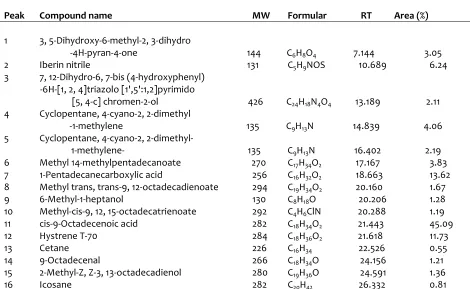
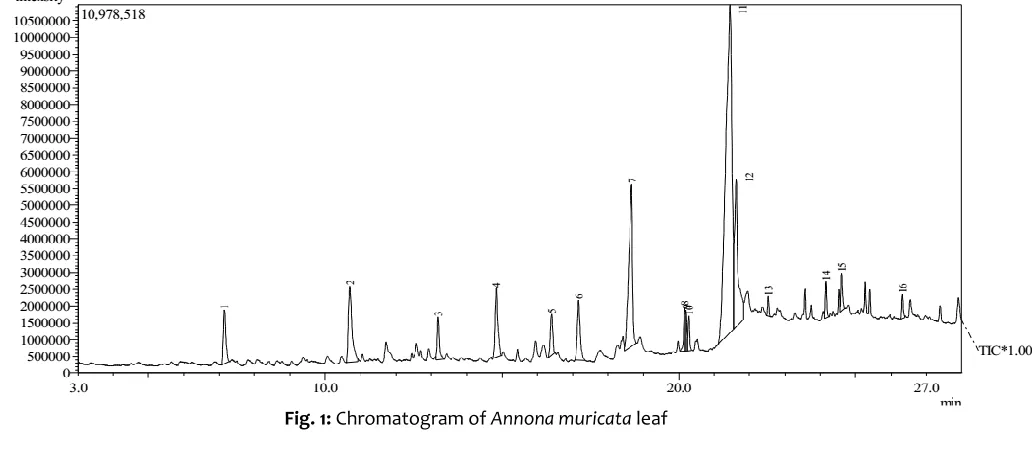
Gas Chromatography-Mass Spectrometry analysis (GC-MS) has been reported by researchers as one of the best methods used in the identification of bioactive compounds [8]; [9]. The spectra of the study revealed sixteen peaks that corresponded to sixteen compounds from A .muricata leaf. The compounds were confirmed by their retention time, percentage area, molecular weight and formulae respectively. From the percentage area calculated, it was observed that 78.51 % of the phytochemicals detected were fatty acids. The major components identified in this leaf were peak 11, which showed the highest composition of 45.09 %, followed by peaks 7 (13.62 %), 12 (11.73 %) and 2 (6.24 %).
The identified phytochemicals present included 3, 5-Dihydroxy-6-methyl-2, 3-dihydro-4H-pyran-4-one (3.05%), Iberin nitrile (6.24 %), 7,12-Dihydro-6,7-bis(4-hydroxyphenyl)-6H-[1,2,4]triazolo
shown in Table 1. 5-Dihydroxy-6-methyl-2, 3-dihydro-4H-pyran-4-one has been reported to possess antimicrobial and antiinflammatory activities [8]. 9,12-Octadecadienoic acid, ethyl ester is a linoleic acid which has hypocholesterolemic,5-alpha reductase inhibitor and antihistaminic
properties and n-Hexadecanoic acid has
nematicide, pesticide, anti-androgenic, flavor, hemolytic 5-alpha reductase inhibitor, antioxidant and hypo-cholesterolemic properties [10]. 9,12-octadecadienoic acid (z, z) had been reported by previous researchers to have anti-inflammatory, nematicide, cancer preventive, hypocholesterolemic and hepatoprotective activities [11]. Similarly, 4H-Pyran-4-one, 2, 3-dihydro-3, 5-dihydroxy-6-methyl- had been reported to possess antimicrobial and anti-inflammatory activity [12].
The GC-MS screening of Xylopia aethiopica fruit revealed the presence of fifteen compounds including oleic acid and linoleic acid [9]. Similarly, the bioactive components of Physalis minima leaves were evaluated using GC-MS as reported by Karpagasundari and Kulothungan [13]. The constituents of Vitex negundo leaf analyzed using GC-MS revealed the presence of 9, 12, 15-Octadecatrienoic acid, (Z,Z,Z)-linolenic acid, which possesses anti-inflammatory, cancer preventive and hepatoprotective properties [14]. The GC-MS analysis of methanolic [8] and ethanolic [15] extract of A. muricata revealed a common compound (9, 12-octadecanoic acid), also identified in this analysis.
FTIR has been employed by previous researchers as one of the reliable tools for the analysis of bioactive compounds [16]; [9]. Figure 2 showed the various FTIR absorption peaks of the leaf. At 632.67 cm-1 there was absorption due to the presence of S=O indicating the presence of sulfonic acids in the leaf. Also, a peak was observed at 1087.89 cm-1, which indicated the presence of S=O (sulfoxides). Subsequently, peaks were observed at 1411.94 cm-1, 1620.26 cm-1, 2353.23 cm-1, 2924.18 cm-1, 3394.83 cm-1 corresponding to O-H (Alcohols), N=N (Nitroso compounds and halogeno), C=NH+ (charged amines), C-H (Alkanes) and N-H (free amides free NH) (Figure 2, Table 2).
Conclusion
The results of this study revealed the presence of diverse important phytochemicals such as 3, 5-Dihydroxy-6-methyl-2, 3-dihydro-4H-pyran-4-one
(3.05%), Iberin nitrile (6.24 %), Cyclopentane, 4-cyano-2,2-dimethyl-1-methylene (4.06%), Methyl-14-methylpentadecanoate (3.83%), 1-Pentadecanecarboxylic acid (13.62%), , cis-9-Octadecenoic acid (45.09%), Hystrene T-70 (11.73%), 2-Methyl-Z, Z-3,13-octadecadienol (1.36%) and icosane (0.81%) in the crude leaf extract of A. muricata. Similarly, the FTIR spectrum gave seven peaks that corresponded to sulfonic acids, sulfoxides, alcohols, nitroso compounds and halogeno, charged amines, alkanes and primary amides and free NH respectively which exert the various pharmacological activities.
References
1 Omeje KO, Odo CE, Ejembi DO, Ossai NI, Eneje VO, Chukwuka RS, Omeje HC. The effects of ethanol extract of Corchorus olitorus leaves on haematological indices of wistar albino rats. Acad. J. Food Res 2014;2(1): 007-009.
2 Moghadamtousi SZ. Fadaeinasab M. Nikzad S. Mohan G. Ali HM. Kadir HA. (2015). Annona muricata (annonaceae): a review of its traditional uses, isolated acetogenins and biological activities. Inter.J. Molec. Sci 2015; 16: 15625-15658.
3 Kedari TS. Khan AA. Guyabano (Annona muricata): A review of its traditional uses phytochemistry and pharmacology. Amer. J. Res. Comm 2014; 2 (10): 247-268.
4 Haro G. Utami NP. Sitompul E. Study of the antibacterial activities of soursop (Annona muricata L.)leaves. Inter. J. PharmTech Res 2014; 6(2): 575-581.
5 Rarassari MA. Maftuch HN. Phytochemicals and antibacterial activities of soursop leaf (Annona muricata) against Edwardsiella tarda (in vitro). J. Life Sci. Biomed 2016; 6(1): 06-09.
6 Omeje KO, Odiba AS, Ejembi DO, Chukwuka RS. Platelet aggregation effect of Corchorus olitorus extract as an index of managing blood clotting disorders. IOSR J. Dental Med. Sci 2014; 13 (10): 58-60
8 Shibula K. Velavan S. Determination of phytocomponents in methanolic extract of Annona muricata leaf using GC-MS technique. Inter. J. Pharmacog. Phytochem. Res 2015; 7(6): 1251-1255. 9 Okereke SC. Arunsi UO. Nosiri CI. GC-MS/FT-IR screening of Xylopia aethiopica (Dunal) A. rich fruit. Afri. J. Biochem. Res 2017; 11 (3): 12-17.
(Aedesaegypti) larvae. Inter. J. Eng. and Technol 2012; 12(03): 28–32.
11 Sermakkani M. Thangapandian V. (2012). GC-MS analysis of Cassia italica leaf methanol extract. Asian J. Pharmacy and Clin. Res 2012;5 (2): 90-94 12 Kumar P, Kumaravel S. Lalitha C. Screening of antioxidant activity, total phenolics and GC-MS study of Vitex negundo. Afr. J. Biochem. Res. 2010; 4 (7): 191-195.
13 Karpagasundari C. Kulothungan S. Analysis of bioactive compounds in Physalis minima leaves using GC MS, HPLC, UV-VIS and FTIR techniques. J. Pharmacog. Phytochem 2014; 3(4): 196-201. 15 Gavamukulya Y, Abou-Elella F, Wamunyokoli F. El-Shemy HA. GC-MS analysis of bioactive phytochemicals present in ethanolic extracts of leaves of Annona muricata: A further evidence for its medicinal diversity. Pharmacog. J 2015; 7 (5): 300 – 304.
Table 1. Compounds identified from the GC-MS analysis of A. muricata leaf
Peak Compound name MW Formular RT Area (%)
1 3, 5-Dihydroxy-6-methyl-2, 3-dihydro
-4H-pyran-4-one 144 C6H8O4 7.144 3.05
2 Iberin nitrile 131 C5H9NOS 10.689 6.24
3 7, 12-Dihydro-6, 7-bis (4-hydroxyphenyl) -6H-[1, 2, 4]triazolo [1',5':1,2]pyrimido
[5, 4-c] chromen-2-ol 426 C24H18N4O4 13.189 2.11
4 Cyclopentane, 4-cyano-2, 2-dimethyl
-1-methylene 135 C9H13N 14.839 4.06
5 Cyclopentane, 4-cyano-2, 2-dimethyl-
1-methylene- 135 C9H13N 16.402 2.19
6 Methyl 14-methylpentadecanoate 270 C17H34O2 17.167 3.83
7 1-Pentadecanecarboxylic acid 256 C16H32O2 18.663 13.62
8 Methyl trans, trans-9, 12-octadecadienoate 294 C19H34O2 20.160 1.67
9 6-Methyl-1-heptanol 130 C8H18O 20.206 1.28
10 Methyl-cis-9, 12, 15-octadecatrienoate 292 C4H6ClN 20.288 1.19
11 cis-9-Octadecenoic acid 282 C18H34O2 21.443 45.09
12 Hystrene T-70 284 C18H36O2 21.618 11.73
13 Cetane 226 C16H34 22.526 0.55
14 9-Octadecenal 266 C18H34O 24.156 1.21
15 2-Methyl-Z, Z-3, 13-octadecadienol 280 C19H36O 24.591 1.36
16 Icosane 282 C20H42 26.332 0.81
Table 2: FTIR analysis result of A. muricata leaf
Peaks Functional groups
632.67 S=O (Sulfonic acids) 1087.89 S=O (Sulfoxides) 1411.94 O-H (Alcohols)
1620.26 N=N (Nitroso compounds and halogeno) 2353.23 C=NH+ (Charged amines)
2924.18 C-H (Alkanes)
Chemical structures of the compounds identified.
1 2 3
4 5 6
7 8 9
10 11
12 13
14 15
Fig. 1: Chromatogram of Annona muricata leaf