Licensed under Creative Common Page 497
http://ijecm.co.uk/
THE IMPLEMENTATION OF THE HUMAN, ORGANIZATION,
AND TECHNOLOGY–FIT (HOT–FIT) MODELS TO
EVALUATE THE MOBILE BANKING
Yoga Alif Prasetyo
Faculty of Technology and Engineering, Gunadarma University, Jakarta, Indonesia [email protected]
Teddy Oswari
Faculty of Technology and Engineering, Gunadarma University, Jakarta, Indonesia [email protected]
Abstract
This research intended to examine the effect of utilization Bank Mandiri Syariah Mobile Banking
applications to customers using the Human-Organization-Technology (HOT) Fit evaluation model.
These components are connected, they are divided into three relationships, Human organization,
Technology, Organization-technology. As well as conformity (FIT) between internal elements
(Technology) and External (Human & Organization). Human factors, organizations, and
technology include information systems whose impact is assessed on the net benefit. These
factors are related to the 8 dimensions of information system success, System Quality,
Information Quality, Service Quality, System Use, User Satisfaction, Structure, Environment, Net
Benefits. This research used secondary data analyzed using multiple linear regression analysis
with SPSS. With the number of respondents 316 customers, before the researcher used multiple
regression, researchers tested the data with classic assumption test, the resulted is declared valid
and reliable from the 7 Variables examined by the researcher only take the most significant
variables i.e. Structure, Environment, Quality of Information, Use of the System to influence the
benefits of Mandiri syariah mobile. The study concluded that Mandiri Syariah Mobile Banking is
strongly influenced by the Seven Variables of the HOT Fit Model.
Licensed under Creative Common Page 498 INTRODUCTION
The Evolution of information and communication technology was also followed by banking industry, especially in Indonesia. Technology has opened new ways that are more efficient for the banking industry. Bank has transformed from a provider of paper -based banking solutions to the latest technology. The evolution has also made it easier for customers to use various products anytime and anywhere. This fact is a big challenge for the banking industry. As is known, banks have a strategic role is service excellent their customers.
One of the technologies used in modern banking is Self Service Technology (SST). According to Meuter in (Fatimah and Suyanto, 2016) Self Service Technology (SST) is a technology that enables customers to produce their own services that they need without relying on employees. One of the Online service banking is the Automatic Teller Machine (ATM) and electronic banking (e-banking). The Bank has seven types of e-banking services, namely ATM (Automated Teller Machine), EDC (Electronic Data Capture), Internet Banking, SMS Banking, Mobile Banking, E-Commerce, Phone Banking, and Video Banking. Bank Indonesia divides e-banking services into 4 categories, namely internet e-banking, mobile e-banking, phone e-banking and SMS banking (OJK, 2015:02).
In Indonesia, mobile banking is not only introduced by conventional banks, but also developed by sharia- banks, one of the largest Indonesian syariah banks, Bank Mandiri Syariah, for the first time launching an Android-based mobile banking application on October 9, 2014 at the Play Store.
Mandiri Syariah Mobile application continues to develop in order to serve its customers well. In the implementation phase there is a system evaluation point that is being implemented, because to provide a system development to a better direction..
In this case we use Human-Organization-Technology Fit Model, This model is use to evaluate a system that includes important components of an information system, namely human (human), organization (Organization), technology (technology). Using this method is to know which aspects need to be maintained in quality and which aspects are still weak, so that it can be improved to optimize the Mandiri Syariah Mobile application for Bank Mandiri Syariah customers.
LITERATURE REVIEW
Bank
Licensed under Creative Common Page 499 the welfare of the people and According to Indonesian Law 10/1998 about banking, banks are business entities that raise funds from the public in the form of deposits and distribute to the public in order to improve the standard of living of the people.
So the understanding of the bank are the institutions involved in the field of finance, which means that banking activities are always associated in the field of finance, means that banking activities are always associated in the midwife of finance, so talk about the banks is not about financial issues in order to collect or distribute, either in the form of cash or credit.
Shariah Bank
According to KBBI, a bank is a financial institution that provides credit primary business and services in payment traffic and circulation of money. According to the provisions contain ed in Bank Indonesia Regulation no. 2/8/PBI / 2000, article I, Islamic Bank is a commercial bank referred to in Act Number 7 year 1992 about banking and has been amended by Act Number 10 of 1998 based on the principles of Islamic law, including Sharia and the branches of the bank of foreign business conducting day-to-day Islamic Law based on the Regulations of Islamic Law.
Mobile Banking
According to Audi et al. (2016) mobile banking can be defined as a banking channel where the consumer / customer or the account holder can use his mobile phone to conduct banking transactions or other financial services related or interact with the bank. Mobile banking is not the same with the phone banking and fixed different from internet banking. Mobile banking is based on the exchange of information between the bank and the user through his mobile phone using the mobile app.
The Concept Of Mobile Banking
Licensed under Creative Common Page 500 RESEARCH METHODS
The method of the research is used secondary data collection. The Data were analyzed quantitatively using multiple linear regression analysis using software SPSS. The respondents that were analyzed in this study amounted to 316 people.
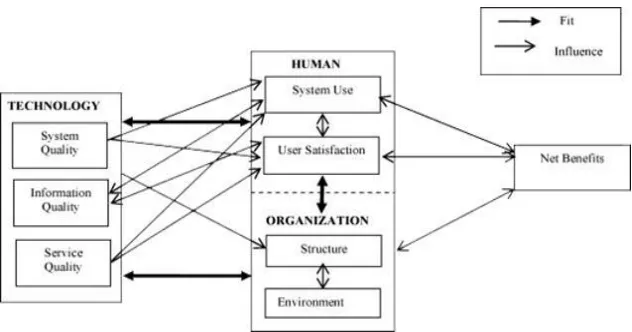
This study uses the Model proposed by Maryati Mohd. Joseph, Ray. J Paul, Lampros K. Stergiolus that is HOT FIT Model, the model is a framework adopted from the 2 pieces of the evaluation model is a system that Information Systems Success Model and The MIT90s (IT-Organization Fit Model).
On both models have strengths and limitations, however, the two models complement each other in presenting the framework of a thorough evaluation. HOT FIT Model has a variable structure and environment of organization where these variables are not contained on the previous model.
1. Human - Components of the human explained information systems from the use of the system (user). System use is also correlated with who to use (who use it), the level of user (level of user), training, knowledge, expectations and attitudes accept (acceptance) or resist (resistance) system.
2. Organization - Leadership, support from top management and support staff is an important part in measuring the success of the system. While the environment of the organization consists of financing sources, government, politics, competition, relationship interorganisasional and communication.
3. Technology - A component technology consists of system quality (system quality), information quality (information quality) and service quality (service quality). The quality of the system in the system information concerning the interconnectedness of features in the system including system performance and user interface.
Licensed under Creative Common Page 501 THE RESULTS
Before using multiple Regression, the researchers conducted a test. Test of normality shows that the residuals have a normal distribution. The results of the calculation also does not indicate the presence of multicollinearity as well as the symptoms of autocorrelation. The results of the next test also does not indicate the presence heterokedastisitas.
The Results of The Multiple Linear Regression Analysis
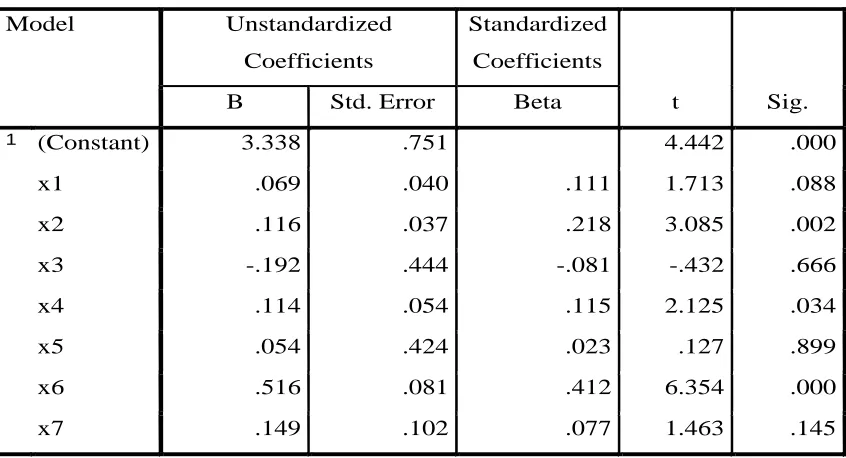
The results of data processing obtained an equation of multiple linear regression as follows Y = 3,338 + 0.069 X1 + 0.116X2 - 0.192X3+ 0.114X4+ 0.54X5+0.516X6+ 0.149X7
The equation shows the constant value of 3,338 this means the 7 independent variables not changed or reduction.
The regression coefficient of the variable System Quality (X1) has the direction of positive its influence on the Benefits of Mandiri Syariah Mobile Banking by 0,069 times or 6.9%, If the Quality of Information (X2), enhanced 1 time, then the Benefits Syariah Mandiri Mobile Banking will be increased by 0.116 times or 11.6%, If the Service Quality variable (X3) is improved 1 times, then the Benefits Syariah Mandiri Mobile Banking will be decreased by 0.192 times or -19,2, If variable Use of System (X4) upgraded 1 time, then the Benefits Syariah Mandiri Mobile Banking will increase by 0.114 times or 11.4%, If the Variable User Satisfaction (X5) improved 1 times, then the Benefits Syariah Mandiri Mobile Banking will increase by 0.054 times or 5.4%, If the Variable Structure (X6) improved 1 times, then the Benefits Syariah Mandiri Mobile Banking will increase by 0.516 times or 51.6 percent. And vice versa if it is lowered 1 time then the benefits will be decreased by 51.6 percent, If the Environment Variable (X7), enhanced 1 time, then the Benefits Syariah Mandiri Mobile Banking will increase by 0.149 times or 14.9%.
Table 1 Simultaneous hypothesis test (F test)
Simultaneous hypothesis test (F test), the results of statistical calculation shows the value of Fcount > Ftable of 73.107 > 2,12 with a significance of 0.000 < 0.05. With this value Fcount is greater than Ftable and a significance below 0.05 indicates that together the seven independent variables has a positive and significant influence on the Benefits of Mandiri Syariah Mobile
Model F Sig.
1 Regression 73.107 .000a
Licensed under Creative Common Page 502 banking system quality (system quality), information quality (information quality) and service quality (service quality). The quality of the system in the system information concerning the interconnectedness of features in the system including system performance and user interface.
Table 2 T Partial Test
Based on these results, there are 3 Variables of the 7 variables that most affect the Structure (x6), Environmental (x7), Information Quality (x2), the Use of the System (x4) against the influence of the benefits of Mandiri syariah mobile.
Table 3 Coefficient Of Determination
The results of the regression calculation can be seen that the coefficient of determination ( R Square ) obtained of 0.624. This means that 62,4% of the benefits of the application of Syariah Mandiri Mobile Banking is strongly influenced by the Seven Variables of the HOT-Fit Model, while the rest of the benefits are influenced by other variables not examined in this study.based on these results, there are 3 Variables of the 7 variables that most affect the Structure (x6), Environmental (x7), Information Quality (x2), the Use of the System (x4) against the influence of the benefits of Mandiri syariah mobile.
Model Unstandardized
Coefficients
Standardized
Coefficients
t Sig.
B Std. Error Beta
1 (Constant) 3.338 .751 4.442 .000
x1 .069 .040 .111 1.713 .088
x2 .116 .037 .218 3.085 .002
x3 -.192 .444 -.081 -.432 .666
x4 .114 .054 .115 2.125 .034
x5 .054 .424 .023 .127 .899
x6 .516 .081 .412 6.354 .000
Licensed under Creative Common Page 503 CONCLUSIONS AND RECOMMENDATIONS
This study examines the effect of applying the Mandiri Syariah Mobile Application to Customers by using the HOT (Human Organization Technology) Fit Model. In this study there were seven independent variables which were tested for the benefits of the application of Mandiri Syariah Mobile Application for customers. The seven variables are system quality, information quality, service quality, system usage, user satisfaction, structure and environment. Furthermore, for the results of the Partial Significance Test (T Test) there are 3 variables that have partial effect, namely Information Quality, Structure and Environment. these three variables have significance results <0.05. And the three variables are representative of the Human Organization and Technology Model..
From the conclusions of the research, it could be suggested that for further development this research can use other methods to see deeper results. for structure variables here assess the system in terms of management contained within an organization that runs in Bank Mandiri Syariah. It can be said that the structure here as the initial foundation for the formation of an application, therefore to make a useful application management support is needed. then in making an application must be sensitive to the surrounding environment, so that later the application can accommodate customer needs and have benefits that can be used by customers to facilitate the transaction and the last in application must have good quality information that has components such as completeness of information, actuality, Availability, Relevance, Consistency, Reliability, Quality, Accuracy. We can know that a system should have a system that produces good quality information so that customers who use it can trust the application.
REFERENCES
Ardy Riza Saputra1, M. ,. (2015). Penerapan Metode HOT-FIT dalam Evaluasi Internal Information System (IIS) Pada PT. Indaco Cabang Palembang. Internal Information System (IIS), 1-7.
Arikunto, S. (2010). Prosedur Penelitian Suatu Pendekatan Praktik. Jakarta: Rineka Cipta. Dajan, A. (2000). Pengantar Metode Statistik. Jakarta: LP3ES.
DeLone, W. H., & Mc Lean, E. R. (1992). Infromation System Succes: The Quest For the Dependent Variable. Information System Research 3 (March).
Dwi Krisbiantoro, M. S. (2015). Evaluasi Keberhasilan Implementasi Sistem Informasi dengan Pendekatan HOT FIT Model (Studi Kasus : Perpustakaan STMIK AMIKOM Purwokerto). Konferensi Nasional Sistem & Informatika 2015, 6. G, D. (2013). Manajemen Perbankan Syariah. Jakarta : Salemba Empat.
Guza, A. (2008). Undang-undang SISDIKNAS dan UU Guru dan Dosen. Jakarta: Asa Mandiri.
Hapsara, R. F. (2015). Pengaruh Kegunaan, Kemudahan, Resiko dan Kepercayaan Terhadap Penggunaan Mobile Banking Terhadap Pengguna Mobile Banking(Studi pada Nasabah Bank BRI Kantor Cabang Solo Kartasura). Surakarta: Naskah Publikasi Ilmiah Universitas Muhammadiyah.
Licensed under Creative Common Page 504 Indriantoro, Nur, & Supomo, B. (1999). Metodologi Penelitian dan Bisnis. Yogyakarta: BPFE Yogyakarta.
Keuangan, O. J.K (2015). Buku Bijak Ber E-Banking. Jakarta.
Lubis, S. H. (2017). Evaluasi Sistem Informasi Perpustakaan IAIN Padangsidimpuan Menggunakan HOT FIT Model. Universitas Sumatera Utara, 1-112.
Maryati Mohd, Y., Ray J, P., & Lampros K, S. (2006). Towards a Framework for Health Information System Evolution,". The 39th Hawaii International Conference on System Science.
Nanang, M. (2010). Metode Penelitian Kuantitatif. Jakarta: Rajawali Press. Pedoman Tesis. (t.thn.). Jakarta: Pascasarjana Universitas Gunadarma.
Pujo Hari Saputro, A. D. (2015). Model Delone and Mclean untuk Mengukur Kesuksesan E-government Kota Pekalongan. Scientific Journal of Informatics, 8.
Sani, A. (2013). Inovasi Pembelajaran. Bandung: Bumi Aksara.
Santoso, S. (2007). Menguasai Statistik di Era Informasi Dengan SPSS 15. Jakarta: PT Elex Media Komputindo. Santoso. (2000). Buku Latihan SPSS Statistik Parametrik. Jakarta: PT Elex Media Komputindo.
Sugiyono. (2011). Metode penelitan kuantitatif kualitatif dan R&D. Alfabeta.
Sugiyono. (2012). Metode Penelitian Kuantitatif Kualitatif dan R&D. Bandung: Alfabeta.
Sugiyono. (2013). Metode Penelitan Pendidikan Pendekatan Kuantitatif, Kualitatif, dan R&D. Bandung: Alfabeta. Suharyadi, & Purwanto. (2004). Statistika Untuk Ekonomi dan Keuangan Modern. Jakarta: Salemba Empat. Sutabri, T. (2016). Sistem Informasi Manajemen. Yogyakarta: Andi Offset.