129 IJSTR©2020
Using U- Learning In Developing Creative
Thinking Levels Among University Students
Ahmed Mohammed, Rabea Ali, Bader Aldalan
Abstract: U-learning provides the educational systems with many benefits and particularly the University Education but there is still a shortage of using U-learning in many universities all over the world. The current study aimed at examining the impact of the ubiquitous learning (U- Learning) in developing some creative thinking levels among university students in different specializations (the educational technology, English language, and Mathematics Majors). The significance of the study lies in three important points: first, the employment of the U- learning in the educational process. Second, this study contributed in creating new activities that might be used in developing creative thinking levels and improving the learning process. Third, this study might be seen by educators as an important method of using U- learning and its applications which might open the door for more researches. Moreover, the findings revealed that there was a positive effect for using U-learning on creative thinking levels among university students.
Keywords: U- Learning - Creative Thinking - University Students – spreading education
————————————————————
1
INTRODUCTION
Along with the appearance of the informatics revolution, several innovative and modern technological methods had appeared which contribute to the development of the educational facilities and level them up. Remote education, computerized education, and many educational systems are ways that spread so fast reaching the wireless revolution that highlighted a new model which is the U-Learning. That sort of education depends on using the wireless technologies and it imposed itself strongly on many sectors such as the Educational Sector.
According to, Hwang & etal, (2008) it is difficult to find a clear definition for the term of U-learning because of rapid changes of learning environments until now so researches have different opinions in defining the term ―U-learning‖. A general definition of U-learning is ‗anywhere and anytime learning‖. The definition is referring to any environment that allows any mobile learning devices to access the learning and teaching contents via wireless networks in any location at any time. The term U-learning has been introduced by Weiser (2017) as ubiquitous computing systems. The development of U-learning has been increased by the improvement of wireless, telecommunication capabilities, open network, continued increases in computing power, improved battery technology and the emergence of flexible software architectures (Lyytines & yoo ,2002). Additionally, Bomsdorf (2005) mentioned that U-learning provides the value of grounded learning conditions in everyday life. The U-learning system as well as mobile technology includes, web-based learning and computer-assisted learning (Cheng & et al, 2005) Moreover, U-Learning is the process of connecting the process of education along with its content of electronic interactions, supporting the educated ones, teaching remotely anytime and anywhere by using open digital devices and the wireless connection technology. The Spreading Education is regarded as one of the most important factors and the rapid ones which allows E-Learning for all the students anytime and anywhere. (Mahdi, Majdi Salah, (2008), Al-Dahshan, Gamal Ali (2010).
U-learning applications have many advantages in acquiring needed instructions for learners. (Hwang & etal ,2008). U-Learning is also defined as it is the usage of mobile devices, handheld IT devices such as personal digital assistants, mobile phones, laptops and tablet PCs in the process of teaching and learning. (Haddad, AkramMasoud, (2008), Aljuaid, Nada Mansour F (2014), Litchfield, S. (2010). The process of spreading education is done through one of the most common ways that are used among the learners which is the smart phones. Smart phones are viewed as a source of the U-Learning sources which has recently been added to the organization the E-learning sources as most universities provide their students with. Smart phones are characterized by their fast performance, network connection and the high storage. (El-Hussein, M. O. M., & Cronje, J. C. ,(2010), Salem, Ahmed Mohamed, (2004). Smart phones‘ systems are prepared to connect with only one system within the network. It‘s possible to exchange files easily among devices using the Bluetooth technology that connects more than one device that are similar in properties at the same time. With the spread of such technologies of smart phones, which reaches billions of users, the technology became reliable and trusted. Smart phones replaced many devices of the Spreading Education. (Satoshi M, 2017) Many researchers and educators expect that within few years, smart phones will become the main way of communication. (Chen, N. S. & etal, 2011, Bdiwi, R. etal, 2019) During a scan that Smart Courses -the largest supplier of E-textbooks- had done, they found that the university students depend on the Spreading Education in a large way. The smart phone turned from an additional device that is confined upon a specific class of individuals into the main object that is irreplaceable and available for everyone. Universities are always searching for new innovative ways to teach students and enrich their educational experience. The Spread Education has the ability to be an innovative educational tool within the High Education environment regarding its characters and mobility nature. (Edward D,2005, Hasamu, Suha
&
Abdullah, Fawaz ,2012).2
THE
ISSUE
OF
THE
STUDY
The issue of the study was determined in examining the efficiency of employing U-Learning approach in developing ————————————————
Ahmed Mohammed, Department of Basic Education , College of Sciences and Arts, Qassim University, Ar rass branch , KSA.
E-mail: [email protected]
Rabea Ali, Department of English language & Translation, college of Sciences and Arts, Qassim University, Ar rass, KSA.
E-mail:[email protected]
Bader Aldalan, Department of Education Curriculum and Instruction, Qassim University, Buridah, KSA
130 creative thinking levels among university students. Hence,
the main question can be formed as: what is the effect of using U- Learning in developing creative thinking Levels among University Students?
Some sub-questions are extracted from the previous main question:
What‘s the effect of using U- Learning in developing creative thinking levels among the educational techniques, Mathematics, and English language Majors?
How efficient is using U- Learning in developing creative thinking levels among the educational techniques Mathematics, and English language Majors?
What‘s the effect of employing U-Learning in developing the levels of skillful thinking among the educational techniques, Mathematics, and English language Majors?
How efficient is using U-Learning in developing the levels of innovation thinking among the educational techniques, Mathematics, and English language Majors?
3
THE
RESEARCH
METHODOLOGY
The current research depended on:
The semi-experimental approach to measure the impact of the interaction between the independent variable (U-Learning) and the dependent variable (creative thinking levels)
The experimental design of the research which the researcher used on two experimental groups with the pre-application and post-application to each of an observation card and an achievement test.
3.1THE EXPERIMENTAL PROCESSING OF THE RESEARCH
It was done with a proposed form based on U-Learning to identify its impact in developing creative thinking levels among the educational techniques, Mathematics, and English language Majors.
3.2 RESEARCH SAMPLE
It included (75) male and female fresh students who are specialized in (educational techniques, the Department of Education Technology), (English language, the Department of English language and translation), and (Mathematics, the department of basic education) faculty of science and Arts, Qassim University, Saudi Arabia. Measuring levels of creative thinking was applied before and after the experimental processing.
3.3 Tools of the Research.
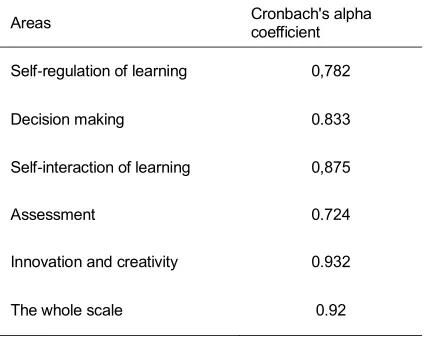
Measuring of the creative thinking levels: the first image of this tool was represented in 5 fields (Self-regulation of learning, Decision making, Self-Interaction of learning, Assessment Innovation, and creativity). It contained 30 testing passages in order. The five-step scale was used to measure the degree of skill ownership from the students' perspective, with degrees of Very large (5), Large (4), Moderate (3), Little (2) and Rare (1). The scale‘s internal consistency was computed by finding both the correlation of each paragraph of the scale, and the total grade of the domain to which it belongs. Stability of the scale: it was calculated using Cronbach's alpha coefficient. Cronbach's alpha coefficient was calculated for each subscale, and for the scale as a whole. The results were as shown in the following table.
Levels of skillful-thinking measurement:
Table 1 shows that the total value of the stability of the whole scale is 0.92; the matter which assures that the scale has a high degree of stability. After making certain of the validity of the scale and its stability, the scale becomes applicable.
The scales aimed at measuring the skillful-thinking of the high education students. According to that aim, which is consisted of 40 paragraphs distributed on special three areas that related to the skillful thinking levels. As in the scale of the creative thinking levels, a five-grade scale has been applied to measure the degree of a skill‘s possession from the perspective of the students. Stability of the scale: Cronbach's alpha coefficient was utilized to calculate the stability factors of each subscale, and of the scale as a whole. The results were as shown in the following table 2. Table 2 shows that the total value of the stability of the whole scale is 0.81; the matter which assures that the scale has a high degree of stability. After making certain of the validity of the scale and its stability, the scale becomes applicable.
TABLE1
RESULTS OF CRONBACH'S ALPHA CALCULATION PROCESS
Areas Cronbach's alpha coefficient
Self-regulation of learning 0,782
Decision making 0.833
Self-interaction of learning 0,875
Assessment 0.724
Innovation and creativity 0.932
The whole scale 0.92
TABLE2
RESULTS OF CRONBACH'S ALPHA CALCULATION PROCESS
Areas Cronbach's alpha coefficient
Skill of search 0.65
Skill of browsing 0.58
Skill of sending 0.78
The whole scale 0.81
RESEARCH
RESULTS
AND
THEIR
DISCUSSION
In order to answer the research questions, the researcher examined the study hypotheses; the results were as the following: The results which are related to the examination of the first hypothesis. The first hypothesis states that there are differences of statistical significances; a 0.5 degrees difference in the students‘ grades, in the creative thinking scale, between the pre-application and the post one; in favor of the post-application. The statistical value (T) was calculated to determine the significance of the differences between the average of pre and post-application. The results were as shown in the following table 3. The results in the upcoming table (3) show that the calculated value (T) is greater than the tabular value (T) at level of 0.01 at each level of the creative thinking before and after application, in favor of the post-application. The researcher attributes this to the variety of services that can be provided by learning in the field of teaching and learning, allowing students the freedom to learn in the educational halls and beyond; in any place, location, and accessibility of educational information and expertise in the quickest way. Students can explore the information themselves, and follow the training exercises. They can also download educational resources including
images, links, videos, maps of thinking and mental maps that are used in computer applications in education. The students can also publish exchange, save and retrieve the sources without having to ask for the programmers‘ help. This will lead to a more comprehensive realization of the vitality of education according to the needs of the students. It helps the learner to follow his learning, based to the previous experiences and skills, which further enhance the levels of creative thinking. The results which are related to the examination of the second hypothesis. Using U- learning in developing creative thinking levels achieved an impact at least 0.14 as measured by the ETA squared. The above table shows the effect of using U-learning on developing creative thinking levels among the students of educational techniques, Mathematics, and English language in all dimensions of the scale and the scale as a
whole was higher than the value of 0.14. This indicates that U- learning had a very significant impact on creative thinking levels. The researcher attributes this to the prevalence and spread of the methods and patterns of distance learning, in addition to the need for them. U-learning is a real and practical translation of the philosophy of distance learning, and the establishment of creative thinking levels that expand the base of educational opportunities for individuals and reduce their cost. Also, U- Learning enables students to take advantages of available educational opportunities that are not restricted by time, place, or category of learners, and not limited to a specific
level or gender. Students have the freedom to learn whether within or outside the walls of the university. The results which are related to the examination of the third hypothesis: The employment of U- learning in the developing creative thinking levels achieved an impact at least 1.2.
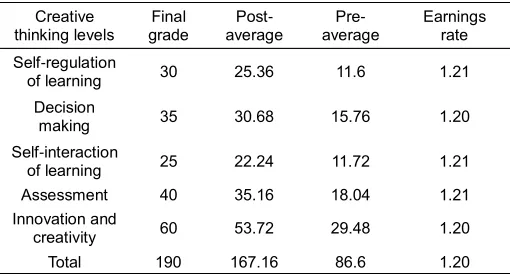
Table (5) shows that Black's earning rates for the five levels of creative thinking and the total ranged from 1.20 to 1.21, which is not less than 1.20 for the black gain factor based on the hypothesis; indicating that the use of U- Learning is very effective in developing creative thinking levels. The third hypothesis accepts the previous. U-Learning provides free applications that help learners in using multimedia, enriching the educational content, and adapting to the
TABLE4
SHOWS THE IMPACT OF U- LEARNING ON CREATIVE THINKING LEVELS
Creative thinking levels
V
alu
e t
V
alu
e
2 ŋ Valu
e
d
S
iz
e o
f
im
pa
ct
Self-regulation
of learning 22.43 0.95 9.16 Huge Decision
making 33.36 0.98 13.62 Huge
Self-interaction
of learning 10.34 0.96 25.32 Huge
Assessment 9.54 0.96 26.36 Huge Innovation and
creativity 32.92 0.98 13.44 Huge Total 59.30 0.99 24.21 Huge TABLE3
EXAMINATION (T) RESULTS TO FIND THE DIFFERENCES BETWEEN THE AVERAGE OF PRE AND POST-APPLICATION OF
CREATIVE THINKING LEVELS Table 1
Table 2 Creative thinking
levels Table 3
Pre-examination
Post-examination
T Sig
A
ve
ra
ge
S
ta
nd
ar
d
de
vi
atio n
A
ve
ra
ge
S
ta
nd
ar
d
de
vi
atio n
Self-regulation
of learning 11.6 2.35 25.36 1.98 22.43 0.01 Decision
making 15.76 1.94 30.68 1.11 33.36 0.01
Self-interaction
of learning 11.72 1.49 22.24 1.45 25.32 0.01 Assessment 18.04 2.35 35.16 2.81 23.36 0.01
Innovation and creativity
29.48 2.29 53.72 2.88 32.92 0.01
Total 86.6 4.26 167.16 5.29 59.30 0.01
TABLE5
THE DIFFERENCES BETWEEN THE PRE AND POST-AVERAGE AND REMOTE MEAN AND BLACK GAIN RATES FOR THE SCALE
DOMAINS AND THE TOTAL Creative
thinking levels grade Final average Post- average Pre- Earnings rate Self-regulation
of learning 30 25.36 11.6 1.21
Decision
making 35 30.68 15.76 1.20
Self-interaction
of learning 25 22.24 11.72 1.21
Assessment 40 35.16 18.04 1.21
Innovation and
creativity 60 53.72 29.48 1.20
Total 190 167.16 86.6 1.20
132 nature of creative thinking in ways and means that help to
acquire knowledge and skills in an interactive way. Fourthly: the results which are related to the examination of the fourth hypothesis: There are statistically significant differences at the level of function 0. 5. The researchers measured the levels of skillful thinking on the students; the sample of the study before and after the experiment, then calculated the mathematical averages and standard deviations of the students' grades. Thereafter, the researcher calculated the value of the statistics (T) to determine the significance of the differences between the average scores of the study sample in the post-measurement application. The results were as shown in the following table (6).
It is clear from the results in table (6) that the calculated value (T) is greater than the tabular value (T) at a significance level of 0.05 for its total number. Thus, the fourth hypothesis is acceptable. The researchers attribute this to the students' using of the skillful thinking tools in a way that helped improving their skillful thinking levels. Through U-Learning learning multi-applications, lectures, photos and videos can be received and shared, as well as through Bluetooth, e-mail, Viber, Tango, Facebook, and WhatsApp. Therefore, the students‘ skillful thinking levels have been improved.The results which are related to the examination of the fifth hypothesis: The employment of the U-Learning in the developing creative thinking levels achieved an impact of at least 0.14. It is also measured by the ETA squared.
It is clear from table (7) that the impact of U- Learning in developing skillful thinking levels among university students in all dimensions of the scale and the scale as a whole was higher than 0.14. This indicates that U- Learning achieved a great influence on skillful thinking levels. This is because of the various programs which U- learning provides in order to make the students communicate with the teachers in the lecture; such as sending and receiving messages and lectures, inquiring about information about the course. In addition to receiving announcements and decisions; such as postponing the exam, apologizing for not attending a lecture, or even bringing a delivery deadline of student projects forward. These are all suffered by the university student where U- Learning can be used to obtain and share information more easily and quickly. Various U-Learning programs make both learners and teachers able to participate in the implementation of processes and tasks in a group. The results which are related to the examination of the sixth hypothesis: using U-Learning in developing creative thinking levels achieved an impact of at least 1.2. It is also measured by Black gain rate. The researcher calculated the value of the Black gain rate for the skillful thinking levels. It is clear from table (8) that the rates of gain of Black in the levels of skill thinking and the total sum ranged between 0.16-0.19 which all less than the rates of gain of Black 1.2. This means that the differences between the average of the pre-measure and the post-measure sample of the study will not reach the level of earning for Black. In this way, we reject the sixth hypothesis that students have background experience and skill to use in learning applications that are prevalent in professional thinking: such as using a university site to register, or surfing the web or chatting with friends or via emails. With all of what has been mentioned above, the researchers assume that the opportunity of universities in employing the U-Learning in education is the best for the environment that the university provides.
5
CONCLUSION
In conclusion, the aim of this study was to identify the effect of using U-Learning in developing creative thinking levels. The findings of the current study were that using U-learning had a positive effect on developing creative thinking levels among university students. Accordingly; these results echo TABLE 6
Creative thinking
levels
Pre-examination Post-examination T Sig
A
ve
ra
ge
S
ta
nd
ar
d
de
vi
atio
n
A
ve
ra
ge
S
ta
nd
ar
d
de
vi
atio
n
Skill of
search 24.6 1.85 28.6 1.47 2.12 0.5
Skill of
browsing 48.4 1.76 49.52 1.87 2.18 0.5
Skill of
sending 38.76 1.64 39.72 1.38 2.25 0.5
The whole
scale 114.76 3.69 117.84 3.59 2.99 0.01
TABLE7
SHOWS THE EFFECT OF THE INDEPENDENT FACTOR (EMPLOYING U- LEARNING) ON THE SUBORDINATE FACTOR
OF SKILLFUL THINKING LEVELS WAS CALCULATED
Creative thinking
levels Value t
Value 2
ŋ Value d
Size of impact
Skill of search 2.12 0.16 0.86 Huge
Skill of browsing 2.18 0.17 0.89 Huge
Skill of sending 2.25 0.17 0.92 Huge
the studies of researchers proposes the following recommendations. First, it is highly recommended to use the wireless systems in university education, employ the U-Learning in universities and make the necessary plans and policies required to activate cooperation and coordination among the educational facilities and the telecommunication facilities to provide special systems that are managed by professors to share educational materials. Second, program designers should be encouraged to provide application in U-Learning so that a complete educational content shall be provided and shall be characterized by its economic and educational benefit. Third, learning via U-Learning should be adopted by the ministry of High Education and the Facility of Telecommunications and information technology. Fourth, Carrying out more studies on U-Learning tools and defining how far it is vital to the university education is highly recommended. Studying the efficiency of U-Learning in developing the innovational thinking.
REFERENCES
[1] Al-Dahshan, Jamal Ali (2010) "Mobile phone use in education and training, why ?, what? And how ?, the first seminar in IT applications and communication in education and training, King Saud University, Faculty of Education.
[2] Aljuaid, Nada Mansour F.; Alzahrani, Mohammed Ali Rajab; Islam, A. Atiquil (2014). Assessing Mobile Learning Readiness in Saudi Arabia Higher Education: An Empirical Study. Malaysian Online Journal of Educational Technology, 2(2) 1-14 .
[3] Bdiwi, R., Runz, C. D., Faiz, S., & Cherif, A. A. (2019). Smart learning environment: Teacher‘s role in assessing classroom attention. Research in Learning Technology, 27(0).
[4] Bomsdorf, B.(2005). Towards Plasticity of Digital Learning Spaces. In: Proceedings of the international Conference.
[5] Chen, N. S., Teng, D. C. E., Lee, C. H., & -9 Kinshuk (2011). Augmenting paper-based reading activity with direct access to digital materials and scaffolded questioning. Computers & Education, 57 (2), 1705-1715.
[6] Cheng, Z. S., S, K. M., Huang, T., & He, A. (2005). A Personalizes Ubiquitous Education Support Environment by Comparing Learning Instructional
Requirement with Learners`Behaviour. Proceedings of the 19th International Conference on Advanced Information Networking and Applications.
[7] Edward D, (2005). Handheld devices for Ubiquitous learning and Analysis, Technology in Education Office, Harvard Graduate School of Education.
[8] El-Hussein, M. O. M., & Cronje, J. C. (2010). 1. Defining Mobile Learning in the Higher Education Technology & Society, Landscape. Educational 13 (3), 12-21.
[9] Haddad, AkramMasoud (2008). Adult Education and Open Universities, Advanced Search to the Third Arab Scientific Conference (Education and Issues of Contemporary Society), Faculty of Education, Sohag University, Egypt.
[10]Hasamu, Suha & Abdullah, Fawaz (2012) "The Impact of Self-Learning in the Use of Simultaneous and Asynchronous Communication Skills in Tishreen University Students", Journal of Educational Sciences, 50,5, 34-15.
[11]Hwang, G-J., Tasai, c.c. & Young, SJH (2008), Criteria, strategies and Research Issue of Context-Aware Ubiquitous Learning. Education Technology & society, vol. II, No. 2, PP-81-91.
[12]Litchfield, S. (2010). Defining the smartphone. -5 Retrieved from Loiseau, M., et al., "Raising awareness on-9 Archeology: A Multiplayer Game-Based Approach with Mixed Reality", Proceedings of European Conference on Games Based Learning (EGCBL). Porto, Portugal, p. 336-343,2013.
[13]Lyytinen, K. & Yoo, Y (2002). Issue and challenges in Ubiquitous computing. Communications of Acm, vol. 45, no. 12, PP. 62-65.
[14]Lyytinen, K. and Yoo, Y (Apr. 2002). The next wave of nomadic computing. Information Systems Research 13, 4.
[15]Mahdi, Majdi Salah (2008). Virtual learning, philosophy, its components, opportunities for application, Alexandria: New University House, 85.
[16]Salem, Ahmed Mohamed, "Mobile Learning, A New Vision for Learning Using Wireless Technologies", The 18th Scientific Conference of the Egyptian Association for Curriculum and Teaching Methods, (2006), 1-22. [17]Satoshi M, Junji T, Yoshito T (2017) Creation of
communication groups using sound of Smartphones, ambient intelligence and smart environments. Intell Environ 22:8–14.
[18]Weiser, M. (2017, 07 26). ubiq. Weiser Ubiquitous Computing:
ttp://www.ubiq.com/hypertext/weiser/UbiCACM.html adresinden alındı
TABLE8
SHOWS THE PRE AND POST-AVERAGE AND BLACK GAIN RATES FOR THE SCALE DOMAINS AND THE TOTAL
Creative thinking levels
Final grade
Post-average
Pre-average
The rate
Skill of search 35 28.6 27.6 0.16
Skill of
browsing 55 49.52 48.4 0.19
Skill of
sending 45 39.72 38.76 0.18