Licensed under Creative Common Page 814
http://ijecm.co.uk/
ISSN 2348 0386
A KNOWLEDGE AUDIT OF A HIGHER EDUCATION
INSTITUTION: A CORE PROCESS APPROACH
Ushe Makambe
Department of Business Management, Botho University, Gaborone, Botswana [email protected]
Abstract
Many adopters of knowledge management commit the mistake of not including the knowledge
audit in the organisational overall knowledge management strategies and methods for
conducting their knowledge management activities. This makes it important for organisations’
managers to identify the knowledge the organisation needs as well as knowledge assets, and
determine where this knowledge is and where it is needed, hence a knowledge audit. This
paper is a knowledge audit of an institution of higher education focusing on its core processes.
A mixed method research approach was used whereby a questionnaire was distributed to fifty
respondents while fifteen managers were interviewed at the same time. The results of the study
revealed some gaps in the knowledge possessed by the employees of this institution and its
distribution which need to be addressed. Strategic knowledge among organisational employees,
that is the knowledge of vision, mission, and objectives of the institution, is inadequate. The
results also revealed that a reasonable number of employees lack a good theoretical and
practical knowledge of the organisation’s processes; employees’ level of information technology
skills still show some gaps that need filling in.
Keywords: Knowledge Management, knowledge audit, core process, explicit knowledge, tacit
knowledge, strategic knowledge
INTRODUCTION
Licensed under Creative Common Page 815 (Riege, 2005).Hylton (2012) states that many of the mistakes that both earlier and more recent adopters of knowledge management make emanate from the serious oversight of not including the knowledge audit in the organisational overall Knowledge Management strategies and methods for conducting their Knowledge Management initiatives.
There is no doubt that the 21st century economy has become predominantly knowledge-based and those organisations that do not have a clear and effective strategy to harness and utilize knowledge will find it extremely difficult to compete on the local, regional and global markets (Alaviand Leidner, 2001; Becerra-Fernandez, 2004; Beckerand Knudsen, 2000;Boisot, 1999). This makes it important for managers of organisations to be able to identify the knowledge needs as well as knowledge assets of their organisations and how to manage them effectively and efficiently to give them a competitive edge over their rivals. Some organisations operate without utilising the knowledge they need because they do not know where to find it. Consequently, there are often significant gaps in consistencies and duplications in knowledge resources within the organisations (Chong, 2004;Chuaand Lam, 2005). This institution, as one of the thirteen private tertiary education institutions registered with the Tertiary Education Council and receiving government sponsored students, is operating in an environment that is dynamic, highly uncertain, very sensitive and risky from a business point of view. There is therefore every reason for the institution to be able to fully exploit its intellectual capital to enable it to know what it knows and know what it does not know in its core processes and then determine how it is managing and how it should manage what it knows. This Study is a knowledge audit of an institution of higher education focusing on its core processes
LITERATURE REVIEW
Knowledge Audit
Hylton (2012) and Davenport and Prusak (1998) aver that the fundamental cause of most of the failures in KM is the serious oversight of excluding a knowledge audit in the organisation’s overall knowledge management plans and initiatives. Yet an audit can uncover important insights about the state of knowledge in an organisation and how it flows. This helps an organisation to shape and determine an effective KM strategy (Debowski, 2006; Donnelly, 2008).
Licensed under Creative Common Page 816 What necessitates a knowledge audit?
Paramasivan (2003) believes that a knowledge audit is a practical way for the organisation to get to grips with knowing what it knows, which enables it to identify owners, users, uses and key attributes of its core knowledge assets. It is often carried out in conjunction with a KM assessment as a baseline on which to develop a KM strategy. A knowledge audit should be carried out when the situation demands it. Debenham and Clark (1994) postulate that indicators that make a knowledge audit worthwhile include:
Managers and professionals feel the symptoms of information overload;
Key knowledge and information is difficult and slow to find;
Useful sources of information and knowledge are accidentally stumbled upon too frequently;
There is a duplication of knowledge gathering activities taking place across different departments;
Questions are being raised about the value and quality of available knowledge or information systems; and
Employees are too frequently not sure where to go for expertise in their work.
A knowledge audit is a planning document which provides a structural overview of a designated section of an organisation’s knowledge as well as details of the qualitative and quantitative characteristics of the individual chunks of knowledge within that designated section. The document also identifies the knowledge repositories in which those chunks reside (Debenham and Clark, 1994). The idea is to discover what knowledge is possessed in order to find the most effective method of storage and dissemination of available knowledge. This is then used as the basis for evaluating the extent to which change needs to be introduced in terms of how the organisation is managing its knowledge assets to gain competitive advantage (Perez-Soltero, 2007).
Analyzing knowledge flows
Licensed under Creative Common Page 817 share the knowledge that they possess in the process of going about their core activities. It focuses on people, processes, and systems as briefly explained below (Paramasivan, 2003) as:
People
The focus of knowledge flow analysis is employee (people) attitudes towards knowledge sharing and use, as well as their behaviours and habits concerning their skills in knowledge sharing and use.
Processes
This implies looking at how people go about their daily work activities and to what extent they seek, share and use knowledge in the process of undertaking those daily responsibilities. The audit at this stage also looks at what policies and practices currently affect the flow and use of knowledge in the organisation.
Systems
An assessment is required of key capabilities that will be used in any recommended actions or solutions. The focus will be on technical infrastructure, that is, information technology systems, management of content, accessibility and ease of use of technology, and current levels of use of the technology. In other words, the question to be asked and answered here is to what extent the organisation’s systems effectively facilitate knowledge flows and help to connect people with information and the people who need information.
This paper is a knowledge audit of a higher education institution focusing on its core processes. It is premised on the audit model shown in Figure 1.
Firstly, the model shows the diverse elements with which an organisation counts, that is, the strategic elements namely mission, vision and organisational objectives, and the structural elements namely workers, processes, and technologies.
Second, the model considers the core processes of the organisation, that is, cross-functional activities that are essential for the achievement of organisational goals. They integrate people, materials, equipment, information, and so on.
Licensed under Creative Common Page 818 Figure 1: Knowledge Audit Model considering organisational core processes
Source: Perez-Soltero et al.
RESEARCH METHODOLOGY
Licensed under Creative Common Page 819 The questionnaire was used to determine the availability and effectiveness of the flow of knowledge in the institution as well as identifying its core processes. Stratified random sampling (chance sampling) was adopted for this paper, a technique used to acquire a representative sample when the population to be sampled does not constitute a homogeneous group (Kothari, 2011). The population was stratified into several sub-populations (strata) that were individually more homogenous than the overall population. The different strata comprised academic and non-academic staff in middle management, lower management and non-managerial positions. From the qualitative side, units of analysis were selected based on some characteristics from which the most can be learned about the research problem. Purposive sampling was therefore used to select interview respondents with a good knowledge on the topic.
In order to get a firmer understanding of the state of knowledge in the organisation and its core processes, interviews were conducted with selected members of senior and middle management. All in all, fifteen respondents were interviewed ranging from junior to top management. The interviews enabled participants to discuss their understanding and interpretations of the vital phenomena under investigation and to express how they regard situations with reference to knowledge sharing at the institution from their own points of view. Questionnaires were distributed to fifty employees of the organisation and forty-six were returned translating to a 92% response rate.
ANALYSIS AND RESULTS
The college and its core processes
The organisation is a higher education institution registered with the Tertiary Education Council (TEC) and the Botswana Training authority (BOTA). It offers degrees and diplomas in Information Technology, Engineering, Accounting, and Business Management among others. It also offers professional accounting qualifications such as Association of Certified Chartered Accountancy (ACCA), Chartered Institute of Management Accountancy (CIMA), and Association of Accounting Technicians (AAT).
According to the college’s website, its core processes are as follows:
Education- This key process is the foundation or basis of the organisation’s existence. It involves teaching, setting and marking examinations, and research.
Licensed under Creative Common Page 820 Management Information Systems (MIS)- This department is the central repository of all student related personal and academic information at the institution. The process involves monitoring all student attendance, keeping students records, providing students with their academic transcripts, certificates and resolving any issues to do with academic records management system.
Admissions- This process encompasses the admission of students into the college. It involves application of the admission criteria in selecting students, administering the selection test, managing the exemption policy, checking applicants’ results, initiating offer letters and passing the information to MIS.
The processes outlined above are the major (core) processes at the college that are supposed to benefit immensely from an effective KM programme. It is the essence of this paper to carry out a knowledge audit around these core processes and identifying knowledge gaps.
Strategic knowledge
This theme was an attempt to determine respondents’ knowledge of their organisation’s vision and mission so as to depict if they are working towards the vision and mission. The majority of respondents have no knowledge of the vision and mission of their institution. Of the forty-six respondents who returned questionnaires, sixty-five percent did not agree to have knowledge of the organisation’s vision and mission as illustrated in Figure 2:
Figure 2: Knowledge of vision and mission of the college
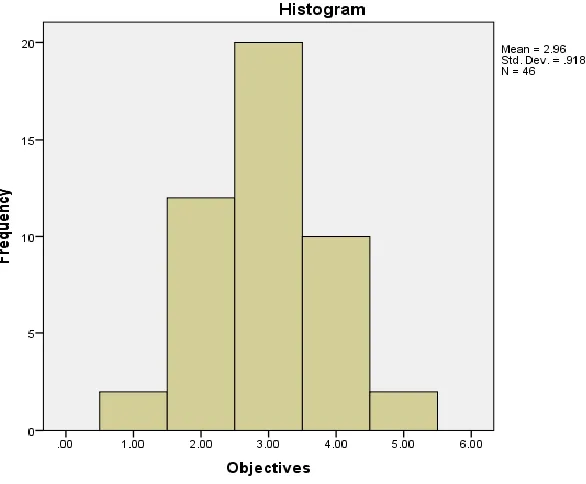
Licensed under Creative Common Page 821 Table 1: Knowledge of objectives of Botho College
Frequency Percent Valid Percent Cumulative Percent
Valid
1.00 2 4.3 4.3 4.3
2.00 12 26.1 26.1 30.4
3.00 20 43.5 43.5 73.9
4.00 10 21.7 21.7 95.7
5.00 2 4.3 4.3 100.0
Total 46 100.0 100.0
Figure 3: Knowledge of objectives of Botho College
Respondents exhibited poor knowledge of objectives of their organisation. For instance, only 12 respondents agreed to the statement that they have knowledge of the college’s objectives, while 20 were neutral, and 14 did not agree with the statement.
Table 2: multi-response_ Strategic Frequencies
Responses Percent of Cases
N Percent
Knowledge of strategic information
Strongly disagree 13 5.7% 28.3%
Disagree 53 23.0% 115.2%
Neutral 103 44.8% 223.9%
Agree 49 21.3% 106.5%
Strongly agree 12 5.2% 26.1%
Licensed under Creative Common Page 822 The table above shows that 73, 5% do not have knowledge of the strategic vision and mission of the college. This is shown as Pearson correlation below.
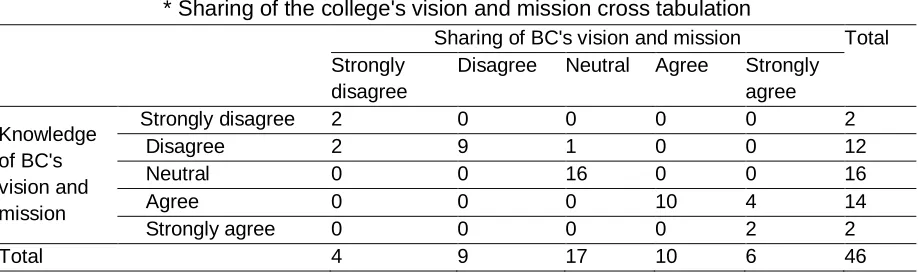
Table 3: Knowledge of the college's vision and mission * Sharing of the college's vision and mission cross tabulation
Sharing of BC's vision and mission Total Strongly
disagree
Disagree Neutral Agree Strongly agree
Knowledge of BC's vision and mission
Strongly disagree 2 0 0 0 0 2
Disagree 2 9 1 0 0 12
Neutral 0 0 16 0 0 16
Agree 0 0 0 10 4 14
Strongly agree 0 0 0 0 2 2
Total 4 9 17 10 6 46
The results show that 10 of the respondents that agree to have knowledge of the vision and mission of the college also agree in sharing that vision and mission. Furthermore, four of those that agree to having knowledge of the vision and mission of the college strongly agree to the sharing of that vision and mission too. Two of them strongly agree to have knowledge of vision and mission of the college and they also strongly agree to the sharing of the same.
Table 4: Symmetric Measures Value Asymp. Std.
Errora
Approx. Tb Approx. Sig.
Interval by Interval Pearson's R .945 .015 19.191 .000c Ordinal by Ordinal Spearman Correlation .970 .013 26.284 .000c
N of Valid Cases 46
a. Not assuming the null hypothesis.
b. Using the asymptotic standard error assuming the null hypothesis.
c. Based on normal approximation.
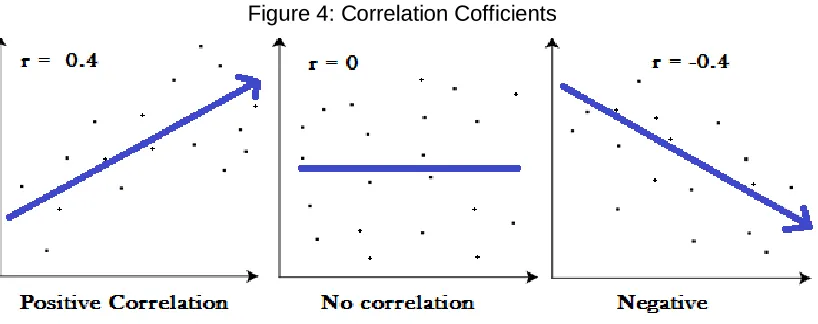
Licensed under Creative Common Page 823 High correlation: .5 to 1.0 or -0.5 to 1.0. These scenarios are shown below.
Figure 4: Correlation Cofficients
As the statistics show an r value is 0.945, this means there is a high correlation between knowledge of vision and mission of the college and sharing of that vision and mission.
Knowledge of organisational processes
Licensed under Creative Common Page 824 that he once got himself into trouble after expelling a misbehaving student from class. The student reported the issue to the Director who gave the Team Leader a verbal warning arguing that there was no policy authorizing lecturers to exclude students from class. Only senior management can do so. What complicates issues of student discipline further is that it involves a number of different departments such as Education, Security, and Students Services yet there is no clear explanation on what role each of these departments plays and at what stage, or where the whole issue is kick started.
Most interviewees indicated that top management is trying hard to improve knowledge of their work. Business programmes Team leaders particularly feel their theoretical knowledge is way above the requirements of their work since they all have Masters’ degrees yet they are all teaching at the foundation year level. They indicated that management tries to improve their knowledge through regular briefings, training, and workshops. However, there is a feeling among most of them that workshops are too few and far between. The diagrams below represent the extent to which at times the college employees are unaware of how to handle certain work processes in the organisation:
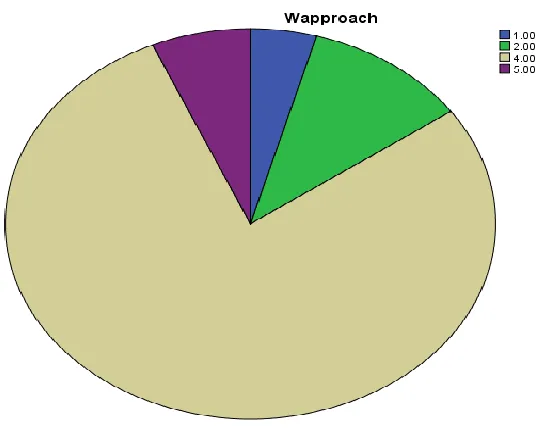
Table 5: Knowledge of the college processes
Frequency Percent Valid Percent Cumulative Percent
Valid
1.00 4 8.7 8.7 8.7
2.00 5 10.9 10.9 19.6
3.00 3 6.5 6.5 26.1
4.00 29 63.0 63.0 89.1
5.00 5 10.9 10.9 100.0
Total 46 100.0 100.0
Licensed under Creative Common Page 825 This question sought to determine the extent to which the college’s employees are well versed with the organisation’s processes while doing their work. Thirty-four respondents agreed with the statement that there are times they are not sure what to do when confronted with some work situations. Only eight respondents believe the statement to be untrue to them.
Information technology (IT) skills
Most college employees have good knowledge of IT skills which is quite commendable as most of the college’s work processes are computer- based. Figure 6 illustrates this scenario from responses to the questionnaire:
Table 6: IT skills
Frequency Percent Valid Percent Cumulative Percent
Valid
Strongly disagree 2 4.3 4.3 4.3
Disagree 4 8.7 8.7 13.0
Neutral 4 8.7 8.7 21.7
Agree 20 43.5 43.5 65.2
Strongly agree 16 34.8 34.8 100.0
Total 46 100.0 100.0
Figure 6: IT skills
Licensed under Creative Common Page 826 However, the figure that does not agree to the statement is still high considering that all respondents came from key process areas and that the institution is technology – based.
Theoretical Knowledge
A good number of the college employees have a good knowledge of their work owing to their good education. Table 7 shows the distribution of respondents by this aspect and whether other employees are aware of this theoretical knowledge:
Table 7: Theoretical Knowledge
Frequency Percent Valid Percent Cumulative Percent
Valid
Strongly disagree 2 4.3 4.3 4.3
Disagree 6 13.0 13.0 17.4
Neutral 4 8.7 8.7 26.1
Agree 25 54.3 54.3 80.4
Strongly agree 9 19.6 19.6 100.0
Total 46 100.0 100.0
Figure 7: Theoretical Knowledge
Licensed under Creative Common Page 827 Explicit and tacit knowledge
Fourteen of the fifteen interviewees indicated that they have access to both explicit and tacit knowledge at the college in the form of written instructions and directives from the Directors, regular emails, telephone calls, the website, several databases such as the Leave Management System, the Student Feedback System, the I-Tracker and others, meetings with their supervisors as well as briefings and workshops. Should they become stuck in their work processes as is normally the case, they always appeal to their immediate supervisors and superiors for guidance. Five Team leaders interviewed feel expertise particularly in some departments such as Assessments, MIS, Technical, Projects Office, and Career Services is too concentrated in the hands of the managers in charge such that in their absence it is difficult to undertake certain processes effectively. A case in point was the previous week when the Assessments Manager did not turn up for work. Two departments failed to access the examination server because the Assessments Team Leader did not have the credentials required to access the data base. The director had to call the Assessments manager from home to get the credentials. When those were accessed, it was discovered that the server could only be accessed from the Assessments manager’s laptop, which he had at home. Someone had to drive there to collect it. The examination started three hours late.
Licensed under Creative Common Page 828 A good number of respondents at the lower rungs of the college agreed to the statement that there are times they are not sure as to whom exactly to approach to solve certain problems related to their work. Table 8 illustrates the distribution of responses on the matter:
Figure 8: Explicit and Tacit Knowledge
Frequency Percent Valid Percent Cumulative Percent
Valid
1.00 2 4.3 4.3 4.3
2.00 5 10.9 10.9 15.2
4.00 36 78.3 78.3 93.5
5.00 3 6.5 6.5 100.0
Total 46 100.0 100.0
Figure 8: Explicit and Tacit Knowledge
Staff development
Licensed under Creative Common Page 829 and 2012. However, all the eleven interviewees who happen to be expatriate staff are of the view that the sponsorship policy is discriminatory as it is too generous to local staff who they feel contribute much less to the development of the institution than expatriate staff. They also feel that the criteria used to select beneficiaries is not clear or is absent, leaving it to the discretion of the directors to decide who they want to sponsor or who they do not.
CONCLUSIONS
The results of the audit of the higher education institution, focusing on its core processes, revealed knowledge gaps that need to be filled. Strategic knowledge among organisational employees is inadequate, and there is need for institutional top leadership to conduct workshops to educate employees on the vision, mission, and objectives of the institution, and motivate them to believe and support the vision, mission, and objectives of the organisation. This view is supported by O’Dell and Grayson (1998) who argue that vision plays a crucial role in propagating knowledge sharing and that knowledge of overall organisation’s vision generates a clear organisational purpose so that it can achieve its desired future goals, which in turn, are important to engender a sense of involvement and contribution among employees.
The research discovered that while knowledge of organisational processes is reasonably good, there is still much room for improvement. The findings confirmed that a sizeable number of employees, including those in middle, lower, and even top management lack effective theoretical and practical knowledge of the college’s organisational processes. The net effect of this scenario is hampering of the productivity and performance of such employees in particular and the organisation in general. There is therefore need for more induction and enhancement of both explicit and tacit knowledge of organisational processes among employees at all levels of the organisation.
Licensed under Creative Common Page 830 is usable for gaining knowledge. This view is reinforced by Hansen et al (2009) who posit that IT enables codification of knowledge through common storage in order to achieve economic reuse of knowledge (electronic knowledge repositories). IT also enables personalisation of knowledge where more tacit and unstructured knowledge is shared largely through direct personal communication, and here IT helps people to locate each other and communicate so as to achieve complex knowledge transfer (Huang and Pan, 2010).
Though the contribution of this study to the genre of knowledge management is immense, it is useful to acknowledge the existence of limitations that leave room for further research. The most obvious limitation is that the study was a knowledge audit of a single higher education institution and the results of the study may not be generalisable to all similar institutions. However, at least in learning institutions, the results should be valuable. Without the prohibition of cost and time, a larger sample would have rendered the results much more reliable than they are. Qualitative research is particularly subject to researcher bias although the researcher tried to reduce the effect of bias by approaching the discussion objectively. Due to cultural differences of the respondents, further research is required focusing on different cultural dimensions and how they influence KM processes.
REFERENCES
Alavi, M, and Leidner, D, (2001), “Knowledge Management and knowledge management systems: Conceptual foundations and research issues”, MIS Quarterly, Vol. 25, (1) p.107.
Becerra-Fernandez I, (2004), Knowledge Management: Challenges, Solutions, and Technologies, New Jersey: Prentice-Hall.
Becker, M.C, and Knudsen, M.P, (2000), Intra and Inter organisational Knowledge Transfer Processes: Identifying the missing links, DRUID working paper 06‐32, Copenhagen Business School, Copenhagen.
Boisot, M.H, (1999), Knowledge Assets: Securing Competitive Advantage in the Information Economy. Oxford: Oxford University Press.
Chong, Y.Y.D (2004) Re - Thinking knowledge audit: Its values and limitations in the evaluation of organisational and cultural Assets, The Hong Kong Polytechnic University, Kowloon, Hong Kong.
Chua, A, and Lam, W, (2005), “Why Knowledge Management Projects Fail: A Multi – Case Analysis”, Journal of Knowledge Management, Vol.9, Issue 3.
Davenport, T.H, and Prusak, L, (1998), Working Knowledge: How organisations Manage what they know, Harvard Business School Press.
Debenham, J. and Clark, J.(1994) “The knowledge Audit”, Robotics and Computer Integrated Manufacturing Journal, Pergamum Press, Vo. 11, No. 3, pp. 68.
Debowski, S.,(2006), Knowledge Management, Milton: John Wiley and Sons, QLD.
Donnelly, T.W. (2008) “Knowledge Management and the strategic leader”, Journal of Knowledge Management, Vol. 8, no. 1, pp. 234.
Licensed under Creative Common Page 831 Hansen, M.T. et al., (2009) “What’s your strategy for managing knowledge?”,Harvard Business Review, Vol.77, no. 2, pp. 112.
Huang, J.C. and Pan, S.L. (2010) “Learning from an oil giant: Case evidence from British Petroleum Amocos”, KM programme”, Journal of Information Technology Management, Vol. 11, no. 2, pp. 48.
Hylton, A., (2012) “Knowledge auditing” in Introduction to knowledge management, Community knowledge: http://www.communityknowledge.co.uk, [accessed 12 May 2015]
Kokemuller, N. (2013) “How technology and communication affect Knowledge Management”, Journal of Knowledge Management, Vol 10, no. 3, pp. 113.
Kothari, C. R. (2011) Research methodology: Methods and Techniques, New Delhi, New Age International Publishers.
O’Dell, C, and Grayson, C, (1998) “If Only We Knew What We Know: Identification and Transfer of Internal Best Practices”, California Management Review, Vol. 40, no. 5, pp.32-48.
Paramasivan, T, (2003) “Knowledge Audit”, The Chartered Accountant, Vol. 5, no. 1, pp. 19-31.
Perez-Soltero, A., Barcelo-Varenzuela, M., Sanchez-Schmitz, G., Martin-Rubio, F. and Palma- Mendez, J.T. (2007) “A model and methodology to knowledge auditing considering core processes”, The Icfai Journal of Knowledge Management, Vol.5, no. 1, pp. 17-31.
Prinz, B. and Syri, K. (2007), “The new organisational wealth: Managing and measuring knowledge-based assets”, San Francisco: Berret-Koehler Publishers.