c
Owned by the authors, published by EDP Sciences, 2010
Neutron-induced capture cross sections via the
surrogate reaction method
M. A¨ıche1,a, G. Boutoux1, B. Jurado1, G. Barreau1, N. Capellan1, I. Companis1,8, S. Czajkowski1,
D. Dassi´e1, B. Haas1, L. Mathieu1, A. Bail2, E. Bauge2, J.M. Daugas2, T. Faul2, L. Gaudefroy2,
V. M´eot2, P. Morel2, N. Pillet2, O. Roig2, J. Taieb2, C. Th´eroine2, O. S´erot3, F. Gunsing4, J.T. Burke5, X. Derkx6, and L. Tassan-Got7
1 CENBG, CNRS/IN2P3, Chemin du Solarium, BP. 120, 33175 Gradignan, France 2 CEA – DAM DIF, 91297 Arpajon, France
3 CEA Cadarache, DEN/DER/SPRC/LEPh, 13108 Saint Paul-lez-Durance, France 4 CEA Saclay, DSM/DAPNIA/SPhN, 91191 Gif-sur-Yvette, France
5 LLNL, US Department of Energy, Livermore, California 94551, USA
6 Grand Acc´el´erateur National d’Ions Lourds, Bld. Henri Becquerel, BP. 55027, 14076 Caen, France 7 Institut de Physique Nucl´eaire, 15 rue Georges Clemenceau, 91406 Orsay, France
8 HHNIP and Nuclear Engineering, PO Box MG-6, 077125 Bucharest-Magurele, Romania
Abstract. The surrogate reaction method is an indirect way of determining cross sec-tions for nuclear reacsec-tions that proceed through a compound nucleus. In this method, the compound nucleus is produced via an alternative (surrogate) reaction and its decay (by fission, gamma or neutron emission) is measured in coincidence with the outgoing ap-propriate charged particle. This technique has enabled neutron-induced cross sections to be extracted for nuclear reactions on short-lived nuclei that otherwise could not be mea-sured. The CENBG collaboration has successfully applied this technique to determine the neutron-induced fission cross sections of several short-lived nuclei such as233Pa,242,243Cm
and241Am. These data are very important for the development of the Th/U cycle and for
minor actinide transmutation. We currently investigate whether this powerful technique can also be used to determine the neutron-induced capture cross sections. For this purpose we will use the surrogate reaction174Yb(3He,pγ)176Lu to infer the well known175Lu(n,γ)
cross section and compare the results with the directly measured neutron-induced data. The experimental set-up and the first results will be presented. We will also discuss our future plans to use the surrogate method for extracting actinides (n,γ) cross sections.
1 Introduction
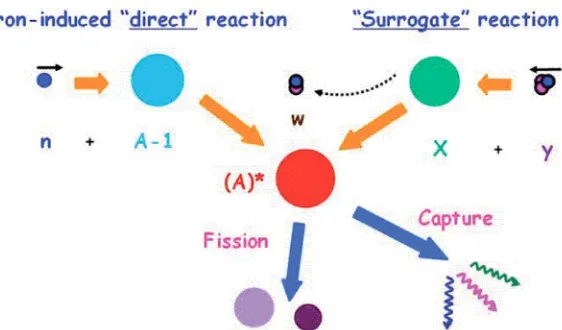
Neutron-induced cross sections of short-lived nuclei are of great interest in applied science and fun-damental physics. However, very often such cross sections are very difficult to measure directly due to the fabrication issues on account of the radioactive decay of the targets. These difficulties can be overcome with the so called surrogate reaction technique, developed in the 1970’s by Cramer and Britt [1]. It consists of obtaining neutron induced cross-sections by measuring the decay probability of a compound nucleus (e.g., fission, neutron emission, or radiative capture) produced via an alternative (surrogate) reaction. In this work the surrogate reaction used is a few nucleon transfer reaction, as illustrated in Figure 1.
ae-mail:[email protected]
Fig. 1.Schematic representation of the surrogate reaction method. The surrogate reaction is here a transfer reaction X(y,w)A*. Three possible exit channels (fission,γ,nγ) are also represented.
The left part of Figure 1 represents the desired neutron-induced reaction on the target A-1, which leads to the compound-nucleus A at an excitation energy E*. The nucleus A can decay through dif-ferent exit channels: fission, neutron emission, etc. . .On the right part of Figure 1, in the surrogate reaction method, the same compound nucleus A is produced by a transfer reaction between a projectile y (a light charged particle) and a target X. In the exit channel of the transfer reaction (y+X→A+w) we have the heavy recoil nucleus A and an outgoing particle w (proton, deuton, triton, etc). The iden-tification of the ejectile w permits to determine the mass A and charge Z of the decaying nucleus. In addition, we can deduce the excitation energy E* of the compound nucleus A by measuring the kinetic energy and the emission angle of the ejectile w. Experimentally, the detection of the ejectile w, in coincidence or not, with a given decay product (e.g., fission fragments or gammas) of the compound nucleus A* gives the decay probabilityPAdeca,expy(E∗) of the given reaction channel. According to the sur-rogate reaction method, the measurement of the fission or capture probability permits to determine the neutron-induced cross section for the nucleus A-1 as follows:
σA−1
decay(En)=σCNA (En)·P A,exp
decay(E∗) (1)
whereσA
CN(En) is the compound nucleus formation cross section in the desired reaction (formation of the nucleus A after a neutron absorption with an energy En). In our case,σCNA (En) is obtained from the optical model calculations performed with the TALYS code [9]. One of the biggest interest of the surrogate method is that in some cases the targets needed are less radioactive than the target A-1 of the desired reaction.
An important issue to be investigated in the context of surrogate reactions is the difference between the distributions in spin and parity (J,π) of the states populated in the desired and surrogate reactions, a problem referred to as the Jπ population mismatch in the litterature [2]. Since the Jπ population influences the decay probabilities of the compound nucleus, one would expect differences between the decay probabilities measured in surrogate and in neutron induced experiments. However, in the Weisskopf-Ewing limit, the decay probability is independent of the spin and parity of the compound nucleus and eq. 1 is valid. The conditions under which the Weisskopf-Ewing limit applies have been investigated in Refs [3]. This limit holds when the excitation energy is sufficiently high for the de-cay widths to be dominated by the statistical level density. Neutron induced fission cross sections of
233Pa [12], 242Cm and 243Cm [13] have been obtained by the CENBG collaboration with this
compared to fission, may be more sensitive to the difference of spin-parity distributions populated in neutron-induced and surrogate reactions. Our aim is to study the transfer reaction174Yb(3He,p)176Lu
as surrogate for the175Lu(n,γ) cross sections. We have considered the175Lu(n,γ) cross section since
it presents the advantage to be one of the best known capture cross sections, see for example [5, 6]. Lutetium isotopes have attract considerable interest in astrophysics due to their importance to s-process studies but also in the interpretation of radiochemical activation in the inertial confinement of fusion experiments.
2 Capture probability of
175Lu
2.1 Experimental set-up
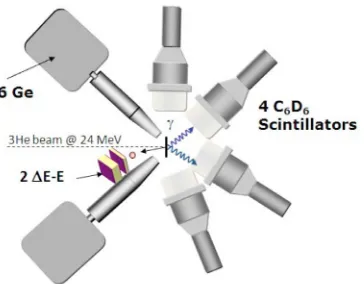
We performed the174Yb(3He,p) measurement at theTandem accelerator at the IPN Orsay in March 2010. We used an energy of 24 MeV for the incident3He ions beam with an intensity of 20 nA. To infer the capture probability, gammas rays are detected in coincidence with the ejectiles. The latter are fully identified by two large area∆E-E telescopes placed symmetrically at 130◦with regard to the
3He beam. The E detectors are two Si(Li) 3000µm detectors. The∆E detectors are two 300µm silicon
position sensitive detectors, whose 16*16 X-Y strips [7] provide the angle of the detected ejectile with an angular coverage of 108◦ to 152◦. Notice that we shield the Si detectors with an electrostatic Mylar(Al) screen made of 3µm negatively biased at 300 V in order to prevent the interaction of thermal electrons with the telescopes. We use a set of four C6D6 liquid scintillators for gamma detection.
The total number of gamma cascades can be obtained with these detectors by using the total energy detection principle in combination with the pulse height weighting technique. The advantage of this technique is that it allows one to determine the gamma-cascade detection efficiency independently of the level scheme of the decaying nucleus. The same technique was used to obtain the233Pa(n,γ)
cross section [8]. Notice that the coupling of these detectors to a pulse shape discriminator permits to separate between photons and neutrons interacting with the scintillators. The174Yb target is also
surrounded by six germanium detectors. They are used to measure low-lying-ray transition intensities as a function of the compound nucleus excitation energy, which is an experimental way to investigate the difference in spin distributions between transfer and neutron-induced reactions. Figure 2 illustrates our experimental set-up.
2.2 Preliminary data analysis
The identification of the light charged particles and the determination of their energy and scattering angle is achieved in the Si detectors. With this information and the related Q-values, the excitation
E* (MeV)
5.5 6 6.5 7 7.5
Pgamma
0 0.2 0.4 0.6 0.8 1 1.2
Telescope 1
Telescope 2
Sn
PRELIMINARY RESULTS
Fig. 3.Preliminary results: Experimental Pγfor the neutron-induced radiative capture of175Lu.
energy E* of the corresponding compound nucleus is determined. The experimental radiative capture probability P(n;γ)(E*) of176Lu can be obtained in the following way:
Pn,γ(E∗)=Ncoinc(E∗)/(Nsingle(E∗)·εγ(E∗)) (2)
whereεγ represents the C6D6 photon detection efficiency, Ncoinc(E*) are the number of protons
de-tected in coincidence with one of the C6D6detectors and Nsingle(E*) the total number of protons, i.e.
the number of176Lu formed. Since the nucleus176Lu is formed by a transfer reaction, it is possible
to extend our investigation below neutron separation energy Sn corresponding to E∗ = 6.29 MeV
where onlyγ-rays can be emitted and consequently the measured emission probability should be 1 (see Fig. 3).
Below the neutron separation threshold, the ratio Ncoinc(E*)/Nsingle(E*) gives the total C6D6
de-tectors efficiency. This ratio is of around 15% (±3%) and remains constant from E*=5.5 MeV to Sn.
Assuming that this preliminary value for the efficiency independent of excitation energy also above Sn
we obtain the probability for emitting a gamma cascade of176Lu as a function of E* (Figure 3). Our
data are compared with a TALYS calculation for the neutron-induced capture probability of175Lu [9]. The parameters of the code have been tuned to reproduce the experimental data for the 175Lu(n,γ)
cross sections. The preliminary results of Figure 3 show that our data agree rather well with the calcu-lation right above the neutron separation energy. Nevertheless, our data are clearly above the capture probability for E* >6.5 MeV. This is caused by the opening of the neutron-inelastic decay channel (nγ), which has not yet been substracted from our data. Our aim is to determine the efficiency for detecting a gamma cascade independently by using the weighting function technique, which requires
0 200 400 600 800 1000 1200 1400 1600 1800
300 400 500 600 700 800 900
E* (10keV/canal) Iγ
343 keV (175Lu) 70 keV (176Lu) 192.2 keV (176Lu)
complete knowledge of the response functions for the C6D6 detectors for a large range of gamma
energies. These have been determined experimentally using gamma-ray sources, inelastic scattering reactions and transfer reactions on light nuclei, as explained in [10]. Simulations, using MCNP 4C2 and GEANT4 transport codes, permit to build response functions of the C6D6 detectors for
unmea-sured gamma energies. This work remains to be done.
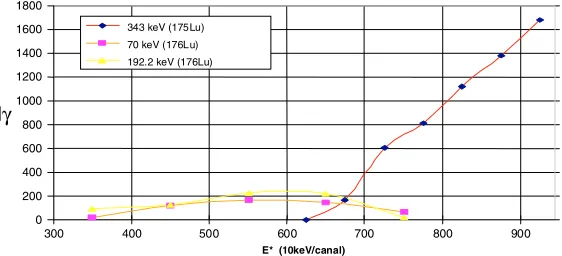
On the other side, Germanium detectors are used for the detection of discrete low-lying γ-rays emitted by the residual nucleus in coincidence with the proton ejectile. This information will be useful to constrain reaction deexcitation models and infer the calculated level spin distribution. The latter requires modelling the decay of the compound nucleus and fitting the relevant parameters of the spin distribution to reproduce the experimental data. In addition,γ-ray intensity ratios of isomeric states can be measured. This observable is very sensitive to the spin distribution and has the advantage that it can be directly compared to the same quantity measured in a neutron-induced experiment. The population of the (nγ) low-lying state of the175Lu in the present measurements is nicely illustrated
by the disappearance of theγtransition 5/2+→7/2+343 keV at E*=Sn=6.29 MeV (Fig. 4). Finally, the use of germanium detectors will also considerably help in the identification of the decaying nucleus. The prompt and delayed Germanium spectra observed experimentally are in good agreement with previous studies [11]. As mentioned above, with C6D6 detectors alone it is not possible to disentangle between a gamma arising from the (3He,p) and from the (3He,pn) reaction. Statistical model calculations are used to correct for this effect. However, with the Germaniums we can measure excitation functions for certain low-lying transitions related to the (3He,pn) reaction. These excitation functions represent a precious piece of information for improving the models used to correct data of Figure 3 for this effect.
3 Conclusion and perspectives
We have performed an experiment to study the validity of the surrogate method for extracting capture cross sections. We have used the well known175Lu(n,γ) cross section to test the174Yb(3He,p) reac-tion. Our experimental set-up uses C6D6scintillators for determining the capture probability. The use
of germanium detectors will allow us to extract information on the spin-parity distribution of the pop-ulated states. Ge detectors will also be useful in order to correct the measured gamma probability from
174Yb(3He,pn) events. First preliminary results have been presented. The analysis of the other transfer
channels (d, t andα) will also allow us to extract the (n,γ) cross sections for174Lu (T1=2=3.31y),
173Lu(T1=2=1.37y) and172Yb.This experiment is extremely important in view of the application of
the surrogate method to infer capture cross sections of minor actinides, which are crucial for nuclear waste incineration. In the future, we plan to use the237Np(n,γ),238U(n,γ) and232Th(n,γ) cross sections
to validate the238U(3He,t)238Np,238U(d,p)239U and232Th(d,p)233Th surrogate reactions respectively.
Finally, we would like to stress that the surrogate approach is very general and in principle can be employed to determine cross sections for all types of compound-nuclear reactions on a large variety of nuclei and applications (such as astrophysics, nuclear fusion, etc. . .).
This work was supported by the CNRS program PACEN/GEDEPEON and the EURATOM 6 Framework Pro-gramme European Facilities for Nuclear Data Measurements. (EFNUDAT), contract number FP6-036434.
References
1. J.D. Cramer, H.C. Britt,Nucl. Sci. and Eng.,41, 177 (1970) 2. J. Escher, F.S. Dietrich,Phys. Rev. C,74, 054601 (2006) 3. W. Younes, H.C. Britt,Phys. Rev. C,67, 024610 (2003)
4. B. Jurado et al.,Conf. Proceedings of CNR*09, Bordeaux 2009, 06004 (2010) 5. K. Wisshak et al.,Phys. Rev. C,73, 015807 (2006)
6. M. Heil et al.,Nucl. Instr. Meth. A,459, 229 (2001)
8. S. Boyer et al.,Nucl. Phys. A,775, 175 (2006) 9. A.J. Koning, S. Hilaire, et al.,User Manual Talys
10. J.N. Wilson et al.,Nucl. Inst. Meth. A,511, 388 (2003) 11. W. Andrejtsche et al.,Nucl. Phys. A,226, 142 (1974) 12. M. Petit et al.,Nucl. Phys. A,735, 345 (2004)