IJSRR, 7(3) July – Sep., 2018 Page 2086
Review article
Available online www.ijsrr.org
ISSN: 2279–0543
International Journal of Scientific Research and Reviews
A Novel Shade to Obtain an Optimal Solution to a Fully Fuzzy Linear
Programming Problem
Sundari M. Shanmuga
Department of Mathematics,Faculty of Science and Humanities,
SRM Institute of Science and Technology, Kattankulathur, Chennai - 603203, India.
Email: [email protected]
ABSTRACT
A different shade provided in this paper, is to find an optimal solution of a fully fuzzy linear programming problem. A different ranking method is provided for solving linear programming problem in a fuzzy uncertain environment. The proposed method is easy to understand and to apply for fully fuzzy linear programming in real life and flexible as compared to the existing one. Advantages of the proposed method over existing methods are discussed and to illustrate this method, a numerical example is solved and results are also discussed.
KEYWORDS:
Fuzzy sets, Fuzzy number, Trapezoidal Fuzzy number, Fuzzy arithmetic, Fuzzy Ranking.*Corresponding author
Dr. M. Shanmuga Sundari
Department of Mathematics,
Faculty of Science and Humanities,
SRM Institute of Science and Technology,
Kattankulathur, Chennai - 603203, India.
IJSRR, 7(3) July – Sep., 2018 Page 2087
1. INTRODUCTION
A typical mathematical program consists of a single objective function, representing either
profits to be maximized or costs to be minimized and a set of constraints that circumscribe the
decision variables. Decision making under fuzzy environment was first proposed by Bellman and
Zadeh 1 The idea was adopted by several authors for solving fuzzy linear programming problems.
Zimmermann2 proposed an application of fuzzy optimization techniques to linear programming
problem with single and multi-objective functions Rommel fanger et al3. Fang and Hu4, Maleki et
al5, Maleki6 and Khan et al7 are studies where the objective functions, the decision variables, the
technical coefficients and the constraints are fuzzy numbers respectively. All these studies
considered fuzzy linear programming problems in which some of the parameters are crisps. Nasseri
et al8 and Amiri and Nasseri9 are some examples utilizing ranking function method for solving
linear programming problems without converting the problem to its crisp equivalent. The FLP
problem is said to be a fully fuzzy linear programming (FFLP) problem if all parameters and
variables are considered as fuzzy numbers. Recently, two methods have been introduced to solve the
FFLP problems by Lotfi et al10 and Kumar et al11. In the first method10 the parameters of FFLP
problem have been approximated to the nearest symmetric triangular fuzzy numbers. After that, a
fuzzy optimal approximation solution has been achieved by solving a multi objective linear
programming (MOLP) problem. As a resulting the optimal solution of FFLP is not exact. So, it is not
reliable solution for decision maker. In the second method11 an exact optimal solution is achieved
using a linear ranking function. In this method, by the above ranking has been used to convert the
fuzzy objective function to the crisp objective function. By this method, fuzziness of objective
function has been neglected by the linear ranking function so by this method the originality
of the problem will get changed . Now Our ultimate aim is to solve the given FFLPP without
sacrificing the originality of the problem that means without converting them to a classical one. So in
this paper we provide a new version of solving FFLPP. In general, most of the existing methods
provide only crisp solutions for the fully fuzzy linear programming problem. In this paper we
propose a simple method, for the solution of fully fuzzy linear programming problem without
converting them in to classical fully fuzzy linear programming problem. The rest of this paper is
organized as:In section 2, we recall the basic concepts and the results of trapezoidal fuzzy numbers
and their arithmetic operations. In section 3, we define fully fuzzy linear programming problem and
prove some of the important theorems, related results and also fuzzy version simplex algorithm is
IJSRR, 7(3) July – Sep., 2018 Page 2088 for the fully fuzzy linear programming problem without converting them to classical linear
programming problem and the results obtained are discussed.
2 PRELIMINARIES
The aim of this section is to present some notations, notions and results which are of useful in
our further consideration.
2.1 Fuzzy number
A fuzzy set à defined on the set of feal numbers R is said to be a fuzzy number if its
membership function : 0 ,1
A R
has the following characteristics
(i) Ã is normal. It means that there exists an xR such that 1
A
x
(ii)A is convex.
1 2
1 2 1 2
A A A
It m e a n s th a t fo r e v e ry x , x R ,
x 1 x m in x , x , 0 ,1
(iii) A is upper semi continous.
(iv)supp (A) is bounded in R.
2.2 Trapezoidal Fuzzy Number
A trapezoidal fuzzy number à is denoted as à = a , a , a , a 1 2 3 4and is defined by the
membership
function
1
1 2
2 1
A
4
4
4 3
2 3
3
o t h e r w i s e
x - a
, a x a a - a
1, a x a ( x )
a - x
, a x a a - a
0 ,
We use F(R) to denote the set of all trapezoidal fuzzy numbers. Also if m ( A ) represents the
mid point, w ( A ) represents the width, ( a2 a )1 represents the left spread and ( a4 a )3
represents the right spread of the trapezoidal fuzzy number Ã, then the trapezoidal fuzzy number Ã
IJSRR, 7(3) July – Sep., 2018 Page 2089
2.3 Ranking of trapezoidal fuzzy numbers
Several approaches for the ranking of fuzzy numbers have been proposed in the literature. An
efficient approach for comparing the fuzzy numbers is by the use of a ranking function based on their
graded means. That is, for every : F R Rwhich maps each trapezoidal fuzzy number into a real
number, where a natural order exists
For every trapezoidal fuzzy number à = a , a , a , a 1 2 3 4
, ranking function : F R R is
defined by graded mean as
2 3
( ) ( )
2 4
a a
A
For any two trapezoidal fuzzy numbers à = a , a , a , a 1 2 3 4 and B b1,b2,b3,b4
we have the
following comparison
i A B i f a n d o n ly i f A B
i i A B i f a n d o n ly i f A B
i i i A B i f a n d o n ly i f A B
i v A B 0 i f a n d o n ly i f A B 0
A trapezoidal fuzzy number A a1,a2,a3,a4 F R
is said to be positive if A 0
Also 0
0
A if A
and A 0 if A 0
If A B then the trapezoidal fuzzy numbers A a n d B are said to be equivalent and it is denoted
by A B .
2.4 Arithmetic operations on trapezoidal fuzzy numbers
For any two arbitrary trapezoidal fuzzy numbers à a , a , a , a 1 2 3 4( m ( à ), w ( à ), , )
, the
arithmetic operations are defined as follows:
(i). Addition: A B ( m ( A ) m ( B ), m a x w ( A ) , w ( B ) , m a x ( 1,2), m a x (1,2) )
(ii). Subtraction: AB ( m ( A )m ( B ), m inw ( A ) , w ( B ) , m in ( 1,2), m in ( 1, 2) )
)
(iii). Multiplication: A B ( m ( A ) m ( B ), m a x w ( A ) , w ( B ) , m a x ( 1,2), m a x (1,2) )
IJSRR, 7(3) July – Sep., 2018 Page 2090
3 MAIN RESULTS
3.1 General form of Fully Fuzzy Linear Programming
Optimize (m a x o r m in ) z( c x11c2x2c3x3...cnxn)
subject to the following constraints,
1 1 1 1 2 2 1 3 3 1 n n 1
2 1 1 2 2 2 2 3 3 2 n n 2
3 1 1 3 2 2 3 3 3 3 n n 3
m 1 1 m 2 2 m 3 3 m n n m
a x a x a x . . . a x , , b
a x a x a x . . . a x , , b
a x a x a x . . . a x , , b
. . . . . . . . . . . . . .
a x a x a x . . . a x , , b
...(1)
where
(i). x , x1 2 , x3 ... , xn are fuzzy decision variables.
(ii). c , c , c , ... c1 2 3 n are called fuzzy cost or fuzzy profit coefficients.
(iii). ai j ; i 1, 2 , 3 ....m , j 1, 2 , 3 ...n are called structural fuzzy
coefficients.
(iv). b , b , b , . . . , b1 2 3 m
represent fuzzy requirements or fuzzy availability of
m constraints.
(v). The expression
, ,
means that each constraint may takeonly one of the three possible forms.
(vi). The restrictions x j 0 simply implies that the x j must be non
negative.
That is (m a x o r m in ) zc x
IJSRR, 7(3) July – Sep., 2018 Page 2091
1 X n
1 2 3 n
n X 1
1 2 3 n
m X 1
1 2 3 m
1 1 1 2 1 n
2 1 2 2 2 n
i j m x n
m 1 m 2
w h e r e c c , c , c , . . . c F ( R )
x x , x , x . . . , x F ( R ) ; b b , b , b , . . . , b F ( R ) a n d
a a . . . a a a . . . a A ( a ) . . . .
. . . . a a . . . a
m x n
m n
( F ( R ) )
Definition 3.1. The standard form of fully fuzzy linear programming
problem is defined as (m a x o r m in ) zc x
subject to A x b a n d x 0
Definition 3.2. Any n X 1
1 2 3 n
xx , x , x ... , x F ( R ) where
each xi F ( R ) which satisfies the constraints and non-negativity
restrictions of (1) is said to be a fuzzy feasible solution to (1).
Definition 3.3. Let S be the set of all fuzzy feasible solutions of (1).
A fuzzy feasible solution x0S is said to be a fuzzy optimum solution
to (1) if c x0c x fo r a ll x S w h e re c c , c , c , ... c1 2 3 n and
1 1 2 2 3 3 n n c x c x c x c x ...c x .
Definition 3.4. Let xx , x1 2, x3 ... , xn. Suppose x solves A xb
. If all
j j j j j
x ( m ( x ), w ( x ), , ) 0 for all j=1,2,...,n, then x is said
to be a fuzzy basic solution. If not, x has some non-zero components,
say x , x1 2, x3 ... , xk ,1k n . Then A xb
can be written as:
1 1 2 2 3 3 k k
1 1 2 2 3 3 k k k 1 k 1 k 2 k 2 n n
j
a x a x a x ... a x b
a x a x a x ... a x a x a x .... a x b
w h e r e x 0 f o r a ll j k 1, k 2 , ...n
If the columns a , a , a , ....a1 2 3 k corresponding to these non-zero components x , x1 2, x3 ... , xk are linearly
independent, then x is said to be a fuzzy basic solution.
Theorem 3.1. Let 1
B
x B b be a fuzzy basic feasible solution of
(2). If for any column aj in A w h ic h is n o t in B , the condition
IJSRR, 7(3) July – Sep., 2018 Page 2092
one of the columns in B by aj
. Proof
Suppose that
1 2 3
, , ...
m
B B B B B
x x x x x be a fuzzy basic feasible solution with k positive
components such that
B
B x b or
1
B
x B b
, , ,
0 1, 2 , ... 0 1, 2 , ...i i i
i
i i
B B B
B
w h e r e x m x w x f o r i k
a n d x f o r i k k m
Now equation B x B b becomes
1 1
0 ...(3 )
i
k m
B
i i k
x b b b
Then for any column aj of A which is not in B , we write
m
j i j i 1 j 1 2 j 2 r j r m j m j i 1
a y b y b y b ... y b ... y b y B
We know that if the basis vector br
for which
r j
y 0 is replaced by
j
b of A then the new set of vectors
1 2 3 r 1 j r 1 m
b , b , b , ..., b , b , b , ...b still form a basis. Now for
r j
y 0and r ≤ k, we can write
1 ,
1 1
m
j i j
i i r
r j r j
k m
j i j i j
i i k
r j r j r j
a y
b b
y y
a y y
b b
y y y
IJSRR, 7(3) July – Sep., 2018 Page 2093
1 , 1
1 , 1 1 1
1 , 1 . 1
0
0
i r
i r
r r r
i
k m
i r
B B
i i r i k
k k m m
j i j i j
i i i i
B B
i i r r j i r j i k r j i k
k k m
B B B
i j i j i i j
B
i i r r j r j i i r r j i k
x b x b b b
a y y
x b x b b b b
y y y
x x x
x b a y b y
y y y
1
1 , 1 1
1 ,
0
0
S i n c e 0 ; f o r i = k + 1 ; k + 2 , . . . m , w e h a v e
r r r
i i r i m i i i k
k m m
B B B
i j i j i j
B
i i r r j r j i k r j i k
B k
B
i j i
B
i i r r j
b b b
x x x
x y b a y b
y y y
x
x
x y b
y
1 1
1 ,
1 ,
ˆ ˆ . . . ( 4 )
ˆ ; r r i r r i i r r i i m m B B
j B i j
i k i k
r j r j
m
B B
i j i j
B
i i r r j r j
m
i j
B B
i i r
B i j
B B
r j
x x
a x y b
y y
x x
x y b a b
y y
x b x a b
x
w h e r e x x y
y ˆ r r B B r j i r x x y
which gives a new fuzzy basic solution to A x b . We shall show that this new fuzzy basic solution
is also feasible. This requires that
0 ;
0
0 m i n ; 0
m , , , m , ,
r i r i r i r i i r r B i j B r j B r j B B
r j i j
r j i j
B B
r j i j
B B
B B r r
r j r j r j r j i j i j
x
x y i r
y x
y
x x
S e l e c t y s u c h t h a t y
y y x x y y x x x x w w
y y y y y y
,
m , , , m , , , 0
m m , m i n ,
i i r r
i r i
i i
i j i j
B B i i B B r r
i j i j i j i j r j r j r j r j
B B B B
i j r j i j
y y
x x x x
w w
y y y y y y y y
x x x x
w w
y y y
, m i n , , m i n , 0
0
r
i r
i r i r
r j i j r j i j r j
B B
i j r j
y y y y y
x x y y
Hence the new fuzzy basic solution is a fuzzy basic feasible solution.
IJSRR, 7(3) July – Sep., 2018 Page 2094 problem is convex.
Proof
Let SF0
denote the set of optimal solution
. If SF0
is empty or singleton , then it is convex.
Let SF0
contain more than one solution say
0
1 2 F
x , x S
Then c x1c x2 m a x z
Consider convex combination of x , x1 2as
0
0 1 2
0 1 2
1 2
0 F
W x 1 x
c W c x 1 x
c x 1 c x
m a x z 1 m a x z m a x z
W S
HenceSF0
is convex.
3.3 Fuzzy version of simplex algorithm
Step 1: Formulate the Fuzzy linear programming problem for the given data.
Step 2:Express the FFLP in the standard form by adding slack variables in the left hand side of less than or equal to constraint as well as
to the objective function.
Optimize ( m a x o r m in ) z( c x1 1c2x2c3x3...cnxn) 0 s10 s20 s3....0 sm
subject to the fuzzy linear constraints,
1 1 1 1 2 2 1 3 3 1 n n 1 1
2 1 1 2 2 2 2 3 3 2 n n 2 2
3 1 1 3 2 2 3 3 3 3 n n 3 3
m 1 1 m 2 2 m 3 3 m n n m m
1 2
a x a x a x . . . a x s b
a x a x a x . . . a x s b
a x a x a x . . . a x s b
. . . . . . . . . . . . . .
a x a x a x . . . a x s b
a n d x , x , x
3 . . . , x n , s1, s2, . . . .sm 0
Where s , s , ...s1 2 mare slack variables which have been assigned zero
fuzzy coefficient in the objective function.
IJSRR, 7(3) July – Sep., 2018 Page 2095 Before the initial simplex tableau can be set up obtain the initial
Feasible solution By setting x1 x2 x3... xn 0
such that in
the constraint set, we get
1 1 2 2 3 3 m m
s b , s b , s b ..., s b
Step 4:Set up the initial tableau
Step 5:Test for optimality
If all the elements in the cjzj are negative or equal to zero then the
current solution is optimal.If there exists some positive fuzzy number
,the current solution can be improved by removing one basic variable
from the basis and replacing it by some non basic one.
Step 6:Revising simplex tableau At each iteration ,the simplex method moves from the current basic feasible solution to a better basic feasible
solution.
(i)Determine the entering variable.
(ii) Determine the leaving variable.
(iii)Identify the pivotal number.
Step 7: construct a new simplex tableau. (i) Compute new values for the pivotal row.
(ii) compute fresh values of the remaining rows as
N e w r o w n u m b e r O ld r o w n u m b e r e le m e n t in th e p iv o t r o we le m e n t in th e p iv o t r o w p iv o t n u m b e r
Step 8:Test the optimality
Step 9:If any of the numbers in cjzjrow are positive, repeat the
entire step 5 and 6 again.This process is repeated until an optimal
solution has been obtained.
4 Numerical Examples
The following examples are taken from the paper solving fully fuzzy linear
programming problem with inequality constraints by Amit Kumar,
Jagdeep Kaur [3].
Example 4.1. Solve m a x z1, 3, 5, 7x1 2 , 4 , 6 , 8x2 Subject to the constraints,
1 2
1 2
0 , 2 , 4 , 5 1, 2 , 3 , 4 1, 1 0 , 2 7 , 4 8 2 , 4 , 5 , 6 2 , 4 , 6 , 8 4 , 2 0 , 4 5 , 8 0
x x
x x
IJSRR, 7(3) July – Sep., 2018 Page 2096
Solution
First we convert the trapezoidal fuzzy number à a , a , a , a 1 2 3 4( m ( à ), w ( à ), , )
1 2
m a x z 4 ,1, 2 , 2 x 5,1, 2 , 2 x
Subject to the constraints,
1 2
1 2
3 , 1, 2 , 1 2 .5 , .5 , 1, 1 1 8 .5 , 8 .5 , 9 , 2 1 4 .5 , .5 , 2 , 1 5 , 1, 2 , 2 3 2 .5 , 1 2 .5 , 1 6 , 3 5
x x
x x
Standard form is
1 2 1 2
m a xz 4 ,1, 2 , 2 x 5,1, 2 , 2 x 0 , 0 , 0 , 0 s 0 , 0 , 0 , 0 s
Subject to the constraints,
1 2 1
1 2 2
3 , 1, 2 , 1 2 . 5 , . 5 , 1, 1 1, 0 , 0 , 0 1 8 . 5 , 8 . 5 , 9 , 2 1 4 . 5 , . 5 , 2 , 1 5 , 1, 2 , 2 1, 0 , 0 , 0 3 2 . 5 , 1 2 . 5 , 1 6 , 3 5
x x s
x x s
The basic solution is
1
2
1 8 .5 , 8 .5 , 9 , 2 1 3 2 .5 , 1 2 .5 , 1 6 , 3 5
s
s
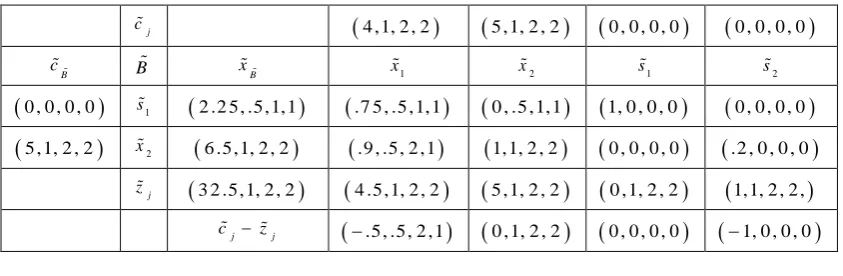
Table 1: Initial table
j
c 4 ,1, 2 , 2 5 ,1, 2 , 2 0 , 0 , 0 , 0 0 , 0 , 0 , 0
B
c B xB x1 x2 s1 s2 Row
minimum
0 , 0 , 0 , 0 s1 1 8 .5, 8 .5, 9 , 2 1 3,1, 2 ,1 2 .5, .5,1,1 1, 0 , 0 , 0 0 , 0 , 0 , 0 7 .4 , .5,1,1
0 , 0 , 0 , 0 s2 3 2 .5,1 2 .5,1 6 , 3 5 4 .5, .5, 2 ,1 5 ,1, 2 , 2 0 , 0 , 0 , 0 1, 0 , 0 , 0 6 .5,1, 2 , 2
j
z 0 ,1 2 .5,1 6 , 3 5 0 ,1, 2 ,1 0 ,1, 2 , 2 0 , 0 , 0 , 0 0 , 0 , 0 , 0
j j
c z 4 ,1, 2 ,1 5 ,1, 2 , 2 0 , 0 , 0 , 0 0 , 0 , 0 , 0
2
x is entering ,s2 is leaving
IJSRR, 7(3) July – Sep., 2018 Page 2097 Table 2: First iteration table
j
c 4 ,1, 2 , 2 5 ,1, 2 , 2 0 , 0 , 0 , 0 0 , 0 , 0 , 0
B
c B xB x1 x2 s1 s2
0 , 0 , 0 , 0 s1 2 .2 5, .5,1,1 .7 5 , .5 ,1,1 0 , .5 ,1,1 1, 0 , 0 , 0 0 , 0 , 0 , 0 5 ,1, 2 , 2 x2 6 .5,1, 2 , 2 .9 , .5, 2 ,1 1,1, 2 , 2 0 , 0 , 0 , 0 .2 , 0 , 0 , 0
j
z 3 2 .5,1, 2 , 2 4 .5,1, 2 , 2 5 ,1, 2 , 2 0 ,1, 2 , 2 1,1, 2 , 2 ,
j j
c z .5, .5, 2 ,1 0 ,1, 2 , 2 0 , 0 , 0 , 0 1, 0 , 0 , 0
All cj zj 0
The current solution is optimal.
1
2
3 2 .5 , 1, 2 , 2
2 9 .5 , 3 1 .5 , 3 3 .5 , 3 5 .5 0 , 0 , 0 , 0
6 .5 , 1, 2 , 2 3 .5 , 5 .5 , 7 .5 , 9 .5
z
x
x
These results are sharper than the results obtained by the existing method.
Example 4.2
Solve m a xz 0 ,1, 2 , 3x1 2 , 3, 4 , 5x2
Subject to the constraints,
1 2
1 2
1 2
1, 2 , 3 , 4 3 , 2 , 5 , 1 0 1 5 , 1 0 , 3 2 , 7 4 2 , 3 , 5 , 6 4 , 5 , 7 , 8 8 , 2 1, 4 8 , 7 6 0 , 1, 2 , 3 2 , 4 , 6 , 8 2 , 1 4 , 3 2 , 5 8
x x
x x
x x
Solution
First we convert the trapezoidal fuzzy number à a , a , a , a 1 2 3 4( m ( à ), w ( à ), , )
1 2
m a x z 1 .5, .5,1,1 x 3 .5, .5,1,1 x
Subject to the constraints,
1 2
1 2
1 2
2 .5 , .5 , 1, 1 3 .5 , 1 .5 , 5 , 5 2 1, 1 1, 2 5 , 4 2 4 , 1, 5 , 1 6 , 1, 1, 1 3 4 .5 , 1 3 .5 , 2 9 , 2 8 1 .5 , .5 , 1, 1 5 , 1, 2 , 2 2 3 , 9 , 1 2 , 2 6
x x
x x
x x
IJSRR, 7(3) July – Sep., 2018 Page 2098
1 2 1 2
1 2
m a x 1 .5 , .5 .1 .1 3 .5 , .5 , 1, 1 0 , 0 , 0 , 0 0 , 0 , 0 , 0 , 0 , 0 , 0 , 0 , 0 , 0
z x x s s
M A M A
Subject to the constraints,
1 2 1
1 2 2 1
1 2 2
2 .5 , .5 , 1, 1 3 .5 , 1 .5 , 5 , 5 1, 0 , 0 , 0 2 1, 1 1, 2 5 , 4 2
4 , 1, 5 , 1 6 , 1, 1, 1 1, 0 , 0 , 0 1, 0 , 0 , 0 3 4 .5 , 1 3 .5 , 2 9 , 2 8 1 .5 , .5 , 1, 1 5 , 1, 2 , 2 1, 0 , 0 , 0 2 3 , 9 , 1 2 , 2 6
x x s
x x s A
x x A
The basic solution is
1
1
2
2 1, 1 1, 2 5 , 4 2 3 4 .5 , 1 3 .5 , 2 9 , 2 8
2 3 , 9 , 1 2 , 2 6
s
A
A
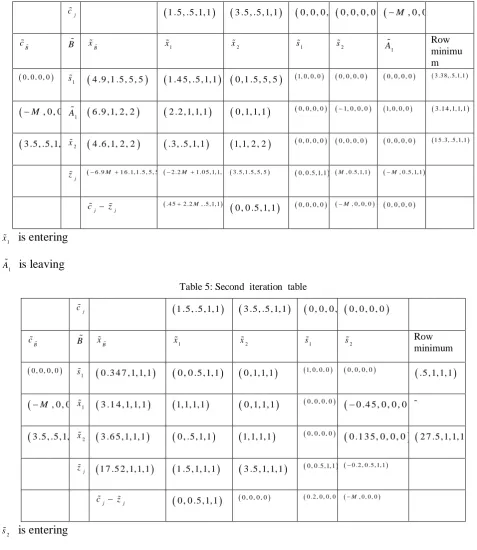
Table 3: Initial table
j
c 1 .5 , .5 ,1,1 3 .5, .5,1,1 0 , 0 , 0 , 00 , 0 , 0 , 0M , 0 , 0 , 0M , 0 , 0 , 0
B
c B xB x1 x2 s1 s2 A1 A2
0 , 0 , 0 , 0 s1 2 1,1 1, 2 5, 4 2 2 .5, .5,1,1 3 .5,1 .5, 5, 5 1, 0 , 0 , 0
0 , 0 , 0 , 0 0 , 0 , 0 , 0 0 , 0 , 0 , 0
M , 0 , 0 , 0
1
A 3 4 .5,1 3 .5, 2 9 , 2 84 ,1, 5 ,1 6 ,1,1,1 0 , 0 , 0 , 0 1, 0 , 0 , 0 1, 0 , 0 , 0 0 , 0 , 0 , 0
M , 0 , 0 , 0
2
A 2 3, 9 ,1 2 , 2 6 1 .5 , .5 ,1,1 5 ,1, 2 , 2 0 , 0 , 0 , 0 0 , 0 , 0 , 0 0 , 0 , 0 , 0 1, 0 , 0 , 0
j
z 5 7 .5M,1 3 .5 , 2 9 , 4 2 5 .5M,1, 5,1 1 1M,1 .5, 5, 5 0 , 0 , 0 , 0 M, 0 , 0 , 0 M, 0 , 0 , 0 M, 0 , 0 , 0
j j
c z 1 .55 .5M, .5,1,1 3 .51 1M, 1, 2 , 2 0 , 0 , 0 , 0 M, 0 , 0 , 0 0 , 0 , 0 , 0 0 , 0 , 0 , 0
2
x is entering
2
A is leaving
IJSRR, 7(3) July – Sep., 2018 Page 2099 Table 4: First iteration table
j
c 1 .5 , .5 ,1,1 3 .5, .5,1,1 0 , 0 , 0 , 00 , 0 , 0 , 0M , 0 , 0 , 0
B
c B xB x1 x2 s1 s2 A1 Row
minimu m
0 , 0 , 0 , 0
1
s 4 .9 ,1 .5, 5, 5 1 .4 5, .5,1,1 0 ,1 .5, 5, 5 1, 0 , 0 , 0 0 , 0 , 0 , 0 0 , 0 , 0 , 0 3 .3 8, .5,1,1
M , 0 , 0 , 0
1
A 6 .9 ,1, 2 , 2 2 .2 ,1,1,1 0 ,1,1,1 0 , 0 , 0 , 0 1, 0 , 0 , 0 1, 0 , 0 , 0 3 .1 4 ,1,1,1
3 .5, .5,1,1x2 4 .6 ,1, 2 , 2 .3, .5,1,1 1,1, 2 , 2 0 , 0 , 0 , 0 0 , 0 , 0 , 0 0 , 0 , 0 , 0
1 5 .3, .5 ,1,1
j
z 6 .9M 1 6 .1, 1 .5 , 5 , 52 .2M 1 .0 5,1,1,13 .5 ,1 .5 , 5 , 5 0 , 0 .5,1,1 M, 0 .5,1,1 M, 0 .5 ,1,1
j j
c z .4 52 .2M, .5,1,1
0 , 0 .5,1,1 0 , 0 , 0 , 0 M, 0 , 0 , 0 0 , 0 , 0 , 0
1
x is entering
1
A is leaving
Table 5: Second iteration table
j
c 1 .5 , .5 ,1,1 3 .5, .5,1,1 0 , 0 , 0 , 00 , 0 , 0 , 0
B
c B xB x1 x2 s1 s2 Row
minimum
0 , 0 , 0 , 0
1
s 0 .3 4 7 ,1,1,1 0 , 0 .5,1,1 0 ,1,1,1 1, 0 , 0 , 0 0 , 0 , 0 , 0 .5 ,1,1,1
M , 0 , 0 , 0x1 3 .1 4 ,1,1,1 1,1,1,1 0 ,1,1,1 0 , 0 , 0 , 0 0 .4 5, 0 , 0 , 0-
3 .5, .5,1,1x2 3 .6 5,1,1,1 0 , .5 ,1,1 1,1,1,1 0 , 0 , 0 , 0 0 .1 3 5, 0 , 0 , 0 2 7 .5,1,1,1
j
z 1 7 .5 2 ,1,1,1 1 .5 ,1,1,1 3 .5 ,1,1,1 0 , 0 .5,1,1 0 .2 , 0 .5 ,1,1
j j
c z 0 , 0 .5,1,1 0 , 0 , 0 , 0 0 .2 , 0 , 0 , 0 M, 0 , 0 , 0
2
s is entering
1
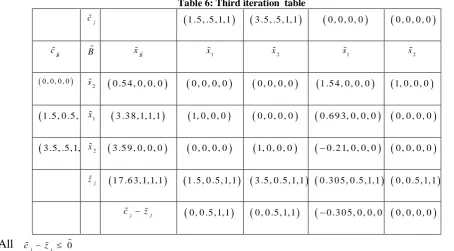
IJSRR, 7(3) July – Sep., 2018 Page 2100 Table 6: Third iteration table
j
c 1 .5 , .5 ,1,1 3 .5, .5,1,1 0 , 0 , 0 , 0 0 , 0 , 0 , 0
B
c B xB x1 x2 s1 s2
0 , 0 , 0 , 0
2
s 0 .5 4 , 0 , 0 , 0 0 , 0 , 0 , 0 0 , 0 , 0 , 0 1 .5 4 , 0 , 0 , 0 1, 0 , 0 , 0
1 .5, 0 .5,1,1x1 3 .3 8,1,1,1 1, 0 , 0 , 0 0 , 0 , 0 , 0 0 .6 9 3, 0 , 0 , 0 0 , 0 , 0 , 0
3 .5, .5,1,1x2 3 .5 9 , 0 , 0 , 0 0 , 0 , 0 , 0 1, 0 , 0 , 0 0 .2 1, 0 , 0 , 0 0 , 0 , 0 , 0
j
z 1 7 .6 3,1,1,1 1 .5, 0 .5,1,1 3 .5, 0 .5,1,1 0 .3 0 5, 0 .5,1,1 0 , 0 .5,1,1
j j
c z 0 , 0 .5,1,1 0 , 0 .5,1,1 0 .3 0 5, 0 , 0 , 0 0 , 0 , 0 , 0
All cj zj 0
The current solution is optimal.
1
2
1 7 .6 3 , 1, 1, 1
1 5 .6 3 , 1 6 .6 3 , 1 8 .6 3 , 1 9 .6 3 3 .3 8 , 1, 1, 1
1 .3 8 , 2 .3 8 , 4 .3 8 , 5 .3 8 3 .5 9 , 0 , 0 , 0
3 .5 9 , 3 .5 9 , 3 .5 9 , 3 .5 9
z
x
x
These results are sharper than the results obtained by the existing method.
5 CONCLUSION
Based on the current study it can be concluded that it is better to use proposed version of
solving Fully Fuzzy Linear Programming as it was compared to the existing one. In this paper, a new
algorithm has been suggested to solve the FFLP problem. By simple examples and the obtained
results of proposed algorithm (with Kumar’s method) have been compared and shown the reliability
and applicability of our algorithm
ACKNOWLEDGEMENTS
The authors are grateful to the anonymous referees and the editors for their constructive
IJSRR, 7(3) July – Sep., 2018 Page 2101
REFERENCES
1. Bellman, R.E and Zadeh, L.A, Decision-making in fuzzy environment,Management sciences,
1970; 17(4): 141- 164
2. Zimmermann H. J, Fuzzy programming and linear programming with several objective
functions, Fuzzy sets and systems, 1978; 1: 45-55.
3. Rommelfanger, H, Hanuscheck, R, and Wolf, J, Linear programming with fuzzy objective,
Fuzzy Sets and Systems, 1989; 29: 31-48.
4. Fang, S. C, and Hu, C. F, Linear programming with fuzzy coefficients in constraint ,Comput
Math Appl, 1999; 37: 63-76,DOI:10.1016/s0898-1221(99)00126-1.
5. Maleki, H. R , Ranking functions and their applications to fuzzy linear programming, Far
East J Math Sci, 2002; 4: 283-301.
6. Maleki, H. R, Tata, M., and Mashinchi, M, Linear programming with fuzzy variables, Fuzzy
sets and systems, 2000; 109: 21-33.
7. Khan, I. U, Ahmad, T, and Maan, N, A two phase approach for solving linear programming
problems by using fuzzy trapezoidal membership functions, International Journal of Basic
and Applied Sciences, 2010; 6: 86-95
8. Nasseri, S. H, Ardil, E, Yazdani, A, and Zaefarian, R , Simplex method for solving linear
programming problems with fuzzy numbers, Proceedings of World Academy of Science,
Engineering and Technology, 2005; 10: 284-288, DOI:10.1.1.192.8585.
9. Amiri, N. M, and Nasseri, S. H, Duality results and a dual simplex method for linear
programming problems with trapezoidal fuzzy variables. Fuzzy Sets and Systems, 2007; 158:
1961-1978, DOI:10.1016/j.fss.2007.05.005.
10. Lotfi, F.H., Allahviranloo, T, Jondabeha, M.A, Alizadeh, L, Solving a fully fuzzy linear
programming using lexicography method and fuzzy approximate solution, Appl. Math.
Model, 2009; 33: 3151-3156, DOI:10.1016/j.apm.2008.10.020.
11. Kumar,A, Kaur,J, Singh,P,A new method for solving fully fuzzy linear programming
problems, Appl. Math. Model, 2011; 35: 817-823, DOI:10.1016/j.apm.2010.07.037.
12. Abbasbandy, S and Hajjari, T, A new approach for ranking of trapezoidal fuzzy numbers,
Computers and Mathematics with Applications,2009; 57:
413419,DOI:10.1016/j.camwa.2008.10.090.
13. Amit Kumar, Jagdeep Kaur, Pushpinder Singh, Solving Fully Fuzzy linear programming
problem with inequality constraints, International Journal of Physical and Mathematical
IJSRR, 7(3) July – Sep., 2018 Page 2102
14. Kauffmann,A, Gupta, M.M, Introduction to fuzzy Arithmetic:Theory and Applications, Van
Nostrand Reinhold, New York, 1991.
15. Ming Ma, Menahem Friedman, Abraham Kandel, ”A new fuzzy arithmetic” ,Fuzzy sets and