Open Access
Review
The function of APC/C
Cdh1
in cell cycle and beyond
Min Li
1and Pumin Zhang*
1,2Address: 1Department of Molecular Physiology and Biophysics, Baylor College of Medicine, Houston, TX 77030, USA and 2Department of Biochemistry and Molecular Biology, Baylor College of Medicine, Houston, TX 77030, USA
Email: Min Li - [email protected]; Pumin Zhang* - [email protected] * Corresponding author
Abstract
The anaphase promoting complex/cyclosome (APC/C) is a multi-subunit E3 ubiquitin ligase playing essential functions in mitosis. It is conserved from yeast to human and relies on two adaptor proteins, Cdc20 and Cdh1, to bring in substrates. Both APCCdc20 and APCCdh1 are implicated in the control of mitosis through mediating ubiquitination and degradation of important mitotic regulators such as cyclin B1, securin, and Plk1. In addition, APCCdh1 is thought to prevent premature S phase entry by limiting the accumulation of mitotic cyclins in G1 and to regulate processes unrelated to cell cycle. In this review, we will summarize our current understanding of APCCdh1 function in cell cycle and beyond.
Introduction
Two ubiquitin E3-ligase complexes, SCF (Skp1/CUL1/F-box protein) and APC/C (anaphase promoting complex/ cyclosome), control the timely transitions of cell cycle phases by promoting the degradation of many key cell cycle regulators. SCF complex mainly functions in G1, S and early M phases, whereas APC/C regulates mitosis including metaphase-anaphase transition and mitotic exit and maintains G1 phase [1,2]. APC/C is a large (1.5 MDa complex) composed of at lease 11 core subunits. It relies on two WD-40 repeat-containing adaptor proteins, Cdc20/fizzy(fzy)/p55CDC and Hct1/srw1/fizzy-related(fzr)/Cdh1, to engage with its substrates. Destruc-tion box (RXXLXXXXN/D/E) and KEN box are motifs fre-quently found in APC's substrates, but other motifs are also possible for recognition by APCCdc20 or APCCdh1 [3].
The consensus sequence of destruction box can be found in many proteins. However, not all of these proteins are APC's substrates. Thus, there must be other sequence con-strains we do not understand yet that define true APC sub-strates. Moreover, some substrates only have an RxxL
motif and yet are recognized by APC, indicating the last amino acid in the consensus is not stringently conserved.
APCCdc20 initiates the metaphase-anaphase transition
through mediating the ubiquitination and degradation of cyclin B1 and securin. To prevent premature separation of sister chromatids and mitotic exit, APCCdc20 is inhibited by
Mad2 and BubR1 through the spindle assembly check-point mechanism [4-9]. Only when the sister chromatids are aligned at the metaphase plate and have established bivalent spindle attachment can the inhibition of APC/ Cdc20 be released. In contrast to APCCdc20, APCCdh1 is
inactive in early mitosis [3] when it is inhibited by phos-phorylation [10] and binding of Nup90/Rae1 complex [11,12]. APCCdh1 only becomes active from late mitosis to
G1. The difference in the timing of activation between APCCdc20 and APCCdh1 suggests a functional division
between the two E3 ubiquitin ligases in mitosis. Recent analyses of mice deficient in Cdc20 or Cdh1 strongly sup-port that notion [13-15]. It appears that Cdc20 is required for metaphase to anaphase transition [15], whereas Cdh1
Published: 19 January 2009
Cell Division 2009, 4:2 doi:10.1186/1747-1028-4-2
Received: 6 January 2009 Accepted: 19 January 2009
This article is available from: http://www.celldiv.com/content/4/1/2
© 2009 Li and Zhang; licensee BioMed Central Ltd.
plays a nonessential role in mitotic exit but an essential role in G1/S regulation [13,14].
Mitotic Function of Cdh1
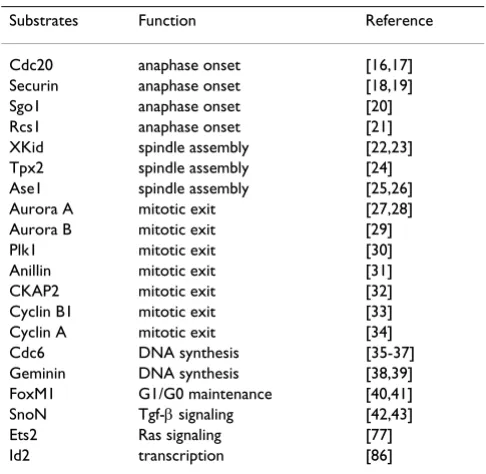
A large number of mitotic regulators are degraded at the end of mitosis. These include Cdc20, Aurora B, Plk1, etc. and are most likely the substrates of APCCdh1 (Table 1)
[16-43]. Although many of these mitotic regulators did accumulate in the absence of Cdh1, they were eventually degraded, probably because of the stabilization of Cdc20 that compensates for the loss of Cdh1 [13,14]. As a result, Cdh1-deficient cells could still proliferate. However, these cells did accumulate mitotic errors and display difficulties in completing cytokinesis, resulting in the formation of binucleated cells at a high frequency [13,14].
The lethality associated with the loss of Cdh1 is largely a result of failed development of placenta, an essential organ for embryonic life in mammals [13,14]. In the pla-centa, there is a special cell type, giant cells which are poly-ploid. The polyploidy is acquired through endoreplication. In the absence of Cdh1, the placental giant cells failed to form, suggesting that APCCdh1 is
required for DNA endoreplication. To undergo endorepli-cation, a cell must not enter mitosis after a round of DNA synthesis. One critical factor for mitotic entry is cyclin B1, a substrate of APCCdh1 [33]. Therefore, it is possible that
the failed formation of giant cells in Cdh1 mutant embryos was a result of the inability of the would-be giant cells to block the accumulation of cyclin B1. Indeed, cyc-lin B1 was readily detectable in the mutant placenta in the area where the giant cells should reside [14].
Like an endoreplicating cell, cells with their DNA dam-aged do not enter mitosis either. A recent study revealed that APCCdh1-medicated degradation of Plk1 played an
important role in preventing mitotic entry of DNA-dam-aged cells [44]. Under normal conditions, Cdh1 is kept inactive from late G1 to early mitosis. When cells suffered DNA damage, Cdc14B is translocated out of nucleoli into nuclearplasm where the phosphatase dephophorylates and activates Cdh1 [44]. It is unknown if a similar mech-anism is employed by the placental giant cells to activate Cdh1 in G2 to prevent mitotic entry.
Maintenance of G1 by APCCdh1
In Drosophila, loss of fzr leads to an extra division cycle in the epidermis, a likely result of the accumulation of mitotic cyclins in G1 [45]. In HeLa cells, knocking down the expression of Cdh1 causes stabilization of Skp2 [46,47], a F-box containing protein responsible for bring-ing p27Kip1 to the SCF complex for ubiquitination [48,49].
As a result, p27 is destabilized in the cells with impaired Cdh1 function and the G1 phase is shortened in these cells.
Our recent work identified Ets2 as a new substrate of APCCdh1 [14]. Ets2 is a member of the Ets family of
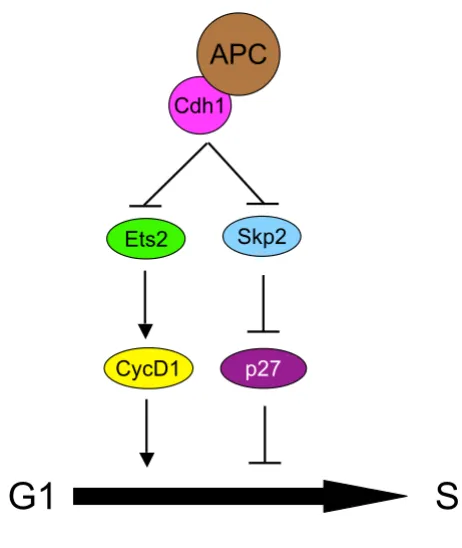
tran-scription factors which share a unique DNA binding domain, the ETS domain [50,51]. The first Ets protein was identified as transduced mutant form of Ets1, v-Ets, in a retrovirus, E26 (ETwenty six-specific, so the name Ets) avian leukosis virus (ALV), that induces erythroblastosis in avian species [52]. It is well known that Ets2 is activated by Ras-Raf-MAPK signaling and mediates some effects of this important signaling pathway [53-59]. The most prominent effect of Ras signaling is the stimulation of pro-liferation which relies in part on the induction of cyclin D1 expression by Est2 [60,61]. Increased expression of Ets2 has been associated with initiation and progression of various cancer types [62-65] and its expression was altered in cervical cancer cell lines due to chromosomal changes in 21q22.1–22.2 where human ETS2 resides [66]. Moreover, Ets2 was found overexpressed in esophageal squamous cell carcinoma [67]. These results suggest that Ets2 is an oncogene. By targeting both Skp2 and Ets2, APCCdh1 maintains G1 by increasing the levels of a Cdk
inhibitor p27 through destabilizing Skp2 and by limiting the expression of cyclin D1 through promoting Ets2 deg-radation (Fig. 1). Since both Skp2 and Ets2 are potential oncogenes, APCCdh1 may possess tumor-suppression
activity. Indeed, mice heterozygous for Cdh1 display increased rates of tumorigenesis at old ages [13].
It was shown previously by Nasmyth's group that inacti-vation of APC/C by deleting its subunit APC2 in adult hepatocytes induced these otherwise quiescent cells to re-enter cell cycle [68]. This is most likely a result of the loss
Table 1: Substrates of APCCdh1.
Substrates Function Reference
of APCCdh1 activity and subsequent accumulation of Skp2
and Ets2.
To enter S-phase, APCCdh1 must be inactivated. Several
dif-ferent mechanisms are in place to contain APCCdh1
[69,70]. First, the ubiquitination of APC-specific ubiqutin-conjugating enzyme (E2) UbcH10 by APCCdh1
itself provides a negative feedback mechanism that would eventually destroy APCCdh1 activity [71,72]. Second, as
Cdk activity accumulates, Cdh1 is phosphorylated. The phosphorylation promotes Cdh1 dissociation from APC [10,73]. Third, phosphorylated Cdh1 is targeted by SCF liagse [74], further limiting the activity of APCCdh1.
Finally, in late G1 phase, E2F activates the transcription of early mitotic inhibitor-1 (Emi1)/Rca1, which inhibits the activity of APC/CCdh1 as a pseudo-substrate [75,76].
Cdh1 and Cellular Senescence
Opposite to the expected high proliferation rates in Cdh1-deficient cells, Cdh1-/- mouse embryonic fibroblasts
(MEFs) proliferate poorly and entered senescence after only a few passages [77]. We found that the induction of p16Ink4a in these cells was the cause for the reduced
prolif-eration potential. The reason for the increased levels of p16 in Cdh1-/- MEFs could simply be that p16 is a
sub-strate of APCCdh1. Alternatively, it could be that a
tran-scriptional activator of p16 is a substrate. It turned out that the latter was the case [14]. We demonstrated that
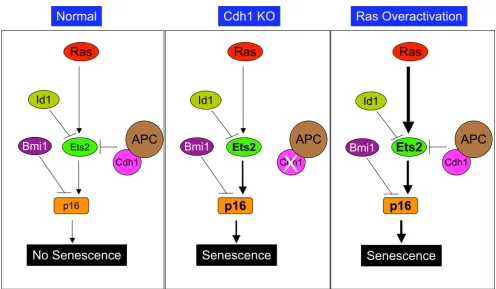
Cdh1-deficiency induced upregulation of p16 was a result of Ets2 stabilization. It was shown previously that Est2 could activate p16 expression [78]. The expression of p16 is regulated by a number of factors in response to various stimuli. Under normal conditions, Ets2 levels are not enough to induce p16 expression and senescence because of Id1 and Bim1 (Fig. 2A). Id1 interacts with Ets2 and blocks its transcriptional activation of p16 [78,79], whereas Bmi1 directly represses p16 promoter [80]. Our identification of the APCCdh1-Ets2-p16 axis shows the
del-icacy of the balance that determines the level of p16 expression. Loss of Cdh1 leads to increases in the levels of Ets2 to the point that it overcomes Id1's inhibition and results in senescence (Fig. 2B). This would imply that Ets2 activity required for p16 activation and that for other tar-gets are different, which remains to be determined.
Overactivation of Ras signaling could also cause senes-cence in primary cells [81-83]. It is likely that Ets2 medi-ates, at least in part, this senescence effect of Ras signaling (Fig. 2C). It remains to be determined however if Ras sig-naling interacts with APCCdh1. The phosphorylation of
Ets2 by Erk may interfere with the recognition of Ets2 by Cdh1, for example, leading to stabilization of Est2. There-fore, when Ras signaling is overactivated, APCCdh1 would
only be able to provide limited balancing function against Ets2. By placing p16 under the transcriptional control of Ets2, evolution has setup a failsafe mechanism to prevent unwarranted proliferation.
Cdh1 and Neural Function
Two places where appreciable levels of Cdh1 (and APC subunits) but not Cdc20 are expressed in adult mice are the brain and the liver [84]. In the liver, APCCdh1 is likely
required for preventing hepatocytes from reentering the cell cycle spontaneously (see above). What is the function of APCCdh1 in postmitotic neurons? The depletion of
Cdh1 expression in primary neuron of the cerebellar cor-tex promotes significant elongations of axons, indicating a role of APCdh1 in limiting axonal growth [85], possibly
through regulating the abundance of SnoN and Id2 [86,87]. APCCdh1 may also control pattering of axon
growth in the mammalian brain [85].
We assessed neural functioning of mice that are hetero-zygous Cdh1 mutant. Electrophysiology studies of hip-pocampus revealed a deficit in late phase long-term potentiation (L-LTP), a process that underlies synaptic plasticity and is known to depend on both protein synthe-sis and degradation [88]. In behavior tests, we found that Cdh1 heterozygous mice performed poorly in contextual fear conditioning [14], a hippocampus-dependent proc-ess [89,90], but no difference was observed in cued fear condition which is less dependent on hippocampus [89,90]. Similar behavior findings were also reported by Cdh1 regulate the timing of S-phase entry
Figure 1
Cdh1 regulate the timing of S-phase entry.
Skp2
Ets2
Cdh1
APC
CycD1
p27
Malumbres' group [13]. It is unclear at the moment what are the substrates of APCCdh1 that play a role in memory
formation in mammals. However, studies from lower organisms may provide a clue. In C. elegans, the abun-dance of GLR-1 glutamate receptors in the ventral nerve cord is regulated by anaphase promoting complex, albeit unlikely to be in a direct manner [91]. In Drosophila, Liprin-α, a multidomain scaffolding protein which is localized to synapses and regulates synaptic activities, seems to be a substrate of APCCdh1 [92]. It remains to be
determined if mammalian homologues of Liprin-α and GLR-1 are regulated by APCCdh1 and if their misregulation
can account for the learning and memory defects dis-played by Cdh1 heterozygous mice.
Conclusion
Tremendous progresses have been made towards under-standing the regulation and function of APC/C in the last decade. Its role in cell cycle regulation has largely been elucidated. It appears that APCCdc20 is dedicated to mitosis
while APCCdh1 has a much broader application not
restricted to the cell cycle. The most intriguing question remains to be addressed is the role of APC/C in non-divid-ing cells. Accumulatnon-divid-ing evidence points to the
involve-ment of APCCdh1 in many aspects of neural function
including axon growth, morphology and plasticity of syn-apses, and learning and memory. Identification of the rel-evant substrates will provide significant insights into the functioning of the complex nervous system. Further, in addition to its potential role in maintaining the G0 state of hepatocytes, whether APCCdh1 participates in the
phys-iological function of the liver remains to be elucidated
Competing interests
The authors declare that they have no competing interests.
Authors' contributions
ML and PZ wrote the manuscript together.
Acknowledgements
This work was supported by grants from The National Institute of Health to PZ (CA122623-02 and CA116097-04). ML is supported by a NIH post-doctoral training grant.
References
1. Vodermaier HC: APC/C and SCF: Controlling Each Other and the Cell Cycle. Curr Biol 2004, 14(18):R787-R796.
2. Nakayama KI, Nakayama K: Ubiquitin ligases: cell-cycle control and cancer. Nature Reviews Cancer 2006, 6:369-381.
Cdh1 and cellular senescence
Figure 2
Cdh1 and cellular senescence. (A) Under normal conditions, the expression of p16 is tightly controlled by both positive and negative regulators. (B) Deletion of Cdh1 causes accumulation of Est2, leading to overexpression of p16 and senescence. (C) Oncogenic Ras may also induce senescence through Ets2.
Ras
Ets2
p16
Cdh1
APC
No Senescence
Normal
Id1
Bmi1
Ras
Ets2
p16
Cdh1
APC
Senescence
X
Cdh1 KO
Ras
Ets2
p16
Cdh1
APC
Senescence
Ras Overactivation
Id1
Bmi1
Id1
3. Harper JW, Burton JL, Solomon MJ: The anaphase-promoting complex: it's not just for mitosis any more. Genes & develop-ment 2002, 16(17):2179-2206.
4. Hwang LH, Lau LF, Smith DL, Mistrot CA, Hardwick KG, Hwang ES, Amon A, Murray AW: Budding yeast Cdc20: a target of the spindle checkpoint. Science (New York, NY) 1998, 279(5353):1041-1044.
5. Fang G, Yu H, Kirschner MW: The checkpoint protein MAD2 and the mitotic regulator CDC20 form a ternary complex with the anaphase-promoting complex to control anaphase initiation. Genes & development 1998, 12(12):1871-1883. 6. Kallio M, Weinstein J, Daum JR, Burke DJ, Gorbsky GJ: Mammalian
p55CDC mediates association of the spindle checkpoint pro-tein Mad2 with the cyclosome/anaphase-promoting com-plex, and is involved in regulating anaphase onset and late mitotic events. J Cell Biol 1998, 141(6):1393-1406.
7. Wu H, Lan Z, Li W, Wu S, Weinstein J, Sakamoto KM, Dai W: p55CDC/hCDC20 is associated with BUBR1 and may be a downstream target of the spindle checkpoint kinase. Onco-gene 2000, 19(40):4557-4562.
8. Fang G: Checkpoint protein BubR1 acts synergistically with Mad2 to inhibit anaphase-promoting complex. Molecular biol-ogy of the cell 2002, 13(3):755-766.
9. Tang Z, Bharadwaj R, Li B, Yu H: Mad2-Independent inhibition of APCCdc20 by the mitotic checkpoint protein BubR1. Dev Cell
2001, 1(2):227-237.
10. Kramer ER, Scheuringer N, Podtelejnikov AV, Mann M, Peters JM: Mitotic regulation of the APC activator proteins CDC20 and CDH1. Molecular biology of the cell 2000, 11(5):1555-1569. 11. Jeganathan KB, Baker DJ, van Deursen JM: Securin associates with
APCCdh1 in prometaphase but its destruction is delayed by Rae1 and Nup98 until the metaphase/anaphase transition.
Cell Cycle 2006, 5(4):366-370.
12. Jeganathan KB, Malureanu L, van Deursen JM: The Rae1-Nup98 complex prevents aneuploidy by inhibiting securin degrada-tion. Nature 2005, 438(7070):1036-1039.
13. García-Higuera I, Manchado E, Dubus P, Cañamero M, Méndez J, Moreno S, Malumbres M: Genomic stability and tumour sup-pression by the APC/C cofactor Cdh1. Nature cell biology 2008, 10(7):802-811.
14. Li M, Shin Y-H, Hou L, Huang X, Wei Z, Klann E, Zhang P: The adap-tor protein of the anaphase promoting complex Cdh1 is essential in maintaining replicative lifespan and in learning and memory. Nature cell biology 2008, 10(9):1083-1089. 15. Li M, York JP, Zhang P: Loss of Cdc20 causes a
securin-depend-ent metaphase arrest in two-cell mouse embryos. Molecular and cellular biology 2007, 27(9):3481-3488.
16. Prinz S, Hwang ES, Visintin R, Amon A: The regulation of Cdc20 proteolysis reveals a role for the APC components Cdc23 and Cdc27 during S phase and early mitosis. Curr Biol 1998, 8(13):750-760.
17. Pfleger CM, Kirschner MW: The KEN box: an APC recognition signal distinct from the D box targeted by Cdh1. Genes & Development 2000, 14:655-665.
18. Zur A, Brandeis M: Securin degradation is mediated by fzy and fzr, and is required for complete chromatid separation but not for cytokinesis. The EMBO journal 2001, 20:792-801. 19. Zou H, McGarry TJ, Bernal T, Kirschner MW: Identification of a
vertebrate sister-chromatid separation inhibitor involved in transformation and tumorigenesis. Science (New York, NY) 1999, 285(5426):418-422.
20. Karamysheva Z, Diaz-Martinez L, Crow SE, Li B, Yu H: Multiple APC/C degrons mediate the degradation of human SGO1.
Journal of Biological Chemistry 2008 in press.
21. Zhao W-m, Coppinger JA, Seki A, Cheng X-l JRY III, Fang G: RCS1, a substrate of APC/C, controls the metaphase to anaphase transition. The Proceedings of the National Academy of Sciences 2008, 105(36):13415-13420.
22. Antonio C, Ferby I, Wilhelm H, Jones M, Karsenti E, Nebreda AR, Vernos I: Xkid, a Chromokinesin Required for Chromosome Alignment on the Metaphase Plate. Cell 2000, 102:425-435. 23. Funabiki H, Murray AW: The Xenopus Chromokinesin Xkid Is
Essential for Metaphase Chromosome Alignment and Must Be Degraded to Allow Anaphase Chromosome Movement.
Cell 2000, 102:411-424.
24. Stewart S, Fang G: Destruction box-dependent degradation of aurora B is mediated by the anaphase-promoting complex/ cyclosome and Cdh1. Cancer research 2005, 65(19):8730-8735. 25. Juang Y-L, Huang J, Peters J-M, McLaughlin ME, Tai C-Y, Pellman D:
APC-Mediated Proteolysis of Ase1 and the Morphogenesis of the Mitotic Spindle. Science (New York, NY) 1997, 275:1311-1314.
26. Visintin R, Prinz S, Amon A: CDC20 and CDH1: a family of sub-strate-specific activators of APC- dependent proteolysis. Sci-ence 1997, 278(5337):460-463.
27. Castro A, Vigneron S, Bernis C, Labbe J-C, Prigent C, Lorca T: The D-Box-activating domain (DAD) is a new proteolysis signal that stimulates the silent D-Box sequence of Aurora-A.
EMBO Reports 2002, 3:1209-1214.
28. Castro A, Arlot-Bonnemains Y, Vigneron S, Labbé J-C, Prigent C, Lorca T: APC/Fizzy-Related targets Aurora-A kinase for pro-teolysis. EMBO Reports 2002, 3:457-462.
29. Stewart S, Fang G: Anaphase-Promoting Complex/Cyclosome Controls the Stability of TPX2 during Mitotic Exit. Molecular and cellular biology 2005, 25(23):10516-10527.
30. Lindon C, Pines J: Ordered proteolysis in anaphase inactivates Plk1 to contribute to proper mitotic exit in human cells. J Cell Biol 2004, 164(2):233-241.
31. Zhao W-m, Fang G: Anillin Is a Substrate of Anaphase-promot-ing Complex/Cyclosome (APC/C) That Controls Spatial Contractility of Myosin during Late Cytokinesis. The Journal of biological chemistry 2005, 280(39):33516-33524.
32. Seki A, Fang G: CKAP2 is a spindle-associated protein degraded by APC/C-CDH1 during mitotic exit. The Journal of biological chemistry 2007, 282(20):15103-15113.
33. King RW, Peters J-M, Tugendreich S, Rolfe M, Hieter P, Kirschner MW: A 20s complex containing CDC27 and CDC16 catalyzes the mitosis-specific conjugation of ubiquitin to cyclin B. Cell
1995, 81:279-288.
34. Geley S, Kramer E, Gieffers C, Gannon J, Peters J-M, Hunt T: Ana-phase-promoting Complex/Cyclosome-dependent Proteoly-sis of Human Cyclin A Starts at the Beginning of MitoProteoly-sis and Is Not Subject to the Spindle Assembly Checkpoint. The Jour-nal of cell biology 2001, 153:137-148.
35. Duursma A, Agami R: p53-Dependent Regulation of Cdc6 Pro-tein Stability Controls Cellular Proliferation. Molecular and cel-lular biology 2005, 25(16):6937-6947.
36. Mailand N, Diffley JFX: CDKs Promote DNA Replication Origin Licensing in Human Cells by Protecting Cdc6 from APC/C-Dependent Proteolysis. Cell 2005, 122:915-926.
37. Petersen BO, Wagener C, Marinoni F, Kramer ER, Melixetian M, Denchi EL, Gieffers C, Matteucci C, Peters J-M, Helin K: Cell cycle-and cell growth-regulated proteolysis of mammalian CDC6 is dependent on APC-CDH1. Genes & Development 2000, 14:2330-2343.
38. McGarry TJ, Kirschner MW: Geminin, an Inhibitor of DNA Rep-lication, Is Degraded during Mitosis. Cell 1998, 93(6):1043-1053.
39. Zielke N, Querings S, Rottig C, Lehner C, Sprenger F: The ana-phase-promoting complex/cyclosome (APC/C) is required for rereplication control in endoreplication cycles. Genes & Development 2008, 22:1690-1703.
40. Park HJ, Costa RH, Lau LF, Tyner AL, Raychaudhuri P: Anaphase-Promoting Complex/Cyclosome-Cdh1-Mediated Proteolysis of the Forkhead Box M1 Transcription Factor Is Critical for Regulated Entry into S Phase. Molecular and cellular biology 2008, 28(17):5162-5171.
41. Laoukili J, Alvarez-Fernandez M, Stahl M, Medema RH: FoxM1 is degraded at mitotic exit in a Cdh1-dependent manner. Cell Cycle 2008, 7(17):2720-2726.
42. Wan Y, Liu X, Kirschner MW: The anaphase-promoting com-plex mediates TGF-beta signaling by targeting SnoN for destruction. Mol Cell 2001, 8(5):1027-1039.
43. Stroschein SL, Bonni S, Wrana JL, Luo K: Smad3 recruits the ana-phase-promoting complex for ubiquitination and degrada-tion of SnoN. Genes & Development 2001, 15:2822-2836. 44. Bassermann F, Frescas D, Guardavaccaro D, Busino L, Peschiaroli A,
45. Sigrist SJ, Lehner CF: Drosophila fizzy-related down-regulates mitotic cyclins and is required for cell proliferation arrest and entry into endocycles. Cell 1997, 90(4):671-681.
46. Bashir T, Dorrello NV, Amador V, Guardavaccaro D, Pagano M: Control of the SCF(Skp2-Cks1) ubiquitin ligase by the APC/ C(Cdh1) ubiquitin ligase. Nature 2004, 428(6979):190-193. 47. Wei W, Ayad NG, Wan Y, Zhang GJ, Kirschner MW, Kaelin WG Jr:
Degradation of the SCF component Skp2 in cell-cycle phase G1 by the anaphase-promoting complex. Nature 2004, 428(6979):194-198.
48. Tsvetkov LM, Yeh KH, Lee SJ, Sun H, Zhang H: p27(Kip1) ubiquiti-nation and degradation is regulated by the SCF(Skp2) com-plex through phosphorylated Thr187 in p27. Curr Biol 1999, 9(12):661-664.
49. Nakayama K, Nagahama H, Minamishima YA, Matsumoto M, Nakam-ichi I, Kitagawa K, Shirane M, Tsunematsu R, Tsukiyama T, Ishida N,
et al.: Targeted disruption of Skp2 results in accumulation of cyclin E and p27(Kip1), polyploidy and centrosome overdu-plication. The EMBO journal 2000, 19(9):2069-2081.
50. Macleod K, Leprince D, Stehelin D: The ets gene family. Trends in biochemical sciences 1992, 17(7):251-256.
51. Crepieux P, Coll J, Stehelin D: The Ets family of proteins: weak modulators of gene expression in quest for transcriptional partners. Critical reviews in oncogenesis 1994, 5(6):615-638. 52. Leprince D, Gegonne A, Coll J, de Taisne C, Schneeberger A, Lagrou
C, Stehelin D: A putative second cell-derived oncogene of the
avian leukaemia retrovirus E26. Nature 1983,
306(5941):395-397.
53. Foulds CE, Nelson ML, Blaszczak AG, Graves BJ: Ras/mitogen-acti-vated protein kinase signaling activates Ets-1 and Ets-2 by CBP/p300 recruitment. Molecular and cellular biology 2004, 24(24):10954-10964.
54. Langer SJ, Bortner DM, Roussel MF, Sherr CJ, Ostrowski MC: Mitogenic signaling by colony-stimulating factor 1 and ras is suppressed by the ets-2 DNA-binding domain and restored by myc overexpression. Molecular and cellular biology 1992, 12(12):5355-5362.
55. Galang CK, Der CJ, Hauser CA: Oncogenic Ras can induce tran-scriptional activation through a variety of promoter ele-ments, including tandem c-Ets-2 binding sites. Oncogene 1994, 9(10):2913-2921.
56. Yang BS, Hauser CA, Henkel G, Colman MS, Van Beveren C, Stacey KJ, Hume DA, Maki RA, Ostrowski MC: Ras-mediated phosphor-ylation of a conserved threonine residue enhances the trans-activation activities of c-Ets1 and c-Ets2. Molecular and cellular biology 1996, 16(2):538-547.
57. McCarthy SA, Chen D, Yang BS, Garcia Ramirez JJ, Cherwinski H, Chen XR, Klagsbrun M, Hauser CA, Ostrowski MC, McMahon M: Rapid phosphorylation of Ets-2 accompanies mitogen-acti-vated protein kinase activation and the induction of heparin-binding epidermal growth factor gene expression by onco-genic Raf-1. Mol Cell Biol 1997, 17(5):2401-2412.
58. Wasylyk C, Bradford AP, Gutierrez-Hartmann A, Wasylyk B: Con-served mechanisms of Ras regulation of evolutionary related transcription factors, Ets1 and Pointed P2. Oncogene 1997, 14(8):899-913.
59. Patton SE, Martin ML, Nelsen LL, Fang X, Mills GB, Bast RC Jr, Ostrowski MC: Activation of the ras-mitogen-activated pro-tein kinase pathway and phosphorylation of ets-2 at position threonine 72 in human ovarian cancer cell lines. Cancer research 1998, 58(10):2253-2259.
60. Albanese C, Johnson J, Watanabe G, Eklund N, Vu D, Arnold A, Pes-tell RG: Transforming p21ras mutants and c-Ets-2 activate the cyclin D1 promoter through distinguishable regions. The Journal of biological chemistry 1995, 270(40):23589-23597.
61. Carbone GM, Napoli S, Valentini A, Cavalli F, Watson DK, Catapano CV: Triplex DNA-mediated downregulation of Ets2 expres-sion results in growth inhibition and apoptosis in human prostate cancer cells. Nucleic Acids Res 2004, 32(14):4358-4367. 62. de Nigris F, Mega T, Berger N, Barone MV, Santoro M, Viglietto G,
Verde P, Fusco A: Induction of ETS-1 and ETS-2 transcription factors is required for thyroid cell transformation. Cancer research 2001, 61(5):2267-2275.
63. Neznanov N, Man AK, Yamamoto H, Hauser CA, Cardiff RD, Oshima RG: A single targeted Ets2 allele restricts development of
mammary tumors in transgenic mice. Cancer research 1999, 59(17):4242-4246.
64. Sapi E, Flick MB, Rodov S, Kacinski BM: Ets-2 transdominant mutant abolishes anchorage-independent growth and mac-rophage colony-stimulating factor-stimulated invasion by BT20 breast carcinoma cells. Cancer research 1998, 58(5):1027-1033.
65. Sementchenko VI, Schweinfest CW, Papas TS, Watson DK: ETS2 function is required to maintain the transformed state of human prostate cancer cells. Oncogene 1998, 17(22):2883-2888. 66. Simpson S, Woodworth CD, DiPaolo JA: Altered expression of Erg and Ets-2 transcription factors is associated with genetic changes at 21q22.2–22.3 in immortal and cervical carcinoma cell lines. Oncogene 1997, 14(18):2149-2157.
67. Li X, Lu JY, Zhao LQ, Wang XQ, Liu GL, Liu Z, Zhou CN, Wu M, Liu ZH: Overexpression of ETS2 in human esophageal squamous cell carcinoma. World J Gastroenterol 2003, 9(2):205-208. 68. Wirth KG, Ricci R, Giménez-Abián JF, Taghybeeglu S, Kudo NR,
Jochum W, Vasseur-Cognet M, Nasmyth K: Loss of the anaphase-promoting complex in quiescent cells causes unscheduled hepatocyte proliferation. Genes & Development 2004, 18:88-98. 69. Peters J-M: The anaphase promoting complex/cyclosome: a
machine designed to destroy. Nature Reviews Molecular Cell Biol-ogy 2006, 7:644-656.
70. Pesin JA, Orr-Weaver TL: Regulation of APC/C Activators in Mitosis and Meiosis. Annual Review of Cell and Developmental Biology
2008, 24:475-499.
71. Rape M, Kirschner MW: Autonomous regulation of the ana-phase-promoting complex couples mitosis to S-phase entry.
Nature 2004, 432:588-595.
72. Rape M, Reddy SK, Kirschner MW: The Processivity of Multiubiq-uitination by the APC Determines the Order of Substrate Degradation. Cell 2006, 124(1):89-103.
73. Lukas C, Sørensen CS, Kramer E, Santoni-Rugiu E, Lindeneg C, Peters J-M, Bartek J, Lukas J: Accumulation of cyclin B1 requires E2F and cyclin-A-dependent rearrangement of the anaphase-promoting complex. Nature 1999, 401:815-818.
74. Benmaamar R, Pagano M: Involvement of the SCF Complex in the Control of Cdh1 Degradation in S-phase. Cell Cycle 2005, 4(9):1230-1232.
75. Hsu JY, Reimann JDR, Sørensen CS, Lukas J, Jackson PK: E2F-dependent accumulation of hEmi1 regulates S phase entry by inhibiting APCCdh1. Nature cell biology 2002, 4:358-366. 76. Grosskortenhaus R, Sprenger F: Rca1 Inhibits APC-Cdh1Fzr and
Is Required to Prevent Cyclin Degradation in G2. Developmen-tal Cell 2002, 2(1):29-40.
77. Li M, Shin YH, Hou L, Huang X, Wei Z, Klann E, Zhang P: The adap-tor protein of the anaphase promoting complex Cdh1 is essential in maintaining replicative lifespan and in learning and memory. Nature cell biology 2008, 10:1083-1089.
78. Ohtani N, Zebedee Z, Huot TJ, Stinson JA, Sugimoto M, Ohashi Y, Sharrocks AD, Peters G, Hara E: Opposing effects of Ets and Id proteins on p16INK4a expression during cellular senescence.
Nature 2001, 409(6823):1067-1070.
79. Alani RM, Young AZ, Shifflett CB: Id1 regulation of cellular senes-cence through transcriptional repression of p16/Ink4a. Pro-ceedings of the National Academy of Sciences of the United States of America 2001, 98(14):7812-7816.
80. Jacobs JJ, Scheijen B, Voncken JW, Kieboom K, Berns A, van Lohuizen M: Bmi-1 collaborates with c-Myc in tumorigenesis by inhib-iting c-Myc-induced apoptosis via INK4a/ARF. Genes Dev 1999, 13(20):2678-2690.
81. Serrano M, Lin AW, McCurrach ME, Beach D, Lowe SW: Oncogenic ras provokes premature cell senescence associated with accumulation of p53 and p16INK4a. Cell 1997, 88(5):593-602. 82. Lin AW, Barradas M, Stone JC, van Aelst L, Serrano M, Lowe SW:
Premature senescence involving p53 and p16 is activated in response to constitutive MEK/MAPK mitogenic signaling.
Genes Dev 1998, 12(19):3008-3019.
83. Zhu J, Woods D, McMahon M, Bishop JM: Senescence of human fibroblasts induced by oncogenic Raf. Genes Dev 1998, 12(19):2997-3007.
Acad-Publish with BioMed Central and every scientist can read your work free of charge "BioMed Central will be the most significant development for disseminating the results of biomedical researc h in our lifetime."
Sir Paul Nurse, Cancer Research UK
Your research papers will be:
available free of charge to the entire biomedical community peer reviewed and published immediately upon acceptance cited in PubMed and archived on PubMed Central yours — you keep the copyright
Submit your manuscript here:
http://www.biomedcentral.com/info/publishing_adv.asp
BioMedcentral
emy of Sciences of the United States of America 1999, 96(20):11317-11322.
85. Konishi Y, Stegmüller J, Matsuda T, Bonni S, Bonni A: Cdh1-APC Controls Axonal Growth and Patterning in the Mammalian Brain. Science (New York, NY) 2004, 303:1026-1030.
86. Lasorella A, Stegmuller J, Guardavaccaro D, Liu G, Carro MS, Roth-schild G, de la Torre-Ubieta L, Pagano M, Bonni A, Iavarone A: Deg-radation of Id2 by the anaphase-promoting complex couples cell cycle exit and axonal growth. Nature 2006, 442(7101):471-474.
87. Stegmüller J, Konishi Y, Huynh MA, Yuan Z, DiBacco S, Bonni A: Cell-Intrinsic Regulation of Axonal Morphogenesis by the Cdh1-APC Target SnoN. Neuron 2006, 50(3):389-400.
88. Fonseca R, Vabulas RM, Hartl FU, Bonhoeffer T, Nagerl UV: A bal-ance of protein synthesis and proteasome-dependent degra-dation determines the maintenance of LTP. Neuron 2006, 52(2):239-245.
89. Kim JJ, Fanselow MS: Modality-specific retrograde amnesia of fear. Science 1992, 256(5057):675-677.
90. Phillips RG, LeDoux JE: Differential contribution of amygdala and hippocampus to cued and contextual fear conditioning.
Behavioral neuroscience 1992, 106(2):274-285.
91. Juo P, Kaplan JM: The Anaphase-Promoting Complex Regu-lates the Abundance of GLR-1 Glutamate Receptors in the Ventral Nerve Cord of C. elegans. Curr Biol 2004, 14(22):2057-2062.