Volume 37, 2011 29
stars: Jodie foster as matthew mcconaughey as palmer Joss and tom skeritt as david drumlin storyline: astronomer dr. ellie arroway has long been interested in contact to faraway lands, a love fostered in her childhood by her father, ted arroway, who passed away when she was nine years old leaving her then orphaned. her current work in monitoring for extraterrestrial life is based on that love and is in part an homage to her father. ever since funding from the national science foundation (nsf) was pulled on her work, which is referred to some, including her nsf superior david drumlin, as more science fiction than science, ellie, with a few of her rogue scientist colleagues, have looked for funding from where ever they could get it to continue their work. When ellie and her colleagues hear chatter originating from the vicinity of the star Vega, ellie feels vindicated. but that vindication is short lived when others, including politicians, the military, religious leaders and other scientists such as drumlin.
Advised by Laima Railiene, University of Siauliai, Lithuania
received: September 15, 2011 accepted: October 26, 2011
Agnaldo Arroio Doctor, Professor, Faculty of Education, University of São Paulo, São Paulo, Brazil.
E-mail: [email protected] Website: http://www.fe.usp.br
Diana M. Farías Ms. Sc., Assistant Professor, Universidad Nacional de Colombia, Ciudad
Uni-versitaria Edificio 451 Oficina 417, Colombia.
E-mail: [email protected]
COMPUTER SUPPORTED SCHOOL
CHEMICAL EXPERIMENT IN COMPLEX
APPROACH – “ACIDIC BUBBLES”
Jana Braniša, Zita Jenisová
Constantine the Philosopher University, Nitra, Slovakia E-mail: [email protected], [email protected]
Martin Bílek
University of Hradec Králové, Hradec Králové, Czech Republic Constantine the Philosopher University, Nitra, Slovakia E-mail: [email protected], [email protected]
Abstract
Digital technologies are used in experimental practice under school conditions mainly for data statistic processing, computer modeling of natural principles and supporting the real experiments by computer, so that the measurement process can occur simultaneously with data recording during experiments. This study is focused on the use of computer within real experimenting. We have chosen the experiment “Acidic bubbles” as an example of running the computer-aided real experiment. Solubility of carbon dioxide (CO2) in the liquid is influenced by characteristics of the solvent and the solute, pressure
and temperature. The aim of the experiments is to show changes in pH values in water/carbon dioxide (H2O/CO2) mixtures (differing in various CO2 content) in time and temperature. Experiments confirmed that the temperature increased in relation to increasing pH. CO2 solubility decreased along with increasing temperature and the resulting lower concentration of CO2 in the mixture also caused the reduction of the carbonic acid (H2CO3) concentration. Moreover, the acid was decomposed by the influence of the higher temperature. Advantages of using the measuring systems can be seen in their supportive functions leading to investigative experimental activities of students, which are gradually disappearing from both primary and secondary schools for various reasons. Advantages of this approach are increasing by applications connected with everyday life products as in presented example “Soda-stream” device in the kitchen.
Key words: computer school chemical experiment, complex experiment, everyday chemistry.
Introduction
chemistry as a natural science discipline provides many opportunities to run experiments. real experiments are included in chemistry lessons from the primary school level. anyone who was fortunate enough to meet such a chemistry teacher, who did not underestimate this approach, has been strongly influenced. it is not only about the experiments with light or sound effects; even a seemingly simple experiment can attract attention by its unexpected course (richtr et al., 2011).
computer devices are used in experimental practice under school conditions mainly in three following areas:
1. data processing by computer (statistics, measurement error evaluation). 2. computer simulation and animations, i.e. modelling of natural principles.
3. computer-aided real experiments where the measurement during experiments is recorded and processed by computer directly in real time (bílek, 1997).
it is evident that computer can support very well all specific features of natural sciences, especially observations of the course of experiments and forming conditions for their repetition and changes. then, it is clear that the intellectual activities participate in every senso-motoric (or only sensory, and only motoric) activity. dominant, or rather starting, activities in the theoretical procedure will be intellectual ones, while sensorimotor activities work in the empirical procedure (Bílek & Kmeťová, 2010).
the importance of using computers and their implementation in real natural science experiments is increasing. their successful application into the experimental part of teaching is based primarily on the possibility of scanning and recording the measured values of physical and chemical variables during the monitored process in real time and immediate evaluation and data storage.
in our schools there are several measuring systems used: labQuest - Vernier, ises, sm system, coach 6, cms etc.
Measuring System Coach 6
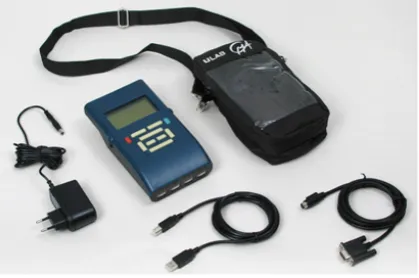
coach 6 is integrated school measuring, modelling and control system. there are several interfaces for measured records, the most frequently used are coachlab and ulab. ulab
(figure 1) is easy to use, portable, graphic system for
collecting data which can
be used in different ways in
the class as well as at fieldwork. the software is
an open environment in which both the basic programme and supportive sub-programmes can be run.of education in the 21st century Volume 37, 2011 31
the system is universal and provides following actions:
• measurement of physical, chemical and biological variables,
• modelling natural processes,
• controlling a currently running experiment,
• video-measurements,
• advanced data processing or analysis.
currently the latest version coach 6 is used.
Complex Experimental Task Using Computer Measuring Systems
chemistry belongs to natural sciences and that is the reason why its experimental principle predestines an implementation of school measuring systems in the teaching process. observation of the whole chemical reaction simplifies the understanding of the process by students. it also increases motivation character of the experiment. We have chosen the experiment “acidic bubbles” as a computer-aided example of complex real experiment.
Characteristic of CO2
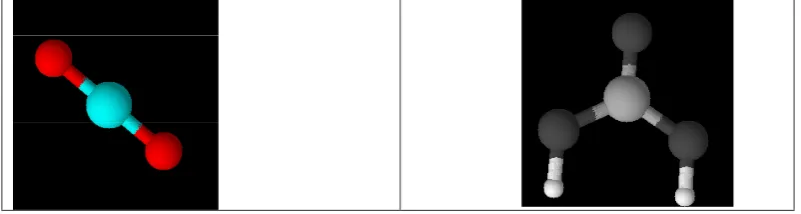
co2 (figure 2) is an odourless, colourless flammable gas with slightly sour taste. it is not toxic in low concentrations, so it can be used in the production of sparkling waters refreshing soft and alcoholic drinks. if reacting with water under increased pressure, small amounts of carbonic acid (h2co3) (figure 3) are produced which act as a preservative. its presence in carbonated drinks ameliorates the sensory quality and produces the sense of freshness (Poláček, 2008).
Figure 2: Carbon dioxide (ChemSketch). Figure 3: Carbonic acid (ChemSketch).
co2 is soluble in water to a large degree (carbonated drinks) and partially reacts with water according to the following reversible reaction:
(1)
if the gas is incorporated into the liquid, the result is the mixture of two states. solubility of gas in the liquid is influenced by three basic factors (Kellӧ & Tkáč, 1977; Novotný et al, 1971; Vodrážka, 1972):
• character of the solvent and the solute.
gas and pressure was formulated by W. henry (1803). the law states that: the amount of dissolved gas is proportional to its partial pressure above the solution according to equation:
(2)
where “c“is concentration of the gas in saturated solution, “p“is the pressure above the solution and “k“is the constant of proportionality influenced only by the temperature.
• temperature.
according to the classification of solubility of gases in liquids written above, co2 is only partly soluble in water, thus it can be categorized to boundary zone. dependence of co2 water solubility on temperature is displayed in the table 1.
Table 1. Solubility of CO2 at a partial pressure for CO2 of 1 bar abs (Physical and Engineering Data, 1978).
Temperature (°C) 0 10 20 30 40 50 80 100
Solubility (cm3 CO
2/g of water) 1.8 1.3 0.88 0.65 0.52 0.43 0.29 0.26
Aims of Complex Experiments
the aims of the complex experiment were to:
• show the behaviour of co2 in water by changing the mixtures of ph, with different content of co2 versus time and temperature,
• demonstrate the potential uses of measuring systems coach 6 for sensing and processing of measured data,
• use graphical outputs obtained for the interpretation of theoretical context (temperature dependence of co2 solubility in water, temperature and time instability h2co3) and
• compare the appropriateness of the measurement systems coach 6
Course of the Complex Experiment
before the experiment starts, students state several fields of interest based on their theoretical knowledge about the course of ph changes with changing temperature on the blank graphs for different types of mixtures. then they can start laboratory activities by following steps:
of education in the 21st century Volume 37, 2011 33
Figure 4: Apparatus consists of magnetic stirrer, beaker with mixture of
wa-ter and CO2 and sensors (measuring pH and temperature) (created in
Chemix).
2. prepare the mixtures of water and co2 of different concentrations (two as minimum). 3. the mixture was heated by magnetic stirrer and acidity changes of the solution were monitored by temperature and ph electrodes at the same time.
4. measurements were carried out by measuring systems.
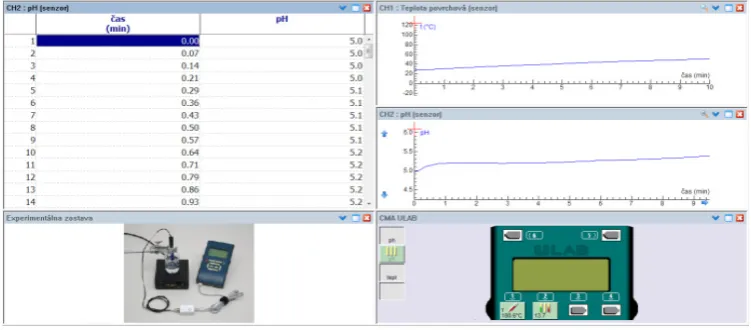
the apparatus having been constructed and h2o/co2 mixtures prepared, the basic parameters of measurement were set in the coach 6 programme. two values of ph, temperature and their changes in time were measured separately. the measurement lasted ten minutes. the collected data are presented in figure 5.
first, the measurement of tap water was done. by using the sodastream co2 wasadded into water. the water was fully saturated by gas. before the saturation, the ph was measured and the initial value was 7.6. at first glance it is apparent that data obtained from both measuring systems were very similar (figure 5).
leads to the increase in the ph value, i.e. the basicity increased. to make the influence of temperature on ph values more clear and evident, we created a new graph in the software coach 6 displaying the relation of ph values to changing temperature (figure 6).
Figure 6: Graph of changes in pH values depending on the temperature
chang-es in CO2 saturated tap water.
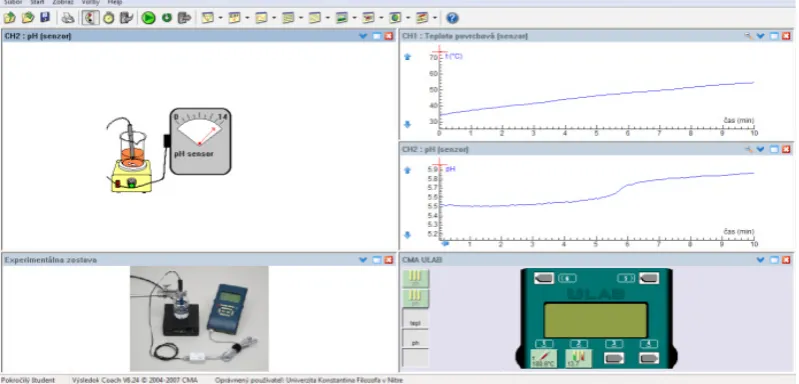
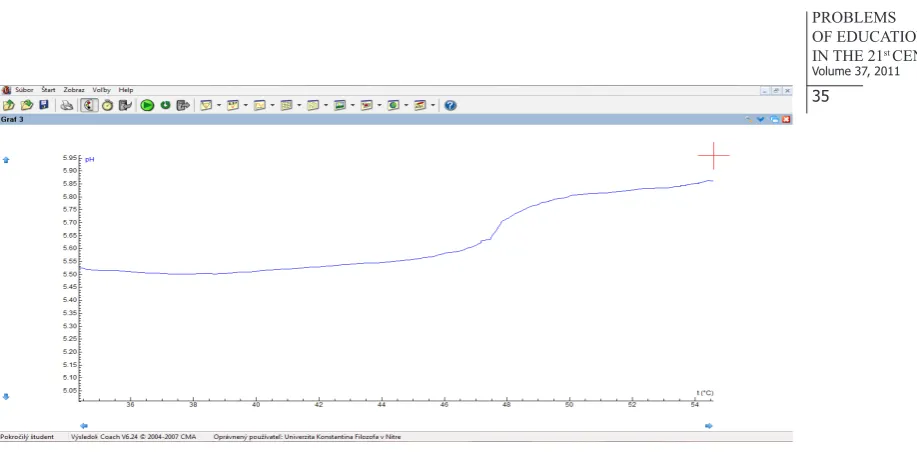
second, another measurement was done with a light sparkling soda water (lower co2 concentration). data of the measurements are processed and presented in the graph (figure 7).
Figure 7: Results of the measurements of the observed variables for light spar-kling soda water in Coach6.
of education in the 21st century Volume 37, 2011 35
Figure 8: Interdependence of pH and temperature changes in light sparkling soda water.
Third, the ph values of the deionised water saturated with co2 (from sodastream) were measured. the ph value of water before the addition of co2 was 5.67. the ph values of the saturated deionised water were monitored for 50 hours. external conditions were practically not changed; the room temperature fluctuated within 22 – 24 °c and the atmospheric pressure was stable. We wanted to prove that in an open system the amount of dissolved co2 decreases and consequently a smaller amount of carbonic acid is formed. at the same time unstable carbonic acid decomposes without heating the system. this assumption was confirmed by rising of ph values, acidity was declined due to the loss of carbonic acid. the results are reported graphically in figure 9.
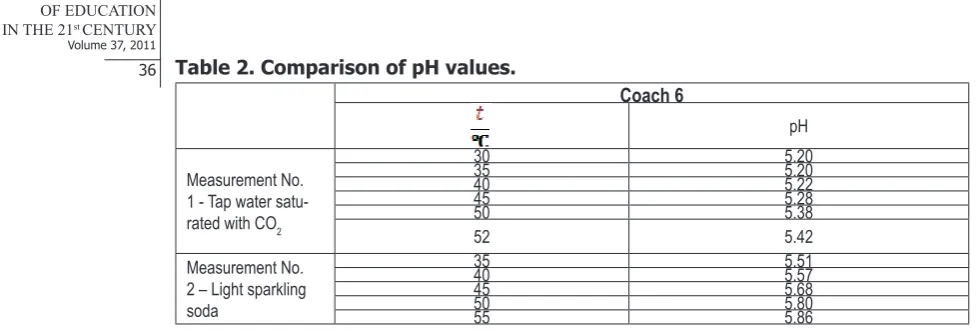
Coach 6
pH
Measurement No. 1 - Tap water satu-rated with CO2
30 5.20 35 5.20 40 5.22 45 5.28 50 5.38 52 5.42 Measurement No. 2 – Light sparkling soda 35 5.51 40 5.57 45 5.68 50 5.80 55 5.86
these experimental results can be compared to students´ initial ideas, which are a contributive element for fixing knowledge (braniša �� Jenisov�, 2011).�� Jenisov�, 2011). Jenisov�, 2011).
Conclusion
dissolving of the co2 in water is a complex system of reactions. except of un-reacted molecules of co2, the h2co3 molecules and their ions are present in the solution. at room temperature the solubility of co2 is approximately 90 cm3 of co
2 per 100 ml of water (carroll, mather �� slupsky, 1991)., 1991).
to demonstrate the changes in properties of the system h2o/co2 two school measuring systems coach were used. obtained dependencies of ph values of mixtures h2o/co2 on temperature in time were depicted in the graphs. the results achieved can be applied in chemistry teaching for interpretation patterns of solubility of gas in water as well as the instability of h2co3.
experiments confirmed that the temperature increased in relation to increasing ph. co2 solubility decreased along with increasing temperature, and resulting lower concentration of co2 in the mixture also caused the reduction of the h2co3 concentration. moreover, acid was decomposed by the influence of the higher temperature. experimental data were identical when processed and evaluated by both measuring systems.
the advantages of the measuring systems can be seen in their supportive functions leading to investigative experimental activities of students, which are gradually disappearing from both primary and secondary schools for various reasons. the measuring systems can not only streamline the teaching, but they can also make it more interesting for students and even attract them to chapters of less popular fields of chemistry or physics, and return “the magic of experimentation” back.
Acknowledgements
the article was published with partly support of the Grant agency of the czech republic Project (GAČR) Nr. 406/09/0359.
References
becker, h. J. (2000). Who�s Wired and Who�s not: children�saccess to and use of computer technology,Who�s Wired and Who�s not: children�s access to and use of computer technology,, 10/26/2011, from: http://www.crito.uci.edu/tlc/findinGs/WhosWiredWhosnot.pdf. 2011-10-26 bílek, m. et al. (1997). Výuka chemie s počítačem. hradec Kr�lové: Gaudeamus.
Bílek, M., Kmeťová, J. (2010) Current Challenges for Computer Supported School Chemical Experiments.
of education in the 21st century Volume 37, 2011 37
braniša, J., �� Jenisov�, Z. (2011). the school chemical experiment supported by digital technologies. in
Young researchers 2011 – Proceedings. nitra: fpV uKf.
carroll, J. J., mather, a. e. �� slupsky, J. d. (1991). the solubility of carbon dioxide in water at low pressure. Journal of Physical and Chemical Reference Data, 20 (6), pp. 1201-1209.
Kellӧ, V., & Tkáč, A. (1977). Fyzikálna chémia. bratislava: alfa.
Novotný, V., Siládiová, V. & Daučík, K. (1971). Fyzikálna chémia. bratislava: alfa.
physical and engineering data (1978). the hague: shell internat. petroleum maatschappij bV.
Poláček, Š. (2008). Sýtená voda a nápoje. Poľnohospodár, ročník 52 (9) p. 5.
Richtr, V., Kraitr, M, & Štrofová, J. (2011). Atraktivita jako významný prvek reálneho chemického
experimentu. Biologie, Chemie, Zeměpis, ročník 20 (3), pp. 193-198.
Vodrážka, Z. (1972). Obecná a fyzikální chemie pro lékaře a biology. praha: avicenum. ip-coach (2005). 9/22/2011, from: http://www.cma-science.nl, 2011-09-22.
Advised by Mária Porubská, Constantine the Philosopher University, Nitra, Slovakia
received: September 05, 2011 accepted: October 26, 2011
Jana Braniša Ph.D., Assistant Professor, Department of Chemistry, Faculty of Natural Sciences,
Constantine the Philosopher University, Tr. �. �lin�u 1, �4� 74 �itra, �lova�ia.Tr. �. �lin�u 1, �4� 74 �itra, �lova�ia., Slovakia. E-mail: jbranisa@ukf,sk
Website: http://www.ukf.sk
Zita Jenisová Ph.D., Assistant Professor, Department of Chemistry, Faculty of Natural Sciences,
Constantine the Philosopher University, Tr. �. �lin�u 1, �4� 74 �itra, �lova�ia.Tr. �. �lin�u 1, �4� 74 �itra, �lova�ia., Slovakia. E-mail: zjenisova@ukf,sk
Martin Bílek Prof. Ph.D., Full Professor, Department of Chemistry, Faculty of Science, University
of �radec Králové, Ro�itans�ého 62, 500 03 �radec Králové, C�ech Republic and, 500 03 �radec Králové, C�ech Republic and
Department of Chemistry, Faculty of Natural Sciences, Constantine the Philosopher