80
CHEMISTRY TEACHERS’ AND STUDENTS’
PERCEPTIONS OF PRACTICAL WORK
THROUGH DIFFERENT ICT LEARNING
ENVIRONMENTS
Johannes Pernaa, Maija Aksela University of Helsinki, Finland E-mail: maija.aksela@helsinki.f
Abstract
This paper presents the first phase of a design research, where four practical work activities within ICT learning environments (concept maps, molecular modeling, animations and videos) were created and evaluated. Materials were designed carefully after the orientation of research literature and Finnish chemistry curriculum by 21 che mistry student teachers during their M.Sc. chemistry education course. Designed materials were peer evaluated before they were presented to 27 teachers and students who made their external evaluation. Research questions of the research were i) What kind of need is there for creating learning environments that connect practical chemistry and ICT?, ii) What kind of features does meaningful practical work through different ICT learning environments contain? And iii) What kind of effect does practical work through ICT have on chemistry learning according to che mistry teachers and students? Data was gathered by observing and using questionnaires. This study shows that the need for meaningful practical work through ICT learning environments is substantial. According to the designers and respondents, meaningful characteristics of practical working through ICT are i) cooperative, ii) constructivist, iii) motivating, and iv) time saving and safe, In addition, they should visualize chemical phenomenon and processes at macro and molecular levels. Studied teachers found that ICT gives i) important aid to learning and teaching prac tical work, ii) it arouses interest and iii) it develops research skills. At the second phase of this research, activities will be developed to more contextual and inquirybased form and the effect on learning will be examined thoroughly with comprehensive school students.
Keywords: chemistry teaching, information and communications technology, ICT, modeling, practical work.
Introduction
IN THE 21CENTURY Volume 16, 2009 81
tical work illustrates social aspects and communication related to problem solving in science (Millar, 2004). In addition, it is shown to promote students interest and motivation towards chemistry. (Hofstein & Lunetta, 2004)
Practical working seems to be the most effective for learning when it is openended (Millar, 2004) and contextbased (Nakhleh et al., 2002) with clear objectives. To avoid cognitive overload and increase meaningful learning, practical work should consist of three phases (pre discussion, working, post dis cussion) (Millar, 2004). An opportunity to computer usage also is recommended (Lazarowitz & Tamir, 1994).
Some studies also bring forth criticism towards the importance of practical work. According to Hod son (1996), practical work is an ineffective and overrated teaching method. He claims that the large role of the practical work in science education is usually explained by teaching students scientific research methods, but actually practical work represents scientific inquiry poorly. The frailty of practical work has also been a cookbook trend where the instructions are carried out like a recipe which reduces meaningful learning (Monteyne & Cracolice, 2004).
More research is needed from the role and nature of practical work. For example, research of the goals and effect of practical work, students’ perceptions and interactions with the working environment and new instruments that promote learning and teaching. (Nakhleh et al., 2002) This paper aims to in vestigate teachers’ and students’ perceptions of practical work through different information and commu nication technology (ICT) learning environments and it presents four learning environments and their design processes.
Practical Work and ICT
Practical work through ICT is one of the future research fields that Nakhleh et al. (2002) encourages to work with. Important fields also are different kind of visualizations and possible learning outcomes (Nakhleh et al., 2002).
The role of modern technology in curricula has grown remarkably for the last two decades and it enables extensive visualization recourses for chemistry educators. (Kozma & Russell, 2005) Visua lization technologies include computerbased molecular modeling, simulations, animations, computer assisted conceptual framework modeling and microcomputerbased laboratories. This paper is delimited to animations, computerbased molecular modeling, concept mapping and videos (discussed under ani mations). This section introduces these ICT tools, but in order to understand their importance, it is first necessary to view visualization in chemistry, in generally.
Visualization in chemistry
Chemistry is a difficult discipline to teach and learn, partly because of its three dimensional nature (Gabel, 1999). Chemical phenomenon can be represented in three different levels: macro (observable), symbolic (e.g. H2O) and sub-microscopic (e.g. electron flow). Teachers are experts in chemistry, and for
them it is easy to visualize chemistry in all these three levels mentally without confusion. Students are novices, and changing from a level to another is challenging for them. It is necessary to develop new ways for teachers to visualize their teaching. (Johnstone, 1993)
Visualizations, for example pictures, gestures, chemical symbols, mathematical symbols, graphs, maps or animations, are a central element in understanding, learning and teaching. They are cognitive tools for communicating and representing knowledge. (Tversky, 2005) In chemistry, visualizations are carried out using gestures, pencil and paper, thinking and computers. In chemistry the concept of visuali zation is tightly related to the concept of modeling. (Justi & Gilbert, 2002).
82 Concept maps and practical work
Concept mapping is a modeling technique where conceptual frameworks related to certain pheno-mena are illustrated with concepts and linking words. They are used as graphical teaching, learning, evaluation and presentation tools. (see Figure 1) (Novak, 1998).
There is some research of the benefits of concept mapping in practical working. According to stu-dies (e.g. Gahr, 2003; Kaya, 2008; Kiliç, Kaya, & Doğan, 2004; Markow & Lonning, 1998; Stensvold & Wilson, 1992; Özmen, Demircioğlu, & Coll, 2009), concept maps can improve understanding of chemi-cal concepts, help building connections among abstract concepts and work as a misconception correcting tool. The use of pre and postlaboratory concept maps has been showed to improve students understan ding of concepts related to the practical work. (Kaya, 2008; Markow & Lonning, 1998; Özmen et al., 2009). There also is evidence that concept maps reduce students’ attentions to distractions in laboratory, improve understanding of procedures, instructions (Stensvold & Wilson, 1992) and attitudes towards practical work (Kiliç et al., 2004).
There is a few studies made on the use of computerbased concept mapping and practical working. Gahr (2003) reported using computer assisted concept mapping cooperatively with students which dec reased notably questions concerning procedures and techniques. In the study of Markow and Lonning (1998), students used computers in constructing pre and postconcept maps.
Computerbased molecular modeling and practical work
Traditionally, the term molecular modeling concentrates on modeling single molecules or small sta tic systems. Computer-based molecular modeling benefits chemistry education in all education levels. (Aksela & Lundell, 2008) Indeed, computers make possible to visualize sub microscopic and symbolic levels simultaneously, which help students to visualize connections between three chemical dimensions and develop their mental models. It facilitates learning and leads to deeper understanding of chemical concepts (e.g. Kozma & Russell, 2005; Russell & Kozma, 2005). Molecular modeling also has found an effective tool in supporting practical work. Kozma (2003) reports that using molecular modeling softwa re at the laboratory increases communication and knowledge sharing related the examined activities.
In the secondary school, molecular modeling is mostly used on building, studying and representing molecules and their properties. The main reasons for the use of modeling are new ways to illustrate and explain chemical phenomena and a way to give students an opportunity to carry out their own investi gations. Combining molecular modeling and practical work is still rare in secondary schools. Teachers wish more materials and education from it. (Aksela & Lundell, 2008)
Animations and practical work
Animations differ from molecular modeling by portraying dynamic processes. They are not interac tive and do not base on real data. Animations represent purely a modelers’ mental model and are sensiti ve to graphical expression skills, which makes creating good and pedagogically meaningful animations as a challenging task. Meaningful animations are i) short, illustrating one concept under 60 seconds, ii) understanding is supported through narration or text, iii) the user interface is clear and iv) the content is tested with students and experts. It also is important to plan the design process based on research literature. A lot of animations also are freely available from the Internet, but often teachers find them inappropriate to serve their purposes, because of the wrong language, inaccuracy or low quality. (Burke, Greenbow, & Windschitl, 1998)
IN THE 21CENTURY Volume 16, 2009 83
Wulfsberg, & Young, 2003). Using modern technology (e.g. cameras, mobile phones) videos are easy to make and distribute through the Internet.
Velázquez-Marcano, Williamson, Ashkenazi, Tasker, and Williamson (2004) reported that obser-ving animations improve students ability to sketch connections between macro, symbolic and submic roscopic levels and develop their mental models more dynamic. In order to get the best benefit out of them, a careful design and high quality of animations are necessary (Tasker & Dalton, 2006). Velázquez-Marcano et al. (2004) claimed that animations are the most effective when they are shown together with a video demonstration, whereas Vermaat, KramersPals, and Schank (2003) suggested that constructing animations is more efficient than observing.
Methodology of Research
This case study is the first phase of a design research (Edelson, 2002). Its’ final goal is to develop meaningful practical work through ICT learning environments and measure their effect on learning. In this phase, designing is focused on developing four types of learning environments for different types of ICT, based on research literature and Finnish curriculum. Research questions were:
i. What kind of need is there for creating learning environments that connect practical chemistry and ICT?
ii. What kind of features does meaningful practical work through different ICT learning environ ments contain?
iii. What kind of effect does practical work through ICT have on chemistry learning according to chemistry teachers and students?
Designing was carried out by chemistry student teachers attending to the M.Sc. course called Prac tical Chemistry in Chemistry Education in spring 2009. The course included both majors and secondary subject students (N=21). They divided into five ICT groups depending on their personal interests. Selec-table ICT groups were 1) animations and simulations, 2) concept maps, 3) computer based molecular modeling, 4) videos and 5) microcomputer based laboratory (MBL) (not discussed in this paper). At the course, groups had an assignment to develop a laboratory activity that combines practical work and ICT. There were three demands of the design: i) The development of the activity should base on research li terature, ii) the context and phenomena should fit under the Finnish curriculum, and (iii) the designing should also take consider the usability and limited ICT resources. Researchers worked as teachers on the course and coordinated the design process. They gave guidance for the developing and technical support.
The students’ design process included three phases:
Phase 1: Familiarization of research literature and the Finnish curriculum, generating a raw version of the laboratory activity and testing it.
Phase 2: Presenting the activity in a peer session, performing two peer tests and giving feedback to two other groups and developing designing of the own project after peer feedback.
Phase 3: All groups gave two workshops for teachers and students in the spring 2009 at the national inservice training event for chemistry teachers. One session included 1015 minutes presentation from each group and 5 minutes discussion.
The external evaluation of the materials was carried out at the inservice training event in the spring 2009 by teachers and students at the workshops. Data was gathered by observing the sessions and using questionnaires that were delivered at the beginning of the sessions. The questionnaire consisted of both closed and open questions. Data analysis of the open questions and observations was carried out through a content analysis in order to reveal key features and concepts related to meaningful practical work through ICT -learning environments (Tuomi & Sarajärvi, 2009). The closed questions included arrange-ment and measurearrange-ment level questions and from them, frequencies and percentages were calculated.
The evaluative sample group consisted of 27 teachers and students (Nmale = 13 and Nfemale = 14). The
84 sciences the third one (f = 5). The 19 teachers had been teaching from one year to over 20 years (f05 = 6,
f610 = 3, f1115 = 5, f1620 = 1 and fover 20 = 4). They worked in a comprehensive school (f = 3), upper secon dary school (f = 6), in the whole secondary school (f = 5), polytechnic (f = 2) and three of them worked as substitute teachers.
For teachers from the sample, depending on time and recourses, practical work is a common wor king method. 23% (f = 6) of them uses practical work sometimes and 46% (f = 12) often. They feel that practical work is the center of chemistry and that laboratory activities are motivating for students and they arouse their interests towards chemistry.
(R2) “It is important because of it enables observing, thinking in science and motivating.”
(R3) “Chemistry can not be learned without practical work”
(R5) “I use practical work, If there is time and a working space”
(R7) “It is important because of learning and motivation”
Results of Research
Need for Developing Practical work and ICT – learning environments
The respondents (R) are familiar with the use of ICT. 48% (f = 13) of them use it as a daily bases in their teaching. The using rate of ICT together with practical work is much lower: only 8% (f = 2) uses practical work and ICT often together and 46% (f = 12) occasionally. 23% (f = 6) of the respondents re plied that they never use them together.
The main reasons for rare use of ICT with practical work are i) lack of skills, ii) software or iii9 time. They are eager to use them more together in the future. The respondents agreed (26%, f = 7) and strongly agreed (67%, f = 18) that there is an extreme need for developing meaningful practical work through ICT – learning environments.
(R5) “It would give variety to teaching”
(R7) “If there is a lot of different types of practical work through ICT environments available, schools get a good reason to invest in something new.”
(R7) “It is the lack of skills, knowledge and time, I am trying to do it more”.
(R25) “It depends on time and the underlying practical work”
Characteristics of meaningful practical work through ICT learning environments
This section describes all four activities from students (designers) point of view and reports how the respondents experienced them at the workshops (see table 1).
Table 1. Evaluation of the designed practical work and ICT – environments.
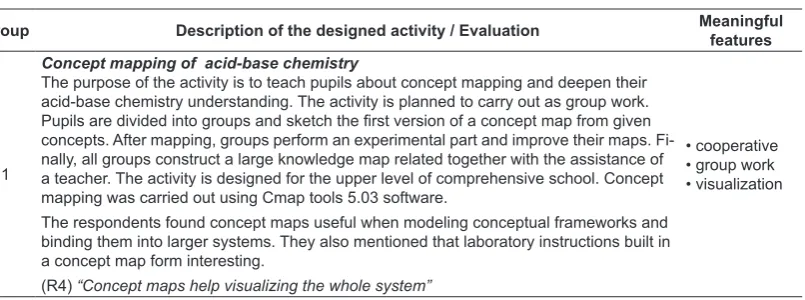
Group Description of the designed activity / Evaluation Meaningfulfeatures
1
Concept mapping of acid-base chemistry
The purpose of the activity is to teach pupils about concept mapping and deepen their acid-base chemistry understanding. The activity is planned to carry out as group work. Pupils are divided into groups and sketch the first version of a concept map from given concepts. After mapping, groups perform an experimental part and improve their maps. Fi-nally, all groups construct a large knowledge map related together with the assistance of a teacher. The activity is designed for the upper level of comprehensive school.Concept mapping was carried out using Cmap tools 5.03 software.
The respondents found concept maps useful when modeling conceptual frameworks and binding them into larger systems. They also mentioned that laboratory instructions built in a concept map form interesting.
(R4) “Concept maps help visualizing the whole system”
IN THE 21CENTURY Volume 16, 2009 85
2
Modeling solubility
Group 2 combined molecular modeling and practical work to support understanding of solubility in the upper level of comprehensive school. The aim is to teach how to use mo-deling to analyze macroscopic results on a microscopic level.
The exercise consists of three phases:
1) pupils test in the laboratory how difference substances dissolve, 2) discussion from observations,
3) modeling the phenomena with computers and discussion. Used modeling software was Spartan student 03.
The respondents felt that computer-based molecular modeling is a vital improvement for traditional practical work, but some of them suspected that large class sizes makes this kind of activity impossible to carry out in real class. Study also revealed the lack of resour-ces and difficulties to buy commercial software. Some teachers did not know where or how to get freeware software.
(R10) “So far, there is now good ICT resources available, but these help teaching”
(R23) “More information from the different software.”
(R27) ”We do not have modeling software in school and they are too expensive.”
(R27) “These are far away from reality. Impossible to carry out with a large group.”
• analyzing • discussion • explanation • evaluation • observation • visualization 3
Animations and practical work: Dissolving sodium chloride in water
The animation group made a short animation for teaching the dissolving of Sodium Chlori-de (NaCl) in water. They approached the task by reviewing research literature concerning common misconceptions related to dissolving NaCl and carried out a small text book content analysis of Finnish upper level of comprehensive chemistry text books. They ma-de the animation using ChemSense animator -software. The animation was build for an example, how easy it is to make a simple animation with the students. They also presen-ted a collection of Internet links for the respondents at the presentation session.
The respondents found animations useful with practical work because they illustrate mole-cular level. They appreciated ChemSense software because of its free and seemed easy to use. Teachers discussed, for example how students could easily download it to home computer and explore chemistry animations after school. According to teachers, making animations would be motivating for students. The respondents also valued the link collec-tion because they can use them in their work as such.
(R4) “Animations are easily connected to practical work and they give an image from a molecular level.”
(R26) “For students, it easy to picture molecular level if it is seen with own eyes.”
• easy to use • free • motivating • visualization
4
Video demonstration: Chloride Mohr titration for upper secondary school
The activity introduces macroscopic changes in Mohr’s titration and is designed after pre-serve-observe-explain-method (POE) in order to emphasize constructivism. Group 4 saw videos as an excellent tool for presenting macroscopic demonstrations. They argue that videos are time saving and suit e.g. for highlighting main points from long experiments or introducing equipments. They are a safe way to carry out practical work with inadequacy recourses, e.g. the lack of equipments, chemicals or a fume chamber. They also noticed that the quality of videos in the Internet was diverse and it is time-consuming for teachers to make their own Finnish language video demonstrations. But once they are made, they are long lasting and easy to use through the Internet.
The respondents found video demonstrations good for motivating the students and for illustrating the theory as an introduction. They strongly emphasized animations role only as an introduction. According to them, videos can not replace traditional practical work. They were enthusiastic about exploiting the Internet as distributing channel together with students. They suggested that a video demonstration material bank classified as pheno mena could be in order.
(R14) “Videos suit as a motivation or introduction element for practical work, but does not replace it.”
• POE • time saving • safe • diverse usability • easy to distribute • motivating • constructi-vism
Perceptions of the effects on learning and teaching
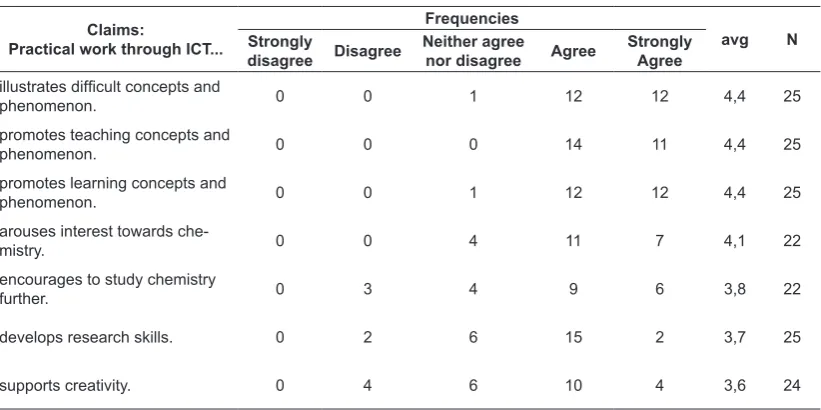
The designed environments possible effects on learning and teaching were evaluated using a fi-vepoint Likert scale (1 = Strongly disagree, 2 = Disagree, 3 = Neither agree nor disagree, 4 = Agree and 5 = Strongly agree) (see Table 2). Teachers and students agree and strongly agree that practical work through ICT illustrates difficult concepts and phenomenon (avg = 4,4) and promotes their teaching (avg = 4,4) and learning (avg = 4,4). They emphasized that it enables to visualize the submicroscopic level but it is the teachers who ensure their meaningful usage.
86 (avg = 4,1) and encourages to study chemistry further (avg = 3,8). Teachers also argued that just the
computer usage is not enough to encourage further chemistry studies, roles of the teacher and theory also are important. The respondents agreed (f = 15) that practical work through ICT develops research skills but also six of them felt neutral about it (avg = 3,7). Some replied that even if ICT supports practical working and teaching, development of research skills is still up to students’ motivation. The presented claim”Practical work through ICT supports creativity” divided answers the most (avg = 3,6), the respon dents revealed the strongest frequency on disagreements (f = 4), six of them answered neutral, ten agreed and four also strongly agreed.
Table 2. Teachers and students perceptions of the effects of practical work through ICT on teaching and learning.
Claims:
Practical work through ICT...
Frequencies
avg N
Strongly
disagree Disagree Neither agree nor disagree Agree Strongly Agree
illustrates difficult concepts and
phenomenon. 0 0 1 12 12 4,4 25
promotes teaching concepts and
phenomenon. 0 0 0 14 11 4,4 25
promotes learning concepts and
phenomenon. 0 0 1 12 12 4,4 25
arouses interest towards
che-mistry. 0 0 4 11 7 4,1 22
encourages to study chemistry
further. 0 3 4 9 6 3,8 22
develops research skills. 0 2 6 15 2 3,7 25
supports creativity. 0 4 6 10 4 3,6 24
(R6) “Especially molecular modeling and animations bring out the submicroscopic level, which sometimes remain unclear. Concept maps clarifies conceptual frameworks”
(R8) “ICT and practical work is a modern approach in chemistry education, but sometimes limi ted abilities of the software reduces creativity.”
(R24) “Practical work through ICT supports teaching and learning especially, but research skills depend on students. Computers alone are not enough to encourage further chemistry stu dies, the role of the teacher and theory are crucial in it.”
Conclusions and Discussion
As a result of the first phase of this design research, four practical work activities through ICT lear-ning environments were created. ICT types that were included in design were concept maps, molecular modeling, animations and videos.
The study showed that the need for meaningful practical work through ICT learning environments is substantial. 46 % of the teachers carried out practical work often with students and the use of ICT in ge neral is ordinary, but combining them is rare. Only 8% uses practical work and ICT often together. Main reasons for rare use are lack of skills, software or time. Common desire is to use them more together in the future, but in order to accomplish that, teachers wish to have more support in a form of education and material. Results correlates with Aksela and Karjalainen (2008) and Aksela and Lundell (2008), which studied the use of molecular modeling and chemistry teaching in general in Finland.
IN THE 21CENTURY Volume 16, 2009 87
Laroche et al., 2003; Özmen et al., 2009). It is remarkable that the designers did not use contextual or in quiry-based approach more, which is a common meaningful feature for practical working (Millar, 2004; Nakhleh et al., 2002).
According to chemistry teachers and students perceptions, combination of practical work through different kind of ICT visualization techniques promote teaching and learning difficult chemical concepts (e.g. Aksela & Lundell, 2008; Kozma & Russell, 2005; Tasker & Dalton, 2006; Velázquez-Marcano, et al., 2004; Vermaat et al., 2003). It also arouses interest towards chemistry (e.g. Aksela & Lundell; Kiliç et al., 2004) and develops research skills (e.g. Hofstein & Lunetta, 2004).
Work with this project continues at the spring 2010, when the second phase of this design research will be executed. The aim of the second phase is to develop these learning environments in a more contex tual and inquiry-based form and study how practical work through ICT effect on chemistry learning. The effect on learning will be tested on comprehensive school students using pre and post measurements. At this point, the results have been encouraging, but in order to transfer practical work through ICT to scho ols, more materials, information and education on the possibilities of computer assisted visualization in laboratory environment are needed.
Acknowledgements
We thank all the students who participated in “Practical Chemistry in Chemistry Education” course in spring 2009 for their enthusiastic and innovative development work with the materials.
References
Aksela, M., & Karjalainen, V. (2008). Kemian opetus tänään: Nykytila ja haasteet Suomessa. Helsinki: The Center of Chemistry Education, Department of Chemistry, University of Helsinki, University Press.
Aksela, M. & Lundell, J. (2008). Computerbased molecular modelling: Finnish school teachers experiences and views. Chemistry Education Research and Practice, 9, 301308.
Burke, K. A., Greenbow, T. J., & Windschitl, A. (1998). Developing an Using Conceptual Computer Animations for Chemistry instruction. Journal of Chemical Education, 75(12), 16581661.
Edelson, D. C. (2002). Design research: What we learn when we engage in design. The Journal of the Learning Sciences, 11, 105121.
Elliott, M. J., Stewart, K. K., & Lagowski, J. J. (2008). The Role of the Laboratory in Chemistry Instructions. Jour nal of Chemical Education, 85(1), 145149.
Gabel, D. (1999). Improving Teaching and Learning Through Chemistry Education Research: A look to the Future. Journal of Chemical Education, 76(4), 548554.
Gahr, A. A. (2003). Cooperative Chemistry: Concept Mapping in the Organic Chemistry Lab. Journal of College Science Teaching, 32 (5), 311315.
Hodson, D. (1996). Laboratory work as scientific method: three decades of confusion and distortion. Journal of Curriculum Studies, 28 (2), 115135.
Hofstein, A., & Lunetta, V. N. (2004). The Laboratory in Science Education: Foundations for the TwentyFirst Cen tury. Science Education, 88 (1), 2854.
Johnstone, A. H. (1993). The Development of Chemistry Teaching: A Changing Response to Changing Demand.
Journal of Chemical Education, 70 (9), 701705.
Jonassen, D. H. (1999). Designing constructivist learning environments. In C. Reigeluth (Eds.), Instructional design theories and models: A new paradigm of instructional theory, volume II (pp. 215239). Mahwah, NJ: Lawrence Erlbaum Associates.
Justi, R., & Gilbert, J. (2002). Models and Modelling in Chemical Education. In J. K. Gilbert, O. De Jong, R. Justi, D. Treagust, & J. van Driel (Eds.), Chemical Education: Towards Researchbased Practice (pp. 4768). Dordrecht: Kluwer Academic Publishers.
Laroche, L. H., Wulfsberg, G., & Young, B. (2003). Discovery Videos: A Safe, Tested, Time-Efficient Way To Incor-porate DiscoveryLaboratory Experiments into the Classroom. Journal of Chemical Education, 80 (8), 962966. Lazarowitz, R., & Tamir, P. (1994). Research on using laboratory instruction in science. In D. L. Gabel (Ed.), The
88 Perceptions and Effects on Achievement. Journal of Research in Science Teaching, 35 (9), 1015–1029.
Monteyne, K., & Cracolice, M. S. (2004). What’s wrong with Cookbooks? A Reply to Ault. Journal of Chemical Education, 80 (11), 15591560.
Millar, R. (2004). The role of practical work in the teaching and learning of science. Paper prepared for the Mee ting: High School Science Laboratories: Role and Vision. Washington: National Academy of Sciences, 122. Nakhleh, M. B., Polles, J., & Malina, E. (2002). Learning Chemistry in a Laboratory Environment. In J. K. Gilbert, O. De Jong, R. Justi, D. Treagust, & J. van Driel (Eds.), Chemical Education: Towards Researchbased Practice
(pp. 6994). Dordrecht: Kluwer Academic Publishers.
Novak, J. D. (1998). Learning, creating, and using knowledge: Concept Maps as Facilitative Tools in Schools and Corporations. Mahweh, NJ: Lawrence Erlbaum Associates.
Kaya, O. N. (2008). A StudentCentred Approach: Assessing the Changes in Prospective Science Teachers’ Con ceptual Understanding by Concept Mapping in a General Chemistry Laboratory. Research in Science Education,
38 (1), 91110.
Kiliç, Z., Kaya, O. N., & Doğan, A. (2004). Effects of Students’ Pre and PostLaboratory Concept Maps on Stu dents’ Attitudes toward Chemistry Laboratory in University General Chemistry, Online Submission, Poster presen ted at the International Conference on Chemical Education (18th, Istanbul, Turkey, 2004).
Kozma, R. (2003). Material and social affordances of multiple representations for science understanding. Learning and Instruction, 13 (2), 205226.
Kozma, R., & Russell, J. (2005). Students becoming chemists: Developing representational competence. In J. K. Gil bert (Ed.), Visualization in Science Education (pp. 121146). Dordrecht: Springer.
Stensvold, M., & Wilson, J. T. (1992). Using Concept Maps as a Tool to Apply Chemistry Concepts to Laboratory Activities. Journal of Chemical Education, 69 (3), 230232.
Russell, J., & Kozma, R. (2005). Assessing learning from the use of multimedia chemical visualiztion software. In J. K. Gilbert (Ed.), Visualization in Science Education (pp. 299332). Dordrecht: Springer.
Tasker, R., & Dalton, R. (2006). Research into practice: Visualization of the molecular world using animations. Che mistry Education Research and Practice, 7 (2), 141159.
Tuomi, J., & Sarajärvi, A. (2009). Laadullinen tutkimus ja sisällönanalyysi. Jyväskylä: Tammi.
Tversky, B. (2005). Prolegomenon to scientific visualizations. In J. K. Gilbert (Ed.), Visualization in Science Educa tion (pp. 2942). Dordrecht: Springer.
Velázquez-Marcano, A., Williamson, V. M., Ashkenazi, G., Tasker, R., & Williamson, K. C. (2004). The Use of Video Demonstrations and Particulate Animation in General Chemistry. Journal of Science Education and Techno logy, 13 (3), 315323.
Vermaat, J. H., KramersPals, H., & Schank, P. (2003). The use of animations in chemical education. In Paper pre sented at the international convention of the association for educational communications and technology, Anaheim, CA, USA, October 2226, 2003.
Özmen, H., Demircioğlu, G., & Coll, R. K. (2009). A comparative study of the effects of a concept mapping en-hanced laboratory experience on Turkish high school students’ understanding of acidbase chemistry. International Journal of Science and Mathematics Education, 7 (1), 124.
Adviced by Vincentas Lamanauskas, Šiauliai University, Lithuania
Johannes Pernaa Doctoral Student, The Unit of Chemistry Teacher Education, A.I Virtasen aukio 1, P. O. Box55, 0014 University of Helsinki, Finland. Phone: +358-50-415-1177.
E-mail: Johannes.pernaa@helsinki.fi Website: http://www.helsinki.fi/university/
Maija Aksela Professor, The Unit of Chemistry Teacher Education, Department of Chemistry, University of Helsinki, P. O. Box 55, FIN-00014 Finland.
E-mail: maija.aksela@helsinki.fi Phone: +358-50-5141450.