Taniya et al. World Journal of Engineering Research and Technology
OPTIMIZATION OF MAP REDUCE APPLICATIONS USING
PARTITION AND AGGREGATION IN BIG DATA APPLICATION
Malatesh S.H, Jyothi Kanaka Durga Kasa, Mushtaq Ahmed, Rahul Reddy, Taniya Chadha*
CSE, MSEC, Bangalore, India.
Article Received on 10/04/2016 Article Revised on 01/05/2016 Article Accepted on 21/05/2016
ABSTRACT
Cloud computing, rapidly emerging as a new computation concept,
offers agile and scalable resource access in a utility-like fashion,
particularly for the processing of big data. An important open problem
here is too effectively progress the data, from various geographical
locations more time, into a cloud for efficient processing. Big Data introduces to datasets
whose sizes are beyond the capability of typical database software tools to capture,
accumulate, maintain and examined. The application of Big Data differs across verticals
since of the several challenges that bring about the various use cases. With the increasing
amount of data and the availability of high performance and relatively low-cost hardware,
database systems have been extended and parallelized to run on multiple hardware platforms
to manage scalability. Recently, a new distributed data processing framework called Map
Reduce was proposed whose fundamental idea is to simplify the parallel processing using a
distributed computing platform that offers only two interfaces. To further reduce network
traffic within a Map Reduce job, we consider to aggregate data with the same keys before
sending them to remote reduce tasks. Map Reduce is a framework for processing and
managing large scale data sets in a distributed cluster, which has been used for applications
such as generating search indexes, document clustering, access log analysis, and various
other forms of data analytics. In existing system, a hash function is used to partition
intermediate data among reduce tasks. In this project the system proposed a
decomposition-based distributed algorithm to deal with the large-scale optimization problem for big data
World Journal of Engineering Research and Technology
WJERT
www.wjert.org
SJIF Impact Factor: 3.419*Corresponding Author Taniya Chadha
application and an online algorithm is also designed to adjust data partition and aggregation
in a dynamic manner.
KEYWORDS: Aggregation, Hadoop, Job Scheduling, Map Reduce, Partitioning.
1. INTRODUCTION
Hadoop is an open-source framework that allows to store and process big data in a distributed
environment across clusters of computers using simple programming models. It is designed
to scale up from single servers to thousands of machines, each offering local computation and
storage. The core of Hadoop consists of a storage part, known as Hadoop Distributed File
System (HDFS), and a processing part called Map Reduce. Hadoop splits files into large
blocks and distributes them across nodes in a cluster. To process data, Hadoop transfers
packaged code for nodes to process in parallel based on the data that needs to be processed.
This approach takes advantage of data locality nodes manipulating the data they have access
to allow the dataset to be processed faster and more efficiently than it would be in a more
conventional supercomputer architecture that relies on a parallel file system where
computation and data are distributed via high-speed networking. Hadoop consists of the
Hadoop Common package, which provides file system and OS level abstractions, a Map
Reduce engine and the Hadoop Distributed File System (HDFS). The Hadoop Common
package contains the necessary Java Archive (JAR) files and scripts needed to start Hadoop.
The Hadoop distributed file system (HDFS) is a distributed, scalable, and portable file-system
written in Java for the Hadoop framework. A Hadoop cluster has nominally a single name
node plus a cluster of data nodes, although redundancy options are available for the name
node due to its criticality. Each data node serves up blocks of data over the network using a
block protocol specific to HDFS. The file system uses TCP/IP sockets for communication.
Clients use remote procedure call (RPC) to communicate between each other.Map Reduce is
a programming model and an associated implementation for processing and generating large
data sets with a parallel, distributed algorithm on a cluster.
Map Reduce works by breaking the processing into two phases: the map phase and the reduce
phase. Each phase has key-value pairs as input and output, the types of which may be chosen
by the programmer. The programmer also specifies two functions: the map function and the
reduce function. A Map Reduce program is composed of a Map () procedure that performs
filtering and sorting and a Reduce () method that performs a summary operation. The Map
various tasks in parallel, managing all communications and data transfers between the various
parts of the system, and providing for redundancy and fault tolerance.
Above the file systems comes the Map Reduce Engine, which consists of one Job Tracker, to
which client applications submit Map Reduce jobs. The Job Tracker pushes work out to
available Task Tracker nodes in the cluster, striving to keep the work as close to the data as
possible. With a rack-aware file system, the Job Tracker knows which node contains the data,
and which other machines are nearby. If the work cannot be hosted on the actual node where
the data resides, priority is given to nodes in the same rack. This reduces network traffic on
the main backbone network. If a Task Tracker fails or times out, that part of the job is
rescheduled. The Task Tracker on each node spawns a separate Java Virtual Machine process
to prevent the Task Tracker itself from failing if the running job crashes its JVM. A heartbeat
is sent from the Task Tracker to the Job Tracker every few minutes to check its status. The
Job Tracker and Task Tracker status and information is exposed by Jetty and can be viewed
from a web browser. By default Hadoop uses FIFO scheduling, and optionally 5 scheduling
priorities to schedule jobs from a work queue.
The Map Reduce programming model simplifies large-scale data processing on commodity
cluster by exploiting parallel map tasks and reduce tasks. Although many efforts have been
made to improve the performance of Map Reduce jobs, they ignore the network traffic
generated in the shuffle phase, which plays a critical role in performance enhancement.
Traditionally, a hash function is used to partition intermediate data among reduce tasks,
which, however, is not traffic-efficient because network topology and data size associated
with each key are not taken into consideration.
2. RELATED WORK
In existing system, the system propose a Map Reduce algorithm to solve the ER problem for
a huge collection of entities with multiple keys. The algorithm is characterized in the
combination-based blocking and the load-balanced matching. The combination-based
blocking utilizes the multiple keys to sort out necessary entity pairs for future matching. The
load-balanced matching evenly distributes the required similarity computations to all the
reducers in the matching step so as to remove the bottleneck of skewed matching
The effectiveness and scalability of Map Reduce-based implementations of complex
data-intensive tasks depend on an even redistribution of data between maps and reduce tasks. In
the presence of skewed data, sophisticated redistribution approaches thus become necessary
to achieve load balancing among all reduce tasks to be executed in parallel. For the complex
problem of entity resolution, we propose and evaluate two approaches for such skew handling
and load balancing. The approaches support blocking techniques to reduce the search space
of entity resolution, utilize a preprocessing Map Reduce job to analyze the data distribution,
and distribute the entities of large blocks among multiple reduce tasks. The evaluation on a
real cloud infrastructure shows the value and effectiveness of the proposed load balancing
approaches. In this paper, we propose and evaluate two effective load balancing approaches
to data skew handling for MR-based entity resolution.
Note that MR’s inherent vulnerability to load imbalances due to data skew is relevant for all
kind of pairwise similarity computation, e.g., document similarity computation and
set-similarity joins. Such applications can therefore also benefit from our load balancing
approaches though we study MR-based load balancing in the context of ER only. The actual
execution of an MR program (also known as job) is realized by an MR framework
implementation such as Hadoop. An MR cluster consists of a set of nodes that run a fixed
number of map and reduce processes. For each MR job execution, the number of map tasks
(m) and reduce tasks (r) is specified. Note that the partition function part relies on the number
of reduce tasks since it assigns key-value pairs to the available reduce tasks. Each process can
execute only one task at a time. After a task has finished, another task is automatically
assigned to the released process using a framework-specific scheduling mechanism.
In Fig 2.1 load balancing is mainly realized within the map phase of the second MR Job. Both
strategies follow the idea that map generates a carefully constructed composite key that
(together with associated partition and group functions) allows a balanced load distribution.
The composite key thereby com-bines information about the target reduce task(s), the block
of the entity, and the entity itself. While the MR partitioning may only use part of the map
output key for routing, it still groups together key-value pairs with the same blocking key
component of the composite key and, thus, makes sure that only entities of the same block are
compared within the reduce phase.
As we will see, the map function may generate multiple keys per entity if this entity is
phase performs the actual ER and computes match similarities between entities of the same
block. Since the reduce phase consumes the vast majority of the overall runtime (more than
95% in our experiments), our load balancing strategies solely focus on data redistribution for
reduce tasks. Other MR-specific performance factors are therefore not considered. For
example, consideration of data locality would have only limited impact and would require
additional modification of the MR framework. We utilized two real-world datasets.
Note that the blocking attributes were not chosen to artificially generate data skew but rather
reflect a reasonable way to group together similar entities. Two entities were compared by
computing the edit distance of their title. Two entities with a minimal similarity of 0.8 were
regarded as matches. We proposed two load balancing approaches, Block Split and Pair
Range, for parallelizing blocking-based entity resolution using the widely available Map
Reduce framework. Both approaches are capable to deal with skewed data (blocking key)
distributions and effectively distribute the workload among all reduce tasks by splitting large
blocks. Our evaluation in a real cloud environment using realworld data demonstrated that
both approaches are robust against data skew and scale with the number of available nodes.
The Block Split approach is conception-wise simpler than Pair Range but achieves already
excellent results. Pair Range is less dependent on the initial partitioning of the input data and
slightly more scalable for large match tasks.
Fig 2.1. Illustrates the Map Reduce Algorithm of Hadoop system.
2.1. Disadvantages
• The existing works focuses on load balance at reduce tasks.
• It ignoring the network traffic during the shuffle phase.
• It can be only applied to the network topology with servers directly linked to other
• This approach is not traffic efficient.
• Hash based work load gives unstable work load.
3. PROPOSED SYSTEM
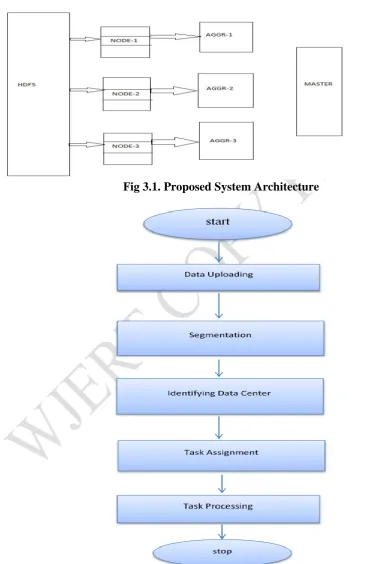
The system proposed a distributed algorithm for big data applications by decomposing the
original large-scale problem into several sub problems that can be solved in parallel. The
system design an online algorithm whose basic idea is to postpone the migration operation
until the cumulative traffic cost exceeds a threshold. The network topology is based on
three-tier architectures: an access three-tier, an aggregation three-tier and a core three-tier. The system investigate
network traffic reduction within Map Reduce jobs by jointly exploiting traffic-aware
intermediate data partition and data aggregation among multiple map tasks. It offers
computers as physical or more often as virtual machines (VMs).
A cluster of VMs, virtual cluster, is often requested as a platform for users to run parallel or
distributed applications such as Map Reduce and Dryad applications. In order to get high
throughput, fast response, load balance, low cost, and low price, many topics on VM
configuration, VM placement, VM consolidation, and VM migration are explored. The
network topology of a virtual cluster has a significant impact on the execution of applications
running on it because the physical nodes where VMs are located can be linked in different
ways. For example, some nodes are located in the same rack while others in different racks
through a slow link.
Another special architecture is the hierarchical network where two physical nodes may lie in
different local area networks. Furthermore, the characteristics of different applications have
different requirements for the network topology. Some applications create tasks running on
different VMs which need to exchange large amount of data frequently, while others create
tasks which execute independently or exchange a little data. Map Reduce and Map
Reduce-like models are widely used to process “Big Data”. Applications based on such models place
heavily datadependency or communication on VMs, so network traffic becomes the
bottleneck of jobs. The following are three phases of data exchange in the execution process
of an application based on Map Reduce model.
This paper targets at provisioning a virtual cluster according to the position relationship
between VMs so as to decrease the network traffic and improve the performance of Map
or VM configurations. By optimizing the architecture of virtual clusters, cloud users can get a
more efficient platform with the same resource request and cost, and cloud providers can
obtain a higher resource utilization ratio. The shorter the distance, the closer the virtual
cluster. The shortest distance problem is presented to obtain the closest virtual cluster.
We solve the shortest distance problem by formulating it into an integer linear programming.
The online heuristic VM placement algorithm and the global sub-optimization algorithm are
compared by simulations. The former has lower time complexity while the latter returns
shorter average distance for multiple requests. We analyze the performance of our approach
through experiments. In the experiment, we adopt different virtual cluster architectures to test
different Map Reduce applications. Two metrics of application runtime and cluster affinity
show the efficiency of virtual cluster optimization. The distance difference between two
central node selection strategies.
Heuristic distance is mapped to the virtual cluster with the most appropriate central node built
by our online VM placement algorithm. Shortest distance with a random central node is
mapped to the same virtual cluster, however, the central node is chosen randomly. It is clear
that even if we select the same virtual cluster, but not the same position of the central node,
the distance difference is also great. For Map Reduce applications, the selection of the central
node is the same important with the architecture of the virtual cluster. Each physical node has
different capability and each request has different requirement.
For Map Reduce applications, it is very important to match the request with a virtual cluster
and appropriate central node so as to make full use of the advantage of data-locality and
reduce the network traffic. Fig. 2.1 shows the different distances under the different central
nodes. We can see that the choice of the central node has an important impact on the distance
for one request. This is because Map Reduce and Map Reduce-like models are based on
master-slaves network topology. When the requests arrive randomly, their service time are
also random, and the cloud resources are enough to meet multiple requests at one time, we
can get the virtual cluster provisioning according to our online heuristic algorithm and global
sub-optimization algorithm.
3.1 Advantages
• This algorithm is traffic efficient.
• Network traffic cost is reduced in this approach.
• This is the first to propose the scheme that exploits both aggregator placement and
traffic-aware partitioning.
• Each reduce task aggregates the related data partitions belonging to it and stores its result
in the distributed file system.
Fig 3.1. Proposed System Architecture
4. RESULT AND ANALYSIS
Through this project we plan to solve the below two problems:
• Network traffic: by designing a novel intermediate data partition scheme we aim to
reduce network traffic cost.
• Aggregator placement problem: A decomposition based distributed algorithm is proposed
to with the largescale optimization problem for big data application.
5. CONCLUSION
Map Reduce job scheduling. It is a hot topic to improve the performance of Map Reduce
applications. Traditional and efficient locality-aware scheduling strategies can reduce
processing time and increase throughput by decreasing the data traffic between nodes and
balancing the loads of the cluster. The shuffle operation of Map Reduce model is proved to
be as much as a third of the completion time of a Map Reduce job with others are map
operation and reduce operation. The proposed system also presents the effectiveness of the
relationship of task precedence and dependence.
6. ACKNOWLEDGEMENT
We express deepest gratitude to our project guide Prof. MALATESH S.H, Head of the
Department, Computer Science and Engineering, M S Engineering College. We would like to
thank our Principal Dr. K.S BADRINARAYANA who provide a healthy environment for all
of us to work in best possible way. We also express our deep gratitude towards all the people
who have helped us to completion of this project successfully.
7. REFERENCES
1. J. Dean and S. Ghemawat, “Map reduce: simplified data processing on large clusters,”
Communications of the ACM, 2008; 51(1): 107–113.
2. W. Wang, K. Zhu, L. Ying, J. Tan, and L. Zhang, “Map task scheduling in map reduce
with data locality: Throughput and heavy-traffic optimality,” in INFOCOM, 2013
Proceedings IEEE. IEEE, 2013, pp. 1609–1617.
3. F. Chen, M. Kodialam, and T. Lakshman, “Joint scheduling of processing and shuffle phases in map reduce systems,” in INFOCOM, 2012 Proceedings IEEE. IEEE, 2012, pp.
1143–1151.
4. Y. Wang, W. Wang, C. Ma, and D. Meng, “Zput: A speedy data uploading approach for the hadoop distributed file system,” in Cluster Computing (CLUSTER), 2013 IEEE
5. T. White, Hadoop: the definitive guide: the definitive guide. ” O’Reilly Media, Inc.”,
2009.
6. S. Chen and S. W. Schlosser, “Map-reduce meets wider varieties of applications,” Intel
Research Pittsburgh, Tech. Rep. IRP-TR-08-05, 2008.
7. J. Rosen, N. Polyzotis, V. Borkar, Y. Bu, M. J. Carey, M. Weimer, T. Condie, and R. Ramakrishnan, “Iterative mapreduce for large scale machine learning,” arXiv preprint
arXiv:1303.3517, 2013.
8. S. Venkataraman, E. Bodzsar, I. Roy, A. AuYoung, and R. S. Schreiber, “Presto: distributed machine learning and graph processing with sparse matrices,” in Proceedings
of the 8th ACM European Conference on Computer Systems. ACM, 2013, pp. 197–210.
9. A. Matsunaga, M. Tsugawa, and J. Fortes, “Cloudblast: Combining mapreduce and virtualization on distributed resources for bioinformatics applications,” in eScience, 2008. eScience’08. IEEE Fourth International Conference on. IEEE, 2008, pp. 222–229.
10. J. Wang, D. Crawl, I. Altintas, K. Tzoumas, and V. Markl, “Comparison of distributed
data-parallelization patterns for big data analysis: A bioinformatics case study,” in
Proceedings of the Fourth International Workshop on Data Intensive Computing in the
Clouds (Data Cloud), 2013.
11. R. Liao, Y. Zhang, J. Guan, and S. Zhou, “Cloudnmf: A mapreduce implementation of nonnegative matrix factorization for largescale biological datasets,” Genomics,
proteomics & bioinformatics, 2014; 12(1): 48–51.
12. G. Mackey, S. Sehrish, J. Bent, J. Lopez, S. Habib, and J. Wang, “Introducing map-reduce to high end computing,” in Petascale Data Storage Workshop, 2008. PDSW’08.
3rd. IEEE, 2008, pp. 1–6.
13. W. Yu, G. Xu, Z. Chen, and P. Moulema, “A cloud computing based architecture for cyber security situation awareness,” in Communications and Network Security (CNS),
2013 IEEE Conference on. IEEE, 2013, pp. 488–492.
14. J. Zhang, H. Zhou, R. Chen, X. Fan, Z. Guo, H. Lin, J. Y. Li, W. Lin, J. Zhou, and L. Zhou, “Optimizing data shuffling in dataparallel computation by understanding user-defined functions,” in Proceedings of the 7th Symposium on Networked Systems Design
and Implementation (NSDI), San Jose, CA, USA, 2012.
16. H.-c. Yang, A. Dasdan, R.-L. Hsiao, and D. S. Parker, “Mapreduce-merge: simplified relational data processing on large clusters,”in Proceedings of the 2007 ACM SIGMOD
international conference on Management of data. ACM, 2007, pp. 1029–1040.
17. T. Condie, N. Conway, P. Alvaro, J. M. Hellerstein, J. Gerth,J. Talbot, K. Elmeleegy, and
R. Sears, “Online aggregation and continuous query support in mapreduce,” in
Proceedings of the 2010 ACM SIGMOD International Conference on Management of
data. ACM, 2010, pp. 1115–1118.
18. A. Blanca and S. W. Shin, “Optimizing network usage in mapreduce scheduling.”
19. B. Palanisamy, A. Singh, L. Liu, and B. Jain, “Purlieus: localityaware resource allocation for mapreduce in a cloud,” in Proceedings of 2011 International Conference for High
Performance Computing, Networking, Storage and Analysis. ACM, 2011, p. 58.
20. S. Ibrahim, H. Jin, L. Lu, S. Wu, B. He, and L. Qi, “Leen: Locality/fairness-aware key partitioning for mapreduce in the cloud,” in Cloud Computing Technology and Science
(Cloud Com), 2010 IEEE Second International Conference on. IEEE, 2010, pp. 17–24.
21. L. Fan, B. Gao, X. Sun, F. Zhang, and Z. Liu, “Improving the load balance of mapreduce operations based on the key distribution of pairs,” arXiv preprint arXiv: 1401.0355, 2014.
22. S.-C. Hsueh, M.-Y. Lin, and Y.-C. Chiu, “A load-balanced mapreduce algorithm for
blocking-based entityresolution with multiple keys,” Parallel and Distributed Computing
2014, p. 3.
23. T. Condie, N. Conway, P. Alvaro, J. M. Hellerstein, K. Elmeleegy, and R. Sears, “Mapreduce online.” in NSDI, vol. 10, no. 4, 2010, p. 20.
24. J. Lin and C. Dyer, “Data-intensive text processing with mapreduce,” Synthesis Lectures
on Human Language Technologies, 2010; 3(1); 1–177.
25. P. Costa, A. Donnelly, A. I. Rowstron, and G. O’Shea, “Camdoop: Exploiting in-network aggregation for big data applications.” In NSDI, 2012; 12: 3–3.
26. Huan Ke, Peng Li, Song Guo, and Minyi Guo, “On Traffic-Aware Partition and Aggregation in MapReduce for Big Data Applications”.
27. Apache Hadoop - Wikipedia, the free encyclopedia
https://en.wikipedia.org/wiki/Apache_Hadoop.