Volume-5 Issue-1
International Journal of Intellectual Advancements
and Research in Engineering Computations
Ubiquitous smart home system using
Iot application
S.Divya1, Dr.S.Prabhadevi2
PG Student1, Professor2, Department of Computer Science and Engineering,
Nandha Engineering College, Erode.
[email protected] , [email protected]
Abstract
-
In today’s world Automatic systems arebeing preferred over manual system. It is still hard to
find a comprehensive solution. Therefore in this
paper, an intelligent energy method, named the Home
Automation Control (HAC) is proposed ,which is
developed based on Microcontroller and Internet of
Things (IoT). This project demonstrates the
programming of the ESP8266- 01 with the Arduino
IDE and interfacing with a LM35 temperature
sensor. HAC using IoT is a system that uses
computers or mobile devices to control basic home
functions and features automatically through
internet from anywhere around the world, an
automated home is sometimes called a smart
home. It is meant to save the electric power and
human energy. The home automation system differs
from other system by allowing the user to operate the
system from anywhere around the world through
internet connection . The integration of cloud
networking, wireless communication, to provide the
user with remote control of various lights, fans, and
appliances within their home and storing the data in
the cloud. The system will automatically change on
the basis of sensors’ data. This system is designed
to be low cost and expandable allowing a variety
of devices to be controlled.
Keywords: Internet of Things, Energy Consumption,
Arduino Uno, WiFi Module;
I. INTRODUCTION
IoT (Internet of Tnings) means new opportunities for a security professional (like myself) to develop
novel security solution. For example in 2015 1 billions of people used, but in a future 2020 it have used from 3.2billions peoples are manufactured from smart meter, smart city. Moreover IoT is one of the new devices with new capabilities for example digital sensing, computing, communication etc. Homes of the 21st century will become more and more self-controlled and automated due to the comfort it provides, especially when employed in a private home. A home automation system electric appliances of varying kind. Many existing, well-established home automation systems are based on wired communication. This does not advance and installed during the physical construction of the building. But for already existing buildings the implementation cost goes very high. In contrast, Wireless systems can be of great help for automation systems. With the advancement of wireless technologies such as Wi-Fi, cloud networks in the recent past, wireless systems are used every day and everywhere.
household appliances with simulation for demand response (DR) analysis. This algorithm manages household loads according to their preset priority and guarantees the total household power consumption below certain levels. In [6] Investigated A ZigBee based home automation system and Wi-Fi network are integrated through a common home gateway. The home gateway provides network interoperability, a simple and flexible user interface, and remote access to the system. A dedicated virtual home is implemented to cater for the system's security and safety needs. [7] surveyed from a lightweight time synchronization algorithm for constrained application protocol( CoAP)-based home automation system networks. The CoAP option field and a shim header are used to include time-stamps in the home automation system. The proposed scheme can thus be applied to both IP-based and non-IP-IP-based home automation systems. In [8] obtained from the aim of home automation is to control home devices from a central control point. In this paper, we present the design and implementation of a low cost but yet flexible and secure Internet based home automation system. The communication between the devices is wireless. In [9] surveyed from An increasing number of home automation systems using wireless devices compete for the radio access in the same space and time. Lately, a stressing trend consists of aggregating home automation systems to save energy consumption, while at the same time avoiding wireless interference. This article proposes virtualization, open software deployment, and separation of radio and higher layers as the response to the increasing expandability of home automation systems combined with the increasing number of technologies for connecting wireless devices.[10] studied from this paper, we present the design and implementation of a home automation system where communication technologies GSM (Global System for Mobile Communication), Internet, and speech recognition have been used. All these techniques are successfully merged in a single wireless home automation system. This system offers a complete, low cost, powerful and user friendly way of real-time monitoring and remote control of a house .
This paper propose a Home Automation Control(HAC), which is developed based on Microcontroller and Internet of Things (IoT). It is an effective low-cost and flexible solution for
monitoring and control the appliances. The basic operations include Arduino based monitor the temperature and if a person it detect to the alarm the sound. The remote management and control of domestic devices such as electric lamp, fan etc., unobtrusive monitoring of domestic utilizations and providing ambient intelligence to reduce the energy consumption through IoT technology are the key functions of the developed system. In order to solve the problem, the web - based temperature monitoring system that can be access anywhere and anytime through the Internet is build. With this system a user can remotely monitor the room temperature from anywhere which could save the human expenses.
The rest of the paper is organized as follows. In section II system analysis were defined. In section III system design and implementation were explained. In section IV methodology were shown. In section V result discussion and followed by the conclusion was discussed in section VI. In section VII explained in future work.
II. SYSTEM ANALYSIS
A. Problem Definition
Home automation systems face four main challenges, these are high cost of ownership, inflexibility, poor manageability, and difficulty in achieving security. The main objectives of this research is to design and implement a home automation system using IoT that is capable of controlling and automating most of the house appliances through an easy manageable web interface. The proposed system has a great flexibility by using Wi-Fi technology to interconnect its distributed sensors to home automation server. This will decrease the deployment cost and will increase the ability of upgrading, and system reconfiguration.
B. Proposed System Feature
technology is selected to be the network infrastructure that connects server and the sensors.
C. Advantages of Proposed Systems
In recent years, wireless systems like Wi-Fi have become more and more common in home networking. Also in home and building automation systems, the use of wireless technologies gives several advantages that could not be achieved using a wired network only.
The inefficiency of operation of conventional wall switches can be overwhelmed using various home automation systems (without using conventional switching methods).
The loss of power can be reduced and manpower required for home automation is very less compared to conventional methods.
Arduino based home automation systems can be more efficient, provides ease of operation.
Provides safety from electrical power short circuits while using conventional wall switches to operate loads.
The main advantage of “Home Automation through IOT” is that the “Physically Challenged and Disabled People”.
Replace television, air conditioner etc., remotes for sleep mode.
III. SYSTEM DESIGN AND
IMPLEMENTATION
A. Proposed Home Automation System
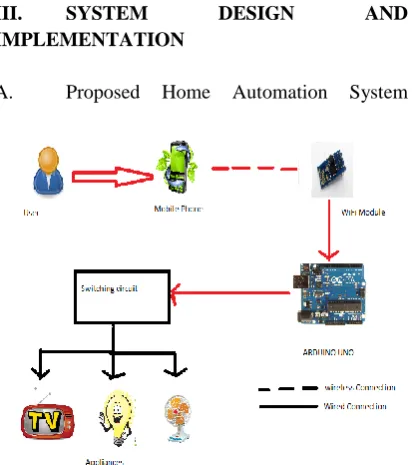
Figure 1: Proposed model of Home automation system
The system has two parts, namely; hardware and software. The hardware system consists of arduino uno board, arduino wi-fi shield, sensors and home appliances. The software system consists of a java based android application also arduino language is used to configure the arduino uno board and the sensors. In this system, the components used are arduino uno board, wi-fi module shield, sensors(lm35 , LDR).[3] These hardware components are used in order to control the home appliances. Arduino uno board will help to develop an interface between the hardware and the software application. The arduino wi-fi module will help in transmitting and receiving the input given by the user.
B. Proposed Home Automation System Functions The proposed home automation system has the capabilities to control the following components in users home and monitor the following alarms: • Temperature and humidity
• Motion detection • Fire and smoke detection • Light level
The proposed home automation system can control the following appliance:
• Lights on/off/dim • Fan on/off
• On/off different appliance
C. Software design
Arduino is an Open-source-electronic-prototyping-base for simple used hardware and software in the field of microcontrolling. It is suitable to realize fascinating projects in a short time. The code will be implemented from arduino software ,this paper find the room temperature and person will be detect to alarm the sound it can be used from PIR(Passive Infrared Sensor).
D. ESP 8266
ESP8266 is an impressive, low cost WiFi module suitable for adding WiFi functionality to an existing microcontroller project via a UART serial connection. The module can even be reprogrammed to act as a standalone WiFi connected device–just add power.The feature list is impressive and includes:
An official Software Development Kit (SDK) has been released for the System-on-Chip (SoC) controller which powers the ESP8266 WiFi module. Using the SDK it’s possible to add extra features to the AT command firmware or even create a standalone firmware.
Figure 2: WiFi Module
IV. METHODOLOGY
A. Arduino
Arduino is an open-source platform used for building electronics projects. Arduino consists of both a physical programmable circuit board (often referred to as a microcontroller) and a piece of software, or IDE (Integrated Development Environment) that runs on your computer, used to write and upload computer code to the physical board. The Arduino platform has become quite popular with people just starting out with electronics, and for good reason. Unlike most previous programmable circuit boards, the Arduino does not need a separate piece of hardware (called a programmer) in onto the board – you can simply use a USB cable. Additionally, the Arduino IDE uses a simplified version of C++, making it easier to learn to program. Finally, Arduino provides a standard form factor that breaks out the functions of the micro-controller into a more accessible package.
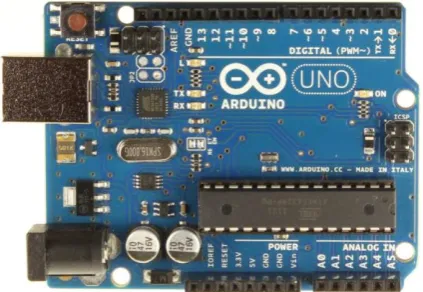
The Arduino is a microcontroller board based on the ATmega8. It has 14 digital -input/output pins (of which 6 can be used as PWM outputs), 6 analog inputs, a 16 MHz ceramic resonator, a USB connection, a power jack, an ICSP header, and a reset button. It contains everything needed to support the microcontroller; simply connect it to a computer with a USB cable or power it with a AC-to-DC adapter or battery to get started. The Uno differs from all preceding boards in that it does not use the FTDI USB-to-serial driver chip. Instead, it features the Atmega16U2 (Atmega8U2 up to version R2) programmed as a USB-to-serial converter.
Figure 3: Real Ardunio UNO board
B. IC LM35 Temperature Sensor
A temperature is an objective comparative measure of hot or cold. It is measured in ◦ c or ◦. Sensors used to measure temperature is called Thermometer. They may be Contact or Non-contact type Sensors. The sensor should have following properties.
1) Range – is the maximum and minimum value range over which a sensor works well.
2) Accuracy – how well the sensor measures the environment in an absolute sense.
3) Resolution – the ability of a sensor to see small differences in readings.
4) Repeatability – This is the ability of a sensor to repeat a measurement when put back in the same environment.Accurate sensors are always have degree of repeatability.
5) Stability – The sensor should be very stable with change in temperature.
However, if you use 1.1V as aRef, the equation changes entirely. If you divide 1.1V over 1024, each setup in the analog reading is equal to approximately 0.001074V = 1.0742 mV. If 10mV is equal to 1 degree Celsius, 10/1.0742 =~9.31. So, for every change of 9.31 in the analog reading, there is one degree of temperature change.
C. Passive Infrared Sensor
A passive infrared sensor (PIR sensor) is an electronic sensor that measures infrared (IR) light radiating from objects in its field of view. They are most often used in PIR – based motion detectors.
D. Relay Boards
switch (as shown below). There are different types of relays and they operate at different voltages. When a circuit is built the voltage that will trigger it has to be considered. In this project the relay circuit is used to turn the appliances on/off. The high/low signal is supplied from the Arduino Uno microcontroller. When a low voltage is given to the relay of an appliance it is turned off and when a high voltage is given it is turned on. The number of appliances can be modified according to the user’s requirements.
E. WHY ARDUINO?
Arduino is open source prototyping platform.
Arduino based language is available for developing inputs and interacting with other softwares.
Supported in all operating systems.
Main aspect of it is less expensive than other prototyping systems available.
You can get Arduino board with LOTS of different I/O and other interface configurations.
The Pi is pretty much what it is and has a lot less time in the field.
Pi - for $35 you get video, audio, Ethernet , and USB.
That will cost you 2X that to get the same on top of an Arduino UNO.
The Arduino UNO runs comfortably on just a few milliamps
The Pi needs more like 700mA whereas aurdino requires less power.
ARDUINO VS RASPBERRY PI
V. RESULTS AND DISCUSSION
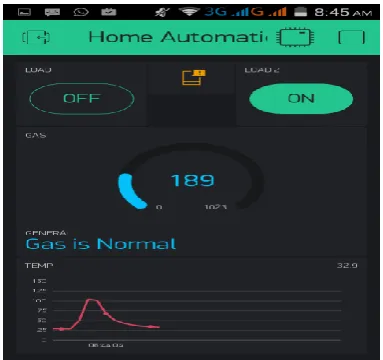
It will be find the temperature, gas detected, fire detected, and if any one person entered they alarm the sound and display the message.
Figure 4: Graph showing the different temperature value along with the threshold
Figure 5: Screenshots of the proposed smart home app
VI. CONCLUSION
A Smart Home system integrates electrical devices in a house with each other. The techniques which are going to use in home automation include those in building automation as well as the control of domestic activities, such as TV, fan, electric tubes, refrigerator and washing machine. After studying and understanding literature survey and other existing works, we proposed a Novel technique that will gives us better understanding of the Environmental conditions in home. Our system not only just monitors environmental conditions but it acts according to inhabitant requirement. In this paper we are planning to eliminate most of the human interaction by providing intelligent system. Development of such Smart Home achieve by using Internet of Things technologies. By using these system we can actually manage to make low cost, flexible smart homes to adjust its environmental conditions and resolve its errors with energy saving.
VII. FUTURE WORK
Looking at the current situation we can build cross platform system that can be deployed on various platforms like iOS, Windows. Limitation to control only several devices can be removed by extending automation of all other home appliances. Security cameras can be controlled, allowing the user to observe activity around a house or business. Security systems can include motion sensors that will detect any kind of unauthorized movement and notify the user. Scope of this project can be expanded to many areas by not restricting to only home. It will be flexible to support various wired as well as wireless technologies like Bluetooth, Zigbee, Wi-Fi, World Wide Web.
VIII. REFERENCES
[1] Nagender Kumar Suryadevara, Subhas Chandra Mukhopadhyay, “WSN- Based Smart sensor and Actuator for Power Management inIntelligent Buildings”, IEEE ASME
TRANSACTION ON MECHATRONICS,
VOL.61, NO.2, APRIL 2014.
[2] H. Sundmaeker, P. Guillemin, P. Friess and Challenges for Reading the Internet of Things. Luxembourg, Germany: Europen Union, 2010, ISBN 9789279150883.
[3] Internet 3.0: The Internet of Things, Analysys Mason, Singapore, 2010.
[4] Sean Dieter Tebje Kelly, Nagender Kumar Suryadevara, and Subhas Chandra Mukhopadhyay “Toward the Implementation of IoT for Environmental Condition Monitoring in
Homes”, IEEE SYSTEMS
JOURNA,VO.13,NO.10,JUNE 2013.
[5] Manisa Pipattansomporn, Murat Kuzulu, Saifur Rahman, “An Algorithm for Intelligent Home Energy Management And Demand Response Analysis”, IEEE TRANSACTION ON SMART GRID, VOL. 3, NO. 4, DEC 2012 . [6] Khusvinder Gill, Shuang-Hua Yang, “A Zigbee Based Home Automation System”, IEEE
TRANSACTIONS ON CONSUMER
ELECTRONIC, VOL. 55, NO. 2, MAY 2009. [7] Nak-woo Kim, Byung –tak Lee, Chae Ho Cho,”A Time Synchrnization Techniques for COAP –Based Home Automation System”, IEEE
TRANSACTIONS ON CONSUMER
ELECTRONIC, VOL. 62, NO. 1, FEB 2016. [8] A.Z. Alkar, U.Buhur, “An Internet Based Wireless Home Automation System For
Multifunctional Devices “,IEEE
TRANSACTIONS ON CONSUMER
ELECTRONIC, VOL. 51, NO. 4, NOV 2005. [9] Minsoo Lee, Yoonsik Uhm, Yong Kim, Sehyum Park, “intelligent power management device with middleware based living pattern learning for power Wireless Sensor Networks”,
IEEE TRANSACTIONS ON CONSUMER
ELECTRONIC, VOL. 55, NO. 4, NOV 2009. [10] B.Yuksekkaya, A.A. Kayalar, M.B. Tosum, M.K. Ozcan, “A GSM Internet And Speech Controlled Wireless Interactive Home Automation System”, IEEE TRANSACTIONS
ON CONSUMER ELECTRONIC,VOL.52,