Volume-5 Issue-2
International Journal of Intellectual Advancements
and Research in Engineering Computations
Secure data transmission using visual cryptography
1.Ms.N.Zahira Jahan.,M.C.A.,M.Phil., Associate Professor 2. Mr.A.Gokulnath Final M.C.A.
Department of MCA, Nandha Engineering College,(Autonomous), Erode-52. [email protected], [email protected]
Abstract: When it is desired to transmit redundant data over an insecure and bandwidth-constrained channel, it is customary to first compress the data and then encrypt it. In this paper, they investigated the novelty of reversing the order of these steps, i.e., first encrypting and then compressing, without compromising either the compression efficiency or the information-theoretic security. Although counterintuitive, they showed surprisingly that, through the use of coding with side information principles, this reversal of order is indeed possible in some settings of interest without loss of either optimal coding efficiency or perfect secrecy. They showed that in certain scenarios our scheme requires no more randomness in the encryption key than the conventional system where compression precedes encryption. In addition to proving the theoretical feasibility of this reversal of operations, they also described a system which implements compression of encrypted data. Consider the problem of transmitting redundant data over an insecure, bandwidth-constrained communications channel. It is desirable to both compress and encrypt the data. The traditional way to do this is to first compress the data to strip it of its redundancy followed by encryption of the compressed bit stream. The source is first compressed to its entropy rate using a standard source coder. Then, the compressed source is encrypted using one of the many widely available encryption technologies. At the receiver, decryption is performed first, followed by decompression.
Index term: visual cryptography, secret sharing, primitive color
I. INTRODUCTION
Visual cryptography is a popular solution for image encryption. Using secret sharing concepts, the encryption procedure encrypts a secret image into the shares(printed on transparencies) which are noise-like secure images which can be transmitted or distributed over an untrusted communication channel. Using the properties of the HVS to force the recognition of a secret message from
overlapping shares, the secret image is decrypted without additional computations and any knowledge of cryptography. Visual cryptography is proposed in 1994 by Naor and Shamir who introduced a simple but perfectly secure way that allows secret sharing without any cryptographic computation, which they termed as Visual Cryptography Scheme (VCS). The simplest Visual Cryptography Scheme is given by the idea of A secret image consists of a collection of black and white pixels where each pixel is treated independently.
There are many algorithm to encrypt the image in another image, but a few of them have been in visual cryptography for color image. In this paper, the different approach have been produced for the visual cryptography for color image, the proposed algorithm splits a secret image into three shares based on three primitive color components.
Section 2 in this paper give a review of the literature and research in this field and it concerns with the main fundamental concept to understand the idea of visual cryptography of (black and white) and color image and theoretical foundation for each algorithm. In section 3, we present the problem under consideration and introduce the proposed algorithm and constructing of new algorithm is explained.
Section 4, the experimental results are discussed in detail.. Finally, Section 5 and 6 summarizes the conclusions and future work.
II. VISUAL CRYPTOGRAPHY MODEL
A printed page of ciphertext and a printed transparency (which serve as a secret key). The unique clear text is revealed by placing the
transparency with the key over the page with the cipher, even though each one of them is indistinguishable from random noise. The model for visual secret sharing is as follows. There is a secret picture to be shared among n participants. The picture is divided into n transparencies (shares) such that if any m transparencies are placed together, the picture becomes visible. If fewer than m transparencies are placed together, nothing can be seen. Such a scheme is constructed by viewing the secret picture as a set of black and white pixels and handling each pixel separately.
There are some researches that deal with visual cryptography for color images. In this section, we will explore several representative work over the years. [3] discussed the visual cryptography scheme which reconstructs a message with two colors, by arranging the colored or transparent subpixels, they only discussed construction of (k,n)-threshold scheme where a subset X 2 is a qualified set if and only if |X| = k. Koga et al. devised a lattice-based (k, n) scheme[4]. The approach by [5] is basically similar to Koga’s. Both approaches assign a color to a subpixel at a certain position, which means that displaying m colors uses m−1 subpixels. The resulting pixels contain one colored subpixel and the rest of the subpixels are black. Therefore the more colors are used, the worse the contrast of the images becomes significantly. Their approaches cannot be applied to the extended visual cryptography, either. Rijmen and Preneel talked about enabling multicolors with relatively less subpixels(24 colors with m = 4)[6]. However each sheets must contain color random images, which means applying this approach to the extended visual cryptography is impossible.[ 7]
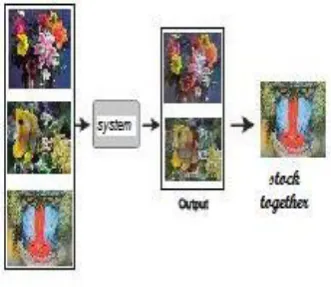
Figure 1: visual cryptography system
In visual cryptography system the pixels of the image to be encrypted can be applied to the image in different manner. There is a set of n participants(image), and the secret image is divided and encoded into n shadow images called shares Each participant encrypted by one share, k out of n participants are needed to combine shares and see secret image, sometime k-1 of shares cannot reveals information about secret image. The technology makes use of the human vision system to perform the OR logical operation on the superimposed pixels of the shares. When the pixels are small enough and packed in high density, the human vision system will average out the colors of surrounding pixels and produce a smoothed mental image in a human’s mind. For example, a block of 2 × 2 pixels will be viewed as a gray-like dot as the two black pixels and the two nearby white pixels are averaged out. If we print the 2×2 pixel blocks shown in Fig. 2 separately onto two transparencies and superimpose them. This effect is equivalent to performing a pixel-wise OR logical operation on each of the four pairs of pixels between these two transparencies. The result is shown in Fig. 3. One of the unique and desirable properties of VCS is that the secret recovery process can easily be carried out by superimposing a number of shares (i.e. transparencies) without requiring any computation.
2.1 PROBLEM DEFINITION
The first step in the software development life cycle is the identification of the problem. As the success of the system depends largely on how accurately a problem is identified.
But instead of CMY model, if RGB model is used, then the variation will be very low in resultant carrier images. So the project helps to solve the problem and uses RGB model. The software used to solve the problem and develop the application is Microsoft Visual Studio.Net with C# as programming language and MS-SQL Server 2000.
III. EXPERIMENTAL DESIGNS
Every single pixel in secret image is splited into subpixels , that can still perceived them as one pixel by Human vision system. The security of each share depends crucially on the color composition of the unique secret image. To recovering a secret image, it is required that the cover image should at least be able to determine the shape or pattern of the unique secret image, which is able to determine the boundary between two distinct color regions in the image. In this paper, for the problem of interest here, assuming an input 24-bit bitmap color image which each 3-byte sequence in the bitmap array represents the relative intensities of red, green, and blue, respectively for image sized 256 256 RGB pixel for hiding Baboon image.
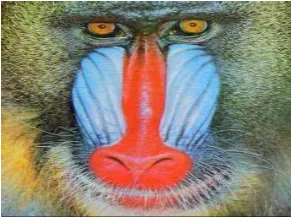
In the following, the steps of the proposed algorithm and illustrate it using an example where the unique secret image is a 24-bit color baboon image shown in Fig.4. The encryption process consists of determining the arrangements of transparent subpixels on each sheet according to the pixel transparencies,
Figure 4: Unique secret image
Step 1: The proposed algorithm first
decomposes the unique image into three primitive-color images under the subtractive model, namely, C (Cyan), M (Magenta) and Y (Yellow). Fig. 5 shows the three primitive color components of the
baboon image, where each image has 256 levels of the corresponding primitive color, and each pixel represented by three bytes. Converting to (C,M, Y ), where C,M, Y {0- 255}.
Figure 5: Primitive Color (C, M, Y ) Components
Step 2: For each pixel of the C primitive
Pi,j will be store it in the other image for reducing the Pi,j value by holding ¼ pi,j Fig.6 show the color of a pixel in the unique baboon secret image in terms of primitive cyan, magenta and yellow with reducing value, respectively.
Figure 6: Reducing pixels value of (C,M,Y)
Step 3: Selecting the cove image to encrypt
on it the secret image depends on minimum difference between the values of pixel, there are three primitive colors, therefore we need three cover images to generate three share.
Step 4: In this step, three shares, namely a,b
Consider the problem of transmitting redundant data over an insecure, bandwidth-constrained communications channel. It is desirable to both compress and encrypt the data. The traditional way to do this is to first compress the data to strip it of its redundancy followed by encryption of the compressed bitstream. The source is first compressed to its entropy rate using a standard source coder. Then, the compressed source is encrypted using one of the many widely available encryption technologies. At the receiver, decryption is performed first, followed by decompression.
Step 5: Repeat step 1 to 4 for all pixel
from unique image
(a) (b)
(c)
Figure7 : The Generation of C, M, Y Shares
To share a secret pixel with color (C,M, Y) in cover image depending on the value of threshold for selection the proper image. It is found that the shares ( a,b,c) reveal the information about the secret image . To recover the secret unique baboon image it is necessary to removing the unwanted color in each share by the operation 255 minus ¾ CPi,j, where CPi,j image (a,b,c).
Visual Cryptography is a special encryption technique to hide information in images, which divide secret image into multiple layers. Each layer holds some information. The receiver aligns the layers and the secret information is
revealed by human vision without any complex computation.
The proposed algorithm is for color image that presents a system which takes four pictures as an input and generates three images which correspond to three of the four input pictures. The decoding requires only selecting some subset of these 3 images, making transparencies of them, and stacking them on top of each other, so the forth picture is reconstructed by printing the three output images onto transparencies and stacking them together. The reconstructed image achieved in same size with original secret image. During image hiding, RGB based hiding technique is used.
They considered situations in which on the order of hundreds or even thousands of users may wish near-simultaneous access to the same video content. Thus, for superior scalability the network service provider must transmit the content by making use of a multicast distribution model.
They focused on the problems of video fingerprinting and encryption. Fingerprinting, which was first introduced by Wagner in 1983, is the process of embedding a distinct set of marks into a given host signal to produce a set of fingerprinted signals that each “appear” identical for use, but have a slightly different bit representation from one another.
These differences can ideally be exploited in order to keep track of a particular copy of the fingerprinted signal. The marks, also called the fingerprint payload, are usually embedded through the process of robust digital watermarking. In digital watermarking, subtle changes are imposed on the host signal such that the perceptual content of the host remains the same, but the resulting composite watermarked signal can be passed through a detection algorithm that reliably extracts the embedded payload.
IV. CONCLUSION
original secret image. The number of images are tested to hiding the part secret image and it is found that the image with color near to the primitive R (Red), G (Green) and B (Blue). In particular, it can find out the shape of the original secret image with %25 in each share and the original secret image is color image and the adversary has acquired three of the R, G and B shares.
The winning chance of the adversary decreasing so it get more security because to recover the original image it need to stacker all the three shares , and each share may only be able to retrieve partial information of the original secret image. The results suggest that the security of the scheme depends critically on the color composition and distribution of the original secret image.
7 FUTURE ENHANCEMENTS
The future work is to improve the contrast and produce more clear the resultant secret image. Further extend this work to use this technique with other format of color images. In future, study related to establish a sophisticated color mixing model for the extended visual cryptography with better color quality will be considered. The system is very flexible and user-friendly, so the maintenance based on the changing environment and requirements can be incorporated easily. Any changes that are likely to cause failures are prevented with security and preventive measures could be taken. The coding is done in understandable and flexible method program which helps easy changing. Since MS-SQL Server and.NET are very flexible tools, user can easily incorporate any modular program in the application. In future, the scheme may be applied to video files also.
REFERENCES
[1] Talal Mousa Alkharobi, Aleem Khalid 2003. New
Algorithm For Halftone Image Visual Cryptography, Alvi
King Fahd University of Pet. & Min. Dhahran.
[2[ JIM CAI 2003. A Short Survey on Visual Cryptograpy
Schemes,www.wisdom.weizmann.ac.il/naor/ PUZZLES
/visual.html.
[3] Nakajima, M. and Yamaguchi, Y.2002. Extended Visual
Cryptography for Natural Images,WSCG02, 303.
[4] M. Naor and A. Shamir,1996. Visualcryptography ii:
Improving the contrast via the cover base. Theory of
Cryptography Library, (96-07).
[5] Hiroki Koga and Hirosuke Yamamoto,1998. Proposal of a lattice-based visual secret sharing scheme for color