THE IMPACT OF FRESH SAWDUST AND DRY PIG MANURE PRODUCED
ON SAWDUST BEDDING APPLICATION ON THE NUTRIENTS MOBILITY
IN SOIL AND SUGAR BEET YIELD
Peter Kováčik1, Mária Kmeťová1, Marek Renčo2
1 Slovak University of Agriculture in Nitra, Department of Agrochemistry and Plant Nutrition, Tr. A. Hlinku 2,
949 01 Nitra, Slovakia, e-mail: [email protected]
2 Institute of Parasitology, Department of Plant Nematology, Slovak Academy of Sciences, Hlinkova 3, 040 01
Košice, Slovakia, e-mail: [email protected]
INTRODUCTION
Positive correlation between the dose of ap-plied nutrients and their content in soil is de-termined in a standard manner. However, the relation between the dose of nutrients and their content in a mobile form in the soil can be not only positive, but also negative. Its evidence is determined by the selection of fertilizer, i.e. if the organic or inorganic fertilizer is utilized, or if we apply the fertilizer which increases biological or chemical sorption of nutrients or the fertilizer in-creasing the mobility of nutrients.
From the viewpoint of achieving high yields the total content of nutrients is not decisive but the content of nutrients in mobile or potentially mobile form is important [Havlin et al. 2004].
The content of mobile nutrients in soil is influ
-Volume 14, No. 3, July 2013, pp. 69–76
DOI: 10.5604/2081139X.1056049 Research Article
ABSTRACT
The objective of the pot trial carried out at the area of the Slovak University of Agri-culture in Nitra was to determine the impact of dry pig manure produced on the saw-dust bedding and sawsaw-dust litter on the level of nutrients’ mobility in the soil and sugar beet yield. The achieved results showed that one month after the sawdust and manure application to the soil, the contents of mobile nutrients (Nan, P, K, Ca, Mg) in soil were lower than in the control unfertilized treatment. The sawdust litter immobilized nutri-ents more considerably than manure. Four months after the manure application into soil, its immobilization effect was not evident. On the contrary, the manure increased the mobile nutrients content in soil. In the second year of experiment the immobiliza-tion effect of sawdust litter was proved even four months after its applicaimmobiliza-tion into soil. The application of manure increased considerably the beet root yield. The maximum root yield was determined in the treatment where the highest dose of manure was ap-plied. The minimum root yield was detected in the treatment where the highest dose of sawdust litter was applied.
Keywords: sawdust, pig manure, immobilization, sugar beet. Received: 2013.06.07
Accepted: 2013.06.20 Published: 2013.07.10
enced by soil cultivation [Rembon and MacKen-zie 1997], application doses of fertilizers [Reid 2002], selection of applied fertilizers and soil
sup-plementary substances [Kjønaas 1999; Kováčik and Wiśniowska-Kielian 2009], irrigation [Misra
fact that the production of farm manure has been
falling for more than 20 years. The deficiency of
organic fertilizers (cattle manure, pig manure, etc.) caused that the number of applications of low quality organic fertilizers in Slovakia has been increasing, in addition, in unsuitable periods
and dosage, which leads to the negative influence
on the yield and its quality as well as on the
envi-ronment [Kováčik et al. 2010].
The objective of the experiment was to deter-mine the impact of dry pig manure produced on the sawdust bedding and subsequently fermented
for 7 days by larvae of housefly and fresh spruce
sawdust on the contents of the available nutrients in soil and the yield of sugar beet roots.
MATERIAL AND METHODS
The pot trial was carried out at Slovak Uni-versity of Agriculture in Nitra (48°18´ S, 18°06´
V) in the period of two years. In the first year the
experiment started in October and in the second year in November. In the given months 23.5 kg of soil was put into the pots of 0.38 m height and diameter of 0.38 m. The soil was taken from the upper 0.0–0.3 m humus horizon Haplic Luvisol. In the process of soil weighing the tested organic fertilizers were applied into soil, what resulted in their equal mixture in the whole pot. After weigh-ing the pots with soil were placed at dishes which
were able to collect 1000 ml of the overflown soil
solution in the period of precipitation. Agrochemi-cal parametres of the used soil are shown in Table 1. The pig manure used in the experiment was
fer-mented by larvae of housefly (Musca domestica)
for 7 days. The manure was produced in the fol-lowing way: the fresh manure taken from under nursing sow littered by spruce sawdust was placed at shelves evenly to the heigh of 0.2 m in the
fer-mentation halls. The eggs of the housefly, which were obtained by breeding flies, were placed into
the manure. The brooded larvae were
process-ing manure for 7 days. Afterwards, they pupated. Immediately before the pupation the temperature increased slightly in the fermentation halls which led to the pupation on the manure surface. This enabled to collect most of the pupas. The pupas collection was not necessary from the aspect of manure production, however, it made the manure formation more effective. The humidity of the manure produced in this way was 30–40%. After-wards, the manure was dried to 88.63% dry mat-ter and ground. The principal chemical composi-tion and nutrient contents of manure fermented by
housefly larvae are given in Table 1.
In the experiment the same sawdust was used as it was added to the bedding in pig breed-ing (Norway spruce sawdust – Picea abies). The principal agrochemical parametres of sawdust are stated in Table 1. Table 2 shows the ratio between the total carbon content and the total nutrients contents in the organic materials.
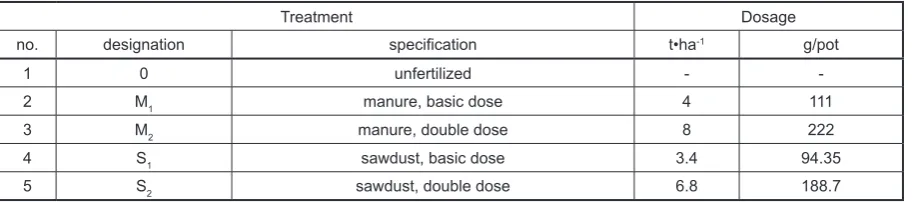
The experiment was established with qua-druple repetitions and it had 5 treatments (Table 3). During the dosage of pig manure fermented
by larvae of housefly (tr. 2 and 3) the nitrogen
content in manure was taken into consideration
172 kg•ha-1 N was applied by the dosage 8 t•ha-1
(tr. 3) (dose N complies with the Council Direc-tive 91/676 EEC concerning the protection of wa-ters against pollution by nitrates from agricultural
sources). The dose 4 t•ha-1 (tr. 2) is a half dose of
the treatment 3. The sawdust doses were selected so that they put the same quantity of the organic substance into soil as the used manure did. The identical quantity of the organic substances was
put into soil by the dose 3.4 t•ha-1 of sawdust (tr. 4) as by the dose 4 t•ha-1 of manure, or the same
quantity of the organic substances was put into
soil by the dose 6.8 t•ha-1 of sawdust (tr. 5) as by 8 t•ha-1 of manure.
The contents of accessible nutrients in soil were probed in two periods: after one month and after 4 months from the foundation of experi-ments. The contents of the following accessible
Table 1. Agrochemical parametres of soil and materials used in experiment (dry matter)
Org.m – organic matter.
Material Nan P K Ca Mg Nt Cox
C : Nt
Org.m. pH/
KCl pH/
H2O
mg·kg-1 % %
Soil 2009 14.8 66.25 430 1010 360 1358 1.34 9.9:1 4.61 5.66 6.07
Soil 2010 17.63 118.75 417.5 1355 385 1198 1.46 12.2:1 5.08 5.88 7.02
Manure 1030 1227 16 303 5839 451 19 686 40.04 20.3:1 81.99 7.53 7.65
nutrients Nan, P, K, Ca, Mg in soil were studied. The content of inorganic nitrogen was determined by the summation N-NH4+ and N-NO
3-, where
N-NH4+ was defined colorimetrically by Nessler
agent and N-NO3- colorimetrically by the phenol 2.4 disulphonic acid [Kováčik 1997]. The acces -sible phosphorus, potassium, calcium and mag-nesium were determined according to the me-thodical procedure Mehlich III [Mehlich 1984];
P – spectrophotometrically, K and Ca – by flame
photometry, Mg – by atomic absorbefacient spec-trophotometry. The content of the total nitrogen was set by distilling after the minetralization of strong H2SO4 [Kjeldahl method]. The contents of Pt, Kt, Cat, Mgt were determined after miner-alization with the utilization of HNO3 and HClO4;
P – spectrophotometrically, K and Ca – by flame
photometry, Mg – by atomic absorbefacient spec-trophotometry [Koppová et al. 1955]. The content
of the total carbon was set oxidometrically [Ťjurin
1966], the content of the organic substances gravi-metrically (550 oC), pH/KCl – potentiometrical-ly (1.0 mol•dm-3 KCl).
Sugar beet sowing was carried out in the first
decade of April in both years of the experiment. After sowing 6 seeds of the cultivar Antek, the soil surface was covered up evenly with 0.5 kg of siliceous sand. By the end of June the number of plants was 3 individuals, which remained until the end of the growing season. The experiment was completed in the second decade of October. The yield of sugar beet roots was determined by weighing. The acquired results were processed by mathematical and statistical method, by analysis of variance and linear regression analysis using Statgraphics PC program, version 5.0.
RESULTS AND DISCUSSION
The impact of the organic fertilizers on the contents of the accessible nutrients in soil was evident one month after their application into soil (Table 4). The maximum contents of Nan, ac-cessible P, K, Ca and Mg were found evidential statistically in the control treatment. The detected data point out the inhibitive impact of the dry pig manure produced on the sawdust bedding and spruce sawdust on the mobility of all nutrients detected in the soil. The immobilization of nutri-ents was increasing with the growing dosage of manure and sawdust, the contents of the available nutrients in soil were decreasing. The sawdust lit-ter inhibited nutrients in soil more considerable in comparison to the tested pig manure produced on the sawdust bedding. After the application of both tested organic substances regardless their application dose, the contents of the inorganic ni-trogen were lowered most considerably. After the manure application the decreases of Nan varied in the interval from 6.08% to 18.79% and after the sawdust application they varied from 29.97% to 59.73% (Table 5). It is evident that one month after the sawdust application in the doses, which put the same quantity of organic substances as the farm fertilizers, cca 30 – 60% decrease of inor-ganic nitrogen content in soil is expected, which is a considerable descent. This kind of drop can be assessed as both positive and negative
phe-nomenon [Kováčik 2013]. It can be assessed pos -itively if the decrease occurs out of the growing season because it reduces considerably the nitro-gen losses by leaching. The decrease is evaluated negatively if it is present during the growing
sea-Table 2. Ratio of total carbon content to the content of total nutrients in tested materials
t – total
Material C : Nt C : Pt C : Kt C : St C : Cat C : Mgt C : Nat
Manure 20.3 : 1 81.6 : 1 16.5 : 1 60.4 : 1 26.4 : 1 292.3 : 1 79.8 : 1
Sawdust 632 : 1 2231.6 : 1 401.7 : 1 662.4 : 1 174.6 : 1 529 : 1 1434.6 : 1
Table 3. Experiment treatments and application doses of tested materials
Treatment Dosage
no. designation specification t•ha-1 g/pot
1 0 unfertilized -
-2 M1 manure, basic dose 4 111
3 M2 manure, double dose 8 222
4 S1 sawdust, basic dose 3.4 94.35
son as the grown plants fall behind their
develop-ment, which is caused by the deficiency of the
accessible nitrogen.
The decreases of accessible nutrients contents in soil after the sawdust application were expect-ed because spruce sawdust contains low amount of total nutrients in relationship to the content of total carbon (Table 2). The rate C : N was higher than 30 : 1, which is the threshold value of the rate indicating immobilization N [Fotyma et al. 1987] and it achieved the value up to 632 : 1. Similarly, the rates C : P, but also C : S were higher than 300 : 1 and they proved unambiguously the biological sorption (immobilization) of phosphorus and sul-phur. In the treatment 5, where the highest dose of
sawdust (6.8 t•ha-1) was applied, there the lowest
contents of the accessible nutrients were recorded out of all treatments of the experiment. The differ-ences in contents of the accessible nutrients were
statistically significant between the treatment 4, where 3.4 t•ha-1 of sawdust was applied, and the
treatment 5 where the double dose of sawdust was
applied (Table 4). The double dose of sawdust did not increase the nutrient immobilization in soil twice more intensively in comparison to the ba-sic sawdust dose (Table 5 and 6). The recorded inhibitive impact of sawdust on nutrients was in
accordance with knowledge of Čvančara [1964] and Kováčik et al. [2001].
The decreases of accessible nutrients’ con-tents in soil were not expected after the applica-tion of dry pig manure produced on sawdust bed-ding (Table 4). Their recorbed-ding was surprising as the rates of carbon to the content of total nutrients (C : Nt, or C : Pt and the like) in manure created the prerequisite for the fast mineralization of ma-nure and the consequent increase of the contents of accessible nutrients forms in soil (Table 2). The decrease of the available nutrients contents
in soil was statistically significant with the appli
-cation dose 8 t•ha-1 of manure (tr. 3) in both years of experiment related to all five studied nutrients.
The decreases of contents of the studied macro-elements – apart from phosphorus - with the half
Table 4 Impact of experiment treatments on the contents of available nutrients in soil (one months after founda-tion of experiment, November 2009 and December 2010, 100% dry matter)
No. – number, des. – designation, M – manure, S – sawdust, LSD0,05 – limit of significant difference at the level a
= 0.05 (LSD test, different letter behind a numerical value respond to the statistically significant difference at the
level 95.0%.
Treatment Nan P K Ca Mg
2009 2010 2009 2010 2009 2010 2009 2010 2009 2010
no. des. mg·kg-1
1 0 14.90e 20.22d 85.6d 132.2c 472.5e 426.1d 1138c 1488b 439c 425d
2 M1 13.45d 18.99c 82.5cd 128.6bc 447.5d 411.0c 1078b 1426a 390b 407c
3 M2 12.10c 18.16c 79.4c 125.9b 427.5c 400.7b 1045b 1406a 383b 398bc
4 S1 9.65b 14.16b 70.6b 120.4ab 410.0b 396.4b 1050b 1387a 393b 390b
5 S2 6.00a 11.88a 58.8a 114.5a 390.0a 387.2a 1003a 1339a 320a 364a
LSD0,05 1.083 0.992 3.231 6.123 15.400 8.546 32.710 90.304 12.050 10.284
LSD0,01 1.567 1.341 4.792 8.024 22.423 9.627 47.603 97.774 17.537 11.314
Table 5 Impact of experiment treatments on contents of available nutrients in soil expressed in relative percent-age (one month after the experiment foundation)
No. – number, des. – designation, M – manure, S – sawdust
Treatment Nan P K Ca Mg
2009 2010 2009 2010 2009 2010 2009 2010 2009 2010
no. des. %
1 0 100.00 100.00 100.00 100.00 100.00 100.00 100.00 100.00 100.00 100.00
2 M1 90.27 93.92 96.38 97.28 94.71 96.46 87.08 95.83 88.84 95.76
3 M2 81.21 89.81 92.76 95.23 90.48 94.04 84.41 94.49 87.24 93.65
4 S1 64.77 70.03 82.48 91.07 86.77 93.03 84.81 93.21 89.52 91.76
dose of manure (4 t•ha-1 – tr. 2) were significant
statistically as well (Table 4). The reason for re-cording the decrease of the accessible nutrients quantity in soil one month after the manure appli-cation was not the biological sorption. The rates of carbon to nutrients N, P, K, Ca and Mg were low. We assume that the reason was the chemi-cal sorption increased temporarily. Its probable reason was the assumed increased quantity of the reactive organic groups in manure caused by the non-standard technology of manure
produc-tion (fermentaproduc-tion by larvae of housefly. Stone
and Wild [1977], Stevenson [1982a, b], Bielek [1998], Muneshwar et al. [1999] referred to the possibility that the organic substances would react with inorganic substances of soil solution where the stable organic compounds occur temporarily.
Similarly, Yadvinder et al. [1988] first found out
the decrease of inorganic nitrogen contents in soil after ploughing in manure and later their increase.
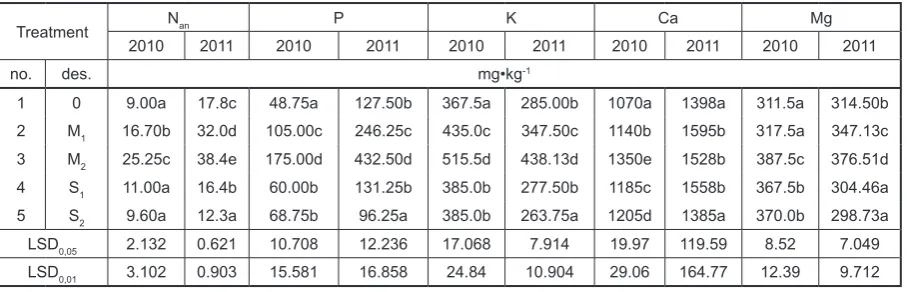
Table 7 shows the data related to the tran-sience of decrease of the accessible nutrients contents in soil after the application of manure
fermented by larvae of housefly. It is obvious
that all determined nutrients contents in soil were
statistically significantly higher four months after
ploughing in manure, comparing to the contents
in the control, unfertilized treatment, apart from Mg content in 2010 (tr. 2). The increased appli-cation dose of manure (tr. 3 versus tr. 2) was
re-flected as statistically significant higher content
Nan, accessible P, K, Mg and also Ca in 2010. The learnt data point out the fact that the autumn ap-plication of the tested manure in the experiment does not cause shock because of the nutrient
de-ficiency for the crops sown in spring or planted
later. On the contrary, it leads to the increase of
contents statistically significantly.
The transitoriness of the immobilization ef-fect was evident not only after the manure ap-plication but also after the sawdust apap-plication (Table 7). In 2010 the content of the accessible nutrients was the same or higher with all the el-ements in comparison to the control treatment four months after the foundation of the experi-ment (tr. 4 a 5 versus tr. 1). On the contrary, in 2011 the contents of Nan, accessible K, Mg and partially also P were lower than the contents of the given elements in the control treatment. These facts proved that what determines the decay and synthesis processes in soil is not only the quality of the used organic substances, which are given by the rate of carbon to nutrients (C : N, C : P, etc.), but also the cultivating year (weather
de-Table 6 Impact of double dose of sawdust on contents of available nutrients in soil expressed in relative percent-age (one month after the experiment foundation).
Table 7 Impact of experiment treatments on the selected soil parametres (four months from the experiment foun-dation, 3rd March 2010 and 30th March 2011 – 100% dry matter)
No. – number, des. – designation, M – manure, S – sawdust, LSD0,05 – limit of significant difference at the level
a = 0.05 (LSD test), different letter behind a numerical value respond to the statistically significant difference at
the level 95.0%
Treatment Nan P K Ca Mg
2010 2011 2010 2011 2010 2011 2010 2011 2010 2011
no. des. mg•kg-1
1 0 9.00a 17.8c 48.75a 127.50b 367.5a 285.00b 1070a 1398a 311.5a 314.50b
2 M1 16.70b 32.0d 105.00c 246.25c 435.0c 347.50c 1140b 1595b 317.5a 347.13c
3 M2 25.25c 38.4e 175.00d 432.50d 515.5d 438.13d 1350e 1528b 387.5c 376.51d
4 S1 11.00a 16.4b 60.00b 131.25b 385.0b 277.50b 1185c 1558b 367.5b 304.46a
5 S2 9.60a 12.3a 68.75b 96.25a 385.0b 263.75a 1205d 1385a 370.0b 298.73a
LSD0,05 2.132 0.621 10.708 12.236 17.068 7.914 19.97 119.59 8.52 7.049
LSD0,01 3.102 0.903 15.581 16.858 24.84 10.904 29.06 164.77 12.39 9.712
Treat-ment Nan P K Ca Mg
2009 2010 2009 2010 2009 2010 2009 2010 2009 2010
no. des. %
4 S1 100.00 100.00 100.00 100.00 100.00 100.00 100.00 100.00 100.00 100.00
velopment). The more organic substances with the low nutrient contents are put into soil the lon-ger the process of immobilization is. In order to
prevent the deficit of mobile nutrients in soil it
is needed to apply the fertilizers containing
sig-nificant quantities of organic substances ahead of time before the plant sowing. Kováčik [2013]
recommends to apply the high quality manure at least 6 weeks before the plant sowing and the low quality manure at least 3 or 4 months before sow-ing. The achieved results show that the sawdust should be applied more than 4 months ahead of time before plant sowing. This usage of sawdust enables the producer to save money for the nitro-gen and other nutrients purchase. These nutrients are not leached out from soil due to immobili-zation. The sawdust application creates the
pre-requisite for sufficient access of nutrients to the
cultivated plants. In case of the sawdust usage in the short period before plant sowing not only the
evidence of insufficiency of several nutrients can
be expected but also lower yields.
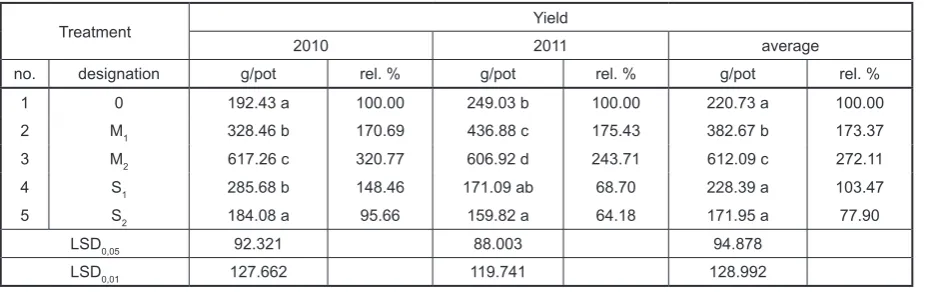
The differences in the sawdust impact on the contents of mobile nutrients in soil -recorded be-tween 2010 and 2011 - were also evident in the yield of sugar beet roots (Table 8). In 2011 – the year when the process of immobilization of N, K, Mg and partially P appeared even before the sugar beet sowing (Table 7) - lower yields by 31.3 and 35.8% were recorded in the treatments 4 and 5 in comparison to the control treatment (Table 8). On the contrary, in 2010 - the year when the increase of the accessible nutrients content in soil was monitored in the pre-sowing period of beet in the treatments 4 and 5 – there in the treatment 4 48.46% increase of yield was achieved and in treatment 5 there was a yield decrease. The drop
was insignificant and it did not reach 5%. The re
-sults affirm that in order to prevent the negative
impact of sawdust application on the yield of cul-tivated crop it is important either to apply
nitro-gen with sawdust in a form of artificial fertilizers,
or to carry out nitrogen fertilizing before the plant
sowing itself. The same results were confirmed by Jančich et al. [2012].
The impact of the tested pig manure
ferment-ed by larvae of housefly on the yield of sugar beet roots was statistically significantly positive
in each year. As a result of manure application
in the dose of 4 t•ha-1 the yield of beet roots
in-creased from 70.7 to 75.4%. The double dose of manure increased the yield of roots from 143.7
to 220.8%. In the experiments of Kováčik et al. [2010] the differences in the yield of sunflower achenes were not significant between the appli
-cation doses 4 t•ha-1 and 8 t•ha-1 of pig manure fermented by larvae of housefly.
The recorded unambiguously positive impact of the dry pig manure produced on the sawdust
bed-ding by the fermentation of housefly larvae on the
yield of sugar beet roots opposes to the opinion of Lacko-Bartošová et al. [2005], who claim that the types of manure produced on the sawdust bedding require fermentation taking the period of six months.
On average of both years the lowest root yields were detected in the treatment with the double dose of sawdust (tr. 5). Sawdust impact on root yield with both application doses was not
statistically significant on average in both years
of the experiment. On the contrary, the impact of the dry pig manure produced on the sawdust bedding and fermented only during seven days
by larvae of housefly was significant. The manure
utilization increased the yield of sugar beet roots
significantly. Higher application dose of manure
resulted in higher root yield. The yields increases
Table 8 Impact of experiment treatments on the yield of sugar beet roots (fresh phytomass)
No. – number, M – manure, S – sawdust, LSD0,05 – limit of significant difference at the level a = 0.05 (LSD test),
different letter behind a numerical value respond to the statistically significant difference at the level 95.0%
Treatment Yield
2010 2011 average
no. designation g/pot rel. % g/pot rel. % g/pot rel. %
1 0 192.43 a 100.00 249.03 b 100.00 220.73 a 100.00
2 M1 328.46 b 170.69 436.88 c 175.43 382.67 b 173.37
3 M2 617.26 c 320.77 606.92 d 243.71 612.09 c 272.11
4 S1 285.68 b 148.46 171.09 ab 68.70 228.39 a 103.47
5 S2 184.08 a 95.66 159.82 a 64.18 171.95 a 77.90
LSD0,05 92.321 88.003 94.878
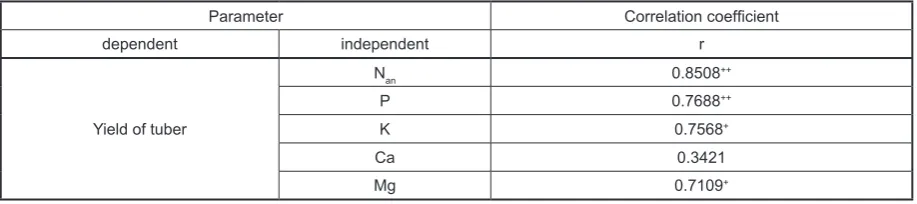
Table 9 Dependence between the yield of sugar beet roots and content of mobile nutrients in soil determined
before beet sowing expressed by correlation coefficient r
varied about 73% (tr. 2), or 172% (tr. 3). The
sta-tistically significant correlations (Table 9) were
determined between the roots yield and the con-tent of mobile nutrients in soil set before the beet
sowing. These facts prove the findings of several authors [Dowdel et al. 1983; Bízik 1989; Kováčik
2009] that the most important is Nan specified in
the pre-sowing period for the calculation of the nitrogenic fertilizers dosage.
CONCLUSION
One month after the sawdust application and manure application, which was produced on the sawdust bedding, the contents of mobile nutrients (Nan, P, K, Ca, Mg) in soil were lower than in the control unfertilized treatment. The most distinc-tive drop was that of inorganic nitrogen. Nan con-tents decreased by 29.97% even 59.73% after the sawdust application and by 6.08% even 18.79% after the manure application. The sawdust
immo-bilized nutrients more significantly than manure.
With the growth of manure and sawdust doses the immobilization of nutrients was increased.
Four months after application of manure in soil its immobilization effect was not present. On the contrary, manure increased the content of mo-bile nutrients (N, K, Ca, Mg) in soil. In the second year of the experimenmt the immobilization ef-fect of sawdust was evident even 4 months after its ploughing in soil.
There was an evident correlation between the content of the accessible nutrients in soil (Nan, P, K, Mg), determined before beet sowing and the yield of beet roots.
Manure application increased significantly
the yield of beet roots. The highest root yield was found in the treatment with the highest manure application. The lowest root yield was observed in the treatment with the highest dose of sawdust application.
Sawdust application is recommended to be used four months ahead of time of plant sow-ing. In the case of sawdust application in soil, it is needed to fertilize by nitrogen before sow-ing itself. The application of manure produced at the sawdust bedding should be carried out four months before the plant sowing. In the experiment of the tested manure the autumn application does
not cause shock from nutrients insufficiency to
the plants sown in spring or to the planted crops. On the contrary, this kind of application leads to
the statistically significant increase of nutrients’
contents.
From the viewpoint of plant cultivation it is necessary to reappraise the opinions stating the need of six months for the fermentation of ma-nure produced at the sawdust bedding.
Acknowledgements
This research was supported by the project VEGA 1/0591/13 and the project ITMS code 26110230085.
REFERENCES
1. Bielek, P. 1998. Dusík v poľnohospodárskych pô -dach Slovenska. VÚPÚ, Bratislava 1998, 255 s, ISBN 80-85361-44-2.
2. Bízik, J. 1989. Podmienky optimalizácie výži -vy rastlín dusíkom. Veda, Bratislava 1989. 189 s. ISBN 80-224-0041-6.
3. Conti, M.E., Palma, R. M., Arrigo, N. M., Zoura-rakis, D. P., Cappelletti, C. A. 1998. Long term ro-tation effect of soybean with no – till maize on soil N availability indices and microbial activity in the Argentine Pampa. Soil Till. Res., 49(3): 267-270. 4. Council Directive of 12 December 1991
concer-ning the protection of waters against pollution cau-sed by nitrates from agricultural sources (91/676/ EEC). In: http://ec.europa.eu/environment/water/ water-nitrates/directiv.html.
Parameter Correlation coefficient
dependent independent r
Yield of tuber
Nan 0.8508++
P 0.7688++
K 0.7568+
Ca 0.3421
5. Čvančara, F. 1962. Zemědělská výroba v číslech.
První díl. SZN, Praha 1962, 1170 s.
6. Dowdell, R. J., Cress, R., Cannel, R. Q. 1983.
A field study of effects of contrasting methods of
cultivation on soil nitrate content during autumn, winter and spring. J. Soil Sci., 34: 367-379. 7. Fotyma, M., Mercik, S., Faber, A. 1987.
Chemicz-ne podstawy żyzności gleb i nawożenia. PWRiL,
Warszawa 1987, 320 s. ISBN 83-09-01117-2. 8. Freckleton, R. P, Watkinson, A. R., Webb, D. J.,
Thomas, T. H. 1999. Yield of sugar beet in relation to weather and nutrients. Agricultural and Forest Meteorology, 93(1): 39-51.
9. Havlin, J. L., Tisdale, S. L., Nelson, W. L., Bea-ton, J. D. 2004. Soil Fertility and Nutrient Mana-gement: An Introduction to Nutrient Management. 7th Edition. 515 p. Pearson/Prentice Hall. Upper Saddle River, NJ. ISBN 9780130278241.
10. Chang, C. S., Sung, J. M. 2004. Nutrient uptake and yield responses of peanuts and rice to lime and fused magnesium phosphate in an acid soil. Field Crops Research, 89: 319-325.
11. Kjønaas, O. J. 1999.Factors affecting stability and
efficiency of ion exchange resins in studies of soil
nitrogen transformation. Communications in Soil Science and Plant Analysis. 30: 2377-2397. 12. Koppová, A., Pirkl, J., Kalina, J. 1955. Stanovění
popelovin v rostlinném materiálu přesními expeditív
-ními metodami. Vědecké práce VÚRV, Praha 1955.
13. Kováčik, P. 1997. Rozbory pôd, rastlín, hnojív a výpočet dávok živín k poľným a záhradným
plodinám. PU v Nitre, Nitra 1997, 99 s., ISBN 80-7137-355-9.
14. Kováčik, P., Ducsay, L., Varga, L. 2001. Pestovateľské substráty. Slovenská
poľno-hospodárska univerzita, Nitra 2001. 89 s. ISBN 80-7137-875-5.
15. Kováčik, P. 2009. Výživa a systémy hnojení rost
-lin. Kurent, s.r.o., České Budějovice 2009. 109 s.
ISBN: 978-80-87111-16-1.
16. Kováčik, P., Wisnowskia-Kielian, B. 2009. Effect
of waste rock wools on the spring barley(
Hor-deum vulgare L.) yield and some soil parameters. Ecological chemistry and engineering, 16(5/6): 589-597.
17. Kováčik, P., Kozánek, M., Takáč, P., Galliková, M.,
Varga, L. 2010. The effect of pig manure fermented
by larvae of house flies on the yield parameters of sunflowers (Helinthus annul L.). Acta universitatis
agriculturae et silviculturae mendelianae brunen-sis, 58(2): 147-153.
18. Kováčik, P. 2013. Agrochémia a výživa ras -tlín. Prvé prepracované vydanie. Slovenská
poľnohospodárska univerzita v Nitre, Nitra 2013.
179 s. ISBN 978-80-552-1012-4.
19. Lacko-Bartošová, M., Cagáň, L., Čuboň, J., Kováč, K., Kováčik, P., Macák, M., Moudrý, J., Sabo, P. 2005. Udržateľné a ekologické poľnohospodárstvo.
SPU, Nitra 2005, 575 s. ISBN 80-8069-556-3. 20. Marschner, H. 2005. Mineral nutrition of higher
plants. Second edition. Elsevier Academic press. San Diego, California 2005, 889 p., ISBN 0-12-473543-6, (PB).
21. Lehmann, K., Czekala, J., Dobrzeniecka, U. 1988.
Nawożenie azotem pszenicy ozimej z uwzglę-dnieniem zawartości N-mineralnego w glebie.
Rocz. Akad. Rol. w Poznaniu, 197(35): 67-77. 22. Mehlich, A. 1984. Mehlich 3 soil test extractant:
Amodification of Mehlich 2 extractant. Commun.
Soil Sci. Plant Anal., 1(5), 1409-1416.
23. Misra, R. K., Patel, J. H., Baxi, V. R. 2010. Reuse potential of laundry greywater for irrigation based on growth, water and nutrient use of tomato. Jour-nal of Hydrology, 386: 95-102.
24. Muneshwar, S., Barman, K. K., Kundu, S., Tripa-thi, A. K., Singh, M. 1999. Transformation of soil
organic pools of N as influenced by integrated use
of organic manure and fertilizer nitrogen under soybean – wheat system in vertisol. J. Indian Soc. Soil Sci., 47(3): 483-487.
25. Reid, J. B. 2002. Yield response to nutrient supply across a wide range of conditions 1. Model deriva-tion. Field Crops Research, 77, 161-171.
26. Rembon, F. S., Mackenzie, A. F. 1977. Soybean ni-trogen contribution to corn and residual nitrate under conventional tillage and no-till. Canadian Journal of Soil Science, 77(4): 543-551, 10.4141/S96-096. 27. Stevenson, F. J. 1982a. Nitrogen in agricultural
soils. ASA, Madison – Wisconsin 1982a, 940 p. 28. Stevenson, F. J. 1982b. Humus chemistry: Genesis,
composition reactions. John Wiley and Sons, New York 1982b, 450 p.
29. Stone, M. H., Wild, A. 1977. Rate of nitrification of
ammoniated vermiculate. Plant and Soil, 46: 633-636. 30. Števlíková, T., Vjatráková, J., Javoreková, S. 2000.
Vplyv prípravku Novozir MN-80 na vybrané
akti-vity pôdnej bioty. Poľnohospodárstvo, 46 (5), 325-328.
31. Tlustoš, P., Balík, J., Hanč, A., Vaněk, V. 1999. Pohyb dusíku v životním prostředí. Agrochémia,
3(3): 12-14.
32. Ťurin, I. V. 1966. K metodike analiza deja
sravníteľnogo izučenja sostava počvennogo pereg -noja ili gumusa. Voprosy genezisa i plodorodija
počv. Nauka, Moskva 1966.
33. Yadwinder, S., Bijay, S., Maskiana, M. S., Meelu, O.P. 1988. Effect of organic manures crop residues and green manure (Sesbania aculeata) on nitrogen and phosphorus transformations in a sandy loam
at field capacity and under waterlogged conditions.