Volume 38: September 2018
ISSN 2414-6633
https://doi.org/10.22151/politikon.38
Editorial Board
Editor-in-Chief:
Max Steuer (Slovakia)
Deputy Editor-in-Chief:
Rafael Plancarte (Mexico)
Justinas Lingevičus
(Lithuania)
Andrés Lopez Rivera
(Ecuador)
Ana Magdalena Figueroa (Brazil)
Stephanie Mojica (USA)
Gergana Tzvetkova (Bulgaria)
Editorial Assistants
Ngoc Anh Khoa Doan (Vietnam)
Dana Rice (Australia)
Table of Contents
Editorial Note ... 4
Articles
Mission Accomplished? Evaluating the Effectiveness of the Financial Action Task
Force’s War on Terrorist Financing
/
James Ferencsik
... 6
The Formation of Electoral Alliances in the Republic of Armenia: A Case Study of
the 2017 Parliamentary Elections /
Gayane Shakhmuradyan
... 31
The Challenge of Unintelligible L
ife: Critical Security Studies’
Failure to Account for
Violence Against Queer People /
Alexander Stoffel
... 48
Book review
T
he People vs. Democracy: Why Our Freedom is in Danger and How to Save It by
Yascha Mounk /
David W. Choi
... 64
Editorial Note
https://doi.org/10.22151/politikon.38.0
Politikon, the flagship journal of the International Association for Political Science Students (IAPSS), welcomes submissions from scholars and students of all academic levels. Run by students and junior researchers, the journal occupies a prominent space in ‘studentpublishing’ in Political Science and International Relations. A recent study comparing IAPSS Politikon to two other student-run journals in the field found that it not only published the highest number of articles among the three in the period from 2005 to 2015, but it also attracts authors from a diverse set of countries and institutions from almost all continents (Cox and Kent, 2018: 807–8). While there are limitations to this analysis, it indicates the impartiality and openness of the submission evaluation process where what matters
is the quality of the scholarship rather than the ranking of the author’s institution.
The present issue consists of three research articles that succeeded in the double-blind peer review process and one book review. The issue starts with James Ferencsik’s study of one of the less known
international organizations, the Financial Action Task Force (FATF). Contributing to the scholarship about the trends in (non)compliance with the decisions of such organizations, he conducts a quantitative analysis of the effectiveness of selected recommendations of the FATF in terms of reducing the instances of terrorist attacks and restricting terrorist financing. The conclusions give
grounds to some scepticism about the FATF’s effectiveness in selected areas and give rise to questions about the factors standing behind these trends. Secondly, Gayane Shakhmuradyan directs our attention to the 2017 parliamentary elections in Armenia which witnessed an unusually high number of electoral alliances. Her analysis of original data obtained through interviews and a survey gives some support to the prevalence of strategic, as opposed to ideological, motivations of the parties in forming these alliances. Recognizing some methodological limitations, the article contributes to the scholarship about electoral alliances and electoral studies more generally. Thirdly, the academic subfield of critical security studies is subject to scrutiny by Alexander Stoffel, who argues in his article that the scholarship in this field does not currently possess appropriate tools for comprehending the phenomenon of violence against queer people, and explains this by the specific
features that ‘queerness’. Hence, a more refined theoretical frameworks is needed to decrease the
risk of violent acts going unnoticed even at the level of academic analysis. Finally, David W. Choi reviews the book The People vs. Democracy: Why Our Freedom is in Danger and How to Save It by Yascha Mounk, pointing to some of its core claims as well as limitations of the framework the author used.
process (which in IAPSSPolitikon operates on a double-blind basis) cannot be overstated since it is a core vehicle towards academic excellence. The Editorial Board hopes that even if the peer review process does not end with publication, the authors will benefit from the feedback obtained, and this experience (the first for many IAPSSPolitikon authors) will encourage them to contribute further to the areas of their research interests.
From this issue, IAPSS Politikon has a new member of its Editorial Board (Stephanie Mojica) and has been collaborating more actively with the IAPSS Editorial Assistants, who contribute to increasing the quality of its presentation. Furthermore, the Editorial Board is very grateful to those senior and high-profile scholars who accepted the invitation for membership in the International Advisory Committee of the journal and are willing to invest their time and effort to advise the journal on selected questions pertaining to its further development. Last but definitely not least, special thanks in this issue goes to outgoing IAPSSPolitikon Editor Andrés Lopez Rivera who significantly contributed to the quality of this issue as well as previous ones.
As always, we look forward to receiving new submissions from aspiring as well as more experienced students and researchers fascinated by puzzles in the societal reality that social sciences endeavour to unpack.
Max Steuer Editor-in-Chief
References
Mission Accomplished? Evaluating the Effectiveness of the
Financial Action Task
Force’s
War on Terrorist Financing
James Ferencsik
https://doi.org/10.22151/politikon.38.1
James Ferencsik 23, from Savannah (United States), received his Bachelor’s degree in Political Science from Duke
University and is currently studying for a Master’s degree in International Security at L’Institut d’Études Politiques de Paris (Sciences Po). His master’s and undergraduate theses have explored jihadist radicalization in Europe. He has co-translated a treatise-condemning jihad from Arabic to English. His interests include radicalization studies, terrorism studies, security studies, and international relations. E-mail: [email protected].
Abstract
The Financial Action Task Force (FATF), an intergovernmental body accountable to the Finance Ministers from its member states, has been at the forefront of the war to counter terrorist financing (CTF). It has issued nine recommendations and “named and shamed” those who have failed to comply. While this strategy has convinced all states or countries, except North Korea, to cooperate, the effectiveness of the recommendations still remains unclear. This article seeks to answer the question: is compliance with the FATF recommendations associated with a) fewer terrorist attacks and b) a lower proportion of attacks using expensive weaponry? Through analysis of 138 countries’
records of FATF compliance and terror attacks, this article finds neither a statistically significant relationship between compliance and the number of attacks nor between compliance and the cost of attacks. These results cast doubt upon the FATF recommendations’ effectiveness recommendations and the global war on terrorist financing.
Keywords
Introduction
As American troops mobilized to enter Afghanistan, the United States (U.S.) opened a financial front in the Global War on Terror. By emphasizing, “money is the lifeblood of terrorist
organizations,” President George W. Bush froze the assets of “suspected Islamic terrorist groups”
with Executive Order 13224 (Kahn and Sanger, 2001). The Bush Administration then sought to internationalize this effort (Hayes, 2012). Ratification of the International Convention for the Suppression of Terrorist Financing (ICSTF), a 1999 treaty that criminalized terrorist financing, became a top priority for American diplomats (Hayes, 2012). Responding to American pressure, the International Monetary Fund (IMF) and the World Bank (WB) accelerated the efforts to incorporate counter terrorist financing (CTF) into their work (Hayes, 2012). However, the global war on terrorist financing centered on a little-known (or uncommon) intergovernmental organization, called the Financial Action Task Force (FATF).
The Finance Ministers attending the July 1989 G-7 Summit in Paris initially created the FATF to continue the Summit’s mission to counter money-laundering (FATF, 2017a). In April 1990, the FATF released a list of 40 recommendations, which focused on laws that countries could adopt to combat money laundering (FATF, 2017b). By 1992, the FATF grew to 28 members (Hayes, 2012). Membership has been based on compliance with the recommendations and “strategic importance,”
as determined by GDP, financial sector size, and other factors (FATF, 2017c).
In the effort to internationalize American CTF policies, the FATF offered several advantages comparing with the IMF, the WB or the United Nations (UN). Although IMF and WB loans could include CTF provisions, countries would first need to approach those organizations. Similarly, ratifying additional treaties would be voluntary and slow. Once ratified, enforcement would pose a problem. G-7 countries tried to use these channels to combat terrorist financing in the 1990s, and the Bush Administration learned from the shortcomings of these efforts (Hayes, 2012). In contrast, the FATF centralized “rule” making in the hands of a few countries while ensuring nearly universal cooperation.
The FATF considers itself as a “policy-making body that works to generate necessary political will to bring about national legislative and regulatory reforms in these areas” (2017a). It generates political will through a blacklist. The FATF or one of its regional affiliates evaluates whether countries are compliant, largely compliant, partially compliant, or not compliant with each recommendation (FATF, 2016). The evaluations are public, and a poor evaluation can undercut a
(FATF, 2016). The FATF instructs its members and other co-operative non-members to enhance due to diligence measures when dealing with blacklisted countries (FATF, 2016). As a result, international trading partners face higher costs when dealing with blacklisted countries and may stop trading with them (FATF, 2016). If these negative economic consequences fail to induce cooperation, the FATF calls for its members - and non-members - to apply “counter-measures,” a financial quarantine tied to economic sanctions (FATF, 2016). In order to be removed from the list, a country must develop a FATF-approved plan of action with support at the ministerial level to become compliant (FATF, 2016).
The Bush Administration noted the immediate impact of the first blacklist published in June 2000 (Hayes, 2012). The member states could make a decision, leverage their financial influence, and present all other states with the option: comply or be isolated from the world’s largest economies. The efficient decision-making process and global impact of the blacklist distinguished the FATF as the ideal organization to internationalize CTF measures. Faced with pressure from the Bush Administration, the 2001 FATF meeting in Washington, D.C. revised the organization’s mandate to include CTF and adopted eight new recommendations within the scope of that new mission (FATF, 2017b). In October 2004, the FATF added a ninth special recommendation (FATF, 2017b).
With 198 countries publicly committed to implementing the recommendations, it is hard to question the success of the strategy to use the FATF as a platform to internationalize the war on terrorist financing (FATF, 2016). The FATF Executive Secretary David Lewis boasts that within the 53 countries named and shamed since 2007, “43 of these countries have made the necessary reforms”
(FATF, 2016). Today, only two countries - North Korea and Iran - remain on the blacklist, but Iran has adopted a plan of action (FATF, 2016).
question: is compliance with the FATF special recommendations associated with a) fewer terrorist attacks and b) a lower proportion of attacks using expensive weaponry?
This article represents the first attempt to rigorously and quantitatively answer that question. To that end, the remainder of this article is divided into four sections. Section 2 surveys past research on the FATF’s CTF recommendations. Section 3 describes the quantitative, comparative methodology used to analyze the special recommendations’ effectiveness. Section 4 discusses the results of the regressions conducted. Based on those results, Section 5 notes this article’s limitations and argues that there is no evidence suggesting the recommendations are effective. The section calls on the FATF to conduct an in-house evaluation on the CTF recommendations’ impact on terrorism as well as adopt two new CTF recommendations.
Literature Review
The literature examining the effectiveness of the FATF’s CTF recommendations is scant and generally critical of the recommendations. Most critical articles focus on countries’ low compliance rates with the recommendations or the FATF’s inability to regulate transactions in informal or crypto-currency markets. However, Peter Neumann’sForeign Affairs article takes a clear position on the impact of the special recommendations. The critical articles with a more positive bent emphasize the number of countries cooperating. In addition, the responses to Neumann’s article on Foreign Affairs rely on a few concrete examples in an effort to refute Neumann’s arguments.
From the critical literature, there is a clear consensus that compliance is low. This trend began with an article by IMF staffers Jean-François Thony and Cheong-Ann Png (2007: 160) who conclude that the recommendations “are slow to be implemented effectively”. The following year, Jackie Johnson (2008: 47) analyzes compliance before and after the FATF adopted the nine special recommendations, and she finds that the worthy has decreased since 2003. Three years later, Png (2011: 110) looks at compliance among members of the Asian Development Bank (ADB) and determines, “the general level of compliance is quite limited”. Verdugo Yepes (2011: 1) indicates in an IMF working paper, “overall compliance is low”. Most recently, King Kwang Choo (2013) summarizes the compliance record of countries as of 2013 and similarly notes the low compliance. Some scholars, however, strike a more positive perspective on the FATF’s recommendations by focusing on cooperation rather than compliance. Kathryn Gardner’s (2007: 325) article on
“Fighting Terrorism the FATF Way” stresses the number of countries cooperating, “the FATF has become adaptive, facilitating transnational effectiveness in the fight to counter terrorist financing”.
work through legal discourse. Gardner, Abbott, and Snidal rely less on quantitative data than their peers criticizing compliance rates and fail to address the point that cooperation with low compliance impedes an effective CTF regime.
The newest approach in the literature criticizes the FATF’s inability to respond to the rapidly changing nature of financial transactions. William Vleck (2018: 260) argues that the FATF’s work has pushed terrorist financing into the informal economy and the FATF’s “rule-based approach lacks the flexibility necessary for dealing with the nature of an informal economy”. Malcolm Campbell-Verduyn (2018) finds that the FATF guidance on countering money laundering and terrorist financing via crypto-currency is insufficient and relies too heavily on self-regulation by the private sector. All of these works; however, do not mention about the effectiveness of the CTF recommendations.
One cannot say the same thing about Peter Neumann’s article in Foreign Affairs. His conclusion is clear: the war on terrorist financing has been a failure (Neumann, 2017). His key point compares the size of budget for the Islamic State of Iraq and as-Sham (ISIS) and the quantity of money frozen in CTF efforts (Neumann, 2017). According to estimates from King’s College and Ernst and Young, ISIS had a budget of $1 billion in 2016 and $1.9 billion 2014 and the total terrorist assets frozen in 2017 amounted to $60 million (Heißer et al, 2017). Therefore, international CTF efforts have not stopped terrorist organizations from amassing large amounts of money (Neumann, 2017). Then he explains why CTF efforts do not affect ISIS’s main streams of revenue: raiding local banks, taxing those living under its banner, maintaining a monopoly on oil production in its territory, and ransoming individuals (Neumann, 2017). Noting the costs of compliance with the FATF recommendations, Neumann (2017) calls for policymakers to rethink the financial front in the War on Terror.
Neumann’s article provoked a wave of responses in the next issue of Foreign Affairs, primarily from former senior civil servants involved in CTF efforts who defended CTF as part of a multipronged strategy. Among the responses, Matthew Levitt and Katherine Bauer provide concrete, albeit anecdotal evidence, in response to Neumann. They mention how financial intelligence allowed authorities to track down the mastermind of the 2002 Bali bombing and foil plots in the United Kingdom and Germany (Bauer and Levitt, 2017). They also cite Al-Qaeda’s finance chief, Mustafa Abu al-Yazid, in a propaganda video complaining about the lack of funds to achieve its goals. (Bauer and Levitt, 2017). Although these responses do not mention the FATF, this debate raises a simple question: who is right?
support each argument is minimal. This review of past research on the effectiveness of the FATF’s
recommendations underscores the need for quantitative, comparative analysis on the subject.
Theory and Methodology
The FATF special recommendations aim to combat terrorism by reducing the funding available to terrorists and their ability to move that funding internationally. With funding reduction, terrorists would have less money to pay subordinates. Although ideology drives terrorists, some still need financial motives as Peter Neumann (2013: 67) analyzed in his book Radicalized. If the groups did not have the finance to pay competitive wages, Neumann’s research indicates that these groups would lose the opportunists who join for livelihood. Since attacks require individuals to shoot, set or detonate explosives, or take other actions, fewer fighters translate to a reduced capacity to carry out attacks. That reduced capacity – all else remaining constant – should lead to fewer attacks. With reduced funding, terrorist groups would also have less money to buy or make weapons. As a result, these groups would resort to cheaper weapons, which are typically less lethal. While some groups may capture expensive weapons, not all groups would be able to and the captured weapons are unlikely to arm every fighter in a group. If the recommendations reduce terrorism by reducing their funds, one should observe two negative correlations: one between recommendation compliance and the number of attacks and another between recommendation compliance and the cost of weaponry used. One should be able to observe these correlations globally and within a given country over time.
The state-centric approach of this theory has limitations in a world increasingly plagued by transnational terrorism. Nevertheless, many terrorist groups remain clustered in one country or have branches in different countries that do not pool resources. Furthermore, if compliance with the recommendations decreases funding for terrorist groups, Country A’s weak compliance record would not erase the impact of Country B’s strong compliance record. If the recommendations achieve their goal and a group operates in both countries, Country B’s compliance would reduce the
group’s short-term budget in Country B and its overall budget. Unless the group replenishes the funds lost in Country B with funds from its branch in Country A, the group’s long-term budget in country B would decrease, and its number of attacks should reflect that. Furthermore, the recommendations seek to stop terrorist groups from transferring funds internationally. If the recommendations are effective, the group should struggle to shift substantial funds from Country A to B. Thus, it remains unlikely that the compliance of one country, if the recommendations were effective, would eliminate a statistically significant effect of compliance in another country.
of currency and seize the money if related to terrorist financing. If a country complies with the recommendation, it is reasonable to assume that a country can detect and stop the cross-border transportation of most expensive weapons, especially considering that the FATF considers enforcement as part of compliance. Given that link between stopping the physical transportation of weapons and funds, the weak compliance record or ability to counter terrorism of one country would not necessarily lead to weapons flowing into a country with a strong compliance record. Therefore, the limitations of this state-centric approach are not crippling.
To operationalize this theory, this article examines compliance with the FATF’s CTF recommendations, the number of terror attacks between 2004 and 2016, and the financial cost of the attacks between 2004 and 2016 in 138 countries. In the 33 countries with two publicly accessible mutual evaluations, this article also examines the change in compliance, the change in the number of attacks, and the change in the weaponry used. The start and end years reflect the adoption of the last CTF recommendation in 2004 and the last update in the terrorism data used for this article.
Countries
The 138 countries analyzed for this article met two criteria. First, they were subjects to a mutual evaluation by the FATF or a regional body. Second, they must have suffered at least one terror attack between October 2004 and the end of 2016 as defined by the University of Maryland’s
National Consortium for the Study of Terrorism and Responses to Terrorism (START). If a country has not suffered a terrorist attack in that twelve-year timespan, it is reasonable for that country to consider terrorism as a distant threat and to dismiss the importance of CTF compliance. These criteria are as inclusive as possible to reduce the impact of geographic and cultural factors and improve the statistical power of the analysis. While the countries analyzed are not a random sample, a given country’s mutual evaluation score does not affect another country’s score, and different staff are used to carry out each evaluation (FATF, 2012). Hence, there is little possibility of correlated measurement error that could bias the independent variable.
The thirty-three countries with two mutual evaluations examined in the secondary analysis are a subset of the original 138 countries. Here, the independent variable is the change in compliance over time. This variable in one country does not affect the change in another country. As with the full set of 138 countries, the two evaluations in one country do not affect the two evaluations in another country, and most of the staffs conducting the evaluations are different. While a country’s
first score likely affects its second score and a country’s compliance could influence another country’s
Compliance Score
The number of the nine CTF recommendations with which a country is compliant or largely compliant in their most recent mutual evaluation determines compliance score. The FATF or one of its nine regional affiliates determines compliance with each recommendation and summarizes the results in the first table of every mutual evaluation report. Largely compliant signifies that a country has followed the majority of guidelines for a particular recommendation (FATF, 2012). The two other ratings, non-compliant and partially compliant, will be categorized as non-compliant. While partial compliance can signify that a country followed a substantial minority of the guidelines to follow a recommendation, it also includes minimal effort towards compliance. For the subset of thirty-three countries, the change in compliance will be measured between each country’s most recent and second most recent evaluations. The first approach is ultimately non-binary with a maximum score of nine and a minimum score of zero. The second approach has a maximum score of plus nine and a minimum score of negative nine. While the compliance score is not an interval scale given the nature of the recommendations, the recommendations are similar in scope and content with each one suggesting a concrete legislative action in a particular area. Each recommendation also has the same goal, approach, and creator, so compliance with a recommendation is a comparable qualitative measurement. There; however, is one important exception.
The nine “special” recommendations, specifically addressing CTF, were re-numbered in 2012 and integrated into the broader forty recommendations on money laundering for the most recent round of evaluations (FATF, 2012). The harmonization of the recommendations is summarized below:
Chart 1. FATF’s CTF Recommendations
Recommendations (Rounds 1-3) Recommendations (Round 4) Special Recommendation 1 – Ratify
international CTF instruments Recommendation 35 – Ratify international
instruments on money laundering
Recommendation 36 – Ratify international instruments on money laundering and CTF
Special Recommendation 2 – Criminalize terrorist financing
Recommendation 5 – Criminalize terrorist financing
Special Recommendation 3 – Allow authorities to seize terrorist assets
Special Recommendation 4 – Require reporting suspicious transactions related to
terrorism
Recommendation 13 – Require reporting suspicious transactions related to money
laundering
Recommendation 20 – Require reporting suspicious transactions related to terrorism and
money laundering
Special Recommendation 5 – Provide legal assistance to other countries on CTF Recommendation 36 – Provide legal assistance to other countries on money
laundering
Recommendation 37 – Provide legal assistance to other countries on money
laundering and CTF
Special Recommendation 6 – Require a license and CTF compliance for money
transfer services
Recommendation 14 – Require a license and CTF compliance for money transfer services
Special Recommendation 7 – Mandate due diligence for wire transfers
Recommendation 16 – Mandate due diligence for wire transfers Special Recommendation 8 – Oversee
non-profit funding
Recommendation 8 – Oversee non-profit funding
Special Recommendation 9 – Detect cross-border cash couriers and stop funds for
terrorists
Recommendation 32 – Detect cross-border cash couriers and stop funds for terrorists
Source: FATF, 2012
For this article, recommendations 5, 6, 8, 14, 16, 20, 32, 36, and 37 determine the compliance score for fourth round evaluations whereas Special Recommendations 1 through 9 determine the compliance score for the previous rounds. Other recommendations fused with the special recommendations for the 4th round are excluded from compliance scores for earlier rounds in order to maintain equivalent maximum and minimum scores for all rounds. While the fourth round changes limit the ability to precisely compare mutual evaluations from this round with prior evaluations, there is only Special Recommendation 1’s content significantly changed with the addition of other international conventions. The other two changes – to Special Recommendations 4 and 5 – only added anti-money laundering to the existing content on terrorist financing. While anti-money laundering efforts address the source of funds and CTF efforts address the use of funds, those efforts sometimes overlap. With the second change on suspicious transactions, reporting suspicious transactions for money laundering and reporting suspicious transactions for terrorist financing both require scrutinizing the transactions based on similar criteria and reporting them to the same financial intelligence unit (FATF, 2012: 17). It is reasonable to assume that compliance with the money laundering reporting recommendation often coincides with compliance with the CTF reporting recommendation. With the third change, mutual legal assistance on money laundering and CTF requires laws enabling international co-operation on financial crimes, removing possible impediments like secrecy laws, and creating similar institutions to act as vehicles for co-operation (FATF, 2012: 25). If a country has complied with the CTF recommendation, it likely has complied with the money laundering recommendation because the laws and institutions for that assistance are already in place. Considering the limited nature of these changes, this approach is preferable to a) assessing only countries evaluated in the fourth round, which would constitute a very small dataset, and to b) assessing countries evaluated before 2012 and thereby ignoring the most recent data.
Terrorism
The University of Maryland’s (START) Global Terrorism Database provided this article’s
data on the number of attacks and the weaponry used (START, 2017). The data for each country spans from the start of the year before its evaluation was released until the end of the year when the evaluation was released. This timeframe mirrors the evaluation period, which takes approximately two years. The evaluations do not indicate the day they began, precluding a more specific timeframe for terrorism attack data. For countries evaluated in 2017, there is not corresponding START data as of this writing, so 2015-2016 will be used to keep a consistent two-year timeframe for all countries.
This article uses START’s three criteria for defining a terrorist attack:
3. The violent act was outside the precepts of International Humanitarian Law (START, 2016).
While START directly indicates the number of attacks in a given period, the cost of the weaponry comes from the START database’s weapon-type variable, which categorizes weapons as biological, chemical, radiological, nuclear, firearms, explosives/bombs/dynamite, fake weapons, incendiary (a Molotov cocktail or gasoline), melee (non-projectile weapon like a club or knife), vehicle (without explosives), sabotage equipment, other, and unknown. This article codes biological weapons, chemical weapons, radiological weapons, nuclear weapons, firearms and explosives/bombs/dynamite as expensive weapons and all other weapons as inexpensive weapons. While some cheaper explosives are possible to produce, the START categorization does not allow for a more precise distinction based on the cost of explosives. While firearms are cheaper than the other “expensive” weapons, they still cost significantly more than fake weapons, gasoline, knives, or rented vehicles. If multiple weapons are used, the attack is coded as expensive if any “expensive”
weapon was used. While the proliferation of weapons like firearms and explosives in some countries has reduced their price in those places, the lack of accurate, public black market prices for weapons in every country precludes a country-specific categorization of weapons as expensive or not expensive.
Hypotheses
With this data and methodology, this paper considers four null and alternative hypotheses in an effort to determine the effectiveness of the special recommendations. Those are summarized below:
Chart 2 – Hypotheses
Null Hypotheses Alternative Hypotheses
H1: No association between compliance score and number of attacks
HA1: Association between compliance score and number of attacks
H2: No association between compliance score and proportion of attacks using expensive
weaponry
HA2: Association between compliance score and proportion of attacks using expensive
weaponry H3: No association between change in
compliance and change in the number of attacks
HA3: Association between change in compliance and change in the number of
H4: No association between change in compliance and change in proportion of
attacks with expensive weaponry
HA4: Association between change in compliance and change in proportion of
attacks with expensive weaponry
Source: Author
Considering the many factors impacting terrorist activity and this article’s limitations, rejecting these null hypotheses would not prove a causal relationship between compliance and terrorism; however, if there were a causal link, one would expect to see associations between these variables. Thus, the article cannot show a causal relationship but it can suggest the lack of one.
These hypotheses test both components of the theory: that complying with effective recommendations would a) reduce the number of attacks in a given country and b) reduce the proportion of attacks with expensive weapons. The two approaches, looking at compliance and change in compliance, take into consideration that the recommendations might take time to have an effect. A mutual evaluation soon after the implementation of the recommendations may not reflect their impact on terrorist financing, but examining change in compliance should reflect it. However, the FATF has not yet evaluated many countries twice, so the global approach incorporates more data to improve statistical power. The two approaches allow this article to leverage the comparative advantages of each approach.
While the initial components of compliance score are binary, the score itself and the change in score have nine and nineteen levels, respectively. Given the nature of these variables, regressions represent the best tool to analyze the statistical relationship between the two variables. This article will use negative binomial regression analysis to evaluate the first hypothesis,1 a logistic regression
to evaluate the second hypothesis, and simple linear regressions to evaluate the third and fourth hypotheses.
Results
This section summarizes the data collected and assesses the article’s four hypotheses. In terms of compliance, only Armenia and Malaysia received a perfect 9 for compliance. There are fifty countries, which had compliance scores of zero, and the median compliance score was 2. The number of terrorist attacks ranged from one attack for eleven countries to 21,863 in Iraq with a median of 17 attacks. The median proportion of attacks with expensive weapons was .8. Although overall compliance appears low, compliance increased by a median of one special recommendation from the first evaluation to the second evaluation for the subset of thirty-three countries. Likewise,
the number of attacks increased by a median of one attack for that subset. In contrast, the median change in the proportion of attacks with expensive weapons was zero.
Chart 3 – Summary Data
Median (198 countries) Median Change (33 countries)
Compliance 2 1
Number of Attacks 17 1
Proportion with Expensive Weapons
0.8 0
Source: Author
Chart 4 – Compliance and the Number of Attacks
Source: Author
The negative binomial regression conducted with H1 indicates a statistically significant regression coefficient between compliance and the number of attacks of -0.2239 with a p-value of 0.000345. Chart 4 graphs this relationship. Chart 5, however, identifies three outliers – Afghanistan (1), Iraq (57), and Pakistan (93). At the time of their mutual evaluations, Afghanistan, Iraq, and Pakistan’s
Waziristan region were active war zones where multiple jihadist groups were operating.2 These
factors underscore the unique situation in these countries and necessitate additional regression analysis without these three outliers. After removing these three countries from the database, the correlation coefficient shrank to -0.09986 with a p-value of 0.087. Using a p=0.05 threshold for
2 The FATF published evaluations for Pakistan in 2009, Afghanistan in 2011, and Iraq in 2012. Syria’s last evaluation,
in 2006, and Yemen’s last evaluation, in 2008, preceded their civil wars. Libya has yet to be evaluated. 0
7500 15000 22500 30000
0 2 5 7 9 11
Nu
mb
er
o
f
At
tac
ks
(2004
-2016)
Special Recommendation Compliance
Compliance and the Number of Attacks
significance, this coefficient is not statistically significant. Therefore, I fail to reject the first null hypothesis (H1).
Chart 5 – Outliers for Compliance and the Number of Attacks
Source: Author
Moving to H2, binomial regression for compliance scores and the proportion of attacks with expensive weaponry indicates a regression coefficient of -0.04588 with a p-value of 0.2487. Chart 6, below, plots these variables and shows no clear linear relationship. Using the same threshold for significance, I fail to reject H2.
Chart 6 – Compliance and Weapons Used
Source: Author 0, 0,25 0,5 0,75 1, 1,25
0 2 5 7 9 11
P
ro
po
rtio
n
of
E
xp
en
sive
At
tac
ks
Compliance
Compliance and Proportion of Expensive Attacks
Simple linear regression for the change in compliance and the change in the number of attacks yields a regression coefficient of 9.932 with a p-value of 0.166. Chart 7,plots the two variables. As shown in Appendix A, the conditions of linearity, homoscedasticity, and a nearly normal distribution of residuals are not satisfied. As the regression coefficient is not statistically significant and the conditions are not met, I fail to reject H3.
Chart 7 – Changes in Compliance and Number of Attacks
Source: Author
With H4, the regression coefficient between the change in compliance and the change in the proportion of attacks using expensive weaponry is 0.0162 with a p-value of 0.667. Appendix B shows that the conditions for linear regression of linearity (top left), homoscedasticity (top right, bottom right), and nearly normal distribution of residuals (bottom left) are not met. In light of this information, I fail to reject H4.
Chart 8 – Changes in Compliance and Weapons Used
Source: Author
The hypotheses and the corresponding result are summarized in Chart 9. -75
-38 0 38 75
-6 -3 0 3 6 9
C ha nge in Nu mb er o f At tac ks
Change in Compliance
Changes in Compliance and Attacks
ChangeNumber -1, -0,5 0, 0,5 1,
-6 -3 0 3 6 9
C ha nge in P ro po rtio n of E xp en sive W ea po ns
Change in Compliance
Changes in Compliance and Weaponry Used
Chart 9 – Summary of Hypotheses and Results
Null Hypotheses Results
H1: No association between compliance score
and the number of attacks Failed to reject the null hypothesis H2: No association between compliance score
and proportion of attacks that use expensive weaponry
Failed to reject the null hypothesis
H3: No association between change in
compliance and change in attacks Failed to reject the null hypothesis H4: No association between change in
compliance and proportion of attacks that use expensive weaponry
Failed to reject the null hypothesis
Source: Author
Conclusions, Limitations, and Recommendations
The methodology and results have six limitations. First, not all of the evaluations were carried out and published simultaneously. However, unless the FATF begins to do so, any form of comparative analysis will have to accept this limitation. Second, the fourth round recommendations had several differences compared to earlier rounds. As mentioned in the methodology section, assessing the round data along with previous rounds is preferable to using data solely from the 4th round or from earlier rounds. Third, there is not 2017 terrorism data from START as of this writing yet. Consequently, this article uses 2015-2016 data as the terrorism data for countries evaluated in 2017. The updated data can eliminate these last two limitations. Fourth, it was not possible to precisely assess the cost of weapons. All bombs or guns do not cost the same and prices vary by country, but there was no way to incorporate that nuance into the article’s methodology with the START statistics. Additionally, the article’s state-centric approach does not completely account for the possibility that terrorist groups could transfer funds and weapons across borders. Last but not least, this paper’s approach has looked for statistical associations and not pretended to assert a causal relationship, given the complicated nature of terrorism and these limitations. In contrast, it has relied upon the logic that whether a causal relationship between compliance and reduced terrorism exists, a statistically significant relationship should be discernible.
there is nothing beyond anecdotal evidence suggesting that the FATF’s special recommendations ultimately reduce terrorism. With this evidence in mind, the FATF’s special recommendations do not appear to have accomplished their goal in reducing terrorism. These results should alarm the FATF and warrant further study.
For far too long, cooperation and compliance have served as the lone metrics of the FATF’s
effectiveness. It is ironic that an organization conducting hundreds of compliance evaluations does not evaluate the special recommendations. There are some recent indications that the FATF understands this irony. With the most recent evaluations, the organization has started to add intermediate effectiveness measures (FATF, 2013). At present, the two CTF effectiveness measures are whether CTF offenses are investigated and prosecuted and whether terrorist organizations cannot raise money in the country (FATF, 2013). These measures, however, still fail to analyze the impact of the recommendations on terrorism itself. Without this analysis, the international community does not know whether the centerpiece of the global war on terrorist financing is working.
To remedy the critical deficiency, the FATF should develop its own methods for evaluating the impact of the special recommendations on terrorism. To do so, it can adopt the two strategies used in this paper: examine the global relationship between compliance and the prevalence of terrorism or the relationship between changes in compliance and terrorism. If this evaluation arrives at a similar conclusion to the one reached in this article, the FATF should consider adopting two new special recommendations.
The first special recommendation would evaluate the financial resources in a given country to enforce the FATF-recommended legal infrastructure on CTF. To date, FATF recommendations only address legal infrastructure. However, if a country’s authorities do not have the financial resources necessary to conduct thorough investigations, that legal infrastructure will do little to reduce terrorist financing. Thus, this new recommendation would specifically examine funding for a country’s financial intelligence unit or other law enforcement entities targeting CTF.
trend “calling upon all Member States” to not pay ransoms to terrorist groups and prevent their citizens from doing so (United Nations, 2014). Compliance, however, remains low. If past is precedent, FATF’s blacklist could pressure governments around the world to end ransom payments and eliminate a major source of terrorist funding. These two recommendations represent common sense steps that are widely supported by the international community and could turn the tide in the global war on terrorist financing.
References
Abbott, Kenneth and Duncan Snidal (2000): ‘Hard and Soft Law in International Governance’,
International Organization 54(3): pp. 421–456. DOI: https://doi.org/10.1162/002081800551280
Bauer, Katherine and Matthew Levitt (2017): ‘Can Bankers Fight Terrorism? What You Get When You Follow the Money’. Foreign Affairs 96(6). Accessible at:
https://www.foreignaffairs.com/articles/2017-10-16/can-bankers-fight-terrorism (11 August 2018).
Callimachi, Rukmini (2014): ‘Paying Ransoms, Europe Bankrolls Qaeda Terror’. The New York Times. Accessible at https://www.nytimes.com/2014/07/30/world/africa/ransoming-citizens-europe-becomes-al-qaedas-patron.html (11 August 2018).
Campbell-Verduyn, Malcolm (2018): ‘Bitcoin, Crypt-coins, and Global Anti-money Laundering
Governance’, Crime, Law, and Social Change 69(2): pp. 283-305. DOI:
https://doi.org/10.1007/s10611-017-9756-5
Choo, Kim-Kwang (2013): ‘New payment methods: A review of 2010-2012 FATF Mutual Evaluation Reports’, Computers and Security 36: pp. 12-16. DOI:
https://doi.org/10.1016/j.cose.2013.01.009
Financial Action Task Force (2008): ‘FATF IX Special Recommendations’. Accessible at
https://www.un.org/sc/ctc/wp-content/uploads/2016/03/fatf-9specialrec.pdf (1 March 2018).
Financial Action Task Force (2012): ‘FATF Recommendations’. Accessible at http://www.fatf-gafi.org/media/fatf/documents/recommendations/pdfs/FATF%20Recommendations%202012.p df (1 March 2018).
Financial Action Task Force (2013): ‘Methodology’. Accessible at
http://www.fatfgafi.org/media/fatf/documents/methodology/FATF%20Methodology%2022%2 0Feb%202013.pdf (1 March 2018).
Financial Action Task Force (2017a): ‘Who We Are’. Accessible at http://www.fatf-gafi.org/about/whoweare/ (1 March 2018).
Financial Action Task Force (2017b): ‘History of the FATF’. Accessible at http://www.fatf-gafi.org/about/historyofthefatf/ (1 March 2018).
Financial Action Task Force (2017c): ‘FATF Membership Policy’. Accessible at http://www.fatf-gafi.org/about/membersandobservers/fatfmembershippolicy.html (1 March 2018).
Gardner, Kathryn (2007): ‘Fighting Terrorism the FATF Way’, Global Governance 13(3): pp. 325-345.
Hayes, Ben (2012): ‘Counter-Terrorism, Policy Laundering, and the FATF’, The International Journal for Non-Profit Law 14(1-2).
Heißer, Stefan, Peter Neumann, John Holland-McCowan, and Rajan Basra (2017): ‘Caliphate in Decline: An Estimate of Islamic State’s Financial Fortunes',” International Centre for the Study of Radicalisation. Accessible at https://icsr.info/wp-content/uploads/2017/02/ICSR-Report-Caliphate-in-Decline-An-Estimate-of-Islamic-State%E2%80%99s-Financial-Fortunes.pdf (15 February 2018).
Jensen, Neil and Cheong-Ann Png (2011): ‘Implementation of the FATF 40 + 9 Recommendations’,
Journal of Money Laundering Control 14(2): pp. 110-120. DOI:
https://doi.org/10.1108/13685201111127777
Johnson, Jackie (2008): ‘Third round FATF Mutual Evaluations Indicate Declining Compliance’,
Journal of Money Laundering Control 11(1): pp. 47-66. DOI:
https://doi.org/10.1108/13685200810844497
Kahn, Joseph and David Sanger (2001): ‘A Nation Challenged’. The New York Times. Accessible at
https://www.nytimes.com/2001/09/25/world/nation-challenged-overview-bush-freezes-assets-linked-terror-net-russians-offer.html (3 March 2018).
Khalid, Imran, and Arooj Naveed (2015): ‘Conflict in Waziristan’, South Asian Studies 29(2), pp. 559-582.
Lindholm, Danielle (2017). ‘Can Bankers Fight Terrorism?: Money Talks’, Foreign Affairs 96 (6). Accessible at https://www.foreignaffairs.com/articles/2017-10-16/can-bankers-fight-terrorism (11 August 2018).
National Consortium for the Study of Terrorism and Response to Terrorism (START) (2016):
‘Global Terrorism Database’. Accessible at https://www.start.umd.edu/gtd (28 February 2018).
Neumann, Peter (2017): ‘The Problem with the War on Terrorist Financing’, Foreign Affairs, Accessible at https://www.foreignaffairs.com/articles/2017-06-13/dont-follow-money (2 March 2018).
Png, Cheong-Ann and Jean-François Thony (2007): ‘FATF Special Recommendations and UN Resolutions on the financing of terrorism: A review of the status of implementation and legal challenges faced by countries’, Journal of Financial Crime 14(2), pp.150-169. DOI:
https://doi.org/10.1108/13590790710742645.
United Nations. International Convention for the Suppression of Terrorist Financing. December 9, 1999. Available at http://www.un.org/law/cod/finterr.htm (19 January 2018).
United Nations Security Council. United Nations Security Council Resolution 2133: Calling Upon States to Keep Ransom Payments, Political Concessions from Benefitting Terrorists. January 27, 2014. Accessible at https://www.un.org/press/en/2014/sc11262.doc.htm (19 January 2018).
Vlcek, William (2018): ‘Global Financial Governance and the Informal: Limits to the Regulation of
Money”, Crime, Law, and Social Change (69): pp. 249-265. DOI: https://doi.org/10.1007/s10611-017-9754-7
Yepes, Verdugo (2011): ‘Compliance with the AML/CFT International Standard: Lessons from a Cross-Country Analysis’, International Monetary Fund. Accessible at
http://www.imf.org/external/pubs/ft/wp/2011/wp11177.pdf (15 January 2018).
Appendices
Appendix 2 – Hypothesis 4 – Conditions for Linear Regression
Appendix 3 – Compliance, Number of Attacks and % Expensive Attacks
Country SR Compliance Number of Attacks Country SR Compliance % Expensive attacks
Afghanistan 3 11016 Afghanistan 3 0.922839506
Albania 4 10 Albania 4 0.9
Algeria 0 878 Algeria 0 0.962414579
Angola 1 5 Angola 1 0.4
Argentina 0 17 Argentina 0 0.823529412
Armenia 9 7 Armenia 9 0.714285714
Australia 7 39 Australia 7 0.179487179
Austria 6 17 Austria 6 0.176470588
Bahamas 7 1 Bahamas 7 1
Bahrain 3 146 Bahrain 3 0.671232877
Bangladesh 8 990 Bangladesh 8 0.729292929
Belarus 2 8 Belarus 2 0.625
Belgium 6 11 Belgium 6 0.727272727
Belize 0 1 Belize 0 1
Benin 0 6 Benin 0 1
Bolivia 0 8 Bolivia 0 0.875
Bosnia & Herzegovina 4 21 Bosnia & Herzegovina 4 0.761904762
Brazil 4 16 Brazil 4 0.875
Bulgaria 3 13 Bulgaria 3 0.769230769
Burkina Faso 0 17 Burkina Faso 0 0.823529412
Cambodia 6 4 Cambodia 6 1
Cameroon 0 215 Cameroon 0 0.651162791
Canada 7 36 Canada 7 0.777777778
Central African
Republic 0 224 Central Republic African 0 0.799107143
Chad 0 63 Chad 0 0.619047619
Chile 1 73 Chile 1 0.698630137
China 4 110 China 4 0.590909091
Colombia 6 1368 Colombia 6 0.877192982
Croatia 2 6 Croatia 2 1
Cuba 8 1 Cuba 8 1
Cyprus 5 22 Cyprus 5 0.954545455
Czech Republic 5 16 Czech Republic 5 0.625
Democratic Republic
of the Congo 0 599 Democratic Republic of the Congo 0 0.50918197
Denmark 6 8 Denmark 6 0.75
Ecuador 1 12 Ecuador 1 0.833333333
Egypt 3 1690 Egypt 3 0.984615385
Equatorial Guinea 0 1 Equatorial Guinea 0 1
Estonia 7 3 Estonia 7 0.666666667
Ethiopia 4 68 Ethiopia 4 0.852941176
Finland 3 15 Finland 3 0.066666667
France 8 280 France 8 0.817857143
Georgia 4 92 Georgia 4 0.902173913
Germany 6 151 Germany 6 0.258278146
Ghana 0 2 Ghana 0 1
Greece 1 439 Greece 1 0.437357631
Guatemala 5 13 Guatemala 5 1
Guinea 0 6 Guinea 0 0.833333333
Guinea-Bissau 0 7 Guinea-Bissau 0 1
Guyana 0 6 Guyana 0 1
Haiti 0 9 Haiti 0 1
Honduras 8 14 Honduras 8 1
Hungary 4 6 Hungary 4 0.833333333
Iceland 3 2 Iceland 3 0.5
India 4 7146 India 4 0.840610132
Indonesia 0 255 Indonesia 0 0.843137255
Iraq 0 21863 Iraq 0 0.975117779
Ireland 5 147 Ireland 5 0.836734694
Israel 5 930 Israel 5 0.932258065
Italy 8 72 Italy 8 0.777777778
Ivory Coast 0 42 Ivory Coast 0 0.833333333
Jamaica 6 2 Jamaica 6 1
Japan 2 20 Japan 2 0.6
Jordan 0 26 Jordan 0 0.923076923
Kazakhstan 1 17 Kazakhstan 1 0.294117647
Kuwait 0 6 Kuwait 0 0.833333333
Kyrgyzstan 1 16 Kyrgyzstan 1 0.75
Laos 0 7 Laos 0 1
Latvia 5 1 Latvia 5 1
Lebanon 0 555 Lebanon 0 0.918918919
Lesotho 0 3 Lesotho 0 0.666666667
Liberia 0 3 Liberia 0 0.666666667
Macedonia 3 22 Macedonia 3 0.863636364
Malaysia 9 54 Malaysia 9 0.592592593
Maldives 0 18 Maldives 0 0.611111111
Mali 0 384 Mali 0 0.776041667
Malta 7 2 Malta 7 1
Mauritania 1 13 Mauritania 1 0.846153846
Mexico 0 88 Mexico 0 0.795454545
Moldova 2 4 Moldova 2 1
Montenegro 4 4 Montenegro 4 0.75
Morocco 1 8 Morocco 1 0.875
Mozambique 0 128 Mozambique 0 0.71875
Myanmar 0 222 Myanmar 0 0.774774775
Nepal 0 795 Nepal 0 0.657861635
Netherlands 6 16 Netherlands 6 0.1875
New Zealand 4 7 New Zealand 4 0.714285714
Nicaragua 1 2 Nicaragua 1 1
Niger 0 99 Niger 0 0.505050505
Nigeria 0 3311 Nigeria 0 0.634249471
Norway 7 5 Norway 7 0.8
Pakistan 1 11640 Pakistan 1 0.92362543
Panama 0 2 Panama 0 1
Papua New Guinea 0 1 Papua New Guinea 0 1
Paraguay 0 69 Paraguay 0 0.623188406
Peru 2 56 Peru 2 0.732142857
Philippines 0 3887 Philippines 0 0.844095704
Poland 4 2 Poland 4 1
Portugal 6 2 Portugal 6 0
Qatar 1 2 Qatar 1 0.5
Romania 5 1 Romania 5 0
Russian Federation 4 1392 Russian Federation 4 0.924568966
Rwanda 0 26 Rwanda 0 0.961538462
Saudi Arabia 3 280 Saudi Arabia 3 0.896428571
Senegal 0 31 Senegal 0 0.774193548
Serbia 6 11 Serbia 6 0.909090909
Sierra Leone 0 1 Sierra Leone 0 1
Slovak Republic 2 1 Slovak Republic 2 1
South Africa 4 72 South Africa 4 0.666666667
South Korea 2 3 South Korea 2 0
Spain 7 164 Spain 7 0.792682927
Sri Lanka 4 701 Sri Lanka 4 0.87446505
Sudan 0 756 Sudan 0 0.575396825
Swaziland 0 4 Swaziland 0 0.5
Sweden 6 69 Sweden 6 0.217391304
Switzerland 7 8 Switzerland 7 0.75
Syria 0 1803 Syria 0 0.799223516
Taiwan 3 6 Taiwan 3 0.833333333
Tajikistan 0 14 Tajikistan 0 0.142857143
Tanzania 0 38 Tanzania 0 0.631578947
Thailand 0 3406 Thailand 0 0.871109806
Togo 0 1 Togo 0 0
Trinidad & Tobago 6 7 Trinidad & Tobago 6 0.428571429
Turkey 1 1539 Turkey 1 0.796621183
Turkmenistan 2 1 Turkmenistan 2 1
Uganda 1 72 Uganda 1 0.486111111
Ukraine 3 1619 Ukraine 3 0.844966028
United Arab Emirates 3 5 United Arab Emirates 3 0.8
United Kingdom 8 733 United Kingdom 8 0.422919509
United States of
America 7 264 United America States of 7 0.878787879
Uruguay 0 2 Uruguay 0 0.5
Uzbekistan 4 10 Uzbekistan 4 0.8
Venezuela 1 20 Venezuela 1 0.8
Yemen 0 2970 Yemen 0 0.798316498
Zimbabwe 6 13 Zimbabwe 6 0.384615385
Appendix 4 – Years and Changes in Compliance
Country Compliance1 Compliance2 ChangeCompliance Year1 Year2
Argentina 1 0 -1 2004 2010
Armenia 3 9 6 2009 2016
Australia 5 7 2 2005 2015
Austria 3 6 3 2009 2016
Bahamas 4 7 3 2007 2017
Bangladesh 0 8 8 2009 2016
Belgium 7 6 -1 2005 2015
Bolivia 0 0 0 2006 2011
Brazil 4 4 0 2004 2010
Canada 7 7 0 2008 2016
Cambodia 0 6 6 2007 2017
Chile 2 1 -1 2006 2010
Colombia 1 6 5 2004 2008
Denmark 4 6 2 2006 2017
Ecuador 0 1 1 2007 2011
Guatemala 5 5 0 2012 2017
Honduras 1 8 7 2009 2016
Hungary 3 4 1 2010 2016
Ireland 3 5 2 2006 2017
Italy 7 8 1 2006 2016
Jamaica 5 6 1 2005 2017
Malaysia 5 9 4 2007 2015
Norway 3 7 4 2005 2014
Paraguay 1 0 -1 2005 2008
Peru 5 2 -3 2005 2008
Serbia 2 6 4 2009 2016
Spain 8 7 -1 2006 2014
Sri Lanka 0 4 4 2006 2015
Sweden 4 6 2 2006 2017
Switzerland 4 7 3 2005 2016
Tunisia 5 6 1 2007 2016
United States 9 7 -2 2006 2016
Uruguay 0 0 0 2006 2008
Appendix 5 – Change in the Number of Attacks and Proportion of Attacks Using Expensive Weaponry
Country Compliance1 Compliance2 ChangeCompliance Year1 Year2 Country
Argentina 1 0 -1 2004 2010 Argentina
Armenia 3 9 6 2009 2016 Armenia
Australia 5 7 2 2005 2015 Australia
Bahamas 4 7 3 2007 2017 Bahamas
Bangladesh 0 8 8 2009 2016 Bangladesh
Belgium 7 6 -1 2005 2015 Belgium
Bolivia 0 0 0 2006 2011 Bolivia
Brazil 4 4 0 2004 2010 Brazil
Canada 7 7 0 2008 2016 Canada
Cambodia 0 6 6 2007 2017 Cambodia
Chile 2 1 -1 2006 2010 Chile
Colombia 1 6 5 2004 2008 Colombia
Denmark 4 6 2 2006 2017 Denmark
Ecuador 0 1 1 2007 2011 Ecuador
Guatemala 5 5 0 2012 2017 Guatemala
Honduras 1 8 7 2009 2016 Honduras
Hungary 3 4 1 2010 2016 Hungary
Ireland 3 5 2 2006 2017 Ireland
Italy 7 8 1 2006 2016 Italy
Jamaica 5 6 1 2005 2017 Jamaica
Malaysia 5 9 4 2007 2015 Malaysia
Norway 3 7 4 2005 2014 Norway
Paraguay 1 0 -1 2005 2008 Paraguay
Peru 5 2 -3 2005 2008 Peru
Serbia 2 6 4 2009 2016 Serbia
Spain 8 7 -1 2006 2014 Spain
Sri Lanka 0 4 4 2006 2015 Sri Lanka
Sweden 4 6 2 2006 2017 Sweden
Switzerland 4 7 3 2005 2016 Switzerland
Tunisia 5 6 1 2007 2016 Tunisia
United States 9 7 -2 2006 2016 United States
The Formation of Electoral Alliances in the Republic of Armenia:
A Case Study of the 2017 Parliamentary Elections
Gayane Shakhmuradyan
https://doi.org/10.22151/politikon.38.2
Gayane Shakhmuradyan, 22, from Yerevan (Armenia) is a Master’s student at the American University of
Armenia, Political Science and International Affairs program. She holds a Bachelor’s degree in Political Science from Yerevan State University (2017) and currently is working on her Master’s thesis. Her research interests include the
formation of electoral and post-electoral coalitions, energy politics, and administrative ethics. Email:
Abstract
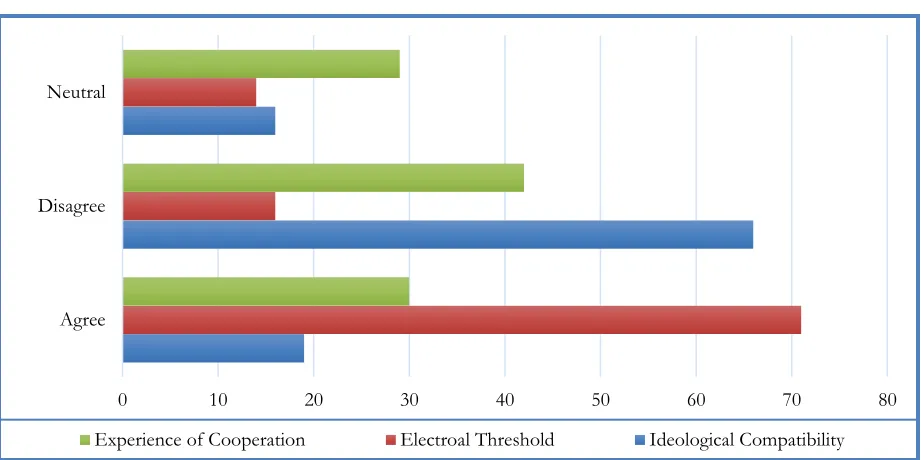
This article examines how electoral alliances were formed in the 2017 parliamentary elections in the Republic of Armenia. It hypothesizes that alliances were formed among parties that are ideologically compatible and could not individually overcome the electoral threshold. Contrary to the established theory in the field, the data collected and analyzed from February to May 2018 reveal that ideological and programmatic similarities were not the primary
factor that influenced the party leaders’ decision to cooperate with others. Instead, parties converged because of the short -term objectives of overcoming the electoral threshold and gaining more seats in the parliament.
Keywords
Introduction
The 2017 parliamentary elections in the Republic of Armenia were unprecedented in two important respects. These were the first elections to the National Assembly after the country made a transition from a semi-presidential form of government to parliamentary (December, 2015), and starting from December 2016 to March 2017, a process of alliance formation took place, as a result of which ten parties coalesced into four alliances: “Yelq” (“Bright Armenia,” “Civil Contract”, and “Republic” parties), “Tsarukyan” (“Prosperous Armenia”, “Alliance”, and “Mission” parties),
“Oskanyan-Raffi-Ohanyan”(“Heritage” and “Unity” parties), “Congress-PPA” (the Armenian National
Congress and Peoples’ Party of Armenia).
This paper aims to reveal how these alliances were formed, i.e. what were the main factors that party leaders took into consideration while negotiating with potential allies. In order to accomplish that, a review of the literature was conducted (section 1), and both qualitative and quantitative data were gathered and analyzed in the light of theoretical framework on the formation of electoral alliances (sections 2-4). Data analysis was followed by interpretation and discussion of findings (section 5). Finally, conclusions from the inquiry were drawn and related back to the literature.
1 Literature Review
As a field of study within Political Science, the formation of electoral alliances has a history of slightly more than a decade, but substantive work has been done. Sona Golder, one of the pioneers and the most influential authors in the field notes that this is an important topic to study for several reasons. Firstly, electoral alliances have impact on election results and thus, the policies that are subsequently implemented. Secondly, the formation of alliances has ‘normative implications for the
representative nature of governments’. Finally, as a political phenomenon, the formation of electoral alliances is quite common in many countries of the world (2006: 193-194). The theories on the formation of electoral alliances that have thus far been advanced and developed can be grouped under four categories or themes: ideological compatibility and programmatic similarities; electoral rule and threshold;electoral support and representation; and post-election bargaining and government formation.
1.1 Ideological compatibility and programmatic similarities
Haber, 2016; Ibenskas, 2015). Ideological compatibility, as all these authors acknowledge, makes electoral co-ordination easier and more successful.
Along with ideology, party platforms are also considered to be a factor that influences the formation of alliances. Distinguishing between policy-seeking and office-seeking parties, some authors (Ibenskas, 2015; Kellam, 2015; Spoon and West, 2015; Wahman, 2011) argue that parties that are policy-seeking, i.e. strive to win legislative seats in order to implement their programs, form alliances more often. Wahman (2011) states that opposition parties form alliances only when they are able to present clear policy alternatives to the incumbent. By contrast, there are authors (Lefebvre and Robin, 2009; Rakner et al., 2007; Sridharan, 2004) who argue that parties act as vote-maximizers and generally form alliances irrespective of ideological and programmatic differences.
1.2 Electoral rule and threshold
As a complement to theories that consider ideology, platforms, and prior experience of cooperation to be the main determinants of alliance formation, a group of authors have advanced theories that stress the importance of the electoral rule and the electoral threshold (Blais and Indridason, 2007; Carey, 2017; Ibenskas, 2015; Kaminski, 2001; Lefebvre and Robin, 2009; Golder, 2005, 2006; Parigi and Bearman, 2008; Sridharan, 2004). Whether alliances will form or not, as well as how they will form, according to these authors, largely depends on the type of the electoral rule (majoritarian or proportional) that a country has adopted, and the threshold that has been set. The dominant theory is that parties form and join alliances more often in countries that have systems favoring large parties, i.e. employ majoritarian electoral rule or set high electoral thresholds (Blais and Indridason, 2007; Golder, 2005, 2006; Lefebvre and Robin, 2009; Parigi and Bearman, 2008; Sridharan, 2004).
There is a consensus in the literature that proportional representation (PR) systems favor the formation of electoral alliances less than majoritarian systems. However, Ibenskas (2015) has found, based on a study of eleven post-communist countries, that alliances form more often under closed PR systems where voters do not have the opportunity to express preferences for individual
candidates. Carey (2017) has found that as opposed to the widely used D’Hondt divisions method
for translating votes into seats, the formula known as Hare Quota with Largest Remainders (HQLR) discourages the formation of alliances.
often than medium-sized and large parties because by doing so they have greater opportunities to overcome the threshold and gain seats in the parliament (Ibenskas, 2015; Spoon and West, 2015). Medium-sized and large parties may form alliances with the goal of gaining a majority in the parliament and forming the government (Ibenskas, 2015).
1.3 Electoral support and representation
A group of authors (Blais et al., 2014; Decker and Best, 2010; Duch et al., 2010; Eichorst, 2014; Golder, 2005; Gschwend and Hooghe, 2008; Plescia, 2016; Tillman, 2013) explain the
formation of electoral alliances by voter behavior. Alliances, according to them, are ‘electorally motivated’ (Eichorst, 2014: 107) and provide valuable cues to the electorate with regards to future governments and policies.
Golder (2005) has argued that the formation of electoral alliances reduces voter uncertainty with respect to future governments and creates an incentive to turn out. Following her, Tillman (2013) has found that the presence of alliances increases voter turnout by 1.5%. Others (Gschwend and Hooghe, 2008; Plescia, 2016; Fortunato, 2017) have shown that voters tend to choose alliances over individual parties in case of perceiving them as ideologically homogenous and deny support to parties which they believe have made significant concessions by forming an alliance.
Some of the authors who stress the importance of electoral support and representation in the formation of alliances note that often, the phenomenon of “strategic voting”, as opposed to
“sincere voting”, occurs, i.e. voters cast votes not for the alliance of their genuine choice, but for the one that seems more likely to win (Blais et al., 2014; Bowler et al., 2010; Duch et al., 2010). Blais et al. (2014) state that this is conditioned by electoral history: voters tend to cast votes for the alliances that have been successful in the previous elections and/or in the previous round of elections if the electoral system is majority run-off. Bowler et al. (2010) add that strategic votes are specifically cast
for the parties that are the most expected to form the government. As they mention, ‘voters cast a
vote to promote a policy outcome rather than a party platform, and that policy outcome will be the consequence of coalition bargaining’ (Bowler et al., 2010: 351).
1.4 Post-election bargaining and government formation
et al. (2011) develop a game-theoretical model of alliance formation and argue that ideologically distant parties may also form electoral alliances.
Trying to explain the legislative behavior of the parliamentarians after the formation of alliances, Christiansen et al. (2014) have found that MPs representing alliance member parties tend to vote similarly thus signaling that they can govern together. Eichorst (2014) and Chiru (2015) have looked at the effects of alliance formation on government durability and revealed that largely due to the prior experience of cooperation among member parties, governments based on electoral alliances last longer.
2 Theoretical Framework
Two theories, one emphasizing the role of ideological compatibility and the other- that of the electoral rule and threshold, served as the theoretical framework for this study. As noted by Golder (2005), electoral systems that favor large parties also favor the formation of electoral alliances, and parties that are ideologically compatible, i.e. have similar orientations towards issues of social and political significance, are more likely to form or join alliances (Golder 2006). These two theories were chosen for the analysis of alliance formation in Armenia because of the following reasons.
Firstly, ideology and programmatic similarities are often viewed as the ‘natural’ and indeed
the decisive factor that makes cooperation among parties possible. Except for one (“Yelq”), alliances
in Armenia did not promulgate joint statements, and thus, the basis for cooperation was not explicit. Secondly, in May 2016, a year before the 2017 parliamentary elections, a new electoral code was adopted by the National Assembly: transition was made from a mixed electoral system to a fully proportional one3. The change in the electoral code could be one of the reasons for the formation of an unprecedented number of alliances (four) in Armenian history since independence in 1991.
No studies have been conducted on the formation of electoral alliances in Armenia. Thus, this study aims to make a small contribution to the literature by examining the patterns of alliance formation in a post-Soviet Caucasian country.
3 Research Design and Methodology
This study used a mixed-method research design to reveal how alliances were formed in the 2017 RA parliamentary elections. The following hypotheses were advanced:
H1: Electoral alliances in the 2017 RA parliamentary elections were formed among parties
that are ideologically compatible.
3 Instead of electing 90 MPs through proportional system of closed party lists and 41 MPs through single member