EFFECTIVENESS OF PLANNED TEACHING PROGRAMME ON
KNOWLEDGE REGARDING PRECONCEPTION CARE AMONG
ADOLESCENTS
LINCY S CHERUVATHUR, MSc(N), Associate Professior Baby Memorial College of Nursing, Kozhikode
ABSTRACT
Unwanted teenage pregnancy, sexually transmitted diseases, HIV/AIDS, substance abuse and other problems in adolescents necessitates the need for programms designed to improve their preconceptional health. The objective of the study were: a) Determine the existing knowledge of adolescents regarding preconception care b)Develop and adminis-ter a planned teaching programme on preconception care among adolescents. c) Evaluate the effectiveness of planned teaching programme on preconciption care among adoles-cents. The conceptual framework for the study was developed based on ‘ Becker’s health belief model’. Quasi- experimental one group pre-test post -test design was used for col-lection and analysis of data. Multistage random sampling technique was used to select 120 adolescents from selected colleges.
Result showed that the overall mean percentage of knowledge score had improved from 39.05% in pre-test to 74.45% in post-test and the mean percentage of effectiveness was 35.40%. Inferential statistics using paired ‘t’ test showed a very highly significant differ-ence (t=31.861, P<0.005) between pre-test and post-test knowledge scores of adolescents.
Key words
Planned teaching programme (PTP); preconception care; adolescents.
INTRODUCTION
Adolescents are the future parents. Adolescence is regarded as a unique phase of hu-man development. It is a period of sexual maturity that transforms a child to a biologically mature adult capable of sexual reproduction & potential consequences of that sexual ac-tivity.
There are approximately 10 million pregnant adolescents and adolescent mothers throughout India at any given time1. Each year around 20 million young women aged
be-tween 15-19 years undergo unsafe abortions which results in 78,000 deaths worldwide.2
Compared to adult women, childbearing during adolescence poses greater risk to the mother and the newborn. Fertility during this period contributes to maternal morbidity and mortality, high incidence of low birth weight babies and neonatal morbidity and
identify and treating risk factors and providing anticipating guidance with emphasis on healthy lifestyles may be the key to improve health of next generation (Freda, 1993)4
Majority women who become pregnant do not seek prenatal care and advice until the middle of the first trimester. By that time organogenesis is well advanced and it may have been affected by the client’s life style, both healthy and unhealthy. The target clientle for preconception advice should be all individuals of reproductive age, particularly women who are contemplating a pregnancy in the near future and teenage school children 5
A study on ‘effectiveness of planned teaching programme on knowledge regarding selected area of safe motherhood among the female pre-university students showed the findings that gain in knowledge in this area was compartively less than other areas and the researcher concluded that there is much scope for improving knowledge in the area of preconceptional health6.
The objectives of the present study were as following
• Determine the existing knowledge of adolescents regarding preconception care among adolescents.
• Develop and administer a planned teaching programme on preconception care
• Evaluate the effectiveness of the planned teaching programme on preconception care among the adolescents.
MATERIALS AND METHODS Design
A quasi- experimental study with one group pre-test post -test design was used
Pretest (X) Treatment PTP Post -test (Y)
Setting
The study was conducted in three selected degree colleges in Manglore city.
Sample
One hundred and twenty students who met inclusion criteria
- Studying in selected degree colleges, Mangalore
- In the age group of 17-19 years
- Willing to participate and available during the period of study.
Multistage random sampling technique was used to select the sample for the study.
Tools to assess knowledge of adolescents on preconception care
A structured knowledge questionnaire was used which has two parts.
Part I
Consists of demongraphic variables such as age, sex, religion, type of family, family in-come, residential area, previous awareness & source of information about preconception care.
Part II
Consists of 38 items related to preconception care which are devided in to section A, section B and section C
Section A - had seven items regarding the concept of preconception care
Section B - had 20 items regarding preconceptional promotion of health
Section C - had eleven items cencering the prevention of teratogenic exposure.
The planned teaching programme was developed by the investigator. The method of instruction adopted was lecture cum discussion using powerpoint. After the pretest on the same day PTP was administered. Post - test was done on fifth day using same questionnaire.
Validity & reliability
Content validity of the tool was ascertained in consulation with the experts in the field of nursing, obstetrics & gynacology. Reliability of tool was tested by test retest method using Karl pearson’s correlation formula. (r = .916, P<.001). Tool was found to be reliable.
Plan for data analysis
Frequency & percentage distribution of demographic data was done. The pre-test and post-test scores of knowledge regarding preconception care was analysed using paired ‘t’ test.
RESULTS
Part I : Percentage distribution of demographic variables of adolescents :
percentage from mass media. From parents, grandparents & friends (6.67%) of sample got the information regarding preconception care
Part II
Analysis of pre-test knowledge of adolescents on preconception care
Table -I
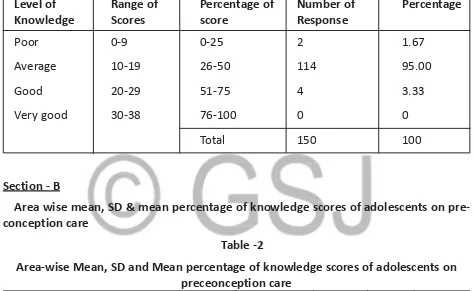
section - A Level of Knowledge of Adolescents on Preconception Care
n=120
Level of Range of Percentage of Number of Percentage
Knowledge Scores score Response
Poor 0-9 0-25 2 1.67
Average 10-19 26-50 114 95.00
Good 20-29 51-75 4 3.33
Very good 30-38 76-100 0 0
Total 150 100
Section - B
Area wise mean, SD & mean percentage of knowledge scores of adolescents on pre-conception care
Table -2
Area-wise Mean, SD and Mean percentage of knowledge scores of adolescents on preceonception care
Knowledge area Maximum Mean SD Mean
Possible score %
score
a. Concept of preconception care 7 3.08 1.16 44.00
b. Preconceptional promotion of health 20 7.93 1.89 39.65
c. Prevention of teratogenic exposure 11 3.83 1.45 34.82
Section- C
Item- wise analysis of correct responses of adolescents on preconception care
Table -3
SL Itemwise distribution of percentage of correct No.of Percentage NO responses of adolescents on ‘concept of correct
preconception care’ response
1. Conception means fusion f sperm aand ovum 37 30.83
to form zygote
2. Preconception care is the care and advice for 58 48.33
future parents
3. Teenage is the most suitable age for providing 78 65.00
preconception care
4. Preconception care helps to reduce birth defects 45 37.5
5. The first few weeks after conception is critical because 19 15.83
of the organogenesis of foetus
6. Risk assessment and health promotion are the 42 35
components of preconception care
7. Preconception care will help to ensure safe motherhood 91 75.83
Table - 4
SL Itemwise distribution of percentage of correct No.of Percentage NO responses of adolescents on ‘preconceptional correct
promotion of health’ response
8. Balanced diet contains carbohydrate, protein, 61 50.83
fat, vitamins and minerals
9. Energy requirement for adolescent in the age 22 18.33
group of 17-19 years is 2001-2800 Kcal
10. Energy producing foods are rich in fat and 28 23.33
carbohydrate
12. Neural tube defect can be prevented by folic acid 23 25.19
supplementation during reproductive age
13. Menstruation can cause Iron loss in adolescent girls 40 33.33
14. Body requirement of Calcium and Phosphorus can 79 65.83
be obtained from cow’s milk
15. BMI Means weight in kilogram divided by height 15 12.5
in meter squared
16. BMI sixteen shows underweight 61 50.83
17. Menstrual hygiene is important because of the chance 31 25.83
for the growth of bacteria in the presence of blood
18. Before eating food and after passing urine and stool 73 60.83
hands should be cleaned with soap and water
19. Teenage pregnancy should be avoided because of their 81 67.5
physical and mental immaturity
20. Marriage between relations should be avoided because 49 40.83
it can cause genetic abnormality in foetus
21. Most suitable age for pregnancy is 20-35 years 67 55.83
22. The best method for prevention of unplanned 54 45
pregnancy is contraceptives
23. For calculating the expected date of delivery, women 48 40
should know the first day of last menstrual cycle
24. Regular exercise helps to attain physical and 45 37.5
psychological wellness
25. Brisk walking and yoga are the best moderate exercises 62 51.67
26. Preconceptional medical consultation is essential for 14 11.67
family with genetic abnormality
27. Preconceptional medical check-up is a must for girls 16 13.33
with foul smelling vaginal discharge, hypertension
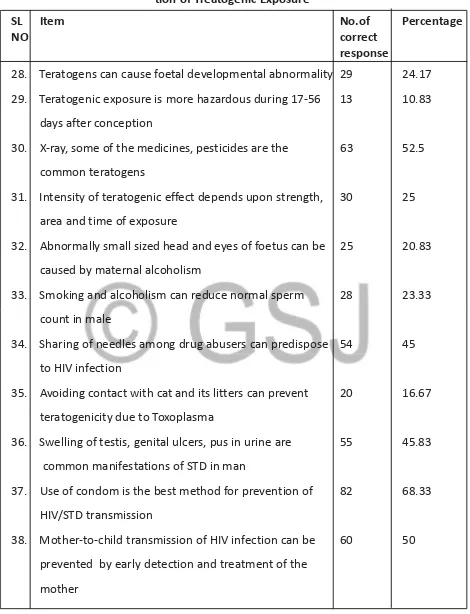
Table - 5
Item wise Distribution of percentage of correct responses of Adolescents on ‘Preven-tion of Treatogenic Exposure’
SL Item No.of Percentage
NO correct
response
28. Teratogens can cause foetal developmental abnormality 29 24.17
29. Teratogenic exposure is more hazardous during 17-56 13 10.83
days after conception
30. X-ray, some of the medicines, pesticides are the 63 52.5
common teratogens
31. Intensity of teratogenic effect depends upon strength, 30 25
area and time of exposure
32. Abnormally small sized head and eyes of foetus can be 25 20.83
caused by maternal alcoholism
33. Smoking and alcoholism can reduce normal sperm 28 23.33
count in male
34. Sharing of needles among drug abusers can predispose 54 45
to HIV infection
35. Avoiding contact with cat and its litters can prevent 20 16.67
teratogenicity due to Toxoplasma
36. Swelling of testis, genital ulcers, pus in urine are 55 45.83
common manifestations of STD in man
37. Use of condom is the best method for prevention of 82 68.33
HIV/STD transmission
38. Mother-to-child transmission of HIV infection can be 60 50
prevented by early detection and treatment of the
Part III
Evaluation of the effectiveness of PTP on preconception care for adolescents & testing of Hypothesis
A. Comparison of pre-test and post- test knowledge scores of adolescents on precon-ception care.
B. Testing of Hypothesis
Ho: There is no significant difference between the pre-test and post-test knowledge scores of adolescents regarding preconcption care.
paired ‘t’ test was used to analyse the difference in knowledge scores of adolescents in the pre test and post-test regarding preconception care. The calculated ‘t’ value was greater than table value in all sections. Therefore null hypothesis was rejected & research hypothesis was accepted. Findings revealed that there was very highly significant difference (t = 31.861, P< 0.005) between test & post-test knowledge scores of adolescents regarding pre-conception care.
DISCUSSION
The findings of the present study showed that majority (95%) of the sample had only average knowledge regarding preconception care whereas 1.67 % of the respondents had poor level of knowledge regarding the topic. Findings also revealed that 3.33 % of respon-dents had good knowledge & none of them had very good knowledge regarding precon-ception care.
SD of 7.93± 1.89. Findings of present study are consistent with the findings observed by another study among female pre-university students which revealed that in the area of preconceptional health the mean percentage of pre-test knowledge scores was 43.75% with a mean & SD of 3.5 ± 1.20
The findings of mean, SD & mean percentage of knowledge scores in the pre-test and post-test revealed that the mean percentage in the pre-test was 39.05 with the mean and SD of 14.84 ± 29.2, where as post-test mean percentage was 74.45% with mean & SD of 28.28± 3.4. This finding showed high effectiveness (35.44%) of planned teaching programme. This finding is consistent with another study finding which showed that mean percentage of the pre-test score in the area of preconceptional health was 43.75% with mean and SD of 3.5± 1.20 where as post-test mean percentage in this area was 76.25% with mean & SD 6.1 ± 0.88. This revealed a high effectiveness (32.5%) of planned teaching programme in the area of preconceptional health.
CONCLUSION
Planned teaching programme was very highly effective in improving the knowledge of the adolescents on preconception care.
REFERENCE
1. Ministry of Human Resource Development, Department of Education. Selected educational statistics. New Delhi : Government of India; 1999
2. Nair CKC. Adolescent sexual and reproductive health. Indian paediatrics 2004; 41: 7-13 3. Nanda AR. Addressing the reproductive health needs of adolescents in India: directions
for programmes. New Delhi : Ministry of Health and family Welfare; 2001 4. Perry S E, Wong DL. Maternal child Nursing. 1st ed. St. Louis : Mosby; 1998
5. Alexander J, Levy V, Roch S. Midwifery practice. London : Macmilla press ; 1996
6. Varalakshmi K. An evaluative study on the effectiveness of planned teaching programme on knowledge regarding selected areas of safe motherhood among the female second year pre-university students. Unpublished M.Sc Nursing Thesis : University of MAHE; 1998
7. Cefalo R C, Moos MK. Preconceptional health care : a practical guide. 2nd ed. St. Louis : Mosby ; 1988.
8. Summers L, Price R. Preconception care : An opportunity to maximize health in pregnancy.J Nurse Midwifery 1993 Jul-Aug; 38(4): 188-98.
9. www.unfpa.org/swp/2003/english/chi/-25k 10.www.hsph.harvard.edu/takmi/rp139.pdf