Research Article
Energy Based Performance analysis of AODV Routing
Protocol under TCP and UDP Environments
Ahmad Shaf
1*, Tariq Ali, Umar Draz and Sana Yasin
Computer Science Department, CIIT, Sahiwal, Pakistan [email protected]
Abstract
Mobile Ad hoc Network (MANET) is a combination of wireless nodes that share resources and information. One of the major issues in MANET is to minimize the energy consumption of wireless nodes. Higher energy consumption nodes minimize the network life while lower energy consumption nodes increase the network life. Various routing protocols have been proposed for energy saving. Ad hoc On-demand Distance Vector (AODV) is an energy efficient routing protocol. In this paper, the energy based performance of AODV routing protocol is evaluated under Transmission Control Protocol (TCP) and User Datagram Protocol (UDP) by using different simulation scenarios. NS2 has been used for simulation purposes. An energy model is defined in which power for receiving and transmitting one packet, initial energy, sleep power, idle power, transition power and transition time values are kept constant for different simulation scenarios. The simulation results show that AODV routing protocol consumes less energy in TCP environment as compared to UDP environment.
Keywords: MANET, AODV, Energy, TCP, UDP, NS2
Received on 10 November 2017, accepted on 21 February 2018, published on 10 April 2018
Copyright © 2018Ahmad Shafet al., licensed to EAI. This is an open access article distributed under the terms of the Creative Commons Attribution licence (http://creativecommons.org/licenses/by/3.0/), which permits unlimited use, distribution and reproduction in any medium so long as the original work is properly cited.
doi: 10.4108/eai.10-4-2018.154453
1. Introduction
An ad hoc routing protocol enumerates routers communicate with each another, propagate the message to allow nodes for choosing their perspective routes and takes action to share routing packets information among computing devices on a MANET [1, 2, 3, 4]. Table-driven and Source-initiated-on-demand are two types of ad hoc routing protocol. In table-driven, there is consistent and up-todate information about routing packets with respect to the single node to all another node. In source-initiated-on-demand, only creates a route when coveted by initial node [5]. Due to dynamic, automatic configuration and multi leap networking nature, ad hoc networks are formed on the outside of any infrastructure [1]. In such networks nodes mobility plays the main role to find the availability of any routes. The topology of such networks cannot be
locked and generally modify many times [6]. Due to such nature, ad hoc network has limitations e.g energy utilization, small bandwidth and narrow channel size [7]. Nodes movement changes the routes of the network. Such mobility causes routes damage therefore maintenance is required [8]. Ad hoc network‘s viable lifetime is leaned on batteries power. Therefore energy plays a fortitude role in ad hoc networks. In ad hoc network, each node takes a decision on the basis of advantages that its neighbors will get from it when it‘s vitality awake [9]. Nodes mobility consumed more battery life as compared to fixed nodes [10]. To minimize consumption of battery life in ad hoc network, the shortest-path algorithm is used in polynomial time [11]. Ad Hoc on Demand Distance Vector (AODV) is a type of ad hoc networks and considered as a reactive protocol. It is a source driven routing protocol in which communication starts only when desired by source node [2, 5, 7, 8]. AODV is used for unicast [7] and multicast routing [12]. Only those nodes maintain routing information in the routing table which is presented in the
2 path. Each routing table consists of destination IP address, destination sequence number, valid destination sequence flag, network interface, hop count, next hop, list of precursors and life time [3, 4, 13]. Destination sequence number is used to avoid loops. There is no central administrative system for controlling the routing protocol in AODV. AODV only updates those nodes which are affected by topological changes in the network. In AODV, destination node always entertains the first request and ignores all others [14]. Due to HELLO message support, unnecessary overhead in network never occurs [13]. AODV minimizes the number of active routes between active source and destination. Each route has its own life time. If the route is not used within its life time, it expires [14]. In [4, 8, 15, 16], TCP is a transmission control protocol and considered as connection oriented protocol. To start a communication between two nodes handshake mechanism synchronization (SYN), synchronization acknowledgment (SYN-ACK) and acknowledgment (ACK) is used. Handshake mechanism provides us absolute guarantee that data receive the same order in which it was sent. In [3, 4, 12, 16], UDP is a user datagram protocol or universal datagram protocol and considered as a connectionless protocol. Due to its lightweight, no ordering of messages, no tracking connections etc. UDP is designed on top of Internet Protocol (IP). UDP is capable of error checking and discards erroneous packets but not capable of error recovery. There is no absolute guarantee that receiving packets in the same order in which it was sent. In this paper, we have evaluated the performance of AODV routing protocol under connection oriented protocol (TCP) and connectionless protocol (UDP) for analyzing the energy consumption of wireless nodes. The remaining sections are as follow. A brief overview of related work shows in section 2. A detailed description of simulation methodology explains in section 3. Simulation parameters and their values are displayed in section 4. Simulation results and graphs are shown in section 5 and finally, section 6 concludes the paper.
2. Related work
In [1], for energy saving purposes two routing protocols algorithms AODV and Dynamic MANET on Demand (DYMO) have been evaluated by using different radio energy models. Energy models have been selected as mica-motes, generic Model and micaZ radio energy model. MicaZ is best energy model as compared to other two models. It has been experimentally proving that the mica-motes energy model with 50 nodes as best as micaZ energy model. Some simulation performs with respect to 100 nodes for second way terrain size of 500 cross 500. Average jitter, throughput and end-to-end delay are some common parameters that have been taken to evaluate the energy consumption. AODV perform well in mica-motes energy module as compared to DYMO. In [4], authors have explained a difference between two major transport layers protocols TCP and UDP by using AODV routing
protocol. The only definition of throughput, end to end delay, drop ratio and packet delivery ratio is provided in this paper. In [9], Wireless Mesh Network (WMN) is one of the key technologies in the next generation of wireless network. In this type of network, the most fundamental property is self-scheduling, self-organizing, reduced maintenance and easy deployment. AODV is the one of the famous routing protocol that used in WMN. AODV uses hop count, energy constraints, channel utilization and speed. These energy constraints in the form of TCP and UDP to be lie in safe-mesh. Due to simultaneous change in mobility and energy, AODV faces difficulty to produce accurate results. Instead of AODV, Regional Energy and Mobility Aware (REMA) routing protocol are introduced for solving the energy constraints and mobility of nodes in WMN. REMA is based on Cross-Layer Aware (CLA) for measuring the energy and mobility of nodes more accurately. By comparing the performance of AODV, REMA, CLA and Adoptive Load-Aware Routing Metric (ALARM) on the behalf of several parameters like throughput, packet loss, end to end delay, network lifetime, routing overhead and energy consumption of every packet. The average packet loss rate and throughput are high in AODV due to route reply and acknowledgment. Similarly, end-to-end delay is much higher than REMA, CLA and ALARM. The routing overhead and network lifetime are the dominant parameters of AODV as compared to REMA, CLA and ALARAM.
3 Methodology
Firstly, installed and validate the essential components of NS2 in UNIX based operating system. TCL (Tool Command Language) is a high-level programming language and used to write a simulation script in transparent syntax. TCL scripts are generated for 25, 50, 75 and 100 mobile nodes. Two types of TCL script are generated, one in which all nodes are connected under TCP and in other all nodes are connected under UDP. AODV supports both TCP and UDP connections [15]. Due to flexibility and lineup scenario, grid layout is used for mobile nodes [12]. In TCL scripts only first two nodes behave like servers while the remaining one considers as mobile nodes. There are 14, 28, 42 and 56 connections are established between 25, 50, 75 and 100 mobile nodes. Initially, each node is assigned by 90 Joule energy. Except traffic agents, all parameters such as routing protocol, packet size, interval, simulation time, packet queue and others remain same for both TCP and UDP connections. For TCP based connections, File Transfer Protocol (FTP) is adopted while for UDP based connections, Constant Bit Rate (CBR) is used [3, 16]. TCL script generates trace file when simulates on NS2 [15]. Each TCL script is iterated 25 times on NS2 to produce different trace files. Each trace file is further extracted to take energy consumption result by using AWK energy script. At the end of the simulation, 25 energy values for each script are obtained for both TCP and UDP connections. Separate and average
EAI Endorsed Transactions on
energy consumed graphs of wireless nodes under TCP and UDP is generated. After that taking the average of simulation results for both TCP and UDP, a comparison graph is generated. In AODV protocol, if nodes are connected under TCP connection they consume less energy as compared to UDP connection.
3.1 Simulation
To find the pros and cons of routing protocols in simple and complex networks, simulation is used. For real time applications, simulation helps us to visualize the performance of routing protocols and complex networks. Different types of parameters such as packet size, interval, traffic type, routing protocols, agents, number of nodes and others are used to analyze the performance of the network. Each individual parameter result is taken by simulation. Each parameter result helps us to analyze in depth the behavior of routing protocols in the network. Performance of routing protocols is being directly affected by mobility, localization, long route, energy consumption, high bandwidth, channel size and synchronization. On the basis of performance, which protocol should be used in different conditions has been decided. Several open source simulations tools are available to find the performance of routing protocols. For simulation model, Network Simulator (NS-2.35 allinone) has been used with a different number of nodes and connections. AWK scripts are used to extract the result from trace file [15]. NS2 [8, 12] provides the framework for designing the simulation model. This simulation model has dynamic nature and can be updated easily as per our requirement. The simulation model can be designed for both wired and wireless networks. NS2 simulates this model and provides the result to analyze the performance of routing protocols. In our approach, the NS2 tool is used to take the energy based performances of AODV routing protocol in TCP and UDP connections under different mobile nodes. In NS2, for simulation NS directory is used. Other directories such as TCL/TK, Nam, Xgraph and Zlib are also used to analyze the performance of routing protocols [15]. NS2 is an open source tool for network simulation and can be easily downloaded from various websites. NS2 can be installed in Windows and UNIX based operating systems. For data extraction from trace file AWK script is used. It is a data driven approach. There are three parts of AWK script. First, one is BEGIN part in which initializes the variables. Second is Content part in which computations and different operations are used to extract the result from the trace file. The third is END part in which resulted data are displayed [12, 15].
4 Simulation Parameters
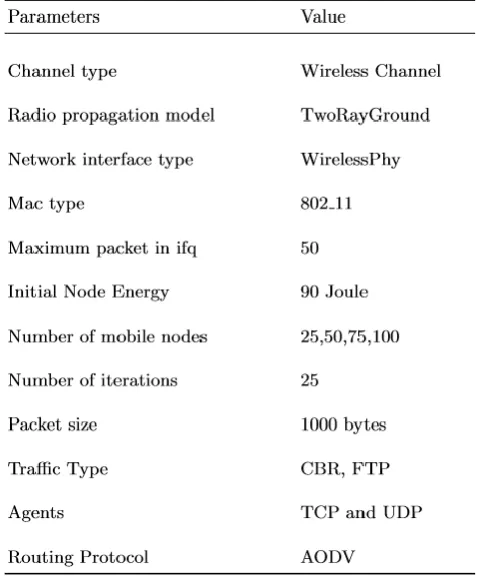
Table 1 shows important simulation parameters and their values that we have taken for simulation environment in NS2.
5 Results
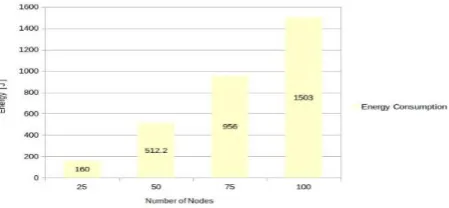
Results produced under a different number of nodes, connections and agents by using AODV routing protocol under TCP and UDP based communication. The graphs are shown below:
5.1 Energy based performance under TCP
4 Fig. 2 shows the average energy consumed by mobile nodes when AODV routing protocol is used under TCP connections.
5.2 Energy based performance under UDP
Fig. 3 shows the energy based performance of AODV routing protocol under UDP connections. Each iteration result with respect to a number of nodes and energy consumption are shown separately in Fig. 3.
Fig. 4 shows the average energy consumed by mobile nodes when AODV routing protocol is used under UDP connections.
5.3 Comparison of TCP and UDP
Fig. 5 shows the energy consumption base comparison of AODV routing protocol in both TCP and UDP
connections. In Fig. 5 it is clearly visible that TCP consumes less energy as compared to UDP in AODV routing protocol.
6 Conclusion
In this paper, the energy based performance of AODV routing protocol is taken out under TCP and UDP based connections for a different number of nodes and connection agents. All other parameters except traffic agents remain same for both TCP and UDP connections. By increasing the number of nodes the energy
consumption will be increased. At small scale (25-40 mobile nodes), UDP connections consume less energy as compared to TCP connections in AODV routing protocol whereas at large scale the results are truly reversed. In last, the comparison shows that the AODV routing protocol consumes less energy in TCP connections as compared to UDP connections. This analysis helps us for designing energy aware AODV routing protocol for real time applications. In future horizons try to simulate the other reactive protocols on the behalf of different parameters to know which protocol is best suited to the TCP and UDP environment.
References
1. P. K. Varshney, G. Agrawal, and S. K. Sharma, ”Energy Consumption Analysis of Wireless Ad hoc Networks Routing Protocols under Different Energy Models,” INROADS-An International Journal of Jaipur National University, vol. 5, no. 1s, pp. 250-253, 2016
2. P. Nayak and B. Vathasavai, ”Impact of Random Mobility Models for Reactive Routing Protocols over MANET,” International Journal of Simulation–Systems, Science Technology, vol. 17, no. 34, 2016
3. M. A. R. Mahmud, M. M. Rahman, and M. S. Miah, ”PERFORMANCE ANALYSIS OF ROUTING PROTOCOLS FOR CBR TRAFFIC IN MOBILE AD-HOC NETWORKS,” Journal of Information, vol. 2, no. 1, pp. 1-9, 2016 4. R. Singh, P. Tripathi, and R. Singh, ”A Survey on TCP (Transmission Control Protocol) and UDP (User Datagram Protocol) over AODV Routing Protocol,” International Journal of Research, vol. 1, no. 7, pp. 26-33, 2014
5. P. K. Varshney, G. Agrawal, and S. K. Sharma, ”Relative Performance Analysis of Proactive Routing Protocols in Wireless Ad hoc Networks using Varying Node Density,”
EAI Endorsed Transactions on
Invertis Journal of Science & Technology, vol. 9, no. 3, pp. 161-169, 2016
6. B. Karthikeyan, S. H. Ganesh, and M. N. Kanimozhi, ”Security Improved Ad-Hoc on Demand Distance Vector Routing Protocol (SIm AODV),” International Journal on Information Sciences and Computing, vol. 10, no. 2, 2016 7. D. Rathi and R. R. Welekar, ”Performance Evaluation of AODV Routing Protocol in VANET with NS2,” International Journal of Interactive Multimedia and Artificial Intelligence, vol. 4, no. Special Issue on Advances and Applications in the Internet of Things and Cloud Computing, 2017
8. S. Sandhu, A. Menon, P. Sinha, N. Afinwale, and M. P. T. Mahida, ”Comparative Analysis of TCP variants with AODV in Mobile Ad Hoc Network.”
9. W. Shi, Y. Chai, and D. Liu, ”Regional energy-and mobility-aware routing protocol for hybrid wireless mesh network,” International Journal of Distributed Sensor Networks, vol. 13, no. 1, p. 1550147716682039, 2017.
10. T. Ali, L. T. Jung, and I. Faye, ”End-to-End Delay and Energy Efficient Routing Protocol for Underwater Wireless Sensor Networks,” Wireless Personal Communications, journal article vol. 79, no. 1, pp. 339-361, 2014.
11. S. Baugh, G. Calinescu, D. Rincon-Cruz, and K. Qiao, ”Improved Algorithms for Two Energy-Optimal Routing Problems in Ad-Hoc Wireless Networks,” in Big Data and Cloud Computing (BDCloud), Social Computing and Networking (SocialCom), Sustainable Computing and Communications
(SustainCom)(BDCloud-SocialComSustainCom), 2016 IEEE International Conferences on, 2016, pp. 509-516: IEEE.
12. N. Surayati, ”Performance evaluation of AODV, DSDV DSR routing protocol in grid environment,” Universiti Putra Malaysia, 2008.
13. P. K. Maurya, G. Sharma, V. Sahu, A. Roberts, M. Srivastava, and M. Scholar, ”An overview of AODV routing protocol,” International Journal of Modern Engineering Research (IJMER), vol. 2, no. 3, pp. 728-732, 2012. 14. H. Simaremare, ”A development of secure and optimized AODV routing protocol using ant algorithm,” Mulhouse, 2013. 15. B. Singh and R. Hans, ”TCP and UDP Based Performance Analysis of AODV, DSR and DSDV Routing Protocols Under Different Traffic Conditions in Mobile AdHoc Networks,” International Journal of Future Generation Communication and Networking, vol. 8, no. 2, pp. 73-92, 2015.
16. M. R. Hossen, K. T. Ahmed, S. Saha, and Z. Hossain, ”Estimating an Efficient Routing in MANET for UDP and TCP Traffic,” Transactions on Networks and Communications, vol. 4, no. 6, p. 33, 2016