© 2016 IJSRSET | Volume 2 | Issue 4 | Print ISSN : 2395-1990 | Online ISSN : 2394-4099 Themed Section: Engineering and Technology
A Study of Architecture and Routing Protocols used in Wireless
Sensor Networks
C. Naveeth Babu
1, Dr. K. Karthikeyan
21
Research Scholar & Asst. Prof Department of CT, Dr.SNSRCAS, Coimbatore Tamilnadu, India
2
Head - Department of CS, Government Arts & Science College, Karambakudi, Pudukkottai, Tamilnadu, India
ABSTRACT
A wireless sensor network is a group of specialized transducers with a communications infrastructure for monitoring and recording conditions at diverse locations. Commonly monitored parameters are temperature, humidity, pressure, wind direction and speed, illumination intensity, vibration intensity, sound intensity, power-line voltage, chemical concentrations, pollutant levels and vital body functions. To design these networks, the factors needed to be considered are the coverage area, mobility, power consumption, communication capabilities etc. In this paper a survey is given regarding the architecture design issues, classification of protocols. The paper explores with research issues for the realization of networks.
Keywords: Wireless Sensor networks, Applications, Design Issues, Architecture Design, Routing protocols.
I.
INTRODUCTION
A sensor network is defined as the composition of a large number of low cost, low power - multi functional sensor nodes which are highly distributed either inside the system or very close to it. These nodes which are very small in size consist of sensing, data processing and communicating components. The position of these tiny nodes need not to be absolute; this not only gives random placement but also means that protocols of sensor networks and its algorithms must possess self-organizing abilities in inaccessible areas . However nodes are constrained in energy supply and bandwidth, one of the most important constraints on sensor nodes are the low power consumption requirements. These constraints combined with a specific deployment of large number of nodes have posed various challenges to the design and management of networks. These challenges is necessitates energy awareness at all layers of networking protocol stack.[2]
The issues related to physical and link layers are generally common for all kind of sensor applications , therefore the research on these areas has been focused on system level power awareness such as dynamic
voltages calling, radio communication hardware, low duty cycle issues, system portioning, and energy aware MAC protocols . At the network layer, the main aim is to find ways for energy-efficient route setup and reliable relaying of data from the sensor nodes to the sink so that the lifetime of the network is maximized. Sensor nodes not only carry limited but usually carry irreplaceable power sources and thus the main focus of sensor network protocol is primarily on power conservation. At the cost of lower throughput or higher transmission delay they must possess inbuilt trade-off mechanism that gives the end user the option of prolonging network lifetime. Realization of these and other sensor network applications require wireless ad hoc networking techniques. Although many protocols and algorithms have been proposed for traditional wireless ad hoc networks, they are not well suited for the unique features and application requirements of sensor networks.
To illustrate this point, the differences between sensor networks and ad -hoc networks are as follows
The topology of a sensor network changes very frequently.
Sensor nodes may not have global identification because of the large amount of overhead and large number of sensors.
The number of sensor nodes in a sensor network can be several orders of magnitude higher than the nodes in Ad-hoc networks.
In this paper, we present a survey of the protocols, design issues and outline the use of certain tools to meet the design objectives [2]. The paper is organized as follows.
In First section we specify some of sensor network applications. In Second section summarizes the system architecture design issues for sensor networks and there implications on data routing. In section Three, classification and comparison of protocols have been discussed.
II.
METHODS AND MATERIAL
A. Sensor Network Applications
Sensor networks may consist of many different types of sensors such as seismic, low sampling rate magnetic, visual, thermal, infra -red, acoustic and radar, which are able to monitor a wide variety of ambient conditions. Sensor nodes can be used for continuous sensing, event detection, event ID, and local control of actuators. The concept of micro sensing and wireless connection of these nodes promise many new application areas. We categorize the applications into military, environmental, health, home, and other commercial areas.
A. Military Applications:Wireless sensor networks can be an integral part of military command, control, communication, computing, intelligence, surveillance and targeting (C4ISRT) systems. The rapid deployment, fault tolerance and self-organization characteristics of sensor networks make them a very promising sensing technique for military (C4ISRT). Since sensor networks are based on dense deployment of disposable and low cost sensor nodes, destruction of some nodes by hostile actions does not affect military applications as much as the destruction of traditional sensor, which makes sensor networks concept a better approach for battlefield. Various military applications of sensor networks are
monitoring friendly forces, equipments and ammunition; biological and chemical (NBC) attack detection and reconnaissance.
B. Environmental Applications: Some environmental applications of sensor network include tracking the movement of birds, small animals and insects; monitoring environmental conditions that affect crops and livestock ; irrigation; macro instruments for large scale earth monitoring and planetary exploration; chemical/biological detection; precision agriculture; biological, Earth and environmental monitoring in marine, soil and atmospheric contexts ; forest fire detection and meteorological and geophysical research; flood detection; bio complexity mapping of the environment and pollution study.[1]
C. Health Application: Some of the applications are providing interfaces for the disabled; integrated patient monitoring; diagnostics; drug administration in hospital; monitoring the movements and internal process of insects or other small animals; telemonitoring of human physiological data; and tracking and monitoring doctors and patients inside a hospital.
D. Home Applications: Home automation; as
technology advances, smart sensor nodes and actuators can be buried appliances, such as vacuum cleaners, micro wave ovens, refrigerators and VCRs. These sensor nodes inside the domestic devices can interact with each other and with a external network via the internet or satellite. They allow end users to manage home devices locally and remotely more easily.
E. Other Commercial applications: Some of the commercial applications are monitoring material fatigue; building virtual keyboards ; managing inventory; monitoring product quality; constructing s mart office spaces ; environmental control in office buildings ; robot control and guidance in automatic manufacturing environment; interactive toys ; interactive museums ; factory process control and automation; monitoring disaster area; smart structures with sensor nodes embedded inside; machine diagnosis ; transportation; factory instrumentation; local control of actuators ; detecting and monitoring car thefts ; vehicle detection and tracking; and instrumentation of semiconductor processing chambers , rotating machinery, wind tunnels and anechoic chambers . [1]
B. Sensor Architecture Design
capabilities to collect data and route data back to the sink and the end users. Data are routed back to the end user by a multi-hop infrastructure less architecture through the sink.
Figure1. Sensor nodes scattered in sensor field and components of a sensor node
The protocol stack combines power and routing awareness, integrates data with networking protocols, and communicates power efficiently through the wireless medium. The protocol stack consists of the application, transport, network, data link, physical layer, power management plane, mobility management plane and task management plane. Depending on the sensing task, different types of applications software can be built and us e on the application layer. The transport layer helps to maintain the flow of data if the sensor networks application requires it. The network layer takes care of routing the data supplied by the transport layer. Since the environment is noisy and sensor nodes can be mobile, the MAC protocol must be power aware and able to minimize collision with neighbors broadcast. The physical layer addresses the needs of the simple but robust modulation, transmission and receiving techniques. In addition, the power, mobility and task management planes monitor the power, movement and task distribution among the sensor nodes. These planes help the sensor nodes coordinate the sensing task and lower the overall power consumption. [3]
Design Issues Since the performance of a routing protocol is closely related to the architectural model, in this section we strive to capture architectural issues and highlight there implications.
1) Network dynamics:There are three main components in a sensor network. These are the sensor nodes, sink and monitored events. Aside from the very few setups that utilize mobile sensor, most of the network architecture assumes that sensor nodes are stationary. On
the other hand supporting the mobility of s ink or cluster heads (gateways) is sometimes deemed necessary.
2) Node Deployment: Another consideration is the topological deployment of the nodes which is Application dependent and affects the performance of the routing protocol. The deployment is either deterministic or self-organizing. In deterministic situations, the sensors are manually placed and data is routed through pre-determined paths. However in s elf organizing system the sensor nodes are scattered randomly creates an infrastructure in an ad -hoc manner. [6]
3) Energy Consideration: During the creation of an infrastructure, the processes of setting up the routes are greatly influenced by energy considerations. Since the transmission power of a wireless radio is proportional to the distance squared or even higher order in the presence of obstacles, multi hop routing will consume less energy than direct communication. However, multi hop routing introduces significant overhead topology management and medium access control. Direct routing would perform well inform if all the nodes are very close to the sink. Most of the time sensors are scattered randomly over an area of interest and multi hop routing becomes unavoidable.
4) Data Delivery Models: Depending on the application of the sensor network, the data delivery model to the sink can be continuous, event- driven, query-driven and hybrid. In continuous delivery model, each sensor sends data periodically. In event driven and query driven models, the transmission of data is triggered when an event occurs or a query is generated by the sink. Some network applies a hybrid network using a combination of continuous, event driven and query driven data delivery. The routing protocol is highly influenced by data delivery model, especially with regard to the minimization of energy consumption and route stability. [4]
C. Routing Protocols
Following is the classification of routing protocols according to their design characteristics:
RR :- Rumor Routing
GBR :- Gradient Based Routing
CADR :- Constrained Anisotropic Diffusion Routing
ACQUIRE :- Active Query forwarding in sensor networks
LEACH :- Low Energy Adaptive Clustering Hierarchy
TEEN & APTEEN :- [Adaptive] Threshold sensitive Energy Efficient sensor Network
PEGASIS :- Power Efficient Gathering in Sensor Information Systems
VGA :- Virtual Grid Architecture Routing
SOP :- Self Organizing Protocol
GAF :- Geographic Adaptive Fidelity
SPAN
GEAR :- Geographical and Energy Aware Routing
SAR :- Sequential Assignment Routing
SPEED :- A Real time Routing Protocol
Re BR :- Reactive Based Routing
Pr BR :- Proactive Based Routing
HBR :- Hybrid Based Routing
Data routing in sensor networks is classified according to the three main categories, namely Flat, Hierarchical and Location - based.
Flat Routing: SPAN, RR, GBR, CADR, COUGAR, ACQUIRE, EAR,
Hierarchical Routing: LEACH, PEGASIS, TEEN & APTEEN, SOP, HPAR, and VGA.
Location Based Routing: GAF, GEAR.
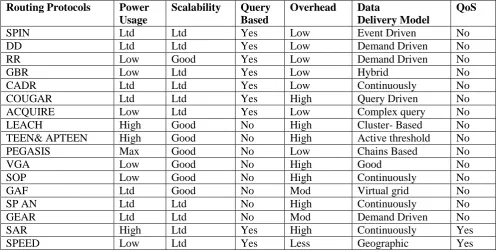
Table 1. Comparison Result of Routing Protocols
Routing Protocols Power
Usage
Scalability Query
Based
Overhead Data
Delivery Model
QoS
SPIN Ltd Ltd Yes Low Event Driven No DD Ltd Ltd Yes Low Demand Driven No RR Low Good Yes Low Demand Driven No GBR Low Ltd Yes Low Hybrid No CADR Ltd Ltd Yes Low Continuously No COUGAR Ltd Ltd Yes High Query Driven No ACQUIRE Low Ltd Yes Low Complex query No LEACH High Good No High Cluster- Based No TEEN& APTEEN High Good No High Active threshold No PEGASIS Max Good No Low Chains Based No VGA Low Good No High Good No SOP Low Good No High Continuously No GAF Ltd Good No Mod Virtual grid No SP AN Ltd Ltd No High Continuously No GEAR Ltd Ltd No Mod Demand Driven No SAR High Ltd Yes High Continuously Yes SPEED Low Ltd Yes Less Geographic Yes
III. RESULTS AND DISCUSSION
Wireless sensor networks are particularly important for the transport of traffic with special requirements. From this tabular column we can conclude that each and every routing protocol has its own set of characteristics. The routing protocol is an effective one when the Power usage is Low, so the energy is used by the computing
Design Issues of Routing Protocol
Initially WSNs was mainly motivated by military applications. Later on the civilian application domain of wireless sensor networks have been considered, such as environmental and species monitoring, production and healthcare, smart home etc. These WSNs may consist of heterogeneous and mobile sensor nodes, the network topology may be as simple as a star topology; the scale and density of a network varies depending on the application. To meet this general trend towards diversification, the following important design issues [8] of the sensor network have to be considered.
(a)Fault Tolerance: Some sensor nodes may fail or be blocked due to lack of power, have physical damage or environmental interference. The failure of the sensor node should not affect the task of wireless sensor networks. This is the reliability. Fault tolerance is the ability to sustain sensor network functionalities without any interruption due to sensor node failures.
(b)Scalability: The number of sensor nodes deployed in the sensing area may be in the order of hundreds, thousands or more and routing schemes must be scalable enough to respond to events.
(c) Production Costs: Since the sensor networks consist of a large number of sensor nodes, the cost of a single node is very important to justify the overall cost of the network and hence the cost of sensors is to be kept low.
(d) Operating Environment: We can set up sensor network in the interior of large machinery, at the bottom of an ocean, in a biologically or chemically contaminated field, in a battle field beyond the enemy lines, in a home or a large building, in a large warehouse, attached to animals, attached to fast moving vehicles, in forest area for habitat monitoring etc.
(e) Power Consumption: Since the transmission power of a wireless radio is proportional to distance squared or even higher order in the presence of obstacles, multi-hop routing will consume less energy than direct communication.[5] However, multi-hop routing introduces significant overhead for topology management and medium access control. Direct routing would perform well enough if all the nodes were very close to the sink. Sensor nodes are equipped with limited power source (<0.5 Ah 1.2V).Node lifetime is strongly dependent on its battery lifetime.
(f) Data Delivery Models: Data delivery models determine when the data collected by the node has to be delivered. Depending on the of the sensor network, the data delivery model to the sink can be Continuous, Event- driven, Query-driven and Hybrid [10]. In the continuous delivery model, each sensor sends data periodically. In event-driven models, the transmission of data is triggered when an event occurs. In query driven models, the transmission of data is triggered when query is generated by the sink. Some networks apply a hybrid model using a combination of continuous, event-driven and query- driven data delivery.
(g) Data Aggregation/Fusion: Since sensor nodes might generate significant redundant data, similar packets from multiple nodes can be aggregated so that the number of transmissions would be reduced. Data aggregation is the combination of data from different sources by using functions such as suppression (eliminating duplicates), min, max and average [9]. As computation would be less energy consuming than communication, substantial energy savings can be obtained through data aggregation. This technique has been used to achieve energy efficiency and traffic optimization in a number of routing protocols
(h) Quality of Service (QoS): The quality of service means the quality service required by the application, it could be the length of life time, the data reliable, energy efficiency, and location-awareness, collaborative-processing. These factors will affect the selection of routing protocols for a particular application. In some applications (e.g. some military applications) the data should be delivered within a certain period of time from the moment it is sensed. [5]
(i) Data Latency and Overhead: These are considered as the important factors that influence routing protocol design. Data aggregation and multi-hop relays cause data latency. In addition, some routing protocols create excessive overheads to implement their algorithms, which are not suitable for serious energy constrained networks. [7]
IV. CONCLUSION AND OPEN ISSUES
tolerance, scalability, cost, hardware, topology change, environment and power consumption. Since these constraints are highly stringent and specific for sensor networks, new wireless ad - hoc networking techniques are required. Routing in sensor networks has attracted lot of attention in the recent years and introduced unique challenges compared to traditional data routing in wired networks. An interesting issue for routing protocols is the consideration of node mobility. Although many routing protocols have been proposed in WSNs, many issues still exist and there are still many challenges that need to be solved in the sensor networks. The following parts describe some of those issues and challenges:
How to effectively utilize the bandwidth and energy for energy application.
To make sensor nodes self- organizing and s elf- reconfigurable.
To make routing protocols secure in WSNs.
To satisfy dense sensor networks with a large number of nodes.
V.
REFERENCES
[1] Rajashree V.Biradar., Patil, V.C., Dr.Sawant, S.R., Dr.Mudholkar, RR.,(2009) “Classification and Comparison of Routing Protocols in Wireless Sensor Networks”, Special Issue on Ubiquitous computing Security systems. Vol 4, No 2, pp.704-711
[2] Akyildiz, I.F., Su.W., subramaniam.Y.S, Cayirci, E., (2002) “Wireless Sensor Networks: A Survey”, Computer Networks Vol 38, No 4, pp 393-422. [3] Luis Javeir Garcia Villalba, Ana Lucila Sandoval
Oroco Alicia Trivino Cabera and Claudia Jacy Barenco Abbas, (2009) “Routing Protocols in Wireless Sensor Networks”, Sensors Vol 9, No 10 pp 8399 - 8421
[4] Gowrishankar. S, Basavaraju, T .G., Manjaiah, D.H., Subir Kumar Sarkar, WCE (2008) “Issues In Wireless Sensor Networks”, Vol I, pp 56 - 64
[5] Mohammad S.Al-fares, Zhili Sun, haitham
Cruickshank, (2009) “High Survivable Routing Protocol in Self Organizing Wireless Sensor Network”, IAENG International Journal of Computer Science, Vol 36, No 2, pp 147 - 156 [6] Jian Wan, Daomin Yuan, Xianghua Xu, (2008) “A
review of Routing Protocols in Wireless Sensor Networks”, IEEE Xplore.
[7] Milos Jevtic, Nikola Zogovic, Goran Dimic, (2009)“Evaluation of Wireless Sensor Network Simulators”, 17th Telecommunications forum TELFOR. pp 1303 - 1306
[8] Kay Romer, Friedemann Mattern (2004) “The Design Space of Wireless Sensor Networks”, IEEE Wireless Communications, Vol 11 (6), pp. 54-61
[9] Krishnamachari, B., Estrin, D., Wicke, S.,(2002) “Modeling data centric routing in wireless sensor networks”, in the Proceedings of IEEE INFOCOM, New York.
[10] Tilaketal, S., (2002) “A taxonomy of wireless
Micro sensor network models: Mobile Computing and Communications” Review 6, No 2, pp.28–36.
AUTHORS PROFILE
Mr. C. Naveeth Babu obtained MCA from Hindusthan College of Arts & Science, Coimbatore, Tamil Nadu and M.Phil., Computer Science from Sree Narayana Guru College, Coimbatore, Tamil Nadu. He is working as Assistant Professor in Department of Computer Technology, Dr. SNS Rajalakshmi College of Arts & Science, Coimbatore, Tamil Nadu, India. He is pursing Ph.D in Advanced Networks.