Security and Law
Security and Law
Volume 12 Number 2 Article 6
6-30-2017
File Type Identification - Computational Intelligence for Digital
File Type Identification - Computational Intelligence for Digital
Forensics
Forensics
Konstantinos Karampidis
Technological Educational Institute of Crete
Giorgos Papadourakis
Technological Educational Institute of Crete
Follow this and additional works at: https://commons.erau.edu/jdfsl
Part of the Computer Law Commons, and the Information Security Commons
Recommended Citation Recommended Citation
Karampidis, Konstantinos and Papadourakis, Giorgos (2017) "File Type Identification - Computational Intelligence for Digital Forensics," Journal of Digital Forensics, Security and Law: Vol. 12 : No. 2 , Article 6. DOI: https://doi.org/10.15394/jdfsl.2017.1472
Available at: https://commons.erau.edu/jdfsl/vol12/iss2/6
This Article is brought to you for free and open access by the Journals at Scholarly Commons. It has been
accepted for inclusion in Journal of Digital Forensics, Security and Law by an authorized administrator of Scholarly Commons. For more information, please contact [email protected].
FILE TYPE IDENTIFICATION –
COMPUTATIONAL INTELLIGENCE FOR
DIGITAL FORENSICS
Konstantinos Karampidis, Giorgos Papadourakis Technological Educational Institute of Crete
Department of Informatics Engineering Heraklion Crete
ABSTRACT
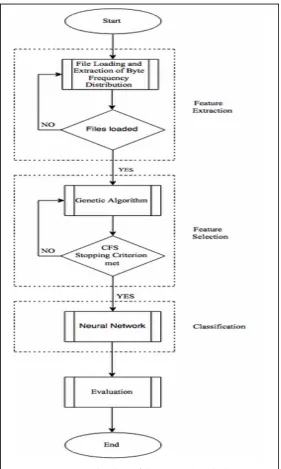
In modern world, the use of digital devices for leisure or professional reasons is growing quickly; nevertheless, criminals try to fool authorities and hide evidence in a computer by changing the file type. File type detection is a very demanding task for a digital forensic examiner. In this paper, a new methodology is proposed – in a digital forensics perspective- to identify altered file types with high accuracy by employing computational intelligence techniques. The proposed methodology is applied to the three most common image file types (jpg, png and gif) as well as to uncompressed tiff images. A three-stage process involving feature extraction (Byte Frequency Distribution), feature selection (genetic algorithm) and classification (neural network) is proposed. Experimental results were conducted having files altered in a digital forensics perspective and the results are presented. The proposed model shows very high and exceptional accuracy in file type identification.
Keywords:
digital forensics, file type identification, computational intelligence, genetic
algorithm, neural network, data integrity
INTRODUCTION
Digital forensics is a relatively new field in Computer Science and focuses on the acquisition, preservation and analysis of digital evidence. Palmer defined digital forensics as “the use of scientifically derived and proven methods toward the preservation, collection, validation, identification, analysis, interpretation, documentation, and presentation of digital evidence derived from digital sources for the purpose of facilitation or furthering the reconstruction of events found to be criminal, or helping to anticipate unauthorized actions shown to be disruptive to
fastest and easiest method of file type detection is the extension-based method.
The main advantage of this method is the speed of file type detection. In the extension based method there is no need to open the file in order to determine the file type. Nevertheless, it has great vulnerability while it can be easily fooled by a simple extension renaming. As soon as a forensic program perceives such a deception, it will immediately highlight an extension mismatch. This method is a common concept in Windows operating systems. In other operating systems such as Linux based ones, the issue of the file command shows information about the type of a file. The second method of file type detection is based on the magic bytes. Magic bytes are predefined signatures and they can be found on file’s header. There are several thousand’s file types for which magic bytes are defined and listed (Kessler, 2015) and there are multiple lists of magic bytes that are not completely consistent. Checking the magic bytes of a file is indeed a much slower method than just checking its extension since the file should be opened and its magic bytes should be read and compared with the predefined ones. One major drawback of this method is the lack of a predefined standard for the developers, so the magic bytes are not used in all file types. Moreover, magic bytes only work on the binary files and predefined signatures differ in length for unlike file types. When a digital media with files of amended signature is attached, the forensic software will indicate the deception and suggest the forensic analyst the true file type. The third method of file type detection is the examination of file contents and the use of statistical modeling techniques to achieve detection. It is a new and promising research area and it is likely the only way to determine the bogus file types. McDaniel and Heydari (McDaniel, 2001), (McDaniel & Heydari, 2003) were the first who actually suggested a way for
Support Vector Machine classifier and finally succeeded in raising the accuracy of the method to 99.16%. Finally, Evensen et al. (Evensen, Lindahl, & Goodwin, 2014) used an n-gram analysis with naïve Bayes classifier to a large dataset of 60000 files (6 file types) with very good results achieving 99.51% topmost. The above papers refer to identification of whole files. Moreover, methods for identifying types of fragments are also proposed by scientists and both (whole files and fragments) are documented in detail (Karampidis, Papadourakis, & Deligiannis, 2015). The above methods showed poor to good results in file type identification, but the real problem during a forensic examination relies on the modification of file’s signature and its extension at the same time. When this occurs the majority – if not all- of the forensic software cannot identify correctly the file type. In this paper, a new methodology is proposed for file type identification using computational intelligence techniques in order to identify the correct file type if the file is altered, i.e. both file’s extension and magic bytes are altered. The paper is organized as follows: In Section 2 the proposed methodology is described, then in Section 3 a large dataset is utilized and the experimental results are presented followed by conclusions.
METHODOLOGY OF
THE PROPOSED
METHOD
As a search method, a genetic algorithm was used. The idea of using a genetic algorithm, for feature extraction is not new (Vafaie & Jong, 1992), (Zhuo Li, Zheng Jing, Wang Fang, Li Xia, Ai Bin, 2008), (Jourdan, Dhaenens, & Talbi, 2001) since they can provide candidate solutions. Each candidate solution (chromosome) is represented by a binary feature vector of dimension 256, where zero (0) indicates that the respective feature is
candidate’s solution merit. Let S be a candidate solution consisting of k features. The merit of each candidate solution is calculated by equation 1.
Meritsk= (1)
where:
is the average value of all feature-classification correlations and
is the average value of all feature-feature correlations.
CFS stops when five consecutive fully expanded candidate solutions show no improvement (MA Hall, 1999). The utilization of the genetic algorithm as a search method and CFS as an evaluator, led to the reduction of the 256 extracted features to 44. The third and final stage is classification, which was performed with a one hidden layer neural network using the backpropagation algorithm. A neural network with one hidden layer was also used by Harris (Harris, 2007) in order to identify file types. Initially, the data are separated into a training set (70%) and a test set (30%).
Furthermore, in order to estimate the accuracy of classification during the training phase a stratified 10 fold cross validation is used (Kohavi, 1995). Subsequently, unseen instances from all categories are presented to the model for evaluation.
EXPERIMENTAL
SETUP AND RESULTS
Due to thousands of known file types, this research has focused only in images and portable documents, because of their significance to Digital Forensics. In particular, this research only included jpeg png, gif (not animated), tiff and pdf files. Furthermore, only
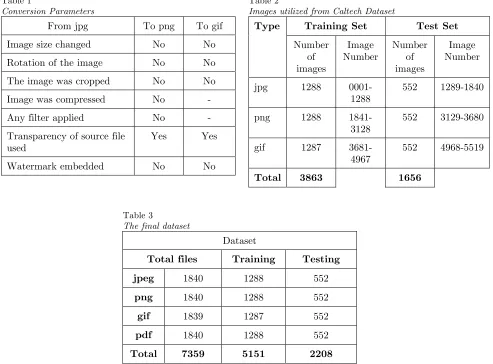
whole files and not fragments were examined. Caltech 101 (Fei-Fei, Fergus, & Perona, 2007) was used as dataset. It is a dataset made by Caltech University containing 9144 images in jpeg format from 101 categories. These images are in 101 subfolders each one representing one category; therefore, the images were extracted to a single folder. From this jpeg dataset, 5519 images were utilized. Afterwards, these images were renamed (image 0001 to image 5519) and one third of them were converted to png format and a similar number to gif format. Total Image Converter (CoolUtils, 2017) -free trial version- was used, in order to convert those files. There were no alterations to converted files regarding size, rotation, crop, further compression, filtering, transparency or watermark embedded. Table 1 shows the conversion parameters used.
Table 1
Conversion Parameters
From jpg To png To gif
Image size changed No No
Rotation of the image No No
The image was cropped No No
Image was compressed No -
Any filter applied No -
Transparency of source file used
Yes Yes
Watermark embedded No No
Table 2
Images utilized from Caltech Dataset
Type Training Set Test Set
Number of images Image Number Number of images Image Number
jpg 1288 0001-1288
552 1289-1840
png 1288 1841-3128
552 3129-3680
gif 1287
3681-4967
552 4968-5519
Total 3863 1656
Table 3
The final dataset
Dataset
Total files Training Testing
jpeg 1840 1288 552
png 1840 1288 552
gif 1839 1287 552
pdf 1840 1288 552
Total 7359 5151 2208
More specifically, the extension of 168 jpeg images was changed from .jpg to .pdf. Also with a hex editor the signature of each jpeg image was also changed. The same procedure was performed to png and gif images and therefore three new test sets were created. The first contained 168 altered files of jpeg format, the second contained 168 files of png format and the third contained 168 files of gif format. Table 4 shows the changes made to the 168 files in each new test set.
A script written in MATLAB® (The MathWorks Inc., 2016) was implemented to create the BFD containing 256 features. Waikato Environment for Knowledge Analysis (Weka) (Mark Hall et al., 2009), a popular machine learning software developed at the
the four possible categories; namely jpeg, png, gif, and pdf. The learning rate was set to 0.3 and in order to avoid local minimum and to accelerate the learning process, the momentum parameter was set to 0.2. The training time (epochs) after experimentation was set to 500. When the training of the neural network was completed the three test sets described previously were evaluated and the results are shown in Tables 5, 6, and 7.
Table 4
Changes made to image files
From To
Extension Signature Extension Signature
jpg FF D8 FF
E0 xx xx 4A 46 49 46 00
pdf 25 50
44 46
png 89 50 4E
47 0D 0A 1A 0A
pdf 25 50
44 46
gif 47 49 46
38 37 61
pdf 25 50
44 46
Table 5
Confusion matrix – Identifying forged jpg images
Test set Classified as
Image Type jpg pdf png gif
jpg 552 0 0 0
pdf (168 jpg) 171 377 2 2
png 0 3 548 1
gif 0 1 7 544
Table 6
Confusion matrix – Identifying forged png images
Test set Classified as
Image Type jpg pdf png gif
jpg 552 0 0 0
pdf (168 png) 3 379 168 2
png 0 3 548 1
Table 7
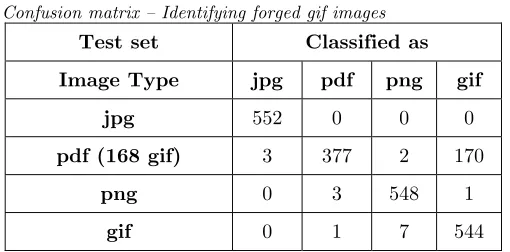
Confusion matrix – Identifying forged gif images
Test set Classified as
Image Type jpg pdf png gif
jpg 552 0 0 0
pdf (168 gif) 3 377 2 170
png 0 3 548 1
gif 0 1 7 544
Table 5 shows the confusion matrix when the neural network tried to identify forged jpg images (168). When the output of the neural network were compared to the testing dataset, the “misclassified” files were the altered jpg images. The accuracy of the proposed method to altered jpg images was 100%. Table 6 shows the confusion matrix when the neural network tried to identify forged png images (168) and 166 out of 168 images were detected. Two png images were wrongly identified as pdf files. In the two misclassified png images there were large areas of a specific color or small variations of a color. Small variations of a color
can be found also on pdf files, which led to misclassification of the images. Therefore 2 out of 168 png altered files were not predicted correctly. The accuracy of the proposed method to altered png images was 98.81%. Table 7 shows the confusion matrix when the neural network tried to identify forged gif images (168). The “misclassified” files were the altered gif images, thus the accuracy of the proposed method in this case was 100%. The accuracy results for the altered images (jpg, png, gif) of the proposed method are summarized in Table 8.
Table 8
Final Confusion Matrix of the proposed method
168 Forged Files Classified as
Actual Type jpg pdf png gif
jpg 168 0 0 0
png 0 2 166 0
gif 0 0 0 168
The above results showed that a very simple neural network achieved excellent results so a traditional clustering method such as the k-means algorithm was implemented in order to examine its accuracy. The k-means algorithm was implemented in Weka and the three test sets were clustered into four categories. The algorithm first computed randomly the initial centers of the four clusters, then assigned every instance of the
Table 9
Results of the k-means algorithm
Altered Type (168 altered files)
Clustered as
jpg pdf png gif
jpg 1 99 0 68
png 4 84 72 8
gif 30 3 1 134
The accuracy of the k-means algorithm to altered jpg images was 0,006%, to altered png images 42,85% and to gif images 79,76%. The clustering method failed to identify correctly the exact type of the altered files.
Moreover, in order to ensure that the proposed model had not learned to detect the software used (Total Image Converter) when converting jpg images to gif and png format, we repeated the experiment using this time
Pixillion (NCH Software, 2017) (free version) another popular converter. Again, no alterations made to the converted images regarding size, crop, filtering or embedding watermark. The same procedure was repeated to create the final dataset, a new classification model was trained again and the resulted confusion matrix when the unseen instances from the three test sets with the forged files was presented to the model is shown in Table 10.
Table 10
Confusion Matrix of the proposed method
168 Forged Files Classified as
Actual Type jpg pdf png gif
jpg 168 0 0 0
png 0 8 160 0
gif 0 0 0 168
Comparing the two confusion, matrices i.e. Table 8 and Table 10, it is obvious that the proposed model shows extremely high accuracy, regardless the software used to convert jpg images to png and gif format.
The proposed method identified with high accuracy images (jpg,png,gif) which are the most common in digital mediums (e.g. computer, tablet, smartphones etc.). Although tiff images are not widely used and by a digital forensics viewpoint are not frequently met, it
Confusion matrix – Identifying forged tiff images
Test set Classified as
Image Type jpg pdf png tiff
jpg 552 0 0 0
pdf (168 tiff) 3 367 9 173
png 0 3 545 4
tiff 4 4 4 540
Only three altered tiff images were misclassified. Two of them were classified as png images and one as pdf file. Images which misclassified as png, had high color depth and this led to misclassification. The image which misclassified as pdf, had large areas of a specific color, something also found on pdf files. Thus, the accuracy of the proposed method in uncompressed tiff images was 98.21%.
CONCLUSIONS
In this paper, a new methodology was proposed – in a digital forensics perspective- to identify altered file types with high accuracy by employing computational intelligence techniques. The proposed methodology was applied to the three most common image file types (jpg, png and gif) as well as to uncompressed tiff images. A three-stage process involving feature extraction (BFD), feature selection (genetic algorithm), and classification (neural network) was proposed. Experimental results were conducted having files altered in a digital forensics perspective. The accuracy of the proposed method to altered jpg images and to gif images was 100%, to altered png images was 98,81% and to altered tiff images was 98,21%. An attempt to replace the neural network with the traditional k-means clustering algorithm in the proposed methodology gave poor results. Experiments also were conducted regarding the scenario the proposed model learned to detect specific converter and the results were promising again.
REFERENCES
Ahmed, I., Lhee, K., Shin, H., & Hong, M.(2010). Content-based File-type Identification Using Cosine Similarity and a Divide-and-Conquer Approach. IETE
Technical Review, 27(6), 465.
https://doi.org/10.4103/0256-4602.67149 Ahmed, I., Lhee, K., Shin, H., & Hong, M.
(2011). Fast content-based file-type identification. In 7th Annual IFIP WG 11.9 International Conference on Digital
Forensics (pp. 65–75). Springer Boston.
https://doi.org/10.1007/978-3-642-24212-0_5
Amirani, M. C., Toorani, M., & Mihandoost, S. (2013). Feature-based Type Identification of File Fragments. Security and Communication Networks, 6(1), 115–
128. https://doi.org/10.1002/sec.553
Amirani, M. C., Toorani, M., & Shirazi, a. a B. (2008). A new approach to content-based file type detection. In IEEE Symposium on Computers and
Communications (pp. 1103–1108).
https://doi.org/10.1109/ISCC.2008.462561 1
Cao, D., Luo, J., Yin, M., & Yang, H. (2010). Feature selection based file type identification algorithm. In 2010 IEEE International Conference on Intelligent Computing and Intelligent Systems (Vol. 3,
pp. 58–62). IEEE. https://doi.org/10.1109/ICICISYS.2010.56
58559
CoolUtils. (2017). Powerful Image Converter Yet Easy-to-use. Retrieved from https://www.coolutils.com/TotalImageCon verter
Dunham, J., Sun, M., & Tseng, J. (2005). Classifying file type of stream ciphers in depth using neural networks. In The 3rd
ACS/IEEE International Conference on
Computer Systems and Applications.
Retrieved from http://ieeexplore.ieee.org/xpls/abs_all.jsp?
arnumber=1387088
Evensen, J. D., Lindahl, S., & Goodwin, M. (2014). File-type Detection Using Naïve Bayes and n-gram Analysis. Norwegian
Information Security Conference, NISK.
Fredrikstad. Retrieved from http://ojs.bibsys.no/index.php/NISK/articl
e/view/99
Fei-Fei, L., Fergus, R., & Perona, P. (2007). Learning generative visual models from few training examples: An incremental Bayesian approach tested on 101 object categories. Computer Vision and Image
Understanding, 106(1), 59–70.
https://doi.org/10.1016/j.cviu.2005.09.012 Goldberg, D. E. (1989). Genetic Algorithms in
Search, Optimization and Machine Learning. Retrieved from http://dl.acm.org/citation.cfm?id=534133
Hall, M. (1999). Correlation-based feature
selection for machine learning. The
University of Waicato. Retrieved from http://www.cs.waikato.ac.nz/~mhall/thesis .pdf
Hall, M., Frank, E., Holmes, G., Pfahringer, B., Reutemann, P., & Witten, I. H. (2009). The WEKA data mining software. ACM SIGKDD Explorations Newsletter, 11(1),
10.
https://doi.org/10.1145/1656274.1656278 Harris, R. (2007). Using artificial neural
networks for forensic file type identification. Master’s Thesis, Purdue
University. Retrieved from
Jourdan, L., Dhaenens, C., & Talbi, E. (2001). A genetic algorithm for feature selection in data-mining for genetics. In Proceedings of the 4th Metaheuristics International
Conference. Retrieved from
ftp://155.253.6.100/acalabria/PhD/Materi ale/MachineLearning/Jourdan 2001 - A Genetic Algorithm for Feature Selection in Data-Mining for Genetics.pdf
Karampidis, K., Papadourakis, G., & Deligiannis, I. (2015). File Type Identification -A Literature Review. In 9th International Conference on New Horizons in Industry Business and Education,
NHIBE 2015 (p. 141). Skiathos, Greece:
9th International Conference on New Horizons in Industry Business and Education. Retrieved from
http://nhibe2015.vs-net.eu/proceedings/papers/3_15_[P]0076.p df
Kessler, G. (2015). File Signatures. Retrieved October 26, 2015, from http://www.garykessler.net/library/file_si
gs.html
Kohavi, R. (1995). A Study of Cross-Validation and Bootstrap for Accuracy Estimation and Model Selection.
International Joint Conference on Artificial Intelligence, 14(12), 1137–1143.
https://doi.org/10.1067/mod.2000.109031 Li, W. J., Wang, K., Stolfo, S. J., & Herzog, B.
(2005). Fileprints: Identifying file types by n-gram analysis. Proceedings from the 6th Annual IEEE System, Man and Cybernetics Information Assurance
Workshop, SMC 2005, 2005(June), 64–71.
https://doi.org/10.1109/IAW.2005.1495935 McDaniel, M. (2001). Automatic File Type
Detection Algorithm. James Madison
University.
McDaniel, M., & Heydari, M. H. (2003). Content based file type detection algorithms. 36th Annual Hawaii International Conference on System
Sciences, 2003. Proceedings of the.
https://doi.org/10.1109/HICSS.2003.11749 05
Meghanathan, Boumerdassi, S., Chaki, N., & Dhinaharan Nagamalai. (2010). Recent Trends in Network Security and Applications (Vol. 89, pp. 253–262). Berlin, Heidelberg: Springer Berlin Heidelberg. https://doi.org/10.1007/978-3-642-14478-3 NCH Software. (2017). Convert Between All
Popular Image Formats with Pixillion.
Retrieved from http://www.nchsoftware.com/imageconvert
er/
Palmer, G. (2001). A Road Map for Digital Forensic Research. Proceedings of the 2001 Digital Forensics Research Workshop
(DFRWS 2004).
https://doi.org/10.1111/j.1365-2656.2005.01025.x
T.E.I of Crete. (2015). E-Thesis. Retrieved October 26, 2015, from http://nefeli.lib.teicrete.gr/search/
The MathWorks Inc. (2016). MATLAB. Natick, Massachusetts: The MathWorks
Inc. Retrieved from http://www.mathworks.com/
Vafaie, H., & Jong, K. De. (1992). Genetic Algorithms as a Tool for Feature Selection in Machine Learning. In International
Conference on Tools with AI (pp. 200–
203).
https://doi.org/10.1109/TAI.1992.246402 Zhuo Li, Zheng Jing, Wang Fang, Li Xia, Ai
Bin, Q. J. (2008). A genetic algorithm based wrapper feature selection method for classification of hyper spectral data using
GEOGRAPHICAL RESEARCH, 27(3),
493–501.