Available online on 15.03.2019 at http://jddtonline.info
Journal of Drug Delivery and Therapeutics
Open Access to Pharmaceutical and Medical Research© 2011-18, publisher and licensee JDDT, This is an Open Access article which permits unrestricted non-commercial use, provided the original work is properly cited
Open Access
Research Article
Design, development and optimization of immediate release tablet of
deflazacort
Raina Binu 1*, Shrivastava Birendra 2, Bhargava Anurag 1, Sharma Shailesh 3, Sharma Abhimanyu Rai 1, Bajwa Prabhjot Singh1
1 Ch. Devi Lal College of Pharmacy, Jagadhri, Yamuna Nagar, Haryana, India
2 School of Pharmaceutical Sciences, Jaipur National University, Jaipur, Rajasthan, India,
3 Department of Pharmaceutics, Amar Shaheed Baba Ajit Singh Jujhar Singh Memorial College of Pharmacy, Bela, Punjab, India
ABSTRACT
The objective of the present study was to prepare immediate release tablets (IRTs) of deflazacort by direct compression method. Two types of superdisintegrants i.e. sodium starch glycolate (SSG) and Ac-Di-sol were used in the formulation of tablets. Twelve preliminary batches were prepared by varying the concentration of superdisintegrants. It was found that formulation containing Ac-Di-Sol disintegrated in less time as compared to formulation containing sodium starch glycolate. Values of friability was found to be more in case of formulation containing Ac-Di-Sol. Attempts were also made to prepare the tablets containing superdisintegrants in combination and these resulted in the formulation with improved values of disintegration time and friability. On the basis of preliminary studies optimization of IRT was done employing 32 full factorial design using design expert 7. The optimized batch of IRTs showed friability and disintegration time values of 0.598 and 64.17±3.50 respectively. It was also found that 96.26±1.82% of drug was released within 5 min.
Keywords: Immediate release tablets, deflazacort, Rheumatoid arthritis, Sodium starch glycolate, Ac-Di-Sol, 32 full factorial design
Article Info:Received 31 Jan 2019; Review Completed 04 March 2019; Accepted 09 March 2019; Available online 15 March 2019 Cite this article as:
Raina B, Shrivastava B, Bhargava A, Sharma S, Sharma AR, Bajwa PS, Design, development and optimization of immediate release tablet of deflazacort, Journal of Drug Delivery and Therapeutics. 2019; 9(2):250-254
http://dx.doi.org/10.22270/jddt.v9i2.2411
*Address for Correspondence:
Binu Raina, Ch. Devi Lal College of Pharmacy, Jagadhri, Yamuna Nagar, Haryana, India E-mail: [email protected]
INTRODUCTION
Oral route is the preferred route of administration for administering therapeutic agents. Rate of absorption of drug is controlled by rate of dissolution. Rate of dissolution can be increased by various methods. In present study IRTs were formulated that disintegrate in less time delivering fine suspension of particles of drug with large surface area, resulting in increased rate of dissolution1. Deflazacort was
chosen as the model drug. Solubility of deflazacort is low thus making its dissolution controlled by disintegration. Deflazacort is a corticosteroid which is an oxazoline derivative of prednisolone, characterized by a high binding affinity to tissue glucocorticoid receptors and exert anti-inflammatory and immunosuppressive effects. Deflazacort significantly inhibits both the proliferation of mononuclear cells derived from human peripheral blood, and the release of inflammatory cytokines by these cells. Thus deflazacort is rapidly effective in symptoms and objective indices of disease activity in rheumatoid arthritis2. RA is a chronic
disorder in which, the body's own immune system starts to attack body tissues, reasons of which are unknown. This disorder is accompanied with swelling, stiffness and pain. In
this disorder the attack is not only directed at the joint but to many other parts of the body. In RA, the joint lining and cartilage gets more damaged which eventually results in erosion of two opposing bones. Based on the studies, it has been reported that deflazacort could be used in treatment of RA. It is as efficacious as prednisolone with less adverse effects as compared to other corticosteroids3.
In the formulation of immediate release tablets basic approach is to use superdisintegrants. In the present study two types of superdisintegrants (sodium starch glycolate and
Ac-Di-Sol) were used. Concentration of both
superdisintegrants was optimized by employing 32 full
factorial design.
MATERIALS AND METHOD Materials
Methods
Preparation of immediate release tablets
Based on composition of deflazacort IRT tablets with deflazacort IRT tablet depicted in table 1 6mg deflazacort and excipients (except the lubricant; magnesium stearate and glidant ; talc) were physically mixed by geometric
mixing. Powdered mixture was passed through 60 # sieve and blended properly using a mortar and pestle. The resultant blend was lubricated with the addition of lubricant and glidant and finally compressed into tablets (30 mg) using 3 mm round flat punches. Machine settings were adjusted to get the desired hardness value, which gave an intact tablet.
Table 1: Composition of preliminary trial batches of immediate release tablets Ingredients
(mg) F1 F2 F3 F4 F5 Formulation Code F6 F7 F8 F9 F10 F11 F12
Deflazacort 6 6 6 6 6 6 6 6 6 6 6 6
SSG 0.6 1.201 1.802 2.403 - - - - 0.6 0.6 1.802 2.40
Ac-Di-Sol - - - - 0.6 1.201 1.802 2.403 0.6 1.802 0.6 2.40
Talc 0.6 0.6 0.6 0.6 0.6 0.6 0.6 0.6 0.6 0.6 0.6 0.6
Mag. stearate 0.3 0.3 0.3 0.3 0.3 0.3 0.3 0.3 0.3 0.3 0.3 0.3
Avicel pH101 22.5 21.99 21.39 20.79 22.5 21.89 21.29 20.697 21.9 20.69 20.69 18.29
Evaluation
The prepared immediate release tablets were evaluated for weight variation and thickness. Using micrometer thickness was determined for twenty tablets4. Weight variation of
prepared tablets was determined as per USP5 by taking
twenty tablets and comparing average weight with the individual weight of tablets. Hardness of ten tablets6 from
each batch was determined using pfizer hardness tester and Friability of all batches of IRT was determined as per USP7
using Roche friabilator. Sample of whole tablets corresponding to about 6.5 g was placed in the friabilator and were subjected to 100 revolutions.
The prepared IRTs were subjected to assessment of in-vitro
disintegration time using USP-27/NF-22 disintegration test
apparatus8. Drug content of prepared IRTs were carried out
by crushing ten tablets in a glass mortar and transferred quantitatively with methanol in a stoppered conical flask. The flask was placed in a sonicator for 30 min. The mixture was filtered and an aliquot, following suitable dilution, was
analyzed at 242 nm using a UV spectrophotometer9.
In vitro release study
The dissolution studies of prepared IRTs were carried out using USP type II dissolution test apparatus10. The tablets
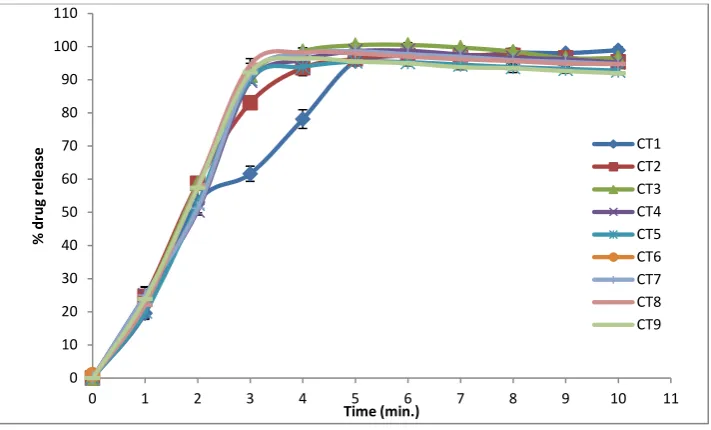
were placed in dissolution vessel containing 900 ml of phosphate buffer pH 6.8 maintained at 37ºC ± 0.5 and stirred at 75 rpm. Samples (6 ml) were collected periodically at different time intervals (1, 2, 4, 6, 8, 10, 15, 20, 25, 30 min) and replaced with fresh dissolution medium. The absorbance was determined spectrophotometrically at 242 nm. Dissolution profiles were constructed as shown in Fig. 1 Concentrations were calculated using calibration curves developed in respective media.
Experimental design
A two factor, three level (32) FFD was used in the
optimization of IRTs of deflazacort. The study design involved the investigation of the effect of independent variables i.e. concentration of Sodium starch glycolate (X1)
and concentration of Ac Di Sol (X2) on the dependent
variables such as disintegration time, and friability. The levels of the factors study was selected on the basis of preliminary studies. Concentration of sodium starch glycolate (2, 4, 6%) and Ac-Di-Sol (6, 7, 8%) were selected as independent factors X1 and X2 respectively. Combination of
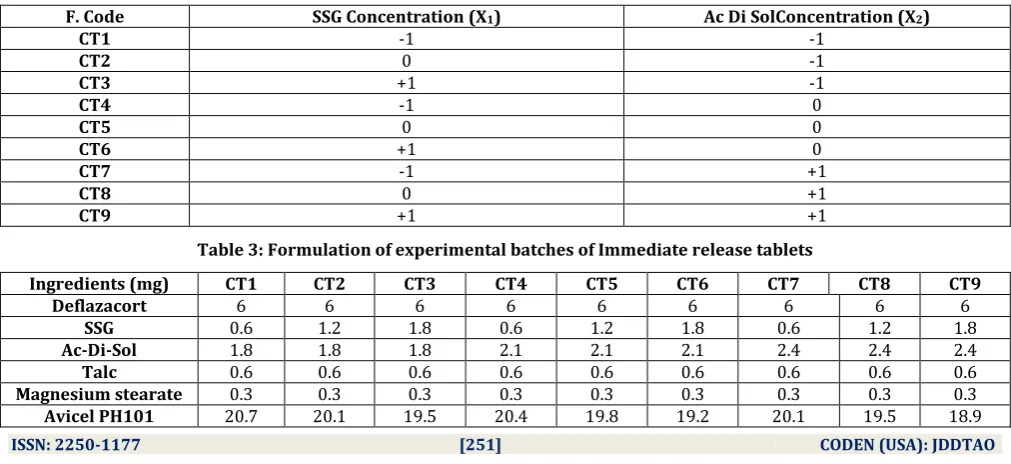
these trials is represented in table 2. Nine formulations (Table 3) were prepared according to experimental design.
Table 2: Experimental plan of 32 full factorial design
F. Code SSG Concentration (X1) Ac Di SolConcentration (X2)
CT1 -1 -1
CT2 0 -1
CT3 +1 -1
CT4 -1 0
CT5 0 0
CT6 +1 0
CT7 -1 +1
CT8 0 +1
CT9 +1 +1
Table 3: Formulation of experimental batches of Immediate release tablets
Ingredients (mg) CT1 CT2 CT3 CT4 CT5 CT6 CT7 CT8 CT9
Deflazacort 6 6 6 6 6 6 6 6 6
SSG 0.6 1.2 1.8 0.6 1.2 1.8 0.6 1.2 1.8
Ac-Di-Sol 1.8 1.8 1.8 2.1 2.1 2.1 2.4 2.4 2.4
Talc 0.6 0.6 0.6 0.6 0.6 0.6 0.6 0.6 0.6
Magnesium stearate 0.3 0.3 0.3 0.3 0.3 0.3 0.3 0.3 0.3
Optimization of IRT
The optimization process was used to obtain a model equation (Y = B0 + B1X1 + B2 X2 + B3 X1 X2 + B4 X12 + B5
X22) that provides a means of evaluating changes in
response due to changes in the independent variable levels. After application of full factorial design and with help of
polynomial terms the optimized tablet (C1) was produced.
Tablets were prepared as per composition given in table 4. This batch targeted to the friability 0.566 and disintegration time of 63.773 s. The observed response for friability and disintegration time were 0.598 and 64.167±3.502 respectively.
Table 4: Composition of optimum batch (C1) of immediate release tablet
Batch Deflazacort SSG Ac-Di-Sol Talc Magnesium stearate Avicel pH101
C1 6 1.8 1.974 0.6 0.3 19.36
Stability studies
To assess the stability of formulation, the optimum IRTs were packed in an amber colored air tight vial and stored at (40 ± 2 °C and 75 ± 5% RH) for a period of 6 months. The tablets were withdrawn after a particular period of time, analyzed for physical appearance, weight, hardness, friability, disintegration time, drug content, and % drug release. At this point, the data was statistically analyzed using ANOVA to test the significance of difference at the level of significance 0.05.
RESULTS AND DISCUSSION
Evaluation of preliminary FDT batches and experimental batches
Preliminary batches of IRT of deflazacort were prepared by direct compression method employing sodium starch glycolate and Ac-Di-Sol as superdisintegrants. Directly compressible Avicel PH 101, was used as diluent. A total of twelve formulations were designed, in formulation F1-F4 and F5-F8 varying concentration of sodium starch glycolate and Ac-Di-Sol were incorporated respectively. F9-F12 formulations were prepared, containing both sodium starch
glycolate and Ac-Di-Sol in different concentrations. Low Hausner’s ratio (≤ 1.32), compressibility index (≤ 24.68) and angle of repose (≤ 18.13) values indicated a fairly good flow ability of powder mixture as per Setty et al. 200811. All the
formulations exhibited uniform weight, as per USP5 with low
standard deviation values, indicating the uniformity of the tablets prepared by direct compression method. Average tablet thickness was found to be within limits (± 5%) (Banker et al. 198712 and Beringer et al. 200513). The %
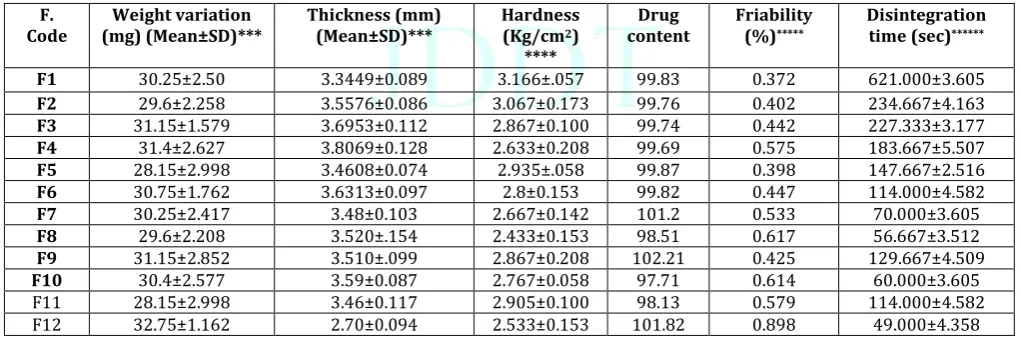
friability of all the formulations was found to be 0.372–0.898. Results of preliminary batch are shown in Table 5.
On the basis of preliminary studies it was found that with increase in concentration of SSG and Ac-Di-Sol tablets disintegrated in less time and value of friability increased. Disintegration time of tablets containing SSG was more as compared to tablets containing Ac-Di-Sol, whereas friability value was more in case of tablets containing Ac-Di-Sol. Thus based on this study both SSG and Ac-Di-Sol were used together for further studies. Drug content of randomly selected ten tablets were determined and it was found that obtained values were within the limits as per USP. Obtained data for experimental batch was found to be between 97.34-103.17%.
Table 5: Characterization of preliminary batch of compressed immediate release tablets F.
Code (mg) (Mean±SD)*** Weight variation Thickness (mm) (Mean±SD)*** Hardness (Kg/cm2) ****
Drug
content Friability (%)*****
Disintegration time (sec)******
F1 30.25±2.50 3.3449±0.089 3.166±.057 99.83 0.372 621.000±3.605
F2 29.6±2.258 3.5576±0.086 3.067±0.173 99.76 0.402 234.667±4.163
F3 31.15±1.579 3.6953±0.112 2.867±0.100 99.74 0.442 227.333±3.177
F4 31.4±2.627 3.8069±0.128 2.633±0.208 99.69 0.575 183.667±5.507
F5 28.15±2.998 3.4608±0.074 2.935±.058 99.87 0.398 147.667±2.516
F6 30.75±1.762 3.6313±0.097 2.8±0.153 99.82 0.447 114.000±4.582
F7 30.25±2.417 3.48±0.103 2.667±0.142 101.2 0.533 70.000±3.605
F8 29.6±2.208 3.520±.154 2.433±0.153 98.51 0.617 56.667±3.512
F9 31.15±2.852 3.510±.099 2.867±0.208 102.21 0.425 129.667±4.509
F10 30.4±2.577 3.59±0.087 2.767±0.058 97.71 0.614 60.000±3.605
F11 28.15±2.998 3.46±0.117 2.905±0.100 98.13 0.579 114.000±4.582
F12 32.75±1.162 2.70±0.094 2.533±0.153 101.82 0.898 49.000±4.358
*** Each value is average of twenty independent determinations; **** Each value is average of ten independent determinations, *****Each value is average of 216 tablets, ****** Each value is average of six independent determinations.
Statistical and response surface analysis of models
Statistical analysis
It was found there was a wide variation in the values of disintegration time and friability with change in concentration of two factors. Table 6describes the effect of SSG concentrations (2, 4, and 6%) and Ac-Di-Sol concentrations (6, 7 and 8%) on the characteristics of IRT. Results showed that with increase in concentration of SSG
and Ac-Di-Sol disintegration time decreased (Patel et al.,
2015)14. The formulation (CT1-CT4) showed unaccepted
increase in disintegration time (106, 92, 78 and 87 s respectively), that exceeded the limits specified for IRTs, which is less than 75 s (Dobetti 2012)15
The in vitro drug release data of prepared IRTs is depicted graphically in fig.1. According to the dissolution profile it was found that the entire batches released drug within 10 min.
Percentage of drug released from all the formulation varied between 95.48-98.86% within 10 min.
Figure 1: Percent released of Deflazacort from compressed immediate release tablets.
Table 6: Effect of superdisintegrant concentration on the characteristics of the prepared immediate release tablet formulations of experimental batch
F. Code Sodium starch glycolate (% w/w)
Ac-Di-Sol
(% w/w) Hardness(Kg/cm2)****
Disintegration
Time (s)****** Friability***** (%)
CT1 2 6 2.8±0.1 106±0.058 0.436
CT2 4 6 3.01±0.1 92±1.53 0.484
CT3 6 6 3.1±0.15 78±1.15 0.502
CT4 2 7 2.67±0.05 87±1 0.492
CT5 4 7 2.82±0.05 69±1.15 0.574
CT6 6 7 2.8±0.1 53±0.58 0.592
CT7 2 8 2.57±0.15 65±1.53 0.586
CT8 4 8 2.5±0.1 52±1 0.613
CT9 6 8 2.43±0.05 39±058 0.798
**** Each value is average of ten independent determinations; *****Each value is average of two hundred sixteen tablets;****** Each value is average of six independent determinations
Optimization
Optimization was done employing a 32 FFD. The
dependent and independent variables were related using quadratic equations obtained with the Design Expert software (Version 7). For each dependent variable, a summarizing equation was generated as shown in Table 7. ANOVA was performed to identify insignificant factors. Model selection was based on lower p values than assigned significance level, high F value i.e. 9.68 and 132.42, absence of lack of fit, highest level of adjusted R2 and predicted
R2, low standard deviation and lower PRESS value. All values
are represented in Table 8. F-value of 9.68 in case of friability and 132.42 in case of disintegration time, implies the model is significant. High values of R2 for all dependent variables
were obtained, which indicate a good fit. Adj-R2 and Pred-R2
values for all responses were in reasonable agreement, signifying good model fit. Further, the adequate precision value greater than four indicated adequate model discrimination. Values of p less than 0.05 indicated that model terms are significant.
Table7: The quadratic equations relating friability and disintegration time with independent variables in IRTs tablets.
Response Experimental Parameters
β0 β1 β2 β3 β4 β5
Friability 0.55 0.063 0.096 0.037 0.011 0.07
Disintegration Time 69.44 -14.67 -20.00 0.50 0.33 2.33
Table 8: ANOVA results of full and reduced model for core tablets
Measured Response SS DF MS F-Value Prob > F SD R2
Friability 0.085 5 0.017013 9.68 0.0454 0.042 0.9416
Disintegration time 3702.78 5 740.56 132.42 0.0010 2.36 0.9955
DF-Degree of freedom; MS-Mean of squares; SS-Sum of squares
0 10 20 30 40 50 60 70 80 90 100 110
0 1 2 3 4 5 6 7 8 9 10 11
%
dr
ug
r
e
le
ase
Time (min.)
Response surface analysis
Response surface plots were generated for each response to study the behavior of the system. Response surface plot for
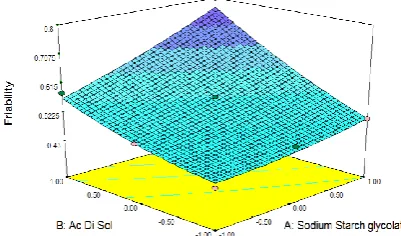
friability in Fig. 2 shows that with the increase in
the concentration of SSG and Ac-Di-Sol the friability value of the tablet also increases in a linear manner. In case of disintegration time Response surface plot (Fig. 3) shows that with the increase in the concentration of SSG and Ac-Di-Sol the disintegration time decreased in a linear manner.
Figure 2: Response surface graph showing the influence of X1 and X2 on the friability of immediate release tablets
of deflazacort
Figure 3: Response surface graph showing the influence of X1 and X2 on the disintegration time of immediate
release tablet of deflazacort Stability studies
Accelerated stability studies on the optimized promising formulation were carried out by storing the tablet at 40 ± 2 °C and 75 ± 5% RH for 3 months. At regular intervals, the formulation was characterized for weight, hardness, disintegration time, friability and drug content. It is found that there was no change in physical appearance, and other tablet characteristics during the study period and at the end of the 3 months. Also, no significant change was shown in the percent drug release. From the statistical analysis, it was found that there was no significant difference between before and after storage (P < 0.05). The similarity factor f2 was calculated to compare the dissolution profiles of optimized formulation before and after storage and it was found to be 84 which is more than 50 indicating similarity between the dissolution profile before and after storage.
Thus, results imply good stability of the formulation on 3-month storage.
CONCLUSION
It can be concluded from the present study that using appropriate concentration of superdisintegrant SSG and Ac-Di-Sol IRT can be formulated with acceptable values of
disintegration time and friability. Addition of
superdisintegrating agent resulted in development of a formulation with lesser disintegration time. It was also found that above 90% of drug was released within 5 min. due to quick disintegration of the tablet. Thus the present investigation concluded that it is possible to formulate IRT with acceptable physical characteristics having less disintegration time and could be used to provide immediate relief from the pain and stiffness that occurs in RA.
Acknowledgement: The authors thank management, Ch. Devilal College of pharmacy for providing the facilities
Conflict of interest:All authors declare that they have no conflict of interest.
REFERENCES
1. Setty CM, Prasad DVK, Gupta VRM, Sa B. Development of fast dispersible aceclofenac tablets: effect of functionality of superdisintegrants. Indian J Pharm Sci. 2008; 70(2):180-184 2. Gray RES, Doherty SM, Galloway J, Coulton L, Broe MD, Kani JA. A
double-blind study of deflazacort and prednisone in patients with chronic inflammatory disorders. Arthritis Rheum. 1991; 34(3).
3. Reid IR. Glucocorticoid osteoporosis–mechanisms and management. Eur J Endocrinol. 1997; 137:209–217.
4. Rai. V. K., Pathak. N., Bhaskar. R., Nandi. B. C., Dey. S., Tyagi. L. K., Optimization of immediate release tablet of raloxifene hydrochloride by wet granultion method. Int J Pharm Sci Drug Res.2009; 1(1):51-54
5. The United States Pharmacopoeia-27/National Formulary-22, 2004, Asian edition. Rockville, MD:US Pharmacopoeial Convention. Inc 2648-2649
6. Raina B, Sharma A, Bajwa PS. Formulation evaluation and optimization of fast disintegrating tablet of ketorolac tromethamine. Journal of pharmaceutical investigation.2017; 1-1 7. United State Pharmacopoeia/NF, 38/33 United
Pharmacopoeial Convention Inc. Rockville, p 1432 8. United State Pharmacopoeia/NF, 38/33 United
Pharmacopoeial Convention Inc. Rockville, p 483
9. Govind A, Manjunath B, Menden MB, Simila R, Mercy, Swamy NVB. Formulation and evaluation of mouth dissolving tablets of deflazacort. Asian journal of pharmacy and technology. 2016; 6(2) 10. United State Pharmacopoeia/NF, 38/33 United
Pharmacopoeial Convention Inc. Rockville, p 486
11. Setty CM, Prasad DVK, Gupta VRM, Sa B, Development of fast dispersible aceclofenac tablets: effect of functionality of superdisintegrants. Indian J Pharm Sci 2008; 70:180–184. 12. Banker GS, Anderson NR. Lachman L, Lieberman HA, Kanig
JL (1987) Tablets. The theory and practice of industrial pharmacy, 3rd edn. Varghese Publishing House, Mumbai, p 296 13. Beringer P, Marderosian AD, Felton L, Gelone S, Gennaro AR,
Gupta PK, Hoover JE (2005) Oral solid dosage form, 21st edn. vol 1, The Science and Practice of Pharmacy, Remington, pp 917–918 14. Patel M, Patel V, Surti N, Patel K. Formulation and Evaluation of
Lorazepam Fast Dissolving Tablets using Synthetic and Natural Disintegrants. Res J Recent Sci. 2015; 4:185-191.