R E S E A R C H
Open Access
Hundreds of putatively functional small open
reading frames in
Drosophila
Emmanuel Ladoukakis
1†, Vini Pereira
2†, Emile G Magny
2, Adam Eyre-Walker
2and Juan Pablo Couso
2*Abstract
Background:The relationship between DNA sequence and encoded information is still an unsolved puzzle. The number of protein-coding genes in higher eukaryotes identified by genome projects is lower than was expected, while a considerable amount of putatively non-coding transcription has been detected. Functional small open reading frames (smORFs) are known to exist in several organisms. However, coding sequence detection methods are biased against detecting such very short open reading frames. Thus, a substantial number of non-canonical coding regions encoding short peptides might await characterization.
Results:Using bio-informatics methods, we have searched for smORFs of less than 100 amino acids in the putatively non-coding euchromatic DNA ofDrosophila melanogaster, and initially identified nearly 600,000 of them. We have studied the pattern of conservation of these smORFs as coding entities betweenD. melanogasterand Drosophila pseudoobscura, their presence in syntenic and in transcribed regions of the genome, and their ratio of conservative versus non-conservative nucleotide changes. For negative controls, we compared the results with those obtained using random short sequences, while a positive control was provided by smORFs validated by proteomics data.
Conclusions:The combination of these analyses led us to postulate the existence of at least 401 functional smORFs inDrosophila, with the possibility that as many as 4,561 such functional smORFs may exist.
Background
Genome sequencing projects have dramatically expanded our knowledge of genome structure and orga-nization. They have also offered a challenge for identify-ing functional (that is, translated and biologically relevant) coding sequences in genomes. However, 15 years after the first eukaryotic genome was sequenced [1] and after the complete sequencing of more than a hundred eukaryotic genomes, gene prediction remains a non-trivial exercise [2]. For example, we still do not have the complete set of translated ORFs for all loci in the genome of any higher eukaryote [3,4]. Gene predic-tion programs use two main computapredic-tional methods: in the first,de novo gene prediction is made using mathe-matical models that determine the probabilities for all possible intron-exon annotations in a given sequence [3]. The second is based on a comparison between the
genome and a known database of cDNA sequences or genes from related organisms. There are several compu-ter programs that identify putative coding sequences (for example, the Critica Suite). These programs are reli-able for predicting sequences above a certain length, but are less reliable for predicting functional small open reading frames (smORFs) [5]. smORFs of less than 100 amino acids corresponding to functional genes can escape detection because they may be buried in a pile of
‘junk’ORFs formed by chance [5,6]. Yet, smORFs might encode translated and biologically active peptides. It is well known, for example, that short peptides can have important functions, as exemplified by hormones and neuropeptides. As of December 2009, UniProt listed 218,504 entries for peptides of less than 100 amino acids in all organisms, of which 256 are inD. melanoga-ster. These peptides have important functions, such as mating pheromones, peptides involved in energy meta-bolism, proteolipids, chaperonins, stress protein trans-porters, transcriptional regulators, nucleases, ribosomal proteins, thioredoxins, metal ion chelators, hormones, * Correspondence: [email protected]
†Contributed equally
2School of Life Sciences, University of Sussex, Falmer, Brighton, BN1 9QG, UK
Full list of author information is available at the end of the article
antibacterial peptides, short transporter peptides and kinase regulatory subunits. The translation of these pep-tides has been established by functional and biochemical
essays in anad hoc manner over the years. Typically,
the peptides that have been identified arise from the processing of a longer protein precursor. This has led to the suggestion that a‘cryptome’might exist, composed of biologically active peptides with their own separate functions resulting from the processing of well-charac-terized proteins [7]. A more recent development is represented by studies into uORFs, short ORFs found upstream of long ORFs in canonical transcripts. It is known that uORFs can regulate the translation of the downstream main ORF [8]. Studies of these putatively regulatory ORFs in humans, animals, plants and fungi have shown, however, high levels of conservation in the putative amino acid sequence and a ratio of non-synon-ymous (Ka) to synonnon-synon-ymous (Ks) nucleotide substitutions that is less than one [8], while some of these uORFs also show an absence of regulatory effects on the down-stream ORF [9,10]. Altogether, these observations sug-gest that rather than being a mere regulatory region, uORFs can encode functional peptides. A further case that is emerging is that of functional smORFs that encode short peptides and are not included in a tran-script containing a long, canonical ORF but have their own, specific, smORF-encoding-only transcript.
A systematic search for smORFs has been undertaken in Arabidopsis, and it has been suggested that 3,241 potential translated smORFs exist on the basis of their Ka/Ks index [11]. However, the question of which smORFs belong to functional genes has only been com-prehensively addressed in yeast. At first, all ORFs of less than 100 codons (including the initial ATG codon) were excluded from the initial yeast genome annotation [12]. This decision was later justified by the observation that ORFs of 100 to 150 codons include numerous artifactual ORFs [13,14]. In subsequent years many studies exam-ined whether (and how many) smORFs are actually functional. Many yeast smORFs were identified by virtue of their expression, using serial analysis of gene expres-sion (SAGE) [15,16], Northern blotting [17], RT-PCR [18] and ORF tagging. More recently, Kastenmayeret al. [19], pooling all published information, concluded that there are 299 functional smORFs inSaccharomyces cere-visiae, which is about 5% of the previously annotated protein-coding sequences in this yeast.
The first annotations of the Drosophila genome did
not set a lower ORF size for coding sequence finding, but it was reported that smORFs are missed because of difficulties in annotation [20]. Such releases eliminated smORFs that did not have additional supporting evi-dence (for example, presence of protein domains, homology to known proteins). More recent annotations
(FlyBase release 5 [21]; as accessed in May 2010) have introduced many putative ORFs between 50 and 100 amino acids but most of these represent isoforms (or truncated cDNAs) of canonical, long proteins (V Pereira and JP Couso, unpublished observations). However, the non-canonical, polycistronicDrosophilagenetarsal-less (tal), encoding smORFs of only 11 amino acids in length has been isolated by standard genetic methods, and its function proven to be mediated by the translated pep-tides [22-24] even though it had been deemed
non-cod-ing initially by the Drosophila genome project and
previous studies [25]. This single yet non-biased func-tional example showed that, in principle, very short but functional smORFs may have escaped from genome annotation programs but still be present in the genome ofDrosophila. Furthermore, atalgene family has been identified in arthropods, containing homologous smORFs of between 10 and 13 codons that are trans-lated into peptides that function during development [22,26]. These results show that very short smORFs whose functionality is completely independent of a long ORF do exist in higher eukaryotes.
Here we report the results from a systematic search for putatively functional smORFs in theDrosophila gen-ome. Our search pipeline is presented in Figure 1. In brief, we scanned putative non-coding regions of the Drosophila genome for ORFs of less than 100 amino
acids conserved between D. melanogaster and
Droso-phila pseudoobscura, two closely related species sepa-rated from their common ancestor by 25 to 55 million years [27]. We investigated whether these putative smORFs were transcribed and had a ratio of non-synon-ymous to synonnon-synon-ymous substitution indicative of protein sequence conservation. Our analyses suggest that there are at least 401 functional smORFs in Drosophila, which would represent almost an additional 3% to the 13,907 protein-coding genes that have been annotated so far (FlyBase release 5 [21]; as accessed in October 2011). This fraction is in line with the estimates for uncharac-terized smORFs in yeast and mouse (5% of canonical genes) [5,28] and our adjustment of a previous estimate forArabidopsis thaliana[11]. Finally, we provide a vali-dation of our bioinformatics search by analyzing exam-ples of previously annotated smORFs for which evidence of translation exists. This validation reinforces the pre-caution that 401 may actually be an underestimate; the upper estimate from our data suggests that up to 4,561
functional smORFs may exist inDrosophila.
Results
Initial search for smORFs
We searched the non-exonic DNA of the euchromatin
portion of the D. melanogaster genome for smORFs
be between 30 and 300 bp. Second, a start and a stop codon had to be in frame. We therefore restricted our search to single exon smORFs. If a sequence met these criteria, we counted it as a putative smORF. We
restricted our analysis to intronless smORFs because fragmentation of exons with introns would further reduce the size of the coding sequence and would greatly increase the difficulty of detecting smORFs. Putative non
-coding Dm DNA
smORFs detection 593,586
Filter for CDS and transposons 556,554
tBLASTn Dp
E= 1x10⁻³
43,210
Evidence of transcription
401
smORFs conserved in Dp4,561
Ka/Ks<0.1
1,075
10% 7%
0.8 %
(Conservative estimate of functional
smORFs) Syntenic
3,314
D
e
t
e
c
t
i
o
n
F
i
l
t
e
r
i
n
g
72%
30%
37%
(Blast hits) (Putative smORFs)
[image:3.595.57.541.88.628.2](Upper estimate of Drosophila smORFs)
Figure 1Search pipeline forDrosophilasmORFs. Diagram of the smORF search pipeline followed in this study. The percentages of smORFs passing each filter are indicated. For full details, see Results and Materials and methods. CDS, coding DNA sequence; Dm,Drosophila
Underestimation of the number of smORFs due to this exclusion is not expected to be high because there is a positive correlation between the length of a protein and the number of introns [29]; smaller coding sequences tend to have fewer introns. We observed 593,586
puta-tive smORFs in the euchromatin of theD. melanogaster
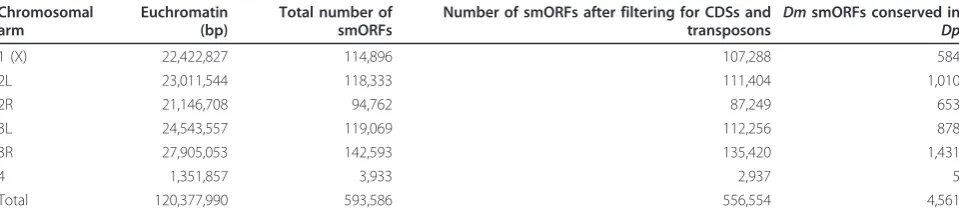
genome. The putative smORFs were distributed across chromosomal arms roughly in proportion to the length of each arm’s euchromatin (FlyBase release 5 [21]; as accessed in December 2009). Chromosomal arm 3R, which is the largest, has the highest number of smORFs (24%), and chromosomal arm 4, which is the smallest, has the lowest number of smORFs (6.6%) (Table 1). Assuming a random even distribution, this produces an estimate of one putative smORF every 400 bp of euchromatic DNA (this was estimated by dividing the length of theD. melanogastergenome, considering both strands, by the number of putative smORFs: 2 × 120,388 kb/593,586.
We do not expect all of these smORFs to be func-tional, as short ORFs can easily appear by chance. In fact it has been suggested that there might be selection for stop codons in non-coding DNA to reduce the length of aberrantly translated DNA sequences, thus producing a bias towards short ORFs in non-functional but transcribed DNA [30]. We removed any putative smORF that showed significant similarity within
data-bases of D. melanogaster transposons and annotated
coding sequences, using BLASTn. This analysis reduced the total number of putative smORFs to 556,554 (Figure 1, Table 1).
As a control for this smORF population we extracted
from the same non-exonicD. melanogasterDNA a pool
of ‘reverse’ smORFs running from stop to start (see
Materials and methods for details). This extraction
pro-duced some 800,000‘reverse’smORFs and from them
we randomly selected a sample of some 54,000 with the same size distribution as the 556 K putative smORF population. This control sample is thus composed of random DNA sequences comparable, and
non-overlapping, to our putative smORF population. Submit-ting this control sample to the same filters as our puta-tive smORFs allows us to ascertain if the smORFs selected by our bioinformatics analyses differ from what could be expected by random chance.
To investigate the presence of these putative smORFs
outside D. melanogaster, we performed a BLAST of
each smORF against theD. pseudoobscura genome. The
two fly species diverged approximately 25 to 55 million years ago [27] and are sufficiently divergent that we do not expect to detect significant similarity between puta-tively neutral sequences. Any significant similarity is therefore expected to be due to active sequence conser-vation by natural selection. However, in a protein-cod-ing sequence nucleotide substitutions at synonymous sites do not alter the amino acid sequence and are expected to be largely hidden from selection [31]. In a small ORF, synonymous substitutions create significant noise, covering the signal of conservation at the nucleo-tide level, and even preventing BLAST from detecting similarity between sequences [32]. At the amino acid level, however, the noise of non-conserved synonymous sites is eliminated. We therefore compared theD. mela-nogaster amino acid sequence of the putative smORFs with all possible translations of the D. pseudoobscura genome, using tBLASTn. We employed a false discovery rate (FDR) framework to estimate the proportion of smORFs that would have a given level of sequence simi-larity to theD. pseudoobscuragenome purely by chance. To determine the cutoff tBLASTn E-value that we should employ, we performed a BLAST with both our 54,000 sample of random control‘reverse’smORFs and
a similar sample of canonical exonic Drosophila
sequences (with the same size distribution as these con-trols, and hence as the 500 K putative smORF pool)
against theD. pseudoobscura genome, and then
com-pared the E-value distributions of both pools. Thus, a cutoff of E = 0.05 (as a standard value for biological sig-nificance) produces a FDR of nearly 10% (9.2%); a cutoff
[image:4.595.58.538.597.704.2]of E = 1 × 10⁻³produces an FDR of nearly 7% (6.8%),
Table 1 smORF numbers
Chromosomal arm
Euchromatin (bp)
Total number of smORFs
Number of smORFs after filtering for CDSs and transposons
DmsmORFs conserved in
Dp
1 (X) 22,422,827 114,896 107,288 584
2L 23,011,544 118,333 111,404 1,010
2R 21,146,708 94,762 87,249 653
3L 24,543,557 119,069 112,256 878
3R 27,905,053 142,593 135,420 1,431
4 1,351,857 3,933 2,937 5
Total 120,377,990 593,586 556,554 4,561
and a cutoff of E = 1 × 10⁻⁵ produces and FDR of 5%. Although in any case the FDR remains acceptable, we decided to opt for a cutoff value of E = 1 × 10⁻³ (7% FDR) as a compromise between specificity and sensitiv-ity, while also taking into account the tendency of BLAST to assign low scores to short sequences (the shorter the region of similarity, the more likely it could have arisen by chance). This tendency is illustrated by a shift in the size distributions of the canonical exonic sequences that pass each of these E-value cutoffs. It can be observed that decreasing the E-value cutoff discrimi-nates against small sequence sizes.
Applying this cutoff of E < 1 × 10⁻³for the tBLASTn filter dramatically reduced the pool of 556 K putative smORFs to 43,210 (Figure 1). This new pool of 43,210
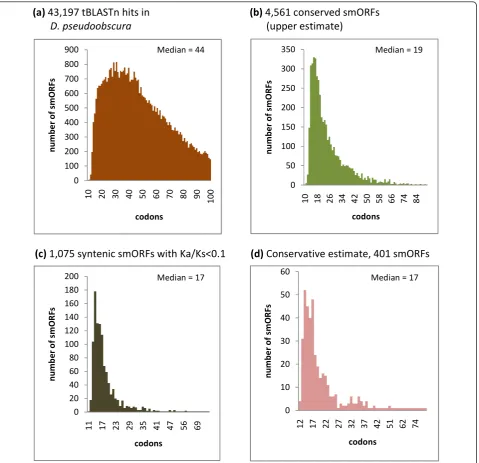
putative smORFs producing tBLASTn hits in D.
pseu-doobscura has a mean length of 44 codons, with a stan-dard deviation of 22 codons (Figure 2a). However, these may not necessarily represent conserved functional cod-ing sequences, but pseudogenes or other conserved
ele-ments in the Drosophilagenome [33-35]. We therefore
designed a further filter to investigate whether the
con-served tBLASTn hits in D. pseudoobscuraformed part
of a conserved ORF in the same frame as the putative
smORF inD. melanogaster. tBLASTn is a local
align-ment algorithm that aligns only the most similar regions between two sequences rather than the whole sequence.
To overcome this, we extracted from theD.
pseudoobs-cura sequence a further 300 bp immediately upstream
and downstream of the tBLASTn hit (since the hit may correspond to the 5’end of the smORF, or the 3’end, or anything in between). The resulting 600+ nucleotide
sequence (5’ 300 nucleotides + tBLASTn hit + 300
nucleotides 3’) was then re-aligned to the initial D. mel-anogastersmORF using ClustalW, and finally, start and
stop codons in frame with theD. melanogaster smORF
were sought in the re-aligned D. pseudoobscura
sequence. This led to a dataset of 4,561 sequences that are conserved as smORFs between both species (Table
1, Figure 1). In the genome of D. pseudoobscurathe
remaining 38,250 smORFs either shared a start codon but did not have a stop codon in-frame, or shared a stop but not a start codon, or, finally, simply shared similarity with an array of codons that did not form an obvious ORF. Some of these similar regions might belong to uncharacterized ‘orphan’exons not ascribed to a main transcript yet, as found by genome-wide stu-dies of transcription [36,37]. The population of 4,561 conserved smORFs has a mean length of 25 codons, with a standard deviation of 12 codons. Interestingly, this average is shorter in ORF size than the previous pool of smORFs with tBLASTn hits only, and their size distributions appear to be different as well (Figure 2a, b). Both a Mann-Whitney U test and a
Kolmogorov-Smirnov goodness-of-fitness test indicate that these dif-ferences are statistically significant (P< 2.2e-16; Addi-tional file 1). To test whether this difference could be obtained by chance, we subjected our pool of control
‘reverse’smORFs to the same filters of tBLASTn and
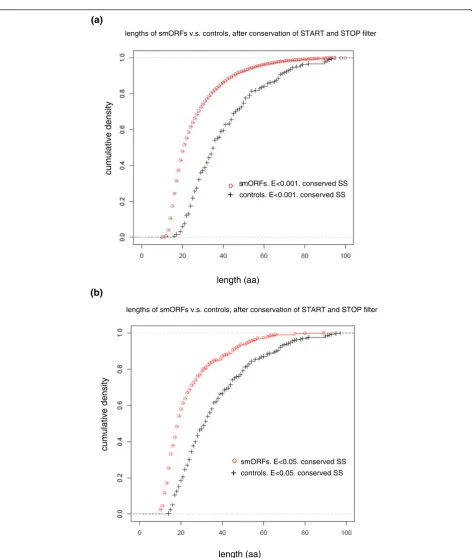
start and stop conservation. The resulting pool of fil-tered control smORFs has a very different size distribu-tion than that of our 4,561 conserved smORFs according to both Mann-Whitney U test and Kolmo-gorov-Smirnov goodness-of-fitness test (W = 182,856, P-value < 1e-15, and D = 0.4546, P-value < 1e-15, respectively; Figure 3a; Additional file 1). The standard interpretation of these results is that our 4,561 con-served smORFs belong to a population of sequences that is significantly different from both the pool of sequences with tBLASTn hits only, and a pool of ran-dom short DNA sequences that pass the same filters purely by chance.
Patterns of evolutionary conservation
Although this conservation in itself would seem potent evidence of functionality, there is still the possibility that some of these positives might still be due to chance. To eliminate spurious cases where sequence similarity was not due to true homology (which would undermine both the previous search and subsequent filters) we
examined whether the D. pseudoobscura hits were
located in genomic positions that are syntenic
(homolo-gous) with respect to the original D. melanogaster
smORFs. Such synteny analysis reveals that the great majority (3,314 out of 4,561, or 72%) of the smORFs conserved in D. pseudoobscuraare actually conserved in syntenic positions. A lack of synteny does not definitely exclude smORFs as non-functional (as smORFs may have been subjected to individual translocation within the genome), but the occurrence of synteny guarantees that similarity is due to homology and enhances the case for conservation being due to functionality.
stringent Ka/Ks limit, we observe that 1,075 of the syn-tenic smORFs (Figures 1 and 4, Table 2) display a pat-tern of sequence conservation indicative of protein sequence conservation and significantly different from the conservation shown by random short sequences.
Transcription of smORFs
As a further test of functionality we investigated whether the conserved smORFs are transcribed using
transcription data from D. melanogaster. Manak et al.
[image:6.595.61.541.88.551.2][36] investigated the transcriptome ofD. melanogaster
Figure 2Size distributions of different pools of smORFs. The size distribution of different pools of smORFs is represented according to their length in codons. Medians are indicated.(a)43,197 smORFs with tBLASTn hits with E-value < 1 × 10⁻³representing putative smORFs with some kind of sequence conservation inD. pseudoobscura. Mean size = 44 codons, standard deviation = 12.(b)4,561 putative smORFs with
conservation of sequence and start and stop codons inD. pseudoobscura, representing our upper estimate for the number of smORFs in
(a)
(b)
lengths of smORFs v.s. controls, after conservation of START and STOP filter
smORFs. E<0.001. conserved SS
+ controls. E<0.001. conserved SS
cumulati
ve densi
ty
length (aa)
smORFs. E<0.05. conserved SS
+
controls. E<0.05. conserved SS
lengths of smORFs v.s. controls, after conservation of START and STOP filter
cumulati
ve densi
ty
[image:7.595.64.537.80.639.2]length (aa)
during embryonic development by hybridizing RNA extracted from embryos to a tiling microarray of geno-mic DNA with an average probe size of 200 bp. They
found that 7% of the intergenicDrosophila DNA, with
no annotated genes, is in fact transcribed. They termed these non-annotated transcribed fragments ‘transfrags’. More recently, the modENCODE project has released data obtained with deep RNA sequencing (RNASeq) for embryonic stages as well. We constructed a database in which we integrated all genomic coordinates of tran-scribed fragments from these two sources (see Materials and methods). We then compared the genome coordi-nates of all 4,561 conserved smORFs with this database. We found that 2,942 syntenic smORFs overlap
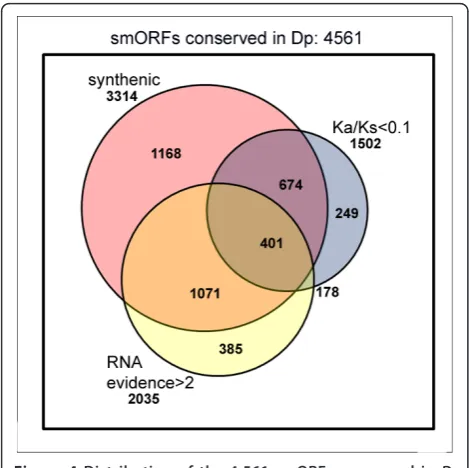
transcribed fragments in the right 5’to 3’ orientation. However, obtaining such experimental evidence of tran-scription is not immune to experimental artifacts and false positives. To minimize such cases, we applied the conservative criterion of considering only those cases where multiple evidence of transcription existed (see Materials and methods). Following this criterion, 2,035 smORFs appear to be transcribed. Of these, 1,472 are conserved in syntenic positions, and of these, 401 have Ka/Ks < 0.1 (Figures 1 and 4).
These 401 smORFs have therefore a high probability of being functional, defined as being i) transcribed (by virtue of their overlap with transcribed fragments in the right orientation), ii) translated (by virtue of their low Ka/Ks scores), and iii) biologically relevant genomic units (by virtue of their syntenic conservation as a
smORF in D. pseudoobscura). Thus, 401 constitutes our
first estimate for the number of putatively functional
smORFs inDrosophila. This number represents
approxi-mately 2.9% of the total number of currently annotated protein-coding genes inDrosophila(13,907).
A further scrutiny of overlaps between smORFs and transcribed regions reveals that only 14 transcribed frag-ments overlap more than one smORF, suggesting that 28 smORFs are arranged in 14 polycistronic double-smORF-encoding transcripts. Thus, we surmise that our 401 smORFs may belong to 387 different smORF-encoding transcripts (373 single-smORF-smORF-encoding plus 14 double-smORF ones). However, this preliminary ana-lysis does not exclude the possibility that some of our smORFs may belong to new exons of previously anno-tated transcripts encoding long proteins, which would then be revealed as polycistronic. The precise mapping of these 401 smORFs to genes will require detailed man-ual curation of genome annotation and, most likely, experimental data (see Discussion).
Attempted extension of the smORF search
Due to the tendency of tBLASTn to assign low values to short sequences (Additional file 2), and because the ORFs of the talgene obtain E-values as high as 0.87 in tBLASTn (see below), we wanted to investigate whether we might have excluded many functional smORFs by setting the stringency too high in our search for
con-served smORFs between D. melanogasterandD.
pseu-doobscura. Thus, we tested the effect on our analysis of lowering the E-value threshold in the tBLASTn from 0.001 to 0.05 (which still only produces a 10% FDR according to our tests with canonical exons and control
reverse smORFs; see above). Because this ‘relaxed’
[image:8.595.56.291.88.322.2]search would generate so many more significant hits, we randomly selected 51,000 smORFs from the 593,586 putative smORFs that we initially found (8.6% of the total; 10,000 from each major autosomal arm and from
Figure 4Distribution of the 4,561 smORFs conserved inD. pseudoobscura. Venn diagram representing the distribution of the smORFs with start and stop codons inD. pseudoobscuraand passing each of the different validation filters, and their combinations. Each circle is proportional to the size of the population it represents. Dp,D. pseudoobscura; Ka/Ks, ratio of non-synonymous (Ka) to non-synonymous (Ks) nucleotide substitution.
Table 2 Ka/Ks analysis of 4,561 smORFs conserved inD. pseudoobscura
Ka/Ks Number of smORFs
0 1,285
< 0.1 1,502
< 1 3,370
> 1 314
NA 877
Total 4,561
Distribution of the 4,561 smORFs conserved inD. pseudoobscuraaccording to their ratio of non-synonymous (Ka) to synonymous (Ks) nucleotide
[image:8.595.57.291.618.704.2]the X chromosome, and 1,000 from the fourth chromo-some; Figure 5). As before, we filtered these smORFs for coding DNA sequences and transposons before search-ing for conservation in the genome ofD. pseudoobscura with the new E-value of 0.05. We found 10,632 smORFs that shared similarity at the amino acid level with regions inD. pseudoobscura(Figure 5). Of these relaxed 10,632 smORFs, 409 also had conserved in-frame start and stop codons. Of these 409 smORFs with conserved amino acid sequence and ORF structure, nine were diffi-cult to align at the DNA level, or showed a small con-served part and some non-concon-served parts. The remaining 400 seem to be good candidates for func-tional smORFs (that is, 0.8% of the initial 51,000 sam-ple), and just as with the previous stricter analysis their size distribution is significantly different from both the starting pool and what could be obtained by chance (Figure 3b; Additional file 1).
Of these 400, 34 smORFs passed the subsequent filters of syntenic conservation, Ka/Ks < 0.1, and multiple evi-dence of transcription. Interestingly, the smORF num-bers passing each filter are very similar to those obtained in the previous stricter search with an E-value cutoff of 0.001 (Figures 1 and 5): 0.8% of the smORFs
detected inD. melanogaster were conserved as smORFs
in D. pseudoobscura, while the estimated number of
total functional smORFs in the Drosophila genome
obtained by extrapolating from the 8.6%‘relaxed’sample is 395, again very close to the actual conservative esti-mate, 401, obtained in the ‘strict’search (Figures 1 and 5).
Altogether, these results indicate that a relaxed search increases neither the conservative pool of candidate smORFs nor the upper estimate for functional smORFs. The subsequent filters in the pipeline, starting with con-servation as a smORF inD. pseudoobscura, are stringent enough to purify an inflated input.
Validation of search with examples of translated smORFs
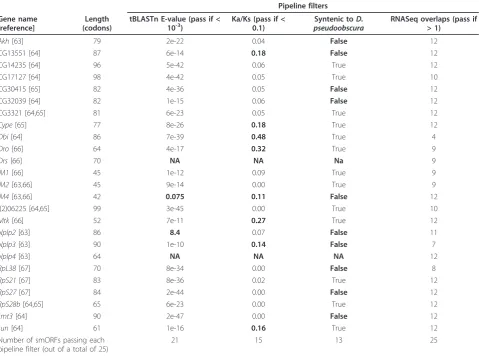
Although different types of analysis and filters seem to converge on a lower estimate of around 400 functional smORFs inDrosophila, it would be interesting to inde-pendently gauge the accuracy of our pipeline. For this, we collected examples of putative smORFs annotated prior to our analysis (and thus excluded from the pool of non-coding sequences that was the starting point of our search) for which firm evidence of translation for their encoded peptides exists, in the form of proteomic data. These translated and annotated smORFs form a sample of 25 smORFs and the results of submitting them to the filters included in our pipeline are pre-sented in Table 3. Twenty-one translated smORFs pass the filter of tBLASTn with E = 0.001, whereas all 25
43% 31% 60%
SAMPLE
51,000
smORFs in Dp
409
Syntenic
249
Ka/Ks<0.1
78
tBLASTn Dp
E= 0.05
10,632
0.8% 21%
3.8%
Relaxed estimate
395
8.6%Evidence of transcription
34
smORFs detection
[image:9.595.305.537.85.641.2]593,586
have multiple evidence of transcription, and 15 display Ka/Ks < 0.1. Interestingly, only 13 of the peptides are
conserved in syntenic positions in D. pseudoobscura,
and altogether, only 8 of these proteomics-validated smORFs pass all our filters. These results reinforce the notion that our pipeline is accurate but also stringent, and would seem to corroborate our labeling of 401 as conservative and 4,561 as upper estimates for the
num-ber of functional smORFs in theDrosophilagenome.
Discussion
In the pre-genomic era the number of genes per gen-ome was predicted based on different techniques, and sometimes extrapolation from other species adjusted by the perceived ‘complexity’of a given species. Thus, the human genome was predicted to contain over 100,000 genes [39]. Surprisingly, after genome sequencing and genome annotation this number fell to a quarter of this estimate [40]. In Drosophila, the annotation indicated
[image:10.595.59.539.101.457.2]13,907 protein-coding genes mapped to chromosomes (FlyBase release 5 [21]; as accessed in October 2011), which is in between old estimates based on number of chromosomal bands and saturation mutagenesis of defined regions (5,000 genes) [41], and those based on estimation of non-repetitive DNA content (80,000 genes) [42], as reviewed in [43]. How can we accommo-date a large number of functions with a small number of genes? Several answers have been proposed: complex genetic interactions, alternative splicing, and non-pro-tein coding genes [44]. Another less discussed possibility could be that non-canonical coding sequences escape detection from genome annotation pipelines. Already an overwhelming number of RNAs in humans and mice are deemed ‘non-coding’(ENCODE data). It could well be that many of these actually encode translated and functional smORFs. For example, the putatively non-coding gene HAR1F [45], which has undergone evolu-tionary acceleration in humans and is therefore
Table 3 Filtering of smORFs with evidence of translation
Pipeline filters
Gene name [reference]
Length (codons)
tBLASTn E-value (pass if <
10-3)
Ka/Ks (pass if < 0.1)
Syntenic toD.
pseudoobscura
RNASeq overlaps (pass if > 1)
Akh[63] 79 2e-22 0.04 False 12
CG13551 [64] 87 6e-14 0.18 False 12
CG14235 [64] 96 5e-42 0.06 True 12
CG17127 [64] 98 4e-42 0.05 True 10
CG30415 [65] 82 4e-36 0.05 False 12
CG32039 [64] 82 1e-15 0.06 False 12
CG3321 [64,65] 81 6e-23 0.05 True 12
Cype[65] 77 8e-26 0.18 True 12
Dbi[64] 86 7e-39 0.48 True 4
Dro[66] 64 4e-17 0.32 True 9
Drs[66] 70 NA NA Na 9
IM1[66] 45 1e-12 0.09 True 9
IM2[63,66] 45 9e-14 0.00 True 9
IM4[63,66] 42 0.075 0.11 False 12
l(2)06225 [64,65] 99 3e-45 0.00 True 10
Mtk[66] 52 7e-11 0.27 True 12
Nplp2[63] 86 8.4 0.07 False 11
Nplp3[63] 90 1e-10 0.14 False 7
Nplp4[63] 64 NA NA NA 12
RpL38[67] 70 8e-34 0.00 False 8
RpS21[67] 83 8e-36 0.02 True 12
RpS27[67] 84 2e-44 0.00 False 12
RpS28b[64,65] 65 6e-23 0.00 True 12
smt3[64] 90 2e-47 0.00 False 12
sun[64] 61 1e-16 0.16 True 12
Number of smORFs passing each pipeline filter (out of a total of 25)
21 15 13 25
considered as a candidate to participate in the acquisi-tion of human-specific traits, contains several smORFs (JP Couso, unpublished observations). In fact, if putative smORFs were distributed evenly every 400 bp on
aver-age, as we find inDrosophila, most non-coding RNAs
must contain smORFs.
Even though programs for yeast genome annotation initially excluded sequences coding for less than 100 codons [1], yeast remains the best-studied genome for the presence of smORF genes [46-49]. smORF searchers used computational methods for an initial screening of small ORFs and subsequently they tested whether the smORFs are expressed, using a variety of expression identification methods [18]. More recently, Kastenmayer et al. [19] collected all potential smORFs from the lit-erature with evidence of either translation or
transcrip-tion and concluded that the S. cerevisiae genome has
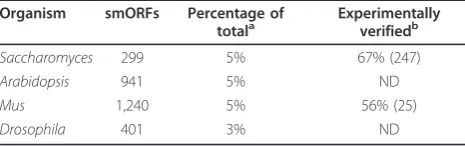
299 potentially functional smORFs, which would repre-sent 5% of the genes in yeast. Of these, at least 168 (67% of those tested; Table 4) were found to have evi-dence of translation into peptides.
A recent study of the genome ofA. thaliana revealed
3,241 smORFs that show evidence for either transcrip-tion or purifying selectranscrip-tion [11]. This estimate is an order of magnitude higher than in yeast; however,
Hanada et al. [11] reach a number of 3,241 smORF
genes by pooling together smORFs with evidence of either transcription or amino acid sequence conserva-tion (a version of the Ka/Ks < 1 test). We would con-sider this number is therefore a maximum estimate, similar to our 4,561 conserved smORFs. However,
Hanada et al. point out that the actual number of
smORFs with evidence of both transcription and amino acid conservation is 941. This is about 5% of the Arabi-dopsisgenes, equal to the fraction postulated in yeast. To date no functional validation of these estimates has been reported.
The study of Frith et al. [28] used a modification of the CRITICA gene-detection program suite, originally designed for prokaryote genomes, to detect smORFs in
the RIKEN Mus musculuscDNA collection. CRITICA’s
entry point to identify coding sequences is sequence similarity between species, and in particular conserva-tion of coding content of putative ORFs. This study is thus comparable to our own pipeline, in that sequence similarity, coding conservation and evidence of tran-scription are considered indicators of smORF function-ality, and used as filters for their detection. It is interesting, therefore, that the volume of putative new,
smORF-encoding sequences found in mouse by Frithet
al. is again very similar, at 5% of the already annotated fraction of canonical genes with ORFs longer than 100 amino acids. The total number of smORFs (1,240) upon which this fraction is based might be an underestimate, as small cDNAs tend to be eliminated from cDNA col-lections (as they may represent truncated cDNAs), but Frithet al. [28] detect no bias in the size distribution of their smORF-containing cDNAs. In that study, the authors assessed the translation of a sample of these new smORFs, and found evidence of translation for 14 out of 25 smORFs assessed (56%), a fraction very similar to that found in S. cerevisiae (67%). It is important to consider that the methods applied (green fluorescent protein tagging in mouse and flies, and a mixture of tag-ging and proteomics in yeast) can still produce false negatives. Even after applying these fractions as correc-tors for the total number of real smORFs in eukaryotes, the numbers still hover at around 2 to 3.5% of anno-tated protein-coding genes, that is, several hundred new coding sequences per organism (Table 4).
The promising results obtained by these three smORF searches previously carried out in other eukaryotes (summarized in Table 4) prompted us to carry out a
search for smORFs inDrosophila. TheDrosophila
gen-ome is considered as one of the best annotated [20,50-53], yet our study suggests that a remarkably similar fraction of smORFs as in other eukaryotes might have escaped detection by genome annotation efforts and might be an important source of functional genes (Table 4). Programs forDrosophila’s genome annotation do not completely omit genes with smORFs from their predictions, but it had been suggested that short coding sequences might escape the cutoff thresholds of the pro-grams [20]. Recently, a lowering of this 100 amino acid threshold has led to the addition of some 700 putative smORFs above 50 amino acids in length (FlyBase release 5 [21]; as accessed in May 2010), but most of these belong to isoforms or truncated cDNAs of canonical long genes, and do not overlap with the smORFs we identify here (V Pereira and JP Couso, unpublished observations). Still, we have corroborated that at least
25 of these seem to correspond to bona fidesmORFs,
[image:11.595.57.290.607.680.2]with proteomic evidence of translation and sizes ranging from 42 to 99 amino acids (Table 3). Finally, we have
Table 4 Comparison of smORF searches in different eukaryotic organisms
Organism smORFs Percentage of
totala Experimentallyverifiedb
Saccharomyces 299 5% 67% (247)
Arabidopsis 941 5% ND
Mus 1,240 5% 56% (25)
Drosophila 401 3% ND
Comparison of different smORF searches showing the number of smORFs identified inS. cerevisiae[19],A. thaliana[11],M. musculus[28] andD. melanogatser(this study).a
The fraction of smORFs relative to previously annotated protein-coding genes.b
recently characterized the tal gene, which encodes smORFs of 11 to 32 amino acids, and shown that these peptides carry out important cell signaling functions during development [22-24]. Adding to these examples, we provide here evidence for the existence of hundreds more functional smORFs.
How manyDrosophilasmORFs are actually functional?
Sequence conservation is an accepted hallmark of func-tionality, when subjected to appropriate controls to dis-tinguish it from random conservation. D. pseudoobscura and D. melanogaster diverged some 25 to 55 million years ago, and have gone through sufficient divergence to scramble neutral sequences but yet not large enough to mask functional conservation [27]. Conservation of a whole ORF, from start to stop, appears to be a reason-ably stringent filter because i) the number of surviving smORFs does not increase when the initial tBLASTn search is made less stringent; ii) surviving smORFs show syntenic conservation in very high numbers; and iii) the size distribution of the 4,561 conserved smORFs is sig-nificantly different from the starting pools and from ran-dom controls, whereas it does not change after applying further filters (Additional file 1). Some 4,500 smORFs might, therefore, constitute an upper estimate of the
number of functional smORFs in Drosophila, which
would be in line with the Hanadaet al. [11] estimate of
3,241 smORFs inArabidopsis.
It might be argued that syntenic conservation (that is, conservation in homologous regions of the genome) should be considered as the definitive criterion to distin-guish real conservation (presumably due to functional significance) from simple similarity (presumably due to chance). However, the absence of synteny may be due to individual gene translocation. It is interesting that almost 50% of the 25 previously annotated and proteo-mics-corroborated smORFs are not conserved in synte-nic positions inD. pseudoobscura (Table 3). Similarly, 178 of our smORFs are conserved with start and stop codons inD. pseudoobscura, have Ka/Ks < 0.1, and have multiple evidence of transcription, yet they do not appear to be conserved in syntenic positions (Figure 4). We note that both these 25 smORFs, plus another 6 for which we have separate evidence of function (E Magny and JP Couso, unpublished observations) belong to tran-scripts of less than 2 kb; perhaps small smORF-encoding transcripts are more mobile than their canonical coun-terparts. Taking into account these facts, we resolved not to consider synteny for our upper estimate of puta-tive functional smORFs, but to include it amongst the criteria to generate our conservative estimate.
Following the conservative approach, we have taken the position that a functional smORF must also show evidence of both amino acid sequence conservation and
transcription. We therefore studied first the pattern of sequence conservation in these conserved 3,144 syntenic smORFs, and observed that 1,075 smORFs show a Ka/ Ks score < 0.1, which distinguish them from random conservation with a 10% FDR. Next, we assessed the correspondence between these 1,075 smORFs and tran-scribed regions in theDrosophilagenome. Again using a conservative criterion, we observe that 401 of these smORFs overlap transcribed fragments on more than one occasion. These 401 smORFs are thus very strong candidates to be functional, as they present evidence of both transcription and amino acid conservation (see Additional files 3 and 4 for the actual sequences). Pend-ing manual curation and functional studies, our preli-minary clustering analysis suggests that those 401 smORFs may belong to 383 different transcripts, and therefore some 380 is our lower estimate for the
num-ber of smORF-containing genes inDrosophila. However,
these may well be underestimates. Firstly, the
experi-mental data of Manaket al. [36] and modENCODE that
we have used here to ascertain transcription detects only transcripts expressed during embryogenesis. It leaves out transcripts only expressed during larval or adult phases of the life cycle, including organs transcrip-tionally active and rich in specific transcripts such as the brain and the gonads. Further, high-throughput detection of transcription during embryogenesis is not absolute but subject to inevitable experimental limita-tions. Thus, genes expressed in only a few cells of the embryo may not be represented (E Magny and JP Couso, unpublished observations). Secondly, the Ka/Ks test is of limited usefulness with short sequences, produ-cing up to 9% false negatives [38] with a limit of Ka/Ks < 1. In order to obtain a 10% FDR, we have had to lower the Ka/Ks limit to 0.1, which is one order of mag-nitude lower than the usual < 1 used for longer protein sequences, and leaves out a further 1,868 smORFs (Table 2). It is also possible that the 314 smORFs with Ka/Ks > 1, may be genuine translated coding sequences undergoing adaptive evolution [54]. Finally, the average length and population size distribution of the 401 smORFs with evidence of transcription, synteny and Ka/ Ks < 0.1 is not significantly different to that of the 4,561 conserved smORFs that have no evidence of synteny, transcription and Ka/Ks < 0.1 (Figure 2; Additional file 1), suggesting that some of the smORFs with no current evidence of transcription or protein sequence conserva-tion may be transcribed at low levels, or at yet not fully explored stages of development and life history. Alto-gether, our conclusion from the Ka/Ks, transcription and synteny analysis is that our estimate of some 400
functional smORFs in Drosophilais solid but perhaps
Between these numbers, other estimates are possible, depending on the actual filters and cutoff values consid-ered (see Figure 4 for a breakdown of the results of applying each filter and of the different overlaps between these filters).
At any rate, a lower estimate of 400 smORFs repre-sents some 3% of currently annotated protein-coding genes, and is in line with the 5% estimate in Saccharo-myces [19], Mus [28] and a conservative Arabidopsis estimate. We therefore favor this conservative estimate
for the number of functional smORFs inDrosophila.
Obtaining further proof of smORF functionality
Full genome annotation, including manual curation, of
the 401 smORFs conserved in D. pseudoobscura,
over-lapping transcripts, and with Ka/Ks < 0.1 is a necessary future step to build the gene models they belong to, but will not offer definitive proof of their functionality or translation, which can only come from experimental verification.
We provide a limited experimental functional valida-tion of our computavalida-tional search, pooling observavalida-tions from previously published studies, and the results would seem to vindicate our computational estimates. The
peptides for 25 smORFs in the annotatedD.
melanoga-ster genome with sizes ranging from 42 to 99 amino
acids have been isolated by proteomics methods, and offer direct and unambiguous proof of their translation. In several cases these smORFs arise after splicing of multi-exon transcripts, and this limits the number of fil-ters we can apply. However, it can be observed that, except for the evidence of multiple overlap with tran-scribed sequences, many of these smORFs pass any of our filters of tBLASTn E-value < 10-3
, syntenic conser-vation, and Ka/Ks < 0.1 (Table 3). This test of our pipe-line reveals it to be stringent, and validates our estimate of 401 functional smORFs inDrosophilaas conservative. It is possible that new proteomics approaches specifi-cally designed to detect peptides of less than 100 amino acids [55,56] could offer definitive proof for the translation of these 401 smORFs. However, successful
peptidomics approaches in insects, including
Droso-phila, have only been reported in a few cases and can only be attempted on an organ-by-organ and stage-by-stage basis [57-59]. Still, such proteomics and peptido-mics studies routinely uncover high numbers of
‘orphan’putative sequences that cannot be matched to
annotated Drosophilaproteins [40,56,60]. The problem
is more serious with very short peptides, which offer fewer sequence signatures (digestion sites, and so no) for proteomic pipelines to obtain high-confidence sequences. These orphan sequences could be artifacts, or could be the products of non-annotated functional smORFs.
An alternative proof for the functionality of these
smORFs in Drosophila could be obtained by genetic
analyses. Single-smORF genetic studies can accurately characterize functional smORFs and are essential to build the gene models they belong to [22-24], but can-not be extended to a whole genome sweep because of restriction in methods, cost and time. Whereas func-tional genetic analysis is routine in D. melanogaster, standard genetic techniques are not suited to the analy-sis of hundreds of loci, which currently could only be attempted by a research consortium. Even in the yeast S. cerevisiae, with its much greater speed and ease of manipulation, Kastenmayeret al. [19] similarly pooled data from previous studies and their own mutational effort and were only able to detect a mutant growth phenotype in 22 out of 247 smORF mutants. Other types of phenotypes were not assessed, but it seems likely that more detailed studies are needed to increase the fraction of smORFs with known functions in this lower eukaryote (since the fraction of canonical genes showing a similar growth phenotype is only 25% [4]). Interestingly also, a staggering number of putative loci (16,383), defined by 18,873 mutant alleles, have still not
been mapped to any Drosophila gene (FlyBase [21],
FB2010_05 release 5 notes, accessed May 2010). Several of these mutants probably correspond to lost alleles of canonical genes. However, a significant fraction of them may in fact map to non-annotated genes and coding sequences, including smORFs.
Thus, it is likely that a specific research effort is needed to obtain experimental evidence for the
transla-tion and functransla-tionality of smORFs inDrosophila,
prob-ably the higher eukaryote model best suited for this, because of its ease of genetic manipulation and exten-sive genome annotation. This enterprise would be well worth the effort, judging from the results of the analysis of a single smORF-encoding gene,tarsal-less, which has prominent essential functions at several life stages and whose encoded peptides seem to work as cell signals [22-24], and the important functions of other smORF products such as antibacterial or sex peptides [60,61]. If the results of the bioinformatics search presented here are thus corroborated by further proteomic and func-tional studies in Drosophila, it would justify similar functional studies in vertebrates, where expense and time are even greater constraints. Since functional trans-lated smORFs and smORF-encoding genes have now
been shown to exist inSaccharomycesand Drosophila,
encoding smORFs to be present; a new class, adding hundreds or even thousands of extra coding sequences to current genome annotations.
Conclusions
Our results suggest that 400 functional smORFs remain to be characterized in Drosophila, and open the possibi-lity that a further 4,000 functional smORFs may also exist. Results in other organisms echo our findings, and altogether suggest that short protein sequences consti-tute a significant, and largely uncharacterized, fraction of the gene products encoded by any genome. Charac-terization of these smORFs could have significant impacts on biology and medicine.
Materials and methods
Data used and smORF search
The intergenic DNA of D. melanogaster was
down-loaded from the FTP site of Flybase (release 5) [21]. We searched for ORFs that began with a start codon and ended with an in-frame stop codon within 30 to 300 bp on both strands of the D. melanogasterintergenic DNA. In doing so we only searched for unspliced ORFs. Due to their small size we called them smORFs (small ORFs) according to Basraiet al. [5]. We filtered from our ana-lysis the smORFs that overlap with known coding DNA
sequences, and transposon databases ofDrosophila, as
well as repetitive DNA.
Control pool
As a control for our candidate smORF population we
extracted from non-exonicD. melanogasterDNA a pool
of ‘reverse’ smORFs running from stop to start. A
‘reverse’smORF runs from a possible stop codon (TAA or TAG or TGA) to the next start codon (ATG). This extraction produced some 800,000‘reverse’smORFs and from them we randomly selected a sample of some 54,000 with the same size distribution as the 500 K smORF population. This control sample is thus com-posed of random DNA sequences comparable to (and not overlapping) our putative smORF population.
Comparison with the genome ofD. pseudoobscura
We translated the ORFs ofD. melanogaster into amino
acids using the universal genetic code. We searched for
similarity between each translated smORF between D.
pseudoobscura and D. melanogaster using standalone BLAST with the program tBLASTn. tBLASTn finds matches to an amino acid sequence within a nucleotide sequence by translating the nucleotide sequence in all three reading frames on both strands of the DNA duplex. It was run with default parameters, apart from
an E-value threshold of 30. D. melanogaster and D.
pseudoobscuraare almost saturated at synonymous sites,
indicating that there has been sufficient time for neutral sequences to almost completely diverge from one another.
We performed a FDR analysis to empirically estimate the proportion of smORF candidates that would have a given level of sequence similarity to theD.
pseudoobs-curagenome purely by chance, and to choose tBLASTn
E-value thresholds with an acceptable proportion of such false positives (that is, smORF candidates similarity above threshold by chance). We randomly sampled
sequence segments from translated D. melanogaster
exons, constraining these segments to have the same length distribution as the (translated) smORFs. We then used tBLASTn to find out the level of sequence similar-ity (represented by the E-value) between theD. melano-gasterexon segments andD. pseudoobscura; for a given E-value threshold, we considered the proportion of exon
segments that have E-value below the threshold‘true
positives’(TP). We repeated the procedure using‘
con-trol smORFs’ (sequences randomly sampled from the
non-coding portion of the D. melanogaster genome,
with the same length distribution as the smORFs), and considered the proportion of those with E-values below the threshold as‘false positives’(FP). We then computed the FDR for a given E-value threshold asFP/(TP+FP).
For each smORF in D. melanogaster, which showed
significant similarity (at the chosen FDR) to the genome
of D. pseudoobscura, we investigated whether the
sequence in D. pseudoobscura also contained an
in-frame start and stop codon within 300 bp either side of the conserved amino acid sequence in the D.
pseudoobs-cura genome. We extracted fromD. pseudoobscura a
further 300 bp immediately upstream of the tBLASTn hit, plus another 300 bp immediately downstream of it. The resulting 600+ nucleotide contig sequence was then
re-aligned to the initial D. melanogastersmORF using
ClustalW [62], and finally, start and stop codons in
frame with the D. melanogastersmORF were sought in
the re-alignedD. pseudoobscurasequence.
For each smORF we calculated non-synonymous sub-stitutions per non synonymous site (Ka) and synon-ymous substitutions per synonsynon-ymous site (Ks). We repeated the procedure described earlier to obtain an empirically estimated 10% FDR value for Ka/Ks, by com-puting Ka/Ks values for both annotated exon fragments and controls (’reverse smORFs’).
Database of transcribed regions
To investigate whether the putative smORFs were
tran-scribed, we used the transcription data from Manak et
DNA were called‘transfrags’by the authors and we have maintained their nomenclature. To ascertain which of our smORFs are transcribed, we matched the coordinates of our putative smORFs with the transfrag coordinates kindly provided by J Manak. For RNASeq data, we used the data released by the modENCODE consortium for embryonic stages. Although data have been released for other stages, only the data for contigs of reads at embryo-nic stages indicate the DNA strand of origin, which is essential to ascertain abona fideoverlap with smORFs. We used the stringent criteria that to pass this filter,
smORFs conserved inD. pseudoobscuramust display
multiple evidence of transcription (2,035 cases).‘Multiple evidence of transcription’means overlap with more than one RNA sequence in the right orientation - that is, over-lap in more than one embryonic substage (1,928 cases) or in a single stage but overlapping two or more contig reads (23 cases), or finally, overlapping a single contig read but at least a transfrag as well (84 cases).
Statistical analysis
Statistical analyses, including the Mann-Whitney and Kolmorogov-Smirnov tests, were performed using the SPSS package and R. Venn diagrams were generated using Venn diagram plotter (Pacific Northwest National Laboratory, US Department of Energy).
Relaxed analysis of a sample of smORFs
Because the total number of smORFs isolated from the
genome of D. melanogaster depends on the E-value for
the tBLASTn search in D. pseudoobscura(Table 1), we
performed a less stringent analysis using a subset of smORFs. Out of the 593,568 smORFs, we randomly sampled 10,000 smORFs from each chromosomal arm (2L, 2R, 3L, 3R and X) and 1,000 smORFs from chro-mosome 4, as it contains an order of magnitude fewer smORFs and euchromatin than other chromosomal arms (Table 1). We filtered these smORFs for coding DNA sequences, transposons and repetitive DNA and
then we searched for homology with the genome of D.
pseudoobscura using tBLASTn run with default para-meters with an E-value threshold set to 0.05.
Additional material
Additional file 1: Statistical analyses for the comparisons of smORF
pools according to their codon length.
Additional file 2: Cumulative size distributions of short exonic
sequences before and after tBLASTn.
Additional file 3: Fasta file with the sequences of the 401 smORFs
representing our conservative estimate.
Additional file 4: Excel file with the sequences of 401 smORFs
representing our conservative estimate.
Abbreviations
Bp: base pairs; FDR: false discovery rate; ORF: open reading frame; smORF: small open reading frame; uORF: upstream open reading frame.
Acknowledgements
We thank J Manak for providing transfrag coordinates, Michael Ashburner for discussions and encouragement, JI Pueyo for comments on the manuscript, and MI Galindo for unpublished results. This work was financed by a Wellcome Senior Fellowship to JPC, ref. WT087516.
Author details 1
Department of Biology, University of Crete, PO Box 2208, 71409 Heraklio, Greece.2School of Life Sciences, University of Sussex, Falmer, Brighton, BN1
9QG, UK.
Authors’contributions
EL, VP, EM and JPC designed the experiments, obtained data, and analyzed and interpreted data. AEW designed experiments and interpreted data. All authors were involved in drafting and reviewing the manuscript. All authors have read and approved the manuscript for publication.
Received: 25 May 2011 Revised: 4 November 2011 Accepted: 25 November 2011 Published: 25 November 2011
References
1. Goffeau A, Barrell BG, Bussey H, Davis RW, Dujon B, Feldmann H, Galibert F, Hoheisel JD, Jacq C, Johnston M, Louis EJ, Mewes HW, Murakami Y, Philippsen P, Tettelin H, Oliver SG:Life with 6000 genes.Science1996, 274:546, 563-547.
2. Claverie JM, Poirot O, Lopez F:The difficulty of identifying genes in anonymous vertebrate sequences.Comput Chem1997,21:203-214. 3. Brent MR:Genome annotation past, present, and future: how to define
an ORF at each locus.Genome Res2005,15:1777-1786.
4. Pena-Castillo L, Hughes TR:Why are there still over 1000 uncharacterized yeast genes?Genetics2007,176:7-14.
5. Basrai MA, Hieter P, Boeke JD:Small open reading frames: beautiful needles in the haystack.Genome Res1997,7:768-771.
6. Wang J, Li S, Zhang Y, Zheng H, Xu Z, Ye J, Yu J, Wong GK:Vertebrate gene predictions and the problem of large genes.Nat Rev Genet2003, 4:741-749.
7. Autelitano DJ, Rajic A, Smith AI, Berndt MC, Ilag LL, Vadas M:The cryptome: a subset of the proteome, comprising cryptic peptides with distinct bioactivities.Drug Discov Today2006,11:306-314.
8. Kozak M:Regulation of translation via mRNA structure in prokaryotes and eukaryotes.Gene2005,361:13-37.
9. Hayden CA, Jorgensen RA:Identification of novel conserved peptide uORF homology groups in Arabidopsis and rice reveals ancient eukaryotic origin of select groups and preferential association with transcription factor-encoding genes.BMC Biol2007,5:32.
10. Zhang Z, Dietrich F:Identification and characterization of upstream open reading frames (uORF) in the 5’untranslated regions (UTR) of genes in
Saccharomyces cerevisiae.Curr Genet2005,48:77-87.
11. Hanada K, Zhang X, Borevitz JO, Li WH, Shiu SH:A large number of novel coding small open reading frames in the intergenic regions of the
Arabidopsis thalianagenome are transcribed and/or under purifying selection.Genome Res2007,17:632-640.
12. Goffeau A:Yeast. Genes in search of functions.Nature1994,369:101-102. 13. Fickett JW:ORFs and genes: how strong a connection?J Comput Biol
1995,2:117-123.
14. Das S, Yu L, Gaitatzes C, Rogers R, Freeman J, Bienkowska J, Adams RM, Smith TF, Lindelien J:Biology’s new Rosetta stone.Nature1997,385:29-30. 15. Velculescu VE, Zhang L, Vogelstein B, Kinzler KW:Serial analysis of gene
expression.Science1995,270:484-487.
16. Basrai MA, Hieter P:Transcriptome analysis ofSaccharomyces cerevisiae
using serial analysis of gene expression.Methods Enzymol2002, 350:414-444.
17. Olivas WM, Muhlrad D, Parker R:Analysis of the yeast genome: identification of new non-coding and small ORF-containing RNAs.
18. Kessler MM, Zeng Q, Hogan S, Cook R, Morales AJ, Cottarel G:Systematic discovery of new genes in theSaccharomyces cerevisiaegenome.
Genome Res2003,13:264-271.
19. Kastenmayer JP, Ni L, Chu A, Kitchen LE, Au W-C, Yang H, Carter CD, Wheeler D, Davis RW, Boeke JD, Snyder MA, Basrai MA:Functional genomics of genes with small open reading frames (sORFs) inS. cerevisiae.Genome Res2006,16:365-373.
20. Misra S, Crosby MA, Mungall CJ, Matthews BB, Campbell KS, Hradecky P, Huang Y, Kaminker JS, Millburn GH, Prochnik SE, Smith CD, Tupy JL, Whitfied EJ, Bayraktaroglu L, Berman BP, Bettencourt BR, Celniker SE, de Grey AD, Drysdale RA, Harris NL, Richter J, Russo S, Schroeder AJ, Shu SQ, Stapleton M, Yamada C, Ashburner M, Gelbart WM, Rubin GM, Lewis SE: Annotation of theDrosophila melanogastereuchromatic genome: a systematic review.Genome Biol2002,3:RESEARCH0083.
21. The FlyBase Database of theDrosophilaGenome Projects and community literature. The FlyBase Consortium.. Nucleic Acids Res1999, 27:85-88.
22. Galindo MI, Pueyo JI, Fouix S, Bishop SA, Couso JP:Peptides encoded by short ORFs control development and define a new eukaryotic gene family.Plos Biol2007,5:1052-1062.
23. Pueyo JI, Couso JP:The 11-aminoacid long Tarsal-less peptides trigger a cell signal inDrosophilaleg development.Dev Biol 20082008, 324:192-201.
24. Kondo T, Hashimoto Y, Kato K, Inagaki S, Hayashi S, Kageyama Y:Small peptide regulators of actin-based cell morphogenesis encoded by a polycistronic mRNA.Nat Cell Biol2007,9:660-U687.
25. Tupy JL, Bailey AM, Dailey G, Evans-Holm M, Siebel CW, Misra S, Celniker SE, Rubin GM:Identification of putative noncoding polyadenylated transcripts inDrosophila melanogaster.Proc Natl Acad Sci USA2005, 102:5495-5500.
26. Savard J, Marques-Souza H, Aranda M, Tautz D:A segmentation gene in
Tribolliumproduces a polycistronic mRNA that codes for multiple conserved peptides.Cell2006,126:559-569.
27. Richards S, Liu Y, Bettencourt BR, Hradecky P, Letovsky S, Nielsen R, Thornton K, Hubisz MJ, Chen R, Meisel RP, Couronne O, Hua S, Smith MA, Zhang P, Liu J, Bussemaker HJ, van Batenburg MF, Howells SL, Scherer SE, Sodergren E, Matthews BB, Crosby MA, Schroeder AJ, Ortiz-Barrientos D, Rives CM, Metzker ML, Muzny DM, Scott G, Steffen D, Wheeler DA,et al: Comparative genome sequencing ofDrosophila pseudoobscura: chromosomal, gene, and cis-element evolution.Genome Res2005, 15:1-18.
28. Frith MC, Forrest AR, Nourbakhsh E, Pang KC, Kai C, Kawai J, Carninci P, Hayashizaki Y, Bailey TL, Grimmond SM:The abundance of short proteins in the mammalian proteome.Plos Genet2006,2:515-528.
29. Lynch M, Kewalramani A:Messenger RNA surveillance and the evolutionary proliferation of introns.Mol Biol Evol2003,20:563-571. 30. Hurst LD:Evolutionary genomics and the reach of selection.J Biol2009,
8:12.
31. Shields DC, Sharp PM, Higgins DG, Wright F:“Silent”sites inDrosophila
genes are not neutral: evidence of selection among synonymous codons.Mol Biol Evol1988,5:704-716.
32. Altschul SF, Gish W, Miller W, Myers EW, Lipman DJ:Basic local alignment search tool.J Mol Biol1990,215:403-410.
33. Bergman CM, Kreitman M:Analysis of conserved noncoding DNA in
Drosophilareveals similar constraints in intergenic and intronic sequences.Genome Res2001,11:1335-1345.
34. Andolfatto P:Adaptive evolution of non-coding DNA inDrosophila.
Nature2005,437:1149-1152.
35. Halligan DL, Keightley PD:Ubiquitous selective constraints in the
Drosophilagenome revealed by a genome-wide interspecies comparison.Genome Res2006,16:875-884.
36. Manak JR, Dike S, Sementchenko V, Kapranov P, Biemar F, Long J, Cheng J, Bell I, Ghosh S, Piccolboni A, Gingeras TR:Biological function of unannotated transcription during the early development ofDrosophila melanogaster.Nat Genet2006,38:1151-1158.
37. Nagalakshmi U, Wang Z, Waern K, Shou C, Raha D, Gerstein M, Snyder M: The transcriptional landscape of the yeast genome defined by RNA sequencing.Science2008,320:1344-1349.
38. Nekrutenko A, Makova KD, Li WH:The K(A)/K(S) ratio test for assessing the protein-coding potential of genomic regions: an empirical and simulation study.Genome Res2002,12:198-202.
39. Schuler GD, Boguski MS, Stewart EA, Stein LD, Gyapay G, Rice K, White RE, Rodriguez-Tome P, Aggarwal A, Bajorek E, Bentolila S, Birren BB, Butler A, Castle AB, Chiannilkulchai N, Chu A, Clee C, Cowles S, Day PJ, Dibling T, Drouot N, Dunham I, Duprat S, East C, Edwards C, Fan JB, Fang N, Fizames C, Garrett C, Green L,et al:A gene map of the human genome.
Science1996,274:540-546.
40. Stein LD:Human genome: end of the beginning.Nature2004, 431:915-916.
41. Garcia-Bellido A, Ripoll P:The number of genes inDrosophila melanogaster.Nature1978,273:399-400.
42. Laird CD:DNA ofDrosophilachromosomes.Annu Rev Genet1973, 7:177-204.
43. Ashburner M, Misra S, Roote J, Lewis SE, Blazej R, Davis T, Doyle C, Galle R, George R, Harris N, Hartzell G, Harvey D, Hong L, Houston K, Hoskins R, Johnson G, Martin C, Moshrefi A, Palazzolo M, Reese MG, Spradling A, Tsang G, Wan K, Whitelaw K, Celniker S,et al:An exploration of the sequence of a 2.9-Mb region of the genome ofDrosophila melanogaster: the Adh region.Genetics1999,153:179-219.
44. Taft RJ, Pheasant M, Mattick JS:The relationship between non-protein-coding DNA and eukaryotic complexity.BioEssays2007,29:288-299. 45. Pollard KS, Salama SR, Lambert N, Lambot MA, Coppens S, Pedersen JS,
Katzman S, King B, Onodera C, Siepel A, Kern AD, Dehay C, Igel H, Ares M, Vanderhaeghen P, Haussler D:An RNA gene expressed during cortical development evolved rapidly in humans.Nature2006,443:167-172. 46. Blandin G, Durrens P, Tekaia F, Aigle M, Bolotin-Fukuhara M, Bon E,
Casaregola S, de Montigny J, Gaillardin C, Lepingle A, Llorente B, Malpertuy A, Neuveglise C, Ozier-Kalogeropoulos O, Perrin A, Potier S, Souciet J, Talla E, Toffano-Nioche C, Wesolowski-Louvel M, Marck C, Dujon B:Genomic exploration of the hemiascomycetous yeasts: 4. The genome ofSaccharomyces cerevisiaerevisited.FEBS Lett2000,487:31-36. 47. Brachat S, Dietrich FS, Voegeli S, Zhang Z, Stuart L, Lerch A, Gates K,
Gaffney T, Philippsen P:Reinvestigation of theSaccharomyces cerevisiae
genome annotation by comparison to the genome of a related fungus: Ashbya gossypii.Genome Biol2003,4:R45.
48. Cliften P, Sudarsanam P, Desikan A, Fulton L, Fulton B, Majors J, Waterston R, Cohen BA, Johnston M:Finding functional features in
Saccharomycesgenomes by phylogenetic footprinting.Science2003, 301:71-76.
49. Kellis M, Patterson N, Endrizzi M, Birren B, Lander ES:Sequencing and comparison of yeast species to identify genes and regulatory elements.
Nature2003,423:241-254.
50. Hild M, Beckmann B, Haas SA, Koch B, Solovyev V, Busold C, Fellenberg K, Boutros M, Vingron M, Sauer F, Hoheisel JD, Paro R:An integrated gene annotation and transcriptional profiling approach towards the full gene content of theDrosophilagenome.Genome Biol2003,5:R3.
51. Celniker SE, Wheeler DA, Kronmiller B, Carlson JW, Halpern A, Patel S, Adams M, Champe M, Dugan SP, Frise E, Hodgson A, George RA, Hoskins RA, Laverty T, Muzny DM, Nelson CR, Pacleb JM, Park S, Pfeiffer BD, Richards S, Sodergren EJ, Svirskas R, Tabor PE, Wan K, Stapleton M, Sutton GG, Venter C, Weinstock G, Scherer SE, Myers EW,et al:Finishing a whole-genome shotgun: release 3 of theDrosophila melanogaster
euchromatic genome sequence.Genome Biol2002,3:RESEARCH0079. 52. Stolc V, Gauhar Z, Mason C, Halasz G, van Batenburg MF, Rifkin SA, Hua S,
Herreman T, Tongprasit W, Barbano PE, Bussemaker HJ, White KP:A gene expression map for the euchromatic genome ofDrosophila melanogaster.Science2004,306:655-660.
53. Tomancak P, Beaton A, Weiszmann R, Kwan E, Shu SQ, Lewis SE, Richards S, Ashburner M, Hartenstein V, Celniker SE, Rubin GM:Systematic
determination of patterns of gene expression duringDrosophila
embryogenesis.Genome Biology2002,3, 0088.0081-0088.0014.
54. Smith NG, Eyre-Walker A:Adaptive protein evolution inDrosophila.Nature
2002,415:1022-1024.
55. Ivanov VT, Yatskin ON:Peptidomics: a logical sequel to proteomics.Expert Rev Proteomics2005,2:463-473.
56. Takahashi T, Fujisawa T:Peptidomic approaches to the identification and characterization of functional peptides in hydra.Methods Mol Biol2010, 615:275-292.
58. Boerjan B, Cardoen D, Bogaerts A, Landuyt B, Schoofs L, Verleyen P:Mass spectrometric profiling of (neuro)-peptides in the worker honeybee, Apis mellifera.Neuropharmacology2010,58:248-258.
59. Schoofs L, Baggerman G:Peptidomics inDrosophila melanogaster.Brief Funct Genomics Proteomics2003,2:114-120.
60. Kim T, Kim YJ:Overview of innate immunity inDrosophila.J Biochem Mol Biol2005,38:121-127.
61. Yapici N, Kim Y-J, Ribeiro C, Dickson BJ:A receptor that mediates the post-mating switch inDrosophilareproductive behaviour.Nature2008, 451:33-37.
62. Thompson JD, Higgins DG, Gibson TJ:CLUSTAL W: improving the sensitivity of progressive multiple sequence alignment through sequence weighting, position-specific gap penalties and weight matrix choice.Nucleic Acids Res1994,22:4673-4680.
63. Taraszka JA, Gao X, Valentine SJ, Sowell RA, Koeniger SL, Miller DF, Kaufman TC, Clemmer DE:Proteome profiling for assessing diversity: analysis of individual heads of Drosophila melanogaster using LC-ion mobility-MS.J Proteome Res2005,4:1238-1247.
64. Uttenweiler-Joseph S, Moniatte M, Lagueux M, Van Dorsselaer A, Hoffmann JA, Bulet P:Differential display of peptides induced during the immune response of Drosophila: a matrix-assisted laser desorption ionization time-of-flight mass spectrometry study.Proc Natl Acad Sci USA
1998,95:11342-11347.
65. Alonso J, Santaren JF:Characterization of the Drosophila melanogaster ribosomal proteome.J Proteome Res2006,5:2025-2032.
66. Beller M, Riedel D, Jansch L, Dieterich G, Wehland J, Jackle H, Kuhnlein RP: Characterization of the Drosophila lipid droplet subproteome.Mol Cell Proteomics2006,5:1082-1094.
67. Baggerman G, Cerstiaens A, De Loof A, Schoofs L:Peptidomics of the larval Drosophila melanogaster central nervous system.Journal of Biological Chemistry2002,277:40368-40374.
doi:10.1186/gb-2011-12-11-r118
Cite this article as:Ladoukakiset al.:Hundreds of putatively functional small open reading frames inDrosophila.Genome Biology201112:R118.
Submit your next manuscript to BioMed Central and take full advantage of:
• Convenient online submission
• Thorough peer review
• No space constraints or color figure charges
• Immediate publication on acceptance
• Inclusion in PubMed, CAS, Scopus and Google Scholar
• Research which is freely available for redistribution