110 | P a g e
REVIEW ON POSITION BASED REACTIVE AND
PROACTIVE ROUTING IN VANET
Ajay Sharma
1, Dr. Sandeep Harit
2 1,2Department of Computer Science and Engineering,
PEC University of Technology Chandigarh (India)
ABSTRACT
Vehicular Ad-hoc Network (VANET) in the current years brings huge consideration of the Researchers as the idea of remote systems administration for vehicle to vehicle (V2V)and vehicle Roadside Units (RSUs) or (V2I) assumes a huge part in giving favourable position Vehicular interchanges have been one of the most sultry research themes throughout the previous couple of years. Many directing conventions have been proposed for such sort of systems. A large portion of them attempt to misuse the The above figure shows the Bigbelly smart waste and recycling system. data which might be accessible at the vehicle when that a steering choice must be made. Moreover, a few arrangements are outlined considering the specific, profoundly divided, organize network in vehicular settings. In this paper review of various position base system and investigation of drop bundle and throughput.
I. INTRODUCTION
A VANET is a radio system that is produced between vehicles in view of need. To partake in a VANET,
vehicles must be equipped with cordless handsets and automated control modules that allow them to accomplish
something as system hubs. Every vehicles cordless system range might be restricted by a few hundred meters, so
giving end-to-end correspondence over a more significant separation obliges data to jump through a few hubs.
Arrange offices are not required for a VANET, albeit enduring system hubs can be used by methods for Road
Side Device (RSU). These RSU begin a large number of administrations for vehicular destinations, for example,
carrying on as a slanted edge for declarations on meagerly filled streets, parcel up topographically applicable
information, or bit as an entryway to the web. In urban areas, crevices between boulevards have a tendency to be
possessed by structures and different obstacles to radio correspondence, so correspondence along avenues may
likewise be vital [1]. Vehicular Ad-Hoc Network (VANET) is an innovation that utilizations moving cars as
hubs in a system to make a portable system [1]. VANET turns into each taking an interest auto into a radio
switch or hub, enabling vehicles around 100 to 300 meters of the other individual to connect and, along these
lines, create a system with an assortment.VANET is employed in many applications to increase the basic safety
of vehicles and travellers by communication between vehicles. VANETs have source node, vacation spot node
and many relay nodes scheduled to which vehicular communication can be done. The foundation node
communicates with the vacation spot node with the aid of relay nodes. Thinking about the substantial quantities
of hubs that participate in these frameworks and their high scope of movement, verbal confrontations stay about
111 | P a g e
whether VANET routing protocols like AODV and OLSR can gratify the jitter, end-to- end wait, throughput
and total unicast subject matter received requirements of such applications [2].
II. PROTOCOLS IN VANET
2.1 RPS Protocols
RPS can be an anchor-based routing process for intermittent connection cases in VANETs. Its goal is to choose
a radio-forwarding route whenever you can. You can find three settings in RPS. The intersection selection
function will start whenever a packet extends to an intersection node. The portion mode is useful to transfer
packets on the section. The last an example may be RPS mode. After the node-disjointed problem looks, it will
permit the recently handed down intersection to renew a way selection from the rest of the road sections. Unlike
the prevailing alternatives where packets are just transported by vehicles, RPS escalates the possibility of
forwarding through cordless stations in intermittent connection scenarios [3].
2.2 Active MANET ON DEMAND (DYMO) Process
DYMO is a new responsive (on request) steering process, which happens to be created in the scope of the
IETF's MANET working gathering. DYMO creates after involvement with the steering standard convention
AODV. It is gone for a moderately less complex plan, helping to diminish the framework necessities of
partaking hubs, and improving the procedure usage [4].
2.3 QoS routing standard protocol
QoS routing process called GVGrid made for vehicular irregular systems. GVGrid can be an on-request,
position-based routing protocol that builds a path from a source (a set hub or a prepare station) to vehicles which
exist in a get-away spot area. Also, it remakes the alternative when it's broken by developments of vehicles [5].
2.4 ACAR Process
An adaptive connection aware routing (ACAR) process that addresses these problems by adaptively selecting an
maximum road with the best network transmitting quality predicated on the statistical and real-time thickness
data that are accumulated via an on-the-fly thickness collection process. The standard protocol contains two
parts: 1) choose an optimal path, consisting of highway sections, with the best projected transmitting quality 2)
in each street section in the decided on route, choose the most effective multi-hop way that will improve
delivery proportion and throughput. The perfect road can be decided on using our new connection model that
considers vehicles densities and traffic light durations to estimate transmitting quality at street sections, which
considers the likelihood of connection and data delivery percentage for transmitting packets [7].
III. VANET APPLICATIONS
3.1. Clever travel applications
Intelligent transportation system(ITS) that typify an assortment of uses like on worldwide position framework,
movement perception, examination of road turned parking lot, administration of activity framework, and
redirection of courses which bolster the movement condition. For instance, existing roadside item watching
movement in the city and send everything to a focal master that survey them to direct activity stream so the best
112 | P a g e
3.2 Comfort applications
Those applications which let the customers to discuss data either with substitute customers in vehicles or with
others having wherever online to lift solace of customers are known as solace applications. For instance,
VANETs enables vehicular hubs to attach with web to so the secondary lounge people will play computer
games or duplicate music. Generally, some vigorous or secured dispensed locales to web entryways are summed
up with the frameworks, to such an extent that it will send the data bundles to the VANETs and afterward the
web.
3.3 Crash Avoidance
Vehicles to vehicles and vehicles to roadside gadget correspondences helps you to spare a few lives and hinder
injuries. As per the application, if an auto decreases its speed impressively once making sense of a noteworthy
mischance then vehicle transmit its area to its neighbor vehicles. What's more, different recipients can try to
exchange the note to the vehicles facilitate in it and after that the vehicle included can radiate some security
caution to its vehicles and different vehicles behind. In this procedure, a lot of vehicles route back of can get a
security caution sign before they begin to see the mishap and could take much better choice.
3.4 Agreeable Driving a vehicle
The drivers assume a noteworthy part in this application. Like change struggle ready, infringement ready, bend
cautioning, road consolidating alert and so on. These administrations may respectably bring down the
life-imperiling episodes. Indeed, a considerable lot of the mischances continue returning from the lack of
co-operation between drivers.
3.5 Activity change
On this demand the vehicles may fill in as learning darlings and advances the movement fettle data for
VANETs. In this product, vehicles may find if the amount of neighboring vehicles is too enormous as well as
the speed of vehicles is quite recently too huge moderate, then duplicate this information to vehicles nearing that
area. The information is moved by vehicles visiting in different way with the goal that it ought to be engendered
snappier to the vehicles toward the clog area. The vehicles nearing the clog area can have adequate time to
remain on various courses.
3.6 Reimbursement Services
This ask for is unfathomably befitting toll collection without decelerating the car or prepared in line.
3.7 Area based Services
Locating the closest fuel put, motels, bistros and so forth is performed viably by misuse of area based for the
most part administration. Worldwide situating framework can be utilized to modern these assortments of
administrations in VANET. The numerous utilizations
of
VANETs are to help the drivers, informationscattering, auto stopping issues, debacle vehicle ready, upkeep of insignificant security remove, web association,
distributed demand, blockage on the interstate, data about convergences, thus numerous more [6].
IV. LITERATURE REVIEW
Ravi Shankar Shukla et.al. [1] The calculation appeared in this paper has better parcel sending capacities
113 | P a g e
correspondence and increment the execution of bundle sending for correspondence from V2V (Vehicle to
Vehicle) and V2R (Vehicle to Roadside). The proposed directing calculation lessens parcel over head,
end-to-end hold off and limits the bundle diminishment.
Rahul Ranjan et.al. [3] This work is targeted on routing protocols that fundamentally refers to street founded
using vehicular traffic (RBVT) routing which generally predicated on a category of routing system and it offers
outperformed over existing routing protocols in city-based big probability, vehicular network connection
included in this. It exhibited the results for Vehicular random network (VANET) which suffer from intermittent
connection problems scheduled to vehicles ability to move, which issue routing protocols. To handle the
problem, propose a book strategy that involves a composite program having applications of Reactive Pseudo
suboptimal avenue Selection routing process (RPS) in the RBVT routing standard protocol through the
intersection mode way selection problems.
Christoph Sommer et.al. [4] To have the capacity to gauge the execution of run of the mill arbitrary directing
conventions - specifically, utilized Active MANET On Demand (DYMO)- - in such VANET circumstances, it
mixed microsimulation of road movement and occasion driven system reproduction. In this way, in a position to
assess conventions of the web convention accumulation in VANET cases with exceptionally correct versatility
models. Contrasting factors of DYMO for an assortment of movement and correspondence circumstances
clarified approaches for expanding the whole execution and revealed issues with the arrangement. Perhaps it's
demonstrated that in honest to goodness cases, notwithstanding for medium densities of beneficial hubs and low
system fill, over-burden conduct realizes a radical loss of the distinguished system quality. Cross-layer site
design improvement of move and steering conventions thusly appears to be exceptionally valuable.
Weihua Sunlight et.al. [5] With this paper, show a QoS directing standard convention called GVGrid for
multi-jump versatile irregular systems worked by vehicles, i.e., vehicular arbitrary locales (VANETs). GVGrid
develops a way on request from a source (a set hub or fundamentals prepare station) to vehicles that have a
home in or drive by utilizing a given geographic locale. The reason for GVGrid is to keep a predominant quality
way, i.e. a strong course for the vehicles' developments. Such a way can be used for top notch correspondence
and information transmitting amongst roadsides and vehicles, or between vehicles. The exploratory outcomes
demonstrate that GVGrid could give courses any longer lifetime, weighed against a prior steering standard
convention for VANETs.
Surmukh Singh et. al. [6] On this paper, exhibit a few steering conventions in VANET that could be an
engaging innovation for savvy transportation (It is). Also, it gave a few utilizations of VANET. The benefits and
negative marks of the examined conventions are likewise characterized. By learning different directing
conventions in VANET perceived various activity circumstances, we've inspected that more examination is
required to confirm the numerous attributes of a steering conventions. The past stand demonstrates the near
assessment of all above clarified steering conventions.
The site of Vehicular RANDOM Network (VANET) and its own particular related investigation stay in
movement stages.
Qing Yang et.al. [7] suggested an adaptive connection aware routing (ACAR) process that addresses these
problems by adaptively selecting an maximum course with the best network transmitting quality predicated on
114 | P a g e
process contains two parts: 1) choose an optimal road, consisting of highway sections, with the best believed
transmitting quality 2) in each street section in the preferred route, choose the most effective multi-hop journey
that will improve delivery proportion and throughput. The perfect way can be chosen using our new connection
model that considers vehicles densities and traffic light cycles to estimate transmitting quality at highway
sections, which considers the likelihood of connection and data delivery percentage for transmitting packets. In
each street segment along the perfect journey, each hop is picked to reduce the packet mistake rate of the
complete path.
Moez Jerbi et.al. [8] this paper presents the better insatiable activity mindful directing standard convention
(GyTAR), which can be a convergence based physical steering standard convention that is with the limit of
discovering strong and perfect courses inside metropolitan situations. The essential idea driving GyTAR is the
dynamic and in-succession gathering of crossing points by which information bundles are sent to the spots. The
crossing points are picked considering factors like the left over separation to the excursion spot and the
difference in vehicular movement. Information sending between crossing points in GyTAR receives a superior
ravenous convey and-forward gadget. Examination of the recommended steering process indicates critical
execution change in contrast with other existing directing techniques. Utilizing thorough recreations, likewise
approve the optimality and level of affectability of critical GyTAR factors.
Valery Naumov et.al. [9] display a position-based steering framework called Connectivity-Aware Routing
(CAR) planned intended for between vehicle correspondence in a city and additionally thruway condition. A
recognizing property of CAR is the capacity to find places of spots as well as to discover connected pathways
amongst source and get-away spot sets. These pathways are auto-balanced on the take off, without another
discovering procedure. "Monitors" help track the current position of any excursion spot, regardless of the
possibility that it traveled an impressive separation from its first and foremost known area. For the investigation
of the vehicle convention utilize characteristic portability follows removed from a minute vehicular movement
test system that is dependant on a style of driver examples and the genuine interstate maps of Switzerland.
Sascha Schnaufer et.al. [10] concentrate existing position-based directing conventions and present Offer,
system of ravenous steering with a theoretical neighbor work area. It recreated every standard convention in city
condition of the Karlsruhe, involving streets with a measure of 66 kilometers, 390 intersections, and radio
checks created from top notch dish pictures. What's more, it mimicked the conventions with a FACE-2-and a
separation vector-based reclamation technique.
Tarik Taleb et.al. [11] This paper contends the usage of data on vehicles' movement data (e.g., position, course,
speed, and advanced mapping of interstates) to conjecture a conceivable connection breakage occasion before its
occasion. Vehicles are assembled identifying with their speed vectors. This kind of collection implies that
vehicles, claimed by a similar gathering, will set up stable solo and multi-bounce pathways in light of the fact
that they are moving together. Setting up courses that involve just vehicles from a similar gathering guarantees a
high level of relentless correspondence in VANETs. The outline offered in this paper likewise lessens the whole
movement in profoundly versatile VANET frameworks. The event of surge requests is diminished by extending
the hyperlink time allotment of the decided ways. To keep away from communicate storms which might be
115 | P a g e
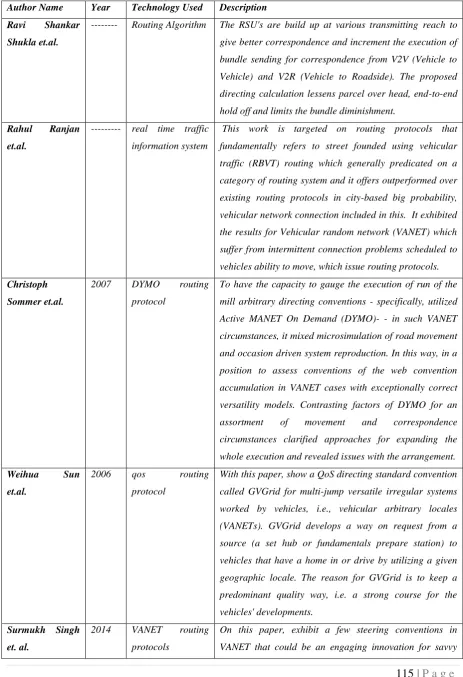
Table 4.1 Description of various algorithms
Author Name Year Technology Used Description
Ravi Shankar
Shukla et.al.
--- Routing Algorithm The RSU's are build up at various transmitting reach to give better correspondence and increment the execution of bundle sending for correspondence from V2V (Vehicle to Vehicle) and V2R (Vehicle to Roadside). The proposed directing calculation lessens parcel over head, end-to-end hold off and limits the bundle diminishment.
Rahul Ranjan
et.al.
--- real time traffic information system
This work is targeted on routing protocols that fundamentally refers to street founded using vehicular traffic (RBVT) routing which generally predicated on a category of routing system and it offers outperformed over existing routing protocols in city-based big probability, vehicular network connection included in this. It exhibited the results for Vehicular random network (VANET) which suffer from intermittent connection problems scheduled to vehicles ability to move, which issue routing protocols.
Christoph
Sommer et.al.
2007 DYMO routing protocol
To have the capacity to gauge the execution of run of the mill arbitrary directing conventions - specifically, utilized Active MANET On Demand (DYMO)- - in such VANET circumstances, it mixed microsimulation of road movement and occasion driven system reproduction. In this way, in a position to assess conventions of the web convention accumulation in VANET cases with exceptionally correct versatility models. Contrasting factors of DYMO for an assortment of movement and correspondence circumstances clarified approaches for expanding the whole execution and revealed issues with the arrangement.
Weihua Sun
et.al.
2006 qos routing
protocol
With this paper, show a QoS directing standard convention called GVGrid for multi-jump versatile irregular systems worked by vehicles, i.e., vehicular arbitrary locales (VANETs). GVGrid develops a way on request from a source (a set hub or fundamentals prepare station) to vehicles that have a home in or drive by utilizing a given geographic locale. The reason for GVGrid is to keep a predominant quality way, i.e. a strong course for the vehicles' developments.
Surmukh Singh
et. al.
2014 VANET routing protocols
116 | P a g e
transportation (It is). Also, it gave a few utilizations of VANET. The benefits and negative marks of the examined conventions are likewise characterized. By learning different directing conventions in VANET perceived various activity circumstances, we've inspected that more examination is required to confirm the numerous attributes of a steering conventions.
Qing Yang et.al. 2008 Adaptive
connectivity aware routing protocol
suggested an adaptive connection aware routing (ACAR) process that addresses these problems by adaptively selecting an maximum course with the best network transmitting quality predicated on the statistical and real-time thickness data that are compiled via an on-the-fly denseness collection process. The process contains two parts: 1) choose an optimal road, consisting of highway sections, with the best believed transmitting quality 2) in each street section in the preferred route, choose the most effective multi-hop journey that will improve delivery proportion and throughput.
Moez Jerbi et.al. 2009 efficient
geographic routing
this paper presents the better insatiable activity mindful directing standard convention (GyTAR), which can be a convergence based physical steering standard convention that is with the limit of discovering strong and perfect courses inside metropolitan situations. The essential idea driving GyTAR is the dynamic and in-succession gathering of crossing points by which information bundles are sent to the spots. The crossing points are picked considering factors like the left over separation to the excursion spot and the difference in vehicular movement. Information sending between crossing points in GyTAR receives a superior ravenous convey and-forward gadget.
Valery Naumov
et.al.
2007 Connectivity-aware routing (CAR)
117 | P a g e
of the possibility that it traveled an impressive separation from its first and foremost known area.
Sascha
Schnaufer et.al.
2008 Position-based unicast routing
concentrate existing position-based directing conventions and present Offer, system of ravenous steering with a theoretical neighbor work area. It recreated every standard convention in city condition of the Karlsruhe, involving streets with a measure of 66 kilometers, 390 intersections, and radio checks created from top notch dish pictures. What's more, it mimicked the conventions with a FACE-2-and a separation vector-based reclamation technique.
Tarik Taleb et.al. 2007 stable routing
protocol
This paper contends the usage of data on vehicles' movement data (e.g., position, course, speed, and advanced mapping of interstates) to conjecture a conceivable connection breakage occasion before its occasion. Vehicles are assembled identifying with their speed vectors. This kind of collection implies that vehicles, claimed by a similar gathering, will set up stable solo and multi-bounce pathways in light of the fact that they are moving together. Setting up courses that involve just vehicles from a similar gathering guarantees a high level of relentless correspondence in VANETs.
V. CONCLUSION
Vehicular Ad Hoc Networks (VANETs) have developed as another effective innovation which can be utilized
in wide territories of uses, for example, Rescue and reconnaissance operations, excitement and so on. For every
one of these applications, there is a prerequisite of productive directing procedures inside the imperatives for
example, high portability and consistent topological changes of the vehicles. This paper gives an entire scientific
categorization of different existing steering plans with their relative points of interest and disservices of each
other. For every classification of directing, a nitty gritty investigation is given in the content. At long last, a
correlation of different steering plans as for various parameters is additionally given.
REFERENCES
[1] Shukla, Ravi Shankar, Neeraj Tyagi, and Irfan Ali Khan. "Routing Algorithm for Vehicular Adhoc
Networks in Highway Scenario Environment."
118 | P a g e
[3] Ranjan, Rahul, Mohd Arif, and Mohammad Suaib. "Routing protocol for intermittent connected VANET
by using real time traffic information system."
[4] Sommer, Christoph, and Falko Dressler. "The DYMO routing protocol in VANET scenarios." Vehicular Technology Conference, 2007. VTC-2007 Fall. 2007 IEEE 66th. IEEE, 2007.
[5] Sun, Weihua, et al. "Gvgrid: A qos routing protocol for vehicular ad hoc networks." Quality of Service, 2006. IWQoS 2006. 14th IEEE International Workshop on. IEEE, 2006.
[6] Singh, Surmukh, and Sunil Agrawal. "VANET routing protocols: issues and challenges." Engineering and Computational Sciences (RAECS), 2014 Recent Advances in. IEEE, 2014.
[7] Yang, Qing, et al. "ACAR: Adaptive connectivity aware routing protocol for vehicular ad hoc
networks." Computer Communications and Networks, 2008. ICCCN'08. Proceedings of 17th International Conference on. IEEE, 2008.
[8] Jerbi, Moez, et al. "Towards efficient geographic routing in urban vehicular networks." IEEE Transactions on Vehicular Technology 58.9 (2009): 5048-5059.
[9] Naumov, Valery, and Thomas R. Gross. "Connectivity-aware routing (CAR) in vehicular ad-hoc
networks." INFOCOM 2007. 26th IEEE International Conference on Computer Communications. IEEE. IEEE, 2007.
[10] Schnaufer, Sascha, and Wolfgang Effelsberg. "Position-based unicast routing for city scenarios." World of Wireless, Mobile and Multimedia Networks, 2008. WoWMoM 2008. 2008 International Symposium on a. IEEE, 2008.