FACTS BASED STUDY BASED UP ON A DATA
MINING MODEL TO SAFEGUARD DATA
Chennupalli Ramesh Babu
1, Betam Suresh
2 1M.Tech Scholar (CSE), Vikas Group of Institutions, Nunna, A.P.,(India)
2
HOD, CSE at Vikas Group of Institutions, Nunna, A.P., Affiliated with JNTU Kakinada, (India)
ABSTRACT
Here in this paper we are introducing a new of data mining concept and that of the transaction process based
on flexible AC transmission system and thyristor controlled series compensator through these devices we can
identify the fault detection and the process of supply in effectiveness we can identify. If in FACTS base
transaction if it had not included it becomes the normal transaction line only, so we can call it’s an independent
transaction without FACTS. This independent lane has considered with the protected zone if that lane has the
less amount of rare transaction then the process will trip and the circuit may be break also. So to know and
proceed further we maintain our levels of transaction at two points through this we can stop some of the barrier
and current faults.
Index Terms:
FACTS, Faults, Transaction Line, Voltage.
I. INTRODUCTION
Now days the usage of bulk power transmission has increased in modern power in the network. And it led an
increased focus on the transmission line constraints, Flexible AC transmission system(FACTS) has supports the
flexible and an alternative conversational reinforcement process for the detection method not only that and
TCSC and UPFC these two are main and important in the FACTS which was used and most utilized in an
alternative system. And the main process of TCSC is to identify the fault detection and to maintain it in stable
level in power transmission and it’s a loop process of transaction. And the controller reactance of the process
has to define for the protection of the capacitors and air gaps has to be stop in the process to and to protect and
prefer more for more conversational and more relaying scheme based process for the limitations of the settings
and importance of the protection methods. In facts based transaction if there is no FACTS device the remaining
line of transaction will be an ordinary and it will be called as an independent line. If it has included the FACTS
device on the transmission lane then it can calculate the faults and based on that transmission and the
independent line will be compared with protective zone and it has maintained the less amount of transaction
process then it will be considered in node point and it will be trip to the process and stop that transaction into
that of particular time or else may be the circuit may break so for all these and to know the further steps of
process and to that the current level of transaction and for the future transaction process and the constant power
relay at the same point of method it has to stable or it has to be consider two constant points or else normal to
stable at the point of transaction and it was more reliable and accruable for to identify the fault zone in the
transaction here for this the more reliable transaction has required for the secure transaction of the process and
for the further process and to identify the fault transaction lanes from the source to the destination with the safe
manner and in the current zone we are proceeding with the TCSC transaction process to maintain the
process in the transaction process. Here in this paper we are implementing with the recent technique based on
the reliable and the aforementioned work has find the limitations and still the limit it has to reach and the
wavelet of transaction has highly form of noise and providers and it will provides anomies solution even in
single node of the transaction and the computational time of Support Vector machine SVM has an higher
comparability on proposed ensemble DTs based data transaction machines. And when of the situation we
consider speed and occurrence then that situation motivation will take place and faster data mining has to be
implement and the fast data transmission of fault detection has to identify the FACTS based solution. As we
know that we are using the Rout foresters for the transformation of fault zone assistance fact of transmission and
the half cycle post pals has assign for the current voltage and its samples are used as a input device of an RF
zone solution. Here in this paper we are implemented a technique of tested wide variation of parameter in the
power supply system in the network region. Including with the noisy and to the fault zone of the transaction
identification factor and that of related remaining concepts we can see in further steps as we follow. And now
we will see the Random Forests (RF) and in this each one of the RFs have a large number of decorated and the
combination of tree predicators so that means each tree will depend on the values of another transmission
random node and its value for sample identification factor f an independent transmission lane. Here each and
every individual nodes are noisy and unstable even tough when it riches the ground stage of stability it will
sufficiently relay on the base level of the law basis. And there we have some of an ideal constants for the
ensemble growth for the capable of the complex able interactive and since the single each every level have fully
and here we are using different types of random selected features and to slip that each and every node and to
re-assemble that nodes as well and to set each and every node in that tree has to be in growing position and to yield
the errors and the fault detection nodes in that process. And that it has a limit of transaction unto how much it
will reduce and increases the process of each and every node in the tree process and that of the process we can
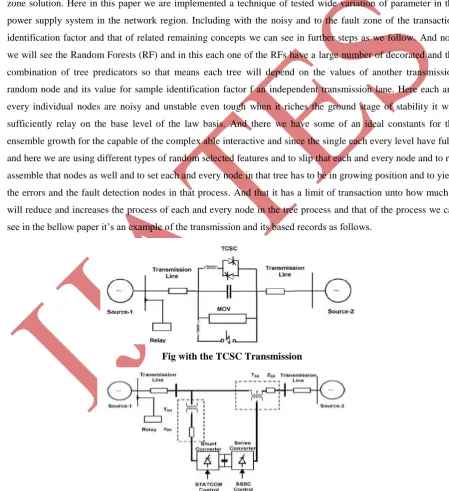
see in the bellow paper it’s an example of the transmission and its based records as follows.
Fig with the TCSC Transmission
This decision traditional trees has essentially replaced in the decision boundary and that of an instance is E we
can consider and it can be classified on the process and the probability of the class has same probably and the
estimation.
II. PROPOSED WORK
In the current system it has build an action of protection for the transmission lines and it held on statically
which means that we have the knowledge on the current accurate knowledge and of its process what is going on
the machine so for that process we have to maintain the current levels in the transmission lane. And also it has to
maintain the remote measurements of the possible things has to lead power lose some of the times and so
maintain that power we have to monitor that each and every time. To overcome all these things we proposed a
way of TCSC transmission mechanisms for the existing system that here we can see that as we extended the
existing definition modules and for that we are introduced the real time transmissions for the monitoring of the
current fluctuations of the system and to measure the voltage and the fault detection on FACTS based current
transmission lanes and the main theme for this is to reduce the wastage of the power and its flow in high and
lower voltages. Through this system we can relay the power grid quickly when the current voltage or the power
gets lags or higher than the normal transaction. We can maintain the graphical measurements and all things in
positive and in normal form. We can maintain the power on remotely and grid also in remotely. The main task
in this project is implementation after the design and the analysis of the project and the most it gives it gives the
confidence to the user to use and to work to know it can work perfectly. Here we have to check and to know a
the stages of process in step by step and we have to maintain it in each session to know the validation of FACTS
based system and its generated power of the things and here the FACTS based system is the main of the process
transmission line and for that we have install the current system and to assign that validations to the FACTS
based transmission line for all the intervals as well. And of the next step is to find frequency in remote stations
for these remote stations we had measured the value of frequency of monitoring system for to take the samples
on the system implementation in a particular time of process and in that time if it has increased or reached the
limit or level of lags then that time we will get an alert message and that message will display the content of
flow and the detection power in the circuit flowing On this system we are implemented a way and we kept two
steps for the lower and higher power circulating and the transmutation on the circuit has regularly generated one
value in randomly the value of the voltage we got and we are going in the steps of step by step identification of
the power supply of the data node transforming in to the system in each and every sec and then after when the
nodes has crossed the limitation of data in process of supplying the data in the circuit and its nodes we can
simply identify through the getting results of the each and every node has transformed for the destination from
the data source machine and all of its tree nodes we can see and that voltage also we can identify through this
we can stop the system and to product the circuit not to break in the general situation of heavy load process in
networks and systems by using the FACTS mechanisms While performing with SVM we have found that the
accurate observation has came as 99% above cases and in that if we paced RF it has compared up to93% of
SVM and with these both we are considering as a TCSC we can see an earlier research and above description
with the general occurrence. And it has not assessed with the noisy environment in this cases of issues we may
get the classification of noisy environment. And to that of the fault detector we can simply identify with the RF
generator and of its transmission which it can show the noisy immunity with the SVM and RF as well. in the
affliction` of reliable of cases is equal to the number of cases we are mis-detetected for the faults for the FACTS
application we are installed the power system to the FACTS based devices to identify the faults and of its
fluctuations on the process for all these things to work here and for all this we can know the process and in this
when user has connected his system/laptop to this device we can see the power flowing in the voltage based in
to the system for that here we are taken two points as a stages of imitations to the power supply that has the
minimum value and of the maximum value the power has to flow in this device must be and it should be in the
mist of these two points only when the device / system has connected to the FACTS device it shows the result
in the device in a form of process step by step and automatically it will update each and every step by the
process of voltage loading in the system and its total fluctuations on devices. In this it will shows the power
supply between the two limitation points and if that power has reached the higher or the lower level of that point
it will detect that two stages and it’s points also then that time it will display an error message to the users who
using that power system then that time user can identify the state of supplying of power in that system then he
can stop that system to save that not to break if in that case user had not identified and if has continued in that of
the situation it may break the system and that of the process circuit. So no to happen these type issues when the
user has used these systems it had not break and misuse the system and of that the process will continue through
this system we can survive the process of saving the power and t maintain our systems at the constant level of
power not to overload on the systems and safe manner through this paper we are proposed that way for the user
benefit and to get the valid results and to maintain our systems as a safe manner not to break the circuit devices
in case of power level is higher or is in lower level of the required state to the system.
III.
RESULTS
In proposed study we had set an existed set of generated data for to train the text cases and of its RF based data
mining process and to develop an accurate and of it robust classifiers for the fault detector zone identification on
FACTS based dat transformation line and here in this the total generated data has set for the TCSC lines and
these are between the 38400 and 43200 respectively. And here in this we just used 70% for the process and the
remaining 30% has for the test cases to check in the transmission lines and which is for the most generated
things and generated cases at the time of testing process and the RF was generated for the 100 times of data
build for the tree based accurate fault detector zone and here the results has came by the RF detector to compare
with the support machine. For the similar system usage and thorough this we implemented the process of
identifying and detecting the solution and that when the use was connected his system or his laptop here we are
identified that the voltage of current passing on the system we are implemented a way and we kept two steps for
the lower and higher power circulating and the transmutation on the circuit and regularly and randomly the
value of the voltage we got and we are going in the steps of step by step identification of the power supply of the
data node transforming in to the system in each and every sec and then after when the nodes has crossed the
limitation of data in process of supplying the data in the circuit and its nodes we can simply identify through the
getting results of the each and every node has transformed for the destination from the data source machine and
all of its tree nodes we can see and that voltage also we can identify through this we can stop the system and to
product the circuit not to break in the general situation of heavy load process in networks and systems by using
the FACTS mechanisms
IV. CONCLUSION
Here in this paper the proposed technique has providing the data mining concepts for the process and to
FACTS devices and the transmission of its based lanes with an accreted data readings and the reliability of
process has more than 99% RF trees for this we are maintaining a way of data mining algorithm for the
detection process trough this we has found the ¾ of the results has came on success to identify the transmission
lane power voltage. In the existing system it had not supported the fault detection of the process and its values
just it was taken values of supply only and for that we proposed SVM machines to identify the fault detections
and t modify it. Here in this the results will indicate the accelerations of the results and its reliable identifier will
compare the data of reading and to that modification we can simply display and we can find out the normal
results for the process.
REFERENCES
[1] A. Girgis, A. A. Sallam, and A. Karim El-din, “An adaptive protection scheme foe advanced series compensated
(ASC) transmission line,” IEEE Trans. Power Del., vol. 13, no. 2, pp. 414–420, Apr. 1998.
[2] M. Noroozian, L. Angquist, M. Ghandhari, and G. Anderson, “Improving power system dynamics by series
connected FACTS devices,” IEEE Trans. Power Del., vol. 12, no. 4, pp. 1635–1641, Oct. 1997.
[3] L. Gyugyi, “Unified power flow concept for flexible ac transmission systems,” Proc. Inst. Elect. Eng. C, vol.
139, no. 4, pp. 323–332, 1992.
[4] X. Zhou, H. Wang, R. K. Aggarwal, and P. Beaumont, “Performance of evaluation of a distance relay as applied
to a transmission system with UPFC,” IEEE Trans. Power Del., vol. 21, no. 3, pp. 1137–1147, Jul. 2006.
[5] K. EI-Arroudi, G. Joos, and D. T. Mcgills, “Operation of impedance protection relays with the STATCOM,”
IEEE Trasn. Power Del., vol. 17, no. 2, pp. 381–387, Apr. 2002.
[6] M. Khederzadeh and T. S. Sidhu, “Impact of TCSC on the protection of transmission lines,” IEEE Trans. Power
Del., vol. 21, no. 1, pp. 80–87, Jan. 2006.
[7] Y. H. Song, Q. Y. Xuan, and A. T. Johns, “Protection of scheme for EHV transmission systems with thyristor
controlled series compensation using radial basis function neural networks,” ElectricMach. Power Syst., vol. 25,
pp. 553–565, 1997
[8] Y. H. Song, A. T. Johns, and Q. Y. Xuan, “Artificial neural network based protection scheme for controllable
series-compensated EHV transmission lines,” Proc. Inst. Elect. Eng., Gen. Transm. Distrib., vol. 143, no. 6, pp.
535–540, 1996.
AUTHORS PROFILE
Chennupalli Ramesh Babu, pursuing M.Tech(CSE) from Vikas Group of Institutions
(Formerly known as Mother Theresa Educational Society Group of Institutions),
Nunna, Vijayawada. Affiliated to JNTU- Kakinada, A.P, India
Betam Suresh, is working as an HOD, Department of Computer science Engineering
at Vikas Group of Institutions (Formerly Mother Teresa Educational society Group of