Volume 2008, Article ID 803217,15pages doi:10.1155/2008/803217
Research Article
Novel Attacks on Spread-Spectrum Fingerprinting
Hans Georg Schaathun
Department of Computing, University of Surrey, Guildford, Surrey GU2 7XH, UK
Correspondence should be addressed to Hans Georg Schaathun,[email protected]
Received 9 May 2008; Accepted 7 August 2008
Recommended by Stefan Katzenbeisser
Spread-spectrum watermarking is generally considered to be robust against collusion attacks, and thereby suitable for digital fingerprinting. We have previously introduced the minority extreme attack (IWDW ’07), and showed that it is effective against orthogonal fingerprints. In this paper, we show that it is also effective against random Gaussian fingerprint. Furthermore, we develop new randomised attacks which counter the effect of the decoder preprocessing of Zhao et al.
Copyright © 2008 Hans Georg Schaathun. This is an open access article distributed under the Creative Commons Attribution License, which permits unrestricted use, distribution, and reproduction in any medium, provided the original work is properly cited.
1. INTRODUCTION
Unauthorised copying is a major worry for many copyright holders. As digital equipment enables perfect copies to be created on amateur equipment, many are worried about lost revenues, and steps are introduced to reduce the problem. Technology to prevent copying has been along for a long time, but it is often controversial because it not only prevents unauthorised copying, but also a lot of the legal and fair use.
A different approach to the problem is to deter potential
offenders using technology to allow identification after the
crime. Thus, the crime is not prevented, but the guilty users
can be prosecuted. If penalties are sufficiently high, potential
pirates are unlikely to accept the risk of being caught. One such solution is digital fingerprinting, first proposed
by Wagner [1]. Each copy of the copyrighted file is marked
by hiding a fingerprint identifying the buyer. Illegal copies can then be traced back to one of the legitimate copies and the guilty user be identified. Obviously, the marking must be made such that the user cannot remove the fingerprint without ruining the file. Techniques to hide data in a file in such a way are known as robust watermarking. All references to watermarking (WM) in this paper refer to robust watermarking.
A group of users can compare their individual copies
and observe differences caused by the different fingerprints
embedded. By exploiting this information they can mount
so-called collusive attacks. There is a growing literature
on collusion-secure fingerprinting, both from mathematical and abstract and from practical view-points.
In this paper, we focus on Gaussian, spread-spectrum fingerprinting, where each user is identified by a random, Gaussian signal which is added to the copyrighted file (host signal). Our main purpose is to demonstrate that there are
collusion attacks which are more effective than the ones
studied by Zhao et al. [2]. We make extensive experiments
to compare the various attacks. Our starting point is the
minority extreme attack introduced in [3] in a context of
non-Gaussian fingerprints.
The outline of the paper is as follows. We will introduce our model for fingerprinting in general and spread spectrum
fingerprinting in particular inSection 2. We introduce our
new collusion attacks inSection 3, and consider noise attacks
in Section 4. In Section 5, we make a further evaluation,
testing the attacks under different conditions. Finally, there
is a conclusion inSection 6.
2. FINGERPRINTING MODELS
There are several different approaches to fingerprinting. It is
often viewed as a layered system. In the fingerprinting (FP)
layer, each user is identified by a codewordc, that is, ann
-tuple of symbols from a discreteq-ary alphabet. If there are
Mcodewords (users), we say that they form an (n,M)qcode.
In the watermarking (WM) layer, the copyrighted file is
divided intonsegments. When a codewordcis embedded,
each symbol ofcis embedded independently in one segment.
Table1: Overview of notation used throughout.
Symbol Name
x Host signal (original, copyrighted file)
w(u) Watermark of useru
y(u)=x+w(u) Watermarked file distributed to useru
z Hybrid copy produced by the collusion
r=z−x Received watermark
r Received watermark after preprocessing
codes and was introduced in [4]. A number of competing
abstract models have been suggested, and mathematically secure solutions exist for most of the models.
In principle, any robust watermarking scheme can be used in the WM layer. However, there has been little research into WM systems which supports the abstract models assumed for the collusion-secure codes, thus it is not known whether existing collusion-secure is applicable to a practical
system. Recent studies of this interface are found in [5,6], but
they rely on experimental studies with few selected attacks, and the mathematical model has not been validated.
In this paper, we will consider a simpler class of solutions, exploiting some inherent collusion resistance in spread-spectrum watermarking. We focus on the solution suggested
in [2].
2.1. Spread-spectrum fingerprinting
We view the copyrighted file as a signal x = (x1,. . .,xN),
called the host signal, of real or floating-point values xi.
Each user u is identified by a watermark signal w(u) =
(w(1u),. . .,wN(u)) over the same domain as the host signal.
The encoder simply adds the two signals to produce a watermarked copyy(u)=(y(u)
1 ,. . .,y(Nu)) for distribution.
A goal is to design the watermarkw so that y and x
are perceptually as similar as possible. No perfect measure
is known to evaluate perceptual similarity. He and Wu [5]
use the peak signal-to-noise ration (PSNR). Zhao et al. [2]
consider thejust noticeable difference(JND) as the smallest,
perceptible change which can be made to a single sample, and they measure distortion as the mean square error (MSE) ignoring samples with distortion less than some threshold
(called JND). This heuristic is called MSEJND.
In the system of [2], which we study, the watermark
signals w(u) are drawn independently at random from a
normal distribution with varianceσ2=1/9 and meanμ=0.
It is commonly argued that in most fingerprinting applications, the original file will be known by the decoder,
so that nonblind detection can be used [2, 5]. Let z =
(z1,. . .,zN) denote the received signal, such as an intercepted
unauthorised copy. Knowingx, the receiver can compute the
received watermarkr=(r1,. . .,rN)=z−x, which is the input
to the decoder.
The adversary, the copyright pirates in the case of fingerprinting, will try to disable the watermark by creating
an attacked copyzwhich is perceptually equivalent toy, but
where the watermark cannot be correctly interpreted. In the
case of a collusion attack, there is a group of pirates each
possessing one watermarked copyyi.
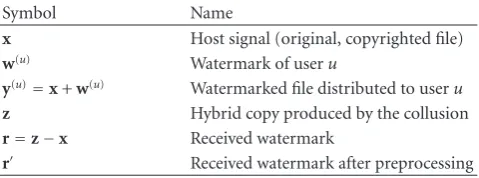
An overview of the symbols introduced can be seen in Table 1.
2.2. Fingerprint decoding
For any signals, letsdenote its average, that is
s=
N
i=1
si
N. (1)
The Euclidean norm is denoted by
s =Ni=1s2
i. (2)
The correlation of two signals is denoted by
s,s =
N
i=1
sisi. (3)
The simplest decoding algorithm would return the user
solving maxuw(u),r. This is sometimes used, but more
often some kind of normalisation is recommended.
2.2.1. The general decoder
Following [2], we study three heuristics which assign a
numerical value h(r,w) to any pair of signals r and w.
Each heuristichcan be used either for list decoding or for
maximum heuristic decoding. The latter returns the useru
solving maxh(r,w(u)). Alist decoder would return all users
usuch thath(r,w(u))≥τfor some thresholdτ.
The performance measure for a maximum heuristic decoder is simply the error rate. Only one user is output, who is either guilty (correct) or not (error). List decoder performance cannot be described by a single parameter. The output may be empty (false negative); it may include innocent users (false positive); or it may be a nonempty set of
guilty users only (correct decoding). The trade-offbetween
false positive and false negative error rates is controlled by
the thresholdτ.
One may also want to consider the number of guilty users returned by the list decoder. If two decoders have identical error rates, one would clearly prefer one which tends to return two guilty users instead of just one.
It should be noted that a list decoder can never have a higher probability of correct decoding than a maximum heuristic decoder for the same heuristic. When the list decoder decodes correctly, the user with the maximum heuristic will clearly be in the output set and also be correctly returned by the maximum heuristic decoder.
We will mainly consider the maximum heuristic decoder. This does provide a bound on the performance of a list decoder, and we avoid any potential controversies in the
2.2.2. Decoding heuristics
The so-called T statistic is simply normalised correlation,
defined as follows:
T(u)=r,w(u)
w(u) . (4)
From the attacker’s point of view, this is the easiest heuristic
to analyse, as it is linear in each sample ofr.
The most effective heuristic according to the experiments
of [2] is the so-calledZstatistic, defined as
Z(u)=1 2
N−3 log1 +ρu
1−ρu
, (5)
where
ρu=
(1/N)r,w(u) −r w(u)
σrσw(u) , (6)
where s is the mean ofsand σs is the empirical standard
deviation, that is,
σ2
s =
1 N−1
N
i=1
(si−s)2. (7)
The final statistic is theqstatistic, which is based on the
meanMu and standard deviationVu of the signal (riwi(u) |
i=1,. . .,N). It is defined as
q(u)= √
NMu Vu .
(8)
Observe thatMu= r,w(u)/N. Thus, all the three heuristics
are based on correlation.
2.2.3. Preprocessing
Zhao et al. [2] point out that the three decoding heuristics
presented have not been designed for collusion-resistance in particular. In order to improve the performance, they introduce a preprocessing step. The theoretical foundation is not very clear in their paper, but it works well experimentally. Our simulations have confirmed this.
They considered the histogram of the received watermark
rat the decoder for various attacks presented in Section 2.3.
The median, average, and midpoint attacks roughly produce normal distribution with zero mean. The Min and Max attacks give normal distributions with nonzero means (negative and positive means, resp.). The RandNeg attacks give a histogram with two peaks, one positive and one negative. Very few samples are close to zero.
In the case of the single peak, the preprocessor subtracts
the mean, to returnr=r−r. In the case of a double peak,
the samples are divided into two subsets, one for negative values and one for positive ones. The mean is calculated and subtracted independently for each subset.
Zhao et al. gave no definition of a peak in the histogram, and no algorithm to identify them automatically. As long as we are restricted to the known attacks, this is only a minor
problem. It is obvious from visual inspection which case we are in.
We will, however, introduce attacks where it is not clear which preprocessor mode to use. In these cases we will test both modes, so Preproc(1) denotes the preprocessor assuming two peaks, and Preproc(2) is the preprocessor assuming a single peak.
2.3. Spread spectrum collusion attacks
The collusion attack is mounted by a collusion of pirates,
each of whom has a watermarked copy y(u) perceptually
equivalent to the (unknown) host x. The most commonly
studied attacks are functions working independently on
each sample i, that is, zi = A(yi(u1),. . .,y
(ut)
i ), where P =
{y(u1),. . .,y(ut)}is the set of colluder watermarks.
Both randomised and deterministic attack functionsA
have been studied. In principle, A could depend on the
entire signal, and not only on the samples corresponding to the output sample, but this possibility has received little attention in the literature. Our starting point is the following
range of attacks which were analysed in [2].
Average: zi=
1 t
y∈P yi.
Minimum: zmin
i =min
y∈P yi.
Maximum: zmaxi =max
y∈P yi.
Median: zmedi =median
y∈P yi.
Midpoint (MinMax): zmidi =(zimin+zimax)/2.
Modified negative: zmodnegi =zmini +zimax−zmidi .
Randomised negative:
zrndnegi = ⎧ ⎨ ⎩
zmin
i with probability p,
zimax with probability 1−p,
(9)
It was assumed in [2], thatpfor the randomised negative
attack be independent of the signals{yi}.
The analysis of [2] demonstrated that the randomised
negative attack gave the highest error rate against decoders
without preprocessing. None of the attacks were effective
against decoders with preprocessing for the parameters studied. The average attack gives the lowest distortion of all the attacks. This is obvious as it is known as a good estimate
for the original hostx.
2.4. Collusion attacks and collusion-secure codes
It is instructive to consider attacks commonly considered in the literature on collusion-secure codes. Recall that the
fingerprintwin the context of collusion-secure codes is not
a numerical signal, but rather a word (vector) over a discrete
alphabetQ. The basic operations of average, minimum, and
maximum are not defined on this alphabet.
The so-called marking assumption defines which attacks
the pirates can produce an output symbol zi, if and only
if zi ∈ {y(iu1),. . .,y( ut)
i }. In a more realistic scenario [6,7],
the pirates can produce a symbolzi∈ {/ yi(u1),. . .,y(iut)}with
probabilityp. However, with probability 1−p, we havezi∈
{y(u1)
i ,. . .,y
(ut)
i }.
It is generally known that the so-calledminority choice
attack is very effective if correlation decoding (or, equiva-lently, closest neighbour decoding) is used. In this attack the
output is the symbolzi ∈ {y
(uj)
i | j =1,. . .,t}minimising
the number of colludersuwithyi(u)=zi.
The rationale for this attack is straight forward. All the
colluders u with y(iu) = zi gets a positive contribution
to the correlation from sample i; all the other users get a
negative contribution. Hence, the minority choice minimises the average correlation of the colluders.
The minority choice attack does not apply directly to Gaussian fingerprints. With each watermark drawn ran-domly from a continuous set, one would expect all the
samples y(iu)seen by the pirates to be distinct. However, we
will see that we can construct an effective attack based on the
same idea.
2.5. Evaluation methodology
There are two important characteristics for the evaluation of fingerprinting attacks.
Success rate:The attack succeeds when an error occurs at the watermark decoder.
Distortion:The unauthorised copy has to pass in place of the original, so it should be as close as possible to the
unknown signalxperceptually.
The success rate of the attack is the resulting error rate at the decoder/detector. As long as we use a maximum heuristic decoder, this is a single figure. In the event of list decoding, it
is more complex as explained inSection 2.2.1.
Distortion is, following [2], measured by the MSEJNDas
defined below.
Definition 1 (just notable difference). Given a signal x =
(x1,. . .,xN), thejust noticeable difference, JNDi, is the smallest
positive real number, such that x = (x1,. . .,xi−1,xi ±
JNDi,xi+1,. . .,xN) is perceptually different fromx.
In our simulations we have assumed, without loss of
generality, that JNDi=1 for alli. The general case is achieved
by scaling each sample of the fingerprint signal by factor of
JND−i1before embedding, and rescale before decoding.
Definition 2. The MSEJND between to signal x and y is
defined as
MSEJND=
N
i=1
[max{0, (|xi−yi| −JNDi)}]2. (10)
It is natural to expect low distortion from the average, median, and midpoint attacks. The pirate collusion is likely to include both positive and negative fingerprint signals. Consequently, these attacks are likely to produce a hybrid
which is closer to the original sample than any of the colluder fingerprints. On the contrary, the maximum, minimum, and randomised negative attacks would tend to give a very distorted hybrid, by using the most distorted version
of each sample. This is experimentally confirmed in [2,
8].
Not surprisingly, the most effective attacks are the most
distorting. The most effective attack according to [8] is the
randomised negative, but the authors raise some doubt that it be practical due to the distortion.
The performance of existing fingerprinting schemes and joint WM/FP schemes have been analysed experimentally or theoretically. Very few systems have been studied both experimentally and theoretically. In the cases where both theoretical and experimental analyses exist, there is a huge discrepancy between the two.
It is not surprising that theoretical analyses are more pessimistic than experimental ones. An experimental
sim-ulation (e.g., [5]) has to assume one (or a few) specific
attack(s). An adversary who is smarter (or more patient) than the author and analyst may very well find an attack
which is more effective than any attack analysed. Thus, the
experimental analyses give lower bounds on the error rate of the decoder, by identifying an attack which achieves the bound.
The theoretical analyses of the collusion-secure codes
of [4, 9, 10] give mathematical upper bounds on the
error rate under any attack provided that the appropriate marking assumption holds. Of course, attacks on the WM layer (which is not considered by those authors) may very well break the assumptions and thereby the system. Unfortunately, little work has been done on theoretical upper bounds for practical fingerprints embedded in real data.
In any security application, including WM/FP schemes, the designer has a much harder task than the attacker. The attacker only needs to find one attack which is good enough to break the system, and this can be confirmed experimentally. The designer has to find a system which can resist every attack, and this is likely to require a complex argument to be assuring.
This paper will improve the lower bounds (experimental bounds) for Gaussian spread spectrum fingerprinting, by identifying more complex nonlinear attacks, which are
more effective than those originally studied. These attacks
are likely to be effective against other joint schemes as
well.
3. THE NOVEL ATTACKS
In this section, we will consider four new classes of attacks. The minority extreme attack was introduced in a
different model in [3], and the uniform attack is
intro-duced in this paper. The last two classes of attacks are
hybrid attacks, behaving as different pure attacks either
Error rates
Number of pirates
20 30 40 50 60 70 80
Er
ro
r
rat
e
0 0.1 0.2 0.3 0.4 0.5 0.6 0.7
MX;Tstat. MX;Zstat. MX;qstat.
RandNeg;Tstat. RandNeg;Zstat. RandNeg;qstat.
Figure 1: Comparing MX against RandNeg. Decoding with preprocessing gives zero errors throughout.
Distortion
20 30 40 50 60 70 80
0 50 100 150 200 250 300 350 400
MMX RandNeg Average
Uniatk No attack Figure2: Distortion of pure attacks.
Letwube the watermark identifying useru, and letr =
z−xbe the hybrid watermark generated by the collusion. All
the heuristics we consider include the correlation
hu=r·w(u)= N
i=1
ri·w(iu). (11)
In order to avoid detection, the pirates should attempt
to minimise maxu∈Phu. Without complete knowledge of
the original host x and the watermark signals used, an
accurate minimisation is intractable. However, attempting
to minimise h = avgu∈Phu is a reasonable approximation,
and this can be done by minimising sample by sample,
avgu∈Pri·wi(u).
All the simulations in this section use sequences of length
n = 10 000 withM =512 users. The sequences are drawn
from a normal distribution of meanμ=0 and varianceσ2=
1/9.
With the exception of the code size (i.e., the number of
users), these are the same parameters as used in [2]. There are
two reasons for using larger codes. Firstly, it is hard to come up with plausible applications for small codes. Secondly, and more importantly, larger codes give higher error rates which can be estimated more accurately.
For each simulation, 1000 different codes are created,
and one hybrid fingerprint is generated and decoded for each code. Although this is a smaller sample size than the
2000 tests used in [2], it is appropriate for tuning the attack
parameters. In the next section we will run larger simulations for a more significant comparison to previous work.
3.1. The minority extreme attack
We introduced the moderated minority extreme (MMX)
attack in [3] in order to break the joint scheme of [5].
Consider the difference D = ziavg − zimid. Since zimid is
an unbiased estimate for the unknown host xi, a positive
D indicates that wi is probably positive. In this case, the
minimum attack is good for the pirates.
IfD ≈ 0, we expect that the choice forzi makes little
difference to the decoding. In this case, we outputzi =zito
minimise the distortion in the hybrid copy.
Definition 3(moderated minority extreme attack). LetDi=
ziavg−zmidi . The MMX attack for a given thresholdθoutputs
the hybrid signalzMMX(θ), where
ziMMX(θ)= ⎧ ⎪ ⎪ ⎪ ⎪ ⎨ ⎪ ⎪ ⎪ ⎪ ⎩
zimin ifDi≥θ,
ziavg ifθ > Di>−θ,
zimax ifDi≤ −θ.
(12)
The MMX attack with θ = 0 was called the minority
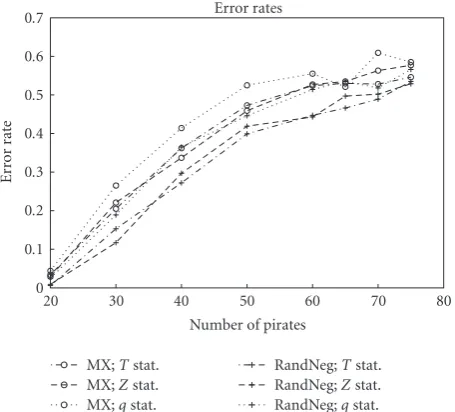
extreme (MX) attack [3]. Figure 1 shows a simulation of
the MX and RandNeg attack. We observe that the MX attack causes a slightly higher error rate, confirming that the
criterion thatD >0 is better than a random choice. However,
with preprocessing, the error rate is zero for both attacks. The average attack was tested as well, but it gave zero errors with all of the tested decoders. These results are consistent with
those reported in [2].
Figure 2shows, unfortunately, that the MX attack also causes about twice the distortion of RandNeg. Given the very modest increase in error rate, the MX attack is unlikely to be useful in itself.
3.2. The uniform attack
So far we have seen that the preprocessor of Zhao et al. is very
effective against the attacks considered to date. Somehow we
need to break the preprocessing scheme.
@(x)modxatk(x, 1, 2)
−2 −1.5 −1 −0.5 0 0.5 1 1.5 2 0
200 400 600 800 1000 1200
(a) MX attack @(x)modxatk(x, 0)
−01.5 −1 −0.5 0 0.5 1 1.5 50
100 150 200 250 300 350 400 450
(b) Uniform attack
Figure3: Histogram of a hybrid copies.
peak. An attack which produces a near-flat histogram seems the natural choice. Our proposal is to draw each hybrid sample a uniformly at random between the minimum and maximum observed. This is defined formally as follows.
Definition 4 (the uniform attack). The uniform attack
(“uniatk”) takestwatermarked signalsw(u), and produces a
hybrid copyzwhere each samplezuni
i is drawn independently
and uniformly at random on the interval [zmin
i ,zmaxi ].
Figure 3 shows example histograms of the MX and uniform attacks. We can clearly see how the MX attack gives a histogram resembling that of the RandNeg attack, while the uniform attack achieves the flatness sought.
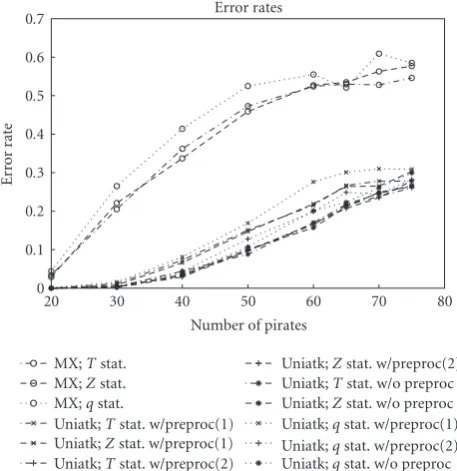
Figure 4shows simulations of the uniform attack com-pared to the MX attack. The important feature to note is that the behaviour is very similar for all the decoding options. The error rate is lower than for the MX decoder without preprocessor, but for the uniform attack the preprocessor
does not help. Furthermore, as seen inFigure 2, the uniform
Error rates
Number of pirates
20 30 40 50 60 70 80
Er
ro
r
rat
e
0 0.1 0.2 0.3 0.4 0.5 0.6 0.7
MX;Tstat. MX;Zstat. MX;qstat.
Uniatk;Tstat. w/preproc(1) Uniatk;Zstat. w/preproc(1) Uniatk;Tstat. w/preproc(2)
Uniatk;Zstat. w/preproc(2) Uniatk;Tstat. w/o preproc Uniatk;Zstat. w/o preproc Uniatk;qstat. w/preproc(1) Uniatk;qstat. w/preproc(2) Uniatk;qstat. w/o preproc Figure 4: Comparing the uniform attack against MMX and the classics.
attack causes very little distortion. For large collusions it seems to have an excellent potential.
3.3. Hybrid attacks
The uniform attack is the bluntest way to produce a flat histogram, and as we see, it breaks the preprocessing. An interesting question is if better attacks can be developed by combining the basic attacks already introduced. We
introducehybrid attacksas the attack is chosen independently
for each sample according to some probability distribution. InFigure 5, we have compared hybrid attacks which use
the uniform attack with probability 1−p, and, respectively,
the MMX or the RandNeg attacks with probability p. As
expected there is a significant difference between one-peak
and two-peak preprocessing, but the most interesting feature
is that different decoding strategies are optimal for different
p. The curves cross aroundp=0.3. Typical histograms at for
p=0.3 are shown inFigure 6.
At the expense of increased distortion, these hybrid attacks allows us to increase the error rates compared to the pure uniform attack. This is true up to the point, where the histogram gets a distinctive two-peak shape and Preproc(1)
becomes effective.
3.4. Hybrid attacks with MMX threshold
An alternative to the randomised hybrid attacks just described is to base the choice on a threshold. This is already
part of the idea in the MMX attack. If the heuristic Di is
Error rates for the RandNeg/uniform hybrid attack
Probability parameter (p)
0 0.1 0.2 0.3 0.4 0.5 0.6 0.7 0.8 0.9 1
Er
ro
r
rat
e
0.2 0.25 0.3 0.35 0.4 0.45
Tstat. w/preproc(1)
Tstat. w/preproc(2)
Zstat. w/preproc(1)
Zstat. w/preproc(2)
Tstat. w/o preproc
Zstat. w/o preproc (a) Error rate—RandNeg/uniform
Distortion for the RandNeg/uniform hybrid attack
Probability parameter (p)
0 0.1 0.2 0.3 0.4 0.5 0.6 0.7 0.8 0.9 1
D
ist
or
ti
on
10 20 30 40 50 60 70 80 90 100 110
(b) Distortion—RandNeg/uniform Error rates for the MMX/uniform hybrid attack
Probability parameter (p)
0 0.1 0.2 0.3 0.4 0.5 0.6 0.7 0.8 0.9 1
Er
ro
r
rat
e
0 0.1 0.2 0.3 0.4 0.5 0.6 0.7
Tstat. w/preproc(1)
Tstat. w/preproc(2)
Zstat. w/preproc(1)
Zstat. w/preproc(2)
Tstat. w/o preproc
Zstat. w/o preproc (c) Error rate—MX/uniform
Distortion for the MMX/uniform hybrid attack
Probability parameter (p)
0 0.1 0.2 0.3 0.4 0.5 0.6 0.7 0.8 0.9 1
D
ist
or
ti
on
0 50 100 150 200 250 300 350 400
(d) Distortion—MX/uniform Figure5: Comparing hybrid attacks fort=70 colluders.
MMX-2 attack, where the average is replaced by the uniform attack.
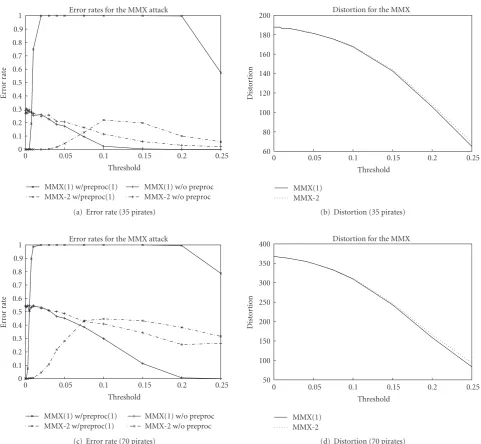
InFigure 7, we have simulated the MMX with different thresholds. The result is similar to what we saw for the previous hybrid attacks, but even more pronounced. The
single-peak preprocessor has no significant effect and has
been excluded from the figure. The two-peak preprocessor
is effective for small thresholds. The curves cross around
θ=0.08.
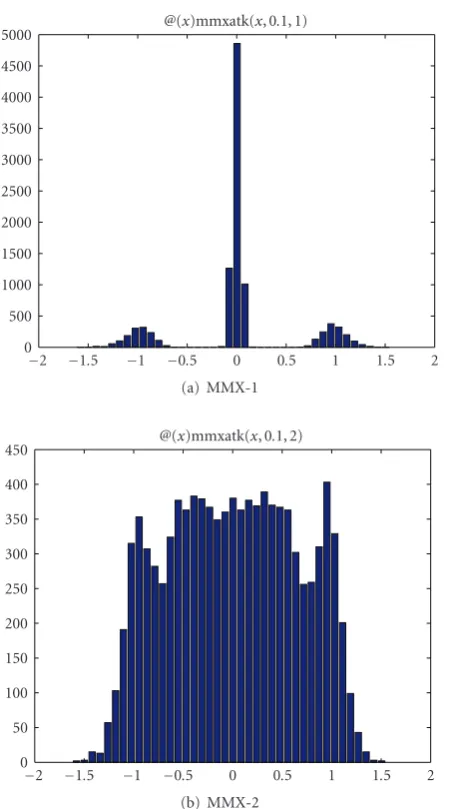
Typical histograms are shown in Figure 8at θ = 0.1.
For the MMX-2 attack, we have the same flattish histogram as before, and no obvious approach preprocessing can be seen. However, for the regular MMX(-1) attack, we see a new pattern, with three peaks. It seems plausible that
a preprocessor can be developed to decode correctly in this scenario, but, unless manual interference is acceptable, a strict definition of a peak would have to be devel-oped.
4. THE NOISE ATTACK
He and Wu [5], citing [2], claim that “a number of nonlinear
@(x)modxatk(x, 0.3)
−01.5 −1 −0.5 0 0.5 1 1.5 50
100 150 200 250 300 350 400 450 500
(a) Uniform/RandNeg
@(x)modxatk(x, 0.3, 2)
−2 −1.5 −1 −0.5 0 0.5 1 1.5 2 0
50 100 150 200 250 300 350 400 450 500
(b) Uniform/MX
Figure6: Histogram of hybrid copies from hybrid attacks withp= 0.3.
We consider the following two attacks:
averaging with Gaussian noise: zNG
i =zi+αNG,
averaging with Uniform noise: zNU
i =zi+αNU,
(13)
where NG is drawn from a standard normal distribution,
and NU is uniformly distributed on [−1/2, 1/2]. The first
simulation, fort = 70 pirates, is shown inFigure 9. As we
can see, both attacks are effective, but Gaussian noise causes
enormous distortion.
To get a better picture, we plot the noise attacks against
distortion in Figures 10 and11. We have shown decoding
of the noise attacks without preprocessor only; decoding
with preprocessing is less effective. Supported by Figure 7,
we decode the MMX attack without preprocessor only and MMX-2 without and with Preproc(1).
Three observations stand out as significant in this comparison:
(i) attacks with uniform noise are very effective for given
distortion compared to other attacks,
(ii) attacks with Gaussian noise are considerably less
effective than Uniform noise, and inferior to several
other attacks studied,
(iii) for few pirates (t = 35) the distortion/error rate
trade-off is much steeper for MMX-1 than for the
noise attack, and it outperforms it at high distortion (150–200).
Now, if a three-peak Zhao et al. type preprocessor is used, the
MMX-1 attack is likely to become ineffective.
We conclude that there may be some truth in the claims
that averaging attacks with added noise are the most efficient
attacks known to date. However, two important points have to be noted in this context. Firstly, the noise should not be Gaussian. We do not know if Uniform noise is optimal, or if an even better distribution can be found. Secondly, the preprocessor of Zhao et al. has to be developed further to be able to cope, automatically, with all the various attacks we have studied.
5. EVALUATION
In this section, we report additional simulations of the
attacks which have proved most effective so far, to see how
they compare under different conditions, that is, varying t,
M, andn.
We have not include simulations with real images, because all the processes studied are oblivious to any added host signal. The detector is nonblind so any host added would be subtracted before detection. Also the attacks would
be unaffected by the added host signal. Hence, simulations
with real hosts would not give us any additional information. The constants, namely, the power of the fingerprint and
the value of the Just Noticeable Difference would be scaled
by the same factor according to perceptibility constraints in the same image. As stated, we have used the values suggested
in [2], and a further study of these parameters is outside the
scope of this paper.
None of the attacks discussed in Section 2.3, nor the
MX attack, are effective against the preprocessor. Hence, the
interesting attacks for further study are the hybrid attacks, the MMX attack with nonzero threshold, and the Uniform noise attack. The Uniform attack is a special case of the hybrid attack.
5.1. The Zhao et al. parameters
In this section, following [2], we assumeM = 100 users.
We have used Uniform noise with scaling factor 2.2, and
Gaussian noise with power 0.47. The MMX-1 attack is with
θ=0.05, and MMX-2 withθ=0.08. The hybrid attacks are
withp=0.25.
The results, shown in Figures12and13, confirm what
Error rates for the MMX attack
Threshold
0 0.05 0.1 0.15 0.2 0.25
Er
ro
r
rat
e
0 0.1 0.2 0.3 0.4 0.5 0.6 0.7 0.8 0.9 1
MMX(1) w/preproc(1) MMX-2 w/preproc(1)
MMX(1) w/o preproc MMX-2 w/o preproc (a) Error rate (35 pirates)
Distortion for the MMX
Threshold
0 0.05 0.1 0.15 0.2 0.25
D
ist
or
ti
on
60 80 100 120 140 160 180 200
MMX(1) MMX-2
(b) Distortion (35 pirates)
Error rates for the MMX attack
Threshold
0 0.05 0.1 0.15 0.2 0.25
Er
ro
r
rat
e
0 0.1 0.2 0.3 0.4 0.5 0.6 0.7 0.8 0.9 1
MMX(1) w/preproc(1) MMX-2 w/preproc(1)
MMX(1) w/o preproc MMX-2 w/o preproc (c) Error rate (70 pirates)
Distortion for the MMX
Threshold
0 0.05 0.1 0.15 0.2 0.25
D
ist
or
ti
on
50 100 150 200 250 300 350 400
MMX(1) MMX-2
(d) Distortion (70 pirates) Figure7: The MMX attack with different thresholds.
different decoders, and the best attacks achieve error rates
pe ≈6% against the best decoder. It seems that the
param-eters of [2] suffice to ensure reasonable robustness against
known nondesynchronising attacks. However, we have also confirmed that with our novel attacks, properly tuned, the preprocessing algorithm does not improve detection.
It is also confirmed that averaging with uniform noise
is among the most efficient attacks. It is not feasible to run
enough simulations to determine the optimal noise power or
MMX thresholds for every numbert of pirates. Thus, this
simulation is insufficient to determine if one attack is strictly
better under any given conditions.
The choice of decoding heuristic seems to matter very
little, although theq statistic is consistently outperformed.
No clear distinction can be made between the Z and T
statistics. InFigure 13we show onlyZdecoding.
5.2. List decoding
Since list decoding is more popular than maximum heuristic decoding in the fingerprinting literature, we will have a brief look at this as well, for comparison.
We have seen that the Uniform noise attack (scale 2.2)
gives an error rate of about 5% witht=70 colluders using
maximum heuristic decoding (3% att=35). The resulting
MSDJNDdistortion (not normalised) is about 100–150. This
is slightly less distortion than the RandNeg attack at t =
70 and slightly more at t = 35. Simulations are shown in
Figure 14.
The experiment is conducted as follows. We generate a
setGoft“guilty” codewords and a setIof 100−t
“inno-cent” codewords. The average of the “guilty” codewords is
@(x)mmxatk(x, 0.1, 1)
−2 −1.5 −1 −0.5 0 0.5 1 1.5 2 0
500 1000 1500 2000 2500 3000 3500 4000 4500 5000
(a) MMX-1 @(x)mmxatk(x, 0.1, 2)
−2 −1.5 −1 −0.5 0 0.5 1 1.5 2 0
50 100 150 200 250 300 350 400 450
(b) MMX-2
Figure 8: Histogram of a hybrid copies with MMX attacks at thresholdθ=0.1.
The Z statistic Z(u) is calculated for every user u ∈ G∪
I. This experiment is repeated 2000 times, and for each
iteration jwe keep the following data:
Gj=
Z(u) :u∈G, Ij= {Z(u) :u∈I},
gj=max
u∈GZ(u), ij=maxu∈I Z(u).
(14)
We estimate the expected number of false positivesE(PF) and
true positivesE(PT) at a given thresholdτ, as
E(PF)=#
h∈
j
Gj:h≥τ
,
E(PT)=#
h∈
j
Ij:h≥τ
.
(15)
We have plottedE(PF) againstE(PT) for varying thresholdτ
inFigure 14(left-hand side).
Error rates for averaging attack with noise
Scaling factor
0 0.5 1 1.5 2 2.5 3 3.5 4 4.5 5
Er
ro
r
rat
e
0 0.1 0.2 0.3 0.4 0.5 0.6 0.7 0.8 0.9
Gaussian w/preproc(1) Uniform w/preproc(1) Gaussian w/preproc(2)
Uniform w/preproc(2) Gaussian w/o preproc Uniform w/o preproc (a) Error rate
Distortion for averaging with noise
Scaling factor
0 0.5 1 1.5 2 2.5 3 3.5 4 4.5 5
Er
ro
r
rat
e
0 0.5 1 1.5 2 2.5×10
5
Gaussian Uniform
(b) Distortion
Figure 9: The averaging with noise attack by 70 pirates with different thresholds.
The probabilitypcof at least one correct output and the
probabilitypf of at least one false negative are estimated as
pc=#{j|ij≥τ}, pf =#{j|gj≥τ}. (16)
Figure 14(right-hand side) shows pcplotted against pf for
varying thresholds.
As we can see, the different attacks have similar
perfor-mances. We observe that with t = 70 and pf = 5%, we
get only pc ≈ 80%, even in the best case for the decoder.
The noise attack gives pc ≈70%. Fort =35 colluders and
pf = 3% we have pc ≈ 80% against the noise attack. It
Error rate against distortion
Distortion
0 50 100 150 200 250
Er
ro
r
rat
e
0 0.05 0.1 0.15 0.2 0.25 0.3 0.35
Gaussian noise Uniform noise MMX w/o preproc
MMX-2 w/o preproc MMX-2 w/preproc(1) (a) 35 pirates
Error rate against distortion
Distortion
0 50 100 150 200 250
Er
ro
r
rat
e
0 0.05 0.1 0.15 0.2 0.25 0.3 0.35 0.4 0.45
Gaussian noise Uniform noise MMX w/o preproc
MMX-2 w/o preproc MMX-2 w/preproc(1) (b) 70 pirates
Figure10: Noise versus the MMX attacks.
If we requirepf ≤1% as assumed in [2], the detection
rate for the noise attack att=70 is little more than 20%, and
att=35 it is about 50%.
5.3. Scalability
So far we have considered very small codes, which are unlikely to be of practical use. One real appli-cation of fingerprinting is for the issue of screening copies for the academy awards (“Oscar”). (See, e.g., http://www.msnbc.msn.com/id/4037016.) In this scenario the number of users is in the order of 5000. It is hard to come up with real applications with fewer users, so we
Error rate against distortion
Distortion
0 50 100 150 200 250
Er
ro
r
rat
e
0 0.05 0.1 0.15 0.2 0.25 0.3 0.35
Gaussian noise Uniform noise RandNeg/uniform RandNeg/uniform w/preproc(1)
RandNeg/uniform w/preproc(2) MMX/uniform
MMX/uniform w/preproc(1) MMX/uniform w/preproc(2) (a) 35 pirates
Error rate against distortion
Distortion
0 50 100 150 200 250
Er
ro
r
rat
e
0 0.05 0.1 0.15 0.2 0.25 0.3 0.35 0.4 0.45 0.5
Gaussian noise Uniform noise RandNeg/uniform RandNeg/uniform w/preproc(1)
RandNeg/uniform w/preproc(2) MMX/uniform
MMX/uniform w/preproc(1) MMX/uniform w/preproc(2) (b) 70 pirates
Figure11: Noise versus hybrid attacks.
run one set of simulations forM = 5000. We assumed an
averaging attack with uniform additive noise on the interval
[−1.1, 1.1].
In coding theory and communications, it is normally expected that a well-designed code can scale freely
keep-ing the rate R = (logM)/n constant. With M =
5000 users and the rate of the (10 000, 100) code, we
get n = 18 500. The result was an error rate of
71.2%, so evidently Gaussian fingerprinting does not scale
Error rate-noise attacks
10 20 30 40 50 60 70
0 0.01 0.02 0.03 0.04 0.05 0.06 0.07
Gaussian/qstat. Gaussian/Tstat. Gaussian/Zstat.
Uniform(2.2)/qstat. Uniform(2.2)/Tstat. Uniform(2.2)/Zstat.
(a) Noise attacks
Error rate (uniform attack)
0 10 20 30 40 50 60 70
0 0.005 0.01 0.015 0.02 0.025 0.03 0.035
Zstat./no preproc
Zstat./preproc(1)
Zstat./preproc(2)
qstat./no preproc
qstat./preproc(1)
qstat./preproc(2)
Tstat./no preproc
Tstat./preproc(1)
Tstat./preproc(2) (b) Uniform attack
Error rate (MMX-1)
0 10 20 30 40 50 60 70
0 0.01 0.02 0.03 0.04 0.05 0.06 0.07 0.08
Zstat./no preproc
Zstat./preproc(2)
qstat./no preproc
qstat./preproc(2)
Tstat./no preproc
Tstat./preproc(2)
(c) MMX-1
Error rate (MMX-2)
0 10 20 30 40 50 60 70
0 0.01 0.02 0.03 0.04 0.05 0.06 0.07 0.08
Zstat./no preproc
Zstat./preproc(1)
Zstat./preproc(2)
qstat./no preproc
qstat./preproc(1)
qstat./preproc(2)
Tstat./no preproc
Tstat./preproc(1)
Tstat./preproc(2) (d) MMX-2
Error rate (MX/uniform)
0 10 20 30 40 50 60 70
0 0.01 0.02 0.03 0.04 0.05 0.06
Zstat./no preproc
Zstat./preproc(1)
Zstat./preproc(2)
qstat./no preproc
qstat./preproc(1)
qstat./preproc(2)
Tstat./no preproc
Tstat./preproc(1)
Tstat./preproc(2) (e) Uniform/RandNeg hybrid
Error rate (MX/uniform)
0 10 20 30 40 50 60 70
0 0.01 0.02 0.03 0.04 0.05 0.06
Zstat./no preproc
Zstat./preproc(1)
Zstat./preproc(2)
qstat./no preproc
qstat./preproc(1)
qstat./preproc(2)
Tstat./no preproc
Tstat./preproc(1)
Tstat./preproc(2) (f) Uniform/MX hybrid
Error rate
0 10 20 30 40 50 60 70
0 0.01 0.02 0.03 0.04 0.05 0.06 0.07
Gaussian noise Uniform noise(2.2) MMX-1 w/o preproc MMX-1 w/preproc(2) MMX-2 w/o preproc MMX-2 w/preproc(1) MMX-2 w/preproc(2) RandNeg/uni. w/o preproc
RandNeg/uni. w/preproc(1) RandNeg/uni. w/preproc(2) MX/uni. w/o preproc MX/uni. w/preproc(1) MX/uni. w/preproc(2) Uniform atk w/o preproc Uniform atk w/preproc(2) (a) Error rate
Distortion
0 10 20 30 40 50 60 70
0 50 100 150 200 250 300 350
Gaussian noise Uniform noise MMX-1 MMX-2 RandNeg/uniform MX/uniform Uniform attack
(b) Distortion Figure13: Large simulation withM=100 users and 25 000 tests, withZstatistic decoding only.
Table2: Error rates after the Uniform noise attack witht = 70 pirates, for various sequence lengthsnand numbersMof users. Simulation based on 1000 samples.
(n,M) R Pe
(10000, 100) 6.64·10−4 6.6
(18500, 5000) 6.64·10−4 71.2
(23500, 3000) 4.92·10−4 52.1
(21500, 1500) 4.91·10−4 44.7
(19500, 750) 4.90·10−4 27.2
(20000, 200) 3.82·10−4 7.9
(25000, 500) 3.59·10−4 16.5
(50000, 2000) 2.19·10−4 11.6
(50000, 1000) 1.99·10−4 6.4
(50000, 500) 1.79·10−4 3.2
A larger range of code parameters are shown inTable 2.
Admittedly, a small sample has been used, to get results in reasonable time, but the tendency is clear and consistent. Keeping constant rate, the error rate increases dramatically when the code size increases.
Codebooks of nM ≈ 108 is close to the limits of
what we can simulate with our current crude Matlab implementation on a 32-bit system. Codebook storage may very well be the limiting factor also for practical applications, even though somewhat larger codebooks could
be made possible by a more efficient implementation. The
largest codebooks that we have tried would use 400 Mb at single precision. Significantly larger codebooks would
probably have to be generated on the fly by a pseudoran-dom number generator, so that only the seed has to be stored.
6. CONCLUSION
We have performed an extensive experimental analysis of collusive and noise attacks on Gaussian spread-spectrum fingerprinting, and introduced a couple of novel attacks. Below, we will itemise what we consider the main out-comes of our study, as well as the key questions left open.
6.1. Observations made
(i) The MX attack introduced in [3] is effective against
common decoders withZ,T, orqstatistics. However,
it is not effective against the preprocessor of Zhao
et al.
(ii) The parameters suggested by Zhao et al. appear to give a fairly robust system against known (nondesyn-chronising) attacks.
(iii) The uniform attack, as well as hybrid attacks based thereon, break the Zhao et al. preprocessor.
(iv) Averaging combined with Gaussian noise is not an
effective attack compared with the other attacks
studied.
(v) Averaging combined with Uniform noise is very
effective. It seems to outperform the other attacks
Expected number of output users (35 pirates)
Correct detection
0 5 10 15 20 25 30 35
Fa
ls
e
p
o
si
tiv
es
0 10 20 30 40 50 60 70
MMX-1 (0) [1] MMX-1 (1) [3] MMX-1 (2) [5] MMX-2 (0) [7] MMX-2 (1) [9] MMX-2 (2) [11] RandNeg/uniform (0) [13]
RandNeg/uniform (1) [15] RandNeg/uniform (2) [17] MMX/uniform (0) [19] MMX/uniform (1) [21] MMX/uniform (2) [23] Uniform Noise (0) [25] (a)t=35 returned user
Probability of error rate (35 pirates)
Correct detection
10−1 100
Fa
ls
e
p
o
si
tiv
es
10−2
10−1
MMX-1 (0) [1] MMX-1 (1) [3] MMX-1 (2) [5] MMX-2 (0) [7] MMX-2 (1) [9] MMX-2 (2) [11] RandNeg/uniform (0) [13]
RandNeg/uniform (1) [15] RandNeg/uniform (2) [17] MMX/uniform (0) [19] MMX/uniform (1) [21] MMX/uniform (2) [23] Uniform Noise (0) [25] (b)t=35 error event
Expected number of output users (70 pirates)
Correct detection
0 10 20 30 40 50 60 70
Fa
ls
e
p
o
si
tiv
es
0 5 10 15 20 25 30
MMX-1 (0) [2] MMX-1 (1) [4] MMX-1 (2) [6] MMX-2 (0) [8] MMX-2 (1) [10] MMX-2 (2) [12] RandNeg/uniform (0) [14]
RandNeg/uniform (1) [16] RandNeg/uniform (2) [18] MMX/uniform (0) [20] MMX/uniform (1) [22] MMX/uniform (2) [24] Uniform Noise (0) [26] (c)t=70 returned user
Probability of error rate (70 pirates)
Correct detection
10−1 100
Fa
ls
e
p
o
si
tiv
es
10−2
10−1
MMX-1 (0) [2] MMX-1 (1) [4] MMX-1 (2) [6] MMX-2 (0) [8] MMX-2 (1) [10] MMX-2 (2) [12] RandNeg/uniform (0) [14]
RandNeg/uniform (1) [16] RandNeg/uniform (2) [18] MMX/uniform (0) [20] MMX/uniform (1) [22] MMX/uniform (2) [24] Uniform Noise (0) [26] (d)t=70 error event
Figure14: List decoding performance. The left-hand figures show the probability of at least one true positive against the false positive rate. The right-hand figures show the average number of true and false positives for different thresholds.
(vi) Gaussian fingerprinting does not scale well from an information theoretic perspective.
Based on these observations, we conclude that the analysis of new fingerprinting schemes requires attention to a wider range of possible attacks than those considered in the
literature. We have introduced a number of attacks worth mentioning, but we do not claim to have found them all.
6.2. Questions left open
to be slightly harder than the analysis of previous attacks [2], leading to more complicated formulae.
From an applied viewpoint, a more important question is how a complete fingerprint system can be designed. Very little research exists on watermarking robust against desynchronising attacks, and nobody has yet considered a combination of collusion attacks and desynchronisation. In a real scenario, the attackers will have such attacks at their disposal in addition to what we have studied.
In our analysis we have been assuming that the correct preprocessor mode can be easily determined, and we also supposed that it can be extended for a three-peak histogram. At present this is, at best, true using manual inspection. Fur-ther research is needed to implement automatic histogram analysis and application of the optimal preprocessor. It is also
an open question if sufficient information is available from
the histogram.
Another open direction in research is the application
of collusion-secure codes (e.g., [4, 6, 9]) in a practical
watermark/fingerprint system. Since Gaussian fingerprints do not scale well, they may have to be combined with an
outer,q-ary, collusion-secure code. In this case,qGaussian
sequences would be used to represent theq-ary symbols of
the outer codewords.
REFERENCES
[1] N. R. Wagner, “Fingerprinting,” inProceedings of the IEEE Symposium on Security and Privacy (SP ’83), pp. 18–22, Oakland, Calif, USA, April 1983.
[2] H. Zhao, M. Wu, Z. J. Wang, and K. J. R. Liu, “Forensic analysis of nonlinear collusion attacks for multimedia fingerprinting,”
IEEE Transactions on Image Processing, vol. 14, no. 5, pp. 646– 661, 2005.
[3] H. G. Schaathun, “Attack analysis for He&Wu’s joint water-marking/fingerprinting scheme,” in Proceedings of the 6th International Workshop on Digital Watermarking (IWDW ’07), vol. 3304 ofLecture Notes in Computer Science, pp. 134–145, Springer, Guangzhou, China, December 2007.
[4] D. Boneh and J. Shaw, “Collusion-secure fingerprinting for digital data,”IEEE Transactions on Information Theory, vol. 44, no. 5, pp. 1897–1905, 1998.
[5] S. He and M. Wu, “Joint coding and embedding techniques for multimedia fingerprinting,”IEEE Transactions on Information Forensics and Security, vol. 1, no. 2, pp. 231–247, 2006. [6] H. G. Schaathun, “On error-correcting fingerprinting codes
for use with watermarking,”Multimedia Systems, vol. 13, no. 5-6, pp. 331–344, 2008.
[7] H.-J. Guth and B. Pfitzmann, “Error- and collusion-secure fingerprinting for digital data,” in Proceedings of the 3rd International Workshop on Information Hiding (IH ’99), vol. 1768 of Lecture Notes in Computer Science, pp. 134–145, Springer, Dresden, Germany, September-October 1999. [8] H. Zhao, M. Wu, Z. J. Wang, and K. J. R. Liu, “Nonlinear
col-lusion attacks on independent fingerprints for multimedia,” inProceedings of IEEE International Conference on Acoustics, Speech and Signal Processing (ICASSP ’03), vol. 5, pp. 664–667, Hong Kong, April 2003.
[9] G. Tardos, “Optimal probabilistic fingerprint codes,”Journal of the ACM, vol. 55, no. 2, article 10, pp. 1–24, 2008.