STUDENT TEACHERS LEARNING TO THINK, KNOW, FEEL AND ACT LIKE A TEACHER: THE IMPACT OF A MASTER OF TEACHING AND LEARNING
PROGRAMME Steven S. Sexton
College of Education, University of Otago, PO Box 56, Dunedin, New Zealand 9054
Abstract
This study reports on how a new master’s degree level Initial Teacher Education (ITE) initiative in New Zealand impacted on student teachers (n = 26) sense of self-as-teacher. A mixed-methods approach examined how the programme’s design of realistic teacher education, reflexivity and learning to become adaptive experts challenged these student teachers’ sense of self-efficacy and concerns about teaching. Two survey instruments Teachers’ Sense of Efficacy Scales (Long Form) and Concerns About Teaching were used. Student teachers’ survey responses and student teacher initiated topics of concern were explored in weekly focus group sessions. Results indicate that the programme’s design provided the transformative experiences necessary for these student teachers to learn how to think, know, feel and act like a teacher.
Key words: initial teacher education, student teaching, primary teacher education, secondary teacher education
1. INTRODUCTION
Initial teacher education (ITE) in New Zealand is at a crossroad. For the past two decades, those seeking to gain ITE qualifications completed either an undergraduate degree programme or a one-year graduate diploma. In 2013, the Ministry of Education invited tertiary providers to develop one-year course-taught master’s level ITE programmes for Primary (students aged 5-12) and/or Secondary (students aged 13-19) education. Three tertiary providers were awarded contracts to pilot their programmes in 2014 (Parata, 2014). It is widely anticipated that these new ITE programmes signal New Zealand’s intention to follow the Scandinavian countries’ Nordic model of education (Antikainen, 2006).
In an investigation into the Nordic model of education, Antikainen (2006) reported, “training of teachers for liberal upper secondary school education in all Nordic countries is subject-specific, and teachers must be university graduates” (p. 231). He then noted that in Finland, “training of primary school teachers and nursery teachers is also a Master’s degree” (p. 231). Antikainen (2006) highlighted that just increasing the content of instruction does not help, as learning to learn is required. Feiman-Nemser (2008) examined this concept of learning to teach.
According to Feiman-Nemser (2008), teachers need more than subject matter knowledge. She argued that teachers’ learning to teach required, “learning to think like a teacher, learning to know like a teacher, learning to feel like a teacher, and learning to act like a teacher” (p. 214). Unfortunately, for initial teacher education Feimen-Nemser notes that typical ITE programmes are not well aligned with what is known about teaching and learning to teach. She reported that ITE programmes are often unrelated courses intermixed with school-based experiences. She highlighted the design principles that research has shown to make a difference: a continuum of learning opportunities, knowledge connected to practice, transforming beliefs, learning situated in practice, and critical colleagueship. Feiman-Nemser (2008) cautioned that while learning to teach required practice, the adage “that practice makes perfect’ was incorrect, ‘to learn well from experience, teachers need time, space and frameworks to analyse their teaching and its effects on students” (p. 213). A programme designed to support and facilitate student teachers’ learning from their experience was the explicit intend of this study’s Master of Teaching and Learning (MTchgLn) programme.
2. MASTER OF TEACHING AND LEARNING
This paper reports on one of the new ITE initiatives in New Zealand. This study’s MTchgLn programme was a one-year course-taught master’s level degree programme for both Primary (students aged 5-12) and Secondary (students aged 13-19) teacher candidates. While this programme did not have a thesis component, it did embed a yearlong self-study into how the student teachers developed their self-as-teacher role identity over the course of the programme.
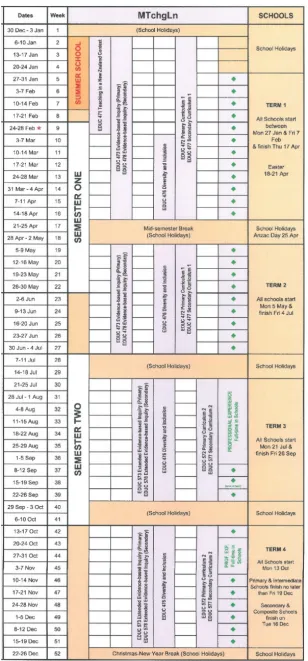
This programme’s design addressed the ITE programme limitations raised by Feiman-Nemser (2008) about typical teacher education programmes being a disjointed mix of courses and school-based experiences. Student teachers in this programme spent 114 days at University and 112 days in one of the programme’s partner schools (see Figure 1). In 2014, this programme began on January 6th with a three-week intensive block of course content to prepare the student teachers for their classroom experiences. The partner schools began their 2014 school year on January 27th. This started a weekly pattern of three days a week at University (Monday, Tuesday and Friday) and two days a week in a partner school setting (Wednesday and Thursday). This pattern was repeated for the first twenty-one weeks (see Figure 1, ♦ denotes which weeks of the school term that the student teachers were in a partner schools for two days per week) of the school year. These student teachers’ University and partner school setting learning opportunities were designed to connect the programme’s theoretical knowledge to realistic teaching practice (Feiman-Nemser, 2008). It was anticipated that this interaction of learning opportunity, knowledge, and practice in an atmosphere of critical colleagueship would influence how these student teachers saw themselves in the role as the teacher (Feiman-Nemser, 2008).
Figure 1: MTchgLn 2014 Year Plan
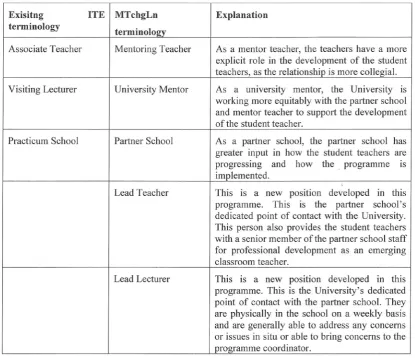
This new programme was designed to work collaboratively with its partner schools as they are a significant component of this programme. Over the course of this programme, the student teachers were in a partner school for two days a week for 31 weeks of the school year and for two sustained teaching block placements of seven-weeks and three-weeks (see Figure 1). Student teachers were welcomed formally into their partner school and undertook new staff induction with any other new staff joining the school. This programme made explicit shifts from how students, schools and teachers were positioned from the University’s existing ITE programmes (see Table 1).
Table 1: MTchgLn
The student teachers worked with a mentor teacher. This new terminology shifting from the University’s existing ITE programmes was a deliberate move towards a model of Professional Experience (practicum) where student teachers are seen as contributing members of a school and mentor teachers are co-learners. These mentor teachers understood that the student teachers were an active participant in the learning process. Mentor teachers agreed not only to facilitate learning conversations that challenged the student teachers based on their classroom practice but also to assist the student teachers in gathering and analysing student-learning data in order to inform next steps/different approaches in their learning. The partner school assigned a senior member of staff as a lead teacher to support the mentor teachers. The lead teacher ensured all aspects of the school-based requirements of the programme were met, such as identifying suitable service projects within the school community. The University allocated one staff member to liaise with the partner school’s lead teacher through a lead lecturer. The lead lecturer liaised with the lead teacher to identify common challenges and to provide feedback about the school-based experience to the programme. The lead lecturer supported the student teachers in development of the e-portfolios to evidence their progress
towards meeting the graduating teacher standards required for professional teacher registration (see, http://www.teacherscouncil.govt.nz/content/graduating-teacher-standards). Finally, the university mentors provided guidance, support and pastoral care to the student teacher as he or she worked towards achieving their teaching goals and professional experience requirements. The university mentor observed the student teacher in the classroom and provided oral and written feedback to the student and the mentor teacher.
3. PROGRAMME DESIGN 3.1 Phase 1
The MTchgLn programme was designed around three key pedagogies: Realistic teacher education (Korthagen, Kessel, Kosters, Lagerwerf, and Wubbels, 2008, Korthagen, Loughran, and Russell, 2006); reflexive teachers (Cunliffe, 2004) and adaptive experts (Timperley, 2013). These three key pedagogies signalled three phases in the programme. Phase 1 began with the initial three-week block, which required these student teachers to make explicit their preconceptions about education. At the end of the three-week block, these student teachers presented how they saw the role of the teacher, student, learning, and ability based on their prior schooling experiences. This was the programme’s overt attempt for the student teachers to recognise that, “student teachers enter teacher education with knowledge, attitudes, and beliefs that are deeply rooted in the years of experiences that they had as students within the educational system” (Korthagen et al., 2008, p. 39). Realistic teacher education requires student teachers to build upon their prior experiences as students in the classroom as they process the, “needs, concerns, values, meanings, preferences, feeling, and behavioural tendencies” (Korthagen et al., 2008, p. 42) or gestalts in their learning to take on the role of the classroom teacher. Korthagen et al. (2008) noted that experience is a starting point for learning; however, for gestalts student teachers need sufficient practical experiences. These practical experiences need to support the relationship between theoretical and practical components of ITE. While ITE programmes may benefit from starting from practical experiences, or including sustained teaching experiences within the programme, this is not a guarantee of success (Korthagen et al., 2008). This study’s MTchgLn programme design sought to capitalise on the benefits of both school-based practice and periods of sustained teaching practice (see Figure 1). Student teachers began the school year spending two days a week in their partner school to gain experiences in teaching practice. These two days a week teaching experiences were designed to provide these student teachers with sufficient and regular opportunities to alternate between teaching practice and time for reflection on practice (Korthagen et al., 2008). 3.2 Phase 2
Phase 2 built on the realistic teacher education’s focus on the student teachers’ experiences and gestalts with reflexive narratives (Cunliffe, 2004). Cunliffe (2004) defines reflexivity as, “examining critically the assumptions underlying our actions, the impact of those actions, and from a broader perspective, what passes as good management practice” (p. 407). While Cunliffe was referring to management education, critical reflexivity encourages people to, “become critical thinkers and moral practitioners” (Cunliffe, 2004, p. 408) and this MTchgLn programme sought to develop these characteristics in these student teachers. As critical reflexivity draws attention to the three issues of: existential, relational and praxis. These three issues must be explicit so that critical reflexivity does not become just another disjunction between theory and practice but “a philosophy-driven practice in which we take responsibility for creating our social and organizational realities” (Cunliffe, 2004, pp. 408-9).
3.3 Phase 3
As the student teachers took on more and more of the day-to-day responsibilities of their mentor teacher during school terms 1 and 2, they begin to learn the daily routines of the classroom and the characteristics of their students. Phase 3 began with the seven-week block of sustained teaching. This teaching experience was designed with the intent that the student teachers would put into everyday
practice their initial forays into becoming adaptive experts (Timperley, 2013). Adaptive experts are, “driven by the moral imperative to promote the engagement, learning, and well-being of each of their students” (Timperley, 2013, p. 5). It was anticipated that as student teachers progressed through this programme, the structured experiences both within the University and partner schools would support these student teachers in developing critical reflexivity of own practice as a central tenet of their future self-regulated learning as classroom teachers.
3.4 The study
As this MTchgLn programme is the first of its kind in New Zealand, no other New Zealand studies were available to compare this programme’s student teachers to how other master’s level student teachers developed their sense of self-as-teacher. International studies, however, have reported that student teachers enter their ITE programmes with a high sense of self-efficacy (Brookhart and Freeman, 1992, Fives and Buehl, 2010, Haverback, 2009). Similarly, there is a body of research into the realty shock that preservice teachers experience entering the classroom (Cooper and He, 2012, Postlethwaite and Haggarty, 2012, Wubbels, 1982).
This paper reports on the first half of this 2014 MTchgLn programme for both primary and secondary student teachers. Specifically this study used both quantitative and qualitative methodology to investigate the following research question:
Research Question: How is this one-year course taught master’s level programme in initial teacher education influencing how these student teachers are developing their sense of self-as-teacher as they learn to think, know, feel, and act like a teacher?
4. METHOD 4.1 Participants
The participants were n = 26 student teachers in the Master of Teaching and Learning programme in Primary and Secondary Education at a large university in New Zealand. These student teachers ranged in age from 21 to 41 with a median age of 24.3. There were n = 18 females and n = 8 males, of which n = 10 Primary candidates and n = 16 Secondary candidates. Twenty-three (88%) self-reported their ethnicity as New Zealand European, two (8.5%) as Māori (New Zealand Indigenous) and one (3.5%) as Pacific Islander.
This programme attracted a range of student teachers. Of the participating n = 26 student teachers: two were registered teachers seeking to retrain in another sector. One in Early Childhood and the other in Secondary, both were retraining in Primary. Three had taught in educational settings either in New Zealand or overseas that did not require teaching qualifications, and the remaining twenty-one student teachers entered the programme with no teaching background or experience.
To determine the impact of this programme on how student teachers saw themselves developing in learning how to think, know, feel and act like a teacher two surveys and focus group sessions were used in this study:
• Teachers’ Sense of Efficacy Scale (TES) (Long Form) (Tschannen-Moran and Woolfolk Hoy, 2001)
• Concerns About Teaching (CAT) (Smith, Corkery, Buckley, and Calvert, 2013) • Focus group sessions, conducted weekly with the student teachers.
4.2 Surveys
The Teachers’ Sense of Efficacy Scale (TES) (Long Form) was chosen as it has established reliability and addresses the following three efficacy areas: student engagement (α = .81), classroom management (α = .86) and instructional strategies (α = .86) (Tschannen-Moran and Woolfolk Hoy, 2001). The survey consists of 24 items. Participants are asked to give their opinion on the items using
a five-point Likert scale ranging from 1 to 9 answering the question ‘How much can you do?’ A response of 1 indicates the answer, ‘nothing,’ 3 indicates, ‘a very little,’ 5 ‘some influence’, 7 quite a bit’ and 9 ‘a great deal.’ As participants are provided with a range from 1 to 9, this allows participants to select the half-way points of 2, 4, 6 and 8.
The Concerns About Teaching (CAT) survey was chosen as it has been modified for the New Zealand context (Smith et al., 2013). Prior to classroom experience the survey has yielded an α = .94 and after student teachers’ classroom experience α = .83 for personal issues, α = .76 for university/mentor teacher support, and α = .72 for work-life balance. The 17 items in the modified survey ask participants to offer their opinion on each statement. The participants are asked to use a six-point Likert scale: 1 - Strongly Disagree, 2 - Moderately Disagree, 3 - Disagree, 4 - Agree, 5 - Moderately Agree and 6 - Strongly Agree.
4.3 Procedure
Ethics was obtained prior to beginning this study. The student teachers were informed that their participation was voluntarily. To facilitate this study, the student teachers were requested to include their names on their surveys only if they wanted the researcher to be able to correlate individual student’s responses from one data collection point to another. All twenty-six of the student teachers in the programme agreed to have their responses tracked over the course of this study. The student teachers are referred to only by a pseudonym as a means to ensure confidentiality.
Both surveys were administered sequentially (first TES and then CAT) at the beginning of the programme (January 6th, 2014) to determine the student teachers’ initial sense of efficacy and concerns before any programme content or school-based experiences. Surveys were administered similarly a second time after their first twelve-weeks of school-based experiences as this corresponded to the completion of the first term in the New Zealand school system (May 5th).
Surveys were planned to be administered twice more. The third time at the completion of the seven-week block as this corresponded to the end of their first sustained period of teaching (September 8th). The fourth and final time after they completed their three-week sustained teaching as the student teachers shifted to a second school setting to put into practice all their newly developed skills and strategies in a new educational setting (November 10th). The third and fourth data collection points were discontinued at the student teachers’ request. These student teachers felt they had been surveyed, interviewed and researched enough by the programme’s New Zealand Teachers Council appointed external evaluator, the Ministry of Education’s contracted evaluator, and the four research projects initiated by University staff members. They did agree to complete online surveys after their seven-week and three-seven-week teaching placements that focused only on their teaching practice and how they felt they were prepared and supported by the programme for these placements.
4.4 Focus group sessions
The student teachers were invited to attend weekly focus group sessions on how they were experiencing the programme to include both University-based instruction and their school-based experiences. These weekly one-hour sessions started when the student teachers began their school-based experiences in a partner school and occurred outside regular programme delivery time. These sessions were not a programme requirement and student teachers attended them voluntarily. As their school-based experiences were on Wednesday and Thursday, these sessions occurred on Friday mornings to facilitate the student teachers’ critical reflexivity. Of the 26 student teachers in the programme, 23 attended regularly.
These focus group sessions were informal, unstructured and comments recorded by pen and paper as notes so as to present a casual atmosphere of collegial sharing. The content was student driven. The sessions occurred in a classroom at the University and the student teachers were free to come and go. These sessions allowed the student teachers regular opportunities to discuss and address issues and concerns around how they were learning to think, know, feel and act like a teacher.
This study’s researcher facilitated these sessions. When the researcher noted a particular comment by a student teacher, the student teacher was contacted by email. These email exchanges allowed the student teacher to elaborate on what they meant and ensured that the researcher accurately reported the student teacher’s concern, comment, or opinion.
5. DATA ANALYSIS
The quantitative data was analysed using SPSS Version 22. SPSS allowed for descriptive statistics for the two surveys used in the study. The qualitative data generated from the focus group sessions provided supporting student voice to the quantitative data. The student teachers comments were explored by email correspondence to support the findings from their surveys.
6. RESULTS
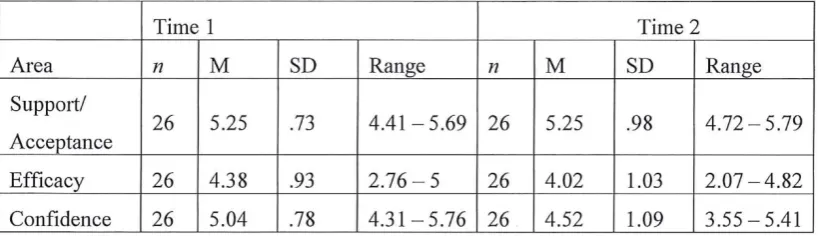
The study’s research question sought to investigate how this newly developed Master of Teaching and Learning programme influenced how the student teachers were learning to think, know, feel and act like a teacher. These results show how the programme has begun to affect these student teachers’ sense of self-as-teacher. Table 2 presents the Teachers’ Sense of Efficacy Scale (TES) (Long Form) results from Time 1 and Time 2. Table 3 presents the participants Time 1 and Time 2 responses to the Concerns About Teaching (CAT) survey.
Table 2: Teachers’ Sense of Efficacy Scale (TES) (Long Form)
Table 3: Concerns About Teaching (CAT)
7. DISCUSSIONS AND CONCLUSIONS 7.1 Time 1 (T1)
As stated, the first administration of the survey instruments occurred prior to any of the student teachers experiencing any course content or programme teaching experiences. A B+ average in their final-year of undergraduate study or proven postgraduate academic ability was one of the entry requirements for this programme. As a result, it was anticipated that the students entering this programme would have had a history of academic success and a favourable self-efficacy in their abilities. This was reflected in the initial responses to four items on the TES rated above 7.5 indicating respondents felt they are able to do more than quite a bit:
• How much can you do to help your students think critically? (7.83)
• To what extend can you make your expectations clear about student behaviour? (8) • How much can you do to get students to believe they can do well in school work? (8.07) • How much can you do to improve the understanding of a student who is failing? (7.69)
In addition to these four items, three other items indicated that these student teachers entered this programme with a strong sense of efficacy in their abilities:
• How much can you do to get through to the most difficult students? (7.41) • How much can you use a variety of assessment strategies? (7.24)
• How well can you provide appropriate challenges for very capable students? (7.45)
The only item on the survey rated below 6.69 was item 19: How well can you keep a few problem students from ruining an entire lesson? These student teachers believed that they would still be able to have more than some influence (5.93) in accomplishing this. As stated, five of the student teachers entered this programme with some prior experience in a teaching: Daniel, Mary, John, Dorothy and Amy. Daniel, Mary and John taught overseas, Dorothy in science education outreach programmes, and Amy in early childhood (students aged 0-5) education. Their TES scores ranges from 5.98 to 7.98 with a mean of 6.79, while their colleagues who entered with no prior teaching experience had averages ranging from 5.69 to 8.22 with a mean score of 6.43. It would appear that those student teachers entering with prior experience did not have significant differences from their colleagues in how they saw their own self-efficacy at the start of this programme. Similar to whether a student teacher entered with or without prior experience, whether a student teacher was entering primary or secondary education also did not appear to be a notable difference in these student teachers’ reported initial self-efficacy. The primary student teachers averaged 6.87 while their secondary counterparts averaged 7.09. This sense of self-efficacy was reflected in the responses to the CAT survey.
Of the seventeen items on the CAT survey, seven were rated at ‘Mostly Agree’ or higher: • I am emotionally prepared to be a teacher. (5)
• I am confident that my literacy skills are sufficient for planning lessons and preparing teaching material. (5.38)
• I will receive support from my associate teachers while I’m on practicum. (5.28) • My lecturers will be supportive. (5.62)
• My family will be supportive of my becoming a teacher. (5.69) • My friends will be supportive of my becoming a teacher. (5.52) • I will be a reliable, punctual, and dependable colleague. (5.76)
The only item that was rated below 4.31 (slightly higher than ‘agree’) was item 13: My teaching experiences will be free of stress, which was reported at 2.76 (more than just ‘disagree’). So while
these student teachers self-reported a high sense of self-efficacy and belief in their abilities to be a teacher, they recognised that learning to teach would be stressful. Ann (primary) is an example of the strong sense of self-efficacy these student teachers held at the beginning the school-based experience: At this stage, I had such determination and high expectations to be the adaptive teacher, aiming to promote learning, engagement and wellbeing for all students. I also had a sense of complete uncertainty and unsettled expectancy as I began my observation in the school, overwhelmed by all of the information to absorb, while trying to blend into the school environment and social community. I was daunted by the idea of fulfilling the high expectations of teaching, without having any understanding of any curriculum content or really, what actually happened in a primary classroom.
Ann begin discussing the high expectations she had of herself and what she would be like in the classroom and then ended knowing all of this was without any knowledge of what was actually going to happen in the classroom. In the sixth week of the programme (February 10th – 14th), the student teachers were required to establish four personal learning goals (and the steps they would take over the course of this programme to achieve them) based on what they believed they needed to accomplish in learning to become the teacher. After the first two weeks (four days of school-based observation of various classes) in her partner school, Ann was beginning to question her initial sense of self-efficacy. Ten weeks later at the completion of the school year’s first teaching term, Ann was able to acknowledge that her original goals were not realistic but she had been able to see her own personal growth:
This year, so far has been a non-stop roller coaster and has whizzed by without the politeness of allowing me to catch up and take the lead. Through this fast-paced journey, I feel as though I have not had enough time to focus on my goals, which I had so enthusiastically planned to accomplish. On the other hand, this date also seems so long ago, as I have come so far and grown as the teacher so much.
This critical self-reflection of beginning to think, know, feel, and act like a teacher was reflected across the cohort in these student teachers’ responses to the second administration of the surveys. 7.2 Time 2 (T2)
As stated, the second administration of the surveys on May 5th occurred after the student teachers had completed the first term of the school year. In 2014, this first term was 12 weeks long and provided the student teachers with 24 days of school-based experiences. There were five notable shifts in how these student teachers saw their own sense of self-efficacy in teaching. This study defined a notable shift as a change in the average score on either survey of more than .5.
These student teachers’ rated themselves as being less able to get through difficult students, T1 – 7.41 and T2 – 6.21. This trend was similar for: being less able to help students who are failing (T1 – 7.68 down to 6.72); being less able to use a variety of assessments (T1 – 7.24 down to 6.65); being less able to respond to defiant students (T1 – 6.86 down to 6.10); and being less able to influence students beliefs that they can do well in school (T1 – 8.07 down to T2 – 7.21). It should be noted that there was a downward shift in every item of the TES with the exception of item 19: How well can you keep a few problem students from ruining an entire lesson. This item remained 5.93. Only six of the respondents rated the survey item the same on both administrations of the survey, however, the average for both T1 and T2 remained 5.93.
Sarah (secondary) explained how the school-based experiences were influencing how she saw herself becoming the teacher. In a discussion around the student teachers’ challenges in classroom practice, Sarah commented:
Timperley [as stated, one of the three key pedagogies for this programme – adaptive experts, see Timperley, 2013] states that teachers still need to master particular routines within teaching to become an adaptive expert, within my school practises I am still attempting to find my personal routine within teaching before I am able to subject myself to these adaptive expertise strategies.
Sarah talked about how she needed to find first her own personal style of teaching before she was going to be able to put into practice any adaptive strategies. Dorothy (primary) provided an explicit
account of how her reflexive journal of classroom experience was challenging her sense of self-as-teacher:
The concept of teacher self-efficacy did not prepare me for the challenge to my own self-efficacy when in the first few days of teaching, a student stormed off into a corner during maths. After careful consideration, I realised how often I asked a question then immediately followed it with an additional leading question. This insight jolted my sense of the type of teacher I thought I was.
Sarah and Dorothy entered this programme after years of being the successful student. Both knew the type of teacher they wanted to be and how they wanted their students to see them, based on those teachers from their own prior schooling experiences. What they did not expect was that they were not this teacher already.
Sarah came into the programme with the expectation that while not all of her students might enjoy her secondary school subject as much as she does, she would be able to engage them all. The first term of her teaching experience has challenged her sense of self-as-teacher. She still felt like a teacher due to the successes that she had with some of her students, but has now come to realise it is going to take time and effort to be able to know and act like the teacher she wants to be. Similarly, Dorothy accepted that not all students will be engaged in every lesson of every day of primary school, but she thought her own passion and enthusiasm would bring her students around. What she was not expecting was to have how she thought of herself as a teacher or how she acts in the classroom as the teacher challenged.
Similar to the anticipated changes to these student teachers’ sense of self-efficacy, the programme expected changes to their initial responses on the CAT survey (Smith et al., 2013). During this first term in their educational setting, the student teachers were expected to take on more of the roles and responsibilities of the classroom teacher. By the end of Term 1, the primary student teachers were required to have taken responsibility for one reading and one mathematics group and whole class daily routines. Then in Term 2, increase this responsibility to half the reading and mathematics groups. Secondary students were required to prepare and begin implementing a teaching plan that allowed them to teach at least twenty full lessons by the end of Term 2 in both their major and minor subjects (for example History and Social Studies, Biology and General Science, or Physical Education and Health).
As a result, of their classroom experiences, these student teachers had four notable shifts in their concerns. These student teachers were beginning to question their own academic ability. There was a shift in their scores from T1 to T2, 4.93 down to 4.27. This shift was repeated in how prepared these student teachers saw themselves being in transitioning the class from the mentor teacher to them in control, T1 – 4.31 down to T2 – 3.55. This could account for the shift in the stress these student teachers were experiencing in their teaching, T1 – 2.76 down to T2 – 2.06. One concern the students had that highlighted their confusion in learning to teach was in how the student teachers saw their values matching the school’s, T1 – 4.34 down to T2 – 3.79 while at the same time reporting that they felt more a part of the school now that they have been there for 12 weeks, T1 – 4.43 up to T2 – 4.72. It is noted that students feeling they are more a part of the school was not a notable shift (change = +.29) but it was the only positive shift in scores from T1 to T2 for either survey.
7.3 Student teachers’ learning to think, know, feel and act like a teacher
One of the purposes of ITE is to challenge student teachers’ naïve preconceptions of teaching and being the teacher (Fives and Buehl, 2010, Stuart and Thurlow, 2000, Weinstein, 1990). It would appear that this MTchgLn programme’s realistic teacher education (Korthagen et al., 2008, Korthagen, Loughran, and Russell, 2006) combined with explicit reflexivity (Cunliffe, 2004) and adaptive experts (Timperely, 2013) did have the programme’s desired impact on how these student teachers were learning to think, know, feel and act like a teacher.
These student teachers support research that preservice teachers concerns change toward a more realistic view of teaching over the course of their training (Lamote and Engels, 2010, Smith et al., 2013, Smith, Klein, and Mobley, 2007). Mark (secondary) discussed this issue when reflecting back
on his four learning goals, “the learning goals that were set at the start of the year were often naïve in the way that they were not considered in terms of practicality and how this practicality would have relevance to practice.” While Mark does not think that his goals for learning to become a teacher were inappropriate or misguided, he did not expect the time, effort, thought and energy that he would have to put into planning, preparing and teaching a subject he has studied for more than half his life. Mark was beginning to realise that passion and his own competence in a subject are only part of the requirements in being able to teach.
These student teachers’ experiences in reconciling their expectations with actual experiences support the research that authentic experiences are critical to developing teacher efficacy (Gurvitch and Metzler, 2009). Wyatt (secondary) described how this programme’s design of putting the theory in practice to have authentic opportunities of practicing the theory changed his sense of self-as-teacher: With regard to developing conceptual frameworks of teaching, I have had to change my entire approach to teaching, learning to construct activities around learning intentions rather than simply transmitting the knowledge into the students’ minds via a PowerPoint Presentation. By asking students to write answers on the board and recording their authentic responses to questions, I have tried to listen far more attentively to their voices and the language in which they express their ideas. I no longer see assessment as a means of filtering students into bright and dumb on the basis of an exam, but rather as an ongoing form of feedback that motivates learning and provides suggestions along the way.
Wyatt’s prior experiences in educational settings resulted in him seeing his role as a teacher to transmit the information necessary for students to achieve similar successes. Wyatt’s school-based experiences have challenged this view of being the teacher. While Wyatt’s prior successes as a student shaped the way he wanted to see himself in the classroom, he has come to realise that what worked for him was not working for his students. After only the first twelve weeks of school-based experiences, Wyatt saw the need to change what he thinks was an effective teacher.
This programme and its student teachers created an environment where the student teachers felt comfortable enough to question their own teaching practice openly. These student teachers took advantage of the opportunities to engage in critical reflexive dialogue with both themselves through their reflexive journals, course assessments and with other student teachers and the study’s researcher in weekly focus group sessions. Realistic teacher education is evidence-based practice but this evidence is based in the student teachers’ own teaching practice.
Jeremy (secondary) provided an example of how this programme’s design supported his developing sense of self-as-teacher:
Establishing the concept of the type of teacher, I want to be, is something that will remain fluid all throughout my teaching career and I expect to continue to develop every day I teach. I have developed a stronger sense of who I am as a teacher but this can never be fully complete, as I will never stop developing as a teacher.
Jeremy entered this programme with no prior experiences in teaching but would appear to be on his way to becoming a reflexive teacher. He did not see himself rigidly trying to enact a predetermined sense of self-as-teacher. He acknowledged that while he has a greater sense of what he thinks was necessary; he would continue to work on this throughout his teaching career. Even more encouraging to this study’s researcher, Sally (primary) commented on how this programme was facilitating her learning, feeling, knowing and acting like a teacher:
Bolstad, Gilbert and the others [a text critically examined in the prgramme, see Bolstad et al., 2012] suggest that rather than seeing learning as either being ‘student centred’ or ‘teacher driven,’ we should instead think about the ways that teachers and learners can create and share a reciprocal knowledge building learning environment. It seems to me that this programme is consistent with this line of thought.
8. FINAL THOUGHTS
This study’s MTchgLn programme supported these student teachers in using their own classroom experiences in a reflexive process to facilitate gestalts. It was anticipated that these student teachers’ initial sense of self-efficacy would be challenged by the realities of classroom experience as seen by the changes from T1 and T2 surveys. Realistic teacher education builds on student teachers’ own experiences, perceptions, thinking, feelings, and concerns in which they were actively involved (Korthagen et al., 2008). This was evident in the weekly focus group sessions. These sessions provided these student teachers with a regular opportunity to discuss how their classroom experiences were affecting their sense of self-efficacy. These sessions also provided these student teachers with the support and guidance necessary to use their experiences as an opportunity for growth and learning.
REFERENCES
ANTIKAINEN, A. 2006. In search of the Nordic model in education. Scandinavian Journal of Educational Research, 50, 229-243.
BOLSTAD, R., GILBERT, J., WITH MCDOWALL, S., BULL, A., BOYD, S. & HIPKINS, R. 2012. Supporting future-oriented learning and teaching - a New Zealand perspective. Wellington, New Zealand: New Zealand Council for Educational Research.
BROOKHART, S. M. & FREEMAN, D. J. 1992. Characteristics of entering teacher candidates. Review of Educational Research, 62, 37-60.
COOPER, J. E. & HE, Y. 2012. Journey of "Becoming": Secondary Teacher Candidates' Concerns and Struggles. Issues in Teacher Education, 21, 89-108.
CUNLIFFE, A. L. 2004. On becoming a critically reflexive practitioner. Journal of Management Education, 28, 407-426.
FEIMAN-NEMSER, S. 2008. Learning to teach. In: GOODMAN, R., FLEXNER, P. & BLOOMBERG, L. (eds.) What we now know about Jewish education: Perspectives on research for practice. Los Angeles: Torah Aura.
FIVES, H. & BUEHL, M. 2010. Examing the factor structure of the Teachers' Sense of Efficacy Scale. Journal of Experimental Education, 78, 118-134.
GURVITCH, R. & METZLER, M. W. 2009. The effects of laboratory-based and field-based practicum expereiences on pre-service teachers' self-efficacy. Teaching and Teacher Education, 25, 437-443.
HAVERBACK, H. R. 2009. A fresh perspective on preservice teacher reading efficacy beliefs. Reading Improvement, 46, 214-220.
KORTHAGEN, F., LOUGHRAN, J. & RUSSELL, T. 2006. Developing fundamental principles for teacher education programs and practices. Teaching and Teacher Education, 22, 1020-1041.
KORTHAGEN, F. A. J., KESSELS, J., KOSTER, B., LAGERWERF, B. & WUBBELS, T. 2008. Linking practice and theory: The pedagogy of realistic teacher education, New York, NY, Routledge.
LAMOTE, C. & ENGELS, N. 2010. The development of student teachers' professional identity. European Journal of Teacher Education, 33, 3-18.
MINISTRY OF EDUCATION 2007. The New Zealand Curriculum. Wellington, New Zealand: Learning Media, Ltd.
PARATA, H. 2014. Announcement of further ITE provisions.
POSTLETHWAITE, K. & HAGGARTY, L. 2012. Student Teachers' Thinking about Learning to Teach: A Study of Student Teachers of Mathematics and Science at the End of Their Initial Training. Research Papers in Education, 27, 263-284.
SMITH, L. F., CORKERY, G., BUCKLEY, J. & CALVERT, A. 2013. Changes in Secondary School Preservice Teachers’ Concerns About Teaching in New Zealand. Journal of Teacher Education, 64, 60-74.
SMITH, L. F., KLEIN, P. A. & MOBLEY, M. M. 2007. Multiple perspectives of preservice teacher efficacy. Learning Consultant Journal, 22, 1024-1037.
STUART, C. & THURLOW, D. 2000. Making it their own: Preservice teachers' experiences, beliefs, and classroom practices. Journal of Teacher Education, 51, 113-121.
TIMPERLEY, H. 2013. Learning to practise: A paper for discussion. In: EDUCATION, M. O. (ed.). Wellington, New Zealand: Ministry of Education.
TSCHANNEN-MORAN, M. & WOOLFOLK, H. A. 2001. Teacher efficacy: Capturing an elusive construct. Teaching and Teacher Education, 17, 783-805.
WEINSTEIN, C. S. 1990. Prospective elementary teachers' beleifs about teaching: Implications for teacher education. Teaching and Teacher Education, 6, 279-290.
WUBBELS, T. 1982. Research Notes: Training Teachers to Cope With the 'Reality Shock'. Studies in Science Education, 9, 147-160.