THE PERCEPTION OF TEACHER CANDIDATES ON TOURISM GEOGRAPHY Tahsin Tapur, Caner Aladag
Department of Geography Education,Ahmet KelesogluEducation Faculty, Necmettin Erbakan University, 42090-Konya/Turkey
Abstract
The aim of this study is to investigate the perceptions of teacher candidates about tourism geography. The data for this study were gathered from 65 undergraduates who studied tourism geography lecture. The collected data were categorized and classified by their semantic relations respectively by the researcher. It was given as table and frequency by these categories. The results indicate that student teacher’ responses are ranked from high frequency to low frequency such as tourism geography, domestic or foreign tourists, cultural heritage, hotels, foreign exchange, and recreation. The main reason of traveling is seemed to be at the forefront of expressions as you explore new places. On the other hand, student teachers mentioned into tourism geography include historical concepts such as monasteries or new trend of tourism such as yacht tourism. In conclusion student teacher’s perception about tourism geography focused mainly local and national level instead of international or global level.
Key words: Geography, tourism geography, teacher candidates, tourism perception
INTRODUCTION
The word “tourism” derives from tornus in Latin. Tornus corresponds to a turning movement. The expressions “touring” and “tour” derive from this word. The term ‘tour’ means transposition with the aim of business and entertainment by visiting various cities and regions (Olalı, 1984).
The first use of the term ‘tourism’ dates back up to the end of 19th century. However, Feuler first scientifically described tourism in 1905. In Feuler’s opinion, tourism is described as an event that believes people’s cumulative need for resting and transposition, meeting natural and humane beauty and the fact that natural beauty makes people happy, thus, provide human communities to knit together depending on the developments on trade, industry and transportation (Quoted by Kozak M, et al 2002).
In 1980’s, AIEST (the International Association of Sciefintic Experts in Tourism) described tourism as entire events and relations deriving from people’s temporary housing at places except of the ones where they normally stay, work and meet their needs, by demanding the goods and services produced by touristic establishments.
Tourism is travels which people perform personally or collectively with personal aims of such as resting, entertainment, curiosity, sports, health, culture, gaining experience, visiting relatives, attending in congresses or seminars, worshipping on condition that they don’t settle in or gain income at places except of the ones where they meet their routine needs. In order to rank these travels as touristic activities, tourists have to stay at those places for at least one night and demand goods and services produced by touristic establishments (Özgüç, 2003:14-15).
Tourism is the whole consisting of various sub systems. The nominal portion in tourism system belongs to geography, since geographical places attract both tourists and local people. In other words, locations like country, region, district, city where demand for tourism occurs are each geographical places. Natural and cultural centers of attraction in these areas, facilities, services, tourism organizations generate tourism elements. Thus, tourism firstly appears in a kind of physical environment. That aforementioned physical environment affects human environment as well (Soykan, 2000: 41).
Tourism geography has a vital role in owning wise stuff in labor force market over the world. Geography as a supplementary develops the attitude providing tourism to interact with elements notably cultural, economical and physical qualifications (Che, 2009: 123).
The fact that natural and cultural objects generating resource for tourism exist on various environments, regions, districts and countries on earth draw geography and tourism together. The fact that the data obtained as result of geographical researches, observations, interviews and surveys are multidimensionality presented in cause effect relationship with maps, pictures and graphics generate the most significant advantage of geography. The most important reason why science fields dealing with culture and tourism utilize from geography is those aforementioned visual geographical materials (Emekli, 2006: 55).
Inheritance and historical resources develop cultural tourism. Geography is a notion encircling natural and cultural inheritance. For instance, natural and cultural inheritance (antique provinces) in delta and travertine fields exist one within the other in our country. Hierapolis at Pamukkale travertine, Millet at Greater Menderes, Efes at Little Meander are the examples to perform the synthesis of natural and cultural resources (Doğaner, 2001: 135).
Although various researches have been performed about the subject, the researches to directly determine senses of trainee teachers about geography tourism are highly narrow. The researches about tourism perception were mostly performed locally. In this study, the characteristics of tourism activities of people living in any places and their attitude towards the development in tourism have been discussed (Yavuz and Zığındere 2000; Carmichael 2000; Tatoglu et al, 2002; Baysan 2002; Akınoğlu 2005; Cottrell et al, 2007; Dyer et al, 2007; Çetin, 2010).
While there aren’t significant differences regarding gender towards environmental, economical, social and cultural effects of tourism in the study of Gümüş and Özüpekçe (2009) named Opinions of Primary School Students about Tourism: Foça Example, significant diversity of opinions were found out between rural and urban settlements. Besides students’ unfavorable opinions about development in tourism, some favorable approaches were revealed as Foça had become a tourism resort. Some strong opinions were revealed showing that tourism had to be developed in Foça and Foça’s economy would shine with tourism.
Service quality of universities in tourism education was qualified by utilizing from serequal method in the study named A Study in Ankara Towards Exceptations and Perception of Service Quality in Tourism Education of University Degree by Güzel Şahin (2011). The result showed that satisfaction of undergraduates towards their education was rather low. It was concluded that service quality of the foundations serving in tourism field would be increased following the efforts of universities to increase service quality.
It was understood by İncekara and Savran (2011) in their study Perception of Secondary School Students towards Tourism Living in Hatay that secondary school students believed the development in tourism in Hatay had favorable results in view of economical, environmental, social and cultural effects. Besides, it was revealed that they emphasized Hatay had the required wealth for development in tourism in view of natural, historical and cultural resources, however, also emphasized the necessity of satisfying the need for matters like introduction, investment and education.
In his study Evaluation of Perception of Urban Tourism of Secondary School Students: Edirne Example (2013), Ateş remarked the awareness, perception and opinions of secondary school students living in Edirne about tourism resources of the city, tourism substructure, social, economical and cultural effects of tourism and necessities about this.
2. AIM
The aim of this study is to determine the perception of trainee teachers about “tourism geography” notion and to reveal the description of “tourism geography” in their mind, as well as to get them ready to different descriptions and statements regarding specific approaches towards tourism put forward by undergraduates. To find out the misunderstandings about the notion “tourism geography” is another aim of the study. From this aspect, the study has specific qualification.
3. MATERIAL AND METHOD 3.1 Research Model
In this study, word association test has been used. Word association is a method designed to reveal the relations people generate between notions. As notions could be units existing in subjects, word association technique could be used with the aim of evaluating how not only notions, but also a discipline, situations and even individuals are perceived (Atasoy, 2004). Word association tests (WAT) are one of the old techniques used with the aim of sorting out the cognitive structure of students and links between notions in this structure, in other words, knowledge network. In this method, a student states the notions which a key notion reminds him about any subject in a certain time as answer (Bahar & Özatlı, 2003:73).
3.2 Study Group
Study group consist of undergraduates of 4th and 5th degree studying at Necmettin Erbakan University Ahmet Keleşoğlu Faculty of Education Department of Geography Teaching in2014-2015 academic year. The common characteristic of undergraduates attending in the research is that they all studied tourism geography.
3.3 Data Gathering and Data Analyze
The research data consist of 10 expressions 65 undergraduates wrote in front of tourism geography notion. It was determined that they wrote 623 notions after word association test practiced on them. Those notions were evaluated by the researcher one by one and notional relation among them was studied. The notions expressed with similar statements or having same meaning although they were differently expressed were combined. On the next stage, those notions were classified. The notional classification shaping in this direction shows that trainee teachers featured expressions about tourism geography such as domestic or foreign tourist, cultural inheritance, hotels, currency, recreation, exploring new places. Additionally, there are notions such as destination, monastery, yacht tourism among the opinions stated less.
As a result, it can be seen that a local evaluation is also affective as well as general view in student perception. Following classification, the expressions were extracted on table and given with frequency distribution.
4. FINDINGS
According to findings obtained from the research, trainee teachers wrote 623 valid notions related to the notion “tourism geography”. Those notions were notionally categorized in view of their lexical unity. Those notional categories are as follows: economical approach, tourism kinds, touristic values, description of tourism and another group hard to be included in classification. Expressions in 5th group don’t form lexical integrity.
Table 1. Notions related to perception of tourism geography as economical benefit (f)
Notions Frequency N=623 %100
Hotel, facilities 50
Currency 29
Smokeless Industry, GNP 18 Activity (Entertainment) 9
Tourist agency and tours 7
Labor force and employment 7
Guide 4
Seasonal labor force 2
Timeshare 2 N=128 %20,5
Examining Table 1, it can be observed that perception of undergraduates related to tourism geography notion has an economic aspect. The fact that there are expressions such as hotels, currency; employment among notions stated by undergraduates remarks the point that tourism has significant importance on national economy. According to undergraduates’ evaluations in this category, tourism attracts attentions with its contributions to national economy with employments such as hotel services and tourist guides, and to GNP as well. Features such as currency inflow and timeshares rented by tourists per season were stated as other economic benefits. This perception points out that undergraduates pay attention to favorable contributions of tourism to national economy.
Table 2. Notions related to perception of tourism geography as tourism kinds (f)
Notions Frequency N=623 %100
Sea, sands, sun, beach tourism 79
Nature tourism and natural beauty 54 Culture tourism and historical artifact 42
Winter tourism 29
Thermal spring tourism and health tourism 20
Religious tourism 18
Tableland tourism 13
Sports tourism 11
Congress and business tourism 7
Yacht tourism 3 N=276 %44,3
Table 2 consists of opinions reflecting that undergraduates made a different kind of evaluations about tourism geography. The undergraduates emphasized tourism kinds in their opinions classified in this category. The kinds such as sea, nature, and culture and winter tourism are the ones mostly emphasized. Examining the range of perception of undergraduates, it’s clear that they emphasized all kinds of tourism and it’s also high rationally. The fact that kinds of tourism were highly stated is sign of undergraduates’ having more permanent perception about this subject.
Table 3. Notions related to perception of tourism geography as touristic values (f) Notions Frequency N=623 %100
Touristic cities 42
Rumi 7
Fairy Chimneys 5 World cultural heritage 4
Eiffel Tower and France 3
Sumela Monastery 3 Pamukkale travertine’s 1
Leaning Tower of Pisa 1 N=66 %10,5
Notions in Table 3 mostly point out places and values having touristic qualification. The necessity for existing of features to affect of people’s travel to other places is emphasized in generating of this perception. Of course, there must be a set of beauty to encourage people to travel. The point is, undergraduates expressed this less in proportion (10%).
Table 4. Notions related to perception of tourism geography as travel and vacation (f)
Notions Frequency N=623 %100
Tourist (domestic-foreign) 59
Tourism, recreation, summer house 36
Travel and exploring new places 10 Vacation and travel 8
Abroad, destination 8
Cultural socializing 7
Tourism policies 6
Language (foreign) 2 N=136 %21,8
The situation we come across when examining Table 4 is that it involves subject about description of tourism. The fact that the undergraduates had included statements such as destination, exploring new places, vacation and travel, tourist, cultural socializing about tourism shows that they have knowledge about the reasons of tourism. Besides, tourism effect on learning language and shaping tourism politics is also among the opinions expressed.
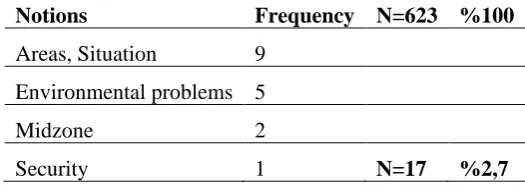
Table 5. Notions related to economic approach perception to tourism geography (f) Notions Frequency N=623 %100
Areas, Situation 9
Environmental problems 5
Midzone 2
Security 1 N=17 %2,7
In Table 5, there are expressions which don’t form lexical integrity among undergraduates’ perception. Despite being stated less in proportion, it points out the existence of undergraduates’ perception such as environmental problems of tourism and security problems. The fact that region and middle
generation were expressed here indicates characteristics of touristic areas.
5. CONCLUSION AND DEBATE
Tourism geography formed in undergraduates’ minds has various characteristics. Examining the general framework, tourism’s benefits for the country has frequently been mentioned. It attracts attention that expressions related to security and environmental problems are too few in proportion. Tourism notion in undergraduates’ minds is formed in association with economical benefits, employment opportunities, tourism kinds and touristic values. Opinions mostly emphasized consist of subjects like the fact that tourism is a significant source of income, building facilities to serve tourism, sea tourism, nature and religious tourism.
The findings obtained correspond to İncekara and Savran’s (2011) study Perception of Secondary School Students Towards Hatay Province in some aspects. Particularly in students’ perception, it can be seen that the opinion about tourism’s positive reflection to national and local economy is permanent. Touristic values and characteristics are also conclusions having similarities.
Gümüş and Özüpekçe’s (2009) findings and conclusions obtained from the research have partly similarities as well. We come across to the opinion that tourism would positively contribute to economic development as a common evaluation. Although different approaches like positive and negative effects come up in conclusions researchers have obtained, the negative effect hasn’t been much emphasized in the findings of this study.
Consequently, a contradiction hasn’t been found between the studies performed before and the conclusions of this research. However, it attracts attention that there are various innovations in undergraduates’ minds. Negative effects of tourism indicated in previous studies haven’t been encountered in conclusions of this study. The findings point out that positive effects of tourism stand out. In consideration of these evaluations, it would be a true determination that trainee teachers perceive tourism as a significant employment opportunity and source of income for the country.
REFERENCES
Akınoğlu, O. ( 2005). Coğrafya Eğitiminin Etkililiği ve Sorunları. Marmara Coğrafya Dergisi, sayı 12, s. 77-97. İstanbul.
Atasoy, B. (2004). Fen Öğrenimi ve Öğretimi. Ankara: Asil Yayın Dağıtım.
Ateş, M. (2013). Ortaöğretim Öğrencilerinin Kentsel Turizm Algılarının Değerlendirilmesi: Edirne İli Örneği, Humanitas International Journal of Social Sciences, issue: 02 / 2013, pages: 49-62.
Bahar, M. & Özatlı, N.S. (2003). Kelime İletişim Test Yöntemi ile Lise 1. Sınıf Öğrencilerinin Canlıların Temel Bileşenleri Konusundaki Bilişsel Yapılarının Araştırılması. Balıkesir Üniversitesi Fen Bilimleri Enstitüsü Dergisi, 5 (2), 75-85.
Baysan, S. (2002). Didim Kıyı Alanı Örneğinde Turizmin Çevresel Etkileri Konusunda Yerli Halkın Tutumları, Türkiye’nin Kıyı ve Deniz Alanları III. Ulusal Konferansı, Bildiriler Kitabı, İstanbul. Carmichael, B. A. (2000). A Matrix Model for Resident Attitudes and Behaviours in a Rapidly Changing Tourist Area. Tourism Management, 21: s.601-611.
Che, D. (2009). Teaching Tourism Geography, Tourism Geographies 11: 1, s. 120-123.
Cottrell, S. P. Vaske, J. Shen, F. ve Ritter, P. (2007). Resident Perceptions of Sustainable Tourism in Chongdugou China, Society and Natural Resources, 20: s. 511-525.
Doğaner, S. (2001). Türkiye Turizm Coğrafyası,İstanbul: Çantay Kitabevi.
Dyer, P. Gursoy, D. Sharma, B. ve Carter, J. (2007). Structural modeling of resident perceptions of tourism and associated development on the Sunshine Coast Australia. Tourism Management, 28: s. 409-422.
Emekli, G. (2006). Coğrafya, Kültür ve Turizm: Kültürel Turizm. Ege Coğrafya Dergisi 15: 51-59. Gülüm, K. & Artvinli, E. (2010). Turizm Coğrafyası Dersinin Coğrafi Algıya Etkisi: Deneysel Bir Çalışma, Marmara Coğrafya Dergisi Sayı: 22, s. 439-453, İstanbul.
Gümüş, N. & Gözüpekçe, S. (2009). İlköğretim Okulu Öğrencilerinin Turizme Yönelik Görüşleri: Foça Örneği. Dokuz Eylül Üniversitesi Buca Eğitim Fakültesi Dergisi, 25: s. 25-34.
Güzel Şahin, G. (2011). Üniversite Düzeyinde Turizm Eğitiminde Hizmet Kalitesi Beklenti ve Algısına Yönelik Ankara’da Bir Araştırma, İşletme Araştırmaları Dergisi 3/4, s. 49-65.
Kozak, M. Maviş, F. Ahipaşaoğlu H.S. ve Kozak, N. (2002). Genel Turizm Bilgisi, Anadolu Üniversitesi Yayınları No: 1360, Eskişehir.
Olalı, H. (1984). Turizm Dersleri, İstiklal Matbaası, İzmir.
Özgüç, N. (2003). Turizm Coğrafyası Özellikler-Bölgeler.İstanbul: Çantay Kitabevi.
Soykan, F. (2000). Turizm Coğrafyası ve Turizm Planlaması, Ege Coğrafya Dergisi 11: 39-55.
Tatoğlu, E. Erdal, F. Özgür, H. Azaklı, S. (2002). Resident Attitudes Toward Tourism Impacts: The Case of Kusadasi in Turkey. International Journal of Hospitality and Tourism Administration, 3(3): 79-100.
Yavuz, E. & Zığındere, Ö. (2000). Sürdürülebilir Kalkınmanın Turizme Etkisi. Balıkesir Üniversitesi Sosyal Bilimler Enstitüsü Dergisi, sayı 3, 4, s. 322-336.