Solid Earth, 9, 1079–1098, 2018 https://doi.org/10.5194/se-9-1079-2018
© Author(s) 2018. This work is distributed under the Creative Commons Attribution 4.0 License.
Shear wave reflection seismic yields subsurface dissolution
and subrosion patterns: application to the Ghor
Al-Haditha sinkhole site, Dead Sea, Jordan
Ulrich Polom1, Hussam Alrshdan2, Djamil Al-Halbouni3, Eoghan P. Holohan4, Torsten Dahm3,7, Ali Sawarieh2, Mohamad Y. Atallah5, and Charlotte M. Krawczyk3,6
1Section 1, Leibniz Institute for Applied Geophysics (LIAG), Stilleweg 2, 30655 Hanover, Germany
2Geological Directorate, Ministry of Energy and Mineral Resources (MEMR), P.O. Box 7 code 11118, Amman, Jordan 3Department 2, GFZ German Research Centre for Geosciences, Telegrafenberg, 14473 Potsdam, Germany
4UCD School of Earth Sciences, University College Dublin, Dublin 4, Ireland
5Yarmouk University 21173, Department of Geological and Environmental Science, Irbid, Jordan
6Technische Universität Berlin, Institute of Applied Geosciences, Ernst-Reuter-Platz 1, 10587 Berlin, Germany 7University of Potsdam, Institute of Earth and Environmental Sciences, 14476 Potsdam, Germany
Correspondence:Ulrich Polom ([email protected]) Received: 8 March 2018 – Discussion started: 25 April 2018
Revised: 26 July 2018 – Accepted: 21 August 2018 – Published: 21 September 2018
Abstract. Near-surface geophysical imaging of alluvial fan settings is a challenging task but crucial for understating ge-ological processes in such settings. The alluvial fan of Ghor Al-Haditha at the southeast shore of the Dead Sea is strongly affected by localized subsidence and destructive sinkhole collapses, with a significantly increasing sinkhole formation rate since ca. 1983. A similar increase is observed also on the western shore of the Dead Sea, in correlation with an ongoing decline in the Dead Sea level. Since different struc-tural models of the upper 50 m of the alluvial fan and varying hypothetical sinkhole processes have been suggested for the Ghor Al-Haditha area in the past, this study aimed to clarify the subsurface characteristics responsible for sinkhole devel-opment.
For this purpose, high-frequency shear wave reflection vi-bratory seismic surveys were carried out in the Ghor Al-Haditha area along several crossing and parallel profiles with a total length of 1.8 and 2.1 km in 2013 and 2014, respec-tively. The sedimentary architecture of the alluvial fan at Ghor Al-Haditha is resolved down to a depth of nearly 200 m at a high resolution and is calibrated with the stratigraphic profiles of two boreholes located inside the survey area.
The most surprising result of the survey is the absence of evidence of a thick (> 2–10 m) compacted salt layer formerly suggested to lie at ca. 35–40 m depth. Instead, seismic
re-flection amplitudes and velocities image with good continu-ity a complex interlocking of alluvial fan deposits and lacus-trine sediments of the Dead Sea between 0 and 200 m depth. Furthermore, the underground section of areas affected by sinkholes is characterized by highly scattering wave fields and reduced seismic interval velocities. We propose that the Dead Sea mud layers, which comprise distributed inclusions or lenses of evaporitic chloride, sulfate, and carbonate min-erals as well as clay silicates, become increasingly exposed to unsaturated water as the sea level declines and are conse-quently destabilized and mobilized by both dissolution and physical erosion in the subsurface. This new interpretation of the underlying cause of sinkhole development is supported by surface observations in nearby channel systems. Overall, this study shows that shear wave seismic reflection technique is a promising method for enhanced near-surface imaging in such challenging alluvial fan settings.
1 Introduction
appar-1080 U. Polom et al.: Application to the Ghor Al-Haditha sinkhole site
ently contemporaneous with the rapid decrease in the Dead Sea level (Sawarieh and Alrshdan, 2011). The sinkhole pro-cesses continuously disrupt farming areas, houses, industrial sites, and infrastructure and, therefore, hamper the future economic development of the whole region. Geological and geophysical sinkhole studies started already in the 1990s at both the western (e.g. Wachs et al., 2000) and eastern (El-Isa et al., 1995) shorelines of the Dead Sea. An early map of the main sinkhole sites was published by Yechieli et al. (2002). The sinkholes typically appear in clusters on either alluvial fans or mudflats. Arkin and Gilat (2000) defined two differ-ent classes of sinkholes: (a) gravel holes on alluvial fans that consist of highly permeable gravel and sand layers including some silt, clay, and evaporites and (b) mud holes on Dead Sea mudflats that consist of very fine marl, silt, clay, and evapor-itic minerals like aragonite, gypsum, and halite.
An early hypothesis postulated that clay softening, lique-faction, and mobilization in the subsurface, due to the dilu-tion of former highly salty porewater by freshwater inflows, generates the sinkholes (Arkin and Gilat, 2000). As discussed by Ezersky and Frumkin (2013), two other factors may con-trol the location of the sinkholes at the Dead Sea: (1) the presence of a thick, massive salt layer that is exposed to a dissolution front at its edge and (2) the presence of subsur-face faults that control freshwater inflow into, and thus enable dissolution of, a salt layer. Such controls were suggested on the basis of a variety of methodical approaches (e.g. Yechieli et al., 2002; Diabat, 2005; Closson, 2005; Abelson et al., 2006, 2009; Frydman et al., 2008; Closson and Abou Karaki, 2009; Ezersky, 2006; Ezersky and Livne, 2013; Ezersky et al., 2010, 2013c, 2017).
Although many geophysical studies have been carried out at the Ghor Al-Haditha sinkhole site (Fig. 1a) in the past 24 years, the subsurface structure and the subsurface ero-sion (subroero-sion) processes are still rather uncertain. Since the year 2000, several authors have proposed that a several metre thick, massive salt layer lies at a top depth of 35–40 m b.g.s. at the site, underneath the alluvial fan deposits (Taqieddin et al., 2000; Legchenko et al., 2008; Frumkin et al., 2011; Ez-ersky et al., 2013 a, b, c, 2017; EzEz-ersky and Frumkin, 2013; Ezersky and Livne, 2013). In this shallow salt layer model, chemical erosion (dissolution) of this salt layer by fresh wa-ter flow from the easwa-tern mountain range is supposed to gen-erate initial cavities in the subsurface, which subsequently move upwards due to the continuous solution or collapse of material at the cavity top, up to the final collapse of the ground surface. In contrast, Al-Halbouni et al. (2017) pre-sented an alternative conceptual model for Ghor Al-Haditha, based on photogrammetric surveying, historic satellite image analysis, and field observations. They propose both chemical and physical subrosion of weak material, which consists both of mudflat (including evaporite lenses) and alluvial fan sedi-ments.
Our reflection seismic study resolves for the first time the fine structure of subsurface layers with a high resolution
at Ghor Al-Haditha and thereby contributes to reappraising the different models suggested above. We further show that shear wave reflection seismics have advantages for study-ing highly porous, partly saturated alluvial fans with com-plex compositions, e.g. compared to P-wave reflection and refraction, which is partly controlled by the pore fluids, and multi-channel analysis of surface wave (MASW), which is only valid in a 1-D layer case. A particular methodological question of interest is to what extent shear wave seismics can be used to identify dissolution processes at depth and early stages of collapse sinkholes.
2 Site of investigation
Ghor Al-Haditha is a small village at the southeastern end of the Dead Sea in the province Al Karak of the Hashemite Kingdom of Jordan (Fig. 1a and b). It is located within the Dead Sea pull-apart basin close to the outlet of the Wadi Ibn Hammad valley. Sediments transported down the Wadi Ibn Hammad and the neighbouring Wadi Mutayl have formed a connected alluvial sediment plain, which is in contact with the border of the Dead Sea. The alluvial plain (current el-evation nearly −360 to −380 m) was formerly located at the bottom of the Dead Sea and has been dry land since an unknown time. It is now mainly used for market gardening and, for the irrigation of the plants, water flowing from Wadi Ibn Hammad and surrounding springs is stored in some man-made pools in the area.
U. Polom et al.: Application to the Ghor Al-Haditha sinkhole site 1081
Figure 1. (a)Generalized map of the Dead Sea area. Except for the site Ghor Al-Haditha at the eastern border, which is the focus of this paper, most sinkhole sites are located along the western shoreline of the Dead Sea (see, e.g., Yechieli et al., 2002).(b)Detailed map of the Ghor Al-Haditha sinkhole site and previous refraction seismic (El-Isa et al., 1995; Sawarieh et al., 2000) and MASW (Bodet et al., 2010) profiling. Boreholes BH1 and BH2 are reported in detail by El-Isa et al. (1995); two other boreholes are reported by Bodet et al. (2010) without any further information. Background is a Pleiades satellite image from 2015 combined with an aerial orthophoto mosaic from 2016.
likely correspond to the Ze’elim Formation of Holocene age (Abou Karaki et al., 2016)
2.1 Borehole information
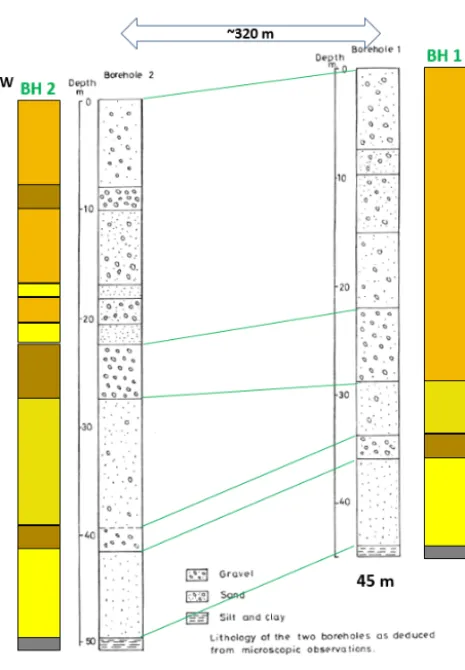
Two boreholes (BH1 and BH2) were drilled at the Ghor Al-Haditha investigation site in January–February of 1995 (Fig. 1b), and the drillings and sample analyses were firstly described in a report of El-Isa et al. (1995). Bodet et al. (2010) reported two additional boreholes (Fig. 1b) from 2006 but without further descriptions, and they are not men-tioned in other reports and publications. Figure 2 shows the borehole lithology of BH1 and BH2 based on a detailed mi-croscopic analysis of cuttings (El-Isa et al., 1995). There, the lithology is described as an alternating sequence of sand and gravel, with a “silt and clay” bed at the bottom down to 51 and 45 m depth. Nothing is mentioned about a massive salt layer.
Several papers have subsequently presented lithologic cross sections for the Ghor Al-Haditha sinkhole area, in which a thick (> 2–10 m) pure salt layer is postulated to lie at between 30 and 45 m depth below the surface (e.g. Taqieddin et al., 2000; Frumkin et al., 2011; Ezersky et al., 2013a, b, c,
2017). The above-mentioned boreholes, the reported depths of which vary from one paper to another, are used to support this finding, although no detailed descriptions of the bore-holes, no details about the drilling method used, and no litho-logic bars are provided. Because the indication of possible massive salt layers is important for comparison with our re-sults, we point out these inconsistencies here.
2.2 Previous geophysical surveys
1082 U. Polom et al.: Application to the Ghor Al-Haditha sinkhole site
Figure 2.Lithologic columns of the boreholes BH1 and BH2 from microscopic analyses, referenced to their surface elevation (black and white columns are the original columns of El-Isa et al., 1995). The coloured, generalized columns are used for the figures of this paper. The main dip tendencies of the units toward the west are vis-ible by the green connecting lines. The annotated borehole depths below the columns follow the text in El-Isa et al. (1995).
lines in Fig. 1b) and ground penetration radar (GPR) sur-veys in February 1999 (Sawarieh et al., 2000; Abueladas and Al-Zoubi, 2004). Seismic equipment was a 350 kg weight drop source and a Bison Geopro 8024 24-channel recorder (10 m geophone interval). The refraction seismic surveys in-dicated that the thickness of the alluvial deposits was more than 70 m, that there was a possible salt intrusion body be-low (at least 70 m deep) at one profile location (profile 5 of Sawarieh et al., 2000; Fig. 1b), and that there were also sinkhole-causing cavities at a relatively shallow depth (less than 20 m). Except for the one location suspected of having a salt intrusion body, the seismic velocity of the deepest refrac-tor below 40–50 m depth was reported to vary from 2245 to 3300 ms−1 in all profiles, and seismic velocities above this are in general less than 2500 ms−1. Unfortunately, the ac-quired seismic data of the 1994 and 1999 campaigns are ir-recoverable.
Soon after the 1999 surveys, Batayneh et al. (2002) ap-plied GPR to assess the potential of sinkholes of the Ghor Al-Haditha area and to determine the location of the filled sink-hole features within relatively dense and more resistive ma-terials. Barjous et al. (2004) carried out a FDEM (frequency domain electromagnetic) survey, supplemented by direct cur-rent (DC) resistivity methods (Wenner and dipole–dipole ar-rays), and conventional geological mapping techniques. Dur-ing this work a systematic electromagnetic (EM) survey was applied on the Wadi Ibn Hammad alluvial fan.
More recent investigations carried out between 2005 and 2008 used a multi-method approach of transient electromag-netic (TEM) sounding, magelectromag-netic resonance sounding (MRS), GPR, and electric resistivity tomography (ERT) (Camer-lynck et al., 2012). In 2007, these also included a seismic survey along four profiles targeted at combined reflection, refraction tomography, and MASW data analysis (e.g. Dhe-maied, 2007; Bodet et al., 2010; Keydar et al., 2011; Ezer-sky et al., 2013a, magenta lines in Fig. 1b). For this seis-mic survey, a Geometrics recorder with a 24-channel geo-phone (4.5 Hz resonant frequency) spread at 5 m intervals and a sledgehammer source (mass not reported) was utilized. MASW results are published in Bodet et al. (2010) (profile 3) and Keydar et al. (2011) (profiles 3 and 4). MASW results and interpretations of profiles 3 and 4 are published in Ez-ersky et al. (2013b, 2017) and EzEz-ersky and Frumkin (2013). The limit of reliable depth penetration was reported as 60 m (maximum half-space depth), following the empirical for-mulaZmax=0.5 L of Park et al. (1999) and Rix and Leip-ski (1991), whereLis the total source–receiver spread length of 120 m. Results of profile 3 (magenta line 3 in Fig. 1b) show shear wave velocities of mainly less than 400 ms−1 from the surface toZmax, while profile 4 (magenta line 4 in Fig. 1b) images a high-velocity layer of more than 800 ms−1 from nearly 30 m depth to Zmax, which was interpreted as the shallow salt layer. A reflection seismic analysis result of profile 4 in Ezersky and Frumkin (2013) shows no reflection response of the proposed shallow salt layer, however. Refrac-tion tomography analysis results are reported to be of insuf-ficient resolution (Camerlynck et al., 2012) and are later on shortly mentioned in Ezersky et al. (2017) only.
Three further MEMR geophysical surveys undertaken in 2009 and 2010 with GPR, ERT, and time–domain electro-magnetic (TDEM) with NanoTEM technique provide the most recent information about the sinkhole area in Ghor Al-Haditha (Alrshdan, 2012). These newer results depict ge-ological and groundwater conditions, the salt-to-freshwater interface, and the limits of safe and vulnerable zones. Alr-shdan (2012) also discusses the mechanism of sinkhole for-mation suggesting that the freshwater inflow acts as the ma-jor player, which dissolves cementing evaporite minerals and the fine materials within the alluvial fan, leaving weak allu-vial layers and cavities which develop to sinkholes later on.
U. Polom et al.: Application to the Ghor Al-Haditha sinkhole site 1083
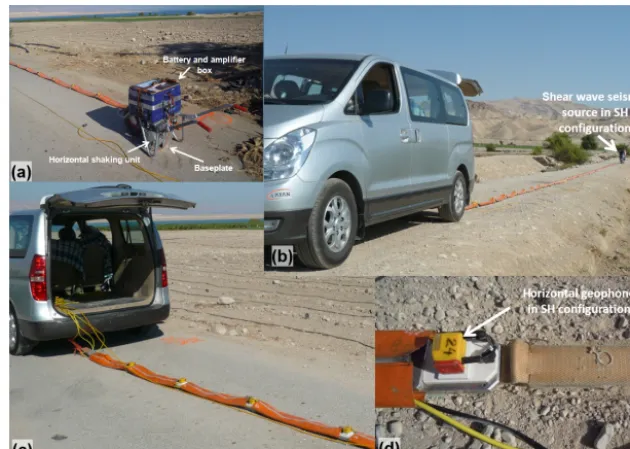
Figure 3.Photos of the shear wave seismic reflection acquisition campaign carried out in October 2013.(a)Wheelbarrow-mounted shear wave source system on asphalt pavement at start location of profile 2.(b)Recording car, towed land streamer and source during operation on profile 3.(c)Land streamer towed by the recording car during acquisition on profile 2. Colour paintings on the road surface were used for location numbering along the profiles.(d)Sledge-mounted horizontal geophone in SH (particle movement perpendicular to profiling direction) configuration along profile 3.
postulated salt layer, its morphology, and synclinal structures expected at its top, we started high-resolution shear wave re-flection seismic surveying in 2013 at Ghor Al-Haditha. The target depth of the survey was initially focused to the pro-posed salt layer depth of 35–60 m and, at most, 100 m depth.
3 Shear wave reflection seismic equipment and survey
A shear wave land streamer (Inazaki, 2004; Pugin et al., 2004, 2007, 2013) consisting of 95 transverse horizontal (shear wave horizontally polarized – SH) geophones (10 Hz resonance frequency) at 1 m intervals was used as a receiver unit, connected to a Geode (Geometrics Inc., four units of 24 channels each) recording system. Transverse horizontal (SH) waves were generated by the seismic micro-vibrator source ELVIS (Polom et al., 2011, 2013; Krawczyk et al., 2012). Figure 3 shows the equipment in operation on site. The small size (under 1.5 m3)and weight (under 600 kg) of the whole equipment enabled air cargo transportation to Jordan.
The source signal (sweep) was set to 20–120 Hz (20–80 Hz during the survey extension in 2014), with a linear frequency modulation on 10 s duration (Crawford et al., 1960). Data recording was set to 12 s duration and stored uncorrelatedly to enable the processing of uncorrelated data later on, if re-quired. In the field, vibroseis correlation processing was ap-plied for immediate quality control. After initial tests on site, the source interval was set to 2 m to increase the statistical redundancy due to challenging, disturbed subsurface
condi-tions, noticeable by strong wave field scattering in the record-ings. Typically, two records were gained at each source loca-tion by alternating the source polarity and stored separately. Only during times of stronger wind disturbances was the number of records per location increased to four. In the 2013 campaign, a total of 2011 records (9.34 Gb data volume) at 898 source locations was gained along 1.92 km of profile length. In 2014, 2000 records (9.14 Gb) at 1144 source loca-tions were recorded along 2.1 km of profile length (see profile locations in Fig. 4).
1084 U. Polom et al.: Application to the Ghor Al-Haditha sinkhole site
Figure 4.Map of the shear wave reflection seismic profiles acquired in 2013 (red lines) and 2014 (yellow lines). Green circles denote the locations of the boreholes made in 1994 (according to the report of El-Isa et al., 1995). Older refilled sinkholes are denoted by brown circles (after El-Isa et al., 1995), blue circles (after Sawarieh et al., 2000), and the orange circle (after Bodet et al., 2010). The dotted black line marks the main sinkhole and subsidence area after Al-Halbouni et al. (2017).
system, leading to precise elevation data of 10 cm horizontal and 15 cm vertical error.
All seismic data recorded were checked and preprocessed in the evening of each recording day by using the VISTA 10.028 (GEDCO Inc., Calgary, CA) seismic data process-ing software on a notebook computer (DELL Precision M65) for quality-control purposes and a first interpretation. De-tailed inspections of correlated raw records showed strong Love wave scattering on profiles 1 and 3 that indicated a low-velocity layer close to the surface, even though the dirt road construction at profile 3 was modified some years ago by gravel infill after heavy damage caused by sinkholes and related subsidence.
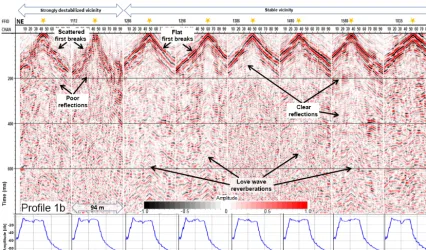
Selected record examples along profile 1b illustrate the typical range of signal propagation responses at the Ghor Al-Haditha site (Fig. 5).
In the northeast sector of the profile, close to the main sink-hole area, a typical scattering of the wave propagation is vis-ible. The wave propagation behaviour is mostly asymmetric regarding the receiver distance to the source position, which indicates heterogeneous subsurface structures. In the middle sector, even though there is an asphalt surface pavement of apparently continuous integrity, Love wave propagation was partly indicated (note the area of Love wave reverberations marked in Fig. 5), probably caused by poor road construc-tion. In the southwest sector, clear reflection events were
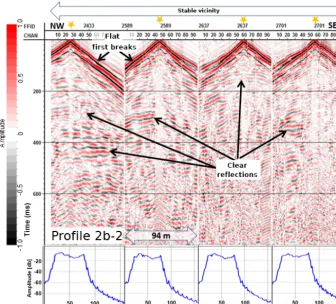
de-tected already in the single recordings. Along profile 2b-2 (Fig. 6), selected record examples show a better data qual-ity compared to profile 1b: flat first breaks and a range of clear reflection events occur. This is surprising because the road quality along profile 2b-2 did not differ from that of the southwest sector of profile 1, and both roads are of obviously similar age.
4 Data processing
Reflection imaging was carried out by following a gen-eral processing sequence described by, e.g., Krawczyk et al. (2012) and Polom et al. (2013). The main data process-ing flow of the first iteration consisted of vibroseis correla-tion, vertical stacking of records, geometry installacorrela-tion, am-plitude scaling, bandpass filter, frequency-wave number (FK) filter, interactive velocity analysis, common midpoint (CMP) stacking, parallel applied frequency-space (FX) deconvo-lution, and finite-difference (FD) migration. Subsequently, depth conversion was applied by using a mean 1-D veloc-ity function. The background of the data processing applied is reported in Aki and Richards (1980) and Yilmaz (2001).
re-U. Polom et al.: Application to the Ghor Al-Haditha sinkhole site 1085
Figure 5.Examples of recorded shot gathers (automatic gain control – AGC of 220 ms window; amplitude scaling and bandpass filter (18-20-76-82 Hz) applied) in the time domain along profile 1b. The positions of the seismic source are labelled by orange stars. FFID denotes the record number along the profile; CHAN denotes the geophone number along the land streamer unit. Arrows at top denote the condition of the ground surface observed along the profile. In the northeast, close to the sinkhole-affected area, first break and reflection signals are weak due to the strong wave scattering in the subsurface caused by material loosening and cracking. The situation improves towards the southeast, where no sinkholes or other subsidence features were present during profiling and the road surface was in good condition. Below, mean amplitude spectra of the time window 0–400 ms (estimated 0–70 m depth) for each record are shown.
Table 1.Reflection seismic data processing sequence.
1 Vibroseis correlation (using the recorded pilot sweep) 2 Bad trace elimination
3 Vertical stack (two records at each source location) 4 Geometry assignment (crooked line binning) 5 Amplitude scaling (AGC 220 ms)
6 Bandpass filter (18-20-76-82 Hz)
7 Vibroseis spectral balancing in the vibrogram domain – convolution by synthetic sweep operator 15–130 Hz (linear), 11.5 s (same frequency gradient as the pilot sweep), AGC 1000 ms, correlation by the synthetic sweep operator 8 Topmute – interactive, elimination of first breaks
9 FK-filter, polygon mode to remove Love wave and harmonic residuals 10 CMP sort
11 Interactive velocity analysis (every 40 m) 12 Normal moveout correction
13 CMP stack (mean 24-fold, max 30-fold) 14 Trace energy normalization
15.1 FX deconvolution
15.2 Finite-difference (FD) time migration, 67◦algorithm
16 Time-to-depth conversion of 15.2 (using a mean 1-D velocity function derived from rms stacking velocities) 17 Elevation statics to−367 m a.s.l.
sponse. This required several iterative loops during the main processing sequence to improve the final result. The main data processing was carried out in two iteration sequences
1086 U. Polom et al.: Application to the Ghor Al-Haditha sinkhole site
Figure 6.Examples of recorded shot gathers (AGC of 220 ms window; amplitude scaling and bandpass filter (18-20-78-82 Hz) applied) in the time domain along profile 2b-2 (labelling as in Fig. 5). Good signal quality of first breaks and reflections mirrors a rather unaffected signal propagation in the subsurface, which correlates to the sinkhole-unaffected vicinity at the surface. Reflection signals up to 400 ms in time represent layer responses from 70 m depth (applying a 350 ms−1shear wave propagation velocity). Below, mean amplitude spectra of the time window 0–400 ms for each record are shown.
structures in the data. In the second iteration sequence, the time section results were used to improve the processing flow in detail towards the specific reduction of imaging artefacts and to stabilize the processing velocities for later use dur-ing depth conversion. It included reduction of the harmonic distortions in the near-source area and vibroseis spectral bal-ancing (Pugin et al., 2009) in a vibrogram transformation do-main (Polom, 1997). Furthermore, the results of the veloc-ity analysis were improved. To derive final depth sections, a mean 1-D rms velocity–time function (shown in Fig. 8) for all profiles was derived from the reflection seismic data set and applied to all profiles. Due to the lack of any refer-ence velocity–depth function, e.g. from vertical seismic pro-filing (VSP) logging, the 1-D solution was chosen as a first depth approximation to prevent the projection of lateral ve-locity irregularities (e.g. due to irregular wave ray paths close to sinkhole-affected areas) onto the depth sections, which would result in structure imaging distortions. The detailed processing sequence is listed in Table 1.
Because of these general improvements, some structures in the near-surface down to 50 m became weaker than in the first iteration. This is a compromise result of combining
shal-low velocity results affected by wave propagation along ir-regular, non-straight ray paths (due to the disturbed shallow subsurface structure) with more regular straight ray path re-sponses from deeper levels (later travel times).
U. Polom et al.: Application to the Ghor Al-Haditha sinkhole site 1087
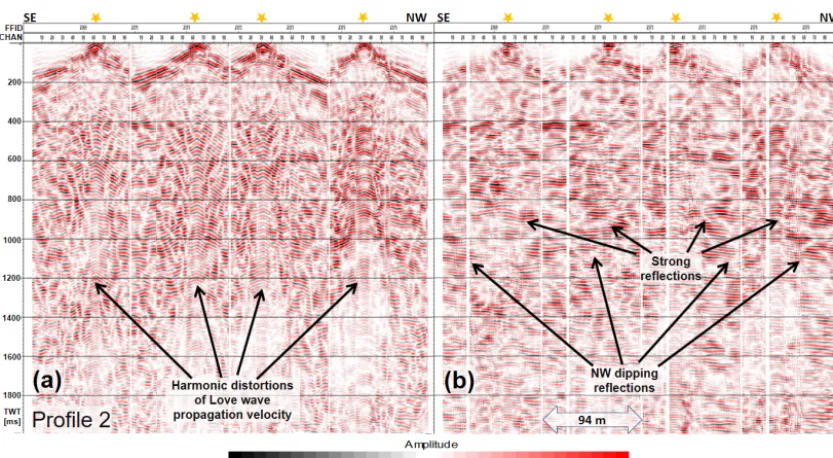
Figure 7. (a)A consecutive set of recorded shot gathers (AGC of 220 ms window; amplitude scaling and bandpass filter (18-20-76-82 Hz) applied) in the time domain in an area of good reflectivity along profile 2 (labelling as in Fig. 5). Parts of the records are disturbed by harmonic distortions centred on the source position and propagating with Love wave velocity (∼200 m s−1). In(b)the disturbing pattern is removed, uncovering the reflection events below. For a raw time-to-depth estimation, a depth scale is added on the right based on a mean velocity of 350 m s−1for body shear waves. In(b)Topmute (step 8 in Table 1) is also applied.
5 Resulting depth sections and structure correlations
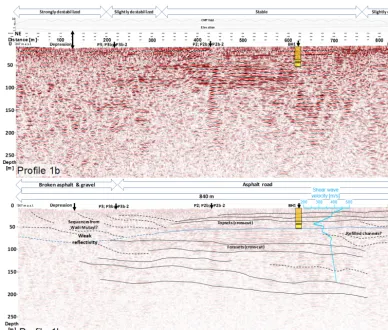
The main northeast–southwest-trending profile 1b has trans-parent and strongly layered segments between the ground surface and 200 m depth (Fig. 8).
The depth section of profile 1b refers to a reference level of −367 m a.s.l., and it includes annotations of joints to the other profiles, remarks about the surrounding area (top), and information on the road construction (bottom). The location of borehole BH1 which is nearly 10 m southeast of the profile is projected perpendicularly into the profile and shown with a simplified lithology (see Fig. 2). The mean 1-D velocity function used for time-to-depth conversion is given as inter-val velocity in depth (Dix, 1955) beside the borehole BH1. It shows estimated shear wave velocities in the range of 250– 450 ms−1down to depths of about 170 m. Finally, the reflec-tion amplitude responses throughout all seismic secreflec-tions rep-resent reflection coefficients of nearly 0.1 or less, indicating materials with relatively low contrasts in seismically sensi-tive material properties (elastic parameters and density) and hence in shear wave seismic velocity.
The main area of sinkhole activity is located immediately northwest of profile 1 (see Fig. 4). This activity has strongly affected the road construction along this part of profile 1b, northeast of its intersection with profile 3 (Fig. 8). A depres-sion with several fractures is visible here along the road sur-face (Fig. 4) but without any sinkhole activity up to now. In detail, this part of the road crosses the southeastern limit of a
major sinuous depression that runs down to the former Dead Sea shore and that hosts the smaller-scale sinkholes (for de-tails, see Al-Halbouni et al., 2017). Several gravel infills on the former asphalt surface in the past make this part of the road usable. Further along profile 1b, to the southwest of its intersection with profile 3, the road stability continuously in-creases. The road surface is essentially unaffected by subsi-dence along the area denoted as stable along the southwest half of the profile 1b. Within this stable area, from the in-tersection of profile 1b with profile 2 to the borehole BH1, a continuous reflectivity pattern is visible below 50 m refer-ence depth (i.e. nearly 45 m below the ground surface). The top of this pattern nearly correlates with the depth of the silt and clay layer detected 44 m below the ground surface in borehole BH1. The bottom of the nearly horizontal pat-tern reaches nearly 100 m depth below reference level along much of the profile, although southwest of the BH1 loca-tion, the pattern extends downward to 230 m depth within a
1088 U. Polom et al.: Application to the Ghor Al-Haditha sinkhole site
Figure 8.Resulting depth section of profile 1b after post stack FD time migration(a)and interpretation of the main structure elements(b). Arrow bars at the top of the upper image denote the surface instability/stability as observed along the profile, while arrow bars below denote the road surface situation along the profile and the profile length. Black arrows at the top indicate joints with the crossing profiles. The lithology of borehole BH1 is projected from 10 m distance perpendicularly into the profile. The interpreted top of the silt and clay layer in BH1 is shown as the blue line along the profile, since it is the first layer detected at depth that is prone to subrosion. Also shown is the 1-D shear wave velocity–depth function derived from seismic data in this area; this function was used for time-to-depth conversion of all profiles.
northeast of the intersection of profiles 1 and 2, i.e. as one ap-proaches the main sinkhole area.
The combined depth sections of profiles 2 and 2b-2 are shown in Fig. 9. The profiles were both acquired on an as-phalt road. Also shown in Fig. 9 are the simplified litho-logical bars of boreholes BH1 and BH2 as projected per-pendicularly into the profile plane from their true locations nearly 200 m to the southwest (cf. El-Isa et al., 1995). Due to this relatively large projection distance, the lithology bars may not precisely reflect the lithology in the profile plane. The sections show a nearly horizontal layering down to 50 m depth below the reference level of−367 m a.s.l. in the south-east part of the combined profile, which changes laterally to less well organized but mainly northwest-dipping structures in the northwest part of the combined profile.
Below 50 m depth the main structural dip is towards the northwest and is divided into several dip sequences visible down to nearly 250 m. Along profile 2, between profiling po-sitions 75 and 200 m, there is a slightly more disorganised
seismic response above 50 m depth (i.e. from 30 to 35 m be-low the ground surface). This is spatially associated with a local depression and related cracks in the road. At least one sinkhole formed directly adjacent to this part of road prior to 2000 (Sawarieh et al., 2000) and was subsequently filled in. Along profile 2b-2, at profiling position 125 m, a striking stack of bowl-shaped structures is visible from the surface down to nearly 75 m depth. Along this part of the profile and for at least 300 m on either side of it (i.e. towards the north-east and southwest), no sinkhole activity was reported in the past.
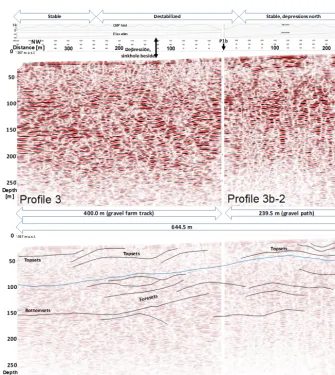
The combined depth sections of profiles 3 and 3b-2 are shown in Fig. 10. The boreholes BH1 and BH2 are not in-cluded in the profile plane due to the distance of nearly 420 m from their true positions further southwest.
U. Polom et al.: Application to the Ghor Al-Haditha sinkhole site 1089
Figure 9.Resulting depth sections of combined profiles 2 and 2b-2 after post-stack FD time migration(a)and interpretation of the main struc-ture elements(b). For annotations, see Fig. 8. Lithology of boreholes BH1 and BH2 is projected perpendicularly into the profile from 200 m distance and therefore may not show the precise layering signature. Except for the top 40 m, the main characteristics down to 200 m show stacked sequences of northwest-dipping reflectors, which are interpreted as northwest-prograding alluvial fan sequences. The interpreted top of the silt and clay layer in BH1 and BH2 is shown by the blue line.
area of sinkhole activity lies immediately northeast of this refilled section of profile 3 (see Fig. 4), and indeed a recent sinkhole (formed in 2008) was located directly beside the track during data acquisition.
Northeast of profile 3b-2, no sinkhole activity was reported in the past. Due to the different surface conditions, and prob-ably caused by the sinkhole activity directly beside profile 3, these sections slightly differ in seismic signature. Pro-file 3b-2 shows some undulating layer structures of contin-uous amplitudes to 50 m depth below reference datum (40– 45 m below the ground surface), which change at the north-west end of the profile to northnorth-west-dipping sequences. In the very southeast part of the profile, a bowl-shaped struc-ture sequence dominates down to 80 m depth but without any indication of deformation at the surface. Profile 3 mainly shows northwest-dipping structural elements without signif-icant amplitude variations, especially above 100 m depth. Only small bowl-shaped structures are visible.
The depth section of profile 4 (Fig. 11), which again in-cludes projections of boreholes BH1 and BH2 (both in re-ality located nearly 200 m northeast of the profile plane), shows mainly slightly northwest-dipping structural signa-tures. Bowl-shaped structures are restricted to the top 50 m of the southeast part of the profile, which lies less than 200 m southwest of where sinkhole activity was reported by El-Isa et al. (1995) and Sawarieh et al. (2000) in the 1990–2000 decade. One sinkhole of 7 m depth was reported to have formed beside the road prior to 1992. No surface damages were reported for the road track itself, however, and no de-pressions, cracks, or repairs were visible at the surface during data acquisition. At the northwest end of the section several continuous events of higher amplitudes occur nearly 50 m be-low the surface.
1090 U. Polom et al.: Application to the Ghor Al-Haditha sinkhole site
Figure 10.Combined depth sections of profiles 3 and 3b-2 after post stack FD time migration(a)and interpretation of the main structure elements(b). For annotations, see Fig. 8. The interpreted top of the silt and clay layer in BH1 and BH2 is shown by the blue line. The centre part of the profiling track was repeatedly affected by recent sinkhole activity directly beside it to the northeast. For farming access, it was refilled with gravel along more than 250 m and was subsequently again affected by sinkholes and subsidence. This may cause the weaker reflection signatures in the upper 50 m when compared to profile 2 (Fig. 8). The main reflection pattern signature is similar to profile 2 and 2b-2, showing northwest-dipping events. In the southeast of the profile, a v-shaped structure is visible close to surface, filled with nearly horizontal reflection events, which is interpreted as a refilled channel side cut. Due to the wide subsidence area northeast of profile 3 the top of the silt and clay layer (blue line) was continued to the northwest starting from profile 1b instead using the projection of BH2.
is−367 m a.s.l. The image illustrates that a direct projection of borehole BH2 to profiles 2 and 4 needs to be carefully handled due to the projection distance of nearly 200 m. Nev-ertheless, the results of the profiles 2 and 4 both show their main structural dips towards the northwest, which fit the dip tendency of the lithology detected in the boreholes (Fig. 2). Blue markers included along the borehole shafts in Fig. 12 determine the top of the silt and clay layer below the allu-vium sequence consisting of gravel and sand. Since this silt and clay layer is the only one detected in the lithology bars of the boreholes that is prone to act as an aquiclude sensi-tive to subrosion and it also fits the general structural dip, it was obvious that this layer probably extends across the whole
re-U. Polom et al.: Application to the Ghor Al-Haditha sinkhole site 1091
Figure 11.Depth section of profile 4 after post stack FD time migration (a)and interpretation of the main structure elements (b). For annotations, see Fig. 8. Lithology of boreholes BH1 and BH2 is projected from 200 m distance perpendicularly into the profile. In contrast to profile 2, more gently northwest-dipping events are present to 150 m depth, indicating less transportation energy of the alluvial material or an apparent structure dip. The top of the silt and clay layer in BH1 and BH2 is indicated by the blue line. Bowl-shaped signatures close to the surface in the southeast indicate sinkhole-caused subsidence and/or refilled channel side cuts. Significant reflection amplitudes of a stronger reflector pattern close to the northwest end at nearly 90 m depth may indicate an evaporite-rich lens included in the alluvium–lacustrine deposits.
flection responses give indications of any included massive salt layers or extended salt lenses. Therefore, subrosion as the origin of the sinkhole process on the exposed alluvial fan is estimated to occur mainly below this constructed horizon within the area of the seismic survey. The deepest part of this constructed horizon reaches−467 m a.s.l. towards the north-west, which is 60 m below the level of the current alluvium-to-mudflat transition of−407 m a.s.l. at the former shoreline of the Dead Sea in the 1960s (as calculated by Al-Halbouni et al., 2017). It therefore represents a different subrosion level to the present mudflat surface, which indicates that alluvium
and silt and clay sequences may lie below the presently ex-posed mudflat.
6 Discussion
1092 U. Polom et al.: Application to the Ghor Al-Haditha sinkhole site
Figure 12.Three-dimensional representation of the 2.5-D profiling grid (cf. sections in Figs. 8–11), restricted to 200 m depth (no vertical exaggeration). Boreholes BH1 and BH2 are included as yellow bars representing the sand and gravel sequence above the detected silt and clay layer, the top of which is marked by a blue disc along each well shaft. Light blue lines along the profiles mark the interpreted continuation of the top of this layer starting from BH1 along profile 1 and subsequently continuing to the crossing profiles. The constructed horizon by triangular interpolation represents the derived top of the silt and clay layer below the reference datum of−367 m a.s.l. based on the drilling and seismic results. At the deepest parts towards the Dead Sea border the top of this layer reaches nearly−467 m a.s.l., which is 60 m below the level of the current alluvium–mudflat transition of−407 m a.s.l. calculated by Al-Halbouni et al. (2017).
al. (2000). The results presented here show the advantageous imaging capabilities of the method regarding high-resolution structural analysis and depth penetration compared to com-mon refraction seismic methods or comcom-mon P-wave reflec-tion analysis. In this secreflec-tion, we discuss firstly the general outcomes of our application of the S-wave reflection method to an alluvial fan setting and secondly the implications for the nature of processes leading to sinkhole development at the Ghor Al-Haditha site.
6.1 The application of the shear wave reflection seismic technique to alluvial fan setting
The S-wave reflection method is especially advantageous in the area close to the Dead Sea border because wave propaga-tion is restricted to the matrix only, and so it is not affected by the pore space content, whether that is air in the shal-low unsaturated zone or freshwater or saltwater in the deeper parts below the groundwater level. Therefore the groundwa-ter level itself does not act as a physical ingroundwa-terface during wave propagation, as is generally the case for common P-wave methods. In the S-P-wave profiles acquired in the area, no influence and no response of the groundwater level to the wave propagation was detected. Furthermore, wave propaga-tion velocities of S waves (Vs) are in general significantly smaller than those ofP waves (Vp). TheVp/ Vsratio ranges from nearly 1.7 for an ideal elastic medium (e.g. perfect con-solidated rock) to more than 10 (Yilmaz, 2015) for uncon-solidated sediments (e.g. Holocene alluvium and soft clays). This leads to a significantly improved resolution when using
Swaves, depending on the grade of matrix consolidation. In the case of the Ghor Al-Haditha site, this results in a
res-olution improvement factor of 8–10 below the groundwater level, when one postulates a similar seismic signal frequency bandwidth forP andSwaves.
U. Polom et al.: Application to the Ghor Al-Haditha sinkhole site 1093
caused by the sinistral transform fault movement, cannot be excluded.
Since wave propagation is controlled by the matrix only, the effects of grain size coupling play a key role in the wave propagation ofS waves in contrast toP waves. In contrast to P-wave velocity, which usually increases with depth in the case of a fluid-saturated pore space, S-wave velocities often decrease with depth, e.g. if the grain cementation reduces or the pore pressure increases with depth as both factors result in reduced grain contacts. A further reason for velocity func-tion decrease with depth is the influence of a high-velocity layer at the surface, which is the case operating on an asphalt road surface. This effect is visible in the 1-D velocity–depth function in Fig. 8 in the range 0–10 m below ground surface. Diminished grain coupling can also arise from mechanical damage, e.g. by fracturing, subsidence, and subrosion, which leads to breaks in the direct (geometrical) wave paths. In con-trast toP waves, where such breaks may be cut short due to the wave propagation through the pore fluids, decoupling be-tween grains causes additional paths forSwaves, leading to enhanced wave energy scattering and an apparent velocity reduction.
In the Ghor Al-Haditha data, enhanced wave energy scat-tering was observed in areas close to sinkhole activity, lead-ing to transparent zones of weak reflectivity in the seismic sections (e.g. Figs. 8, 10). In the northeast part of profile 1b in Fig. 8, the zone of scattered reflections is imaged up to 60 m depth below the reference level of −367 m a.s.l. (i.e. nearly 50 m below the ground surface), indicating the depth range of the destabilized alluvium. Profile 3 in Fig. 10 shows the continuation of this low-reflectivity zone to 70 m depth below the reference level (i.e. nearly 50 m below the ground surface) in the centre of that profile. Beside the transparent zones of strong wave field scattering, buried syncline struc-tures imaged in profiles 2b-2 (Fig. 9), 3b-2 (Fig. 10), and 4 (Fig. 11) are in the depth range of 30–60 m below ground surface. These synclines probably indicate ancient or recent subsidence by sinkhole activity caused by subrosion below the syncline centres at different horizons. The structures are targets for time-lapse monitoring by shear wave reflection seismics in the upcoming years to evaluate changes in the reflectivity response in detail.
The effect of apparent velocity reduction was also ob-served, leading partly to irregular interval velocity values of less than zero. Such velocity irregularities can be caused by curved ray paths instead of straight rays which are the base of the CMP concept in reflection seismic. Subrosion-affected zones (e.g. cavities) in the subsurface may cause the shear waves to propagate around affected zones in stiffer mate-rial instead of passing them along a straight path. Whereas this velocity problem is of minor importance for the CMP stacking, processing the velocity functions of the individual profiles required careful handling during the time-to-depth conversion, where such zones of irregular velocities would locally compress the depth sections, leading to a distorted
structure imaging. Since the discrepancies could not be elim-inated due to missing additional velocity information, e.g. by well logging, the final depth conversion was carried out by using a stabilized 1-D velocity function for all profiles (Fig. 8), derived as mean function from profile parts with suf-ficient reflection responses. Therefore, the resulting depths have to be handled with an estimated error range of up to 20 %.
As is well known in hydrocarbon exploration and shal-low seismic operations using the seismic refraction, reflec-tion, borehole, and other seismic methods, there are no stand-alone seismic properties that enable the detection of the lithology or the grain size of a layer. This also holds for other geophysical methods and their combinations. Such conclu-sions can only be reached if seismic results are calibrated by comprehensive borehole coring in the investigation area. Since the borehole descriptions of BH1 and BH2 are based on the analysis of cuttings only, precise lithology depths and the information about grain size derived from the boreholes are in principle poor, and no information is available below the borehole bottoms due to the missing well logging. The alluvial fill rate can be estimated relatively by the borehole lithology profiles and by the seismic structure dips but must be handled with care since geochronological data are limited and the area is close to an active, main sinistral strike-slip transform fault. It is to be expected that, in addition to the lake level variations, tectonic overprints may have changed the whole sedimentation structure over time, even though there was no main fault structure detected in the seismic data. In summary, the S-wave reflection seismic method achieved advantageous high-resolution imaging results of the alluvial–lacustrine deposit structure at the Ghor Al-Haditha sinkhole site; these results are superior to common near-surface seismic investigation methods. The favourable velocity–frequency relationship of the resulting wavelets and the absence of pore fluid effects enabled a metre-scale res-olution and a nearly 200 m penetration depth. Furthermore, and unlike the refraction method, the shear wave reflection method is independent of an obligatory, increasing velocity– depth function. In the case of the sinkhole-affected subsur-face structure at Ghor Al-Haditha, where strong vertical and lateral subsurface inhomogeneity occurs, it is not free of shortcomings, and, similar to other geophysical methods, it requires borehole calibration to verify precise depth imaging.
6.2 Implications of the shear wave reflection seismic results for sinkhole formation
1094 U. Polom et al.: Application to the Ghor Al-Haditha sinkhole site
2 m were present in the shallow subsurface down to 200 m depth, which is our estimated limit of stable imaging, this would result in strong seismic reflection responses in our pro-files. A reflection coefficient of nearly 0.5 has to be expected for an alluvium–salt interface if one assumes mass densities for alluvium (∼1900 kgm−3)and salt (2200 kgm−3)and if one assumes the mean shear wave velocity range of 250– 450 ms−1in the alluvium, as detected during data process-ing, and at least 1000–1600 ms−1for a massive salt layer, as reported by Ezersky and Livne (2013) for the boreholes MN-5E and EB-3E at the western Dead Sea shore. In contrast, the reflection amplitude responses visible below 52 m depth are similar to the reflection amplitude responses above 52 m depth, which represent reflection coefficients of nearly 0.1 and less. We also find no indication of anticlinal structures, as one must expect from salt diapirism or salt pillows below 52 m depth. Finally, there is no structure or amplitude indi-cation of a hard rock basement below the alluvial–lacustrine sequence as imaged in the profiles down to depths of about 200 m. Such low Vs values and reflection coefficients are typical for poorly consolidated alluvial and lacustrine sili-ciclastic deposits and are consistent with the existing bore-hole information at Ghor Al-Haditha. Similar low Vs veloc-ities for alluvium and silty clay layers (Vs: 100–600 m s−1) were reported at the western Dead Sea shore (e.g. Ezersky and Livne, 2013; Gorstein and Ezersky, 2015; Ezersky et al., 2017), as proven by in situ tests in logged boreholes and lab-oratory tests on related samples.
The previously derived MASW results at the Ghor Al-Haditha site (Bodet et al., 2010; Keydar et al., 2011; Ezer-sky et al., 2013b, 2017) also show Vs of 200–400 ms−1from the surface to nearly 50 m depth (magenta profile 3 in Fig. 1) and to nearly 30 m depth (magenta profile 4 in Fig. 1). As-suming a mean Vs value of 300 ms−1and taking into account the 4.5 Hz low-frequency limit of the geophones used for the MASW survey (see the fundamental-mode low-frequency limit in Ezersky et al., 2013b, Fig. 4c), such low Vs values re-strict the data-driven maximum Rayleigh wavelength to 62 m (VR∼0.93 Vs). This results in a maximum MASW investi-gation depth of 31 m according to, e.g., Park et al. (1999), Rix and Leipski (1991), and Park and Carnevale (2010), in contrast to the rule-of-thumb maximum depth estimation of 60 m (0.5 of the spread length) based on the survey spread length of 120 m. The significance of the high-velocity layer of Vs > 800 ms−1reported to lie below 35–40 m in MASW profile 4, which is the only reported S-wave evidence of the proposed shallow salt layer at the Ghor Al-Haditha site, must therefore be handled with caution. The strong lateral Vs in-homogeneity reported (Bodet et al., 2010) is also in contrast to the required 1-D layer structure along the spread; such in-homogeneity is well known to cause impaired inversion pro-cessing results for the MASW method (Forbriger, 2003).
Due to the significant difference in propagation velocities of P andS waves, the S-wave velocity results in this study are not comparable to the P-wave refraction velocity results
of the previous studies of El-Isa et al. (1995) and Sawarieh et al. (2000). El-Isa et al. (1995) detected a deepest refrac-tor layer of Vp max 2500–3300 ms−1 at 40–50 m depth in nearly all of their profiles. In the profiling tracks, which were repeated by Sawarieh et al. (2000) using a similar acquisition configuration, max P-wave refraction velocities Vp of 2500 and 3130 ms−1 were detected for similar depths, but pre-dominantly the detected velocities were around 2150 ms−1 at nearly 40–50 m depth. In only one of 24 profiles (no. 5, Fig. 1) of Sawarieh et al. (2000), in the northwest outside the study area of El-Isa et al. (1995) and close to profile 3 of our study, Sawarieh et al. (2000) detected a P-wave ve-locity of 3948 ms−1at 70 m depth, which was interpreted as a salt diapir. Directly beside their profile 5, in their profile 4 (Fig. 1), Sawarieh et al. (2000) detected a maximum ve-locity of 2245 ms−1in 40 m depth. The area of profile 4 has subsequently been affected since 2000 by massive sinkhole activity and subsidence, which prevented further investiga-tion, whereas the area of profile 5 has remained unaffected until today (see Figs. 1 and 4). For the Ghor Al-Haditha site, these observations of sinkhole development are in di-rect contradiction to predictions of the salt layer edge model as suggested, e.g., in Ezersky et al. (2017) and as based on the above-mentioned P-wave refraction velocities.
Overall, the P-wave velocities reported for the depth inter-val of 40–60 m in past studies are by themselves not indica-tive of a laterally extensive, thick, massive salt layer at that level. Regarding borehole-defined salt layers on the western shore of the Dead Sea, the overview by Ezersky et al. (2017) notes that P-wave velocities for adjacent alluvial and lacus-trine sediments range from 2000 to 2900 m s−1, while P-wave velocities for the salt layers themselves range from 2900 to 4500 m s−1. The velocities reported for Ghor al-Haditha area in the 30–60 m depth level thus overlap with the mid–upper end of the range expected for semi-consolidated, water-saturated, alluvial, or lacustrine deposits and with the lowermost end of the range expected for compacted salt, and they are thus lithologically ambiguous. Moreover, the inter-pretation of such velocities in terms of a massive salt layer is not supported by borehole data available at Ghor Al-Haditha for the relevant depth interval.
U. Polom et al.: Application to the Ghor Al-Haditha sinkhole site 1095
2013a, b, c) was completely subroded in 2006–2013 from the surrounding area of BH1 and BH2 (see Fig. 1b), subsequent extensive sinkhole development as well as more distributed subsidence of several metres have to be expected in this area. This was, however, not the case: the area has been essentially stable since 2006 (see Fig. 4 here and Fig. 4 in Ezersky et al., 2013a).
The most significant horizon in both boreholes for which documentation exists is the silt and clay layer with its top below ground surface at 43 m in BH1 and 49 m in BH2 be-cause this is the one detected in the boreholes that is most prone to subrosion. The drilling of boreholes BH1 and BH2 had been stopped after nearly 2 m within this layer because it was interpreted as base of the sand and gravel sequence and because it was supposed to act as an aquiclude regarding hy-drogeological aspects (El-Isa et al., 1995). Profile 1b (Fig. 8) shows a change in the main reflection pattern at the loca-tion of borehole BH1 from nearly the top of this layer (ca.
−420 m a.s.l., 50 m b.g.s.) to 110 m below reference depth (ca.−470 m a.s.l., 100 m below surface). So it is obvious that the thickness of this layer is either more than 2 m, or that this layer is part of a stacked sequence including several silt and clay layers below. Since the depth range of the silt and clay layer was always below the Dead Sea level, the sedimenta-tion of this layer occurred in the lacustrine evaporite-rich en-vironment of the Dead Sea during the last 10 kyr BP (Book-man et al., 2004). By analogy with exposures of lacustrine deposits visible in the sides of 1–8 m deep freshwater chan-nels that were carved recently into today’s mud plain (e.g. Al-Halbouni et al., 2017), there may also be thin evaporite layers (< 1 m thick) embedded in this silt and clay sequence below the alluvial plain.
The mineralogy of the clay material in the silt and clay layer in BH1 and BH2 was not determined by El-Isa et al. (1995). The clay material was only described to be of a green colour; this would be an indication of illite (also called French clay), which is typically described to be of dark olive-grey colour and contains portions of potassium and water. Sawarieh et al. (2000) described several fine-material outcrop sequences in sinkholes at the Ghor Al-Haditha site as marl and clay, both of a greenish-grey colour. This is similar to the composition of Dead Sea mud sampled at the eastern shore-line by Khlaifat et al. (2010), which typically consists of > 40 % fine carbonates (aragonite, calcite, CO2), up to 20 % clay, 20 % quartz, and, additionally, halite, water, and further minerals in fractions. The absence of another source for such fine-material layers forces the assumption that the majority of silty–clayey fine-material layers included in the alluvial fan are Dead Sea mud, probably in different mineral com-positions depending on the environmental conditions during sedimentation. Due to the high content of included marl and evaporites, all these layers are prone to dissolution and sub-rosion instead of acting as an aquiclude consisting of pure clay. Such dissolution and erosion processes can be observed today in the mud plain all around the Dead Sea, where
fresh-water channels from the highlands or springs meet the Dead Sea shoreline, forming erosion channels in the mud plain, both on the surface and in the subsurface (Al-Halbouni et al., 2017).
This solution process may in places be amplified by a physical effect well known for the so-called “quick clays” in Nordic countries (Geertsema, 2013). Quick clays are orig-inally deposited in a salt-rich marine environment in the Northern Hemisphere during glaciation where they formed an electrostatically bonded double-layer structure including a cation (e.g. sodium) between two clay particles. When these clays become no longer subjected to saltwater condi-tions (due to isostatic uplifts in Nordic countries and due to a decrease in the Dead Sea level in our study area) and fresh-water infiltrates these clays, washing away the cations, the clay particles do not remain in a stable bonded structure and change to a liquid behaviour. Such a process was previously proposed by Arkin and Gilat (2000) for the Dead Sea sink-holes, although the relatively low clay content of up to 20 % detected in the fine-material sediments around the Dead Sea (e.g. Khlaifat et al., 2010) indicates that such a process ac-counts for only a minor portion of the subrosion process.
In line with Krawczyk et al. (2015), we therefore propose a new, combined process model based on both chemical and mechanical erosion: the fine-material stacks of marl, silt, and clay within the alluvial fan change progressively from solid to liquid behaviour in the contact area of the freshwater in-flow due to (chemical) leaching of the carbonate and evap-orite particles first. Secondly, the clay particles are mechani-cally destabilized and eroded along the path of the subsur-face water flow after the loss of the (physical) stabilizing cations of the double-layer structures. This process results in rapidly growing subsurface channels and cavities in very short times, continuously amplified by the increasing (me-chanical) kinetic energy of the water stream as documented for a spring by Al-Halbouni et al. (2017). Thirdly, even allu-vial material at the subrosion interface gets washed out. The cavities extend horizontally and grow upward until the grav-itation force of overlying alluvial stratum exceeds its bond-ing forces. This initializes a sudden sinkhole. The process is controlled by the long-term, seasonal, and ephemeral move-ment of the saltwater–freshwater interface (Salameh and El-Naser, 2000; Alrshdan, 2012), the volume of the fresh water flow and its velocity, and the volume of buried soluble and/or mechanically erodible material and its mechanical properties within the alluvial fan.
7 Conclusions
allu-1096 U. Polom et al.: Application to the Ghor Al-Haditha sinkhole site
vial fan deposits in arid areas, which opens new feasibilities for shallow subsurface exploration of the Dead Sea sinkhole problem at a high resolution.
In general, the profiling results show a complex contact area between the high-energy prograding alluvial fans of the Wadi Ibn Hammad and Wadi Mutayl and the low-energy la-custrine sedimentation environment of the Dead Sea. None of the available outcrop and borehole lithological data show evidence of any thick massive salt layers in the shallow sub-surface of the survey area down to 51 m depth below ground surface. This range can be extended with the new seismic data, which do not give any indication of a thick (> 2 m) com-pacted salt layer down to 200 m depth below the ground sur-face. Furthermore, there are no structural indications of di-apiric uplifts in the survey area. Also, since the hard rock basement was not detected down to that depth, the thick-ness of the Pliocene–Holocene alluvial–lacustrine sequence is > 200 m.
Based on the shear wave reflection seismic results and supported by the drilled stratigraphy, our new model for the sinkhole process at the Ghor Al-Haditha sinkhole site sug-gests that the dissolution of small, distributed inclusions of marl, silt, clay, and evaporites within the alluvial fan is en-hanced by freshwater intrusions from the eastern wadis. Fur-thermore, we propose that such chemical erosion in the sub-surface exists in a feedback with mechanical erosion of weak material, especially silt and clay, and with higher flow veloc-ities of poorly consolidated alluvial material also. The pro-cess is not restricted to the depth of the silt and clay layer detected in the boreholes BH1 and BH2 and outlined in the area; it can also affect shallower or deeper layer-like inclu-sions of weak, soluble, non-massive lacustrine material. Con-sequently, geophysics-based mapping of areas prone to sink-hole hazard at the Dead Sea should consider different litho-logical controls on the location of sinkhole development.
Areas of future sinkhole development may be indicated by time-lapse monitoring using shear wave reflection seis-mic methods. The observation of time-dependent structure changes in the subsurface and changes in irregular velocity zones caused by disaggregation or cavity formation is recom-mended as a tool to indicate ongoing sinkhole development. This aspect will be the focus of investigation in upcoming experiments.
Data availability. Data are the property of LIAG and will be used for further investigations and publications by the authors. Parts of the data set are available by request to the first author.
Author contributions. All authors contributed to the scientific con-tent, interpretations, message of the paper, and the discussions. Ex-cept for M.Y. Atallah, who mainly supported the interpretation part, all authors participated in seismic data acquisition from the begin-ning.
Competing interests. The authors declare that they have no conflict of interests.
Special issue statement. This article is part of the special issue “Environmental changes and hazards in the Dead Sea region (NHESS/ACP/HESS/SE inter-journal SI)”. It is not associated with conference.
Acknowledgements. The investigation was operated in the frame-work of the DEad SEa Research Venue (DESERVE), a virtual research institute of the Helmholtz Association, designed as a cross-disciplinary and cooperative international project of the Helmholtz Centres KIT, GFZ, UFZ, and their partners. The authors gratefully acknowledge the DESERVE virtual institute for continuous financial support of the investigations. The geology group of the Jordan Ministry of Energy and Mineral Resources (MEMR) – formerly Natural Resource Authority (NRA) of Jordan – provided professional logistic support during equipment shipping and data acquisition, as well as by their excellent field camp infrastructure at Ghor Al-Haditha, enabling fast access to the investigation area. Special thanks to Alexandra Carina Gassner and Khalil Abu Ayyash for the support during the project. We are grateful to Damien Closson for providing us with a high-quality copy of the El-Isa et al. (1995) report. We thank an anonymous reviewer and Pauline Kruiver (Deltares) for critical review and helpful suggestions and comments to improve the paper.
Edited by: Ulrike Werban
Reviewed by: Pauline Kruiver and one anonymous referee
References
Abelson, M., Yechieli, Y., Crouvi, O., Baer, G., Wachs, D., Bein, A., and Shtivelman, V.: Evolution of the Dead Sea sinkholes, in: New frontiers in Dead Sea paleoenvironmen-tal research, edited by: Enzel, Y., Agnon, A., and Stein, M., Geological Society America Special paper, 401, 241–253, https://doi.org/10.1130/2006.2401(16), 2006.
Abelson, M., Gabay, R., Shalev, E., and Yechieli, Y.: Sinkhole haz-ard around the evaporation ponds Dead Sea southern basin, Ge-ological Survey of Israel, Report GSI/27/2009, 2009.
Abelson, M., Yechieli, Y., Baer, G., Lapid, G., Behar, N., Calvo, R., and Rosensaft, M.: Natural versus human control on sub-surface salt dissolution and development of thousands of sink-holes along the Dead Sea coast, J. Geophys. Res.-Earth, 122, https://doi.org/10.1002/2017JF004219, 2017.
Abou Karaki, N, Fiaschi, S, and Closson, D.: Sustainable de-velopment and anthropogenic induced geomorphic hazards in subsiding areas, Earth Surf. Proc. Land., 41, 2282–2295, https://doi.org/10.1002/esp.4047, 2016.
U. Polom et al.: Application to the Ghor Al-Haditha sinkhole site 1097
Al-Halbouni, D., Holohan, E. P., Saberia, L., Alrshdan, H., Sawarieh, A., Closson, D., Waltera, T. R., and Dahm, T.: Sinkholes, subsidence and subrosion on the east-ern shore of the Dead Sea as revealed by a close-range photogrammetric survey, Geomorphology, 285, 305–324, https://doi.org/10.1016/j.geomorph.2017.02.006, 2017. Alrshdan, H.: Geophysical Investigations of Ghor Haditha
Sinkholes, Jordan, EAGE Workshop on Dead Sea Sink-holes – Causes, Effects and Solutions, Session 1: Ge-ology, Hydrogeology & Hydrochemistry of Sinkholes, https://doi.org/10.3997/2214-4609.20143060, 2012.
Aki, K. and Richards, P. G.: Quantitative seismology, W.H. Freeman and Company, San Francisco, 1980.
Arkin, Y. and Gilat, A.: Dead Sea sinkholes – an ever-developing hazard, Environ. Geol., 39, 711–722, 2000.
Barjous, M., Sweidan, G., and AL-Atteyat, N.: Geophysical and geological investigation of sinkholes in Ghor Al-Haditha area, Sinkhole project of Ghor Al-Haditha area (phase 4), Natural Re-sources Authority, Internal Report, Amman, 2004.
Batayneh, A., Abueladas, A., and Moumani, K.: Use of ground-penetrating radar for assessment of potential sinkhole conditions: an example from Ghor Al-Haditha area, Jordan, Environ. Geol., 41, 977–983, 2002.
Bodet, L., Galibert, P. Y., Dhemaied, A., Camerlynck, C., and Al-Zoubi, A.: Surface-wave profiling for sinkhole hazard assess-ment along the eastern Dead Sea shoreline (Ghor Al-Haditha, Jordan), 72nd EAGE Conference & Exhibition incorporating SPE EUROPEC 2010, Barcelona, Spain, 14–17 June 2010 (M027), 2010.
Bookman (Ken-Tor), R., Enzel, Y., Agnon, A., and Stein, M.: Late Holocene lake levels of the Dead Sea, Geol. Soc. Am. B., 116, 555–571, 2004.
Camerlynck, C. M., Abueladas, A., Al-Ruzouq, R., Al-Zoubi, A., Boucher, M., Bodet, L., Dhemaied, A., and Galibert, P.Y .: Geophysical assessment of sinkhole hazard evaluation at Ghor Haditha (Dead sea, Jordan). Expanded Abstract DS07, EAGE Workshop on Dead Sea Sinkholes – Causes, Effects & Solutions, 23–26 September 2012, Amman, Jordan, 2012.
Closson, D.: Structural control of sinkholes and subsidence hazards along the Jordanian Dead Sea coast, Environ. Geol., 47, 290– 301, 2005.
Closson, D. and Abu Karaki, N.: Salt karst and tectonics: sinkholes development along tension cracks between parallel strike-sleep faults, Dead Sea, Jordan, Earth Surf. Proc. Land., 34, 1408–1421, https://doi.org/10.1002/esp.1829, 2009.
Crawford, J. M., Doty, W., and Lee, M. R.: Continuous signal seis-mograph, Geophysics, 25, 95–105, 1960.
Dhemaied, A.: Tomographie seismique d’une zone de subsidence (Sinkhole zone, Ghor Al-Haditha, Jordanie), MSc Report (un-published), Paris University, Paris, France, 2007.
Diabat, A. A.: Sinkholes related to Tectonic Factor at Ghor Al Ha-ditha Area, Dead Sea, Jordan, Hydrogeologie und Umwelt, 33, 1–17, 2005.
Dix, C. H.: Seismic velocities from surface measurements, Geo-physics, 20, 68–86, 1955.
El-Isa, Z. H., Rimawi, O., Jarrar, G., Abu-Karaki, N., Taqieddin, S. A., Atallah, M., Seif El-Din, N., and Al-Saed, A.: Assessment of the hazard of subsidence and sinkholes in Ghor Al-Haditha area. Report submitted to Jordan Valley Authority, University of
Jordan, Amman, University of Jordan, Center For Consultation, Technical Services and Studies, Amman, 141 pp., 1995. Ezersky, M.: The seismic velocities of Dead Sea salt applied to the
sinkhole problem, J. Appl. Geophys., 58, 45–58, 2006.
Ezersky, M. and Frumkin, A.: Fault-Dissolution front relations and the Dead Sea sinkhole problem, Geomorphology, 201, 35–44, 2013.
Ezersky, M. and Livne, E.: Geotechnical and geophysical properties of soils in the Dead Sea sinkhole problem. Near Surface Geo-science, Bochum, Germany, Expanded Abstract Mo P, 13, 5 pp., 2013.
Ezersky, M., Legchenko, A., Camerlynck, C., Al-Zoubi, A., Ep-pelbaum, L., Keydar, S., Baucher, M., and Chalikakis, K.: The Dead Sea sinkhole hazard – new findings based on a mul-tidisciplinary geophysical study, Z. Geomorphol., 54, 69–90, https://doi.org/10.1127/0372-8854/2010/0054S2-0005, 2010. Ezersky, M. G., Eppelbaum, L. V., Al-Zoubi, A., Keydar, S.,
Abue-ladas, A.-R., Akkawi, E., and Medvedev, B.: Geophysical pre-diction and following development sinkholes in two Dead Sea areas, Israel and Jordan, J. Environ. Earth Sci., 70, 1463–1478, https://doi.org/10.1007/s12665-013-2233-2, 2013a.
Ezersky, M., Bodet, L., Akkawi, E., Al-Zoubi, A., Camerlynck, C., Dhemaied, A., and Galibert, P.-Y.: Seismic Surface-wave prospecting methods for sinkhole hazard assessment along the Dead Sea shoreline, J. Environ. Eng. Geophys., 18, 233–253, https://doi.org/10.2113/JEEG18.4.233, 2013b.
Ezersky, M., Keydar, S., Al-Zoubi, A., and Eppelbaum, E.: Sink-hole hazard assessment of the Dead Sea area in Israel and Jor-dan: A multidisciplinary study, Final Technical Report Project M27-050, US Agency for International Development, Bureau of Global programs, Field Support and research, Center of Eco-nomic Growth and Agricultural Development, Washington D.C., 142 pp., 2013c.
Ezersky, M. G., Legchenko, A., Eppelbaum, L., and Al-Zoubi, A.: Overview of the geophysical studies in the Dead Sea costal area related to evaporate karst and recent sinkhole development, Int. J. Speleol., 46, 227–302, 2017.
Fiaschi, S., Closson, D., Abou Karaki, N., Pasquali, P., Ric-cardi, P., and Floris, M.: The complex karst dynamics of the Lisan Peninsula revealed by 25 years of DInSAR observa-tions, Dead Sea, Jordan, ISPRS J. Photogramm., 130, 358–369, https://doi.org/10.1016/j.isprsjprs.2017.06.008, 2017.
Forbriger, T.: Inversion of shallow-seismic wavefields Part II: Infer-ring subsurface properties from wavefield transforms, Geophys. J. Int., 153, 735–752, 2003.
Frumkin, A., Ezersky, M., Al-Zoubi, A., Akkawi, E., and Abue-ladas, A.-R.: The Dead Sea hazard: geophysical assessment of salt dissolution and collapse, Geomorphology, 134, 102–117, https://doi.org/10.1016/j.geomorph.2011.04.023, 2011. Frydman, S., Charrash, J., and Goretsky, I.: Geotechnoical
prop-erties of evaporate soils of the Dead sea area, Eng. Geol., 101, 236–244, 2008.
Geertsema M.: Quick Clay, in: Encyclopedia of Natural Hazards, edited by: Bobrowsky, P. T., Encyclopedia of Earth Sciences Se-ries, Springer, Dordrecht, 2013.
Gilbert, G. K.: The topographic features of lake shores, US Geol. Surv. Ann. Rep., 5, 69–123, 1885.