Archives • 2018 • vol.1 •
128-136
NUTRITIVE VALUES AND BIOACTIVE COMPOUNDS CONTENT OF THREE COMMONLY USED
BLOOD PRESSURE REGULATING PLANT LEAVES
Osunlana OR
1*,
Bello MO
2, Johnson JA
1 1Department of Chemical Sciences, College of Sciences,Afe Babalola University Ado- Ekiti, Ekiti
State.
2
Department of Pure and Applied Chemistry, Ladoke Akintola University of Technology,
Ogbomosho Oyo State.
[email protected]
Abstract
The nutritive and phytochemical contents of three commonly used blood pressure regulating plant
leaves were evaluated. Bryophyllum pinnatum Lam (Oken); Viscum album (L) and Artocarpus altilis
(Parkinson). The proximate analysis of the leaves were carried out using standard methods. The herbs
were screened and quantified for level of phytochemicals. The mineral components were analyzed
using Atomic absorption Spectrophotometer (AAS) and flame photometer. Result revealed that the
proximate composition shows that the plants are good source of carbohydrate, protein and minerals.
Viscum album had the highest oxalate content. Mineral level of the selected plant leaves showed that
these plants are good source of potassium and calcium. The plant leaf samples contain some important
secondary metabolites such as tanins, terpenoids, saponins and alkaloids. Phlobatanins and steroids
were not detected in any of the plant leaf sample. The results of this study suggest that the use of
Viscum album be discouraged because of the high oxalate content and the variation of its chemical
composition when attached to different host plant. Artocarpus altilis and Bryophyllum pinnatum leaf
may still be utilized as anti-hypertensive provided that less than 50g and 100g are consumed daily.
Introduction
From ancient times, different parts of medicinal plants have been used to cure specific ailments [1]. Recently, a gradual revival of interest in the use of medicinal plants in developing countries was rekindled because herbal medicines have been reported to be safe and without any adverse side effect especially
when compared with synthetic drugs
[2,3].Various herbal plants have been used to combat hypertension. B. pinnatum, V. album
and A.altilis are examples of the various
medicinal plants basically used individually in ethno-medicine for the regulation of blood pressure and in the treatment of hypertension.
Artocarpus altilis belongs to the family,
Moraceae. It is commonly referred to as breadfruit as it is similar to freshly baked bread. Breadfruit is a tropical fruit and the breadfruit tree produces fruits from March to June and from July to September [4]. Artocarpus altilis
leaves have been reported to be used as an anti-hypertensive drug [5]. The yellowing leaf is brewed into a tea and taken to reduce high blood pressure [6].
B. pinnatum is an erect, succulent,
perennial shrub that grows about 1.5m tall and
reproduces through seeds and also
vegetatively from leaf bubils [7].It belongs to the family, Crassulaceae. It has a tall hollow stems, freshly dark green leaves that are distinctively scalloped and trimmed in red and dark bell-like pendulous flowers [7].
Bryophyllum pinnatum leaves have tested
positive for antihypertensive activity [8].
European mistletoe (V. album) is an evergreen, hemi-parasitic plant, normally found growing on a variety of trees, especially pine, poplar, apple trees, locust trees among others. ).It belongs to the family, Moraceae Viscum
album has been signaled for its use as
anti-inflammatory, anti-diabetic, anti-hypertensive activities [3].
Despite the efficacy and wide usage of herbal plants, not all of the herbal plants reported to be useful are harmless. Herbal products have no clear statement of content, most times were not validated or certified by any recognized body [9]. Bioactive compounds
derived from medicinal plants can be useful but might have serious dose-related side effects.
In a view to assessing the degree of nutritional safety of a component for humans and animals to ensure its safe utilization, three herbal plant leaves for antihypertensive efficacies were evaluated for nutrients contents and bioactive phytochemicals.
Materials and methods
Collection and identification of plants
Fresh disease free plant leaves of Artocarpus
altilis, Bryophyllum pinnatum and Viscum album
leaves were collected from different locations in Nigeria. Artocarpus altilis was collected from a residential house at Ajilosun area of Ado-Ekiti, Ekiti state in the south west of Nigeria.
Bryophyllum pinnatum was collected from
residential house at iyana Ilobu, sango ota area of Lagos state also in the south west of Nigeria.
Viscum album was detached from a Gmelina
arborea tree at Nurudeen grammar school,
stadium area of Ogbomoso, Oyo state in the south west of Nigeria. The plant leaves were identified and authenticated at the Federal research Institute (FRIN) Ibadan, Oyo state, Nigeria. The leaves were detached from the stem, washed with distilled water to remove dirt and other contaminants, and air dried to reduce moisture content and then oven dried at 450 C to constant weight. The samples were ground and stored in an air tight container prior to analysis
Chemical and reagents
All the chemicals and reagents used in this study were of analytical grade and were products of Sigma Aldrich, USA. The water used was glass distilled.
Equipments
Atomic absorption Spectrophotometer (AAS), Flame Photometer, Kjeldahl apparatus, Oven, digester and fume cupboard.
Analysis
Proximate analysis
determination of ash content was done by dry ashing at 5500 C for about 3hrs. The Kjeldah method was employed for protein content determination by multiplication of the nitrogen value with a conversion factor of 6.25. The crude fiber content of the samples was evaluated by digestion method and the crude fat was done by Soxhlet extraction method. Total soluble carbohydrate was determined by the difference of the sum of all the proximate composition from 100% [11].
Mineral analysis
Potassium and sodium were determined by digesting the ash of the samples with perchloric acid and nitric acid, and then taking the readings on Jenway digital flame photometer [12]. All the other minerals were determined spectrophotometrically by using Buck 200 atomic absorption spectrophotometer, Buck Scientific, Norwalk [1] and their absorption compared with absorption of standards of these minerals.
Quantification of bio-active compounds. Phytochemicals screening
Chemical tests for the screening of bioactive chemical constituents was carried out on aqueous, methanol and dichloromethane extracts using the standard procedures as described by [13, 14].
Extraction
About 1 g of the leaf sample was soaked in 50 ml of the solvent for extraction for three days. The solution was filtered and later concentrated on a water bath. The extract was used for phytochemical screening.
Test for tannins
About 2 ml of the aqueous extract was stirred with 2 ml of distilled water and few drop of FeCl3 solution was added. Formation of green precipitate was indication of the presence of tannins
Test for saponins
About 5 ml of the aqueous extract was shaken vigorously with 5 ml of distilled water in a test tube and warmed. The formation of stable foam was taken as an indication of the presence of saponins.
Test for terpenoids
About 5ml of aqueous extract of each plant sample was mixed with 2ml of CHCl3 in a test tube 3ml of concentrated H2SO4 is carefully added to the mixture to form a layer. An
interface with a reddish brown coloration is formed if terpenoids constituent is present.
Glycosides
Concentrated H2SO4 (1ml) is prepared in test tube 5 ml of aqueous extract from each plant sample is mixed with 2ml of glacial CH3CO2H containing 1 drop of FeCl3. The above mixture is carefully added to 1ml of concentrated H2SO4 so that the concentrated H2SO4 is underneath the mixture. If cardiac glycoside is present in the sample, a brown ring will appear indicating the presence of the cardiac glycoside constituent.
Test for flavonoids
1 g of powdered sample of each sample was separately boiled in 20 ml of water and then filtered. 5ml of dilute ammonia solution was added to a portion of the filtrate, followed by the addition of concentrated H2SO4. A yellow coloration was indicative of the presence of flavonoids.
Quantitative tests for phytochemicals Alkaloids determination.
About 1g sample (W) was weighed and 20ml of 10% Acetic Acid in Ethanol added. It was shaked and allowed to stand for 4 hours, and then filtered. The filtrate was then evaporated to about a quarter of its original volume. One drop of concentrated Ammonia was added and washed with dilute ammonium hydroxide. The precipitate formed was then filtered the through a weighed (W1) filter paper. The filter paper is left to dry in the oven at 6000c and then weighed until a constant weight (W2) is achieved.
%Alkaloids = W2 – W1 × 100 W
[15]
Flavonoid determination
Ten grams of sample was extracted repeatedly with 100 ml of 80% aqueous methanol at room temperature. The solution was filtered through Whatman filter paper No. 42 (125 mm). The filtrate was later transferred into a crucible and evaporated to dryness over a water bath and weighed [16].
Saponin determination
ethanol. The combined extracts were reduced to 40 ml over water bath at 900C. The concentrate was transferred into a 250 ml separator funnel and 20 ml diethyl ether was added and shaken vigorously. The aqueous layer was recovered while the ether layer was discarded. The purification process was repeated. 60 ml of n-butanol extracts were washed twice with 10 ml of 5% aqueous sodium chloride. The remaining solution was heated in a water bath. After evaporation, the sample was dried in the oven to a constant weight. The Saponin content was calculated in percentage [17].
Tannin determination
50 g of the sample was weighed into 100ml plastics bottles, 50 ml of distilled water was added and shaken for 1 h in a mechanic shaker. This was filtered into a 50 ml volumetric flask and made to mark. 5 ml of filtrate was pipetted into a tube and mixed with 3 ml of 0.1M FeCl3 in 0.1M HCl and 0.008M potassium ferrocyanide.
The absorbance was measured in a
spectrophotometer at 120 nm wavelengths within 10 min. A blank sample was prepared and the colour also developed and read at the same wavelength. A standard was prepared using tannin acid to get 100 ppm and measured [18]
Results and discussion Proximate content
The proximate composition in Table (I) revealed that crude protein content was higher
in Bryophyllum pinnatum (17.19 ± 0.03g/100g)
than Artocarpus altilis (14.69 ± 0.05g/100g) and
Viscum album (12.50 ± 0.01 g/100g). High
contents of protein in vegetables are for building and repairing of body tissues, regulation of body processes and formation of enzymes, hormones and antibodies that enable the body to fight infection [19].
The level of crude fiber in the samples varied from 0.20-3.50g/100g. The lowest level was observed in V. album (0.20 ± 0.01g/100g) and highest in A. altilis (3.50 ± 0.03g/100g) while
B. pinnatum had 0.30 ± 0.06g/100g fiber
content. As a nutritive value of food, fibers in the diet are necessary for digestion and effective elimination of wastes, and can lower the serum cholesterol, the risk of coronary
heart disease, hypertension, constipation, diabetes, colon and breast cancer [19].
The moisture content of the selected plants revealed that A.altilis (13.30 ± 0.10g/100g) contained the highest moisture content,
V.album has11.85± 0.20g/100g and the lowest
moisture content was observed in B.pinnatum
is (11.60 ± 0.04g/100g). Hussain et al.,(2010) suggested a strong correlation between moisture contents and fiber, which could be of interest to human health as the fibrous are easily digested and disintegrated [3]. The moisture content of these herbs falls below the 15% moisture required as safe storage limit for food materials [8]. Thus these herbal plants can be stored for long without fear of deterioration.
The crude fat indicated that A.altilis
(2.65 ± 0.14g/100g) has the highest crude fat composition while; B.pinnatum (2.45 ± 0.01g/100g), and V.album (2.40 ± 0.13g/100g). Vegetables are generally poor sources of fat and this is of great benefit for people who require less fat in their diet because high amount of saturated fats have implication on health related disease and cardiovascular disorder like hypertension.
B.pinnatum has a high ash value of
(17.19 ± 0.30g/100g) while A.altilis (10.40 ± 0.01g/100g) and V.album (10.50 ± 0.04g/100g). This proudly signifies that these plants are endowed with mineral components which might be partly responsible for their use as anti-hypertensives. The high values of the ash were indicative of high mineral content (especially the macro-minerals).
lactating mothers are 130g, 130g, 175g and 210g, respectively [20].
The low amount of crude fat accompanied with high amount of mineral compositions in these plants could be responsible for their use as anti-hypertensives. These plants are good source of carbohydrate and minerals and can also contribute to the daily requirement of protein.
Mineral components
All the selected plant leaves that were used in this study contained appreciable amount of minerals (Table II). In this study, plant with higher mineral compositions is
B.pinnatum containing Ca (3862.50 ± 0.04
mg/100g).V. album has the highest potassium content (679.0 mg/100g), A. altilis (A) (552.5 mg/100g), while B.pinnatum (B) has the lowest (537.5 mg/100g). The recommended daily allowance (RDA) of potassium is 4700 mg [20]. Therefore, in per 100 g of these plants taken, the RDA cannot be met. 700g, 900 g, and 850g of V. album ,A. altilis and B. pinnatum will be needed to meet the recommended daily allowance for potassium. A. altilis has the lowest sodium content (145.0 mg/100g) while B.
pinnatum has the highest (180.5 mg/100g), V.
album contains 173.0 mg/100g in the samples
analyzed. V. album alone contained manganese (0.8 mg/100 g). This is lower than RDA. Therefore, V. album cannot be used for building bone structure, for reproduction and for normal functioning of the nervous system. B.
pinnatum has appreciable higher magnesium
content (688.5 mg/100g) than V. album at 593.0 mg/100g than A. altilis at 324.0 mg/100g. The RDA value of magnesium for an adult male is 400 mg and 300mg for women [3]. Result obtained from this study suggests that all the plant samples under study are good sources of magnesium. Thus, they can serve as an activator of many enzyme systems or maintain the electrical potential in nerves. They can also be used in the treatment of diseases arising as a result of magnesium deficiency. Iron is an essential trace element needed for oxidation of carbohydrates, protein and fat [21]. The RDA of iron for an adult is 15mg, 20-300mg for children and 40mg for pregnant women [22]. The Iron content of B. pinnatum was extremely high (125.5 mg/100g) as compared to A. altilis (8.5 mg/100g) and V. album (8.75 mg/100g) that are
below the RDA value. Therefore, B. pinnatum
can be useful in making up for iron deficiency in the body. Iron has been shown to cause oxidative damage by acting catalytically in the production of reactive oxygen species (ROS) which have the potential to damage cellular lipids, nucleic acids, proteins and carbohydrate resulting in a wide range impairment in the cellular function and integrity [9]. ROS can directly attack the polyunsaturated fatty acids of the cell membranes and induce lipid peroxidation. Calcium concentration was lower in all the samples except B. pinnatumwhich contained 3862 mg/100g. The RDA value for calcium in an adult male is 1000mg [20]. B.
pinnatum is thus a good source of calcium.
Lead was detected in all the samples. The lead concentrations were within the allowed range. The observed concentration could be as a result of the environment in which the samples were grown. Zinc is among the required elements for humans. Levels obtained in the present report were 2.63 ± 0.86 mg/100g for A.altilis, 5.15 ± 0.19 mg/100g for
B.pinnatum and 4.75 ± 0.04 mg/100g for V.
album. The RDA of Zn is 11mg [20]. Zinc level is
low in all samples analyzed. Zinc content of all the samples used in this research was below the RDA; therefore, they may not increase the risk of heart disease or decrease iron absorption nor cause copper deficiency [16]. Chromium content was found to be 0.25, 0.90, 1.08 for A.altilis, B.pinnatum and V. album
respectively. Chromium is a component chromodulin, a low molecular weight protein which potentiate the effect of insulin by facilitating its binding to its receptors.
Mineral ratios
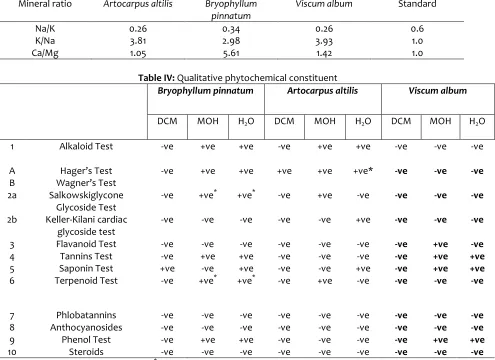
Table (III) shows the computed mineral ratios in the anti-hypertensive herbal plant samples. Appreciable levels of all the essential minerals were present in these samples. The levels of Potassium (K), Sodium (Na), Calcium (Ca) and Magnesium (Mg) were comparably higher than the Manganese (Mn) levels. For normal retention of protein during growth and for balancing fluid a minimum K/Na ratio of 1.0 is recommended [23]. The high values of K/Na ratio (3.81) for A.altilis, (2.98) for B.pinnatum
sodium level in all the sample, this could be the reason these herbs showed anti-hypertensive property because the high potassium level balances the high sodium level responsible for raising high blood pressure. The Ca/Mg values obtained for the present samples
A.altilis, B.pinnatumV. album (1.05) (5.61) and (1.42) were higher than the 1.0 recommended. It means that both Ca and Mg require mineral adjustment especially with B. pinnatum for normal health. This indicates that B. pinnatum is a good source of calcium
The milliequivalent ratio of
[K/(Ca+Mg)] for A. altilis, B. pinnatum and V.
album (0.83) (0.12) (0.47) were comparably
lower than 2.2 recommended, which means the sample would not promote hypomagnesaemia in man [24, 25].
The mineral composition of the herbal plants under study showed that potassium was the most abundant element while chromium was the least abundant in A. altilis. Calcium was the most abundant mineral element in B.
pinnatum and V. album while lead was the least
abundant in both.
Oxalate content
Viscum album leaf has the highest
oxalate content (286.00 mg/100g), Artocarpus
altilis leaves (132.00 mg/100g) and Bryophyllum
pinnatum (66.00 mg/100g). High dietary intake
of soluble oxalate can lead to the formation of kidney stones. Viscum album and Artocarpus
altilis leaves have higher oxalate content than
the recommended daily allowance of less than 100mg daily [20].
Phytochemical screening
Phytochemical screening of the selected plant leaves shows that all the selected plant leaves contained saponin; only
Viscum album tested positive to cardiac
glycoside and flavonoids. terpenoids is present
in B. pinnatum. B. pinnatum and Viscum album
contained tannins; B. pinnatum and Artocarpus
altilis contained alkaloid; steroids,
phylobatannin and free anthacyanosides are absent in all the selected plants.
Phytochemical constituent
Out of all the phytochemicals analyzed in this study, flavonoid was the most abundant while saponin is the least abundant in the three
herbal plants under study. This also justify their use as anti-hypertensives since epidemiological and clinical studies have provided evidence of a potential role for flavonoids in lowering the risk of coronary heart diseases prevention, cardiovascular diseases, alzheimers disease, neurodegenerative diseases, diabetes, osteoporosis and lung cancer [26]through anti-oxidative action and or the modulation of several protein functions.
Conclusion
The phytochemical profiling showed that all the selected plant leaves contained appreciable amounts of phytochemicals like alkaloids, glycoside, and flavonoids which have good pharmacological effect and also carbohydrate, protein and minerals which are nutritional requirements of both humans and livestock. From the result of the oxalate content, possibly, the use of Viscum album could be discouraged because of the high oxalate content and the variation of its chemical composition due to its attachment to different host plant. Artocarpus altilis leaf could still be utilized as anti-hypertensive provided that less than 50g is consumed daily. Bryophllum
pinnatum can be utilized as blood pressure
regulating herb because in per 100g of the plant ingested, the RDA was not exceeded.
Conflict of Interest: The authors hereby declare no conflicts of interest as per this work.
References
1 Essien A.I., Ebana R.U.B., Udo H.B. Chemical evaluation of pod and pulp of the fluted pumpkin (Telfairia
occidentalis) fruit. Food Chem 1992; 45
175-178.
2. Britton R.S., Leicester K.L and Bacon B.R. Iron Toxicity and Chelation Therapy, 2002.
3. Hussain J., Ullah R., Rehman N., Khan A., Muhammad Z. and Khan F.U. Endogenous transitional metal and proximate analysis of selected medicinal plants. Pakistan. J.Med Plants Res 2010
4. Akanbi T.O., Nazamid S., and Adebowale A.A. Functional and pasting properties of a tropical breadfruit (Artocarpus altilis) starch from Ile-Ife, Osun State, Nigeria International Food
5.A.O.A.C, International Official Methods of Analysis, 18th edition Association of Analytical Chemists, Washington DC. 2005.
6. Memnune S., Hilal Y., Neva G. Bulent C. and Sezai E. Pak. J. Pharm. Sci 2009; 22(1) 102-106.
7. Iwu M.M., Duncan A.R. and Okunji C.O. J. New Antimicrobials of Plant Origin.Reprinted from: Perspectives On
New Crops AndNew Uses Janick (Ed.),
ASHS Press:Alexandria, VA. 1999 8. Ishida H., Suzuno H., Sugiyama N., S. Innami, Todokoro T. and Maekawa A. Nutritional evaluation of chemical component of leaves stalks and stems
of sweet potatoes
(Ipomeabatataspoir). Food Chem. 2000; 68359-367
9. Lans C.: Creole remedies of Trinidad
and Tobago, self-published, Lulu.com
2006.
10 A.O.A.C. Official Methods of Analysis. 16th edition, Arlington VA, Association of Official Analytical Chemists 1995.
11. Akinyeye R.O., Oluwadunsin, A. and Omoyeni A. Proximate, mineral, anti-nutrients and phytochemical screening and amino acid composition of the leaves of Pterocarpus mildbraedi
Harms. Electronic Journal of
Environmental, Agricultural and Food Chemistry2010; 9(8) 1322-1333
12. Bonire J.J., Jalil N.S.N, Lo J.A., Sodium and potassium content of two cultivars of white yam (Dioscorea rotundata) and their source soils. J. Sci. Food Agric 1990; 53 271-274
13. Okwu D.E. Evaluation of the chemical composition of indigenous spices of southeastern Nigeria. Global J. Pure Appl. Sci. 2001; 7 455-459 14. Orwa C., Mutua A, Kindt R., Jamnadass R., and Anthony S. Agroforestree Database: A tree reference and selection guide. Version 4.0 World Agroforestry Centre, Kenya 2009.
15. Ciocan I.D and Bara I.I. AnaleleStiintifice Ale Universitatii,
AlexandruIoanCuza, SectiuneaGenetica Si BiologieMoleculara 2007.
16. Nwali B.U,. Okaka,. Ibiam U.A and. Aja, P.M. Phytochemical compositon of
B. pinnatum leaves. International
Journal of Advanced A.N.C Biological research. 2012; 2(4) 614-616.
17. Harborne J.B. Methods in Plant Biochemistry, Plant Phenolics. J.B. (Eds.), Academic Press, London 1999; Vol. 1
18. Harborne Z.B. Phytochemical
methods: A guide to modern
techniques of plant analysis. 3rd edn. Chapman and Hall Press, London 2007; Pp. 1 3, 53, 53 195, 283.
19. Helsper J., Hoogendijk M., Van Norel A. and Burger-Meyer K., Antinutritional factors in faba beans (Viciafaba L.) as affected by breeding toward the absence of condensed tannin. J Agric Food Chem. 1993; 41 1058-1061
20. Lippard S.J. and Berg J.M. Principles of Bioinorganic chemistry, University science Books, Mill Valley, California,U.S.A ; 1994.
21. Adeleye E., and Otokiki M.K.O. Proximate composition and some nutritionally valuable minerals of two varieties of Capsicum annum. Discovery
Innovations. 1999; Vol. 11 75-81
22. Sena L.P, VanderJagt D.J, Rivera C., Tsin A.T,. Analysis of nutritional components of eight famine foods of the Republic of Niger. Glew, Plant Foods Hum. Nutr. 1998;52 17– 30
23.Vasudevan D.M., Sreekumai S. Textbook of biochemistry for medical students. Jaypee brothers publishing ltd, New delhi 2007; Pp313-329. 24. NRC. (National Research Council),
Food and Nutrition Board
Recommended Dietary Allowances” Washington DC, National Academy Press, 10th edition 1989.
Table I: Proximate composition of A. altilis, B. pinnatum and V. album leaves in g/100g
Table II: Mineral elements composition of the herbal plant leaves in (mg/100g)
PLANT SAMPLES
MOISTURE CRUDE
PROTEIN
CRUDE FIBRE
ASH CRUDE
FAT
CHO
Bryophyllum pinnatum 11.60 ± 0.10 17.19 ±0.03 0.30 ± 0.06 17.95 ±0.05 2.45 ±0.07 50.51
Artocarpus altilis 13.30 ± 0.40 14.69 ±0.05 3.50 ± 0.03 10.40 ±0.01 2.65 ± 0.14 55.46
Viscum album 11.85 ± 0.20 12.50 ±0.01 0.20 ± 0.01 10.50 ±0.04 2.40 ± 0.13 62.55
MINERAL ELEMENTS
Artocarpus altilis Bryophyllum
pinnatum
Viscum album %RDA References
Na 145.00 ± 0.04 180.50 ± 0.09 173.00 ± 0.03 1500mg [24]
K 552.50 ± 0.02 537.50 ± 0.10 679.00 ± 0.06 4700mg [24]
Zn 2.63 ± 0.06 5.15 ± 0.19 4.75 ± 0.04 11mg [24]
Ca 340.00 ± 0.02 3862.50 ± 0.04 840.00 ± 0.00 100mg [24]
Mg 324.00 ± 0.04 688.50 ± 0.07 593.00 ± 0.02 400mg [24]
Fe 8.50 ± 0.01 125.50 ± 0.00 8.75 ± 0.02 15mg [24]
Mn ND ND 0.80 ± 0.14 2.3mg
Cr 0.25 ± 0.03 0.90 ± 0.05 1.08 ± 0.02
Table III: Computed mineral ratio of the herbal plant leaves. Mineral ratio Artocarpus altilis Bryophyllum
pinnatum
Viscum album Standard
Na/K 0.26 0.34 0.26 0.6
K/Na 3.81 2.98 3.93 1.0
Ca/Mg 1.05 5.61 1.42 1.0
Table IV: Qualitative phytochemical constituent
Bryophyllum pinnatum Artocarpus altilis Viscum album
DCM MOH H2O DCM MOH H2O DCM MOH H2O
1 Alkaloid Test -ve +ve +ve -ve +ve +ve -ve -ve -ve
A Hager’s Test -ve +ve +ve +ve +ve +ve* -ve -ve -ve
B Wagner’s Test
2a Salkowskiglycone
Glycoside Test
-ve +ve* +ve* -ve +ve -ve -ve -ve -ve
2b Keller-Kilani cardiac glycoside test
-ve -ve -ve -ve -ve +ve -ve -ve -ve
3 Flavanoid Test -ve -ve -ve -ve -ve -ve -ve +ve -ve
4 Tannins Test -ve +ve +ve -ve -ve -ve -ve +ve +ve
5 Saponin Test +ve -ve +ve -ve -ve +ve -ve +ve +ve
6 Terpenoid Test -ve +ve* +ve* -ve +ve -ve -ve -ve -ve
7 Phlobatannins -ve -ve -ve -ve -ve -ve -ve -ve -ve
8 Anthocyanosides -ve -ve -ve -ve -ve -ve -ve -ve -ve
9 Phenol Test -ve +ve +ve -ve -ve -ve -ve +ve +ve
10 Steroids -ve -ve -ve -ve -ve -ve -ve -ve -ve
NB: +ve* = strongly present, +ve = present, -ve = absent
DCM= dichloromethane extract, MOH= methanol extract, H2O= aqueous extract
Table V: Quantitative phytochemical composition of the herbal plants in (mg/100g)
Phytochemicals Bryophyllum pinnatum Artocarpus altilis Viscum album
Flavonoids ND ND 3.34 ± 0.02
Alkaloids 1.28 ± 0.04 0.52 ± 0.02 ND
Saponins Total Oxalate
0.015 ± 0.01 66.00
0.02 ± 0.01 132.00