INTRODUCTION
β-hydroxy thiocyanates play an important role in the realm of organic chemistry, such as biological, pharmaceutical and agricultural chemistry1. In the recent decade, these compounds
were prepared by the reaction of different epoxides with NH4SCN in the presence of various catalysts and different condition.
Epoxides or oxiranes are useful and important synthetic intermediates in organic synthesis.2Their inherent polarity and high angle
strain of three-membered ring make them susceptible to react with a wide variety of reagents, including reducing agents, oxidizing agents,
www.orientjchem.org
CODEN: OJCHEG 2011, Vol. 27, No. (4): Pg. 1531-1553 Est. 1984
An International Open Free Access, Peer Reviewed Research Journal
Some Versatile and Efficient Methods for the
Regioselective Ring Opening of Epoxides to
Corresponding
βββββ
-Hydroxy Thiocyanates
FARIBA HEIDARIZADEH¹ and SOMAYEH ELAHI²
¹Department of Chemistry, Faculty of Science, Shahid Chamran University, Ahvaz (Iran). ²Abadan Branch, Islamic Azad University, Abadan (Iran).
*Corresponding author: E-mail: [email protected]
(Received: April 12, 2011; Accepted: June 04, 2011)
ABSTRACT
In this review, was reported some methods for the preparation of â-hydroxy thiocyanates,
which are considered as an important class of compounds often used as key intermediates in agricultural and pharmaceutical chemistry.
Key words: Regioselectivity, Ring opening, Thiocyanohydrin, Epoxide, β-Hydroxythiocyanate, Solid phase, Liquid phase.
electrophiles, nucleophiles, acids, and bases3-4.
The ring opening of epoxides with different nucleophiles is an attractive subject in organic transformations5.
Between these nucleophiles, the reaction of thiocyanate ion with epoxides, in the absence or in the presence of catalyst is a widely studied and suitable method for the preparation of thiiranes6-13.
There are two methods reported in the literature for the synthesis of β-hydroxy thiocyanates. In the first method, thiocyanohydrins were prepared
by the opening of a cyclic sulfate with NH4SCN to form the corresponding β-sulfate, which is hydrolyzed to the thiocyanohydrines. (Scheme 2) Scheme 1: Reaction of epoxides with NH4SCN
Scheme 2: Reaction of a cyclic sulfate with NH4SCN
Scheme 3: Reaction of epoxides with thiocyanic acid The second method employed the addition
of thiocyanic acid generated in situ to the epoxide
at low temperature .15-18 (Scheme 3)
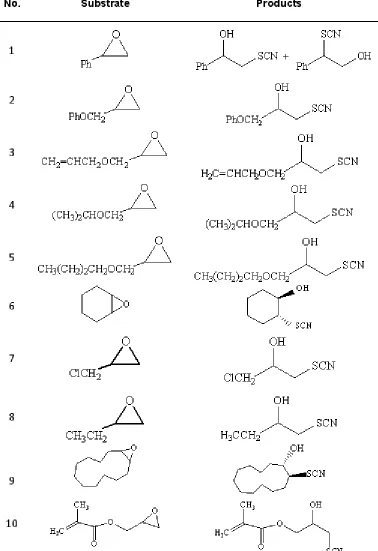
In this review, we report some novel and efficient methods for the regioselective ring-opening of epoxides to corresponding β-hydroxy thiocyanates. Various epoxides and β-hydroxy thiocyanates are shown in following table. (Table1)
It was found that, epoxides carrying electron-donating groups, it is the electronic factor
that predominates, and the thiocyanate ion attacks, predominantly at the secondary carbon atom of the epoxide ring (II), a fact that is reasonably well established. In contrast, in epoxides carrying electron withdrawing groups, it is the steric factor in that predominates and the nucleophilic attack of thiocyanate ion is strongly favored on the less substituted carbon of epoxides (I) (Scheme 4).
In the case of cyclohexene oxide, the stereochemistry of the ring-opened product was
found to be trans. (Scheme 5)
Scheme 5: Stereoselectivity in ring opening of cyclohexene oxide Reaction in liquid phase
Use of phenol-containing macrocyclic diamides as catalyst
Initially, in 2001, the regioselective ring-opening reactions of some epoxides with
ammonium thiocyanate in the presence of a series of new phenol-containing macrocyclic diamides and also dibenzo-18-crown-6-, 18-crown-6-, benzo-15-crown-5-, and pyridine-containing macrocyclic diamide was studied19(Scheme 6)
The epoxides were subject to cleavage by NH4SCN in the presence of these catalysts under mild reaction conditions in various aprotic solvents. Thiocyanation reactions proceed very cleanly
employing CH3CN, while those performed in Et2O and CH2Cl2 led to a lower yield of the thiocyanohydrin. (Scheme 7)
Scheme 6: Various macrocyclic catalysts
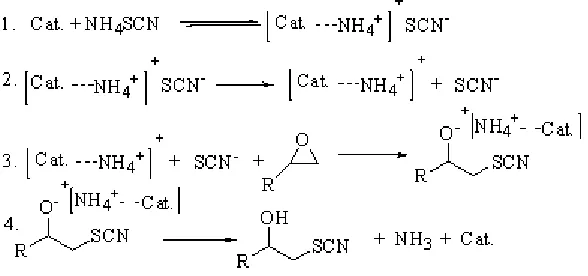
Four-step mechanism was proposed for this reaction (Scheme 8): The first step involves the formation of a 1:1 molecular complex between macrocycle and NH4SCN in which thiocyanate ion (SCN-) exist as a contact ion pair:
Macrocycle + NH4SCN ↔ [Macrocycle....NH4+] SCN
-...(1)
In the second step, this complex is further
decomposed to release SCN- ion into solution as:
(Macrocycle....NH4+)SCN- ↔ [Macrocycle....NH 4
+] +
SCN- ...(2)
Therefore, in this way, SCN- ion is
produced as a nucleophilic species in the presence of a suitable macrocycle, and in the third step, this ion participates in the ring-opening reaction of epoxides
Finally, the catalyst is regenerated in step 4
These steps occur continuously until all of the epoxides and ammonium thiocyanate are consumed, and after workup, the catalyst can be recovered easily.
Use of poly[N-(2 aminoethyl) acrylamido] trimethyl ammonium chloride as phase-transfer catalysts
In 2002, Tamami and coworker used
p o l y [N - ( 2 - a m i n o e t h y l ) a c r y l a m i d o ] t r i m e t h y l ammonium chloride resin (quaternized amino functionalized cross-linked polyacrylamide) as an efficient heterogeneous polymeric PTC, for regioselective ring opening of epoxides by thiocyanate ion to give corresponding thiocyanohydrins.20 (Scheme 9)
Scheme 9: Ring opening of epoxide in the peresence of PTC as catalyst
Phase-transfer catalysts (PTCs) facilitate reactions between water-soluble reagents and organic soluble substrates. The most important PTCs, which have been used widely in organic reactions, are quaternary ammonium and phosphonium salts, crown ethers, and cryptands. 21-24During the last few years much interest has been
focused on the applications of functionalized
polymers as PTCs25-28because they provide ease
polyacrylamide with excess ethylene–diamine. Poly [N- (2-aminoethyl) acrylamido] trimethyl ammonium chloride was prepared by the reaction of poly [N-(2-aminoethyl) acrylamide] with an excess of methyl iodide in DMF at room temperature and subsequent exchange of the iodide anion with chloride.29-30
The reactions were carried out in wet tetrahydroforan, chloroform, dichloromethane, ethyl acetate, acetonitrile and water. The best solvent was acetonitrile.
The poly [N-(2-aminoethyl)acrylamido] trimethyl ammonium chloride resin in this transformation acts both as a catalyst for
nucleophilic ring opening reactions as well as being a phase-transfer agent. It seems that this polymeric catalyst carrying the nucleophile has an activating effect on the epoxy substrate, and the reaction proceeds smoothly in the vicinity of the catalyst. Probably, the ring opening of the epoxide is facilitated by hydrogen bonding between the oxygen of the epoxide and the amidic hydrogen of the polymer.
Use of meso-tetraarylporpherins as catalyst In 2004, Sharghi and coworker used meso-tetraarylporpherins as a catalyst for the synthesis of several 2-hydroxyethyl thiocyanates.31
(Scheme 10)
Scheme 10: Use of meso-tetraarylporpherins as catalyst for preparation of thiocyanohydrin
They synthesed meso-tetraarylporphyrins from pyrrole and aryl aldehydes in the presence of PCl5, at room temperature using air as an oxidant. Pyrrole and the desired arylaldehyde in the
presence of PCl5 react to form tetraarylporphyrins in one pot without the need of 2,3-dichloro-5,6-dicyano-1,4-benzoquinone (DDQ) as an oxidant. Under these reaction conditions tetraarylporphyrins are formed in 28–65% yield (Scheme 11).
Scheme 11: Preparation of tetraarylporphyrins
Five meso-tetraarylporphyrins (tetraphenyl porphyrin [TPP], 5,10,15,20-tetrakis(4 hydroxyphenyl)- porphyrin [T(4-OH P)P], 5,10,15,20-tetrakis(4-methylphenyl) porphyrin [T(4-Me P)P], 5,10,15,20-tetrakis- (4 chlorophenyl) porphyrin [T(4-Cl P)P] and 5,10,15, 20-tetrakis(4-nitrophenyl)porphyrin [T(4-NO2P)P]) that were synthesized according to above method were used
Use of 2,6-bis[2-(o-aminophenoxy)methyl]-4-bromo-1-methoxybenzene (BABMB) as catalyst In 2003, conversion of epoxides in to 2-hydroxyethyl thiocyanates with NH4SCN in the
presence of 2,6bis[2(o aminophenoxy) methyl] -4-bromo – 1 - methoxybenzene (BABMB) as a catalyst was described.32 (Scheme 12)
Scheme 12: Ring opening of epoxide in the peresence of BABMB as catalyst
The properties of cyclic crown ethers are approximated by acyclic neutral ligands (podands). Variation of the endo-polarophilicity/exo-lipophilicity balance, complex stability, ion selectivity can often be accomplished more easily, with greater versatility, and at less expense with acyclic polyether than with their cyclic counterparts: complexation and decomplexation are generally faster in an acyclic system and the pesudocavity usually has greater conformational flexibility.33The research
group found that podand diamino {2,6bis[2(oa m i n o p h e n o x y ) m e t h y l ] 4 b r o m o 1 -methoxybenzene (BABMB) efficiently catalyzed the addition of ammonium thiocyanates to epoxide to form 2-hydroxyethyl thiocyanates.
In comparison with previous methods,19
BABMB is less expensive, have fewer steps needed for the preparation, and has a higher overall yield.
Use of phosphorous (v) tetraphenylporphyrin as catalyst
Sharghi and his groups also described a convenient and efficient procedure for the cleavage of the oxirane rings with ammonium thiocyanates in the presence of phosphorous (v) tetraphenylporphyrin34 (Scheme 13). Phosphorous
(v) porphyrin, with central six-coordinated phosphorus, is both a unique nonmetal porphyrin,35
and an unusual hypervalent compound with a large ï-electron system.36-38
The results of the reaction of styrene oxide with thiocyanates ion in the presence of the
[P(TPP)Cl2]Cl in various solvents are summarized in Table 2.
Table 2: The reaction of styrene oxide with thiocyanates ion in the presence of the [P(TPP)Cl2]Cl in various solvents Entry Solvent Time (min) Yield of 2 (%) Yield of 3 (%)
1 CH3CN 22 80 18
2 CH3COCH3 120 8 2
3 CHCl3 100 12 3
4 THF 60 45 10
5 C6H6 100 5 Trace
6 DMF 120 10 2
7 DMSO 80 16 5
The research group found out that the reaction appeared to be largely dependent on the nature of solvent, and CH3CN was the best solvent for this reaction. The cleavage of the styrene oxide with ammonium thiocyanates in CH3CN in the absence of catalyst was checked. Without the catalyst, the reaction required a much longer time. Moreover, undesirable thiirane-for mation predominated.19
The use of phosphorus porphyrin catalyst resulted in the highest yield of thiocyanohydrin. This was most probably due to the formation of the most stable complexes between NH4SCN and phosphorus porphyrin (i.e., the largest number catalyst sites).
The mechanism of the recent three methods is described in four steps: (Scheme 14)
Scheme 14: The mechanism of the recent three methods
Use of Metalloporphyrins as catalyst
Metalloporphyrins have been the subject of many studies because these complexes show wide applicability and were used as the catalyst for a variety of photosensitizers,39 solar-energy conversion
,40 redox catalyst,41-45 hydroxylation and epoxidation
of hydrocarbon compounds,46-49 aziridation of
olefins,50 oxidation of sulfides to sulfones,51
hydroxylation of aromatic compounds,52 asymmetric
carbon-hydrogen bond formation,53 oxidative
carbonylation of amines,54 silylation of hydroxyl
groups,55 and ring opening of epoxides.56-59
with ammonium thiocyanates in the presence of some metal complexes of tetraphenylporphyrins M
II TPP and MIII(TPP)Cl [M = Co(II), Ni(II), Cu(II),
Zn(II), Mn(II) , Fe(III) and Co(III) and TPP = tetraphenylporphyrin dianion]. The use of CoII
T(p-OHP)P as a catalyst resulted in the highest reaction yield. This is most probably due to the formation of the most stable complexes between NH4SCN and this catalyst.60 (Scheme 15)
Scheme 15: Use of Metalloporphyrins as catalyst for regioselective ring opening of epoxide
UV-Vis spectral data obviously support the increased reaction yield using this catalyst as well
as the predominance of the proposed mechanism in solution (Scheme16).
Based on the experimental results, it can be concluded that the reaction rate in the present reaction should be affected not only by complexation of NH4SCN with metalloporphyrin complexes, but also by dissociation of the SCN
-anion from the adduct and simultaneous activation of epoxide and thiocyanates by two different catalyst molecules.
Use of SelectfluoreTM as catalyst
In 2004, it was reported the use of SelectfluoreTM as a novel and efficient catalyst for
the preparation of β-hydroxy thiocyanates by a regioselective ring opening of epoxides with ammonium thiocyanate under mild conditions.61
(Scheme 17)
Scheme 17: Use of SelectfluoreTM as catalyst for preparation of thiocyanohydrin
SelectfluoreTM has been introduced
commercially as a user-friendly electrophilic fluorinating agent. SelectfluoreTM is readily available
at low cost and is easy to handle and also retains its activity even in the presence of amines.62-63
The reactivity of several epoxides with ammonium thiocyanate was examined using various Lewis acids such as CeCl3.7H2O, YCl3, TaCl5, InCl3, InBr3, In(OTf)3, Bi(OTf)3 and Sc(OTf)3. In most of these cases, thiiranes were obtained exclusively and no β-hydroxy thiocyanate was isolated.
In this reaction selectfluoreTM employed as
an efficient lewis acid catalyst, and β-hydroxy thiocyanate as the only product.
Use of poly(ethylene glycol)-bound sulfonic acid (PEG-SO3H) in CH2Cl2
Kiasat and coworker have began their studies on the synthesis of β-hydroxy thiocyanates since 2008. Initially they described an efficient and simple method for the transformation of epoxides to the corresponding β-hydroxy thiocyanates using NH4SCN in the presence of a catalytic amount of poly(ethylene glycol)-bound sulfonic acid, PEG-SO3H, in high isolated yields.64 (Scheme 18)
Scheme 18: Regioselective ring opening of epoxide in the presence of PEG-SO3H
Soluble polymeric supports offer certain advantages over insoluble polymers in terms of ease of analysis and monitoring and, most importantly, the establishment of homogeneous conditions, which are most conducive to bimolecular processes.65Polyethylene glycol (PEG) and its
derivatives are known to be inexpensive, thermally stable, recoverable, toxicologically innocuous, and environmentally benign media for chemical reactions, 66 as well as having almost negligible
vapor pressure.
PEG-SO3H was prepared67 by simple
mixing of PEG-6000 and chlorosulfonic acid in CH2Cl2 (Scheme 19). The reaction is very clean, and the polymeric phase-transfer catalyst can be easily precipitated in ether. The preparation of polymeric catalyst was confirmed by 1HNMR
The efficiency of PEG-SO3H in the conversion of epoxides to β-hydroxy thiocyanates was definitely confirmed by the reaction of styrene oxide with NH4SCN under similar reaction conditions, without adding PEG-SO3H. In this case, the reaction did not complete after 5 h, and only a little thiirane was obtained. Furthermore, this reaction was examined in the presence of PEG instead of PEG-SO3H. TLC analysis showed that the reaction did not complete after 5 h and only a trace amount of β-hydroxy thiocyanate was
obtained. Any attempts to prepare thiocyanohydrin by ring opening of styrene oxide with thiocyanate anion in the presence of PEG and sulfuric acid were not successful, and polymerization reaction was occurred. It seems that this polymeric catalyst forms a complex with cation, much like crown ethers, and this complex causes the anion to be activated. In addition, polymeric catalyst probably can be facilitated the ring opening of the epoxide by hydrogen bonding as shown in Scheme 20. Scheme 19: Preparation of poly(ethylene glycol)-bound sulfonic acid
Scheme 20: Anion activation by PEG-SO3H
Compared to some previously reported methods with major or minor drawbacks, several noteworthy features of this reagent are apparent, such as easily workup procedure, operational simplicities, and use of inexpensive reagent.
Use of poly(ethylene glycol)-bound sulfonic acid (PEG-SO3H) in water
In order to develop green chemistry method by using water as a reaction medium,68-69
kiasat and coworker examined the catalytic ability of PEG-SO3H for conversion of epoxides to β -hydroxy thiocyanates with ammonium thiocyanate in water at room temperature.70 (Scheme 21)
This catalyst acted very efficiently, and it was observed that only 0.1 M equivalent of the catalyst is enough to convert different epoxides carrying electrondonating or withdrawing groups to their corresponding β-hydroxy thiocyanates in high isolated yields within 1 h. It is noteworthy that no evidence for the formation of thiirane as by-product of the reaction was observed.
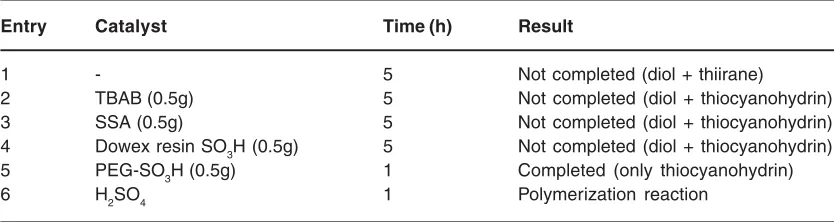
The efficiency of PEG-SO3H as an acidic phase transfer catalyst in the conversion of epoxides to β-hydroxy thiocyanates was definitely confirmed by reaction of styrene oxide with NH4SCN under similar reaction conditions and in the presence of
tetrabutylammonium bromide (TBAB) as a nonacidic phase transfer catalyst, or silica sulfuric acid (SSA) and Dowex resin SO3H as a solid acid catalyst. As shown in Table 3, in these cases, the reaction did not complete after 5 h, and was contaminated by diol and thiirane formation. It is worthy to note that attempts for preparation of thiocyanohydrin by ring opening of styrene oxide with thiocyanate anion in the presence of dilute H2SO4 were not successful and the polymerization reaction was occurred. Unfortunately, the use of recycled PEG-SO3H shows a loss in its activity as the yield of ring opening of cyclohexene oxide dropped to a low value (48%).
Table 3: Reaction of styrene oxide with NH4SCN in water
Entry Catalyst Time (h) Result
1 - 5 Not completed (diol + thiirane)
2 TBAB (0.5g) 5 Not completed (diol + thiocyanohydrin)
3 SSA (0.5g) 5 Not completed (diol + thiocyanohydrin)
4 Dowex resin SO3H (0.5g) 5 Not completed (diol + thiocyanohydrin)
5 PEG-SO3H (0.5g) 1 Completed (only thiocyanohydrin)
6 H2SO4 1 Polymerization reaction
SSA: Silica sulfuric acid.
TBAB: Tetrabutyl ammonium bromide.
Use of ααααα,ααααα',ααααα ''-N-hexakis(triethyl-ammoniummethylene chloride)-melamine as phase-transfer catalyst
They also decided to apply a multi-site phase-transfer catalyst containing the maximum
possible number of active sites for the preparation of β-hydroxythiocyanates by a regioselective ring opening of epoxides with ammonium thiocyanatein in water.71 (Scheme 22)
Scheme 22: Regioselective ring opening of epoxide in the presence of MPTC
In 2004, a report by Balakrishnan72 outlined
the preparation of an efficient multi-site phase-transfer catalyst, α,α',α''-N-hexakis(triethyl ammoniummethylene chloride)-melamine. They found that this MPTC catalyst have higher activity than the commercially available single-site
In this research, initially, ring opening of phenyl glycidyl ether with NH4SCN was investigated in the presence of α,α,α3 –N- hexakis (triethylammonium-methylene chloride)-melamine in various solvents. TLC analysis of the reaction mixture was clearly shown that in organic solvents and under reflux conditions the reaction did not complete even after 5 h and contaminated by
thiirane. Interestingly, the best result was obtained in water as the reaction media. This is not only due to short reaction time and high yield of the obtained β- hydroxythiocyanate, but also due to inhabitation effect of water in the conversion of β-hydroxythiocyanate to the corresponding thiiranes. The obtained results are summarized in Table 4.
Scheme 23: Preparation of MPTC
Table 4: Efficiency of solvents on the thiocyanation of epoxides. Entry Solvent (5mL) Time (min) Results
1 CH2Cl2 300 Not completed
2 n-C6H14 300 Not completed
3 CH3CN 300 Not completed
4 PEG-400 45 Completed (only thiirane)
5 H2O 15 Completed (only thiocyanohydrin)
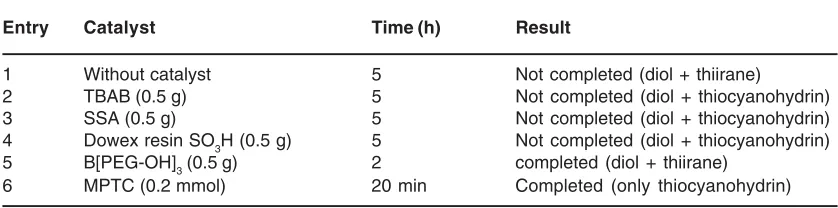
The efficiency of α,α',α''-N hexakis (triethylammoniummethylenechloride) - melamine as a multi-site phase transfer catalyst in the conversion of epoxides to β-hydroxythiocyanates in water was definitely confirmed by the reaction of styrene oxide with NH4SCN under similar reaction conditions. This reaction was in the presence of
tetrabutylammonium bromide (TBAB) as a single site phase-transfer catalyst, β-podants and polyethylene glycol as an alternative to cyclic crown ethers and cryptands and Dowex resin SO3H as a solid acid catalyst. As shown in Table 5, in these cases, the reaction did not complete after 5 h, and contaminated by diol and thiirane formation.
Table 5: Reaction of styrene oxide with NH4SCN in water under reflux condition
Entry Catalyst Time (h) Result
1 Without catalyst 5 Not completed (diol + thiirane)
2 TBAB (0.5 g) 5 Not completed (diol + thiocyanohydrin)
3 SSA (0.5 g) 5 Not completed (diol + thiocyanohydrin)
4 Dowex resin SO3H (0.5 g) 5 Not completed (diol + thiocyanohydrin)
5 B[PEG-OH]3 (0.5 g) 2 completed (diol + thiirane)
6 MPTC (0.2 mmol) 20 min Completed (only thiocyanohydrin)
SSA: Silica sulfuric acid. TBAB: tetrabutyl ammonium bromide.
It should be pointed out that in the absence of catalyst, the reaction was sluggish and a considerable amount of starting material was recovered unchanged and the reaction media was contaminated by diol and thiirane.
Use of N-Thiocyanatosuccinimide (NTS) as reagent
Eventually in 2010, Mokhtari and coworker reported the use of in situ generated N-thiocyanatosuccinimide with NH4SCN in liquid phase and offer an efficient reagent system for the conversion of epoxides to their corresponding thiocyanohydrines in good to high yields.73 (Scheme
24)
Scheme 24: Use of NTS as catalyst for preparation of thiocyanohydrin
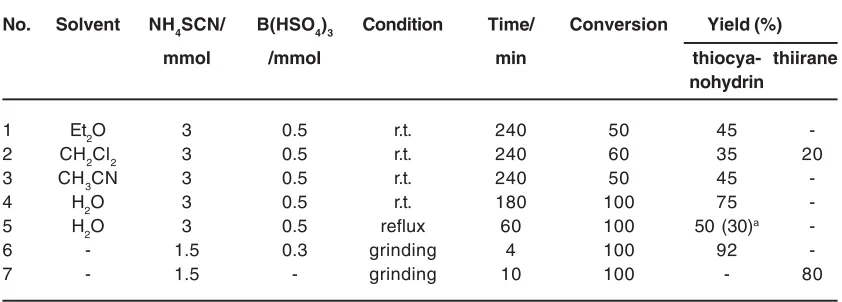
They examined the catalytic ability of B(HSO4)3 for the conversion of epoxides to corresponding thiocyanohydrins. Therefore, phenyl glycidyl ether was reacted with ammonium thiocyanates in the presence of B(HSO4)3 in different solvents and under solvent-free condition. The N-Thiocyanatosuccinimide (NTS) is reactive electrophilic sulfur compound which can be simply prepared by the reaction of thiocyanate anion with N-halosuccinimide.74 Despite the usefulness and
high reactivity of NTS there are few reports on the applications of this reagent in organic synthesis including thiocyanation of electron-rich aromatic
compounds,75 ring-expansion thiocyanation of
1,3-dithiolanes and 1,3-dithiones,76 and a-thiocyantion
of N-acyl imides.77
Addition of ammonium thiocyanate to an acetonitrile solution of NBS gave NTS in 15 min. Reaction of epoxide with this reagent in the presence
of NH4SCN gave the corresponding
thiocyanohydrine.
The following mechanism was suggested for this reaction (Scheme 25).
Reaction in solid phase
The importance of minimizing the impact that chemical processing produces on the environment is growing, with an increased appreciation of the need to reduce pollution and depletion of our finite environmental resources. Optimal use of material and energy, and an efficient waste management can be recognized as important factors for environmental protection. To realize this goal, in recent years, significant articles have been appeared to report efficient solvent-free reactions by grinding.78-80This technique has many
advantages such as reduced pollution, low cost, process simplicity and easier workup. In addition, from the green and environmental acceptability, recently more attention has been paid to the application of inorganic acidic salts in organic synthesis.81-86Solid acids have many advantages
such as simplicity in handling, decreased reactor and plant corrosion problems, and more environmentally safe disposal in different chemical processes. Also, wastes and by-products can be minimized or avoided by using solid acids in developing cleaner synthesis routes.
Use of B(HSO4)3 as solid acid catalyst
In connection with this trend and in continuation of their studies on the synthesis of β-hydroxy thiocyanate, kiasat and coworker described their successful results that led to an extremely convenient method for the transformation of epoxides into the corresponding β-hydroxy thiocyanates using NH4SCN and in the presence of B(HSO4)3 as solid acid catalyst in solvent-free process in high isolated yields.87 (Scheme 26)
Scheme 26: Preparation of thiocyanohydrin in the presence of B(HSO4)3
Boron sulfonic acid was easily prepared by the addition of chlorosulfonic acid to boric acid under N2 atmosphere at room temperature. This
reaction was easy and clean, because HCl gas was evolved from the reaction vessel immediately (Scheme 27).
Scheme 27: Preparation of B(HSO4)3
Best result was obtained under solvent-free conditions. The results in Table 6 were clearly shown that although water was the best solvent among those tested. The best result was obtained under solvent-free conditions.
It is noteworthy that no evidence for the formation of thiiranes as by-product of the reactions was observed. It seems that B(HSO4)3 can be facilitated the ring opening of the epoxides by hydrogen bonding. In addition it, probably stabilize the produced thiocyanohydrins and inhibit their
conversion to thiiranes. In the absence of catalyst, thiirane was produced as only product. Also, in the presence of boric acid as catalyst, reaction time was increased and the mixture of thiocyanohydrin and thiirane were produced.
Table 7: Comparison of thiocyanation of styrene oxide with different methods
Entry Reagent and reaction condition Reaction ααααα attack βββββ attack Yield/
time/min (%)
1 B(HSO4)3/NH4SCN/solvent/free 4 92 8 91
2 DDQ/NH4SCN/CH3CN/reflux 50 89 11 91
3 Ti(OPr)4/ NH4SCN/THF/reflux 240 - - 30
4 PTC/ NH4SCN/CH3CN/r.t. 90 90 10 90
5 T(4-OH P)P/ NH4SCN/CH3CN/reflux 20 - - 96
6 BMBMB/ NH4SCN/CH3CN/reflux 10 20 80 91
7 CoII T(p-OHP)P/ NH
4SCN/N2/CH3CN/reflux 25 17 83 96
8 [PTPPCl2]Cl/ NH4SCN/N2/CH3CN/reflux 22 20 80 96
9 Selectfluor/ NH4SCN/CH3CN/r.t. 150 14 83 95
10 Pd(PPh3)4/ NH4SCN/N2/ THF/reflux 120 thiirane thiirane 35
11 BMBMB/ KSCN/CH3CN/reflux 120 - - 10
12 ZnCl2/KSCN/THF/ reflux 180 - - 60
Table 6: Consideration of different conditions for thiocyanation of phenyl glycidyl ether No. Solvent NH4SCN/ B(HSO4)3 Condition Time/ Conversion Yield (%)
mmol /mmol min thiocya- thiirane
nohydrin
1 Et2O 3 0.5 r.t. 240 50 45
-2 CH2Cl2 3 0.5 r.t. 240 60 35 20
3 CH3CN 3 0.5 r.t. 240 50 45
-4 H2O 3 0.5 r.t. 180 100 75
-5 H2O 3 0.5 reflux 60 100 50 (30)a
-6 - 1.5 0.3 grinding 4 100 92
-7 - 1.5 - grinding 10 100 - 80
aYield in preparation refers to produced diol.
Use of Dowex as reusable eco-friendly catalyst In 2008, a convenient and efficient procedure for the regioselective ring opening of epoxides in the presence of Dowex (strongly acidic cationic exchange resin), as reusable eco-friendly catalyst under solvent free conditions was described by kiasat and coworker.88
Dowex has been used as an efficient solid acid catalyst in organic synthesis. 89-91Recently, they
have reported the use of Dowex polymer in the protection of carbonyl compounds.92In conjunction
with the ongoing work on the new methods for the preparation of β-hydroxy thiocyanates, 64, 70 they
found that Dowex polymer in the presence of silica gel efficiently catalyzed the addition of ammonium thiocyanate to epoxides to form β-hydroxy thiocyanates with high regioselectivity under solvent free conditions (Scheme 28).
It is notable that no evidence for the formation of thiirane as by-product of the reaction was observed, and the products were obtained in pure form without further purification.
The effect of acidic polymeric catalyst was definitely confirmed by the reaction of styrene oxide with ammonium thiocyanate. In the absence of polymeric catalyst, thiirane was produced as the only product.
It is worthy to note that the polymeric catalyst can be reused several times without loss of activity. The catalyst (mixture of Dowex and silica gel) recovered by filtering and washing with water and methanol, and then it was reused four times. The catalyst did not show any loss in its activity.
Use of silica sulfuric acid as heterogeneous catalyst
Kiasat and coworker, keeping in mind these facts as well as reports about the successful application of silica sulfuric acid as a stable and efficient heterogeneous catalyst in organic synthesis.93This prompted them to explore the
potential of this inorganic solid acid as a catalyst for the ring opening of epoxides. They described their successful results that led to an extremely convenient method for the transformation of epoxides into the corresponding β-hydroxy thiocyanate using NH4SCN supported on silica gel and in the presence of silica sulfuric acid as a catalyst solvent-free process in high isolated yields.94 (Scheme 29)
Scheme 29: Use of silica sulfuric acid as catalyst for preparation of thiocyanohydrin
Silica sulfuric acid was easily prepared70
by reaction of silica gel with chlorosulfonic acid. The reaction is very clean, not requiring any work-up procedure because the evolved HCl gas can be removed from the reaction vessel immediately.
NH4SCN supported on silica gel was prepared by simply co-grinding NH4SCN with silica gel in an agate mortar. In this simple and efficient method the starting epoxides (1 mmol) were converted to the corresponding β-hydroxy thiocyanates in the presence of supported NH4SCN on silica gel and silica sulfuric acid.
The inhabitation effect of silica sulfuric acid for the conversion of β-hydroxy thiocyanate to thiirane was definitely confirmed by the reaction of
styrene oxide with NH4SCN supported on silica gel under similar reaction conditions, without adding silica sulfuric acid. In this case thiirane was obtained exclusively and no β-hydroxy thiocyanate was isolated.
Use of Al(HSO4)3/SiO2 as efficient and powerful solid acid catalysts
In 2010, metal hydrogen sulfates and phosphates/silica gel have been studied as an efficient and powerful solid acid catalyst in the ring opening of epoxides with thiocyanate anion.95 The
most significant result was obtained by Al(HSO4)3/ SiO2 which afforded the corresponding β-hydroxy thiocyanates under mild reaction conditions and in very short reaction times (Scheme 30).
Metal hydrogen sulfates and phosphates were easily prepared from the corresponding anhydrous metal chlorides and sulfuric or phosphoric acid, respectively.78,96The reactions
were very clean and did not require a work-up procedure because HCl evolves as a by-product from the reaction vessel immediately (Scheme 31).
Scheme 31: Preparation of metal hydrogen sulfates
Initially Kiasat and coworker attempted to investigate the possible catalytic properties of these solid acids (I–VI) with simpler systems such as phenyl glycidyl ether with NH4SCN. Under
solvent-free conditions, comparative results led them to introduce Al(HSO4)3/SiO2 as the most effective system (Table 8).
Table 8: Comparison of catalytic ability of catalysts
No. Catalyst Time (min) Product
1 Al(HSO4)3 /SiO2 5 Thiocyanohydrine
2 Al(H2PO4)3/SiO2 10 Thiocyanohydrine
3 Mg(HSO4)2/SiO2 10 Thiocyanohydrine
4 Mg(H2PO4)2 /SiO2 10 (thiocyanohydrin + thiirane)
5 Zn(HSO4)2/SiO2 10 Thiocyanohydrine
6 Zn(H2PO4)2/SiO2 10 Thiocyanohydrine
Use of melamine sulfonic acid (MSA) as catalyst This research group in continuation of their research reported the regioselective ring opening of epoxides with thiocyanate anion in the presence
of melamine sulfonic acid (MSA) as a catalyst at room temperature under solvent-free conditions.97
(Scheme 32)
Scheme 32: Ring opening of epoxides to the thiocyanohydrins As described in (Scheme 33), MSA, a
novel and efficient solid acid, was easily prepared by the addition of chlorosulfonic acid to melamine under an N2 atmosphere at room temperature. The reaction was very easy and clean, because the
To ascertain the possible catalytic property of this solid acid, the reaction of 2, 3-epoxypropyl phenyl ether with NH4SCN in the presence of a catalytic amount of melamine sulfonic acid was studied under solvent-free conditions. This reaction
Scheme 33: Preparation of MSA
was completed after 3 min and the corresponding thiocyanohydrin was obtained, whereas in the absence of catalyst, this reaction was completed after 10 min and the corresponding thiirane was obtained as the only product (Scheme 34).
Scheme 34: Ring opening of 2,3-epoxypropyl phenyl ether with and without catalyst The results of the ring opening of
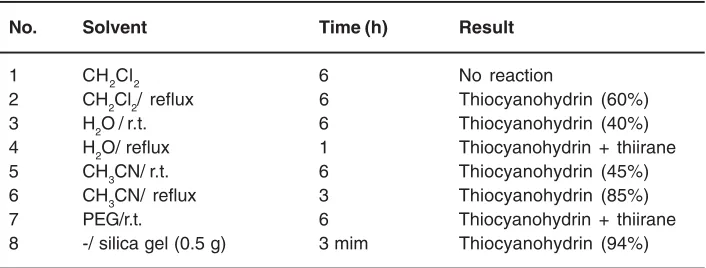
2,3-epoxypropyl phenyl ether in the presence of MSA using various solvents are summarized in Table 9. The results clearly show that although this reaction proceeded in refluxing acetonitrile, the best result
was obtained under solvent-free conditions. The MSA can be stabilized the produced β-hydroxy thiocyanate under solvent-free conditions and without using silica gel, the presence of silica gel for facile grinding of reaction media is necessary.
Table 9: Solvent optimization in the ring opening of 2,3-epoxypropyl phenyl ether (1 mmol) by NH4SCN (1.5 mmol) in the presence of MSA (0.3 mmol)
No. Solvent Time (h) Result
1 CH2Cl2 6 No reaction
2 CH2Cl2/ reflux 6 Thiocyanohydrin (60%)
3 H2O / r.t. 6 Thiocyanohydrin (40%)
4 H2O/ reflux 1 Thiocyanohydrin + thiirane
5 CH3CN/ r.t. 6 Thiocyanohydrin (45%)
6 CH3CN/ reflux 3 Thiocyanohydrin (85%)
7 PEG/r.t. 6 Thiocyanohydrin + thiirane
By comparison, the obtained results for the conversion of 2,3-epoxypropyl phenyl ether to the corresponding thiocyanohydrin in the presence of
acidic catalysts are given in Table 10. As shown in this table, MSA has greater efficiency and shorter reaction time than other catalysts.
Table 10: Comparison of catalytic ability of acidic catalysts in the thiocyanation of 2,3-epoxypropyl
phenyl ether under solvent-free condition
No. Catalyst Time (min) Yield (%)
1 MSA 3 94
2 SSA 10 88
3 Dowex 8 85
4 PEG-SO3H 5
-5 B(HSO4)3 4 92
6 Mg(HSO4)2 10 85
7 Zn(HSO4)2 10 89
8 Al(HSO4)3 5 91
They recently reported the synthesis of thiocyanohydrins in the presence of poly(ethylene glycol) (PEG)-SO3H as an acidic phase-transfer catalyst.64,70Unfortunately, the use of recycled
PEG-SO3H resulted in a substantial loss of its activity as the yield of products dropped to a low value. The most ideal synthetic methodology could be defined as a system wherein 100% atom economy is preserved, the catalyst is recycled, and the excess of reagent remains throughout in the medium and does not lose activity for several runs. In this procedure, ring opening of epoxides with NH4SCN
in the presence of catalyst furnished the corresponding thiocyanohydrins in excellent yields. The catalyst, the additional ammonium thiocyanate, and silica gel were conveniently separated from the reaction mixture by simple filtration. The mixture was reused three consecutive times with only a slight variation in the yields of the corresponding products.
The facile nucleophilic ring opening of epoxides with ammonium thiocyanate in the atom economical method is described in (Scheme 35).
CONCLUSION
In this review, we reported some methods for preparation of β-hydroxy thiocyanates in the liquid and solid phase. By comparing the results, we realized that the reaction in solid phase and use of solid acid as a catalyst is better. Advantages of This method are environmental friendliness, short reaction times, simplicity in the operation catalyst,
the low cost of catalyst, high regioselectivity and stereoselectivity, and excellent yields of products. These advantages make this process as an attractive alternative to current methodologies.
ACKNOWLEDGMENTS
I thank Shahid Chamran University of Ahvaz for financial support of this investigation.
REFERENCES
1. Iranpoor, N.; Kohmareh, G.-A. Phosphorus, Sulfur and Silicon, 152: 135 (1999). 2. Corey, E.-J.; Shibata, S.; Bakshi, R.-K. J. Org.
Chem. 53: 2861 (1988).
3. Bonini, C.; Righi, G. Synthesis, 225 (1994). 4. Smith, J.-G. Synthesis., 629 (1984). 5. Iranpoor, N.; Baltork, I.-M. Synth. Commun.,
20: 2789 (1990).
6. Sander, M. Chem. Rev., 66: 297 (1966). 7. Vedejs, E.; Krafft, G.-A. Tetrahedron., 38: 2857
(1982).
8. Kolc, K.; Kubicz, E.; Mlochowski, J. Heterocycl. Chem., 22: 2517(1984). 9. Tamami, B.; Kiasat, A.-R. Synth. Commun.,
26: 3953 (1996)
10. Jankowski, K.; Harvey, R. Synthesis., 627 (1972)
11. Iranpoor, N.; Kazemi, F. Tetrahedron., 53: 1137(1997)
12. Iranpoor, N.; Kazemi, F. Synthesis., 821 (1996)
13. Iranpoor, N.; Zeynizadeh, B. Synth. Commun., 28: 3913 (1998).
14. Price, C.-C.; Kirk, P.-F. J. Am. Chem. Soc., 75: 2396 (1953).
15. Gao, Y.; Sharpless, K.-B. J. Am. Chem. Soc., 110: 7538 (1988).
16. Van Tamelen, E.-E. J. Am. Chem. Soc., 73: 3444 (1951).
17. Kawashima, K.; Ishiguro, T. Chem. Pharm. Bull., 26: 951 (1978).
18. Vasileva, S.-A.; Minnigulov, F. Khim. Geterotsikl Soedin., 8: 1061 (1997). 19. Sharghi, H.; Nasseri, M.-A.; Niknam, K. J. Org.
Chem., 66: 7287 (2001).
20. Tamami, B.; Mahdavi, H.; Tetrahedron Lett., 43: 6225 (2002).
21. Dehmlow, E.-V.; Dehmlow, S.-S. Phase-Transfer Catalysis; Verlag Chemie: Weinheim, (1980).
22. Keller, W.-E. Phase-Transfer Reactions; Fluka-Compendium; Georg Thieme Verlag: Stuttgart, Vol. 3(1992).
23. Starks, C.-M.; Liotta, C.-L.; Halpern, M.-E. Phase- Transfer Catalysis: Fundamentals, Applications and Industrial Perspectives; Chapman and Hall: New York, (1994) 24. Goldberg, Y. Phase-Transfer Catalysis:
Selected Problems and Applications; Gordon & Breach Science: Reading, (1992) 25. Akelah, A.; Moet, A. Functionalized Polymers
and Their Applications; Chapman and Hall: New York, Chapter 4 (1990)
26. Svec, F. Pure Appl. Chem., 60: 377 (1988) 27. Clapham, B.; Reger, T.-S. Tetrahedron., 57:
4637 (2001).
28. Sherrington, D.-C.; Hodge, P. Synthesis and Separations Using Functional Polymers; J. Wiley & Sons: New York, Chapter 5 (1988). 29. Tamami, B.; Mahdavi, H. Reactive Functional
Polymers., 51: 7 (2002).
30. Tamami, B.; Mahdavi, H. Tetrahedron Lett., 42: 8721 (2001).
31. Sharghi, H.; Nasseri, M.-A.; Hasani Nejad, A. J. Mol. Catal. A: Chem., 206: 53 (2003). 32. Niknam, K. Phosphorus, Sulfur and Silicon.,
179: 499 (2004).
33. Vogtle, F.; Weber, E. Angew. Chem. Int. Ed. Engl., 18: 753 (1979).
34. Sharghi, H.; Hasani Nejad, A. Phosphorus, Sulfur and Silicon., 179: 2297 (2004). 35. Sayer, P.; Gouterman, M.; Connell, C.-R. Acc.
Chem. Res., 15: 73 (1982).
Chem. Soc., 107: 7048 (1985).
37. Trinquier, G.; Daudey, J.-P.; Caruana, G.; Madaule, Y. J. Am. Chem. Soc., 106: 4794 (1984).
38. Cavell, R.-G.; The, K.-I.; Griend, L.-V. Inorg. Chem., 20: 3813 (1981).
39. Sternberg, E.-D.; Dolphin, D.; Bruckner, C. Tetrahedron., 54: 4151 (1998).
40. Mauzerall, D.; Hong, F.-T. in Porphyrins and metalloporphyrins, ed. Smith, K.-M. Elsevier Publishing Company, Amesterdam, Oxford, New York, p. 701 (1975).
41. Mansuy, D. Coord. Chem. Rev., 125: 129 (1993)
42. Bernadou, J.; Fabiano, A.-S. J. Am. Chem. Soc., 116: 9375 (1994).
43. Groves, J.-T.; Nemo, T.-E. J. Am. Chem. Soc., 105: 6243 (1993).
44. Lee, J.; Hunt, J.-A.; Groves, T.-J. J. Am. Chem. Soc., 120: 6053 (1998).
45. Hirotaka, T.; Taketo, I.; Tohru. Y. Synlett., 4: 576 (2003).
46. Meunier, B.; Guilmet, E.; De Garvalho, M.-E.; Poilblanc, R. J. Am. Chem. Soc., 106: 6668 (1984).
47. Traylor, T.-G.; Hill, K.-W.; Fann, W.-P.; Tschiya, S.; Dunlap, B.-E. J. Am. Chem. Soc., 114: 1308 (1992).
48. Hill, C.-L.; Schardt, C. J. Am. Chem. Soc., 102: 6375 (1980).
49. Breslow, R.; Zhang, X.; Huang, Y. J. Am. Chem. Soc., 119: 4535 (1997).
50. Mahy, J.-P.; Bedi, G.; Battioni, P.; Mansuy, D. J. Chem. Soc. Perkin Trans. 2: 1517 (1988). 51. Ramsben, J.-H.; Drago, R.-S.; Riely, R. J. Am.
Chem. Soc., 111: 3958 (1989).
52. Carrier, M.-N.; Scheer, C.; Gourine, P.; Bartoli, J.-F.; Battioni, P.; Mansuy, D. Tetrahedron Lett., 31: 6645 (1990).
53. Noyori, R.; Takaya, H. Acc. Chem. Res., 23: 345 (1990)
54. Leung, T.-W.; Dombex, B.-D. J. Chem. Soc., Chem. Commun., 205(1992)
55. Firouzabadi, H.; Sardarian, A.-R.; Khayat, Z.; Kar imi, B.; Tangestaninejad, S. Synth. Commun., 27, 2709(1997)
56. Sharghi, H.; Naeimi, H. J. Chem. Res., Synop., 370(1999)
57. Robert, A.; Dechy-Cabavet, O.; Cazelles, J.; Meunier, B. Acc. Chem. Res., 35: 167 (2002).
58. Takeuchi, D.; Watanabe, Y.; Ada, T.; Inoue, S. Macromolecules., 28: 651 (1995).
59. Aida, T. Prog. Polym. Sci., 19: 469 (1994). 60. Sharghi, H.; Hasani Nejad, A.; Nasseri, M.-A.
New. J. Chem., 28: 946 (2004).
61. Yadava, J.-S.; Reddy, B.-V.-S.; Srinivas Reddy, Ch. Tetrahedron Lett., 45: 1291 (2004). 62. Shibata, N.; Suzuki, E.; Asahi, T.; Shiro, M. J.
Am. Chem. Soc., 123: 7001 (2001).
63. Burkart, M.-D.; Zhang, Z.; Hung, S.-C.; Wong, C.-H. J. Am. Chem. Soc., 119: 11743 (1997). 64. Kiasat, A.-R.; Mehrjardi, M.-F. Synth.
Commun., 38: 2995 (2008).
65. Toy, P.-H.; Janda, K.-D. Soluble polymer-supported organic synthesis. Acc. Chem. Res., 33: 546 (2000).
66. Du, Y.; Wang, J.-Q.; Chen, J.-Y.; Cai, F.; Tian, J.-S.; Konga, D.-L.; He, L.-N. A poly(ethylene glycol)–supported quaternary ammonium salt for highly efficient and environmentally friendly chemical fixation of CO2 with epoxides under supercritical conditions. Tetrahedron Lett., 47, 1271(2006)
67. Wang, X.; Quan, Z.; Wang, F.; Wang, M.; Zhang, Z.; Zheng, L. PEG-SO3H as catalyst for 3,4-dihydropyrimidones via Biginelli reaction under microwave and solvent-free conditions. Synth. Commun., 36: 451 (2006). 68. Kiasat, A.-R.; Zayadi, M. Catal. Commun., 9:
2063 (2008).
69. Kiasat, A.-R.; Badri, R.; Sayyahi, S. Chin. Chem. Lett., 19: 1301 (2008).
70. Kiasat, A.-R.; Mehrjardi, M.-F. Catal. Commun., 9: 1497 (2008).
71. Kiasat, A.-R.; Mirzajani, R.; Shalbaf, H.; Tabatabaei, T. Chin. Chem. Lett., 20: 1025 (2009).
72. Balakrishnan, T.; Murugan, E.; Siva, A. Appl. Catal. A: Gen., 273: 89 (2004).
73. Mokhtari, B.; Azadi, R.; Rahmani-Nezhad, S. Chin. Chem. Lett., 22: 21 (2011).
74. Ashby, M.-T.; Aneetha, H. J. Am. Chem. Soc., 126 (33): 10216 (2004).
75. Toste, F.-D.; Stefano, V.-De; Still, W.-J. Synth. Commun., 25: 1277 (1995).
76. Firouzabadi, H.; Iranpoor, N.; Garzan, A. et al. Eur. J. Org. Chem., 416 (2005).
78. Mirjalili, B.-F.; Zolfigol, M.-A.; Bamoniri, A.; Hazar, A. J. Braz. Chem. Soc., 16: 877 (2005). 79. Kiasat, A.-R.; Kazemi, F.; Mehrjardi, M.-F.; J.
Chin. Chem. Soc., 54: 1337 (2007). 80. Kiasat, A.-R.; Kazemi, F.; Mehrjardi, M.-F.;
Asian J. Chem., 17: 2830 (2005).
81. Salehi, P.; Zolfigol, M.-A.; Shirini, F.; Baghbanzadeh, M.; Curr. Org. Chem., 10: 2171 (2006).
82. Salehi, P.; Dabiri, M.; Zolfigol, A. ; Fard, M.-A.-B.; J. Braz. Chem. Soc., 15: 773 (2004). 83. Zolfigol, M.-A.; Ghaemi, E.; Madrakian, E.
Molecules., 6: 614 (2001).
84. Shirini, F.; Zolfigol, M.-A.; Mallakpour, B.; Mallakpour, S.-E.; Hajipour, A.-R.; Baltork, I.-M. Tetrahedron Lett., 43: 1555 (2002). 85. Mirjalili, B.-F.; Zolfigol, M.-A.; Bamoniri, A.;
Hazar, A. J. Braz. Chem. Soc., 16: 877 (2005). 86. Shirini, F.; Zolfigol, M.-A.; Abri, A.-R. J. Iran.
Chem. Soc., 5: 96 (2008).
87. Kiasat, A.-R.; Fallah-Mehrjardi, M. B(HSO4)3: A novel and efficient solid acid catalyst for the regioselective conversion of epoxides to thiocyanohydrins under solvent-free
conditions. J. Braz. Chem. Soc., 19: 1595 (2008).
88. Kiasat, A.-R.; Mehrjardi, M.-F. J. Chin. Chem. Soc., 55: 1119 (2008).
89. Huang, T.-C.; Wan, J.; Tsai, L.-H. J. Chin. Chem. Soc., 14: 72 (1967).
90. Fichman, M.-S.; Kupferman, K.; Batz, V.; Rottman, C.; Sasson, Y.; Blum, J. J. Mol. Catal. A: Chem., 144: 159 (1999)
91. Singh, K.; Arora, D.; Singh, S. Tetrahedron Lett., 47: 4205 (2006).
92. Niknam, K.; Kiasat, A.-R.; Karimi, S. Synth. Commun., 35: 2231 (2005).
93. Zolfigol, M.-A.; Madrakian, E.; Ghaemi, E. Molecules., 7: 734 (2002).
94. Kiasat, A.-R.; Zayadi, M.; Mehrjardi, M.-F. Chin. Chem. Lett., 19: 665 (2008).
95. Kiasat, A.-R.; Mouradzadegun, A.; Elahi, S.; Mehrjardi, M.-F. Chin. Chem. Lett., 21: 146 (2010)
96. Niknam, K.; Zolfigol, M.-A.; Sadabadi, T. et al. J. Iran. Chem. Soc., 3: 318(2006)